
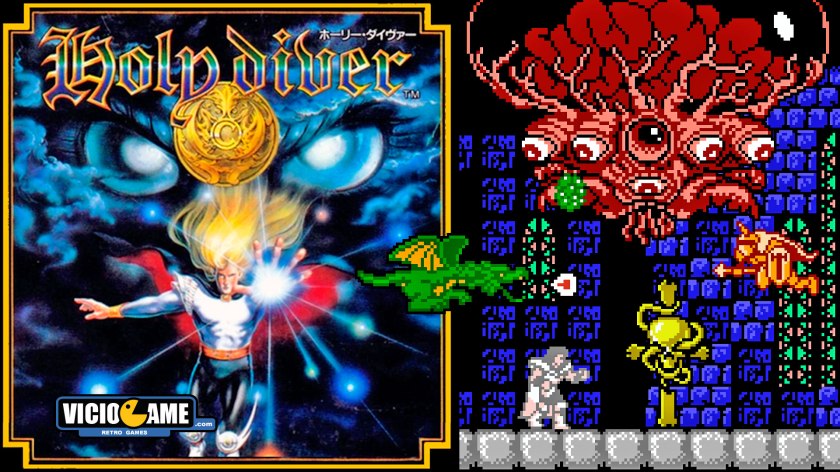
Holy Diver is a side-scrolling platformer released exclusively in Japan in 1989 for the Famicom. The game blends the best of dark, gothic atmosphere with the world of heavy metal. Your mission is to gather enough power to take down a relentless demon.
Developer/Publisher: Irem
Release date: 1989
Platform: Famicom / Nintendo
🇺🇸 Released on April 28, 1989, exclusively in Japan, Holy Diver (ホーリーダイヴァー) remained virtually unknown to Western players for nearly three decades, becoming a cult object in the retrogaming world and one of the most infamous experiences in Nintendo’s 8-bit library. Today, Holy Diver can be played both on original hardware and through the official cartridge re-release published by Retro-Bit in 2018, which finally brought the game to the worldwide market.
Irem Corporation is a Japanese company founded in 1974 under the name IPM — International Playing Machine — which adopted the name Irem Corporation in 1979. Originally established in Osaka by entrepreneur Kenzo Tsujimoto, the company became celebrated in the arcade scene throughout the 1980s, with its most iconic work being the sci-fi shooter series R-Type, released in 1987 and recognized for its masterfully brutal difficulty, frenetic stage design, and innovative power-up mechanics. In the home console market, Irem adopted a strategy of partial outsourcing, delegating the creation of Famicom and NES titles to satellite studios such as Tamtex — responsible, for example, for the excellent Metal Storm (1991) — while also publishing its own products like Holy Diver directly under its own label. This pair of games, Holy Diver and Metal Storm, represents Irem’s peak in the platformer genre on Nintendo’s 8-bit hardware.
The fundamental inspiration behind Holy Diver is an unofficial and completely unlicensed homage to the world of 1980s American heavy metal, particularly to the figure of Ronnie James Dio, the legendary vocalist who, after leaving Black Sabbath, formed the band Dio and released on May 25, 1983, the debut album titled Holy Diver — one of the most acclaimed and influential records in heavy metal history, produced at Sound City Studios in Van Nuys, California. The album features tracks such as “Stand Up and Shout,” “Rainbow in the Dark,” and the title track “Holy Diver,” composed by Ronnie James Dio himself and released as a single in August 1983. The record was certified platinum in the United States and reached number thirteen on the UK charts, and is considered by music critics a landmark of melodic heavy metal. Irem clearly transformed this universe into creative fuel for the game without any formal contractual arrangement with the band or with Warner Bros. Records, which held the album’s rights — a fact that contributes to the underground and almost clandestine aura that surrounds the title to this day.
The musical references in Holy Diver are not limited to the title: they permeate the game’s narrative and structure in a deeply systemic way. The four main characters in the story are named after real musicians from the world of rock and heavy metal. The protagonist Randy is a tribute to Randy Rhoads, the prodigious guitarist who played in Ozzy Osbourne’s band and tragically died in March 1982. The guardian and father figure Ozzy is a direct reference to Ozzy Osbourne himself, vocalist of Black Sabbath and enormously influential solo artist. Zakk, Randy’s missing brother in the story, alludes to guitarist Zakk Wylde, who would become Ozzy Osbourne’s loyal guitar companion starting in the 1980s and would be immortalized with the Black Label Society. Finally, the 16th Crimson Emperor is named Ronnie IV, a transparent reference to Ronnie James Dio himself. Beyond the characters, the magical kingdom ruled by the protagonist is called the Kingdom of Crimson — a nod to the iconic British progressive rock band King Crimson — while the main villain, the Demon King of the Underground Dark Empire, is named Black Slayer, an allusion to the legendary thrash metal band Slayer. The very setting of the narrative, which begins in the “666th year of the magic world,” is an explicit reference to the “Number of the Beast,” an image so central to heavy metal culture.
The story narrated on Holy Diver‘s opening screen carries the subtitle “Resurrected — The Legend of the Holy Magic King’s Justice” and depicts an epic dark fantasy scenario. In the 666th year of the magic world, Black Slayer, Demon King of the Underground Dark Empire, extends his darkness across the universe and weakens the power of King Crimson, whose wisdom has guided the world for generations. Faced with the imminent fall of the empire, the 16th Crimson Emperor, Ronnie IV, entrusts his two infant sons, Randy and Zakk, to his faithful servant Ozzy. The three flee to another dimension with the hope of one day restoring light to the world. Over the following 17 years, Randy, Zakk, and Ozzy dedicate themselves entirely to the cause of Holy Magic Justice, becoming wizard kings. Meanwhile, Black Slayer expands his empire further and reinforces the interdimensional forces of darkness. To defeat Black Slayer and his armies, Randy must recover the five Crimson Emblem Seals. But the mission becomes even more solitary when Zakk mysteriously disappears and Ozzy dies, leaving Randy completely alone to carry out his adoptive father’s will and save the world.
From a gameplay standpoint, Holy Diver is a side-scrolling platformer with undeniable visual and mechanical similarities to Konami’s Castlevania series — close enough that some trade publications of the era called it a “Castlevania clone.” The comparison is fair enough to make, but there are a significant number of elements that set Holy Diver apart as its own experience and, in some respects, as a superior one to the model that inspired it. The player controls Randy on his journey through six stages — exactly the same number as the original Castlevania, a detail that doesn’t seem accidental given the game’s reverence for the number 666. The control scheme is straightforward: the d-pad moves Randy left and right and makes him crouch; the B button fires shots or casts spells; the A button makes Randy jump; SELECT toggles the use of the currently selected magic on or off; and START pauses the game. A fundamental difference from Castlevania is that Randy can redirect his jump mid-air — a freedom of movement the Belmonts never had — making the platforming sections less punishing for momentary lapses, though no less deadly given the sheer density of enemies and traps.
Holy Diver‘s attack system is built on two layers. The first is the standard attack: Randy fires an unlimited supply of fireballs horizontally or upward. These fireballs have a limited range — traveling only about a quarter of the screen’s width — and deal moderate damage, but can be fired in rapid succession. The second layer consists of special spells, which consume magic points (MP) from a dedicated bar. The HUD (the on-screen display showing player information) was clearly inspired by that of Nintendo’s Zelda II: The Adventure of Link, with both health and magic bars visible at all times. The default spell Randy starts his journey with is Twin Fire, which turns him from white to blue and fires two simultaneous fireballs capable of crossing the entire screen, dealing considerably more damage — each Twin Fire shot costs 2 MP, and its strategic use is essential from the very start of the game. As Randy advances and defeats the bosses of the first four stages, he gains access to four additional spells: Blizzard, Breaker, Overdrive, and Thunder.
The Blizzard spell freezes weaker enemies and, crucially, transforms pools or cascades of lava into temporary ice platforms, allowing Randy to cross them — and even destroy them with fireballs to carve paths through the solidified ice. Each Blizzard cast costs 10 MP, and its utility is absolutely critical throughout nearly the entire game, as lava pools are omnipresent obstacles. The Breaker spell also costs 10 MP and concentrates a devastating burst of magic into three consecutive shots, making it especially useful against high-resistance enemies. Overdrive, costing 16 MP, summons two large circular magic blades that orbit Randy for a few seconds, destroying approaching enemies and eliminating certain blocks — vaguely reminiscent of the “Options” from the Gradius series. Finally, Thunder is the most powerful and most expensive spell, consuming 40 MP per cast and unleashing a lightning bolt that explodes into a full-screen discharge, dealing heavy damage to every enemy on screen. Thunder is indispensable in Stage 6 for dealing with the fearsome Rock Faces — high-resistance statue enemies positioned directly over bottomless pits. Upon acquiring the Wizard’s Staff, a permanent item hidden in Stage 4, the cost of all spells is halved, making it by far the most strategically valuable item in the game — valuable enough to justify spending as many lives as necessary to track it down.
The permanent items system is another layer of progression that sets Holy Diver apart from a simple Castlevania clone. The Bracelet, found early in Stage 1, is required for Randy’s fireballs to destroy certain special blocks scattered throughout the game — without it, entire pathways remain permanently inaccessible. The Jump Boots, found in Stage 3 inside a cave, significantly increases Randy’s jump height and distance, opening passages that would otherwise be impossible to reach and making certain platforming sections considerably more manageable. The already-mentioned Wizard’s Staff, hidden along a side path in Stage 4, halves the cost of all spells, essentially doubling the available magic supply. Finally, the Cape of Protection — awarded for defeating the Stage 5 boss — reduces all damage Randy takes from enemies by half, which in practice amounts to doubling his health bar at the most critical point in the game. Beyond these permanent items, there are temporary and consumable pickups: hearts that restore half a block of health; mana crystals that recover just 2 MP; red potions that fully restore health; blue potions that fully restore MP; Life Extenders that not only restore but permanently expand the health bar by one additional block (which starts at just three); Mana Extenders that expand the maximum MP by 8 points each; and Randy Dolls that grant an extra life. Each stage contains at least one Randy Doll and at least one permanently impactful item, creating a structure that rewards careful exploration even under constant pressure.
One of Holy Diver‘s most creative and exciting mechanics is the Dragon Carving — a power that temporarily transforms Randy into a dragon capable of flying freely across the screen and firing blasts of fire. This power-up appears in the later stages, generally dropped by specific enemies, and is essential for crossing long stretches with no solid ground that would simply be impassable on foot. In dragon form, the gameplay shifts into a kind of horizontal shoot-em-up. The transitions to and from dragon form serve as narrative markers within the level design, creating moments of comic relief amid the game’s characteristic suffering.
Stage 1 places Randy on a stormy night atop high cliffs dominated by an ancient castle. The boss is the Satyr, a half-man, half-goat creature that alternates between charging at Randy, leaping over him, and firing fireballs. The Satyr requires 20 Twin Fire hits to defeat — a generous number for a first boss — but its unpredictable behavior already sets the tone for what’s ahead. The reward for victory is the Blizzard spell. Stage 2 is where the difficulty takes its first brutal leap. Lava pools demand immediate use of the newly acquired Blizzard. The boss is Parasite, a stationary creature on the right side of its room that spits acid balls in groups of three. Victory grants the Breaker spell. Stage 3 introduces the Jump Boots and a series of particularly nasty new enemies. The boss consists of two carnivorous plants that emerge from holes in the ceiling and floor, releasing worms that crawl along the ground and firing seeds. The reward is the Overdrive spell. Stage 4 is brutal, featuring more demanding jumps and stronger, smarter enemies. The boss is the Eye Column, a rotating column covered in eyes, floating over a bottomless pit and surrounded by tiny platforms. A single hit against any platform can knock Randy into the abyss for an instant kill. It demands pinpoint precision and precise timing to land shots while the vulnerable eyes rotate into your line of fire. The reward is the Thunder spell, the most powerful in the game. Stage 5 features a darker setting and a demonic palace. The boss is the Embodiment of Evil, an entity with three circling appendages that protect a vulnerable central brain. After 15 hits to the core, the enemy appears defeated — but in a cinematic twist, it regroups and Randy is forced to fight it a second time. The reward for the final triumph is the Cape of Protection, an item that, given the accumulated punishment by that point, really should have arrived much sooner.
Stage 6 carries the name of the main antagonist himself: Black Slayer. It is the longest and most relentless stage in the entire game, taking upward of ten minutes to traverse even for experienced players. The stage offers two alternate routes at the start — one is longer but provides more Mana Extenders, while the other is shorter but stingy with resources — before converging into a series of rooms filled with increasingly merciless enemies and bottomless pits. The final boss, Black Slayer himself, is a two-act fight: in the first phase, Randy must use Thunder and Twin Fire to destroy the boss’s central appendage and then its remaining outer appendages, while spiders keep spawning throughout the room. Randy then automatically transforms into a dragon for the second phase, where Black Slayer releases green bubbles flying across the screen while Randy must align his shots at the boss’s stationary central eye and hammer it into final destruction. The game’s ending sequence reveals the resolution of Randy’s story and closes with musical references befitting the lifestyle of the bands that inspired the whole thing.
Holy Diver‘s difficulty is not just a reputation — it is a consciously maximized design element that places the game in the select company of the most punishing titles of the 8-bit era. Publications and players have frequently compared its brutality to that of Battletoads, Ghosts ‘n Goblins, and the hardest entries in the Castlevania series. Enemies such as the gargoyles are deliberately positioned just outside the range of the standard attack. The flies are completely invulnerable to the standard shot. The floating eyes in certain sections are invincible and simply ignore Randy while blocking passageways. The knockback Randy suffers when taking damage is pronounced, and a single hit frequently spells instant death. Stage 4 specifically has been described by multiple players as one of the most masochistic designs in video game history, combining bottomless pits, larva nests, gargoyles, and flame-spitting serpents all at once. Stage 6 goes even further, introducing five consecutive shooter statues in a single room — which some gaming magazines considered one of the hardest moments in any NES game — each requiring three Thunder hits while Randy is attacked from all directions. The game has no save system, no passwords, and no stage select, meaning starting over means repeating everything from the very beginning. The only concession to mercy is unlimited continues — but getting a game over sends you back to the start of the current stage, and dying within a specific segment resets you to that section. Completing the game through to the final credits is a feat of endurance comparable to the very act of “diving into deep waters” that the title evokes.
Visually, Holy Diver impresses with its use of the NES/Famicom‘s 8-bit hardware capabilities. The sprites are detailed and well-animated by the standards of the era, and the color palette is surprisingly vibrant for a game whose central theme is hell and darkness. The gothic aesthetic manifests in castle, cavern, lava pit, and ice dungeon environments, as well as in enemy designs that range from the organic to the downright alien. There are unsettling images scattered throughout the game — such as a skull with a snake coiled in front of a cross — that on their own would have triggered rejection by Nintendo of America’s content approval system. One of the later stages features sprites and background design that closely resemble the visual world of Konami’s Contra, particularly in a section evoking the interior of a living creature, and the final boss also bears a notable resemblance to Contra‘s alien end boss. The overall art direction delivers the appropriately dark fantasy and heavy metal atmosphere that the game’s name promises.
Holy Diver‘s soundtrack is composed for the Famicom‘s audio chip and features fast-paced action themes with heavy metal influences, incorporating simulated guitar riffs in chiptune form alongside a somber atmosphere that suits the game’s visuals. While it doesn’t reach the level of enthusiasm reserved for soundtracks like those of the Castlevania or Mega Man series, the music is competent and functional. Two of the stage themes are reused in later stages — a clear sign of the cartridge’s memory limitations — and the boss battle theme, despite generating a genuinely tense atmosphere, includes a sharp, repetitive metallic sound that tends to grate during prolonged confrontations, precisely when nerves are already stretched thin. The soundtrack library comprises 18 tracks in total.
From a technical standpoint, the Holy Diver cartridge is a curiosity for collectors. It includes a chip added specifically to compensate for the original hardware’s limited processing speed, revealing Irem’s attention to optimization. This proprietary architecture created a significant practical problem: the cartridge was designed exclusively for the Japanese Famicom slot and did not work correctly in the American NES, whose cartridge adapter introduced incompatibilities with Irem’s specific signal. Since the game was never officially released in the West, this problem never needed to be resolved by the company — but it became a fascinating challenge for the retrogaming community decades later.
The history of Holy Diver‘s Western release is a chapter of interest in its own right. The game was actually announced for a North American release in that same year of 1989, receiving a preview in the September 1989 issue of Electronic Gaming Monthly, which described it as promising. Unfortunately, the release never materialized due to Nintendo of America’s strict content policies in effect during the 8-bit era, which prohibited religious references in games published under the company’s seal. The word “Holy” in the title alone constituted a violation of this policy, and the game also contained iconography such as skulls in front of crosses and the number “666” in the opening narrative — elements that would never have passed approval without radical alterations. The parallel is clear: contemporaries of Holy Diver like the Final Fantasy series had to have spells renamed (Holy became White, then Pearl), references to hell removed, and other cultural changes made before gaining U.S. release approval. For a game whose entire identity is rooted in heavy metal’s satanic imagery, such an adaptation would have completely gutted the work.
During the nearly 30 years in which Holy Diver existed only in Japan, the original Famicom cartridge gradually became an increasingly rare and coveted collector’s item. By around 2018, a loose cartridge alone was fetching around $75 on eBay, while a complete copy with the original box and manual could reach $200. The game’s rarity and notoriety in the retrogaming world led to a proliferation of unauthorized reproductions — bootleg cartridges sold as if they were originals — creating a gray market that persisted until the official re-release. Retro-Bit, a distributor specializing in retro hardware and software re-releases, negotiated directly with Irem for the rights to a legitimate publication, and in July 2018 — 29 years after the original launch — Holy Diver finally reached players worldwide in an official capacity, also marking the first time the game received a complete English translation.
The 2018 re-release was distributed in two formats. The standard version, sold for $35, came with the cartridge in a protective sleeve and a collectible box featuring original artwork. The Collector’s Edition, sold for $59.99 and limited to just 2,900 numbered copies, was one of the most lavish retro releases of the decade: a matte black outer box with gold embossed printing showing only the game’s title, inside which the buyer found an inner box with original game artwork, the cartridge in a protective sleeve, a full-color instruction manual, a hardcover adventure log notebook, an individually numbered certificate of authenticity, a limited-edition set of Retro-Bit x FigPin enamel pins featuring the game’s logo and the character Ronnie, exclusive art prints with original illustrations, and two sticker sheets with the Holy Diver logo and Randy in dramatic poses. The first 1,000 copies of the Collector’s Edition came with a special white cartridge, setting them apart from the remaining 1,900 copies that shipped with the standard-colored cartridge. The re-release was also made available on the Super Retro-Cade, Retro-Bit’s microconsole, providing a small additional avenue for accessing the title. Destructoid gave the package and the game a positive review, highlighting the quality of the physical materials and the historical significance of the release. Weekly Famitsu had originally given the game a score of 22/40 in 1989; the Brazilian magazine VideoGame, in its first issue of 1991, awarded it a 3 out of 5.
Holy Diver‘s reputation in retrogaming culture extends beyond the video game world and reaches into the music community. British magazine Kerrang! included the game in its “Rock’s Greatest Video Games” list in July 2016, and in October 2018 published a feature titled “13 Times Video Games Went Metal,” citing Holy Diver as the prime example. The site Ultimate Classic Rock included the game in its historical survey “Rock Stars in Video Games: The Complete History” from December 2018. The game is frequently cited as proof that 1980s heavy metal culture exerted a real influence on Japanese video game development, creating a rare cultural bridge between Japan and the West that bypassed the usual licensing channels entirely.
Holy Diver remains to this day the most complete synthesis of what Irem knew how to do in the 8-bit platformer space: solid mechanics, creative design drawn from a cultural source well outside the video game mainstream, convincing visuals, and crushing difficulty that simultaneously repels and fascinates. It is a game that does justice to its musical inspiration in an organic way — not because it reproduces heavy metal melodies, but because it embodies the spirit of majestic brutality that made the bands of that genre so unforgettable. Randy’s journey through the six stages of the dark kingdom is a meditation on perseverance rendered in pixels and chiptune: hard, relentless, and, for those with the patience and skill to make it to the final credits, deeply rewarding.
🇧🇷 Lançado em 28 de abril de 1989 exclusivamente no Japão, Holy Diver (ホーリーダイヴァー) permaneceu desconhecido para a grande maioria dos jogadores ocidentais durante quase três décadas, tornando-se objeto de culto no universo do retrogaming e uma das experiências mais infames da biblioteca de 8 bits da Nintendo. Atualmente é possível jogar Holy Diver tanto em hardware original quanto através do relançamento oficial em cartucho publicado pela Retro-Bit em 2018, que finalmente levou o jogo ao mercado mundial.
A Irem Corporation é uma companhia japonesa fundada em 1974 sob o nome de IPM — International Playing Machine — e que adotou o nome Irem Corporation em 1979. Estabelecida inicialmente em Osaka pelo empreendedor Kenzo Tsujimoto, a empresa se tornou célebre no universo dos arcades ao longo dos anos 1980, sendo sua obra mais icônica a série de shooters de ficção científica R-Type, lançada em 1987 e reconhecida pela brutalidade magistral de sua dificuldade, pelo design frenético de fases e pela mecânica inovadora de power-ups. No mercado doméstico, a Irem adotou uma estratégia de terceirização parcial, delegando a criação de títulos para o Famicom e o NES a estúdios satélites como a Tamtex — responsável, por exemplo, pelo excelente Metal Storm (1991) — ao mesmo tempo em que lançava produtos próprios como Holy Diver diretamente sob sua grife. Esta dupla de jogos, Holy Diver e Metal Storm, representa o ápice da Irem no gênero de plataformas para hardware de 8 bits da Nintendo.
A inspiração fundamental de Holy Diver é uma homenagem não oficial e completamente não licenciada ao universo do heavy metal americano dos anos 1980, em especial à figura de Ronnie James Dio, o lendário vocalista que, após deixar o Black Sabbath, formou a banda Dio e lançou em 25 de maio de 1983 o álbum de estreia intitulado Holy Diver — um dos discos mais aclamados e influentes da história do heavy metal, produzido no Sound City Studios em Van Nuys, Califórnia. O álbum conta com faixas como “Stand Up and Shout”, “Rainbow in the Dark” e a faixa-título “Holy Diver”, composta pelo próprio Ronnie James Dio e lançada como single em agosto de 1983. O disco foi certificado platina nos Estados Unidos e alcançou a décima terceira posição nas paradas do Reino Unido, sendo considerado pela crítica especializada um marco do heavy metal melódico. A Irem claramente transformou esse universo em combustível criativo para o jogo sem qualquer formalidade contratual com a banda ou com a gravadora Warner Bros., que detinha os direitos do álbum — fato que contribuiu para a natureza underground e quase clandestina que cerca o título até hoje.
As referências musicais em Holy Diver não se resumem ao título: elas permeiam a narrativa e a estrutura do próprio jogo de maneira sistêmica. Os quatro personagens principais da história recebem os nomes de músicos reais do mundo do rock e do metal pesado. O protagonista Randy é uma homenagem a Randy Rhoads, o guitarrista prodígio que integrou a banda de Ozzy Osbourne e faleceu tragicamente em março de 1982. O guardião e figura paternal Ozzy remete diretamente ao próprio Ozzy Osbourne, vocalista do Black Sabbath e artista solo de enorme influência. Zakk, irmão desaparecido de Randy na trama, faz alusão ao guitarrista Zakk Wylde, que se tornaria o leal companheiro de guitarra de Ozzy Osbourne a partir dos anos 1980 e seria imortalizado com a Black Label Society. Por fim, o 16º Imperador Carmesim se chama Ronnie IV, uma referência transparente ao próprio Ronnie James Dio. Além dos personagens, o reino mágico governado pelo protagonista é chamado de Kingdom of Crimson — uma referência à icônica banda britânica de rock progressivo King Crimson —, enquanto o vilão principal, o Rei Demônio do Underground Dark Empire, recebe o nome de Black Slayer, em alusão à famosa banda de thrash metal Slayer. A própria ambientação da narrativa, que se inicia no “666º ano do mundo da magia”, é uma referência explícita ao “Número da Besta” tão claro ao imaginário do metal pesado.
A história narrada na tela de abertura de Holy Diver traz o subtítulo “Resurrected — The Legend of the Holy Magic King’s Justice” e descreve um cenário épico de fantasia sombria. No 666º ano do mundo da magia, o Black Slayer, Rei Demônio do Underground Dark Empire, estende suas trevas pelo universo e enfraquece o poder do King Crimson, cuja sabedoria guiou o mundo por gerações. Diante da iminente queda do império, o 16º Imperador Carmesim, Ronnie IV, confia seus dois filhos infantes, Randy e Zakk, ao seu fiel servo Ozzy. Os três fogem para outra dimensão com a esperança de um dia devolver a luz ao mundo. Durante os 17 anos seguintes, Randy, Zakk e Ozzy se dedicam integralmente à causa da Holy Magic Justice, tornando-se reis feiticeiros. Enquanto isso, o Black Slayer expande ainda mais seu império e reforça as forças interdimensionais das trevas. Para derrotar o Black Slayer e seus exércitos, Randy deve recuperar os cinco Selos de Emblema Carmesim. Mas a missão se torna ainda mais solitária quando Zakk desaparece misteriosamente e Ozzy falece, deixando Randy completamente só para cumprir a vontade de seu pai adotivo e salvar o mundo.
Do ponto de vista de jogabilidade, Holy Diver é um jogo de plataforma com rolagem lateral que apresenta inegáveis semelhanças visuais e mecânicas com a série Castlevania da Konami, ao ponto de ter sido chamado de “Castlevania clone” por algumas publicações especializadas da época. A comparação é justa o suficiente para ser feita, mas existe um número significativo de elementos que distinguem Holy Diver como uma experiência própria e, em alguns aspectos, superior ao modelo que o inspirou. O jogador controla Randy em sua jornada por seis fases — exatamente o mesmo número de estágios do primeiro Castlevania, um detalhe que não parece acidental quando se considera a reverência do jogo ao número 666. O mapa de controles é direto: o direcional movimenta Randy para os lados e faz com que ele se abaixe; o botão B dispara tiros ou magias; o botão A faz Randy pular; o botão SELECT alterna entre a utilização ou não da magia selecionada; e o botão START pausa o jogo. Uma diferença fundamental em relação ao Castlevania é que Randy pode redirecionar seu pulo durante o salto — liberdade de movimento no ar que os Belmonts jamais tiveram — tornando as seções de plataforma menos punitivas por descuido pontual, embora em nada menos mortíferas pela densidade de inimigos e armadilhas.
O sistema de ataque de Holy Diver é construído sobre duas camadas. A primeira é o ataque padrão: Randy dispara bolas de fogo infinitas horizontalmente ou para cima. Essas fireballs têm alcance limitado — percorrem apenas cerca de um quarto da largura da tela — e causam dano moderado, mas podem ser disparadas em cadeia rápida. A segunda camada são as magias especiais, que consomem pontos de magia (MP) de uma barra dedicada. O HUD (interface gráfica que exibe informações na tela) foi claramente inspirado no de Zelda II: The Adventure of Link, da Nintendo, com barras de vida e magia visíveis durante toda a partida. A magia padrão com a qual Randy começa sua jornada é o Twin Fire, que o transforma de branco em azul e dispara duas fireballs simultâneas capazes de percorrer a tela inteira, causando dano consideravelmente maior — cada disparo de Twin Fire custa 2 MP e seu uso estratégico é essencial desde os primeiros momentos do jogo. À medida que Randy avança e derrota os chefes das primeiras quatro fases, ele ganha acesso a quatro magias adicionais: Blizzard, Breaker, Overdrive e Thunder.
A magia Blizzard congela inimigos mais fracos e, de forma crucial, transforma as piscinas ou cachoeiras de lava em plataformas de gelo transitórias, permitindo que Randy as atravesse — e até mesmo as destrua com fireballs para escavar caminhos dentro do gelo solidificado. Cada conjuração de Blizzard custa 10 MP e sua utilidade é absolutamente crítica ao longo de quase todo o jogo, pois as piscinas de lava são obstáculos onipresentes. A magia Breaker custa também 10 MP e concentra uma rajada de magia devastadora em três disparos consecutivos, sendo especialmente útil contra inimigos de alta resistência. O Overdrive, com custo de 16 MP, invoca duas grandes lâminas circulares de magia que orbitam Randy por alguns segundos, destruindo inimigos que se aproximem e eliminando certos blocos, lembrando vagamente as “Option” da série Gradius. Por fim, o Thunder é a magia mais poderosa e cara, consumindo 40 MP por conjuração e desencadeando um raio que explode numa descarga que cobre a tela inteira, causando dano considerável a todos os inimigos presentes. O Thunder é indispensável na fase 6 para lidar com os temíveis Rock Faces, inimigos-estátua de altíssima resistência posicionados sobre abismos. Ao adquirir o Wizard’s Staff, um item permanente oculto na fase 4, o custo de todas as magias é reduzido pela metade, tornando o item de longe o mais estrategicamente valioso do jogo — tão valioso que vale a pena gastar quantas vidas forem necessárias para encontrá-lo.
O sistema de itens permanentes é outra camada de progressão que diferencia Holy Diver de um simples Castlevania com template alternado. O Bracelet, encontrado logo no início da fase 1, é necessário para que os fireballs de Randy possam destruir determinados blocos especiais espalhados pelo jogo — sem ele, caminhos inteiros permanecem inacessíveis. O Jump Boots, encontrado na fase 3 dentro de uma caverna aumenta significativamente a altura e o alcance dos saltos de Randy, abrindo passagens que seriam impossíveis de transpor sem ele e tornando certas seções de plataforma razoavelmente mais manejáveis. O já mencionado Wizard’s Staff, escondido num desvio de caminho na fase 4, corta pela metade o custo de todas as magias, essencialmente duplicando a quantidade de magia disponível. Por último, o Cape of Protection — concedido como recompensa pela vitória sobre o chefe da fase 5 — reduz à metade todo o dano que Randy recebe de inimigos, o que equivale na prática a duplicar sua barra de vida no momento mais crítico do jogo. Além desses itens permanentes, existem itens temporários e consumíveis: corações que restauram meio bloco de vida; cristais de mana que recuperam apenas 2 MP; poções vermelhas que restauram a vida completamente; poções azuis que restauram o MP completamente; Life Extenders que não apenas restauram, como expandem permanentemente a barra de vida em um bloco adicional (que começa com apenas três blocos); Mana Extenders que expandem o máximo de MP em 8 pontos cada; e Randy Dolls que concedem uma vida extra. Cada fase conta com pelo menos um Randy Doll e ao menos um item de impacto permanente, o que cria uma estrutura de incentivos para exploração cuidadosa mesmo sob pressão constante.
Uma das mecânicas mais criativas e empolgantes de Holy Diver é a Dragon Carving — um poder que transforma Randy temporariamente num dragão capaz de voar livremente pela tela e disparar rajadas de fogo. Esse power-up aparece nas fases mais avançadas, geralmente dropado por inimigos específicos, e é fundamental para atravessar longos trechos sem solo que seriam simplesmente intransponíveis a pé. Na forma de dragão, a jogabilidade se transforma numa espécie de shoot-em-up horizontal. A transição para a forma de dragão e de volta à forma humana são marcadores narrativos dentro do level design, criando momentos de alívio cômico em meio ao sofrimento característico do jogo.
A fase 1 apresenta Randy numa noite tempestuosa sobre altos penhascos dominados por um castelo antigo. O chefe é o Satyr, uma criatura meio homem, meio bode, que alterna entre carregar em direção a Randy, saltar sobre ele e disparar fireballs. O Satyr exige 20 acertos com Twin Fire para ser derrotado — uma quantidade generosa para um primeiro chefe — mas seu comportamento imprevisível já dá o tom do que está por vir. A recompensa pela vitória é a magia Blizzard. A fase 2 é onde a dificuldade dá seu primeiro salto brutal. Piscinas de lava exigem uso imediato do Blizzard recém-adquirido. O chefe é Parasite, uma criatura estacionária no lado direito de sua sala que cospe bolas de ácido em grupos de três. A vitória sobre ele concede a magia Breaker. A fase 3 introduz os Jump Boots e uma série de novos inimigos particularmente maldosos. O chefe é composto por duas plantas carnívoras que emergem por buracos no teto e no chão, liberando vermes que se movem pelo chão e disparando sementes. A recompensa é a magia Overdrive. A fase 4 é brutal, com saltos mais desafiadores, inimigos mais inteligentes e fortes. O chefe é o Eye Column, uma coluna rotativa cheia de olhos flutuante sobre um abismo sem fundo, cercada por plataformas minúsculas. Um único acerto em qualquer plataforma pode empurrar Randy para o abismo e matar instantaneamente. Exige precisão milimétrica nos disparos, e timing para os acertos enquanto os olhos vulneráveis giram em sua direção. A recompensa é a magia Thunder, a mais poderosa do jogo. A fase 5 apresenta um ambiente mais sombrio e palácio demoníaco. O chefe é o Embodiment of Evil, uma entidade com três partes circulantes que protegem um cérebro central vulnerável. Após 15 acertos no núcleo, o inimigo parece derrotado — mas numa virada cinematográfica, a entidade se reagrupa e Randy é forçado a combatê-la uma segunda vez. A recompensa pelo triunfo definitivo é o Cape of Protection, um item que deveria ter chegado muito antes dado o sofrimento acumulado pelo jogador até aquele ponto.
A fase 6 recebe o próprio nome do antagonista principal: Black Slayer. É a fase mais longa e implacável de todo o jogo, chegando a levar mais de dez minutos de travessia mesmo para jogadores experientes. A fase oferece duas rotas alternativas no início — uma é mais longa, mas possui mais Mana Extenders, enquanto a outra é mais curta, mas com recursos escassos — antes de convergir numa série de salas com inimigos e abismos cada vez mais implacáveis. O chefe final, o próprio Black Slayer, é uma luta em dois atos: na primeira etapa, Randy deve usar Thunder e Twin Fire para destruir o apêndice central do boss e depois os demais apêndices externos, enquanto aranhas continuam aparecendo pela sala. Em seguida, Randy se transforma automaticamente num dragão para a segunda etapa, onde o Black Slayer libera bolhas verdes que voam pela tela enquanto Randy deve alinhar seus disparos ao olho central imóvel do inimigo e bombadeá-lo até a destruição final. A sequência de encerramento do jogo revela a resolução da narrativa de Randy e celebra com referências musicais ao estilo de vida das bandas que inspiraram o título.
A dificuldade de Holy Diver não é apenas reputação — ela é um elemento de design conscientemente maximizado que posiciona o jogo em companhia seleta dos títulos mais punitivos da era de 8 bits. Publicações e jogadores compararam frequentemente sua brutalidade à de Battletoads, Ghosts ‘n Goblins e às versões mais difíceis de Castlevania. Inimigos como os gárgulas ficam propositalmente fora do alcance do ataque padrão. As moscas são completamente invulneráveis ao tiro padrão. Os olhos flutuantes em certas seções são invencíveis e simplesmente ignoram Randy enquanto bloqueiam passagens. O empurrão sofrido por Randy ao tomar dano é acentuado, e um único hit frequentemente significa morte imediata. A fase 4 especificamente foi descrita por múltiplos jogadores como uma das criações mais masoquistas da história dos videogames, com a combinação de abismos, nihos de larvas, gárgulas e cobras flamejantes ao mesmo tempo. A fase 6 vai além e introduz cinco estátuas atiradoras consecutivas numa única sala — o que a algumas revistas consideraram um dos momentos mais difíceis de qualquer jogo de NES — cada um exigindo três hits de Thunder enquanto Randy é atacado de todas as direções. O jogo não possui sistema de save, não oferece passwords e não permite selecionar fases, de modo que começar do zero significa repetir tudo desde o início. A única concessão à misericórdia é a disponibilidade de continues infinitos — mas morrer com o game over significa retornar ao início da fase atual, e morrer num segmento específico dentro da fase significa recomeçar daquela seção. A jornada completa até os créditos finais é um feito de resiliência comparável ao próprio “mergulhar em águas profundas” que o título evoca.
Visualmente, Holy Diver impressiona pelo aproveitamento das capacidades do hardware de 8 bits da Nintendo. Os sprites são detalhados e bem animados para os padrões da época, e a paleta de cores é surpreendentemente vibrante para um jogo cujo tema central é o inferno e a escuridão. A estética gótica se manifesta em cenários de castelos, cavernas, tocas de lava e gelo, e nos designs dos inimigos, que transitam entre o orgânico e o alienígena. Há imagens inquietantes distribuídas pelo jogo, como uma caveira com uma cobra enrolada diante de uma cruz — cena que, por si só, teria gerado rejeição pelos sistemas de aprovação da Nintendo americana. Um dos estágios avançados apresenta sprites e design de fundo que se assemelham ao universo visual de Contra, da Konami, em especial num trecho que lembra o interior de uma criatura viva, e o chefe final guarda semelhanças com o alien final de Contra também. A direção de arte geral possui o clima appropriado de fantasia sombria e heavy metal que o nome do jogo promete.
A trilha sonora de Holy Diver é composta para o chip de áudio do Famicom e apresenta temas de ação acelerada com influências do heavy metal, incorporando riffs de guitarra simulados em chiptune e atmosfera sombria condizente com o visual do jogo. Embora não seja do mesmo entusiasmo reservado a trilhas como a da série Castlevania ou de Mega Man, a música do jogo é competente e funcional. Dois dos temas de fase são reutilizados em estágios posteriores — sinal claro das limitações de memória do cartucho — e o tema de batalha contra os chefes, apesar de criar uma atmosfera genuinamente tensa, inclui um som metálico agudo e repetitivo que tende a irritar durante confrontos prolongados, justamente quando os nervos já estão à flor da pele. A biblioteca de sons da trilha soma 18 faixas no total.
Do ponto de vista técnico, o cartucho de Holy Diver é uma curiosidade para colecionadores. O cartucho inclui um chip adicionado especificamente para compensar a velocidade limitada do hardware original, revelando a atenção da Irem para otimizações. Esta arquitetura proprietária criou um problema prático significativo: o cartucho foi projetado exclusivamente para o slot do Famicom japonês e não funcionava corretamente na variante americana do NES, cujo adaptador introduzia incompatibilidades com o sinal específico da Irem. Como o jogo nunca foi lançado oficialmente no Ocidente, esse problema jamais precisou ser resolvido pela empresa originalmente — mas tornou-se um desafio fascinante para a comunidade décadas depois.
A história do lançamento de Holy Diver no Ocidente é um capítulo de interesse próprio. O jogo chegou a ser anunciado para lançamento norte-americano no mesmo ano de 1989, recebendo uma prévia na edição de setembro de 1989 da revista Electronic Gaming Monthly, que o descreveu como promissor. Infelizmente o lançamento nunca se materializou por conta da política rígida da Nintendo americana em vigor na era de 8 bits, que proibia referências religiosas em jogos publicados sob o selo da empresa. A própria palavra “Holy” no título já constituía uma violação dessa política, e o jogo ainda continha iconografia como crânios diante de cruzes e a numeração 666 na narrativa de abertura — elementos que jamais teriam passado pela aprovação sem alterações radicais. A comparação é clara: contemporâneos de Holy Diver como a série Final Fantasy precisaram ter magias renomeadas (Holy virou White, depois Pearl), referências ao inferno removidas e outras alterações culturais para obter aprovação de lançamento nos Estados Unidos. Para um jogo cuja identidade inteira está enraizada no imaginário satânico do heavy metal, a adaptação teria descaracterizado completamente a obra.
Durante os quase 30 anos em que Holy Diver existiu apenas no Japão, o cartucho original do Famicom foi se tornando um objeto cada vez mais raro e cobiçado no mercado de colecionadores. Por volta de 2018, um cartucho sozinho atingia cerca de 75 dólares americanos no eBay, enquanto uma cópia completa com caixa e manual original chegava a 200 dólares. A raridade e a notoriedade do jogo no universo do retrogaming levaram à proliferação de reproduções não autorizadas — cartuchos ilegais vendidos como se fossem originais —, criando um mercado cinzento que persistiu até o relançamento oficial. A Retro-Bit, distribuidora especializada em relançamentos de hardware e software retro, negociou diretamente com a Irem os direitos para uma publicação legítima, e em julho de 2018 — 29 anos após o lançamento original — Holy Diver finalmente chegou às mãos de jogadores em todo o mundo de maneira oficial, marcando também a primeira vez que o jogo recebeu uma tradução completa para o inglês.
O relançamento de 2018 foi distribuído em dois formatos. A versão padrão, vendida por 35 dólares, trazia o cartucho com capa protetora e caixa colecionável com arte original. A Collector’s Edition, vendida por 59,99 dólares e limitada a apenas 2.900 cópias numeradas, foi um dos lançamentos retrô mais caprichados da década: uma caixa externa preta fosca com impressão dourada em relevo trazendo apenas o título do jogo, dentro da qual o comprador encontrava uma caixa interna com arte original do jogo, o cartucho com capa protetora, um manual de instrução em cores, um caderno de capa dura temático para registros de aventura, um certificado de autenticidade numerado individualmente, um conjunto de broches em edição limitada da parceria Retro-Bit x FigPin com o logo do jogo e o personagem Ronnie, impressões de arte exclusivas com ilustrações originais, e duas folhas de adesivos com o logo de Holy Diver e Randy em poses dramáticas. Os primeiros 1.000 exemplares da Collector’s Edition receberam um cartucho de cor branca especial, diferenciando-os dos demais 1.900 exemplares que vieram com o cartucho padrão. O relançamento foi também disponibilizado no Super Retro-Cade, o microconsole da Retro-Bit, ampliando minimamente o acesso ao título. A Destructoid deu uma avaliação positiva ao pacote e ao jogo, destacando a qualidade do material físico e a relevância histórica do lançamento. A Weekly Famitsu havia originalmente dado ao jogo a pontuação de 22/40 em 1989; a revista brasileira VideoGame, em sua primeira edição de 1991, atribuiu 3 em 5.
A reputação de Holy Diver na cultura do retrogaming extrapola os limites do universo dos videogames e alcança o universo da música. A revista britânica Kerrang! incluiu o jogo em sua lista “Rock’s Greatest Video Games” em julho de 2016, e em outubro de 2018 publicou uma matéria intitulada “13 vezes em que os videogames viraram metal”, citando Holy Diver como exemplo máximo. O site Ultimate Classic Rock incluiu o jogo em seu levantamento histórico “Estrelas do Rock nos Videogames: A História Completa” de dezembro de 2018. O jogo é frequentemente citado como prova de que a cultura do heavy metal dos anos 1980 exerceu influência na criação de videogames japoneses, criando uma rara ponte cultural entre o Japão e o Ocidente que contornou os canais habituais de licenciamento.
Holy Diver permanece até hoje como a síntese mais completa do que a Irem soube fazer no universo dos jogos de plataforma de 8 bits: mecânicas sólidas, design criativo inspirado numa fonte cultural fora do mainstream dos videogames, visual convincente, e dificuldade esmagadora que ao mesmo tempo repele e fascina. É um jogo que faz jus a sua inspiração musical de maneira orgânica — não porque reproduz melodias do heavy metal, mas porque encarna o espírito de brutalidade majestosa que tornou as bandas do gênero tão inesquecíveis. A jornada de Randy através dos seis estágios do reino das trevas é uma meditação sobre perseverança em forma de pixels e chiptune: dura, implacável e, para quem tiver a paciência e a habilidade de chegar aos créditos finais, profundamente recompensadora.
🤑💲Earn money without doing anything! Just leave these apps open:
✓ https://r.honeygain.me/CONTA9DB02
✓ https://packetstream.io/?psr=1uPb
🤑💲1-Click button earns Bitcoin every 1 hour: https://freebitco.in/?r=53528449
⬛ 𝗧𝗶𝗸𝗧𝗼𝗸: https://www.tiktok.com/@viciogame
🟧 𝗜𝗻𝘀𝘁𝗮𝗴𝗿𝗮𝗺: http://www.instagram.com/viciogame
🟥 𝗬𝗼𝘂𝘁𝘂𝗯𝗲: http://www.youtube.com/viciogame
🟦 𝗙𝗮𝗰𝗲𝗯𝗼𝗼𝗸: http://www.facebook.com/viciogame
🔳 𝗧𝗵𝗿𝗲𝗮𝗱𝘀: https://www.threads.net/@viciogame
🟪 𝗧𝘄𝗶𝘁𝗰𝗵: https://www.twitch.tv/ViciogameRetroGames
🟨 𝗕𝗹𝗼𝗴: http://www.viciogameblog.com/
🟦𝗧𝘄𝗶𝘁𝘁𝗲𝗿: http://www.twitter.com/viciogame
#Viciogame #Gameplay #LetsPlay #Playthrough #Games #Gaming #Videogames #Review #Game #Detonado #Walkthrough #Ending #Reviews #Facts #Retro #RetroGaming #Roms #Emulator #Longplay #Speedrun #NoCommentary #HolyDiver #Nintendo #NES #Famicom #Irem #Castlevania #HeavyMetal #ホーリーダイヴァー #ファミリーコンピュータ #任天堂 #RonnieJamesDio #BlackSabbath #RandyRhoads #OzzyOsbourne #ZakkWylde #KingCrimson #Slayer


Looks like the game had potential but I cannot get over how slow the character moves!! I had no idea there was that connection to music, too! I actually saw Ronnie James Dio at a musical festival. It was outdoors, though, so my friends and I decided to go way way way to the back so we could play catch with a frisbee 😂
CurtirCurtido por 1 pessoa