
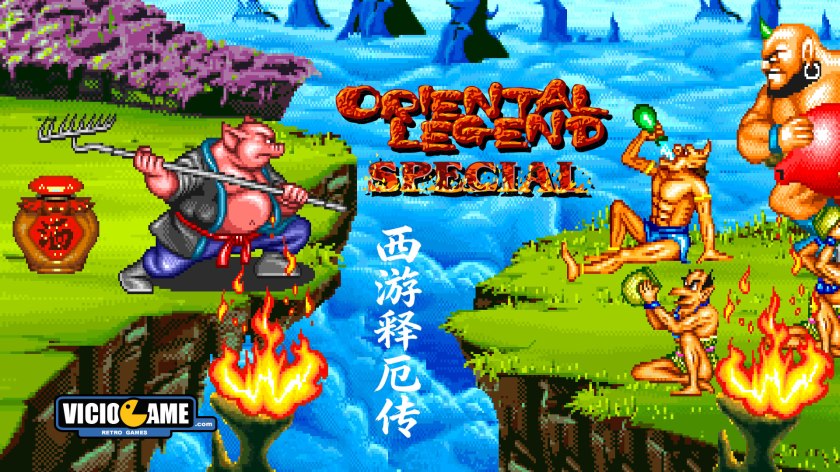
Oriental Legend Special is a beat ‘em up game released in 1998 for arcades. About 1,300 years ago, the world lived in peace — yet it was deeply consumed by sin. This opened the door for demons and evil spirits to take hold of many lands.
Developer/Publisher: International Games System (IGS)
Release date: 1998
Platform: Arcade IGS PolyGame Master (PGM) board
🇺🇸 Oriental Legend Special, known in its Asian release as Xi You Shi E Zhuan Super (西遊釋厄傳 SUPER), was developed and published by International Games System Co., Ltd. — widely known as IGS — a Taiwanese company founded in 1991 with the ambitious goal of competing with the Japanese giants of the electronic gaming market. Released on July 9, 1998, the game is the direct sequel to Oriental Legend (1997), the original entry in the series, and was conceived as a substantially improved and rebalanced version of that initial experience, correcting its design flaws and greatly expanding its gameplay systems. The distinction between the names “Special” and “Super” has a precise technical explanation: in version 100 of the software, the title was called Oriental Legend Special in markets outside Asia — particularly in South Korea and export territories — while later versions officially adopted the name Oriental Legend Super, or Xi You Shi E Zhuan Super, for Asian markets. Both names refer to essentially the same game, with minor regional configuration differences.
The creation of the game is deeply tied to the development of the IGS PolyGame Master (PGM) hardware, a modular arcade motherboard launched by IGS itself in 1997. It was conceived as a cost-effective alternative to SNK‘s Neo Geo MVS, adopting the same concept of a cartridge-based system with interchangeable media compatible with the JAMMA standard, which made integration into conventional arcade cabinets straightforward. The cartridge design uses a dual-PCB structure: the top board holds the program and tile ROMs, while the bottom board houses the audio, background, and main ROMs, with a capacity of up to 16 MB per board. This was the only Asian arcade hardware of the era that was not owned by a Japanese company — a point of national pride for the Taiwanese industry. Oriental Legend and Dragon World II were the first titles released for the PGM in 1997, inaugurating a library that would eventually house around 32 games between 1997 and 2005.
The narrative of Oriental Legend Special is rooted in the classic Chinese literary work Xiyouji (“Journey to the West”), a 16th-century epic novel attributed to Wu Cheng’en, considered one of the Four Great Classical Novels of Chinese literature. The story follows the monk Tang Sanzang — also known as Xuanzang — on his sacred pilgrimage to India to retrieve the Buddhist scriptures of Da Cheng, the deepest teachings of Buddhism. According to the game’s prologue, during the Tang Dynasty, roughly 1,300 years ago, the monk realized that the people of the eastern lands had lived in peace for too long and had fallen into the four cardinal vices: wine, women, wealth, and wrath — opening the door for demons and evil spirits to seize control of the regions along the journey. Tang Sanzang sets out westward, protected by his disciples, constantly attacked by demons who wish to consume his flesh, believing it will grant them immortality. The entire progression of the game reflects specific, recognizable episodes from the original novel — including confrontations with iconic villains from the source material — which gave the game strong appeal among Asian players familiar with the story.
The playable roster of Oriental Legend Special consists of five characters, each directly inspired by the novel’s protagonists. Wu-Kong, the Monkey King — based on Sun Wukong — is a humanoid monkey who wields a powerful extendable staff and is associated with the Fire attribute; he is the most well-rounded character in the game and tends to be the natural choice for beginners. Ba-Chien, the pig-man based on Zhu Bajie, carries a crescent-bladed halberd and corresponds to the Earth attribute; he is the physically largest and most powerfully built character, particularly effective with grab combos. Wu-Chin, based on Sha Wujing — the warrior monk of the flowing sand river — wields a staff with a crescent blade on one end and an axe-shaped blade on the other, and represents the Water attribute; he is the most powerful character in skilled hands, given the reach of his weapon and the versatility of his special moves. Long-Ma, the white dragon horse who in the literary source is Tang Sanzang’s steed — Ao Ying, son of the Dragon King of the Western Sea — appears in the game in humanoid form wielding a spear and represents the Wood attribute. Long-Nui — whose name means “Dragon Maiden” — based on Ao Ling, Long-Ma’s younger sister, is the only female character in the game and uses a dagger; she represents the Metal attribute and is the smallest character but boasts the highest attack speed.
The Five Elements attribute system — Metal, Wood, Water, Fire, and Earth — is one of the most original strategic pillars of Oriental Legend Special compared to other beat ‘em ups of the era. Each stage in the game carries an elemental attribute, and the relationship between the chosen character’s attribute and the stage’s attribute determines whether the player is at an advantage or disadvantage, following the logic of the traditional Chinese Wuxing system: Metal cuts Wood, Wood absorbs Earth, Earth blocks Water, Water extinguishes Fire, Fire melts Metal. When a character is at an elemental disadvantage and the stage boss loses roughly one quarter of its health, the “Away Illusion Realm” phenomenon is triggered — a special state in which enemy soldiers stop appearing and the timer becomes unlimited, but the character suffers significant negative effects: reduced attack power, drastically slower Power Gauge charging speed, and the inability to use items whose attribute is the one that restricts the stage’s element. The Away Illusion Realm can be ended in two ways: by using the Eight Trigrams Stone item (known as “Mie”) directly while in the illusion state, or by defeating the boss — though the boss in the illusion is a phantom form and its defeat does not affect the true form. This system adds a considerable layer of planning to both character selection and item management throughout a full run.
The Power Gauge — the special energy meter — underwent one of the most significant changes from the original Oriental Legend: whereas the first game had only a single charge level, Oriental Legend Special expanded the gauge to four stages, each unlocking different moves as it is fully charged. At the first energy level, the player can execute moves such as the Tumbling Dance (a spinning area attack), the Shrinking Technique, and the Universe Wave Technique, a medium-range elemental projectile. The second level unlocks the Rising Dragon Slash, a devastating upward strike. The third level releases the Soul Departure, an attack that projects the character’s spiritual essence at enemies. The fourth and highest level grants access to the Qiankun Ten Consecutive Slashes, a ten-hit sequence of massive destruction. Additionally, the game allows players to chain multiple gauge levels into wave combos: a Level 3 Wave, for example, can be chained into a Level 2 and then a Level 1 by holding the forward direction and pressing the attack button at the precise moment the previous projectile is about to dissipate. Advanced players, especially those using Wu-Chin, exploit these combinations in sophisticated ways to maximize damage against bosses.
The control scheme of Oriental Legend Special uses four buttons: Button 1 serves both to attack and to pick up items from the ground; Button 2 is dedicated to jumping; pressing Button 2 followed by Button 1 executes an aerial kick; pressing Buttons 1 and 2 simultaneously triggers the desperation move, a high-damage technique that consumes resources. Button 3 opens the special item selection menu — when the player holds more than one, the joystick is used to navigate and Button 1 or 3 confirms the selection — and Button 4 directly uses the currently selected special item. A double-tap left or right activates a dash, and pressing Button 1 while dashing executes a forward special strike. Making contact with an enemy triggers a grab, from which the player can throw in several directions: upward launches the enemy overhead, downward slams them into the ground, and sideways performs the standard throw. In multiplayer, the interaction between characters of different sizes during a grab produces special combined attacks of great destructive power: two characters of similar build spin around each other, crushing everything nearby, while a larger character grabs a smaller one and hurls them at enemies like a living projectile — a mechanic known as the Fastball Special.
Certain stages feature path forks that the player can choose between, and collapsing floors drop the character into alternate areas if they fail to cross in time. The stages are set in locations drawn directly from the Journey to the West novel, organized into eight main stages with defined elemental attributes. Flat Top Mountain, Lotus Flower Cave is an Earth-attribute stage, serving as the Home Stage for Long-Ma and the Away Stage for Wu-Chin; it features three commander enemies: the first is the Silver Horn King, the second is a lesser Silver Horn, and the third is the Golden Horn, who appears within the Illusion Realm. Withered Pine Stream Fire Cloud Cave, a Fire-attribute stage, is the Home Stage for Wu-Chin and the Away Stage for Long-Ma; it has only one commander enemy, the Red Devil, but the confrontation is split into two distinct phases. Flame Mountain, Plantain Cave also carries the Fire attribute — making it the Home Stage for Wu-Chin and the Away Stage for all other characters — where the player faces the Iron Fan Princess and her minions before reaching the main confrontation. The Tongtian River, set in deep waters inhabited by the Sea Urchin King and the Golden Fish Spirit, offers one of the most visually distinctive environments in the game, filled with aquatic enemies. The Cave of Silken Web is one of the most feared stages, where the Spider Queens ensnare Tang Sanzang with silk threads and the player must advance through corridors teeming with arachnid creatures. The game culminates in the confrontation with Cloud Devil, the final boss, whose Illusion Realm can be triggered by any character on the field except Wu-Chin, and who requires attacks to be performed from left to right to maximize the effectiveness of the Ten-Hit Slash.
The arsenal of collectible items and weapons in Oriental Legend Special was substantially reconfigured compared to the first game. The power of small and medium offensive items was reduced to just 40 to 60% of what it was in the original version — as with the Boomerang and the Demon Revealing Mirror — while large items had their potency reduced to 30 to 60%. The carry capacity for small items such as the Demon Revealing Mirror and the Gourd was reduced from 9 to 6 uses. In exchange, five new items were added to the game: the Eight Trigrams Stone (the “Mie”), the Universe Treasure Sword, the Dragon Ball (known as the “Red Pill” or “Red Pearl”), the Invisibility Cloak, and a fifth piece that rounds out this set. In total, the game features 22 types of Five Elements magical items, including categories such as the Sword of Release from Calamity, the Lightning Halberd, and items with full-screen attack effects. Some weapons can be knocked out of the character’s hands during combat; the player can pick them back up or continue fighting bare-handed, which changes the animation and behavior of the desperation move.
From a visual production standpoint, Oriental Legend Special features large, colorful sprites drawn in a cartoon style with a vibrant palette heavily inspired by traditional Chinese folk art illustrations. Character animations are fluid by the standards of the hardware and the era, especially during special moves, which are accompanied by expressive particle effects and intense color flashes. Background scenery is painted in multiple layers with parallax scrolling, creating a reasonable sense of depth, and alternates between rocky mountain environments, blazing volcanic caverns, misty forests, and supernatural rivers. The soundtrack is composed of instrumental themes that blend traditional Chinese percussion with synthesizer arrangements, creating an atmosphere that reinforces the game’s mythical setting. Each stage has its own musical theme, and bosses are accompanied by distinct tracks that heighten the tension of each confrontation.
The immediate comparison critics and players of the time made was to Capcom‘s Dungeons & Dragons series — specifically Dungeons & Dragons: Tower of Doom (1993) and Dungeons & Dragons: Shadow over Mystara (1996) — whose mechanics of collectible items, character-specific special attacks, and linear stage progression with a boss at the end clearly influenced IGS in developing Oriental Legend. IGS’s masterstroke was transporting that formula into the universe of Chinese popular culture, replacing the Western fantasy setting with the mythology of Xiyouji, creating a distinctive cultural identity that resonated powerfully with Asian audiences. Furthermore, the addition of the Five Elements system and the Away Illusion Realm represented a strategic depth that the Capcom titles lacked, elevating the tactical complexity of the genre.
The Oriental Legend series on the PGM comprises four main games. The first, Oriental Legend (1997), was released in April as the system’s launch title and went through four software revisions over its commercial lifespan: versions 105, 111, 112, and 126, each fixing bugs and rebalancing the design. The second, Oriental Legend Special / Oriental Legend Super (1998), is the subject of this article, released in July with the sweeping overhauls described above. The third, Xiyou Shi E Chuan Qunmoluanwu — released in Western markets as Oriental Legend Special Plus — arrived in 2004 and introduced six additional characters to the roster, five of whom are large-build fighters derived from bosses in the series, including four in anthropomorphic animal form; this version, identified by the pink label on its cartridges, is considered the ultimate release in the line, and its English title translates loosely to something close to “Chaotic Demon.” The fourth game, Oriental Legend 2 (2007–2008), was developed for the PGM2 hardware, the successor to the PGM released in 2007, and continued the story with new characters and a redesigned gameplay system featuring new item mechanics and transformations.
Export cartridges were manufactured with text entirely in English, requiring no patch or modification, which eased distribution in markets such as South Korea, Hong Kong, and generic export territories. The Korean version with the version 101 label is the one that serves as the primary international reference for the game. Versions with different labels are the most complete releases in the Oriental Legend Special line, adding extra gameplay elements. The PGM system supports up to four simultaneous players through dedicated cabinet configurations with four joysticks, making the arcade experience genuinely social and ideal for groups looking to cooperate against the tougher bosses.
The reception of Oriental Legend Special in Asian arcades was notably warmer than that of the original Oriental Legend, whose 1997 launch had failed to make the expected impact due to an immature design and insufficiently developed mechanics. The Special version addressed those shortcomings comprehensively, and the game became a hit in arcades across Taiwan and mainland China, where the Xiyouji narrative runs deep in popular culture. The title remained active in many Asian arcades for years after its release, sustained both by recognition of the literary franchise and by the strength of its multiplayer co-op mechanics.
Decades after its original release, Oriental Legend Special remains accessible to the public thanks to IGS itself. In April 2023, the company launched the IGS Classic Arcade Collection for the Nintendo Switch, a compilation of eight classic PGM titles that includes Oriental Legend and Oriental Legend: Spooky — the name under which the Special version is presented in the collection — alongside Knights of Valour: Super Heroes, Knights of Valour Plus, Knights of Valour 2 – Nine Dragons, Martial Masters, Demon Front, and The Gladiator. The collection is available on the Nintendo Switch eShop with support for online cooperative play for up to four players in select titles, global score leaderboards, adjustable difficulty options, and the ability to save and load progress at any point. Years after launch, online rooms for the game remain active, with dozens of matches running simultaneously, particularly on servers hosted in cities across mainland China. The same collection was released on Steam in 2026, published by H2 Interactive Co., Ltd., further expanding the reach of these classics to PC audiences worldwide.
Oriental Legend Special represents a foundational chapter in both the history of IGS and the Asian beat ‘em up genre. It demonstrated that a Taiwanese company was capable of building competitive arcade hardware and, on top of it, developing games with their own cultural identity, innovative gameplay systems, and lasting audience appeal. The choice of Xiyouji mythology as a backdrop was not merely aesthetic: it was a declaration that the Asian gaming industry could look inward toward its own literary tradition and find material every bit as rich and epic as any Western fantasy. The game cemented a legacy that transcends the arcades where it was born — a title that unites the millennia-old heritage of Chinese culture with the universal language of video games.
🇧🇷 Oriental Legend Special, conhecido em sua versão asiática como Xi You Shi E Zhuan Super (西遊釋厄傳 SUPER), foi desenvolvido e publicado pela International Games System Co., Ltd. — popularmente divulgada como IGS —, empresa taiwanesa fundada em 1991 com a ambiciosa missão de competir com os gigantes japoneses do mercado de jogos eletrônicos. Lançado em 9 de julho de 1998, o jogo representa a evolução direta de Oriental Legend (1997), o título original da série, e foi concebido como uma versão substancialmente aprimorada e rebalanceada daquela experiência inicial, corrigindo suas falhas de design e expandindo enormemente seus sistemas de jogo. A distinção entre os nomes “Special” e “Super” tem uma explicação técnica precisa: na versão 100 do software, o título era chamado de Oriental Legend Special nos mercados fora da Ásia — particularmente na Coreia do Sul e em territórios de exportação —, enquanto as versões posteriores passaram a adotar oficialmente o nome Oriental Legend Super, ou Xi You Shi E Zhuan Super, para os mercados asiáticos. Ambas as denominações referem-se essencialmente ao mesmo jogo, com pequenas variações regionais de configuração.
A criação do jogo está profundamente ligada ao desenvolvimento do hardware IGS PolyGame Master (PGM), a placa-mãe de arcade modular lançada pela própria IGS em 1997. Ele foi concebido como uma alternativa de custo acessível ao Neo Geo MVS da SNK, adotando o mesmo conceito de sistema baseado em cartuchos intercambiáveis compatíveis com o padrão JAMMA, o que facilitava sua integração em gabinetes de arcade convencionais. O design dos cartuchos adota uma estrutura de dual-PCB: a placa superior armazena as ROMs de programa e de tiles, enquanto a placa inferior comporta as ROMs de áudio, de background e principal, com capacidade de até 16 MB por placa. Este era o único hardware de arcade asiático da época que não era de propriedade de uma empresa japonesa — um feito de orgulho nacional para a indústria taiwanesa. Oriental Legend e Dragon World II foram os primeiros títulos lançados para o PGM, em 1997, inaugurando uma biblioteca que eventualmente abrigaria cerca de 32 jogos entre 1997 e 2005.
A narrativa de Oriental Legend Special tem suas raízes no clássico literário chinês Xiyouji (“Jornada ao Oeste”), romance épico do século XVI atribuído a Wu Cheng’en, considerado uma das Quatro Grandes Obras Clássicas da literatura chinesa. A história acompanha o monge Tang Sanzang — também chamado de Xuanzang — em sua sagrada peregrinação até a Índia para buscar as escrituras budistas do Da Cheng, os ensinamentos mais profundos do budismo. Segundo o prólogo do jogo, durante a Dinastia Tang, há cerca de 1.300 anos, o monge percebeu que o povo das terras orientais vivia há tempo demais em paz e havia mergulhado nos quatro pecados capitais: vinho, mulheres, riqueza e ira, o que abriu brechas para que demônios e espíritos malignos se apoderassem das regiões pelo caminho. Tang Sanzang parte então rumo ao Ocidente protegido por seus discípulos, sendo constantemente atacado por demônios que desejam consumir sua carne, pois acreditam que isso lhes concederá a imortalidade. Toda a progressão do jogo reflete episódios específicos e reconhecíveis do romance original, incluindo confrontos com vilões icônicos da obra, o que conferiu ao jogo grande apelo entre os jogadores asiáticos familiarizados com a narrativa.
O elenco jogável de Oriental Legend Special é composto por cinco personagens, cada um diretamente inspirado nos protagonistas do romance. Wu-Kong, o Rei Macaco — baseado em Sun Wukong —, é um macaco humanóide que empunha um poderoso cajado extensível e é associado ao atributo Fogo; ele representa o personagem mais equilibrado do jogo e tende a ser a escolha natural para iniciantes. Ba-Chien, o homem-porco baseado em Zhu Bajie, carrega uma alabarda com lâmina em formato de lua e corresponde ao atributo Terra; é o personagem de maior compleição física e força bruta, especialmente eficaz em combos de agarramento. Wu-Chin, baseado em Sha Wujing — o guerreiro monge do rio de areias flutuantes —, empunha um cajado com uma lâmina crescente em uma das extremidades e uma lâmina em forma de machado na outra, e representa o atributo Água; é o personagem mais poderoso do jogo em mãos experientes, dada a extensão de seu alcance e a versatilidade de seus moves especiais. Long-Ma, o cavalo-dragão branco que na obra literária é o corcel de Tang Sanzang — Ao Ying, filho do Rei Dragão do Mar do Ocidente —, aparece no jogo em forma humanóide empunhando uma lança e representa o atributo Madeira. Long-Nui — cujo nome significa “Donzela Dragão” —, baseada em Ao Ling, irmã caçula de Long-Ma, é a única personagem feminina do jogo e usa uma adaga; ela representa o atributo Metal e é o personagem de menor porte mas com grande velocidade de ataque.
O sistema de atributos dos Cinco Elementos — Metal, Madeira, Água, Fogo e Terra — constitui um dos pilares estratégicos mais originais de Oriental Legend Special em relação à concorrência do gênero beat ‘em up da época. Cada fase do jogo possui um atributo elemental, e a relação entre o atributo do personagem escolhido e o atributo da fase determina se o jogador está em situação de vantagem desvantagem, seguindo a lógica do sistema tradicional chinês de Wuxing: Metal corta Madeira, Madeira absorve Terra, Terra barra Água, Água apaga Fogo, Fogo derrete Metal. Quando um personagem está em desvantagem elemental e o boss da fase perde aproximadamente um quarto de sua energia, ocorre o fenômeno do “Away Illusion Realm” — um estado especial em que os soldados inimigos param de surgir e o tempo se torna ilimitado, mas o personagem sofre efeitos negativos significativos: poder de ataque reduzido, velocidade de carregamento do Power Gauge drasticamente mais lenta e impossibilidade de usar itens cujo atributo seja aquele que restringe o elemento da fase. O Away Illusion Realm pode ser encerrado de duas formas: usando o item Eight Trigrams Stone (conhecido como “Mie”) diretamente durante o estado de ilusão, ou derrotando o boss — embora o boss na ilusão seja uma forma fantasma e sua morte não afete a forma verdadeira. Esse sistema adiciona uma camada de planejamento considerável à escolha de personagem e à gestão de itens ao longo de uma run completa.
O Power Gauge — o medidor de energia especial — sofreu uma das alterações mais significativas em relação ao Oriental Legend original: enquanto no primeiro jogo havia apenas um único nível de carregamento, em Oriental Legend Special o gauge foi expandido para quatro estágios, cada um desbloqueando movimentos diferentes conforme é completamente carregado. No primeiro nível de energia, o jogador pode executar golpes como o Tumbling Dance (um ataque giratório de área), a técnica de Encolhimento e o Universe Wave Technique, um projétil elemental de médio alcance. O segundo nível desbloqueia o Rising Dragon Slash, um golpe ascendente devastador. O terceiro nível libera o Soul Departure, um ataque que projeta a essência espiritual do personagem contra os inimigos. O quarto e mais elevado nível dá acesso ao Qiankun Ten Consecutive Slashes, uma sequência de dez golpes de devastação massiva. Além disso, o jogo permite encadear vários níveis do gauge em combos de onda: um Wave de Nível 3, por exemplo, pode ser encadeado em um de Nível 2 e depois em um de Nível 1 ao segurar a direção frontal e pressionar o botão de ataque no exato momento em que o projétil anterior está prestes a se dissipar. Jogadores avançados com Wu-Chin especialmente exploram essas combinações de forma sofisticada para maximizar o dano contra bosses.
O sistema de controles de Oriental Legend Special utiliza quatro botões: o botão 1 serve tanto para atacar quanto para pegar itens do chão; o botão 2 é dedicado ao salto; a combinação do botão 2 seguida do botão 1 executa um chute no ar; pressionar os botões 1 e 2 simultaneamente aciona o golpe de desespero, uma técnica de alto dano que consome recursos. O botão 3 abre o menu de seleção de itens especiais — quando o jogador possui mais de um, usa o joystick para navegar e confirma com o botão 1 ou 3 —, e o botão 4 usa diretamente o item especial selecionado. O movimento duplo toque para esquerda ou direita aciona uma corrida, e durante a corrida o botão 1 executa um golpe especial de avanço. Encostar o personagem em um inimigo ativa o agarramento, a partir do qual é possível arremessar em várias direções: para cima lança o inimigo por cima da cabeça, para baixo o estampa no chão, e para os lados executa o arremesso padrão. Em modo multiplayer, a interação entre personagens de tamanhos distintos durante o agarramento produz ataques combinados especiais de grande poder destrutivo: dois personagens de porte equivalente giram um ao redor do outro esmagando tudo ao redor, enquanto um personagem maior segura um menor como um projétil e o arremessa contra os inimigos, na mecânica conhecida pelo termo Fastball Special.
Certas fases apresentam bifurcações de caminho que o jogador pode escolher, e pisos que desabam levam o personagem para áreas alternativas se ele não atravessá-los a tempo. Os cenários são ambientadas em locações diretamente extraídas do romance Jornada ao Oeste, organizadas em oito fases principais com atributos elementais definidos. A Flat Top Mountain, Lotus Flower Cave é uma fase de atributo Terra, configurando-se como o Home Stage de Long-Ma e o Away Stage de Wu-Chin; ela apresenta três inimigos comandantes: o primeiro é o Silver Horn King, o segundo é um Silver Horn menor e o terceiro é o Golden Horn, que aparece no contexto do Illusion Realm. O Withered Pine Stream Fire Cloud Cave, de atributo Fogo, é o Home Stage de Wu-Chin e o Away Stage de Long-Ma; apresenta apenas um inimigo comandante, o Red Devil, mas o confronto se divide em duas etapas distintas. A Flame Mountain, Plantain Cave também carrega o atributo Fogo — tornando-a o Home Stage de Wu-Chin e o Away Stage de todos os demais personagens, exceto o próprio Wu-Chin —, onde o jogador enfrenta o Iron Fan Princess e seus lacaios antes de chegar ao confronto principal. O rio Tongtian, ambientado nas águas profundas habitadas pelo Sea Urchin King e o Golden Fish Spirit, oferece um dos contextos visuais mais distintos do jogo, repleto de inimigos aquáticos. A Cave of Silken Web é uma das fases mais temidas, onde as Spider Queens prendem Tang Sanzang com fios de teia e o jogador precisa avançar por corredores infestados de criaturas aracnídeas. O jogo culmina no confronto com Cloud Devil, o boss final, cujo Illusion Realm pode ser ativado pela presença de qualquer personagem no campo exceto Wu-Chin, e que exige que os ataques sejam realizados da esquerda para a direita para maximizar a eficácia do Ten-Hit Slash.
O arsenal de itens e armas coletáveis em Oriental Legend Special foi substancialmente reconfigurado em relação ao primeiro jogo. O poder dos itens ofensivos de pequeno e médio porte foi reduzido para apenas 40 a 60% do que era na versão original — caso do Boomerang e do Demon Revealing Mirror —, enquanto itens grandes tiveram sua potência reduzida para 30 a 60%. A capacidade de carregamento de itens pequenos como o Demon Revealing Mirror e o Gourd foi reduzida de 9 para 6 usos. Em contrapartida, cinco novos itens foram adicionados ao jogo: o Eight Trigrams Stone (o “Mie”), o Universe Treasure Sword, o Dragon Ball (conhecido como “Red Pill” ou “Red Pearl”), o Invisibility Cloak e uma quinta peça que complementa esse conjunto. No total, o jogo dispõe de 22 tipos de itens mágicos dos Cinco Elementos, incluindo categorias como a Sword of Release from Calamity, o Lightning Halberd e itens com efeitos de ataque em tela inteira. Algumas armas podem ser derrubadas da mão do personagem durante o combate; o jogador pode recolhê-las ou optar por continuar usando os punhos, o que muda a animação e o comportamento do golpe de desespero.
Do ponto de vista da produção visual, Oriental Legend Special apresenta sprites grandes e coloridos desenhados em estilo cartoon, com uma paleta vibrante fortemente inspirada nas ilustrações tradicionais da cultura popular chinesa. As animações dos personagens são fluidas para os padrões do hardware e da época, especialmente nos golpes especiais, que são acompanhados de efeitos de partículas expressivos e flashes de cor intensa. Os cenários de fundo são pintados em múltiplas camadas com parallax scrolling, criando uma sensação razoável de profundidade, e alternam entre ambientes rochosos de montanha, cavernas vulcânicas em chamas, florestas nebulosas e rios sobrenaturais. A trilha sonora é composta de temas instrumentais que mesclam percussão chinesa tradicional com arranjos de sintetizadores, criando uma atmosfera que reforça a ambientação mítica do jogo. Cada fase possui seu próprio tema musical, e os bosses são acompanhados por músicas distintas que elevam a tensão do confronto.
A comparação imediata que críticos e jogadores da época faziam era com a série Dungeons & Dragons da Capcom — especificamente Dungeons & Dragons: Tower of Doom (1993) e Dungeons & Dragons: Shadow over Mystara (1996) —, cujas mecânicas de itens coletáveis, variedade de ataques especiais por personagem e progressão em fases lineares com boss ao final claramente influenciaram a IGS ao desenvolver Oriental Legend. A grande sacada da IGS foi transportar essa fórmula para o universo da cultura popular chinesa, substituindo o cenário de fantasia ocidental pela mitologia do Xiyouji, criando uma identidade cultural própria e distinta que ressoou de forma poderosa com o público asiático. Além disso, a adição do sistema dos Cinco Elementos e do Away Illusion Realm representou uma sofisticação estratégica que os títulos da Capcom não possuíam, elevando a profundidade tática do gênero.
A série Oriental Legend no PGM compreende quatro jogos principais. O primeiro, Oriental Legend (1997), foi lançado em abril como título inaugural do sistema e passou por quatro revisões de software ao longo de sua vida comercial: as versões 105, 111, 112 e 126, cada uma corrigindo bugs e rebalanceando o design. O segundo, Oriental Legend Special / Oriental Legend Super (1998), é o objeto deste artigo, lançado em julho com as reformulações profundas já descritas. O terceiro, Xiyou Shi E Chuan Qunmoluanwu — lançado em mercados ocidentais como Oriental Legend Special Plus —, chegou em 2004 e introduziu seis personagens adicionais ao cartel, cinco dos quais são de grande porte e derivados de bosses da série, incluindo quatro na forma de animais antropomórficos; essa versão, identificada pelo rótulo rosa em seus cartuchos, é considerada a mais completa da linha, e seu título em inglês traduz-se livremente como algo próximo a “Demônio Caótico”. O quarto jogo, Oriental Legend 2 (2007–2008), foi desenvolvido para o hardware PGM2, a sucessora do PGM lançada em 2007, e retomou a história com novos personagens e um sistema de jogo reformulado com mecânicas de itens e transformações inéditas.
Os cartuchos produzidos para exportação foram fabricados com textos inteiramente em inglês sem necessidade de patch ou modificação, o que facilitou sua distribuição em mercados como Coreia do Sul, Hong Kong e territórios de exportação genérica. A versão coreana com etiqueta de versão 101 é a que serve de base para a maioria das referências internacionais ao jogo. Versões com etiquetas diferentes são as mais completas da linha Oriental Legend Special, acrescentando elementos de jogabilidade adicionais. O sistema PGM aceita até quatro jogadores simultaneamente por meio de configurações de gabinete dedicadas com quatro joysticks, tornando a experiência de sala de arcade genuinamente social, ideal para grupos que desejassem cooperar para enfrentar os bosses mais difíceis.
A recepção de Oriental Legend Special nos arcades asiáticos foi notavelmente mais calorosa do que a do Oriental Legend original, cujo lançamento em 1997 não havia gerado o impacto esperado por conta de um design ainda imaturo e de mecânicas insuficientemente desenvolvidas. A versão Special corrigiu esses problemas de forma abrangente, e o jogo se tornou um sucesso nos arcades de Taiwan e da China continental, onde a narrativa do Xiyouji tem raízes profundas no imaginário popular. O título permaneceu ativo em muitas salas de arcade asiáticas por anos após seu lançamento, alimentado tanto pelo reconhecimento da franquia literária quanto pela solidez de suas mecânicas de cooperação multiplayer.
Décadas após seu lançamento original, Oriental Legend Special continua acessível ao público graças ao trabalho da própria IGS. Em abril de 2023, a empresa lançou a IGS Classic Arcade Collection para o Nintendo Switch, uma coletânea de oito jogos clássicos do sistema PGM que inclui Oriental Legend e Oriental Legend: Spooky — nome pelo qual a versão Special é apresentada na coletânea —, além de Knights of Valour: Super Heroes, Knights of Valour Plus, Knights of Valour 2 – Nine Dragons, Martial Masters, Demon Front e The Gladiator. A coletânea está disponível na eShop do Nintendo Switch com suporte a partidas cooperativas online de até quatro jogadores para títulos selecionados, tabelas de classificação globais de pontuação, opções de dificuldade ajustáveis e a função de salvar e carregar progresso em qualquer ponto. Anos após o lançamento, salas online do jogo continuam ativos, com dezenas de partidas em andamento simultâneo, especialmente em servidores hospedados em cidades da China continental. A mesma coletânea foi lançada na plataforma Steam em 2026, publicada pela H2 Interactive Co., Ltd., expandindo ainda mais o alcance desses clássicos para o público de PC em todo o mundo.
Oriental Legend Special representa um capítulo fundamental tanto na história da IGS quanto na do gênero beat ‘em up asiático. Ele demonstrou que uma empresa taiwanesa era capaz de criar hardware de arcade competitivo e, sobre ele, desenvolver jogos com identidade cultural própria, sistemas de jogabilidade inovadores e apelo de público duradouro. A escolha da mitologia do Xiyouji como pano de fundo não foi apenas estética: foi uma declaração de que a indústria de jogos asiática podia olhar para dentro de sua própria tradição literária e encontrar ali material tão rico e épico quanto qualquer fantasia ocidental. O jogo firmou um legado que transcende os fliperamas onde nasceu — um jogo que une a herança milenar da cultura chinesa à linguagem universal do videogame.
🤑💲Earn money without doing anything! Just leave these apps open:
   ✓ https://r.honeygain.me/CONTA9DB02

   ✓ https://packetstream.io/?psr=1uPb
🤑💲1-Click button earns Bitcoin every 1 hour: https://freebitco.in/?r=53528449
⬛ 𝗧𝗶𝗸𝗧𝗼𝗸: https://www.tiktok.com/@viciogame
🟧 𝗜𝗻𝘀𝘁𝗮𝗴𝗿𝗮𝗺: http://www.instagram.com/viciogame
🟥 𝗬𝗼𝘂𝘁𝘂𝗯𝗲: http://www.youtube.com/viciogame
🟦 𝗙𝗮𝗰𝗲𝗯𝗼𝗼𝗸: http://www.facebook.com/viciogame
🔳 𝗧𝗵𝗿𝗲𝗮𝗱𝘀: https://www.threads.net/@viciogame
🟪 𝗧𝘄𝗶𝘁𝗰𝗵: https://www.twitch.tv/ViciogameRetroGames
🟨 𝗕𝗹𝗼𝗴: http://www.viciogameblog.com/
🟦𝗧𝘄𝗶𝘁𝘁𝗲𝗿: http://www.twitter.com/viciogame
#Viciogame #Gameplay #LetsPlay #Playthrough #Games #Gaming #Videogames #Review #Game #Detonado #Walkthrough #Ending #Reviews #Facts #Retro #RetroGaming #Roms #Emulator #Longplay #Speedrun #NoCommentary #OrientalLegendSpecial #arcade #BeatEmUp #OrientalLegend #西遊釋厄傳 #IGS #OrientalLegendSuper #NeoGeo #DungeonsAndDragons #PGM #fliperama #Xiyouji

