
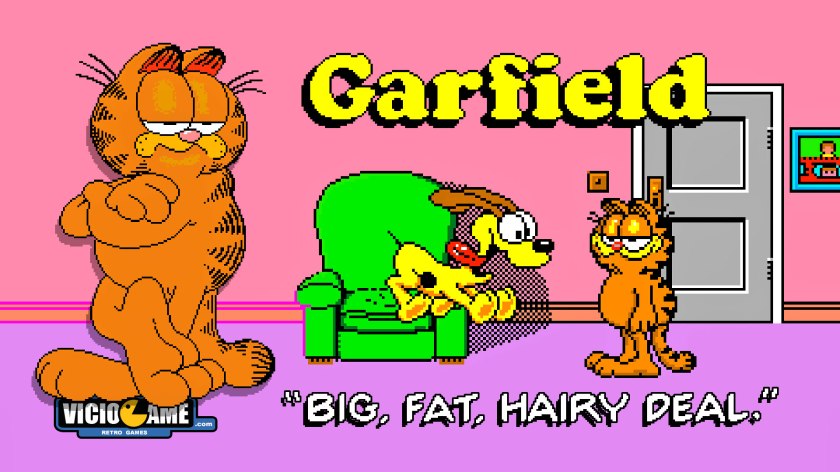
Garfield: Big, Fat, Hairy Deal is a platform/adventure game released in 1988 for the Amiga. Arlene — Garfield’s girlfriend — has been taken to the city pound, and it’s up to him to rescue her. Along the way, he teams up with his pals Odie and Nermal to solve a variety of puzzles.
Developer: Softek
Publisher: The Edge
Release date: 1988
Platform: Commodore Amiga
🇺🇸 Garfield: Big, Fat, Hairy Deal was developed by Softek International and published by The Edge, a British company that at the time had earned a reputation for quality titles such as Bobby Bearing, Fairlight, and Brian Bloodaxe. The game is based on the iconic comic strip created by Jim Davis, which debuted in newspapers in 1978 and would go on to become one of the most recognizable characters in worldwide pop culture. It originally arrived on the Commodore 64 in 1987 and was ported the following year to the ZX Spectrum, the Amstrad CPC, the Atari ST, and the Commodore Amiga.
Although it is officially considered the first game in the Garfield series, there was an earlier unfinished prototype developed for the Atari 2600 in 1982, in which Garfield would have had to rescue Nermal — but Atari ultimately chose not to finalize the licensing deal. The second licensed digital product featuring the character was not actually a game in the traditional sense; it was an animation creation application for the Commodore 64. As a result, Garfield: Big, Fat, Hairy Deal holds the distinction of being the first truly interactive experience featuring the famous orange cat, and its arrival was eagerly anticipated by fans of the strip and gamers alike, who were hoping to see Jim Davis’s expressive artwork and dry wit brought to life on their computer screens.
The original project was conceived and programmed by Stephen Cargill, with graphics by Jack Wilkes for the Amiga and Atari ST versions. The specific Amiga conversion was handled by John Jones-Steele, credited in the game under the name Abersoft. The soundtrack and audio effects were composed and produced by David Whittaker — one of the most prolific and respected musicians in the European home computer gaming scene of the 1980s, known for squeezing every last drop of capability out of the Paula audio chip in the Amiga. His involvement in the project was a mark of quality for the audio standards of the time.
The game’s story is simple but entirely true to the spirit of Jim Davis’s strips. Garfield wakes up and discovers it’s Monday — his least favorite day of the week — and is informed by his owner, Jon Arbuckle, that Arlene has been captured and taken to the City Pound. Garfield must then leave home and make his way through streets, dark alleys, a retirement home, and sewers to find Arlene and rescue her, aided (or hindered) along the way by characters like Odie and Nermal. The humor permeates the entire experience: throughout the adventure, Garfield displays his thoughts as text at the bottom of the screen, commenting with his trademark sarcasm on everything he encounters — including greeting the start of another round with a wry “Oh no, not another day.”
The player must explore the environment, navigate simple platforming sections, collect objects, and carry them to specific locations to trade them for other items — solving a chain of puzzles with the ultimate goal of rescuing Arlene from the City Pound. The concept draws directly from Pyjamarama and other British games of the era, a popular formula that blended exploration with inventory-based puzzle solving. The Amiga version’s map is considerably larger than in the 8-bit versions, with more screens and, in particular, a far more extensive and labyrinthine sewer system filled with ladders and vertical shafts that need to be climbed.
Garfield can walk, kick, and jump, as well as pick up and carry items. The Amiga version is controlled entirely via joystick: pushing the joystick up or diagonally makes Garfield jump in the corresponding direction; pushing down picks up or drops an object; the action button performs the kick; and pushing the joystick sideways while holding the button stops Garfield’s movement. The game can also be paused by pressing RETURN and exited to the title screen with ESC; during gameplay, the F1 and F2 keys toggle between music and sound effects. The title screen doesn’t feature a traditional menu — instead, the player sees an interactive Garfield standing in front of a large sign bearing the game’s title. Moving the character to the left starts the game inside Jon’s house; moving him to the right starts it outside, which can confuse players unfamiliar with this unusual starting-point selection system.
In the Amiga and Atari ST versions, unlike the 8-bit releases, there is no separate stamina meter alongside a hunger meter. Instead, there is a single general energy meter, visually represented as a stack of pizzas, which only depletes when Garfield takes direct damage — specifically from contact with the giant rat in the basement or with Odie. Additionally, in these 16-bit versions, when Garfield needs to sleep he takes a nap and time advances more quickly, without resulting in an immediate game over. The game operates on a time limit rather than the lives system used in the 8-bit versions. When Garfield’s hunger meter reaches a critical level, he shouts “SNACK ATTACK!!!!” and automatically devours whatever item he’s carrying to satisfy his hunger — which can be devastating if the item consumed is one of the objects needed to complete the puzzles. The sleep meter present in the 8-bit versions can be restored by standing still, while in the 16-bit versions the system is unified.
Nine items are essentially required to complete the game, though it is possible to finish it with only eight in most versions, since the ninth object offers only an optional shortcut. Garfield can carry only one item at a time, making the planning of collection and delivery routes absolutely critical. Some of the objects scattered across the map are freely edible and serve only as an energy source; others are indispensable to progress and must never be consumed. Among the key items are the aniseed balls, which must be carried when encountering Odie to prevent him from draining Garfield’s energy; the flashlight, without which it is virtually impossible to navigate the deeper parts of the sewers, as the darkness becomes total and even the information panel disappears completely; and the toy mouse, obtained through a series of interactions with Nermal.
Odie and Nermal play ambiguous roles in the game: they are simultaneously obstacles and essential tools. Odie can trade items with Garfield whenever the two are in contact; Nermal, on the other hand, refuses to hand over any item until he has been kicked repeatedly, making interactions with him simultaneously more violent and more frustrating — especially if he has accidentally picked up the flashlight Garfield needs. Kicking Odie or Nermal is therefore a core gameplay mechanic rather than just a comedic flourish: each kick can alter the inventories of these characters, and the player must carefully manage what each one is carrying at any given moment.
The game offers several side activities that award bonus points: visiting the Pizza Party — an unmarked building — and shaking the joystick to eat pizzas until Garfield gets hit by a pie and falls into the sewers; carrying the golf ball from the shed to the golf course and kicking it, which can result in a hole-in-one; and jumping on the couch and kicking it to reveal it’s torn. These extra interactions aren’t required to finish the game, but they enrich the world and pay homage to the humor of the original strips. In the 8-bit versions, a percentage-completion meter hints that there are objectives beyond rescuing Arlene, while the Amiga version omits this bar entirely.
On the walls of the city’s buildings appear posters of Binky the Clown reading “I WANT YOU” and “JOIN THE CIRCUS,” a parody of the famous Uncle Sam poster created by J.M. Flagg, referencing a strip from September 15, 1986. This kind of detail reflects the team’s care in incorporating authentic references to Jim Davis’s universe, making the game world immediately recognizable to fans.
From a visual standpoint, the Amiga version is by far the most impressive of all the platforms. The 16-bit hardware allows for the maximum number of colors available in context, all characters are colored to match their animated counterparts, and there is far greater focus on appropriate expressions and animations for each action. The sprites for Garfield, Odie, and Nermal are large, detailed, and rank among the most faithful digital representations of the cartoon that the era could deliver. Full-screen backdrops feature colorful and richly detailed backgrounds. The different environments — Jon’s house, the city streets, the alleys, the shops, the park, and the sewers — are all rendered with distinct visual personalities. The shopkeepers, who in the 8-bit versions were all represented by the same little old man with a perpetually startled expression, gain individual appearances and distinct characteristics in the 16-bit versions.
Despite its visual splendor, the Amiga version shares exactly the same in-game graphics as the Atari ST, with no perceptible visual differences between the two; the ST version can only be identified by a subtle detail in Garfield’s posture when he glances slightly upward. The game failed to leverage even half of the Amiga‘s capabilities, since both platform versions are virtually identical. The sprite animation, though large and colorful, exhibits some inconsistency in framerate and a limited number of frames per movement cycle — something that drew commentary at the time. The title screen likewise lacks the visual richness one might have expected.
The soundtrack, composed by David Whittaker, is based on the original theme created by Neil Baldwin for the Commodore 64. The main theme is an upbeat melody with two sections, running approximately four minutes in a loop. The Amiga version features greater chord accuracy but loses some impact and refinement, particularly in the fade-out sequence. The theme is not a direct adaptation of any music heard in the Garfield TV specials, but it carries an animated, easygoing spirit that is compatible with the tone of those productions. In addition to the main theme, the game includes a snippet of the famous Dragnet theme whenever Garfield enters the giant rat’s area — temporarily replacing the main theme and restarting it upon leaving that screen. There is also a short jingle announcing Odie’s appearance on screen, which can become repetitive given that the dog follows Garfield almost constantly. The sound effects library includes the sound of Garfield’s footsteps and a swish when executing a kick.
Garfield’s animated voice was performed by Lorenzo Music (1937–2001), but the game includes no voice samples from the actor or any other member of the TV series cast — which was technically understandable for the era, though it represented a notable gap for fans hoping to hear the character’s unmistakable sarcasm. The animated series referenced by the game was produced by Film Roman, and its original theme, “Friends Are There to Help You Get Started,” served as inspiration for the musical versions of the game on 8-bit platforms.
Critical reception was mixed. Reviewers praised the large and vibrant graphics, considering them the game’s main selling point, but noted that the gameplay left something to be desired — comparing it to a less logical, lower-budget version of the Dizzy series. The magazine The One gave it 74%, while Zzap!64 awarded 60%, praising the character sprites but criticizing the repetitive level design and low replay value. Atari ST User was among the most enthusiastic voices, with critic Nic Outterside calling it one of the most enjoyable games he had played in 1988. On Lemon Amiga, the game’s historical rating sits around 5.18 out of 10 — a modest score reflecting the divided opinions between admiration for the visual presentation and frustration with the unintuitive puzzles.
The main criticism across all versions concerns the energy and hunger balancing system, widely considered unfair, and the inherently feline — and illogical — nature of its puzzles, which rarely follow conventional logic and frequently require players to consult a detailed map or walkthrough to make progress. Solutions for the game were published in Crash magazine in March 1989 and in Your Sinclair in April 1993, demonstrating that the difficulty and opacity of its progression were well recognized by the gaming press of the time. Unlike many British games that offered some level of contextual guidance, Garfield: Big, Fat, Hairy Deal leaves the player entirely without direction, relying exclusively on systematic exploration and manual world-mapping to discover the correct sequence of item exchanges.
From a technical standpoint, the Amiga version is considered an expanded take on the original. In the overall rankings of the Finnish Retro Game Comparison blog — which evaluates all five versions of the game across gameplay, graphics, and sound categories — the Amiga version ties with the Atari ST for third place overall, finishing behind the C64 and the ZX Spectrum in terms of gameplay, despite leading the pack in graphics.
The game marked the beginning of a series of licensed Garfield titles released over the following decades. The Edge itself published a second game featuring the character in 1989, Garfield: Winter’s Tail, universally regarded as inferior to the first and consisting of three winter-themed minigames: alpine skiing, ice skating, and a platforming segment set inside a chocolate egg factory. Other notable titles in the franchise include Garfield no Isshukan: A Week of Garfield, released in 1989 for the Famicom in Japan by Towa Chiki, and Garfield: Caught in the Act, developed by Sega and released in 1995 for the Sega Genesis/Mega Drive and the Game Gear — the latter considered the most polished of the retro Garfield games for its surreal setting and interspersed minigames.
Today, Garfield: Big, Fat, Hairy Deal endures as a genuinely authentic product of its time: a game that captured, within the technical possibilities of 1988, the lazy, sardonic, and irresistibly charismatic essence of the world’s most famous comic strip cat — translating it into an adventure that, for better or worse, no one who played it in childhood can ever quite forget.
🇧🇷 Garfield: Big, Fat, Hairy Deal foi desenvolvido pela Softek International e publicado pela The Edge, empresa britânica que na época era reconhecida por produzir títulos de qualidade como Bobby Bearing, Fairlight e Brian Bloodaxe. O jogo é baseado na icônica tira cômica criada por Jim Davis, que estreou nos jornais em 1978 e se tornaria um dos personagens mais reconhecidos da cultura pop mundial. Chegou originalmente ao Commodore 64 em 1987 e foi portado no ano seguinte para o ZX Spectrum, o Amstrad CPC, o Atari ST e o Commodore Amiga.
Embora seja oficialmente considerado o primeiro jogo da série Garfield, existiu antes dele um protótipo inacabado desenvolvido para o Atari 2600 em 1982, no qual Garfield teria de salvar Nermal, mas a Atari optou por não fechar o contrato de licença. O segundo produto digital licenciado com o personagem não chegou a ser um jogo propriamente dito, tratando-se de um aplicativo de criação de animações para o Commodore 64. Assim, Garfield: Big, Fat, Hairy Deal ocupa o posto de primeira experiência interativa de verdade com o famoso gato laranja, e sua chegada foi aguardada com entusiasmo tanto pelos fãs da tira quanto pelos jogadores da época, que esperavam ver as expressivas animações e o humor ácido de Jim Davis traduzidos para a tela do computador.
O projeto original foi concebido e programado por Stephen Cargill, com os gráficos assinados por Jack Wilkes para as versões Amiga e Atari ST. A conversão específica para o Amiga ficou a cargo de John Jones-Steele, creditado no jogo sob o nome Abersoft. A trilha sonora e os efeitos de áudio foram compostos e produzidos por David Whittaker. Ele era um dos músicos mais prolíficos e respeitados do cenário de jogos para computadores europeus dos anos 1980, conhecido por extrair o máximo das capacidades do chip de áudio Paula presente no Amiga, e sua participação no projeto representava uma garantia de qualidade sonora para os padrões da época.
A narrativa do jogo é simples, mas absolutamente fiel ao espírito das tiras de Jim Davis. Garfield acorda e descobre que é segunda-feira, seu dia menos favorito da semana, e é informado por seu dono, Jon Arbuckle, que Arlene foi capturada e levada para o City Pound. Garfield precisa então sair de casa e percorrer ruas, becos escuros, lares de repouso e esgotos sanitários para encontrar Arlene e resgatá-la, contando ao longo do caminho com a ajuda ou o atrapalho de personagens como Odie e Nermal. O tom bem-humorado permeia toda a experiência: ao longo da aventura, Garfield exibe seus pensamentos em texto na parte inferior da tela, comentando com seu habitual sarcasmo tudo o que encontra pelo caminho, inclusive reagindo com um irônico “Ah não, mais um dia não” ao iniciar mais uma jornada.
O jogador precisa explorar o ambiente, ultrapassar plataformas simples, coletar objetos e transportá-los até determinados locais para trocá-los por outros itens, resolvendo uma série de quebra-cabeças em cadeia com o objetivo final de resgatar Arlene do City Pound. É um conceito que remete diretamente a Pyjamarama e a outros jogos britânicos da época, uma fórmula popular que misturava exploração com resolução de puzzles baseados em inventário. O mapa do jogo na versão Amiga é consideravelmente maior do que nas versões de 8 bits, com mais telas e, em particular, um sistema de esgotos muito mais extenso e labiríntico, repleto de escadas e buracos verticais que precisam ser escalados.
Garfield é capaz de caminhar, chutar e pular, além de poder pegar e carregar itens consigo. O controle na versão Amiga é feito exclusivamente via joystick: mover o joystick para cima ou nas diagonais faz Garfield pular na direção correspondente; para baixo pega ou larga um objeto; o botão de ação executa o chute; e mover o joystick para os lados enquanto segura o botão interrompe o movimento. Também é possível pausar o jogo pressionando RETURN e sair para a tela de título com ESC; durante a partida, as teclas F1 e F2 alternam entre música e efeitos sonoros. A tela inicial não apresenta um menu tradicional: em vez disso, o jogador vê um Garfield interativo parado diante de uma enorme placa com o nome do jogo. Ao mover o personagem para a esquerda, a partida começa dentro da casa de Jon; ao movê-lo para a direita, começa do lado de fora, o que pode confundir jogadores não familiarizados com esse sistema incomum de seleção de ponto de partida.
Na versão Amiga e Atari ST, ao contrário das versões de 8 bits, não existe um medidor de stamina separado do medidor de fome. Em vez disso, há um único medidor de energia geral, visualmente representado por uma pilha de pizzas, que só se depleta quando Garfield sofre dano direto — especificamente ao entrar em contato com o rato gigante no porão ou com Odie. Além disso, nessas versões de 16 bits, quando Garfield precisa dormir, ele tira uma soneca e o tempo avança mais rapidamente, sem resultar em game over imediato. O jogo opera sob um limite de tempo em vez do sistema de vidas das versões de 8 bits. Quando o medidor de fome de Garfield atinge um nível crítico, ele exclama “SNACK ATTACK!!!!” e devora automaticamente o item que está carregando para saciar a fome, o que pode ser devastador se o item ingerido for um dos objetos necessários para concluir os puzzles. O medidor de sono, presente nas versões de 8 bits, pode ser restaurado ficando parado, enquanto nas versões de 16 bits o sistema é unificado.
São necessários essencialmente nove itens para completar o jogo, embora seja possível finalizá-lo com apenas oito na maioria das versões, já que o nono objeto oferece apenas um atalho opcional. Garfield só pode carregar um único item por vez, o que torna o planejamento da rota de coleta e entrega absolutamente fundamental. Alguns dos objetos espalhados pelo mapa são livremente comestíveis e servem apenas como fonte de energia; outros são imprescindíveis para avançar e jamais devem ser consumidos. Entre os itens relevantes estão as bolas de anis, que devem ser carregadas ao encontrar Odie para impedir que ele drene a energia de Garfield; a lanterna, sem a qual é virtualmente impossível navegar pelas partes mais profundas dos esgotos, pois a escuridão torna-se total e até mesmo o painel de informações desaparece completamente; e o rato de brinquedo, obtido através de uma série de interações com Nermal.
Odie e Nermal desempenham papéis ambíguos no jogo: são ao mesmo tempo empecilhos e ferramentas essenciais. Odie tem a possibilidade de trocar itens com Garfield sempre que os dois estão em contato; Nermal, por outro lado, recusa-se a entregar qualquer item até ser chutado repetidas vezes, tornando a interação com ele ao mesmo tempo mais violenta e mais frustrante — especialmente se ele tiver pego acidentalmente a lanterna que Garfield precisa. Chutar Odie ou Nermal é, portanto, uma mecânica central da jogabilidade e não apenas um recurso cômico: cada chute pode alterar o inventário desses personagens, e o jogador precisa gerenciar com cuidado o que cada um está carregando a qualquer momento.
O jogo oferece algumas atividades paralelas que concedem pontos extras: visitar o Pizza Party, um prédio sem placa, e agitar o joystick para comer pizzas até ser atingido por uma torta e cair nos esgotos; levar a bola de golfe do galpão até o campo de golfe e chutá-la pode resultar em um hole in one; e pular no sofá e chutá-lo revela que ele está rasgado. Essas interações extras não são necessárias para completar o jogo, mas enriquecem o mundo e homenageiam o humor das tiras originais. Nas versões de 8 bits existe um medidor de conclusão percentual que revela que há mais objetivos além de salvar Arlene, enquanto na versão Amiga essa barra não está presente.
Nas paredes dos prédios da cidade aparecem cartazes do Binky the Clown com as frases “I WANT YOU” e “JOIN THE CIRCUS”, numa paródia do famoso cartaz do Tio Sam criado por J.M. Flagg, referenciando uma tira de 15 de setembro de 1986. Esse tipo de detalhe demonstra o cuidado da equipe em incorporar referências autênticas ao universo de Jim Davis, tornando o mundo do jogo reconhecível para os fãs.
Do ponto de vista visual, a versão Amiga é de longe a mais impressionante entre todas as plataformas. Os 16 bits permitem o uso do maior número de cores possível no contexto, todos os personagens são coloridos de acordo com suas contrapartes na animação, e há um foco muito maior em expressões e animações adequadas para cada ação. Os sprites de Garfield, Odie e Nermal são grandes, detalhados e estão entre as representações digitais mais fiéis ao desenho animado que a época permitia. Os cenários em tela cheia, com fundos coloridos e bem detalhados. Os diferentes ambientes — a casa de Jon, as ruas da cidade, os becos, as lojas, o parque e os esgotos — são todos renderizados com personalidade visual distinta. Os lojistas, que nas versões de 8 bits eram todos representados pelo mesmo velhinho com expressão de susto perene, ganham nas versões de 16 bits aparências individuais e características próprias.
Apesar do esplendor visual, a versão Amiga compartilha com o Atari ST exatamente os mesmos gráficos de jogo, sem diferenças visuais perceptíveis entre as duas; é possível identificar a versão ST apenas por um detalhe na postura de Garfield ao olhar ligeiramente para cima. O jogo não aproveitou metade das capacidades do Amiga, já que as versões para as duas plataformas são praticamente idênticas. A animação dos sprites, embora grande e colorida, apresenta uma certa irregularidade no framerate e quantidade limitada de frames por ciclo de movimento, o que foi alvo de comentários na época. A tela de título não possui a riqueza visual que seria de se esperar.
A trilha sonora, composta por David Whittaker, é baseada no tema original criado por Neil Baldwin para o Commodore 64. O tema principal é uma melodia animada com duas partes e com cerca de quatro minutos de duração em loop. A versão do Amiga apresenta maior precisão nos acordes, mas perde em certo impacto e refinamento, especialmente na sequência de fade-out. O tema não é uma adaptação direta de nenhuma música ouvida nos especiais de TV do Garfield, mas carrega um espírito animado e descomplicado compatível com o tom das animações. Além do tema principal, o jogo inclui um trecho do famoso tema de Dragnet sempre que Garfield entra no ambiente do rato gigante; esse trecho substitui temporariamente o tema principal e o reinicia ao sair da tela. Também há uma pequena melodia anunciando a aparição de Odie na tela, que pode se tornar repetitiva dado que o cão segue Garfield quase constantemente. A biblioteca de efeitos sonoros inclui o som dos passos de Garfield e um swish ao executar um chute.
A voz do Garfield animado era interpretada por Lorenzo Music (1937–2001), mas o jogo não conta com amostras de voz do ator ou de qualquer outro membro do elenco da série televisiva, o que era tecnicamente compreensível para a época, embora representasse uma lacuna notável para os fãs que esperavam ouvir o sarcasmo inconfundível do personagem. A série animada a que o jogo faz referência é a produzida pela Film Roman, cujo tema original “Friends are There to Help You Get Started” serviu de inspiração para as versões musicais do game nas plataformas de 8 bits.
A recepção do jogo foi mista. Críticos elogiaram os gráficos grandes e vibrantes, considerando-os o principal atrativo, mas apontaram que a jogabilidade deixava a desejar — comparando-a a uma versão menos lógica dos jogos da série Dizzy, de orçamento reduzido. A revista The One atribuiu 74%, enquanto a Zzap!64 deu 60%, elogiando os gráficos dos personagens mas criticando o design repetitivo de fases e a pouca rejogabilidade. A Atari ST User foi uma das vozes mais entusiastas, com o crítico Nic Outterside considerando o jogo um dos mais divertidos que havia jogado em 1988. No Lemon Amiga, a nota histórica do jogo situa-se em torno de 5,18 — um placar modesto que reflete a divisão de opiniões entre a admiração pela apresentação visual e a frustração com os puzzles pouco intuitivos.
A principal crítica ao jogo em todas as suas versões diz respeito ao sistema de balanceamento de energia e fome, considerado injusto, e à natureza felina e ilógica de seus puzzles, que raramente se baseiam em lógica convencional e frequentemente exigem que o jogador consulte um mapa detalhado ou um walkthrough para avançar. Soluções para o jogo foram publicadas na revista Crash em março de 1989 e na Your Sinclair em abril de 1993, o que demonstra que a dificuldade e a opacidade da progressão eram reconhecidas pela imprensa especializada da época. Ao contrário de muitos jogos britânicos que ofereciam algum nível de dica contextual, Garfield: Big, Fat, Hairy Deal deixa o jogador completamente sem orientação sobre o que fazer a seguir, dependendo exclusivamente de exploração sistemática e mapeamento manual do mundo para descobrir a sequência correta de trocas de itens.
Do ponto de vista técnico, a versão Amiga é considerada uma expansão da original. No ranking geral do blog Finnish Retro Game Comparison, que avalia as cinco versões do jogo em categorias de jogabilidade, gráficos e som, a versão Amiga empata com o Atari ST em terceiro lugar geral, ficando atrás do C64 e do ZX Spectrum em termos de jogabilidade, apesar de liderar em gráficos.
O jogo marcou o início de uma série de títulos licenciados com o personagem Garfield ao longo das décadas seguintes. A própria The Edge lançou em 1989 um segundo jogo com o personagem, Garfield: Winter’s Tail, universalmente considerado inferior ao primeiro e composto por três minigames com temática de inverno: esqui alpino, patinação no gelo e um segmento de plataforma dentro de uma fábrica de ovos de chocolate. Outros títulos notáveis da franquia em jogos incluem Garfield no Isshukan: A Week of Garfield, lançado em 1989 para o Famicom pela Towa Chiki no mercado japonês, e Garfield: Caught in the Act, desenvolvido pela Sega e lançado em 1995 para o Sega Genesis/Mega Drive e o Game Gear, este último considerado o mais polido dos jogos retro da franquia pelo seu cenário surreal e pelos minigames intercalados.
Hoje, Garfield: Big, Fat, Hairy Deal permanece como um título genuíno de seu tempo: um jogo que capturou, dentro das possibilidades técnicas de 1988, a essência preguiçosa, sarcástica e irresistivelmente carismática do gato mais famoso das tiras cômicas, transformando-a em uma aventura que, para o bem ou para o mal, ninguém que a jogou na infância consegue esquecer completamente.
🤑💲Earn money without doing anything! Just leave these apps open:
✓ https://r.honeygain.me/CONTA9DB02
✓ https://packetstream.io/?psr=1uPb
🤑💲1-Click button earns Bitcoin every 1 hour: https://freebitco.in/?r=53528449
⬛ 𝗧𝗶𝗸𝗧𝗼𝗸: https://www.tiktok.com/@viciogame
🟧 𝗜𝗻𝘀𝘁𝗮𝗴𝗿𝗮𝗺: http://www.instagram.com/viciogame
🟥 𝗬𝗼𝘂𝘁𝘂𝗯𝗲: http://www.youtube.com/viciogame
🟦 𝗙𝗮𝗰𝗲𝗯𝗼𝗼𝗸: http://www.facebook.com/viciogame
🔳 𝗧𝗵𝗿𝗲𝗮𝗱𝘀: https://www.threads.net/@viciogame
🟪 𝗧𝘄𝗶𝘁𝗰𝗵: https://www.twitch.tv/ViciogameRetroGames
🟨 𝗕𝗹𝗼𝗴: http://www.viciogameblog.com/
🟦𝗧𝘄𝗶𝘁𝘁𝗲𝗿: http://www.twitter.com/viciogame
#Viciogame #Gameplay #LetsPlay #Playthrough #Games #Gaming #Videogames #Review #Game #Detonado #Walkthrough #Ending #Reviews #Facts #Retro #RetroGaming #Roms #Emulator #Longplay #Speedrun #NoCommentary #Garfield #Amiga #Commodore #Nermal #Odie #JimDavis #Commodore64 #CommodoreAmiga #C64 #AtariST #ZxSpectrum #Amstrad #Arlene

