
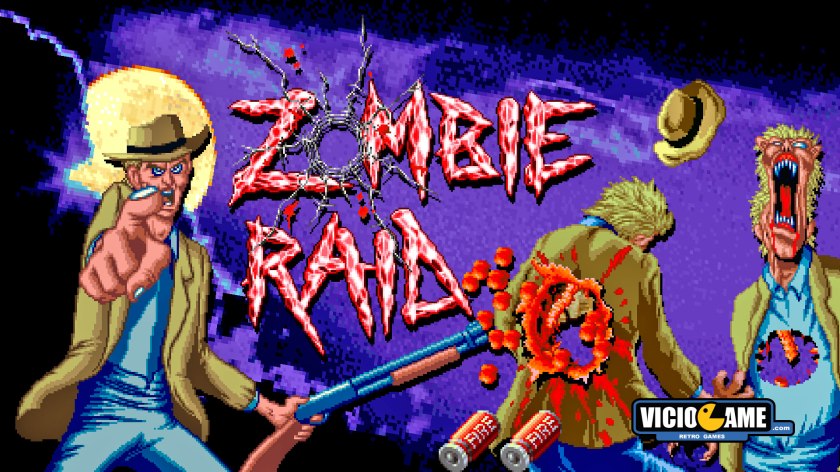
Zombie Raid is a light gun shooter released in 1995 for arcades. A private detective turned hired gun, Edward Windsor is driven purely by money. When reports emerge of lab-engineered monsters terrorizing a haunted village, he sees it as the perfect chance to make a quick buck.
Developer/Publisher: American Sammy
Release date: 1995
Platform: Arcade Seta System board
🇺🇸 Zombie Raid stands as one of the darkest and most technically curious titles in the genre from the ’90s. Developed jointly by Japanese and American teams at Sammy Corporation, the game arrived in arcades at a time when the light gun shooter genre was experiencing one of its most vibrant periods, fueled by the massive impact of Virtua Cop (Sega, 1994) and the near-simultaneous release of Time Crisis (Namco, 1995). In a landscape dominated by 3D polygonal graphics that promised a visual revolution, Sammy opted for a distinct approach: meticulously hand-drawn 2D art, a narrative dense by genre standards, and a setting that channels British Gothic horror with visceral intensity.
American Sammy already had experience with the North American arcade market before Zombie Raid, having released other titles on the same platform during the early 1990s. It ran on Seta Corporation’s first-generation hardware, a system originally developed in 1987 that allowed for high-quality sprite rendering. The cabinet featured a 25-inch monitor and came with a physical shotgun controller with two action buttons: one to fire and one to reload. The design of this controller is central to the game’s identity, as it requires the player to physically perform the pumping gesture to reload when ammunition runs out — replicating the real-world mechanics of a shotgun in a way that contributed significantly to the overall sense of immersion. The game supports up to two simultaneous players, each with their own shotgun.
Zombie Raid‘s narrative begins with an opening text narrated in first person by protagonist Edward Windsor, a private detective who describes himself as a self-declared anti-hero driven by financial need rather than altruism. Windsor’s words echo like a bitter confession: “Tonight reminds me of a nightmare… a small village suffered a great catastrophe. Cemetery robberies and kidnappings happened every night. And there was a resident who saw a horrible monster. Even the police found it uncontrollable. My name is Edward Windsor. I’m a miserable detective. When they came to me for this case, I had no interest whatsoever in such a ridiculous monster hunt. But I needed money and reluctantly took the job.”
The setting is England in 1918, a fictional region that blends late Victorian elements with the horror aesthetic of Hammer Film Productions pictures, rather than any strict historical fidelity to the World War I era. A small village is tormented by grave robbing, nightly kidnappings, and monster sightings, while the local police proves completely helpless in the face of the terror. The culprit is the lord of a nearby castle — a monstrous-looking mad scientist, bald, with purple tumor-riddled skin, sagging cheeks, a metal plate implanted in his skull, a hook in place of his left hand, and a single menacing red eye. This antagonist, whose name is never explicitly revealed, conducts macabre experiments in his dungeons with the stated goal of “evolving the human race,” transforming ordinary mortals into powerful creatures capable of dominating the world. He dismisses everyone as “dumb animals” and displays a megalomaniacal arrogance that, despite his superficially courteous manners — he calls the player “pal” — does nothing to disguise the monstrousness of his character.
The opening sequence ends with Edward Windsor turning to face the player directly, pointing his shotgun at the camera — a moment that immediately establishes the game’s dark tone and first-person perspective. Throughout the game, Edward is accompanied by a man named Charles, rescued in the first stage during a shootout in the village cemetery. The two team up to storm the castle where the zombies originate, but split up upon entering the fortress when Edward falls into an underground dungeon. Their relationship, though developed economically within the confines of the arcade medium, gains considerable dramatic depth in the final stages, culminating in one of the game’s most impactful moments: Charles is fatally shot by a common enemy at the end of the fourth stage, only to resurrect as a corrupted monster in service of the villain, forcing Edward to face him in combat. After defeating Charles in this first form, Edward enters the castle laboratory and finds his friend once again — transformed into an even more distorted new form — and is forced to destroy him a second time. The narrative implication is that Charles fell victim to some kind of brainwashing or possession rather than having willingly surrendered to evil, as his spirit offers words of encouragement to Edward after being defeated in the second battle.
The game is structured across five stages, each with a boss at the end that must be defeated to advance. The first stage takes place in a cemetery at night, establishing the tone of despair and horror from the very first moments. Edward advances between gravestones, gnarled trees, and the dense darkness of the early morning hours as hordes of the undead rise from the ground. The second stage features Edward and Charles fleeing by car toward the castle, with enemies pursuing them in vehicles that generate zombies in implausible quantities — more than any vehicle could possibly carry, as if they were driverless cars simply producing infinite threats. The pillars at the castle entrance in this stage carry a crucial detail: the order of the colored crystals needed to access the final boss is etched into these columns, below a horned head, and the attentive player must memorize it. The third stage deepens the incursion into the castle’s interior, including dungeons and catacombs where mummies emerge from sarcophagi, hurling their bandages as projectiles. The fourth stage includes a notorious elevator sequence inside the castle, where a werewolf resembling the first stage boss drops onto Edward inside the confined compartment, forcing an extremely close-quarters confrontation — until the door opens and Charles, who had split from Edward, eliminates the creature from behind, in a moment of immediate relief followed by the brutal revelation of his death and transformation. The fifth and final stage leads Edward through the mad scientist’s laboratory, filled with technological and biological horrors, including skulls with spinal columns preserved in glass jars — invulnerable while inside the containers, but eventually shattering them to attack directly. At the end of this stage, Edward faces Charles for the second time before reaching the decisive confrontation with the main villain.
Zombie Raid‘s enemies form a true rogues’ gallery of creatures drawn from classic horror mythology. Zombies are the most recurring enemy and display surprisingly varied behaviors for undead creatures: beyond their shambling gait and decomposed appearance, they demonstrate enough rudimentary intelligence to use firearms, hurl sharpened stakes, and even throw knives at high speed. The player can actually shoot projectiles thrown by enemies to destroy them mid-air — with the exception of gunshots, which cannot be intercepted. The game’s werewolves depart from the classic archetype: they are hybrid creatures with the appearance of a wolf-bigfoot hybrid, wearing jeans and spitting corrosive acid at the player. Mummies appear in the castle catacombs, emerging from coffins and using their own bandages as weapons. Mutant bats soar through various environments. Animated brains with attached spinal columns sit silently in jars throughout the laboratory, becoming immediate threats once they escape. The entire art direction for the enemies, entirely hand-drawn with a dark and macabre palette, skillfully blends photorealistic elements — body parts and decomposition textures were clearly based on photographic references or live-action images — with stylized illustrations that give the game an unmistakable visual identity. When common enemies are eliminated, they explode into pieces with explicit detail — blood, viscera, and flesh fragments — creating an intense gore presentation that contributed to the title’s adult rating.
Zombie Raid‘s weapon system goes beyond the simple shotgun the physical player wields. Within the game, Edward starts with a standard six-shot pistol but can find upgrades by destroying environmental elements like gravestones and windows, which reveal hidden power-ups. Available options include an automatic pistol, a higher-powered shotgun, a fire rifle that shoots incendiary projectiles, and as a special variant, silver bullets that summon lightning bolts upon hitting targets. A punishing and decisive design detail is that the player loses all weapon upgrades if hit by an enemy or if they accidentally shoot an innocent civilian. These civilians appear frequently in the environments, dressed similarly to enemies, requiring the player’s constant attention, as hitting them also causes a life penalty.
Beyond conventional power-ups, the game hides three secret rooms with exclusive items: in the first, accessed in the opening cemetery by shooting a specific tree above an armed male figure when the camera pans up, the player finds a crucifix that automatically restores all health when life reaches zero (single-use item); in the second secret room, accessed in the third stage by shooting a specific location where a pillar should be but isn’t, the player obtains a scope (which improves accuracy) and a bomb — whose icon appears in the upper left corner and, when activated, blasts all visible enemies on screen at once; in the third room, also in the third stage immediately after the elevator, by shooting a wall next to a specific pillar, the player finds double ammunition (which enables automatic reloading, eliminating the need to physically pump the gun) and a blue potion that grants an extra life. The game also hides a fun easter egg: shooting the second well in the third stage with the shotgun causes a ghost modeled after the film Ghostbusters to appear. Another easter egg involves triggering a hidden lever to make a clown on a bicycle appear on screen, serving no apparent purpose beyond the surprise.
The most critical element of Zombie Raid‘s design in terms of rewarding experienced players is the three-colored crystal system, essential for accessing the true final boss and obtaining the good ending. The Crystal Code — the correct insertion sequence — is etched in the second stage, on the columns at the castle entrance: red, green, and blue, in that order. The crystals themselves, however, are scattered throughout the later stages and must be actively sought out. The red crystal appears at the end of the third stage after the player eliminates absolutely every zombie inside an elevator. The blue crystal is hidden inside a statuette on a pillar in the fourth stage, a statuette that bears a deliberate visual resemblance to the horned head on the second-stage pillars. The green crystal is obtained by defeating the two-headed monster in the fifth stage. If the player gathers all three crystals and inserts them in the correct order at the end of the fifth stage, the passage to the villain’s inner sanctum opens and the decisive confrontation begins. Should the player fail this task — either by not having found all the crystals or by inserting them in the wrong order — Edward falls into a pit of spikes and the game ends there, with the villain letting out a mocking laugh and suggesting the player try again. This multiple-endings system represented a layer of narrative and mechanical depth that was uncommon in light gun games of the era.
The final confrontation unfolds in two phases. First, Edward faces the scientist in his human form — already visually cadaverous and monstrous, with that swollen skin and metal plate in his skull — who grows increasingly furious and faster as he takes damage (like all bosses in the game, who turn red when near death and begin attacking with greater aggression). Then, after being riddled with bullets, the villain drinks his own potion and transforms into a gigantic reptilian demon, triggering the ultimate battle. Edward’s victory results in the creature’s death with a headshot, and the good ending shows the detective walking away from the village while reflecting that although the danger has passed and the villagers can live in peace, he doesn’t feel as though he completed his mission. Charles’s death weighs on his conscience. The ending is not triumphant in the conventional genre sense — Edward returns to his initial condition as a miserable detective looking for his next case, bearing the scar of losing a friend he barely knew.
The soundtrack composed by Brian L. Schmidt effectively contributes to the game’s oppressive atmosphere, utilizing the cabinet’s built-in chip capabilities to create horror compositions that alternate between slow, tense passages during exploration moments and more frenetic music during boss battles. Schmidt was already a well-respected professional in the sound-for-entertainment and pinball industry, and his work on Zombie Raid demonstrates a sharp understanding of audio’s role in creating immersion in arcade environments, where sound also serves to attract potential players. The creature sound effects, created by Fred Young, complete the sonic picture with growls, moans, screams, and weapon impact sounds that cohere seamlessly with the game’s gore visuals.
When Zombie Raid arrived in arcades, the market was in full transformation. Virtua Cop had set a new visual standard for the genre by using fully polygonal 3D graphics with ultra-realistic gun models as controllers, and its popularity was undeniable. In this context, Sammy’s choice of hand-drawn 2D sprites — while resulting in images of great expressiveness and unique artistic personality — was perceived as technically conservative. The trade publication Next Generation, in its review of the title, awarded two out of five stars and summed up the critical reception as follows: the game isn’t terrible, it can even be fun, but compared to the shooters then available, it lacks something. This lukewarm assessment reflected the consensus of the period: Zombie Raid was functional, tense, and visually interesting within its own aesthetic, but never managed to compete on equal footing with the technologically more advanced titles dominating the spotlight.
A notable peculiarity of the cabinet’s physical design is the need to calibrate the game before each session — a technical requirement stemming from the nature of the light gun system, which must be synchronized with the monitor for the targeting to function correctly. This type of maintenance was a real operational constraint in commercial arcades of the era. The generous dimensions and the nearly 440-pound cabinet weight also made installation and transport demanding. These practical factors contributed to Zombie Raid not being deployed on a large scale in arcades worldwide, reinforcing its status as a rarity. The game never received an official home console port, remaining exclusive to the arcade environment in its original form, which amplified its condition as a little-known work outside of dedicated arcade enthusiast circles.
The existence of a functional Japanese prototype means that simultaneous development occurred for the Japanese market, although the official release never materialized. The differences between versions are technical and code-state related, with no significant changes to content or narrative. Interestingly, the text on the gravestones in the first stage contains a spelling error — “May the Angeles watch over you” instead of “Angels” — a slip by the art team that remains in all known versions of the game.
In the broader context of the light gun shooter genre, Zombie Raid is frequently cited as a spiritual relative of Beast Busters (SNK, 1989), a title that was also a rail shooter with zombie and undead themes, though set in modern times and with a less eerie approach. The choice of a historical setting and a horror aesthetic inspired by Gothic literature and cinema gave Zombie Raid a distinctly different personality, closer to the universe of Mary Shelley, Bram Stoker, and Hammer Films than the urban science fiction of Beast Busters. Compared to its most immediate contemporaries — Virtua Cop and Time Crisis from Sega and Namco respectively, and also games like Crypt Killer (Konami, 1995) and Alien 3: The Gun (Sega, 1993) — Zombie Raid found its niche in a gory aesthetic and a more elaborate narrative, sacrificing technical modernity in favor of a cohesive and immersive artistic vision within its limitations.
In 2021, a game called Zombie Raid developed by Pix Arts was released for Nintendo Switch and Xbox One, with credits referencing members of the original 1995 team such as Hiroaki Murase, Tomohiro Takahashi, Yoshi Suzuki, and Brian Schmidt. However, this 2021 title is a completely different game in genre and concept — it’s a top-down shooter with procedurally generated levels and a survival mechanic based on infinite enemy waves — with no narrative, visual, or mechanical continuity with the original Sammy arcade game. The shared credits suggest some licensing or collaborative relationship between those involved, but the two works are, for all practical purposes, distinct and independent experiences that merely share a name.
Zombie Raid maintains a solid reputation as a cult work: a game that never became an arcade hit, but one that those who had the opportunity to experience it in its original form — with the physical shotgun, the 25-inch CRT monitor, and the blaring volume filling the room — recall with affection and respect. Its genuinely punishing difficulty, legitimate challenges, well-hidden secrets, a narrative with more layers than the genre typically offered, and expressive, visceral art make Zombie Raid a worthy and singular entry from the golden age of arcades — proof that the game industry of the 1990s accommodated experiences as varied as they were unforgettable.
🇧🇷 Zombie Raid representa um dos títulos mais sombrios e tecnicamente curiosos do gênero dos anos 90. Desenvolvido conjuntamente por equipes japonesas e norte-americanas da empresa Sammy Corporation, o jogo chegou aos arcades numa época em que o light gun shooter vivia um de seus momentos mais efervescentes, impulsionado pelo impacto avassalador de Virtua Cop (Sega, 1994) e pelo lançamento quase simultâneo de Time Crisis (Namco, 1995). Num cenário dominado por gráficos poligonais em 3D que prometiam uma revolução visual, a Sammy optou por uma abordagem distinta: arte 2D meticulosamente desenhada à mão, uma narrativa densa para os padrões do gênero e uma ambientação que traz o terror gótico britânico com intensidade visceral.
A American Sammy já tinha experiência com o mercado de arcades norte-americano antes de Zombie Raid, tendo lançado outros títulos pela mesma plataforma durante o início dos anos 1990. Ele rodava no hardware de primeira geração da Seta Corporation, sistema originalmente desenvolvido em 1987 e que permitia a renderização de sprites de alta qualidade. O gabinete usava um monitor de 25 polegadas, e vinha com controle físico em forma de espingarda com dois botões de ação: uma para atirar e outro para recarregar. O design desse controle é central para a identidade do jogo, pois obriga o jogador a realizar o gesto físico de bombear o cano para recarregar a arma quando a munição se esgota, replicando a mecânica real de uma shotgun — algo que contribuía significativamente para a imersão na experiência. O jogo suporta até dois jogadores simultâneos, cada um com sua própria espingarda.
A narrativa de Zombie Raid começa com um texto de abertura narrado em primeira pessoa pelo protagonista Edward Windsor, detetive particular que se descreve como um um anti-herói declaradamente motivado pela necessidade financeira, não pelo altruísmo. As palavras de Windsor ecoam como uma confissão amarga: “Esta noite me lembra um pesadelo… uma pequena vila sofreu uma grande catástrofe. Roubos a cemitérios e sequestros aconteciam todas as noites. E havia um morador que viu um monstro horrível. Até a polícia achou isso incontrolável. Meu nome é Edward Windsor. Sou um detetive miserável. Quando me procuraram para este caso, não tinha o menor interesse em uma caçada a monstros tão ridícula. Mas estava precisando de dinheiro e aceitei o trabalho a contragosto“.
O cenário é a Inglaterra de 1918, região fictícia que mistura elementos vitordianos tardios com estética do terror dos filmes da Hammer Film Productions, mais do que qualquer fidelidade histórica ao período da Primeira Guerra Mundial. Uma pequena vila é atormentada por saques a cemitérios, sequestros noturnos e avistamentos de monstros, e a polícia local se mostra completamente impotente diante do terror. O culpado é o senhor de um castelo próximo, um cientista louco de aparência monstruosa — careca, pele púrpura coberta por tumores, bochechas caídas, uma placa de metal implantada no crânio, um gancho no lugar da mão esquerda e um único olho vermelho e ameaçador. Esse antagonista, cujo nome nunca é revelado explicitamente, conduz experimentos macabros em suas masmorras com o objetivo declarado de “evoluir a raça humana”, transformando mortais comuns em criaturas poderosas capazes de dominar o mundo, chamando todos de “animais bobos” e demonstrando uma arrogância megalomaníaca que, apesar de suas maneiras superficialmente corteses — ele chama o jogador de “camarada” —, não disfarça a monstruosidade de seu caráter.
A sequência de abertura termina com Edward Windsor virando-se para encarar diretamente o jogador, apontando sua espingarda para a câmera — um momento que estabelece de imediato o tom sombrio e a perspectiva em primeira pessoa do jogo. Ao longo do jogo, Edward é acompanhado por um homem chamado Charles, resgatado ainda no primeiro estágio durante um tiroteio no cemitério da vila. Os dois se unem para invadir o castelo onde os zumbis se originam, mas se separam ao entrar na fortaleza quando Edward cai em uma masmorra subterrânea. A relação entre os dois, embora desenvolvida de forma econômica dentro dos limites do meio arcade, ganha profundidade dramática considerável nos estágios finais, culminando em um dos momentos mais impactantes do jogo: Charles é baleado fatalmente por um inimigo comum no final do quarto estágio, apenas para ressuscitar como um monstro corrompido a serviço do vilão, obrigando Edward a enfrentá-lo em combate. Após derrotar Charles nessa primeira forma, Edward adentra o laboratório do castelo e encontra o amigo novamente — transformado em uma nova forma ainda mais distorcida —, sendo forçado a destruí-lo pela segunda vez. A implicação narrativa é de que Charles foi vitimado por uma espécie de lavagem cerebral ou possessão, e não de que havia se entregado voluntariamente ao mal, pois seu espírito oferece palavras de encorajamento a Edward após ser derrotado na segunda batalha.
O jogo está estruturado em cinco estágios, cada um com um boss no final que precisa ser derrotado para avançar. O primeiro estágio transcorre num cemitério à noite, estabelecendo o tom de desespero e horror desde os primeiros momentos. Edward avança entre lápides, árvores retorcidas e a escuridão densa da madrugada enquanto hordas de mortos-vivos emergem do chão. O segundo estágio apresenta Edward e Charles em fuga de carro em direção ao castelo, com os inimigos perseguindo-os em veículos que geram zumbis em quantidades inverossímeis — mais do que qualquer veículo poderia transportar, como se fossem carros sem motorista que simplesmente produzem ameaças infinitas. Os pilares da entrada do castelo nesse estágio carregam um detalhe crucial: a ordem dos cristais coloridos necessários para acessar o chefe final está gravada nessas colunas, abaixo de uma cabeça com chifres, e o jogador atento deve memorizá-la. O terceiro estágio aprofunda a incursão no interior do castelo, incluindo masmorras e catacumbas onde múmias emergem de sarcófagos arremessando suas bandagens como projéteis. O quarto estágio inclui uma sequência notória no elevador do castelo, onde um lobisomem semelhante ao boss do primeiro estágio cai sobre Edward dentro do compartimento fechado, forçando um confronto de extrema proximidade — até que a porta se abre e Charles, que havia se separado de Edward, elimina a criatura pelas costas, num momento de alívio imediato seguido pela revelação brutal de sua morte e transformação. O quinto e último estágio conduz Edward pelo laboratório do cientista louco, repleto de horrores tecnológicos e biológicos, incluindo crânios com espinhas dorsais preservados em jarros de vidro — invulneráveis enquanto dentro dos recipientes, mas que eventualmente os quebram para atacar diretamente. Ao final desse estágio, Edward enfrenta Charles pela segunda vez antes de chegar ao confronto decisivo com o vilão principal.
Os inimigos de Zombie Raid compõem um verdadeiro variação de criaturas oriundas do imaginário do terror clássico. Os zumbis são o inimigo mais recorrente e apresentam comportamentos surpreendentemente variados para criaturas mortas-vivas: além do passo cambaleante e da aparência em decomposição, eles demonstram inteligência rudimentar suficiente para usar armas de fogo, arremessar estacas afiadas e até lançar facas em alta velocidade. O jogador pode, inclusive, atirar nos projéteis arremessados pelos inimigos para destruí-los no ar — com exceção de projéteis de arma de fogo, que não podem ser interceptados. Os lobisomens do jogo fogem do arquétipo clássico: são criaturas híbridas com aparência de lobo e pé-grande, vestindo jeans e cuspindo ácido corrosivo em direção ao jogador. As múmias aparecem nas catacumbas do castelo, emergindo de caixões e usando suas próprias bandagens como armas. Morcegos mutantes sobrevoam vários cenários. Cérebros animados com espinhas dorsais presos em jarros aguardam silenciosos no laboratório, tornando-se ameaças imediatas assim que escapam. Toda a direção de arte dos inimigos, integralmente desenhada à mão com uma paleta escura e macabra, mistura habilmente elementos fotorrealistas — partes de corpos humanos e texturas de decomposição foram claramente baseadas em referências fotográficas ou imagens live-action — com ilustrações estilizadas que conferem ao jogo uma identidade visual inconfundível. Quando os inimigos comuns são eliminados, explodem em pedaços com detalhes explícitos — sangue, vísceras e fragmentos de carne —, criando uma apresentação gore intensa que contribuiu para a classificação adulta do título.
O sistema de armas de Zombie Raid vai além da simples shotgun que o jogador físico empunha. Dentro do jogo, Edward começa com uma pistola padrão de seis tiros, mas pode encontrar upgrades destruindo elementos cenográficos como lápides e janelas, que revelam power-ups escondidos. As opções disponíveis incluem uma pistola automática, uma shotgun de maior poder de fogo, uma fire rifle que dispara projéteis incendiários e, como variante especial, balas de prata que invocam raios ao acertar os alvos. Um detalhe punitivo e decisivo do design de jogabilidade é que o jogador perde todos os upgrades de arma se for atingido por um inimigo ou se acidentalmente atingir um civil inocente. Esses civis aparecem com frequência nos cenários, vestidos de maneira similar aos inimigos, e exigem atenção redobrada do jogador, pois acertá-los também causa penalidade de vida.
Além dos power-ups convencionais, o jogo esconde três salas secretas com itens exclusivos: na primeira, acessada no cemitério inicial atirando numa árvore específica acima de uma figura masculina armada quando a câmera sobe, o jogador encontra um crucifixo que restaura toda a energia automaticamente quando a vida chega a zero (item de uso único); na segunda sala secreta, acessada no terceiro estágio atirando em um local específico onde deveria haver um pilar mas não há, o jogador obtém a mira (que aprimora a acuracidade) e uma bomba — cujo ícone aparece no canto superior esquerdo e que, ao ser ativada, destroça todos os inimigos visíveis na tela de uma vez; na terceira sala, também no terceiro estágio imediatamente após o elevador, atirando numa parede ao lado de um pilar específico, o jogador encontra munição em dobro (que habilita o recarregamento automático, dispensando a necessidade de bombear físicamente) e uma poção azul que concede uma vida extra. O jogo ainda esconde um easter egg curioso: atirar no segundo poço do terceiro estágio com a shotgun faz surgir um fantasma nos moldes do filme Ghostbusters. Outro easter egg envolve acionar uma alavanca escondida para fazer um palhaço em bicicleta aparecer na tela, sem propósito aparente além da surpresa.
O elemento mais crítico do design de Zombie Raid em termos de recompensa ao jogador experiente é o sistema de três cristais coloridos, imprescindíveis para acessar o verdadeiro chefe final e obter o final bom. O Código do Cristal — a sequência correta de inserção — está gravado no segundo estágio, nas colunas da entrada do castelo: vermelho, verde, e azul, nessa ordem. Os próprios cristais, porém, estão espalhados pelos estágios seguintes e precisam ser encontrados ativamente. O cristal vermelho aparece no final do terceiro estágio após o jogador eliminar absolutamente todos os zumbis dentro de um elevador. O cristal azul está oculto dentro de uma estatueta num pilar do quarto estágio, estatueta essa que guarda semelhança visual deliberada com a cabeça com chifres dos pilares do segundo estágio. O cristal verde é obtido ao derrotar o monstro de duas cabeças no quinto estágio. Se o jogador reunir os três cristais e inseri-los na ordem correta ao final do quinto estágio, a passagem para o santuário interno do vilão se abre e o confronto definitivo começa. Caso falhe nessa tarefa — seja por não ter encontrado todos os cristais, seja por inseri-los na ordem errada — Edward cai em uma fossa de espinhos e o jogo termina ali, com o vilão dando uma risada deboochada e sugerindo que o jogador tente novamente. Este sistema de múltiplos finais representava uma camada de profundidade narrativa e mecânica pouco comum em jogos de tiro com pistola da época.
O confronto final desdobra-se em duas fases. Primeiro, Edward enfrenta o cientista em sua forma humana — já cadavérica e monstruosa visualmente, com aquela pele túrgida e a placa de metal no crânio —, que se torna cada vez mais furioso e veloz à medida que sofre danos (como todos os bosses do jogo, que ficam vermelhos quando próximos da morte e passam a atacar com maior agressividade). Em seguida, após ser crivado de balas, o vilão bebe sua própria poção e se transforma em um demônio réptil gigantesco, precipitando a batalha definitiva. A vitória de Edward resulta na morte da criatura com um tiro na cabeça, e o final bom mostra o detetive caminhando para longe da vila enquanto reflete que, embora o perigo tenha passado e os aldeões possam viver em paz, ele não sente que cumpriu sua missão. A morte de Charles pesa sobre sua consciência. O final não é triunfal no sentido convencional do gênero — Edward retorna à condição inicial de detetive miserável em busca do próximo caso, com a cicatriz da perda de um amigo que mal conheceu.
A trilha sonora composta por Brian L. Schmidt contribui de maneira efetiva para a atmosfera opressiva do jogo, utilizando as capacidades do chip embutido no gabinete para criar composições de terror que se alternam entre passagens lentas e tensas nos momentos de exploração e músicas mais agitadas durante as batalhas contra chefes. Schmidt era um profissional já respeitado na indústria de sons para entretenimento e pinball, e seu trabalho em Zombie Raid demonstra compreensão apurada do papel do áudio em criar imersão em ambientes arcade, onde o som também serve para atrair a atenção de potenciais jogadores. Os efeitos sonoros das criaturas, criados por Fred Young, completam o quadro sonoro com rosnados, gemidos, gritos e sons de impacto de armas que se encaixam coerentemente com o visual gore do jogo.
Quando Zombie Raid chegou aos arcades, o mercado estava em plena transformação. Virtua Cop tinha estabelecido um novo padrão visual para o gênero ao usar gráficos 3D totalmente poligonais com modelos de armas ultrarrealistas como controles, e sua popularidade era inegável. Nesse contexto, a escolha da Sammy por sprites 2D desenhados à mão, embora resultasse em imagens de grande expressividade e personalidade artística únicas, era percebida como tecnicamente conservadora. A revista especializada Next Generation, em sua avaliação do título, atribuiu duas estrelas de cinco e resumiu a recepção crítica da seguinte forma: o jogo não é terrível, chega a ser divertido, mas em comparação com os shooters então disponíveis, carece de algo. Essa avaliação morna refletia o consenso do período: Zombie Raid era funcional, tenso e visualmente interessante dentro de sua própria estética, mas nunca chegou a competir de igual para igual com os títulos tecnologicamente mais avançados que dominavam os holofotes.
Uma particularidade do design físico do gabinete que merece atenção é a necessidade de calibrar o jogo antes de cada sessão — requerimento técnico decorrente da natureza do sistema de light gun, que precisa de sincronização com o monitor para que a mira funcione corretamente. Esse tipo de manutenção era um fator real de limitação operacional em arcades comerciais da época. As dimensões generosas e o peso de quase 200 kg do gabinete também tornavam a instalação e o transporte demandantes. Esses fatores práticos contribuíram para que Zombie Raid não fosse instalado em grande escala nos arcades do mundo todo, reforçando seu caráter de raridade. O jogo nunca recebeu uma conversão oficial para consoles domésticos, permanecendo exclusivo do ambiente arcade em sua versão original, o que amplificou sua condição de obra pouco conhecida fora dos círculos especializados em jogos de fliperama.
A existência de um protótipo funcional japonês significa que houve desenvolvimento simultâneo para o mercado do Japão, embora o lançamento oficial nunca tenha ocorrido. As diferenças entre as versões são técnicas e relativas ao estado do código, sem alterações significativas de conteúdo ou narrativa. Curiosamente, o texto das lápides no primeiro estágio contém uma frase com um erro ortográfico — “May the Angeles watch over you” em vez de “Angels” —, um descuido da equipe de arte que permanece em todas as versões conhecidas do jogo.
No contexto mais amplo do gênero de light gun shooters, Zombie Raid é frequentemente citado como um parente espiritual de Beast Busters (SNK, 1989), título que também era um rail shooter com temática de zumbis e mortos-vivos, embora ambiado nos anos modernos e com uma abordagem menos assombrosa. A escolha de um cenário histórico e um terror de inspiração literária e cinematográfica gótica conferia a Zombie Raid uma personalidade bem distinta, mais próxima do universo de Mary Shelley, Bram Stoker e dos filmes da Hammer do que da ficção científica urbana de Beast Busters. Em relação a seus contemporâneos mais imediatos, como Virtua Cop e Time Crisis da Sega e Namco respectivamente, e também a jogos como Crypt Killer (Konami, 1995) e Alien 3: The Gun (Sega, 1993), Zombie Raid encontrou seu nicho em uma estética sanguínea e uma narrativa mais elaborada, sacrificando modernidade técnica em favor de uma visão artística coesa e imersiva dentro de suas limitações.
Em 2021, um jogo chamado Zombie Raid desenvolvido pela Pix Arts foi lançado para Nintendo Switch e Xbox One, com créditos que fazem referência a membros da equipe original de 1995 como Hiroaki Murase, Tomohiro Takahashi, Yoshi Suzuki e Brian Schmidt. No entanto, esse título de 2021 é um jogo completamente diferente em gênero e proposta — trata-se de um top-down shooter com geração procedural de níveis e mecânica de sobrevivência em ondas infinitas de inimigos —, sem qualquer continuidade narrativa, visual ou mecânica com o arcade original da Sammy. O compartilhamento de créditos sugere alguma relação de licenciamento ou colaboração entre os envolvidos, mas as duas obras são, para todos os fins práticos, experiências distintas e independentes que apenas compartilham um nome.
Zombie Raid mantém uma reputação sólida como obra cult: um jogo que não se tornou um sucesso do fliperama, mas que quem teve a oportunidade de jogar em sua forma original — com a espingarda física, o monitor CRT de 25 polegadas e o volume alto inundando o local — recorda com afeto e respeito. Sua dificuldade genuinamente punitiva, com desafios legítimos, os segredos bem escondidos, a narrativa com mais camadas do que o gênero costumava oferecer e a arte expressiva e visceral fazem de Zombie Raid um exemplar digno e singular da era dourada dos arcades, um exemplo de que a indústria dos games dos anos 1990 comportava experiências tão variadas quanto inesquecíveis.
🤑💲Earn money without doing anything! Just leave these apps open:
✓ https://r.honeygain.me/CONTA9DB02
✓ https://packetstream.io/?psr=1uPb
🤑💲1-Click button earns Bitcoin every 1 hour: https://freebitco.in/?r=53528449
⬛ 𝗧𝗶𝗸𝗧𝗼𝗸: https://www.tiktok.com/@viciogame
🟧 𝗜𝗻𝘀𝘁𝗮𝗴𝗿𝗮𝗺: http://www.instagram.com/viciogame
🟥 𝗬𝗼𝘂𝘁𝘂𝗯𝗲: http://www.youtube.com/viciogame
🟦 𝗙𝗮𝗰𝗲𝗯𝗼𝗼𝗸: http://www.facebook.com/viciogame
🔳 𝗧𝗵𝗿𝗲𝗮𝗱𝘀: https://www.threads.net/@viciogame
🟪 𝗧𝘄𝗶𝘁𝗰𝗵: https://www.twitch.tv/ViciogameRetroGames
🟨 𝗕𝗹𝗼𝗴: http://www.viciogameblog.com/
🟦𝗧𝘄𝗶𝘁𝘁𝗲𝗿: http://www.twitter.com/viciogame
#Viciogame #Gameplay #LetsPlay #Playthrough #Games #Gaming #Videogames #Review #Game #Detonado #Walkthrough #Ending #Reviews #Facts #Retro #RetroGaming #Roms #Emulator #Longplay #Speedrun #NoCommentary #ZombieRaid #Arcade #lightgun #shooter #zombie #VirtuaCop #TimeCrisis #thehouseofthedead #fliperama #zumbi
 VICIOGAME