
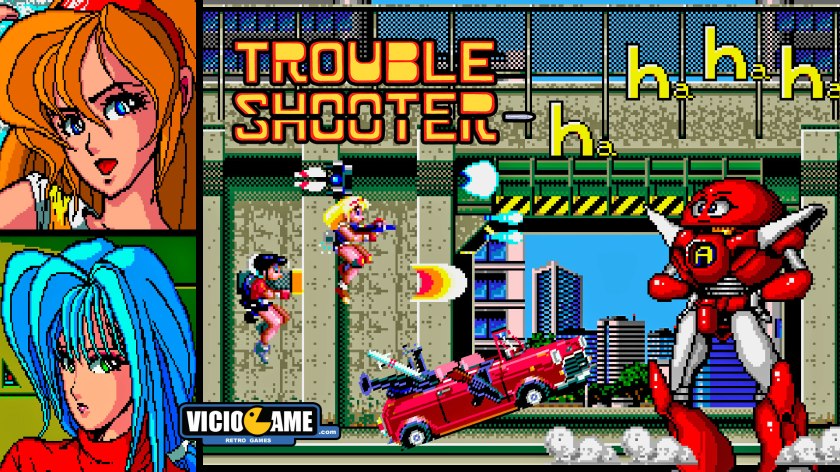
Trouble Shooter, known as Battle Mania in Japan, is a shoot ‘em up released in 1991 for the Sega Genesis. A pair of young heroines are called upon to rescue the prince, who has been kidnapped by a wicked and powerful villainess.
Developer/Publisher: VIC Tokai
Release date: 1991
Platform: Sega Genesis / Mega Drive
🇺🇸 Trouble Shooter hit the North American market four months before the Japanese version (under the name Battle Mania) — a curious reversal for a game originally conceived in Japan, with cultural roots deeply embedded in the world of anime and Japanese science fiction. Vic Tokai was a Japanese developer and distributor that operated primarily during the 1980s and 1990s, responsible for titles such as Decap Attack and Kid Kool, also for the Genesis. In the case of Trouble Shooter, the project was led by designer Fujito Takada, known by his nickname “Takayan” — who appears in the game’s own credits under the grandiose alias “Takayara the Barbarian in Studio Uchoo Tetsujin,” a personal tribute to the Japanese series Space Ironmen Kyodine (宇宙鉄人キョーダイン) that makes plainly evident the kind of cultural references that permeate the entire production.
The development history of Battle Mania is rich with internal struggles that nearly kept the game from ever existing. Takada faced strong resistance within Vic Tokai itself to get the project off the ground. In the early stages, the company showed little interest in the proposal, leaving him to work almost entirely on his own across every aspect of production: level design, programming, graphics, music, public relations, distribution logistics, and release scheduling. The concept behind the game grew out of a manga idea Takada had developed, originally set between 1995 and 1997, with plans to cover an even wider timespan. From that narrative seed, the designer built an arcade prototype that sat unused for years until he decided to adapt the material for the Mega Drive. Over time, more collaborators joined the project, and Takada shifted toward a more supervisory role, delegating much of the hands-on work to the team that had grown around him — though he maintained creative control across multiple fronts. Development was completed in 1990, but the game sat on the shelf for about a year before finally reaching North American store shelves.
A Japanese prototype of the game, predating the North American release, reveals significant differences from the final version. The prototype’s title screen features a distinct typography closer to the Dirty Pair anime logo in vivid pink, and Crystal (called Maria in the Japanese version) appears with her hair down, making her look even more like Yuri, one of Dirty Pair‘s protagonists. Even more revealing is the fact that this prototype contains Sega’s own copyright notices — because at some point, Sega had intended to publish the game directly under the Battle Mania label, just as it had done with Decap Attack. The protagonists’ last names in the Japanese version — Ohtorii and Haneda — are direct references to geographic landmarks near Sega’s headquarters in Japan, chosen during this period of closer involvement between the two companies. For reasons that have never been fully explained, the publishing arrangement fell through, and Vic Tokai ended up releasing the game in the West on its own, under a different title and a different visual identity.
The most obvious and openly acknowledged influence on Trouble Shooter is the Dirty Pair franchise, a light novel series created by Haruka Takachiho in the 1980s and later adapted into anime. The series follows two intergalactic agents named Kei and Yuri, nicknamed the “Trouble Consultants” (an ironic label given that wherever they show up, chaos tends to follow in the wake of their missions). Takada and his team transposed that concept into a more contemporary setting, rechristening their heroines “Trouble Shooters” — a subtle but deliberate variation on the original franchise’s title. The visual resemblance between the two duos is explicit enough to leave no doubt: Madison (Mania in Japanese) mirrors Kei, the blonde and extroverted lead, while Crystal (Maria in Japanese) echoes Yuri, the dark-haired partner with the more measured temperament. For the North American release, the protagonists had their Japanese names replaced — a move that paradoxically stripped away an obvious Dirty Pair reference (the name Mania) while keeping virtually everything else that evoked the anime franchise.
Trouble Shooter‘s narrative is intentionally simple and peppered with humor, serving as scaffolding for the action rather than as genuine drama. Madison and Crystal are mercenaries hired by Colonel Patch, a military officer who shows visible shock upon discovering that the “Trouble Shooters” he summoned are two young women. The mission is to rescue Prince Eldon, the only son of King Frederick and heir to the throne of the Republic of Majestic, who has been kidnapped by the villain Blackball — described as a mutant military genius specializing in weaponry. Blackball’s motivations are never explained by the game, which is entirely intentional as part of the humor: the plot exists to move the heroines from stage to stage without taking itself seriously for a single moment. The game breaks the fourth wall on several occasions, most notably in the scene where Blackball has Prince Eldon tied to a spinning wheel while throwing knives at him; when Madison and Crystal radio in that they’re doing everything they can to rescue him, the prince’s response is simply “Amazing!” — exactly the reaction you’d expect from a character who exists more as comic relief than as a dramatic driving force.
Trouble Shooter plays as a horizontal scrolling shooter, with some vertical-scrolling sequences, structured across six stages. Each stage is preceded by a special weapon selection screen, where Crystal appears to walk the player through the available options before heading into battle. The Sega Genesis controller is used elegantly and efficiently: one button fires Madison’s default shot, another commands Crystal to reverse her firing position, and the third triggers the selected special weapon. The simplicity of the controls contrasts favorably with the depth that the duo system introduces.
The central and most innovative mechanic of Trouble Shooter is precisely this functional duo operating within a single-player game. The player directly controls Madison, while Crystal automatically follows her movements, positioning herself behind her and firing in sync with her partner. Crystal is completely invulnerable to enemy fire — which means the player’s attention needs to focus exclusively on keeping Madison safe. With the press of a button, Crystal rotates 180 degrees and begins firing in the opposite direction from her default position — a crucial mechanic for dealing with enemies that come from behind, which happens frequently throughout the stages. Crystal also adjusts her firing angle vertically in response to Madison’s movements, allowing more skilled players to concentrate double the firepower on smaller targets. There were no clear precedents for this dual-control dynamic in a shooter of the genre, which made Battle Mania a remarkably singular experience by 1991 standards.
At certain points in the narrative, the duo dynamic shifts. After Prince Eldon is rescued, he temporarily joins the group as a third character controlled automatically, but with movement inverse to the duo’s — when Madison and Crystal advance, he retreats, and vice versa, creating a sandwich formation that forces the player to quickly adapt their dodging patterns. This mechanical variation is closely tied to the story’s progression and works as a narrative reward while simultaneously introducing a new challenge.
Trouble Shooter‘s special weapon system differs from the standard found in most shoot ‘em ups of the era. Instead of single-use items or a limited stock of individually counted bombs, each special weapon is governed by an energy meter visible at the top of the screen that continuously recharges after each use. The game includes a penalty for the impatient player: trying to trigger the special weapon before the meter is fully charged resets the charge back to zero — a mechanic that humorously mirrors Madison’s impulsive temperament within the game’s own logic. Since the meter recharges quickly, players rarely need to hold back the urge to fire, but the penalty exists as a moderating factor. The special weapons vary in type — including area-of-effect projectiles, explosives with different dispersal patterns, and directional attack options — and the player chooses a different one at the start of each stage, encouraging exploration of tactical combinations.
Beyond the special weapons, the playfield distributes four categories of collectible power-ups: speed-ups (which increase Madison’s movement speed), life-ups (which restore hit points), firepower upgrades (which boost the standard shot), and — unusually for the genre — speed-downs, which reduce movement speed. This last type, when collected involuntarily in the heat of combat, can compromise control responsiveness at critical moments, adding a layer of risk to the simple act of picking up items. Trouble Shooter operates on a hit point system for Madison rather than the counted-lives setup typical of shooters of the era: the protagonist can absorb several hits before going down, and life-up icons expand that hit point pool. The game offers no extra lives, but provides three continues that restart the player at the beginning of the current stage — making careful health management throughout the early stages essential to completing the adventure.
The environments traversed across the six stages mix contemporary urban settings, industrial facilities, and military complexes. The first stage takes place in a city, with Madison and Crystal flying over streets and buildings while facing waves of robots and mechanized soldiers. The second stage features a massive factory explored through vertical scrolling, with enormous circular saws swinging across the entire length of the level — a considerable difficulty spike over the opening stage that can catch inattentive players off guard. The subsequent stages push deeper into Blackball’s facilities, with more elaborate environments and an increasing frequency of environmental hazards that complement the enemy waves.
Trouble Shooter‘s enemy and boss design is absurd and comedic, in perfect keeping with the narrative’s overall tone. One of the first stage’s mid-bosses bursts up through the asphalt blowing kisses at the heroines; another stage features a mid-boss who conducts the entire battle while pedaling a stationary bike. The main bosses follow the same irreverent spirit: the first stage boss arrogantly laughs during the opening phase of his attack, dealing no damage whatsoever to Madison or Crystal — explicit visual comedy underscored by the text “Ha. Ha. Ha.” appearing in large letters on screen. The second stage boss fires what initially appears to be pink homing lasers, but which turn out to be fake walls that merely restrict maneuvering space without dealing any real damage. One of the bosses has been identified by fans as a visual reference to Dr. Zero from the Golden Bat anime, with his dark suit appearance, pointed ears, and personal spacecraft — another layer of Japanese cultural references the developers wove throughout the game.
The sixth and final stage features a narrative twist that translates directly into a mechanical limitation: after Prince Eldon’s rescue and during the ensuing celebration ceremony, Blackball crashes the party. Crystal had left the area before the attack, and Colonel Patch has only a single blaster available for Madison. The protagonist must then face the final stage entirely on her own, without her partner — which represents a genuine difficulty increase and a narrative thoughtfulness rare in games of the genre. The final confrontation against Blackball herself unfolds across multiple phases: the player first faces a cybernetic clone of Madison, and it is only at the conclusion of that duel that Crystal returns just in time to help finish off the villain, delivering a resolution that is satisfying both narratively and mechanically. The game’s ending presents Madison leading a celebratory dance of sorts alongside NPCs as the credits begin to roll — until Blackball interrupts the scene one more time, landing one last fourth-wall joke before the definitive fade out.
The soundtrack composed by Hiroto Kanno deserves special attention. It masterfully balances urgent, high-energy tracks — perfect for the frantic firefights — with more lightly comedic themes that reinforce the narrative’s easygoing tone. The musical variety is considerable for a game of the period: there are distinct compositions for the animated intro, the title screen, the options and continue menu, the weapon selection screen, each individual stage (with some themes strategically shared between different stages, such as the theme used for stages 3 and 6), boss battles at different points in the game, and the victory fanfares after each encounter. The soundscape drawn from the Mega Drive‘s FM chip features punchy percussion and synth lines that have become unforgettable to fans of the series, and the brief jingles that accompany events like enemy defeats and stage transitions add personality to the overall audio package.
The differences between the North American version Trouble Shooter and the Japanese version Battle Mania go well beyond the titles and the protagonists’ names. In the Japanese version, the special weapon sprites on the selection screen were redesigned to show the weapons viewed from behind rather than in profile, though these new sprites are then used during actual gameplay as well — a visually odd choice for a side-scrolling game, but one that reveals the care the team invested in refining the domestic edition. Several secondary characters were redesigned and given more elaborate animations, correcting elements that in the Western version appeared unfinished, particularly in the ending sequences. Sega references present in the intermission screens of the American version were removed from the Japanese edition, erasing the traces of the original publishing arrangement that never came to fruition.
The box art also differs radically between versions. The North American cover received a pulp fiction and Western action-style illustration that barely communicates the game’s anime character — an editorial choice that critic Ken Horowitz, from the site Sega-16, speculated contributed to the title flying under the radar for many buyers in the US. The Japanese cover, by contrast, features the heroines in the visual style characteristic of light novels and anime, much more faithful to the original inspiration. This dichotomy between the two markets’ visual identities is emblematic of the differences in how Japanese publishers of the era approached adapting their titles for Western audiences.
The most famous easter egg in Battle Mania is accessible through a specific button combination on the Japanese version’s title screen: the sequence triggers an animation of Madison stomping on a Super Famicom. Takada admitted he inserted that scene out of frustration with the larger budgets that Super Famicom-focused development teams received within Vic Tokai itself, compared to the teams dedicated to the Mega Drive. After the game’s release, Sega sent a fax to its development teams asking that they avoid any content that could defame the characters or trademarks of other companies; Takada speculated that he managed to escape the controversy because Sega held little affection for Nintendo at the time. That same button code works in both versions of the game to unlock additional content, and the Japanese version displays the code in the credits as a reward to players who completed the adventure.
One aspect of the development that could have completely changed the game’s visual identity involves the origin of the character who presents the special weapons to the player. In the initial design, that role was not meant to be filled by Crystal/Maria, but by a male character named Fugu, accompanied by a one-eyed cat with wheels in place of its hind legs and mechanical claws in place of its front ones. Fugu was based on a character of the same name from the manga Trouble is My Business. However, Sega’s quality control team reacted very negatively to the character during the approval process, leading to his removal from the project — a decision Takada has publicly stated he regrets. The result was Fugu’s replacement by Crystal/Maria herself, integrating the weapon system presentation into the established dynamic between the two heroines.
Other creative influences cited by Takada in interviews include the light novel series The Gaming Magi, 1980s singer and idol Noriko Sakai, and geographic locations near Sega’s headquarters in Japan (from which the protagonists’ last names in the original version are derived). This heterogeneous mix of 1980s Japanese cultural references — anime, tokusatsu, pop idol music, manga — gives Trouble Shooter a specific cultural texture that sets it apart from the many more generic shooters in the platform’s catalog.
In terms of critical reception, Trouble Shooter earned mostly positive reviews, though without the enthusiasm of a sales phenomenon. GamePro, in its January 1992 issue, welcomed the title with praise for its humorous story, anime-style graphics, sound design, and dynamic gameplay. The British magazine Sega Power awarded it an 86%, while the French Joystick reached 90% and the Italian Game Power gave it 85%. The German Aktueller Software Markt gave it an 8 out of 12, and the French Joypad rated it 78%. In Japan, a reader survey published by Mega Drive Fan resulted in a score of 22.92 out of 30; a 1995 survey conducted by the Japanese Sega Saturn Magazine placed Battle Mania 94th among all titles released for the Mega Drive — a respectable result given the breadth of the platform’s catalog. Famitsu gave it a 22 out of 40, and the French Consoles+ landed at 50%, indicating a mixed reception across different European markets. The American publication Mega Play highlighted the originality of female protagonists in a shooter of the genre, also praising the variety of power-ups, the bosses, and the soundtrack. The site Sega-16 expressed reservations about the game’s relatively low difficulty, but acknowledged its appeal to fans of the genre.
Vic Tokai promoted the title in the US with a campaign called the “Getting Into Trouble Contest,” in partnership with GamePro: seven copies of Trouble Shooter were distributed with special cards hidden inside the packaging — five featuring Crystal’s image, each awarding the winner with a Sega Game Gear, and two featuring Madison’s image, whose holders would receive a Game Gear and the opportunity to appear on the GamePro TV program. There was also a mail-in participation option, requiring contestants to answer a question about the game’s story and mail their response to Vic Tokai’s then-headquarters in Torrance, California.
Trouble Shooter‘s modest success with the public convinced Vic Tokai’s management to greenlight a sequel. Initially reluctant, the company was persuaded by market research data indicating the title’s popularity. Takada, however, had discarded the first game’s design documents — and was forced to reconstruct from memory the foundations of what would become Battle Mania Daiginjō (バトルマニア 大吟醸), released on December 24, 1993 exclusively in Japan and South Korea. The term “daiginjō” refers to the most refined category of Japanese sake, and the choice of subtitle functions as a symbolic promise of superior quality. The sequel substantially expands the original formula: nine stages instead of six, with both horizontal and vertical scrolling, a richer weapon system, more elaborate visual design with larger sprites and more detailed backgrounds, and a soundtrack widely cited as one of the finest ever produced for the Mega Drive in terms of FM chip usage. The narrative involves a cult that resurrects Blackball, who then plans to transfer Mania’s mind into the central processor of a war tank. Battle Mania Daiginjō is today considered one of the rarest and most expensive titles on the Mega Drive, owing to its limited production run and the fact that it never received distribution outside Asia. Takada even proposed a third title, Battle Mania 3 NY: Gankutsujou, conceived for the Sega Dreamcast, but the project was canceled before completion, as the team was unable to find a publisher willing to finance it.
The cultural significance of heroines Madison and Crystal — Mania Ohtorii and Maria Haneda in their Japanese given names — extends beyond the franchise’s two main games. Both appear in Segagaga, a simulation RPG released in 2001 for the Sega Dreamcast exclusively in Japan, as part of the final confrontation against the Dogma Corporation — an inclusion that functions as Sega’s tribute to the history of its console, bringing together iconic Mega Drive characters in a symbolic battle for the platform’s legacy. This cements Trouble Shooter‘s protagonists as figures sufficiently recognized within Sega’s internal culture to merit an appearance in one of the company’s most self-referential titles.
Decades after its release, the game is celebrated as one of the platform’s most distinctive titles — the product of a passionate team that knew how to turn corporate resistance and a limited budget into a vibrant, comedic, and technically competent adventure. Its place in Mega Drive history is secured not as the hardest, the most technically demanding, or the most visually impressive shooter on the console, but as one of the most charismatic: a game that knew exactly what it wanted to be, that refused to take itself seriously without ever compromising on careful game design, and that delivered to the player something the Mega Drive catalog — packed with spaceships and suit-clad warriors — rarely offered: two girls with jetpacks, laser pistols, a razor-sharp sense of humor, and absolutely no intention of failing the mission.
🇧🇷 Trouble Shooter chegou ao mercado norte-americana quatro meses antes da versão japonesa (com o nome de Battle Mania) — uma inversão curiosa para um jogo originalmente concebido no Japão, com raízes culturais profundamente arraigadas no universo do anime e da ficção científica nipônica. A Vic Tokai era uma desenvolvedora e distribuidora japonesa que operou principalmente durante as décadas de 1980 e 1990, responsável por títulos como Decap Attack e Kid Kool, também para o Genesis. No caso de Trouble Shooter, o projeto foi encabeçado pelo designer Fujito Takada, conhecido pela alcunha “Takayan” — que aparece nos créditos do próprio jogo com o nome pomposo de “Takayara the Barbarian in Studio Uchoo Tetsujin”, uma homenagem pessoal à série japonesa Space Ironmen Kyodine (宇宙鉄人キョーダイン) que deixa evidente o tipo de referências culturais que permeiam toda a produção.
A história do desenvolvimento de Battle Mania é rica em peripécias internas que quase impediram o jogo de existir. Takada enfrentou forte resistência dentro da própria Vic Tokai para colocar o projeto em pé. Nas fases iniciais, a empresa demonstrava pouco interesse na proposta, deixando-o trabalhar praticamente sozinho em todos os aspectos da produção: design de fases, programação, gráficos, música, relações públicas, logística comercial e cronograma de lançamento. O conceito por trás do jogo nasceu de uma ideia para um mangá que Takada havia desenvolvido, originalmente ambientado entre os anos de 1995 e 1997, com planos de cobrir uma janela temporal ainda maior. A partir dessa semente narrativa, o designer construiu um protótipo de arcade que ficou sem uso por anos, até que decidiu adaptar o material para o Mega Drive. Com o tempo, mais colaboradores se juntaram ao projeto, e Takada passou a exercer um papel mais supervisório, delegando boa parte da execução prática à equipe que cresceu ao redor dele — embora tenha mantido controle criativo sobre múltiplas frentes. O desenvolvimento foi concluído em 1990, mas o jogo permaneceu engavetado por cerca de um ano até chegar às prateleiras norte-americanas.
Existe um protótipo japonês do jogo, datado anteriormente ao lançamento norte-americano, que revela diferenças significativas em relação à versão final. A tela de título do protótipo apresenta uma tipografia distinta, mais próxima ao logotipo do anime Dirty Pair em rosa vibrante, e Crystal (chamada Maria na versão japonesa) aparece com o cabelo solto, tornando-a ainda mais semelhante a Yuri, uma das protagonistas de Dirty Pair. Mais revelador ainda é o fato de que esse protótipo contém textos de copyright da própria Sega — pois em determinado momento, a Sega pretendia publicar o jogo diretamente sob o rótulo Battle Mania, assim como fez com Decap Attack. Os sobrenomes das protagonistas na versão japonesa — Ohtorii e Haneda — são referências diretas a pontos geográficos próximos à sede da Sega no Japão, escolhidos durante esse período de envolvimento mais estreito entre as empresas. Por razões que nunca foram totalmente esclarecidas, o arranjo de publicação não se concretizou, e a Vic Tokai acabou lançando o jogo por conta própria no ocidente, com outro título e outra identidade visual.
A influência mais evidente e declarada sobre Trouble Shooter é a franquia Dirty Pair, série de light novels criada por Haruka Takachiho nos anos 1980 e posteriormente adaptada para anime. A série segue duas agentes intergalácticas chamadas Kei e Yuri, alcunhadas de “Trouble Consultants” (uma ironia ao fato de que onde elas aparecem, o caos costuma se instalar como consequência de suas missões). Takada e sua equipe transpuseram esse conceito para um cenário mais próximo do contemporâneo, rebatizando suas heroínas de “Trouble Shooters” — uma variação sutil mas deliberada do título original da franquia. A semelhança visual entre os dois duos é suficientemente explícita para não deixar dúvidas: Madison (Mania em japonês) espelha Kei, a protagonista loira e extrovertida, enquanto Crystal (Maria em japonês) ecoa Yuri, a parceira de cabelos escuros e temperamento mais controlado. Para o lançamento norte-americano, as protagonistas tiveram seus nomes japoneses substituídos — um movimento que, paradoxalmente, removeu uma referência óbvia ao Dirty Pair (o nome Mania) enquanto mantinha praticamente tudo o mais que lembrava a franquia de anime.
A narrativa de Trouble Shooter é intencionalmente simples e pontuada de humor, funcionando como suporte para a ação mais do que como drama genuíno. Madison e Crystal são mercenárias contratadas por Colonel Patch, um oficial militar que demonstra visível espanto ao descobrir que as “Trouble Shooters” convocadas são duas jovens. A missão é resgatar Prince Eldon, filho único do Rei Frederick e herdeiro ao trono da República Majestic, sequestrado pela vilã Blackball — descrita como uma gênia militar mutante especializada em armamentos. As motivações de Blackball jamais são esclarecidas pelo jogo, o que é parte intencional do humor: a trama existe para movimentar as heroínas de fase em fase sem se levar a sério em nenhum momento. O jogo quebra a quarta parede em diversas oportunidades, com destaque para a cena em que Blackball mantém Prince Eldon amarrado a uma roda giratória enquanto arremessa facas nele; quando Madison e Crystal comunicam que estão fazendo todo o possível para resgatá-lo, a resposta do príncipe é simplesmente “Incrível!” — exatamente a reação que o jogador espera de um personagem que existe mais como alívio cômico do que como motor dramático.
A jogabilidade de Trouble Shooter classifica-se como um scrolling shooter horizontal, com algumas sequências de scroll vertical, estruturado em seis fases. Cada uma é precedida por uma tela de seleção de arma especial, onde Crystal aparece para apresentar ao jogador as opções disponíveis antes de partir para o combate. O controle do Sega Genesis é utilizado de forma elegante e eficiente: um botão aciona o disparo padrão de Madison, outro comanda Crystal para inverter sua posição de tiro, e o terceiro aciona a arma especial selecionada. A simplicidade dos controles contrasta positivamente com a profundidade que o sistema de dupla introduz.
A mecânica central e mais inovadora de Trouble Shooter é precisamente essa dupla funcional que opera em um jogo single player. O jogador controla diretamente Madison, enquanto Crystal segue automaticamente seus movimentos, posicionando-se atrás dela e disparando em sincronia com a parceira. Crystal é completamente invulnerável ao fogo inimigo — o que significa que a atenção do jogador precisa se concentrar exclusivamente na segurança de Madison. Com o pressionamento de um botão, Crystal rotaciona 180 graus, passando a atirar na direção contrária ao movimento padrão — mecanismo fundamental para enfrentar inimigos que surgem por trás, o que acontece com frequência ao longo das fases. Crystal também ajusta o ângulo de seu disparo verticalmente conforme os movimentos de Madison, permitindo que jogadores mais habilidosos concentrem o dobro da potência de fogo em alvos menores. Não havia precedentes claros para essa dinâmica de controle duplo em um shooter do gênero, o que fez de Battle Mania uma experiência notavelmente singular para os padrões de 1991.
Em determinados momentos da narrativa, a dinâmica do duo se altera. Após o resgate de Prince Eldon, ele se junta temporariamente ao grupo como um terceiro personagem controlado automaticamente, mas com movimento inverso ao da dupla — quando Madison e Crystal avançam, ele recua, e vice-versa, gerando uma formação de sanduíche que exige do jogador adaptação rápida aos padrões de esquiva. Essa variação na mecânica está intimamente ligada à progressão da história e funciona como recompensa narrativa ao mesmo tempo em que introduz um desafio novo.
O sistema de armas especiais de Trouble Shooter difere do padrão da maioria dos shoot ‘em ups da época. Em vez de itens de uso único ou um estoque limitado de bombas contadas individualmente, cada arma especial é regida por um medidor de energia visível no topo da tela, que se recarrega continuamente após cada uso. O jogo inclui uma penalidade para o jogador impaciente: tentar acionar a arma especial antes que o medidor esteja completamente carregado reinicia o carregamento do zero — uma mecânica que reflete de forma bem-humorada o temperamento impulsivo de Madison dentro da própria lógica do jogo. Como o medidor se recarrega rapidamente, o jogador raramente precisa segurar a vontade de disparar, mas a penalidade existe como fator de moderação. As armas especiais variam em tipo — incluindo projéteis de área, explosivos com diferentes padrões de dispersão e opções de ataque direcional — e o jogador escolhe uma diferente no início de cada fase, incentivando a exploração de combinações táticas.
Além das armas especiais, o campo de jogo distribui quatro categorias de power-ups coletáveis: speed-ups (que aumentam a velocidade de deslocamento de Madison), life-ups (que repõem pontos de vida), upgrades de firepower (que potencializam o disparo padrão) e — de forma incomum para o gênero — speed-downs, que reduzem a velocidade de movimento. Esse último tipo, quando coletado involuntariamente durante o calor do combate, pode comprometer a responsividade do controle em momentos críticos, adicionando uma camada de risco ao ato simples de coletar itens. Trouble Shooter opera com um sistema de hit points para Madison em vez das vidas contadas típicas dos shooters da época: a protagonista pode absorver vários acertos antes de ser derrotada, e os ícones de life-up ampliam esse reservatório de pontos de vida. O jogo não oferece vidas extras, mas disponibiliza três continues que reiniciam o jogador no início da fase em andamento — o que torna o gerenciamento cauteloso da saúde ao longo das fases iniciais essencial para completar a aventura.
Os cenários percorridos ao longo das seis fases combinam ambientes urbanos contemporâneos, instalações industriais e complexos militares. A primeira fasese passa em uma cidade, com Madison e Crystal voando sobre ruas e construções enquanto enfrentam ondas de robôs e soldados mecanizados. A segunda faseapresenta uma fábrica colossal percorrida em scroll vertical, com serras circulares enormes sendo balançadas ao longo de toda a extensão da fase — um salto considerável de dificuldade em relação à fase de abertura que pode surpreender jogadores desatentos. As fases subsequentes aprofundam a incursão nas instalações de Blackball, com ambientes mais elaborados e uma frequência crescente de obstáculos ambientais que complementam os inimigos.
O design de inimigos e bosses de Trouble Shooter é absurdo e cômico, em perfeita consonância com o tom geral da narrativa. Um dos mini-bosses da primeira fase emerge do asfalto soprando beijos em direção às heroínas; outra fase apresenta um mini-boss que conduz uma batalha enquanto pedala uma bicicleta ergométrica. Os bosses principais seguem o mesmo espírito de irreverência: o boss da primeira fase ri de forma arrogante na fase inicial do seu ataque, sem causar dano algum a Madison ou Crystal — humor visual explícito marcado pela aparição do texto “Ha. Ha. Ha.” em letras grandes na tela. O boss da segunda fase dispara o que inicialmente parece ser lasers rosas de rastreamento, mas que na verdade são paredes falsas que apenas restringem o espaço de manobra sem causar dano real. Um dos bosses foi identificado pelos fãs como uma referência visual ao Dr. Zero do anime Golden Bat, com sua aparência de terno escuro, orelhas pontudas e nave pessoal — mais uma camada das referências culturais japonesas que os desenvolvedores teceram ao longo do jogo.
O sexta e última fase conta com uma twist narrativa que se traduz diretamente em limitação mecânica: após o resgate de Prince Eldon e durante a cerimônia de comemoração que se segue, Blackball interrompe a festa abruptamente. Crystal havia se retirado da área antes do ataque, e Colonel Patch só tem um único blaster disponível para Madison. A protagonista então precisa enfrentar a fase final completamente sozinha, sem a parceira — o que representa um aumento real de dificuldade e um cuidado narrativo raro em jogos do gênero. O combate final contra a própria Blackball se desdobra em múltiplas fases: o jogador enfrenta primeiro um clone cibernético de Madison, e é apenas na conclusão desse duelo que Crystal retorna a tempo para ajudar a finalizar o confronto com a vilã, numa resolução satisfatória tanto do ponto de vista narrativo quanto mecânico. O encerramento do jogo apresenta Madison liderando uma espécie de dança comemorativa junto a NPCs enquanto os créditos começam a rolar — até que Blackball interrompe a cena mais uma vez, numa última piada com a quarta parede antes do fade out definitivo.
A trilha sonora composta por Hiroto Kanno merece atenção especial. Ela equilibra com maestria faixas urgentes e energéticas — perfeitas para os tiroteios frenéticos — com temas mais levemente cômicos que reforçam o tom descontraído da narrativa. A variedade musical é considerável para um jogo do período: há composições distintas para a abertura animada, para a tela de título, para o menu de opções e continue, para a seleção de armas, para cada fase (com alguns temas compartilhados estrategicamente entre fases distintas, como o tema das fases 3 e 6), para as batalhas de boss em diferentes momentos do jogo, e para as fanfarras de vitória após cada encontro. A sonoridade aproveitada pelo chip FM do Mega Drive apresenta percussões marcantes e linhas de sintetizador que se tornaram insquecíveis para os fãs da série, e as breves jingles que acompanham eventos como a derrota de um inimigo e a transição entre fases adicionam personalidade ao pacote sonoro.
As diferenças entre a versão norte-americana Trouble Shooter e a versão japonesa Battle Mania vão além dos títulos e dos nomes das protagonistas. Na versão japonesa, os sprites das armas especiais na tela de seleção foram redesenhados para exibir as armas vistas de trás em vez de de perfil, embora esses novos sprites sejam então utilizados também durante o gameplay efetivo — uma escolha visualmente estranha para um jogo de scroll lateral, mas que revela o cuidado que a equipe dedicou ao refinamento da edição doméstica. Alguns personagens secundários foram redesenhados e animados de forma mais elaborada, corrigindo elementos que na versão ocidental pareciam inconclusos, particularmente nas sequências de encerramento. As referências à Sega presentes nas telas de intermissão da versão americana foram removidas na edição japonesa, apagando os vestígios do acordo original de publicação que não se materializou.
A arte da caixa também difere radicalmente entre as versões. A capa norte-americana recebeu uma ilustração de estilo pulp fiction e ação ocidental que praticamente não comunica o caráter anime do jogo — uma escolha editorial que o crítico Ken Horowitz, do site Sega-16, especulou ter contribuído para que o título passasse despercebido por muitos compradores nos EUA. A capa japonesa, por contraste, apresenta as heroínas no estilo visual característico de light novel e anime, muito mais fiel à inspiração original. Essa dicotomia entre a identidade visual dos dois mercados é emblemática das diferenças na forma como publicadoras japonesas da época abordavam a adaptação dos seus títulos para o público ocidental.
O easter egg mais famoso de Battle Mania é acessível através de uma combinação específica de botões na tela de título da versão japonesa: a sequência exibe uma animação de Madison pisando em cima de um Super Famicom. Takada admitiu que inseriu essa cena por estar frustrado com os orçamentos maiores que as equipes de desenvolvimento voltadas ao Super Famicom recebiam dentro da própria Vic Tokai, em comparação com as equipes dedicadas ao Mega Drive. Após o lançamento, a Sega enviou um fax às suas equipes de desenvolvimento pedindo que se evitasse qualquer conteúdo que pudesse difamar personagens ou marcas registradas de outras empresas; Takada especulou que conseguiu se safar da polêmica porque a Sega não nutria grande simpatia pela Nintendo naquele período. Esse mesmo código de botões funciona em ambas as versões do jogo para desbloquear conteúdo adicional, e a versão japonesa exibe o código nos créditos como recompensa ao jogador que completou a aventura.
Um aspecto do desenvolvimento que poderia ter mudado completamente a identidade visual do jogo envolve a origem do personagem que apresenta as armas especiais ao jogador. No design inicial, esse papel não seria desempenhado por Crystal/Maria, mas por um personagem masculino chamado Fugu, acompanhado por um gato de um olho só com rodas no lugar das patas traseiras e tenaças mecânicas no lugar das dianteiras. Fugu era baseado em um personagem homônimo do mangá Trouble is My Business. No entanto, a equipe de controle de qualidade da Sega reagiu de forma muito negativa ao personagem durante o processo de aprovação, levando à sua exclusão do projeto — uma decisão que Takada afirmou publicamente lamentar. O resultado foi a substituição de Fugu pela própria Crystal/Maria, integrando a apresentação do sistema de armas à dinâmica estabelecida entre as duas heroínas.
Outras influências criativas citadas por Takada em entrevistas incluem a série de light novels The Gaming Magi, a cantora e ídolo dos anos 1980 Noriko Sakai, e localizações geográficas próximas à sede da Sega no Japão (de onde derivam os sobrenomes das protagonistas na versão original). Essa mistura heterogênea de referências culturais nipônicas dos anos 1980 — anime, tokusatsu, música pop idol, mangá — confere a Trouble Shooter uma textura cultural específica que o diferencia dos muitos shooters mais genéricos do catálogo da plataforma.
Em termos de recepção crítica, Trouble Shooter obteve avaliações majoritariamente positivas, ainda que sem o entusiasmo de um fenômeno de vendas. A publicação GamePro, na edição de janeiro de 1992, recebeu o título com elogios à história humorística, aos gráficos de estilo anime, ao design sonoro e à jogabilidade dinâmica. A revista britânica Sega Power concedeu uma pontuação de 86%, enquanto a francesa Joystick chegou a 90% e a italiana Game Power a 85%. A alemã Aktueller Software Markt deu 8 em 12, e a francesa Joypad avaliou em 78%. No Japão, uma pesquisa de leitores publicada pelo Mega Drive Fan resultou em 22.92 de 30; um pesquisa de 1995 conduzido pela Sega Saturn Magazine japonesa posicionou Battle Mania na 94ª posição entre todos os títulos lançados para o Mega Drive — um resultado respeitável considerando a extensão do catálogo da plataforma. A Famitsu deu 22 em 40, e a Consoles+ francesa ficou nos 50%, indicando uma recepção heterogênea entre os diferentes mercados europeus. A Mega Play americana destacou a originalidade de protagonistas femininas em um shooter do gênero, elogiando também a variedade de power-ups, os bosses e a trilha sonora. O site Sega-16 expressou ressalvas quanto à dificuldade relativamente baixa do jogo, mas reconheceu seu apelo para fãs do gênero.
A Vic Tokai promoveu o título nos EUA com uma campanha chamada “Getting Into Trouble Contest”, em parceria com a publicação GamePro: sete cópias de Trouble Shooter foram distribuídas com cards especiais escondidos dentro das embalagens — cinco com a imagem de Crystal, cada um premiando o vencedor com um Sega Game Gear, e dois com a imagem de Madison, cujos detentores receberiam um Game Gear e a oportunidade de aparecer no programa GamePro TV. Havia ainda a possibilidade de participação por correspondência, respondendo a uma pergunta sobre a história do jogo e enviando a resposta à então sede da Vic Tokai em Torrance, na Califórnia.
O sucesso relativo de Trouble Shooter junto ao público convenceu a gestão da Vic Tokai a autorizar a produção de uma sequência. Inicialmente relutante, a empresa foi persuadida pelos dados de pesquisa de mercado que indicavam a popularidade do título. Takada, porém, havia descartado os documentos de design do primeiro jogo — e precisou reconstruir de memória os alicerces do que se tornaria Battle Mania Daiginjō (バトルマニア 大吟醸), lançado em 24 de dezembro de 1993 exclusivamente no Japão e na Coreia do Sul. O termo “daiginjō” denomina a mais refinada categoria de saquê japonês, e a escolha do subtítulo funciona como uma promessa simbólica de qualidade superior. A sequência expande substancialmente a fórmula original: são nove fases em vez de seis, com scroll tanto horizontal quanto vertical, um sistema de armas mais rico, design visual mais elaborado com sprites maiores e backgrounds mais detalhados, e uma trilha sonora amplamente citada como uma das melhores já produzidas para o Mega Drive em termos de uso do chip FM. A narrativa envolve um culto que ressuscita Blackball, que então planeja transferir a mente de Mania para o processador central de um tanque de guerra. Battle Mania Daiginjō é considerado hoje um dos títulos mais raros e caros do Mega Drive, em função de sua tiragem limitada e do fato de nunca ter recebido distribuição fora da Ásia. Takada ainda chegou a propor um terceiro título, intitulado Battle Mania 3 NY: Gankutsujou, concebido para o Sega Dreamcast, mas o projeto foi cancelado antes de finalizar, pois a equipe não conseguiu encontrar uma publicadora disposta a financiá-lo.
A importância cultural das heroínas Madison e Crystal — Mania Ohtorii e Maria Haneda em seu nome de batismo japonês — transcende os dois jogos principais da franquia. Ambas aparecem em Segagaga, um jogo de simulação e RPG lançado em 2001 para o Sega Dreamcast exclusivamente no Japão, como parte do confronto final contra a corporação Dogma — uma inclusão que funciona como homenagem da Sega à história do seu console, reunindo personagens icônicos do Mega Drive numa batalha simbólica pelo legado da plataforma. Isto solidifica as protagonistas de Trouble Shooter como figuras suficientemente reconhecidas dentro da cultura interna da Sega para merecer uma aparição num dos títulos mais metacinematográficos da empresa.
Décadas depois do seu lançamento, o jogo é celebrado como um dos títulos com maior personalidade da plataforma — um produto de equipe apaixonada que soube transformar resistência corporativa e orçamento restrito numa aventura vibrante, cômica e tecnicamente competente. Seu lugar na história do Mega Drive está garantido não como o mais difícil, o mais técnico ou o mais impressionante dos shooters do console, mas como um dos mais carismáticos: um jogo que sabia exatamente o que queria ser, que se recusou a se levar a sério sem por isso abrir mão de um game design cuidadoso, e que entregou ao jogador algo que o catálogo do Mega Drive — repleto de naves espaciais e guerreiros de terno — raramente oferecia: duas garotas com jetpacks, pistolas laser, senso de humor afiado e absolutamente nenhuma intenção de falhar na missão.
🤑💲Earn money without doing anything! Just leave these apps open:
✓ https://r.honeygain.me/CONTA9DB02
✓ https://packetstream.io/?psr=1uPb
🤑💲1-Click button earns Bitcoin every 1 hour: https://freebitco.in/?r=53528449
⬛ 𝗧𝗶𝗸𝗧𝗼𝗸: https://www.tiktok.com/@viciogame
🟧 𝗜𝗻𝘀𝘁𝗮𝗴𝗿𝗮𝗺: http://www.instagram.com/viciogame
🟥 𝗬𝗼𝘂𝘁𝘂𝗯𝗲: http://www.youtube.com/viciogame
🟦 𝗙𝗮𝗰𝗲𝗯𝗼𝗼𝗸: http://www.facebook.com/viciogame
🔳 𝗧𝗵𝗿𝗲𝗮𝗱𝘀: https://www.threads.net/@viciogame
🟪 𝗧𝘄𝗶𝘁𝗰𝗵: https://www.twitch.tv/ViciogameRetroGames
🟨 𝗕𝗹𝗼𝗴: http://www.viciogameblog.com/
🟦𝗧𝘄𝗶𝘁𝘁𝗲𝗿: http://www.twitter.com/viciogame
#Viciogame #Gameplay #LetsPlay #Playthrough #Games #Gaming #Videogames #Review #Game #Detonado #Walkthrough #Ending #Reviews #Facts #Retro #RetroGaming #Roms #Emulator #Longplay #Speedrun #NoCommentary #TroubleShooter #BattleMania #SegaGenesis #MegaDrive #Sega #Genesis #ShootEmUp #shooter #バトルマニア #VicTokai #DirtyPair #anime #manga #rtype #gradius #Segagaga #Daiginjou #メガドライブ #セガ
 VICIOGAME