
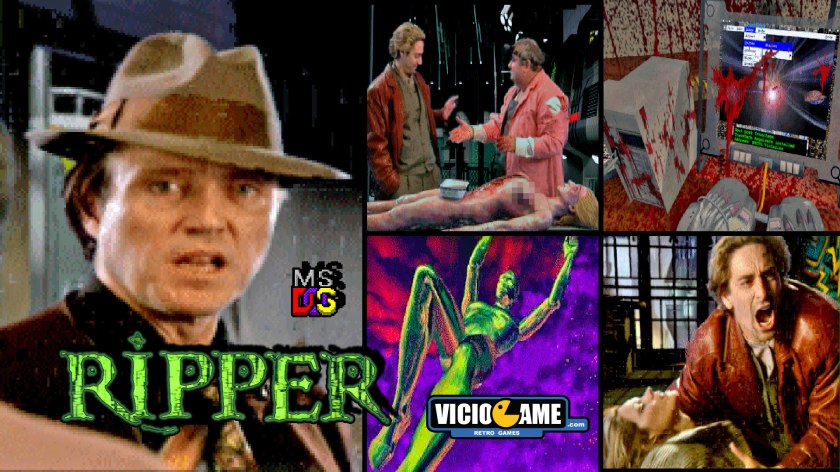
Ripper is a point-and-click adventure game released in 1995 for PC. Imagine the company behind GTA and Hollywood legend Christopher Walken joining forces in the same game! You step into the shoes of a crime reporter tasked with unraveling a string of murders inspired by Jack the Ripper.
Developer/Publisher: Take-Two Interactive
Release date: 1996
Platform: PC MS-DOS
🇺🇸 Ripper is one of those titles that could only have been born in the 1990s — a blend of outsized cinematic ambitions, emerging CD-ROM technology, science-fiction crime writing, and a roster of Hollywood actors whose names, gathered under a single game, still provoke astonishment in any enthusiast of the medium. Released on March 4, 1996, for MS-DOS and Macintosh by Take-Two Interactive — at the time still a young and aggressive studio, far removed from the giant it would become with franchises like Grand Theft Auto and Red Dead Redemption — Ripper represents the high-water mark of a trilogy of full-motion video (FMV) adventure games the company produced in the mid-decade: Hell: A Cyberpunk Thriller (1994), Ripper (1996), and Black Dahlia (1998). Of the three, Ripper is by far the most ambitious in terms of production, the most polarizing in terms of critical reception, and, decades later, the most remembered — above all for the delightful absurdity of watching Christopher Walken play a futuristic detective in a six-CD-ROM game.
The game spent approximately two years in development, with a budget of four million dollars — a considerable sum for the PC game market at the time. A significant portion of that budget, exactly 25%, was allocated exclusively to actor salaries. Take-Two hired cinematographer Phil Parmet to direct the filmed sequences, lending the video scenes a visual language closer to independent cinema than the amateur experiments that characterized most FMV titles of the period. The lead writers were F.J. Lennon — also the game’s chief designer —, John Antinori, and Dennis Johnson, who together crafted a complex, three-act script filled with subplots and interlocking motivations. Programming was handled by Greg Brown, visual design by James H. Dargie, and the soundtrack was composed by Michael Bross. The graphics engine was built from scratch and features a technical characteristic that was remarkable for its era: the ability to switch in real time between resolutions of 640×480 and 320×200, adapting to the available hardware without requiring a game restart.
Ripper‘s setting is New York City in the year 2040 — a metropolis saturated with neon, neural interface technology, and social inequality pushed to the extreme, inspired by the cyberpunk aesthetic popularized by authors like William Gibson and Philip K. Dick. In this near future, humanity has developed the ability to connect directly to cyberspace through brain implants and terminals called “decks,” plunging into virtual environments known as WELLs — a kind of network node, each with its own visual identity and digital architecture. It is within this universe that a serial killer begins committing crimes of disturbing refinement, with a modus operandi as meticulous as it is brutal: victims literally explode from the inside out, with no conventional external marks of physical violence. The press, equally fascinated and terrified, dubs the criminal “The Ripper” — a direct reference to Jack the Ripper, the unidentified killer who terrorized the Whitechapel neighborhood of London in the late nineteenth century.
The player takes on the role of Jake Quinlan, an investigative reporter for the Virtual Herald — an entirely digital newspaper, a narrative device the script uses to justify both Quinlan’s privileged access to crime scenes and the fact that the killer sends him messages directly after each murder. The story begins with the investigation into the murder of Renee Stein, the Ripper’s third victim, who worked as a book editor. Early in the first act, the player’s character comes face-to-face with Detective Vincent Magnotta, a violent, impulsive, and morally ambiguous cop leading the official investigation — who, in a move that serves as both dramatic bait and the game’s first puzzle, deliberately smashes a mug on the floor during the opening conversation with Quinlan. The broken mug must be scanned by the WAC, the protagonist’s portable device, and digitally reconstructed to reveal the word “Salisbury” etched on its surface — an apparently insignificant clue that gains weight as the plot develops.
The WAC — short for Wireless Access Console — is the mechanical heart of Ripper and the most versatile tool at the player’s disposal. It is a portable device that functions simultaneously as a phone, database, object scanner, and forensic analysis platform. Through it, Jake Quinlan scans evidence found at crime scenes, stores documents and images, reconstructs damaged items, runs software, and receives video transmissions from other characters — the so-called “WAC transmissions,” which function as narrative triggers activated when the player exhausts all available options at a given point in the story. The WAC also contains a built-in notepad where players can manually log their discoveries, though the game does not fill it in automatically — a design flaw widely criticized given the sheer volume of information the narrative requires players to memorize or jot down on their own. To run the WAC’s video transmissions correctly, the game must be updated to at least version 1.05 of the official patch; without this fix, the device’s videos suffer severe rendering glitches.
Ripper‘s gameplay mechanics unfold across three distinct and alternating phases. The first is classic point-and-click exploration: the player moves Quinlan through fixed environments — a crime scene, the Virtual Herald offices, the Tribeca hospital, apartments and clandestine labs scattered across 2040 New York — from a first-person perspective, positioning the cursor over objects to inspect, collect, or interact with them. The cursor system is deliberately restrictive: only one action is available for each element of the environment at a time, which eliminates the indiscriminate trial-and-error typical of the genre, but also removes much of the experimentation that defines the best graphic adventure games. The second phase consists of FMV interrogations: when approaching a character, Quinlan can select topics from a list, and the game plays a video clip corresponding to the filmed actor’s response — moving images overlaid onto pre-rendered static backgrounds, producing that characteristic effect of “talking heads floating in the environment” that defines so many games of its era. New conversation topics unlock as the player collects clues and advances the investigation, and many dialogues can only be watched once, making close attention an essential requirement — missing a line can leave the player without the information needed to progress.
The third phase is the most distinctive and, for many players, the most divisive: the cyberspace sequences. To access virtual space, the player uses computers available at certain locations — the newspaper office, locations that reveal themselves throughout the investigation — and is transported to the main cyberspace interface, a navigation screen where WELL-shaped icons float in digital space. Each WELL corresponds to a network node tied to a character or location in the plot, and accessing them requires a password — which might be written somewhere in the physical environment, revealed during a conversation, or, in the most frustrating cases, require a deduction that doesn’t always rest on conventional logic. WELL passwords represent some of Ripper‘s most controversial design moments — an unusual decision the developers themselves seem to have made with full awareness of the excessive difficulty in some passages.
Inside the WELLs, the player encounters two types of sequences. The first is the environmental puzzle — brainteasers ranging from electronic circuit assembly to enigmas based on numerical sequences, chess, or combinatorial logic, presented as “virtual security” systems protecting the sensitive information stored in each node. The second is first-person combat, structured as a rail shooter: the player moves automatically through computer-generated three-dimensional space while fighting enemy entities, in a style that vaguely recalls the on-rail arcade games of the era, such as Virtua Cop and Area 51. One of the most remarkable combat segments takes place in Joey Falconetti’s WELL, set in a space called “Circus Maximus” — a virtual reality environment with an industrial circus theme, with music that blends circus timbres with mechanical beats. The difficulty of the action sequences can be adjusted by the player, ensuring that even those without quick reflexes can advance through the story without getting stuck indefinitely in combat.
Ripper‘s main narrative gradually deepens into a conspiracy connecting all central characters to a shared past. Quinlan discovers that all of the Ripper’s victims — and everyone involved in the investigation, with the exception of the protagonist himself — are members of an online RPG group called Web Runners, who decades earlier participated in a gaming session set in the Jack the Ripper universe. During the group’s final game, something inexplicable happened: one of the players died in real life. That player was the mother of Catherine Powell — Quinlan’s girlfriend, whose story becomes increasingly central as the plot unfolds. Catherine, also a reporter for the Virtual Herald, had begun independently investigating the Ripper case without telling her boyfriend, hoping to break the story on her own. The Ripper discovers her investigation and attacks her — but unlike all the other victims, Catherine doesn’t die. She survives the assault but sinks into a deep coma with severe neurological damage.
Dr. Clare Burton, played by Karen Allen — eternally recognized as the fearless Marion Ravenwood in Indiana Jones and the Raiders of the Lost Ark — is the cybernetic neurosurgeon at Tribeca Center Hospital responsible for treating Catherine. Burton is a complex and technically brilliant character, but marked by a calculated coldness that fuels suspicions about her true motivations. She manages to recover a distorted image of Catherine’s attacker directly from the victim’s retina — a subtle nod to the Victorian theories that speculated a person’s final image remained imprinted on the retina after death — but needs additional information from Quinlan to refine the result. To transmit the data collected during the investigation directly into Catherine’s brain, Quinlan turns to Joey Falconetti, a brilliant, violent, and disturbed hacker who has mastered the art of interfacing technology directly with the human nervous system. Falconetti, portrayed with harrowing intensity by David Patrick Kelly, carries a volatile history with nearly every other character: he was arrested by Magnotta, divorced from Clare Burton, and is the target of the detective’s obsessive vendetta. It is in this web of personal grudges that the game builds its four suspects.
Ripper‘s most unusual narrative design mechanism is the fact that the killer’s identity is randomly determined and concealed at the very start of each playthrough, chosen by the game from four possible characters: Joey Falconetti, Clare Burton, Detective Vincent Magnotta, and Catherine Powell herself. While the game’s overall story structure remains virtually identical across all playthroughs, the third act — triggered by the death of pathologist Vic Farley, who is eliminated by the Ripper immediately after revealing the murder method to Quinlan — features alterations in certain clues, secondary puzzles, and a specific line of dialogue in the final ending, adjusted according to who the culprit turns out to be. The game plants evidence pointing to all four suspects regardless of who the Ripper turns out to be, which means contradictory clues coexist in the narrative without the game offering any resolution for the inconsistencies — Catherine Powell, for example, shows surges of brain activity that coincide with each murder even in playthroughs where she is not the culprit, and no alternative explanation is provided. The effect is that of a detective thriller that deliberately blunts the player’s ability to “solve” the case through pure deduction — the solution always carries an element of irreducible mystery.
Vic Farley, the pathologist who unravels the mechanism behind the crimes, is murdered at the exact moment he completes his explanation: the Ripper operates by inserting malicious code into the victim’s brain during a cyberspace session, forcing the body’s internal pressure to rise to a catastrophic breaking point — a biological explosion that destroys the organism from the inside out without leaving conventional external marks. It is a death the game uses both as a scientific climax and as an aesthetic affirmation of its cyberpunk premise: in the world of Ripper, the line between digital code and organic flesh has become permeable enough that a killer can commit murder with a computer program. After Farley’s death, Quinlan discovers the existence of Hamilton Wofford — a brilliant cyber-architect hired by the Ripper himself to build a faithful replica of London’s Whitechapel neighborhood in cyberspace. Hamilton was murdered by his employer before he could reveal their identity, but left behind an artificial intelligence that holds crucial information for the investigation, along with a digital weapon designed specifically to destroy the Ripper within the virtual environment. The role of Hamilton Wofford — as well as that of his brother Covington Wofford, a recluse who progressively lost touch with reality following his brother’s murder — is played by Burgess Meredith, the actor who for generations of older Americans is trainer Mickey from Rocky and, for fans of cult and camp television, the Penguin from the 1960s Batman series.
Burgess Meredith’s appearance in Ripper carries a melancholy weight that transcends the game itself: it was his final recorded professional performance, filmed just months before his death in September 1997. The veteran actor’s presence in the cast — then 88 years old — is not central to the plot, but his scenes as the digital ghost of Hamilton Wofford carry a quiet strangeness that contrasts with Walken’s intensity and Allen’s studied coolness. In the most emotionally dense scene involving the character, Covington — the brother who survived — appears clearly deteriorated, talking to himself in an isolated house, and Meredith’s performance moves between the serenity of old age and the fragments of a mind coming apart. Knowing it was the final work of his career lends the sequences a layer of meaning no screenwriter could have planned.
Ripper‘s complete cast is extraordinary for a 1996 video game. The protagonist Jake Quinlan is played by Scott Cohen, a television actor who would later gain greater visibility in series like Gilmore Girls, where he played Professor Max Medina. Ossie Davis — one of the most respected African-American actors of his generation, honored by decades of work in film and theater — plays Ben Dodds, the editor of the Virtual Herald. John Rhys-Davies, the British-Welsh actor immortalized as Sallah in Indiana Jones and the Raiders of the Lost Ark and later as Gimli in The Lord of the Rings trilogy, appears as Vigo Haman, a mobster who holds information about Clare Burton. Jimmie Walker, the comedian famous for his “Dy-no-mite!” catchphrase on the classic sitcom Good Times, plays Soap Beatty, a hacker who was one of Catherine Powell’s investigation sources. Tahnee Welch — daughter of icon Raquel Welch — plays Catherine Powell herself. And Paul Giamatti, who years later would cement a remarkable film career with Sideways, appears in a supporting role as Dr. Bud Cable, a doctor caring for Catherine at the hospital. For an MS-DOS game released in 1996, the density of talent assembled in Ripper is virtually unprecedented in the American game market.
The absolute standout, however, is Christopher Walken as Detective Vincent Magnotta — and his performance is a phenomenon that defies easy categorization. Walken, then at the peak of his reputation as one of Hollywood’s most intense and singular actors, delivers a Magnotta that oscillates between genuine menace and the involuntarily hilarious with a consistency only he could sustain. His lines — loaded with the syncopated rhythm, unpredictable pauses, and otherworldly intonation that became his trademark — sound simultaneously perfectly suited to the game’s noir cyberpunk tone and completely unnerving outside any realistic context. According to behind-the-scenes accounts, Walken and Karen Allen each had only a day and a half to record all of their material — an extremely compressed shooting schedule that explains why some of their interactions with the physical space feel slightly off. But what might be perceived as a limitation ends up functioning as an amplifier of strangeness: Magnotta is a cop from 2040, and he would be strange no matter what.
Ripper‘s soundtrack is dominated by a high-impact musical choice: “(Don’t Fear) The Reaper” by American rock band Blue Öyster Cult, written and performed by guitarist Donald “Buck Dharma” Roeser and originally released in 1976 as part of the album Agents of Fortune. The song — which by 2026 has accumulated decades of landmark cultural appearances, from John Carpenter’s Halloween to the “More Cowbell” sketch on Saturday Night Live (where, curiously, Christopher Walken also features prominently) — plays during the game’s opening sequence as the cast credits roll over images of 2040 New York. Its presence transforms the opening screen into something approaching a cinematic sequence: it is one of the first moments in gaming history where a licensed song from an established rock band was used with full awareness of its cultural weight as a statement of identity. But the most ingenious integration of music and gameplay comes at the game’s finale: the final puzzle granting access to the anti-Ripper weapon requires the player to insert a sequence of tarot cards in a specific order, and the key to that sequence is embedded in the song’s lyrics — “Seasons don’t fear the Reaper / Nor do the wind, the Sun and the Rain” — which begins playing at the exact moment the puzzle is presented. Any player who treats the music as mere thematic background will find themselves stuck indefinitely on the enigma.
Take-Two explicitly recommended running the game directly from the MS-DOS prompt rather than within a Windows 95 window, as the multitasking environment caused choppy audio and slowdowns. The CD-ROM drive had to be identified as the D drive to ensure proper recognition. All content was spread across six discs, and during a typical gaming session the player is prompted to swap CDs with considerable frequency — an experience that at the time of release was perceived as glamorous proof of the content’s generosity, and that decades later serves as a nostalgic reminder of the logistical challenges physical media imposed. The game’s physical package included an illustrated manual with a cyberpunk glossary and a step-by-step walkthrough of the prologue — an implicit acknowledgment by the developers that the game’s opening sequences would prove a stumbling block for many players.
Ripper‘s marketing was conducted with an aggressiveness that today sounds almost quaint in its arrogance. Promotional materials openly declared that the game was “Scarier than Phantasmagoria… gorier than The 11th Hour” — a direct comparison with two of the most talked-about FMV titles of the period: Roberta Williams’s horror adventure for Sierra On-Line and the sequel to the equally celebrated The 7th Guest, both from 1995. The claim positioned Ripper as a direct challenger to the genre’s reigning titles and was remembered for years by critics and players who agreed or fiercely disagreed with the premise. Take-Two announced shipments of 160,000 copies to retailers during launch week and described the release as “the biggest game we’ve ever made!” — figures that demonstrated the scale of the company’s bet on the project. By the end of October 1997, roughly eight months after launch, the title had sold more than 150,000 units and accounted for 28.7% of the company’s total revenue in the corresponding fiscal year, generating approximately $3.5 million dollars. CNET Gamecenter, however, noted that sales lost momentum quickly and that the title was pulled from retail shelves ahead of schedule.
Ripper‘s critical reception was essentially mixed, but with nuances that reveal how sharply the game divided opinions based on what each reviewer prioritized. On the GameRankings aggregator, the average settled at 71.5% based on four reviews. Next Generation magazine awarded three out of five stars and distilled its critique into a precise line: “One moment the game thinks it’s a graphic adventure; the next, it’s a movie; the next, it’s a puzzle. If any one of these aspects were polished, it could be a delight. As it stands, the game is mediocre in every category.” The review specifically called out the cartoonish excess of the characters and the fact that first-person sequences could not be skipped, forcing the player to watch the same animations repeatedly when revisiting already-explored locations. PC Gamer (US) gave it 72%, PC PowerPlay (UK) awarded 7 out of 10, and Computer Games Strategy Plus gave it 3.5 out of 5. Computer Game Review, however, was substantially more generous, with scores in the 92–93 range across different categories. Jeff Sengstack of NewMedia wrote that Ripper “meets, and even surpasses, its pre-release hype,” summarizing it as “an engrossing horror mystery with immense depth” — though he had specific reservations about the video compression and difficulty level. Most critics agreed that the story and cast were the game’s undisputed strong suits, while the puzzles inside the WELLs, the combat sequences, and technical performance issues undermined the overall experience.
One of the most widely criticized aspects at the time was the visual quality of the FMV footage. All video in the game suffers from heavy compression and a reduced frame rate — direct consequences of the need to compress more than three hours of audiovisual material across six CDs. Compression artifacts are visible in virtually every scene, and the contrast between the cinematic quality of the performances and the technical quality of the playback created a dissonance that bothered a significant portion of critics. In 1996, the video codecs available for the CD-ROM format were still far from delivering the fidelity needed for the volume of content Take-Two intended to include. The game’s proprietary engine, despite its ability to switch resolutions in real time, also showed evident limitations in the static backgrounds over which the actors’ images were overlaid, constantly creating the impression that the characters inhabit a different space from the surrounding scenery.
A technical curiosity of Ripper that took on a life of its own in the game’s fan culture is the easter egg triggered by a typo: if you attempt to launch the game from the MS-DOS prompt and type “RIPER” instead of “RIPPER” — one P short — rather than receiving an error message, you are greeted with a video of a rotting apple. The small detail reveals a playful creativity from the development team that contrasts with the seriousness of the main material. Another interesting detail is the existence of two versions of the game: a censored version that preserves all graphic violence but removes profanity from the dialogue, and an uncensored version with the full verbal content intact. Take-Two obtained an M (Mature) rating in the United States, while UK distributor GameTek UK received an 18+ rating from the BBFC — though, curiously, the British ELSPA assigned the more lenient rating of 15+.
The announced ports for Sega Saturn and PlayStation never reached the market. Information about these versions was published by Sega Saturn Magazine in May 1996, shortly after the MS-DOS release, but the projects were quietly canceled without Take-Two offering any public explanation. Speculation holds that the technical complexity of adapting the game’s FMV engine to console hardware — and the prospect of compressing content that was already visibly compressed even further — may have made the development cost unfeasible relative to the potential sales.
Within the broader context of the FMV era, Ripper occupies a specific and honorable position: that of a title that pushed the format to its possible limits within the technological constraints of the time, betting on human talent — script, direction, performances — as compensation for technical limitations. The debate around FMV in the 1990s was fierce: a vocal segment of the specialist press and the gaming community considered the format fundamentally antithetical to the nature of video games, a capitulation to cinema that robbed players of agency in exchange for cinematic passivity. F.J. Lennon, Ripper‘s chief designer, responded at the time with conviction: “The whole industry wants to crucify FMV. People say FMV doesn’t belong in games, but if it’s done professionally, I think it can work.” The game is, in a sense, the most solid argument Take-Two was capable of making in favor of that position — and the result, despite its imperfections, demonstrates that FMV worked best when it served a genuinely interesting narrative rather than being used as an end in itself.
Ripper endures as a genuine cultural artifact of its time: a game that wanted to be cinema, that wanted to be a mystery novel, that wanted to be definitive proof of the artistic legitimacy of the CD-ROM as a platform, and that in this multidimensional effort produced something that is not entirely successful as a game nor as a film, but that is absolutely irreplaceable as evidence of the ambitions and contradictions of an industry at the precise moment it was trying to figure out what video games could become. The image of Christopher Walken in a 2040 computer room, delivering lines with that unpredictable cadence that is his alone, while “Don’t Fear the Reaper” plays in the background, is one of the most unforgettable opening sequences the medium has ever produced — and probably the only one of its kind.
🇧🇷 Ripper é um daqueles títulos que só poderiam ter nascido nos anos 1990 — uma mistura de ambições cinematográficas desmedidas, tecnologia emergente de CD-ROM, roteiro policial de ficção científica e um elenco de atores de Hollywood cujos nomes, reunidos em um único game, ainda provocam espanto em qualquer entusiasta do meio. Lançado em 4 de março de 1996 para MS-DOS e Macintosh pela Take-Two Interactive — naquela época ainda um estúdio jovem e agressivo, muito diferente da gigante que se tornaria com franquias como Grand Theft Auto e Red Dead Redemption —, Ripper representa o ponto alto de uma trilogia de aventuras baseadas em full-motion video (FMV) que a empresa produziu em meados da década: Hell: A Cyberpunk Thriller (1994), Ripper (1996) e Black Dahlia (1998). Dos três, Ripper é de longe o mais ambicioso em termos de produção, o mais polarizador em termos de recepção crítica e, décadas depois, o mais lembrado — sobretudo pelo absurdo prazeroso de ver Christopher Walken interpretar um detetive futurista em um game de seis CD-ROMs.
O jogo ficou em desenvolvimento por aproximadamente dois anos, com um orçamento de quatro milhões de dólares — uma soma considerável para o mercado de games de PC da época. Parte significativa dessa verba, mais exatamente 25% do total, foi destinada exclusivamente ao pagamento dos atores. A Take-Two contratou o cinematografista Phil Parmet para dirigir as sequências filmadas, conferindo às cenas em vídeo uma linguagem visual mais próxima do cinema independente do que dos experimentos amadores que marcavam a maioria dos títulos FMV de então. Os roteiristas principais foram F.J. Lennon — também designer-chefe do game —, John Antinori e Dennis Johnson, que construíram juntos um script complexo, de três atos, repleto de subtramas e motivações entrelaçadas. A programação ficou a cargo de Greg Brown, o design visual sob responsabilidade de James H. Dargie, e a trilha sonora foi composta por Michael Bross. A engine gráfica foi construída do zero e possui uma característica técnica notável para sua época: a capacidade de alternar em tempo real entre resoluções de 640×480 e 320×200, adaptando-se ao hardware disponível sem necessidade de reiniciar o jogo.
O cenário de Ripper é Nova York, no ano de 2040 — uma metrópole saturada de neon, tecnologia de interface neural e desigualdade social ampliada ao extremo, inspirada na estética cyberpunk popularizada por autores como William Gibson e Philip K. Dick. Neste futuro próximo, a humanidade desenvolveu a capacidade de se conectar diretamente ao cyberspace por meio de implantes cerebrais e terminais chamados de “decks”, mergulhando em ambientes virtuais denominados WELLs — espécie de nós da rede, cada um com sua própria identidade visual e arquitetura digital. É dentro desse universo que um assassino em série começa a cometer crimes de requinte perturbador, e cujo modo de operar é tão meticuloso quanto brutal: as vítimas explodem literalmente de dentro para fora, sem qualquer marca externa de violência física convencional. A imprensa, fascinada e apavorada em igual medida, batiza o criminoso de “The Ripper” — referência direta a Jack, o Estripador, o assassino não identificado que aterrorizou os bairros de Whitechapel, em Londres, no final do século XIX.
O jogador assume o papel de Jake Quinlan, um repórter investigativo do Virtual Herald — um jornal inteiramente digital, estrutura narrativa que o roteiro usa para justificar tanto o acesso privilegiado de Quinlan às cenas de crime quanto o fato de o assassino enviar mensagens diretamente a ele após cada homicídio. A história se inicia com a investigação do assassinato de Renee Stein, a terceira vítima do Ripper, e que trabalhava como editora de livros. Logo no primeiro ato, o personagem do jogador se vê diante do Detetive Vincent Magnotta, um policial violento, impulsivo e moralmente ambíguo que lidera a investigação oficial — e que, num gesto que serve tanto de isca dramática quanto de primeiro puzzle do jogo, deliberadamente quebra uma caneca no chão durante a conversa inicial com Quinlan. A caneca fragmentada precisa ser escaneada pelo WAC, o dispositivo portátil do protagonista, e reconstituída digitalmente para revelar a palavra “Salisbury” gravada em sua superfície — uma pista aparentemente insignificante que ganha peso conforme a trama avança.
O WAC — abreviação de Wireless Access Console — é o coração mecânico de Ripper e a ferramenta mais versátil à disposição do jogador. Trata-se de um dispositivo portátil que funciona simultaneamente como telefone, banco de dados, scanner de objetos e plataforma de análise forense. Por meio dele, Jake Quinlan escaneia pistas encontradas nas cenas de crime, armazena documentos e imagens, reconstrói itens danificados, usa softwares e recebe transmissões de vídeo de outros personagens — as chamadas “WAC transmissions”, que funcionam como gatilhos narrativos acionados quando o jogador esgota todas as opções disponíveis em um determinado ponto da história. O WAC também contém um caderno de anotações embutido no qual o jogador pode registrar manualmente suas descobertas, embora o jogo não o preencha automaticamente — uma falha de design amplamente criticada, dado o volume de informações que a narrativa exige que o jogador memorize ou anote por conta própria. Para rodar corretamente as transmissões de vídeo do WAC, é necessário atualizar o game ao menos para a versão 1.05 do patch oficial; sem essa correção, os vídeos do dispositivo apresentam falhas graves de renderização.
A mecânica da jogabilidade de Ripper se articula em três fases distintas e alternadas. A primeira é a de exploração point-and-click clássica: o jogador move Quinlan por cenários fixos — uma cena de crime, o escritório do Virtual Herald, o hospital de Tribeca, apartamentos e laboratórios clandestinos espalhados pela Nova York de 2040 — em perspectiva de primeira pessoa, posicionando o cursor sobre objetos para inspecioná-los, coletá-los ou interagir com eles. O sistema de cursor é deliberadamente restritivo: sobre cada elemento do cenário, apenas uma ação é disponibilizada de cada vez, o que elimina a tentativa-e-erro indiscriminada típica do gênero, mas também remove grande parte da experimentação que caracteriza as melhores aventuras gráficas. A segunda fase é a das interrogatórias em FMV: ao se aproximar de um personagem, Quinlan pode selecionar tópicos de uma lista de assuntos, e o jogo reproduz um clipe de vídeo correspondente à resposta do ator filmado — as imagens em movimento são sobrepostas a fundos estáticos pré-renderizados, gerando aquele efeito característico de “busto falante flutuando no ambiente” que define tantos jogos de sua era. Novos tópicos de conversa se desbloqueiam conforme o jogador coleta pistas e avança nas investigações, e muitos diálogos só podem ser assistidos uma única vez, o que torna a atenção redobrada um requisito essencial — perder uma fala pode deixar o jogador sem a informação necessária para avançar.
A terceira fase é a mais diferenciada e, para muitos jogadores, a mais divisiva: as sequências no cyberspace. Para acessar o espaço virtual, o jogador utiliza os computadores disponíveis em determinados locais — o escritório do jornal, locações que vão se revelando ao longo da investigação — e é transportado para a interface principal do cyberspace, uma tela de navegação onde ícones em forma de WELLs flutuam no espaço digital. Cada WELL corresponde a um nó da rede vinculado a um personagem ou localização da trama, e para acessá-los é necessário uma senha — que pode estar escrita em algum lugar físico do cenário, ser revelada em uma conversa ou, nos casos mais frustrantes, exigir uma dedução que nem sempre se apoia em lógica convencional. As senhas dos WELLs constituem alguns dos momentos mais controversos do design de Ripper — uma decisão incomum que os próprios desenvolvedores parecem ter tomado conscientes da dificuldade excessiva de algumas passagens.
Dentro dos WELLs, o jogador se depara com dois tipos de sequência. A primeira é o puzzle ambiental — quebra-cabeças que vão do modelo de montagem de circuitos eletrônicos a enigmas baseados em sequências numéricas, em xadrez ou em lógica combinatória, apresentados como sistemas de “segurança virtual” que protegem as informações sensíveis armazenadas em cada nó. A segunda é o combate em primeira pessoa, estruturado no formato de rail shooter: o jogador se move automaticamente pelo espaço tridimensional gerado por computação gráfica enquanto enfrenta entidades inimigas, num estilo que remete vagamente aos arcades on-rails da época, como Virtua Cop e Area 51. Um dos segmentos de combate mais incrível ocorre no WELL de Joey Falconetti, ambientado em um espaço chamado “Circus Maximus” — um ambiente de realidade virtual com tema circense industrial, com música que mistura timbres de circo com batidas mecânicas. A configuração de dificuldade das sequências de ação pode ser ajustada pelo jogador, o que garante que mesmo aqueles sem reflexos rápidos consigam avançar pela história sem travar indefinidamente em combates.
A narrativa principal de Ripper se aprofunda gradualmente em uma conspiração que conecta todos os personagens centrais a um passado compartilhado. Quinlan descobre que todas as vítimas do Ripper — e todos os envolvidos na investigação, com exceção do próprio protagonista — fazem parte de um grupo de jogadores de RPG online chamado Web Runners, que décadas antes participava de uma sessão de jogo ambientada no universo de Jack, o Estripador. Durante a última partida do grupo, algo inexplicável aconteceu: uma das jogadoras morreu na vida real. Essa jogadora era a mãe de Catherine Powell — a namorada de Quinlan e personagem cuja história se torna cada vez mais central conforme a trama avança. Catherine, também repórter do Virtual Herald, havia começado a investigar o caso do Ripper de forma independente, sem contar ao namorado, na esperança de publicar o furo jornalístico por conta própria. O Ripper descobre sua investigação e a ataca — mas, diferentemente de todas as outras vítimas, Catherine não morre. Ela sobrevive à agressão, porém mergulha em coma profundo, com sequelas neurológicas graves.
A doutora Clare Burton, interpretada por Karen Allen — eternamente reconhecida como a audaciosa Marion Ravenwood de Indiana Jones e Os Caçadores da Arca Perdida — é a neurocirurgiã cibernética do Tribeca Center Hospital responsável por tratar Catherine. Burton é uma personagem complexa e tecnicamente brilhante, mas marcada por uma frieza calculada que alimenta suspeitas quanto às suas reais motivações. Ela consegue recuperar uma imagem distorcida do rosto do atacante de Catherine diretamente da retina da vítima — numa referência sutil às teorias victorianas que especulavam que a última imagem vista pelos olhos de uma pessoa permanecia impressa na retina após a morte —, mas precisa de informações adicionais fornecidas por Quinlan para refinar o resultado. Para transmitir os dados coletados na investigação diretamente para o cérebro de Catherine, Quinlan recorre a Joey Falconetti, um hacker gênio, violento e perturbado que domina a arte de interfacear tecnologia diretamente com o sistema nervoso humano. Falconetti, vivido com intensidade angustiante por David Patrick Kelly, carrega um histórico explosivo com quase todos os outros personagens: foi preso por Magnotta, divorciou-se de Clare Burton e é alvo da obsessão vingativa do detetive. É nessa teia de rancores pessoais que o jogo constrói seus quatro suspeitos.
O mecanismo mais inusitado de design narrativo em Ripper é o fato de que a identidade do assassino é determinada de forma aleatória e oculta logo no começo da partida, escolhida pelo jogo entre quatro personagens possíveis: Joey Falconetti, Clare Burton, Detective Vincent Magnotta e a própria Catherine Powell. Embora a estrutura geral da história permaneça praticamente idêntica em todas as jogadas, o terceiro ato — desencadeado pela morte do patologista Vic Farley, que é eliminado pelo Ripper imediatamente após revelar a Quinlan o método de assassinato utilizado —, sofre alterações em determinadas pistas, puzzles secundários e em uma linha de diálogo específica do desfecho final, ajustada de acordo com quem é o culpado. O jogo planta indícios que apontam para todos os quatro suspeitos independentemente de quem for o Ripper, o que significa que evidências contraditórias coexistem na narrativa sem que o jogo ofereça resolução para as inconsistências — Catherine Powell, por exemplo, apresenta surtos de atividade cerebral que coincidem com cada assassinato mesmo nas partidas em que ela não é a culpada, e nenhuma explicação alternativa é fornecida. O efeito é de um thriller detetivesco que deliberadamente embota a capacidade do jogador de “resolver” o caso por dedução pura — a solução sempre possui um elemento de mistério irredutível.
Vic Farley, o patologista que desvenda o mecanismo por trás dos crimes, é assassinado no exato momento em que conclui sua explicação: o Ripper atua inserindo um código malicioso no cérebro da vítima durante uma sessão de cyberspace, forçando a pressão interna do corpo a se elevar até um ponto de ruptura catastrófica — uma explosão biológica que destrói o organismo de dentro para fora sem deixar marcas externas convencionais. É uma morte que o game usa tanto como clímax científico quanto como afirmação estética de sua premissa cyberpunk: no mundo de Ripper, a linha entre código digital e carne orgânica se tornou permeável o suficiente para que um assassino possa matar com um programa de computador. Após a morte de Farley, Quinlan descobre a existência de Hamilton Wofford — um cyber-arquiteto brilhante contratado pelo próprio Ripper para construir uma réplica fiel do bairro londrino de Whitechapel no cyberspace. Hamilton foi assassinado pelo contratante antes de ser capaz de revelar sua identidade, mas deixou para trás uma inteligência artificial que guarda informações cruciais para a investigação, além de uma arma digital projetada especificamente para destruir o Ripper dentro do ambiente virtual. O papel de Hamilton Wofford — assim como o de seu irmão Covington Wofford, um recluso que foi perdendo progressivamente o contato com a realidade após o assassinato do irmão — é interpretado por Burgess Meredith, o ator que para gerações de americanos mais velhos é o treinador Mickey de Rocky e, para os fãs de série B, o Pinguim da série televisiva de Batman dos anos 1960.
A participação de Burgess Meredith em Ripper carrega um peso melancólico que transcende o jogo em si: foi sua última atuação profissional registrada, gravada poucos meses antes de seu falecimento, ocorrido em setembro de 1997. A presença do veterano ator no elenco — então com 88 anos — não é central à trama, mas suas cenas como o fantasma digital de Hamilton Wofford possuem uma estranheza suave que contrasta com a intensidade de Walken e a frieza estudada de Allen. Na cena mais emocionalmente densa envolvendo o personagem, Covington — o irmão que sobreviveu — aparece claramente deteriorado, falando consigo mesmo em uma casa isolada, e a performance de Meredith transita entre a serenidade da velhice e os fragmentos de uma mente que se despedaça. Saber que aquele era o último trabalho de sua carreira empresta às sequências uma camada de significado que nenhum roteirista poderia ter planejado.
O elenco completo de Ripper é extraordinário para um título de videogame de 1996. O protagonista Jake Quinlan é interpretado por Scott Cohen, ator de televisão que anos depois ganharia maior visibilidade em séries como Gilmore Girls, onde vivia o professor Max Medina. Ossie Davis — um dos atores afro-americanos mais respeitados de sua geração, laureado por décadas de trabalho no cinema e no teatro — interpreta Ben Dodds, o editor do Virtual Herald. John Rhys-Davies, o ator britânico-galês eternizado como Sallah em Indiana Jones e Os Caçadores da Arca Perdida e que mais tarde seria Gimli na trilogia de O Senhor dos Anéis, aparece como Vigo Haman, um mafioso que guarda informações sobre Clare Burton. Jimmie Walker, o comediante famoso pelo bordão “Dy-no-mite!” da sitcom clássica Good Times, interpreta Soap Beatty, um hacker que era uma das fontes de investigação de Catherine Powell. Tahnee Welch — filha do ícone Raquel Welch — dá vida à própria Catherine Powell. E Paul Giamatti, que anos depois consolidaria uma carreira notável em filmes como Sideways, aparece num papel secundário como Dr. Bud Cable, um médico que cuida de Catherine no hospital. Para um game de MS-DOS lançado em 1996, a densidade de talento reunida em Ripper é virtualmente sem precedente no mercado americano de games.
O destaque absoluto, no entanto, é Christopher Walken no papel do Detetive Vincent Magnotta — e sua performance é um fenômeno de difícil classificação. Walken, então no auge de sua reputação como um dos atores mais intensos e singulares de Hollywood, entrega um Magnotta que oscila entre a ameaça genuína e o involuntariamente hilário com uma consistência que só ele seria capaz de manter. Suas falas — carregadas do ritmo sincopado, das pausas imprevisíveis e da entonação lunar que se tornaram sua marca registrada — soam ao mesmo tempo perfeitamente adequadas ao tom noir cyberpunk do jogo e completamente perturbadoras fora de qualquer contexto realista. Segundo relatos de bastidores, Walken e Karen Allen tiveram apenas um dia e meio cada para gravar todo o seu material — um cronograma de filmagem extremamente comprimido que explica por que algumas de suas interações com o espaço cênico parecem ligeiramente deslocadas. Mas o que poderia ser percebido como limitação acaba funcionando como amplificador da estranheza: Magnotta é um policial de 2040, e seria estranho mesmo.
A trilha sonora de Ripper é dominada por uma escolha musical de alto impacto: “(Don’t Fear) The Reaper”, da banda de rock americana Blue Öyster Cult, composta e cantada pelo guitarrista Donald “Buck Dharma” Roeser e lançada originalmente em 1976 como parte do álbum Agents of Fortune. A canção — que em 2026 já acumulou décadas de aparições culturais marcantes, de Halloween de John Carpenter ao sketch “More Cowbell” do Saturday Night Live (onde, curiosamente, Christopher Walken também figura de maneira central) — toca durante a sequência de abertura do jogo, enquanto os créditos do elenco rolam sobre imagens de Nova York 2040. Sua presença transforma a tela de abertura em algo próximo de uma sequência cinematográfica: é um dos primeiros momentos na história dos games em que uma canção licenciada de uma banda de rock estabelecida foi usada com plena consciência de seu peso cultural como elemento de identidade. Mas a integração mais engenhosa entre música e gameplay ocorre no desfecho do jogo: o puzzle final que garante acesso à arma anti-Ripper exige que o jogador insira uma sequência de cartas de tarô em determinada ordem, e a chave para essa sequência está nas letras da música — “Seasons don’t fear the Reaper / Nor do the wind, the Sun and the Rain” —, que começa a tocar no exato momento em que o puzzle é apresentado. O jogador que tentar ignorar a música como mero fundo sonoro temático ficará preso indefinidamente no enigma.
A Take-Two recomendava explicitamente que o jogo fosse executado diretamente pelo prompt do MS-DOS em vez de dentro de uma janela do Windows 95, pois o ambiente multitarefa causava problemas de áudio picotado e lentidão. O drive de CD-ROM precisava ser identificado obrigatoriamente como unidade D para garantir o reconhecimento correto. Todo o conteúdo se distribuía por seis discos, e durante uma sessão típica de jogo o jogador é solicitado a trocar os CDs com frequência considerável — uma experiência que, à época do lançamento, era percebida como glamourosa prova da generosidade do conteúdo, e que décadas depois funciona como um lembrete saudosista das dificuldades logísticas que o formato físico impunha. O pacote físico do jogo incluía um manual ilustrado com glossário de termos cyberpunk e um walkthrough passo a passo do prólogo, reconhecimento implícito da parte dos desenvolvedores de que as primeiras sequências do jogo representariam um obstáculo para muitos jogadores.
O marketing de Ripper foi conduzido com uma agressividade que hoje soa quase pitoresca em sua arrogância. Os materiais promocionais declaravam abertamente que o jogo era “Mais assustador que Phantasmagoria… mais sangrento que The 11th Hour” — uma comparação direta com dois dos títulos FMV mais comentados do período, a aventura de terror de Roberta Williams para a Sierra On-Line e a sequência do também célebre The 7th Guest, ambos de 1995. A afirmação colocava Ripper como desafiante direto dos mestres do gênero e foi lembrada por anos por críticos e jogadores que concordavam ou discordavam veementemente com a premissa. A Take-Two anunciou remessas de 160.000 cópias para varejistas na semana de estreia e descreveu o lançamento como “o maior jogo que já fizemos!” — números que demonstravam o tamanho das apostas da empresa no projeto. Ao final de outubro de 1997, cerca de oito meses após o lançamento, o título tinha vendido mais de 150.000 unidades e representado 28,7% de toda a receita da companhia no exercício fiscal correspondente, gerando aproximadamente 3,5 milhões de dólares. A CNET Gamecenter, no entanto, notou que as vendas perderam fôlego rapidamente e que o título foi retirado das prateleiras de varejo antes do esperado.
A recepção crítica de Ripper foi essencialmente mista, mas com nuances que revelam o quanto o jogo dividia opiniões de acordo com o que cada resenhista priorizava. Na agregadora GameRankings, a média ficou em 71,5% com base em quatro análises. A revista Next Generation atribuiu três de cinco estrelas e condensou sua crítica em uma frase precisa: “A cada minuto, o jogo acredita que é uma aventura gráfica; no próximo, é um filme; no seguinte, é um puzzle. Se qualquer um desses aspectos fosse aperfeiçoado, poderia ser um deleite. Da forma como está, o jogo é medíocre em cada categoria.” A crítica destacou especificamente o excesso caricatural das personagens e o fato de que as sequências em primeira pessoa não podiam ser puladas, forçando o jogador a assistir às mesmas animações repetidamente ao explorar locais já visitados. A PC Gamer americana deu 72%, a PC PowerPlay britânica atribuiu 7 de 10, e a Computer Games Strategy Plus concedeu 3,5 de 5. Já a Computer Game Review foi substancialmente mais generosa, com notas na faixa dos 92 a 93 em diferentes categorias. Jeff Sengstack, da NewMedia, escreveu que Ripper “atende, e até supera, seu pré-lançamento exagerado“, resumindo-o como “um mistério de terror envolvente com profundidade imensa” — embora tivesse ressalvas específicas sobre a compressão de vídeo e o nível de dificuldade. A maioria dos críticos concordava que a história e o elenco eram os pontos fortes incontestáveis do jogo, enquanto os puzzles dentro dos WELLs, as sequências de combate e os problemas técnicos de desempenho comprometiam a experiência como um todo.
Um dos aspectos mais criticados na época era a qualidade visual das imagens FMV. Todo o vídeo do jogo sofre de compressão pesada e taxa de quadros reduzida — consequências diretas da necessidade de comprimir mais de três horas de material audiovisual nos seis CDs disponíveis. Artefatos de compressão são visíveis em praticamente todas as cenas, e o contraste entre a qualidade cinematográfica das performances e a qualidade técnica da reprodução criava uma dissonância que incomodava parte significativa dos críticos. Em 1996, os codecs de vídeo disponíveis para o formato CD-ROM estavam ainda longe de oferecer a fidelidade necessária para o volume de conteúdo que a Take-Two pretendia incluir. A engine própria do jogo, apesar de capaz de mudar resoluções em tempo real, também apresentava limitações evidentes nos fundos estáticos sobre os quais as imagens dos atores eram sobrepostas, gerando a impressão constante de que os personagens habitam um espaço diferente do cenário ao redor.
Uma curiosidade técnica de Ripper que ganhou vida própria na cultura de fãs do jogo é o easter egg ativado por erro de digitação: ao tentar iniciar o jogo pelo prompt do MS-DOS e digitar “RIPER” em vez de “RIPPER” — um P a menos —, em vez de receber uma mensagem de erro, o usuário é surpreendido com um vídeo de uma maçã apodrecendo. O pequeno detalhe revela uma leveza criativa da equipe de desenvolvimento que contrasta com a seriedade do material principal. Outro detalhe interessante é a existência de duas versões do jogo: uma censurada, que preserva toda a violência gráfica mas remove as palavrões do diálogo, e uma sem censura com o conteúdo verbal integral. A Take-Two obteve classificação etária M (mature) nos Estados Unidos, enquanto o distribuidor britânico GameTek UK recebeu uma classificação 18+ da BBFC — embora, curiosamente, a ELSPA britânica tenha atribuído uma classificação mais branda de 15+.
Os ports anunciados para Sega Saturn e PlayStation nunca chegaram ao mercado. A informação sobre estas versões foi publicada pela Sega Saturn Magazine em maio de 1996, pouco depois do lançamento para MS-DOS, mas os projetos foram silenciosamente cancelados sem que a Take-Two oferecesse qualquer explicação pública. Especula-se que a complexidade técnica de adaptar o motor de FMV do jogo para o hardware dos consoles domésticos — e a perspectiva de ter de comprimir ainda mais um conteúdo já visivelmente comprimido — pode ter tornado o custo de desenvolvimento inviável em relação ao potencial de vendas.
Dentro do contexto mais amplo da era FMV, Ripper ocupa um lugar específico e honroso: o de título que levou o formato ao seu limite possível dentro das restrições tecnológicas da época, apostando no talento humano — roteiro, direção, performances — como compensação para as limitações técnicas. O debate em torno do FMV nos anos 1990 foi intenso: uma parcela vocal da crítica especializada e da comunidade gamer considerava que o formato era fundamentalmente antitético à natureza dos videogames, uma capitulação ao cinema que privava os jogadores de agência em troca de passividade cinematográfica. F.J. Lennon, o designer-chefe de Ripper, respondeu à época com convicção: “A indústria toda quer crucificar o FMV. As pessoas afirmam que FMV não pertence aos games, mas se for feito de forma profissional, acho que pode funcionar“. O jogo é, em certo sentido, o argumento mais sólido que a Take-Two foi capaz de construir em favor dessa posição — e o resultado, apesar de suas imperfeições, demonstra que FMV funcionava melhor quando servia a uma narrativa genuinamente interessante em vez de ser usado como fim em si mesmo.
Ripper permanece como um título cultural genuíno de seu tempo: um jogo que quis ser cinema, que quis ser romance de mistério, que quis ser a prova definitiva da legitimidade artística do CD-ROM como plataforma, e que nesse esforço multidimensional produziu algo que não é totalmente bem-sucedido como game nem como filme, mas que é absolutamente insubstituível como prova da ambição e das contradições da indústria no momento exato em que ela tentava descobrir o que os videogames poderiam se tornar. A imagem de Christopher Walken em uma sala de computadores de 2040, entregando linhas de diálogo com aquela cadência imprevisível que é só sua, enquanto “Don’t Fear the Reaper” toca ao fundo, é uma das cenas de abertura mais inesquecíveis que o meio já produziu — e provavelmente a única que existe.
🤑💲Earn money without doing anything! Just leave these apps open:
✓ https://r.honeygain.me/CONTA9DB02
✓ https://packetstream.io/?psr=1uPb
🤑💲1-Click button earns Bitcoin every 1 hour: https://freebitco.in/?r=53528449
⬛ 𝗧𝗶𝗸𝗧𝗼𝗸: https://www.tiktok.com/@viciogame
🟧 𝗜𝗻𝘀𝘁𝗮𝗴𝗿𝗮𝗺: http://www.instagram.com/viciogame
🟥 𝗬𝗼𝘂𝘁𝘂𝗯𝗲: http://www.youtube.com/viciogame
🟦 𝗙𝗮𝗰𝗲𝗯𝗼𝗼𝗸: http://www.facebook.com/viciogame
🔳 𝗧𝗵𝗿𝗲𝗮𝗱𝘀: https://www.threads.net/@viciogame
🟪 𝗧𝘄𝗶𝘁𝗰𝗵: https://www.twitch.tv/ViciogameRetroGames
🟨 𝗕𝗹𝗼𝗴: http://www.viciogameblog.com/
🟦𝗧𝘄𝗶𝘁𝘁𝗲𝗿: http://www.twitter.com/viciogame
#Viciogame #Gameplay #LetsPlay #Playthrough #Games #Gaming #Videogames #Review #Game #Detonado #Walkthrough #Ending #Reviews #Facts #Retro #RetroGaming #Roms #Emulator #Longplay #Speedrun #NoCommentary #Ripper #PC #MsDOS #PcGaming #adventure #pointandclick #rpg #FMV #Phantasmagoria #The11thHour #gta #taketwo #ChristopherWalken #taketwointeractive #Hell #BlackDahlia
 VICIOGAME