
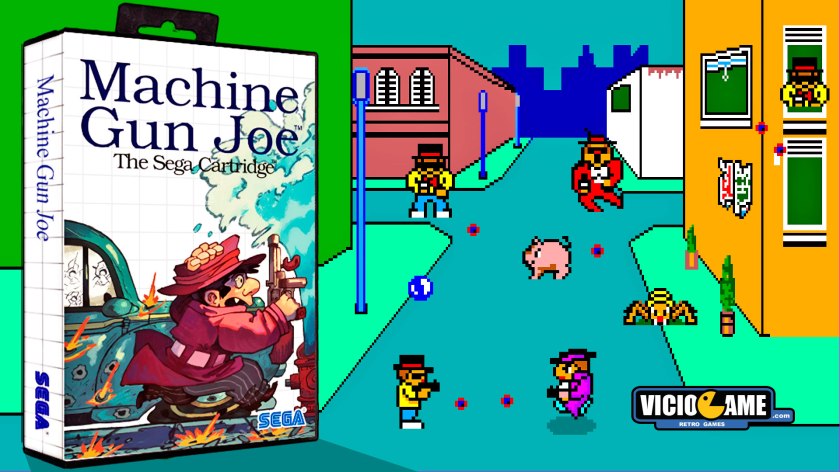
Comical Machine Gun Joe is an action/fixed-screen shoot ‘em up released in 1986 exclusively for the Japanese Master System. You take control of a plucky 1930s gangster tasked with wiping out enemy gunmen who prowl every corner of the city — and even some decidedly outlandish locations.
Developer: Sega Enterprises, Ltd.
Publisher: Sega Research and Development Dept. #2 (Sega R&D 2)
Release: 1986
Platform: Sega Master System / Sega Mark III
🇺🇸 Comical Machine Gun Joe (コミカル マシンガン ジョー) is part of the Sega My Card lineup, the credit card-sized media format that Sega used during the brief period when it tried to establish a cheaper distribution alternative to conventional cartridges. It is one of the most obscure titles from the Master System‘s early years, carrying in its very name the promise of a lighthearted, comedic experience in a genre that typically took itself very seriously.
The technological context in which the game was born is inseparable from understanding it as a product. The Sega My Card format was also known as My Card Mark III when destined for the Sega Mark III, the Japanese version of the console. The cards were manufactured by Mitsubishi Plastics, had a maximum capacity of 32 kilobytes, and cost significantly less to produce than cartridges, which allowed part of those savings to be passed on to consumers. However, the 32 KB of storage — equivalent to 256 kilobits — proved to be a severe limitation for most projects, and the format was gradually abandoned. Sega published only about a dozen games in this format between 1986 and 1987, and the Sega Master System II, released in 1990, no longer included a slot for My Cards in its design. Comical Machine Gun Joe occupies exactly the 32 KB available — the format’s absolute ceiling — which makes the sheer volume of content the development team managed to compress into that minimal space all the more impressive.
Although the Master System was born as a direct response to the Famicom’s dominance in the Japanese market, with technical specs superior to its competitor’s, Sega was unable to reverse Nintendo’s advantage in its own territory. Comical Machine Gun Joe was part of an early wave of releases that tested both the hardware and the Japanese public’s appetite for different kinds of experiences, and its comedic premise represents an interesting attempt at differentiation within a catalog that was accumulating more conventional action titles.
The game’s title is an exercise in cultural evocation. The combination of words — “Comical,” “Machine Gun,” and “Joe” — draws directly from the world of American gangster nicknames from the Prohibition era, with an implicit reference to figures like Machine Gun Kelly, the notorious 1930s criminal who became a cultural archetype for the trigger-happy gunman. Adding “comical” at the front works as a warning to the player: what follows is not meant to be a grim action experience, but rather a slapstick caricature of the genre, a farcical take on the urban gunslinger fantasy. The Japanese packaging reinforces this tone concisely: “The shots echo. The battle against El Doba’s gang has begun. Joe’s machine gun starts spitting fire! Now, intercept El Doba and his violent criminals!” Inside the game itself, however, there are no cutscenes, dialogue, or any form of narrative: you simply press Start and the action begins without any preamble.
The protagonist is Machine Gun Joe, a gunslinger with a characteristically exaggerated look: a purple overcoat, a wide-brimmed hat, and a cigarette permanently dangling from his lips. His goal is to hunt down El Doba, the local gang boss, fighting through a series of urban — and eventually delirious — settings. El Doba — whose name is written in Japanese as エルドバ — appears wearing a bright red suit and has a robotic face with strange features: the most prominent element on his face appears to be a sliding light-up eye, which has led some analysts to compare him visually to an android. It is a boss with an intentionally and strangely comedic design, perfectly in line with the game’s overall aesthetic.
Comical Machine Gun Joe belongs to the single-screen shooter subgenre, also called the static shooting gallery, in which the battlefield is a single, fixed screen with no scrolling whatsoever. The camera displays the environment from an overhead diagonal perspective, with the action unfolding across depth layers that allow enemies to appear at different heights in the visual field — including in building windows and behind structures. Joe moves horizontally along the bottom of the screen and never advances deeper into the environment: it is the enemies that move toward him, emerging from various points in the background. This structure places the game in a lineage close to the earliest arcade shooting galleries and the later static titles that would popularize the genre across different home platforms.
The controls are straightforward: the directional pad moves Joe left and right and also adjusts his aiming direction, button 1 fires the machine gun, and button 2 makes Joe jump. The aiming mechanic is one of the most challenging elements of the design: Joe can only fire in five directions — left, right, up, and at 45-degree angles on both upper sides. There is no downward shot, which means enemies positioned at the same height or below Joe require repositioning before any effective fire can be made. Enemies, on the other hand, are not bound by this restriction and can fire at any angle, creating an intentional asymmetry that sustains the game’s difficulty.
The jump is the primary evasion tool. Enemy projectiles follow relatively linear trajectories, and a well-timed jump is often enough to avoid damage. Joe’s death is instantaneous with a single hit — there is no health system or life bar — and the game begins with three lives. The only score-based extra life is awarded upon reaching 20,000 points, but this bonus is granted only once: multiples of 20,000 do not yield additional lives. There is also the possibility of finding extra lives hidden within the stages themselves, revealed by shooting certain parts of the background — a silent mechanic the game never explains to the player, but one that rewards the more exploratory-minded.
The death animation is one of the most emblematic moments in the game’s visual identity. When Joe is hit, he does not explode or vanish in a flash: he abruptly shrinks, becoming a miniaturized version of himself with his clothes now absurdly oversized for his reduced frame, then slowly wobbles across the screen before disappearing off the bottom edge. This same behavior applies to regular enemies when they are taken down, and it forms the mechanical heart of one of the game’s most original interactions. Each downed thug shrinks and turns into a tiny figure that shuffles toward Joe. If these figures reach the protagonist, they latch onto him — up to three can attach simultaneously. Each one progressively compromises Joe’s movements: the first slows his speed, the second hampers his jumps, and the third completely blocks his ability to jump. The only way to shake off these hangers-on is to jump three consecutive times, flinging them off like an electrified kangaroo. In a detail the game never explicitly announces but that quickly becomes apparent in practice, the attached enemies also function as an involuntary shield: they block some of the projectiles that would otherwise hit Joe, turning defeated opponents into a passive, temporary form of protection.
The game’s six stages are accessed sequentially and feature settings with varying degrees of originality. Harbor, the first stage, situates the action at a waterfront dock with vessels passing in the background and warehouse facades from which thugs emerge. The second stage is Downtown, an urban avenue intersection with windows, side corridors, and a central crossroads that provides multiple spawn points for enemies. The third stage, Saloon, moves the action inside a bar complete with a counter, decorative shields — curiously of Viking style — on the walls, and a pool table visible in the background. The fourth stage is Graveyard, a cemetery with headstones and a heavy horizon that houses one of the game’s most generous secrets. The fifth stage, Midnight, reuses Downtown’s visual layout entirely with a nighttime color palette — a resource-saving decision that did not go unnoticed by critics, though it fits the narrative of Joe patrolling the same city locations at different hours of the day. The sixth and final stage is Fairyland, a fantasy forest setting with anthropomorphic trees bearing expressive, angry faces, giant mushrooms serving as enemy positions, and a delirious atmosphere that clashes entirely with the previous environments — representing the culmination of the surreal humor the title promises from its very name.
Progression within each stage requires the player to eliminate a set number of common enemies to make El Doba appear on the battlefield. This number varies considerably: Harbor requires around ten kills, while Fairyland, the most complex, can demand more than thirty. Regular enemies are yellow-coated thugs, and they are the only henchmen type in the game — a design uniformity that can be cited as a weakness. They appear at specific points in the environments, fire in Joe’s direction, and eventually advance toward him. El Doba appears in a central position or near the top of the screen depending on the stage, and the difficulty of confronting him grows progressively: in the early stages, a few hits are enough to defeat him, but in the later ones he fires denser barrages and positions himself at more disadvantageous angles. When eliminated, El Doba does not shrink like the thugs: he dissolves into a charred skeleton — a visual effect that blends the macabre with the comedic in a way that neatly summarizes the game’s aesthetic balance. His defeat awards the player 5,000 points and opens the path to the next stage.
There is an alternative boss form that replaces El Doba under specific conditions: a schoolgirl who takes over the boss role when El Doba is defeated before firing ten shots in the previous stage and the player has not lost a single life up to that confrontation. This alternative version is considerably more demanding: she fires at higher speed, requires five hits to defeat, and rewards 10,000 points when eliminated — double the payout of the male version. Like El Doba, upon death she is reduced to a charred skeleton. The narrative logic behind this substitution is never explained by the game, making it one of the many eccentricities that form Comical Machine Gun Joe‘s appeal for those who appreciate 8-bit era game design.
The items available during the game are few but strategically dense. The Red Hat — a red hat that drops when a certain number of enemies is defeated — appears once per stage and awards 500 points when collected. With it equipped, Joe begins firing in automatic mode simply by holding the fire button, which significantly accelerates the pace of enemy elimination. The effect lasts until Joe dies or the stage is completed. The Red Hat is simultaneously the most powerful upgrade in the game and a psychological trap: the temptation to stand still and sweep the screen with automatic fire ignores the fact that enemies keep shooting, and any prolonged immobility tends to be fatal in the more advanced stages.
The second notable item is the bomb, obtained through a side mechanic that is one of the game’s most unexpected moments. Pigs occasionally stroll across the top of the screen with complete indifference to the ongoing gunfight. When hit by a shot, the pig flees the screen unharmed but drops a blue pearl that Joe can collect. This pearl functions as a smart bomb with a built-in timer: once collected, it begins gradually changing color from blue to purple, signaling that it is about to detonate. The player must jump before this happens — because if the bomb explodes while Joe is holding it, he dies — and the jump launches the pearl forward, where it explodes and instantly eliminates all common enemies visible on screen. Against El Doba, the bomb deals no lethal damage, only briefly stunning him. The detonation awards 1,000 base points, plus 1,800 bonus points if three or more enemies are caught in the blast. Using the bomb, however, triggers a permanent consequence for the rest of the stage: immediately after the explosion, a giant spider materializes in the middle of the environment and begins patrolling the screen from side to side. This spider is completely invulnerable and has the property of deflecting both Joe’s projectiles and those of the enemies — making it a frustrating obstacle at the exact moment the player has just cleared the screen. After all six stages are completed, the Replay Mode begins, and the spider is present from the start of each new run — with the exception of the Saloon, which never gets one — making each subsequent cycle progressively more difficult.
The Graveyard holds the most generous secret in Comical Machine Gun Joe: if the player survives for 90 seconds in that stage without triggering El Doba — meaning without eliminating enough enemies to summon the boss — the screen goes dramatically dark and the game immediately awards 100,000 points. This is by far the largest scoring bonus available in the title and can be repeated on every visit, both in the initial cycle and in subsequent ones. The challenge lies in surviving enemy fire without killing too many of them — a balance that demands both skill and restraint.
The stages also hide fruit by shooting certain parts of the background, another mechanic with no in-game instructions whatsoever. Apples award 10 points, grapes or berries award 20 points, and an indistinct yellow-shaped fruit is worth 30 points. On certain occasions, the hidden content may be an extra life, making systematic exploration of the backgrounds a strategy that rewards the most attentive players.
The complete scoring table reveals the hierarchy of incentives Sega designed into the game: eliminating a common thug is worth 100 points; collecting the Red Hat awards 500; detonating a bomb yields 1,000 base points, with a 1,800-point bonus if three or more enemies are caught; defeating the male El Doba is worth 5,000 points; the female version, 10,000. The only score-based extra life is awarded upon reaching 20,000 points, once per game.
The game contains two minor secrets that expand the repertoire of the experienced player. The first is the hidden character: at the start of any stage, if the hundreds digit of the current score is 0, 1, 4, or 5, and the very first shot of the stage hits exactly the third enemy to appear — without missing — a secret character emerges at the top of the screen, awarding 10,000 points. This character changes depending on the stage and appears to reference mythological or folkloric figures, though the game provides no explanation whatsoever. The second secret is the invincibility code: during gameplay, pause the game while Joe is still alive and press button 1 eight consecutive times before unpausing, and Joe becomes immune to most damage for the rest of the stage. There are important exceptions: the bomb can still kill Joe if it detonates while he is carrying it, and the effect tends to be less reliable in Fairyland for undocumented reasons. With invincibility active, it is possible to complete all six stages in approximately ten minutes.
The soundtrack of Comical Machine Gun Joe was composed entirely for the Master System‘s PSG sound chip and consists of just five tracks. The title screen music runs six seconds; the main theme — which loops throughout all six stages without any variation — is 35 seconds long; the stage clear jingle runs two seconds; the theme specific to the El Doba confrontation is 20 seconds; and the Game Over music lasts five seconds. The decision to use a single track for all stages is one of the factors that makes the game sonically exhausting during longer play sessions — an effect amplified by the visual repetition of stages that share layouts.
After completing the sixth stage, Fairyland, the game enters Replay Mode: it loops indefinitely with a slight increase in difficulty, slightly more randomized enemy spawn patterns, and the spider present in all stages from the very beginning (with the exception of the Saloon). There is no credits screen or any form of acknowledgment for the player who completes the full cycle — the game simply restarts. This is a design approach typical of early arcade shoot ‘em ups, where the experience was conceived as an endless pursuit of high scores rather than as a journey with a beginning, middle, and end.
Although released in Japan exclusively in the Sega My Card format, Comical Machine Gun Joe quietly made its way to other Asian markets in cartridge form. In South Korea, the game was distributed under the title 코메디권총사죠 (Komedi Gwonchongsa Jyo) or simply 총사죠 (Chongsa Jyo), in a black cartridge with no registered product number. In Taiwan, the game was released as 大戰黑手黨 (Dàzhàn hēishǒu dǎng, roughly “The Great War Against the Mafia”), in a yellow-and-pink cartridge. The three versions of the game — Japanese, South Korean, and Taiwanese — have distinct ROMs. The game never reached Western markets, neither North America nor Europe, which kept Comical Machine Gun Joe off the radar of most players and specialized critics for decades.
Comical Machine Gun Joe has a genuine personality that sets it apart from the mass of early Master System titles. Everything combines into a design that, within the technical constraints of 32 kilobytes, demonstrates inventiveness and a clear desire to do something different within the genre. The fact that the game fits entirely into that minimal space and still manages to offer relative complexity is a testament to the efficient software engineering that characterized the best moments of the first generation of developers working with Sega’s hardware.
Comical Machine Gun Joe represents a specific moment in the evolution of the static-screen shoot ‘em up — that subgenre that flourished in arcades before vertically and horizontally scrolling shooters came to dominate the market. The choice of a 1930s gangster-aesthetic protagonist and the blending of urban environments with a fantasy-infused deliriousness anticipate a trend that would be more fully explored in the second half of the 1980s and throughout the 1990s: transplanting the genre into thematic universes far removed from the conventional spaceships and alien invaders. Its confinement to the short-lived My Card format and the Japanese market kept the game at the margins of collective memory.
Decades after its release, Machine Gun Joe still wields his comedic machine gun in a shooting gallery that never closes: a minor but authentic title from the earliest days of the Mark III, capable of entertaining through its genuine strangeness and a lopsided personality that no other title in the Master System‘s early catalog managed to replicate with quite the same calculated absurdity and inadvertent charm.
🇧🇷 Comical Machine Gun Joe (コミカル マシンガン ジョー) integra a linha Sega My Card, o formato de mídia em cartão do tamanho de um cartão de crédito que a Sega utilizou durante o breve período em que tentou estabelecer uma alternativa de distribuição mais barata do que os convencionais cartuchos. Este é um dos títulos mais obscuros dos primeiros anos do Master System, carregando no próprio nome a promessa de uma experiência despretenciosa e cômica num gênero que normalmente se levava muito a sério.
O contexto tecnológico em que o jogo nasceu é inseparável de sua compreensão como produto. O formato Sega My Card também era chamado de My Card Mark III quando destinado ao Sega Mark III, a versão japonesa do console. Os cartões foram produzidos pela Mitsubishi Plastics, tinham capacidade máxima de 32 kilobytes e custavam significativamente menos para fabricar do que os cartuchos, o que permitia repassar parte dessa economia ao consumidor. No entanto, os 32 KB de armazenamento — equivalentes a 256 kilobits — se revelaram uma limitação severa para a maioria dos projetos, e o formato foi gradualmente abandonado. A Sega publicou apenas cerca de uma dúzia de jogos nessa mídia entre 1986 e 1987, e o Sega Master System II, lançado em 1990, já não incluía o slot para My Cards em seu design. Comical Machine Gun Joe ocupa exatamente os 32 KB disponíveis — o teto absoluto do formato —, o que torna ainda mais impressionante o volume de conteúdo que a equipe de desenvolvimento conseguiu comprimir naquele espaço mínimo.
Embora o Master System tenha nascido como resposta direta ao domínio do Famicom no mercado japonês, com especificações técnicas superiores às do concorrente, a Sega não conseguiu reverter a vantagem da Nintendo em seu próprio território. Comical Machine Gun Joe foi parte de uma leva de lançamentos iniciais que testavam tanto o hardware quanto o apetite do público japonês por diferentes tipos de experiência, e sua proposta cômica representa uma tentativa interessante de diferenciação dentro de um catálogo que acumulava títulos de ação mais convencionais.
O título do jogo é um exercício de evocação cultural. A combinação de palavras — “Comical”, “Machine Gun” e “Joe” — remete diretamente ao universo dos apelidos de gângsteres norte-americanos da era da Lei Seca, com referência implícita a figuras como Machine Gun Kelly, o famoso criminoso dos anos 1930 que se tornou uma espécie de arquétipo cultural do bandido armado com metralhadora. A adição do adjetivo “comical” ao início funciona como um aviso ao jogador: o que se segue não pretende ser um conteúdo de ação sombrio, mas sim uma caricatura do gênero, uma versão pastelão da fantasia do pistoleiro urbano. O texto da embalagem japonesa reforça esse tom com concisão: “Os tiros ecoam. A batalha contra a quadrilha de El Doba começou. A metralhadora de Joe começa a cuspir fogo! Agora, intercepte El Doba e seus violentos criminosos!” Dentro do jogo, no entanto, não há cutscenes, diálogos ou qualquer forma de narrativa: simplesmente pressiona-se Start e a ação começa sem qualquer preâmbulo.
O protagonista é Machine Gun Joe, um pistoleiro de visual caracteristicamente exagerado: sobretudo roxo, chapéu de abas largas e um cigarro permanentemente suspenso entre os lábios. Seu objetivo é caçar El Doba, chefe de uma gangue local, atravessando uma série de cenários urbanos e, por fim, delirantes. El Doba — cujo nome em japonês é grafado エルドバ — surge com um terno vermelho vivo e uma fisionomia robótica de traços estranhos: o único ponto de destaque em seu rosto parece um olho de luz deslizante, o que levou alguns analistas a compará-lo visualmente a um androide. Trata-se de um boss de design proposital e estranhamente cômico, alinhado com a estética geral do jogo.
Comical Machine Gun Joe pertence ao subgênero do single-screen shooter, também chamado de shooting gallery estático, no qual o campo de batalha é uma tela única e fixa sem qualquer scrolling. A câmera exibe o cenário em perspectiva diagonal de cima, com as ações se desenvolvendo em camadas de profundidade que permitem que inimigos apareçam em diferentes alturas do campo visual — inclusive em janelas de edifícios e atrás de estruturas. Joe se move horizontalmente ao longo da base da tela e jamais avança em profundidade no cenário: são os inimigos que se movem em sua direção, surgindo de pontos variados do fundo. Essa estrutura coloca o jogo numa linhagem próxima dos primeiros jogos de galeria de tiro dos arcades e de títulos estáticos posteriores que popularizariam o gênero em diferentes plataformas domésticas.
Os controles são diretos: o direcional desloca Joe para a esquerda e para a direita e também ajusta a direção de mira, o botão 1 dispara a metralhadora e o botão 2 faz Joe pular. A mecânica de mira é um dos elementos mais desafiadores do design: Joe é capaz de atirar em apenas cinco direções — para a esquerda, para a direita, para cima e em ângulos de 45 graus nos dois lados superiores. Não existe tiro descendente, o que significa que inimigos posicionados na mesma altitude ou abaixo de Joe exigem reposicionamento antes de qualquer disparo efetivo. Os inimigos, por outro lado, não sofrem dessa restrição e conseguem atirar em qualquer ângulo, o que cria uma assimetria intencional que sustenta a dificuldade do jogo.
O salto é a principal ferramenta de evasão. Os projéteis inimigos seguem trajetórias relativamente lineares, e um salto bem cronometrado frequentemente é suficiente para evitar dano. A morte de Joe é instantânea com um único acerto — não há sistema de energia ou barra de vida — e o jogo começa com três vidas. A única forma de ganhar uma vida extra baseada em pontuação ocorre ao atingir 20.000 pontos, mas esse bônus é concedido apenas uma vez: múltiplos de 20.000 não rendem vidas adicionais. Há também a possibilidade de encontrar vidas extras escondidas nos próprios cenários, reveladas ao atirar em determinadas partes do fundo — uma mecânica silenciosa que o jogo jamais explica ao jogador, mas que recompensa os mais exploratórios.
A animação de morte é um dos momentos mais emblemáticos da identidade visual do jogo. Quando Joe é atingido, ele não explode nem desaparece num flash: ele encolhe abruptamente, tornando-se uma versão infantilizada de si mesmo com as roupas agora absurdamente grandes para seu novo tamanho reduzido, e em seguida atravessa lentamente a tela bambeando antes de sumir na borda inferior. Esse comportamento se aplica também aos inimigos regulares ao serem abatidos, e é o coração mecânico de uma das interações mais originais do jogo. Cada valentão atingido encolhe e se converte numa minúscula figura que desce em direção a Joe. Se essas figuras alcançarem o protagonista, elas se grudam nele — podendo acumular até três simultaneamente. Cada uma compromete progressivamente os movimentos de Joe: a primeira reduz sua velocidade, a segunda dificulta os saltos e a terceira bloqueia completamente a capacidade de pular. O único jeito de se livrar desses penduricalhos é saltar três vezes consecutivas, sacudindo-os como um canguru eletrificado. Num detalhe que o jogo nunca anuncia explicitamente mas que logo se torna evidente na prática, os inimigos grudados funcionam também como escudo involuntário: eles bloqueiam parte dos projéteis que viriam em direção a Joe, transformando adversários derrotados numa proteção passiva e temporária.
As seis fases do jogo são acessadas sequencialmente e apresentam cenários com graus variados de originalidade. Harbor, a primeira fase, situa a ação num cais portuário com embarcações passando ao fundo e fachadas de armazéns por onde os valentões surgem. A segunda fase é Downtown, uma interseção de avenida urbana com janelas, corredores laterais e um cruzamento central que oferece múltiplos pontos de surgimento para os inimigos. A terceira fase, Saloon, leva a ação para o interior de um bar com balcão, escudos decorativos — curiosamente, de estilo viking — nas paredes e uma mesa de bilhar visível ao fundo. A quarta fase é o Graveyard, um cemitério com lápides e um horizonte pesado que abriga um dos segredos mais generosos do jogo. A quinta fase, Midnight, reutiliza integralmente o layout visual de Downtown com uma paleta de cores noturna — uma decisão de economia de recursos que não passou desapercebida por críticos, embora ela se encaixe na narrativa de Joe percorrendo os mesmos pontos da cidade em diferentes horas do dia. A sexta e última fase é Fairyland, um cenário de floresta fantástica com árvores antropomórficas de rostos expressivos e raivosos, cogumelos gigantes servindo como posições para os inimigos e uma atmosfera delirante que destoa completamente dos ambientes anteriores — representando o ponto culminante do humor surrealista que o título promete desde o nome.
A progressão dentro de cada fase exige que o jogador elimine um número determinado de inimigos comuns para fazer aparecer El Doba no campo de batalha. Esse número varia consideravelmente: Harbor exige cerca de dez abates, enquanto Fairyland, mais complexa, pode demandar mais de trinta. Os inimigos regulares são valentões de casaco amarelo, e são os únicos capangas presentes no jogo — uma uniformidade de design que pode ser apontada como fraqueza. Eles surgem em pontos específicos dos cenários, disparam na direção de Joe e eventualmente avançam sobre ele. El Doba aparece em posição central ou próxima ao topo da tela conforme a fase, e a dificuldade do confronto com ele cresce progressivamente: nas fases iniciais, alguns acertos são suficientes para derrotá-lo, mas nos avançados ele dispara rajadas mais densas e se posiciona em ângulos mais desfavoráveis. Ao ser eliminado, El Doba não encolhe como os capangas: ele se dissolve num esqueleto carbonizado — um efeito visual que combina o macabro com o cômico de forma que resume bem o equilíbrio estético do jogo. Sua derrota concede 5.000 pontos ao jogador e abre o caminho para a fase seguinte.
Existe uma forma alternativa de chefe que substitui El Doba sob condições específicas: uma estudante colegial que assume o papel de boss quando El Doba é derrotado antes de disparar dez tiros na fase anterior e o jogador não perde nenhuma vida até o confronto seguinte. Essa versão alternativa é significativamente mais exigente: dispara em velocidade superior, exige cinco acertos para ser derrotada e rende 10.000 pontos ao ser eliminada — o dobro da recompensa da versão masculina. Assim como El Doba, ao morrer ela se converte num esqueleto chamuscado. A lógica narrativa dessa substituição nunca é explicada pelo jogo, o que a torna uma das muitas excentricidades que compõem o apelo de Comical Machine Gun Joe para quem aprecia o design de games da era de 8 bits.
Os itens disponíveis durante o jogo são poucos mas estrategicamente densos. O Red Hat — um chapéu vermelho que cai quando um determinado número de inimigos é abatido — aparece uma vez por fase e rende 500 pontos ao ser coletado. Com ele equipado, Joe passa a atirar em modo automático simplesmente segurando o botão de disparo, o que acelera significativamente o ritmo de eliminação de inimigos. O efeito dura até Joe morrer ou a fase ser concluída. O Red Hat é simultaneamente a melhoria mais poderosa do jogo e uma armadilha psicológica: a tentação de ficar parado varrendo a tela com disparo automático ignora o fato de que os inimigos continuam disparando, e qualquer imobilidade prolongada tende a ser fatal nas fases mais avançadas.
O segundo item notável é a bomba, obtida a partir de uma mecânica lateral que é um dos momentos mais inesperados do jogo. Porcos percorrem ocasionalmente o topo da tela com total indiferença ao tiroteio em curso. Ao ser atingido por um disparo, o porco foge ileso da tela mas solta uma pérola azul que Joe pode coletar. Essa pérola funciona como uma smart bomb com temporizador integrado: ao ser coletada, ela começa a mudar de cor gradualmente, de azul para roxo, indicando que está prestes a detonar. O jogador deve saltar antes que isso aconteça — pois se a bomba explodir enquanto está com Joe, ele morre —, e o salto lança a pérola para frente, onde ela explode e elimina instantaneamente todos os inimigos comuns visíveis na tela. Contra El Doba, a bomba não causa dano letal, apenas o atordoa brevemente. A detonação concede 1.000 pontos base, mais 1.800 pontos adicionais se três ou mais inimigos forem atingidos por ela. O uso da bomba, porém, desencadeia uma consequência permanente para o restante da fase: imediatamente após a explosão, uma aranha gigante se materializa no meio do cenário e começa a patrulhar a tela de um lado ao outro. Essa aranha é completamente invulnerável e tem a propriedade de defletir tanto os projéteis de Joe quanto os dos inimigos — tornando-se um obstáculo frustrante exatamente quando o jogador acabou de limpar a tela. Após a conclusão de todos as seis fases, se inicia o Replay Mode, onde a aranha está presente desde o início de cada nova rodada — com exceção do Saloon, que nunca recebe uma —, tornando cada ciclo subsequente progressivamente mais difícil.
O Graveyard abriga o segredo mais generoso de Comical Machine Gun Joe: se o jogador sobreviver durante 90 segundos naquela fase sem ativar El Doba — ou seja, sem eliminar inimigos em quantidade suficiente para invocar o chefe —, o cenário escurece dramaticamente e o jogo concede 100.000 pontos de uma só vez. Esse é, de longe, o maior bônus de pontuação disponível no título e pode ser repetido a cada visita, tanto no ciclo inicial quanto nos subsequentes. O desafio está em sobreviver aos disparos sem abater inimigos em excesso — um equilíbrio que exige tanto habilidade quanto autocontrole.
Os cenários também escondem frutas descobertas ao atirar em determinadas partes do fundo, em mais uma mecânica oculta sem qualquer instrução no jogo. Maçãs concedem 10 pontos, uvas ou bagas concedem 20 pontos e uma fruta amarelada de formato indistinto vale 30 pontos. Em certas ocasiões, o conteúdo escondido pode ser uma vida extra, tornando a exploração sistemática dos fundos uma estratégia que recompensa os mais atentos.
A tabela de pontuação completa revela a hierarquia de incentivos projetada pela Sega: eliminar um capanga comum vale 100 pontos; coletar o Red Hat rende 500; detonar uma bomba rende 1.000 pontos base, com bônus de 1.800 pontos se três ou mais inimigos forem atingidos; derrotar El Doba masculino vale 5.000 pontos; a versão feminina, 10.000. A única vida extra baseada em pontuação é concedida ao atingir 20.000 pontos, uma única vez por jogo.
O jogo conta com dois segredos menores que expandem o repertório do jogador experiente. O primeiro é o personagem oculto: no início de qualquer stage, se o dígito das centenas da pontuação for 0, 1, 4 ou 5, e o primeiro disparo da fase atingir exatamente o terceiro inimigo a aparecer — sem errar —, um personagem secreto surge na parte superior da tela, rendendo 10.000 pontos. Esse personagem muda conforme a fase e parece fazer referência a figuras mitológicas ou folclóricas, embora o jogo não forneça qualquer explicação. O segundo segredo é o código de invulnerabilidade: durante o jogo, ao pausar com Joe ainda vivo e pressionar o botão 1 oito vezes consecutivas antes de despausar, Joe se torna imune à maior parte dos danos pelo restante da fase. Há exceções importantes: a bomba ainda mata Joe se detonar enquanto ele a carrega, e o efeito tende a ser menos confiável no Fairyland por razões não documentadas. Com a invulnerabilidade ativa, é possível completar todos as seis fases em aproximadamente dez minutos.
A trilha sonora de Comical Machine Gun Joe foi composta inteiramente para o chip de som PSG do Master System e conta com apenas cinco faixas. A música da tela de título dura seis segundos; o tema principal — que toca em loop durante todas as seis fases sem qualquer variação — tem 35 segundos de duração; a jingle de conclusão de fase dura dois segundos; o tema específico para o confronto com El Doba tem 20 segundos; e a música de Game Over dura cinco segundos. A decisão de utilizar uma única trilha para todas as fases é um dos fatores que tornam o jogo sonoramente exaustivo em sessões mais longas — um efeito amplificado pela repetição visual dos cenários que compartilham layouts.
Após a conclusão da sexta fase, Fairyland, o jogo entra no Replay Mode: o jogo é reiniciado em loop indefinidamente, com dificuldade levemente aumentada, padrões de surgimento dos inimigos ligeiramente mais aleatórios e a presença permanente da aranha em todas as fases desde o início (com exceção do Saloon). Não existe tela de créditos nem qualquer forma de reconhecimento ao jogador que conclua o ciclo completo — o jogo simplesmente recomeça. É um design típico dos primeiros shoot ‘em ups de arcade, onde a experiência era concebida como uma busca interminável por altas pontuações, não como uma jornada com começo, meio e fim.
Embora lançado no Japão exclusivamente no formato Sega My Card, Comical Machine Gun Joe chegou discretamente a outros mercados asiáticos em versões de cartucho. Na Coreia do Sul, o jogo foi distribuído com o título 코메디권총사죠 (Komedi Gwonchongsa Jyo) ou simplesmente 총사죠 (Chongsa Jyo), em cartucho de cor preta sem numeração de produto registrada. Em Taiwan, o jogo recebeu o nome 大戰黑手黨 (Dàzhàn hēishǒu dǎng, algo como “A Grande Guerra contra a Máfia”), num cartucho de coloração amarela e rosa. As três versões do jogo — japonesa, sul-coreana e taiwanesa — possuem ROMs distintas. O jogo nunca chegou ao mercado ocidental, nem à América do Norte nem à Europa, o que manteve Comical Machine Gun Joe fora do radar da maior parte dos jogadores e da crítica especializada por décadas.
Comical Machine Gun Joe possui uma personalidade genuína que o distingue da massa de títulos iniciais do Master System. Tudo compõe um design que, dentro de suas limitações técnicas de 32 kilobytes, demonstra inventividade e uma vontade clara de fazer algo diferente dentro do gênero. O fato de o jogo caber inteiramente naquele espaço mínimo e ainda assim oferecer relativa complexidade é um exemplo da engenharia de software eficiente que caracterizou os melhores momentos da primeira geração de desenvolvedores para o hardware da Sega.
Comical Machine Gun Joe representa um momento específico na evolução dos shoot ‘em ups de tela estática — aquele subgênero que floresceu nas salas de arcade antes dos shooters de scrolling vertical e horizontal dominarem o mercado. A escolha de um protagonista com estética de gângster dos anos 1930 e a mistura de ambientes urbanos com o delírio fantasioso antecipam uma tendência mais explorada na segunda metade dos anos 1980 e nos anos 1990: a de transportar o gênero para universos temáticos distantes dos convencionais naves espaciais e alienígenas. O confinamento ao efêmero formato My Card e ao território japonês manteve o jogo à margem da memória coletiva.
Décadas após seu lançamento, Machine Gun Joe ainda empunha sua metralhadora cômica numa galeria de tiro que não fecha: um título menor, mas autêntico, dos primórdios do Mark III, capaz de entreter por sua estranheza genuína e por uma personalidade torta que nenhum outro título do catálogo inicial do Master System soube replicar com tanto despropósito calculado e charme involuntário.
🤑💲Earn money without doing anything! Just leave these apps open:
✓ https://r.honeygain.me/CONTA9DB02
✓ https://packetstream.io/?psr=1uPb
🤑💲1-Click button earns Bitcoin every 1 hour: https://freebitco.in/?r=53528449
⬛ 𝗧𝗶𝗸𝗧𝗼𝗸: https://www.tiktok.com/@viciogame
🟧 𝗜𝗻𝘀𝘁𝗮𝗴𝗿𝗮𝗺: http://www.instagram.com/viciogame
🟥 𝗬𝗼𝘂𝘁𝘂𝗯𝗲: http://www.youtube.com/viciogame
🟦 𝗙𝗮𝗰𝗲𝗯𝗼𝗼𝗸: http://www.facebook.com/viciogame
🔳 𝗧𝗵𝗿𝗲𝗮𝗱𝘀: https://www.threads.net/@viciogame
🟪 𝗧𝘄𝗶𝘁𝗰𝗵: https://www.twitch.tv/ViciogameRetroGames
🟨 𝗕𝗹𝗼𝗴: http://www.viciogameblog.com/
🟦𝗧𝘄𝗶𝘁𝘁𝗲𝗿: http://www.twitter.com/viciogame
#Viciogame #Gameplay #LetsPlay #Playthrough #Games #Gaming #Videogames #Review #Game #Detonado #Walkthrough #Ending #Reviews #Facts #Retro #RetroGaming #Roms #Emulator #Longplay #Speedrun #NoCommentary #ComicalMachineGunJoe #MasterSystem #SegaMarkIII #Sega #コミカルマシンガンジョー #マスターシステム #セガ #shootemup #shooter #gangster

