
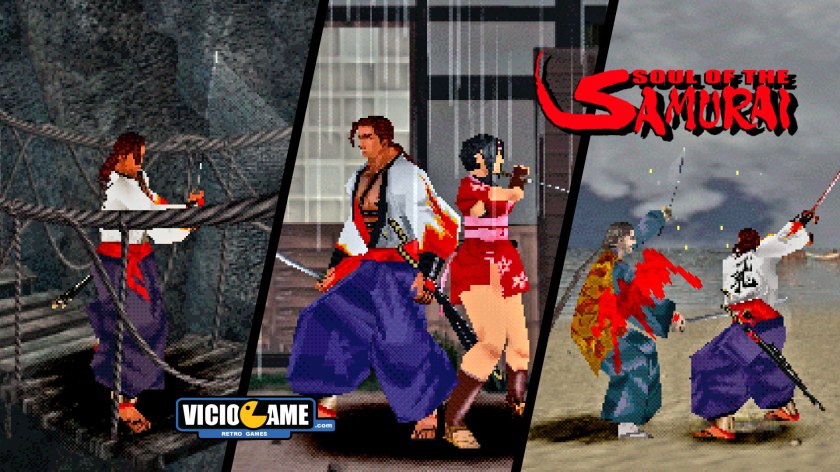
Soul of the Samurai (released in Europe as Ronin Blade) is an action game launched in 1999 for the PlayStation. In the wake of seemingly supernatural events, a samurai and a ninja each set out on their own journey to resolve a deeply personal dilemma — until, at a pivotal moment, their paths converge in pursuit of a shared ideal.
Developer/Publisher: Konami
Release date: 1999
Platform: Sony PlayStation
🇺🇸 The year was 1999, and the PlayStation was at the height of its lifespan. Sony had consolidated its dominance over the 32-bit console market, and Japanese developers were pushing the platform’s technical capabilities to their absolute limit, wringing every last millisecond of performance out of its graphics chips and processors. It was in this environment saturated with creativity and experimentation that Konami, one of the most powerful publishers of the era, released a title that, through an irony of fate and a combination of poor marketing and unfortunate timing, would pass almost invisibly before the eyes of critics and the public: Soul of the Samurai. Known in Japan as Shin Jidaigeki Action: Rasetsu no Ken (新時代劇アクション 羅刹の剣) — whose literal translation would be something like “New Period-Drama Action: Blade of the Rakshasa” — and marketed in Europe under the title Ronin Blade, the game stands as one of the most fascinating examples of a work that anticipated trends without ever reaping the rewards of that foresight.
The title was developed by Konami Computer Entertainment Sapporo, a relatively new division within the Konami group at the time. The studio had been established in March 1997, alongside other regional Konami branches in Nagoya and Yokohama, as part of a corporate strategy of decentralization and internal competition among development teams. The goal was to encourage the creation of new IPs and diversify the company’s portfolio. KCE Sapporo, based in the capital of the island of Hokkaido in northern Japan, was therefore still a young studio when it began work on the project that would become Soul of the Samurai. The soundtrack was composed by Yasuhisa Ito, who would later work on notable projects such as Metal Gear Solid 4: Guns of the Patriots, Super Smash Bros. Ultimate, and Castlevania: Harmony of Despair.
The game’s development went through an impressive evolution before reaching its final form. In its early stages, the project was simply called “Japan,” a placeholder label that already made the team’s thematic intent clear. The working title was later changed to Shogun Assassin, as revealed by the February 1999 issue of GamePro, which ran an early preview of the title. At that early stage, the protagonists also went by different names: the character who would become Kotaro was referred to as Hotaru — though this may also have been a translation error in Western promotional materials — and the character who would become Lin was called Hyaku. Both were described as members of the shogunate’s secret police. Sources within Konami itself even stated that the game would combine elements of Bushido Blade and Tenchu, two of the most talked-about Japanese action titles of the period. That dual influence would remain visible in the final product, albeit with additional elements mixed in.
The narrative backdrop of Soul of the Samurai is the turbulent Edo period, set in a small, unnamed fiefdom where dark forces move within the shadows of power. The plot begins with the mysterious disappearance of a gold shipment in the waters near the fiefdom ruled by Lord Tohjo. A spy from the Tokugawa Shogunate is sent to investigate the case, but he too vanishes without a trace. When three more Shogunate ninja are dispatched and likewise disappear, the situation escalates into a full-blown crisis. It is in this context that the two playable protagonists enter the picture, each for their own reasons, converging on the same labyrinth of conspiracies, deaths, and supernatural horror.
The ronin Kotarō Hiba is the male protagonist: a masterless samurai who wanders Japan on his own, not out of necessity, but by choice. His origins are partly shrouded in mystery, which seems to suit him just fine. It’s known that he grew up in a dojo alongside a childhood friend named Yukinosuke, both trained by the same masters in the art of kenjutsu. The two were so evenly matched that neither ever managed to decisively beat the other in sparring. Kotarō left abruptly after the death of his parents, and the weight of that never-explained departure will color the two friends’ eventual reunion in the story. Kotarō has a laid-back, irreverent personality and bristles at the formalities of the period — he refuses to sit in the traditional seiza position in the dojo, a seemingly small detail that reveals a great deal about his character. The ronin returns to his childhood village to visit his parents’ grave, but instead finds castle samurai attacking a young woman at the town’s entrance, and a world that is clearly hiding something deeply disturbing.
The young woman in question is Lin, also known as Rin, the female protagonist. Unlike Kotarō, Lin isn’t a samurai but a kunoichi — a female ninja. She and her older brother, Shin, were orphaned as children and taken in by a ninja clan that trained them in the art of ninjutsu until both became active agents in the service of the Tokugawa Shogunate. Shin was the spy sent to investigate the missing gold — and his disappearance becomes the reason Lin sets out on her own unauthorized mission, driven by a sibling devotion that overrides any sense of hierarchical obedience. Lin is eighteen years old and carries all the restless impatience of youth: she deeply resents any treatment that diminishes her or treats her like a child, which creates a dynamic that is both comedic and occasionally tense in her interactions with Kotarō, who repeatedly finds himself surprised after underestimating her. The game closes with an ambiguous post-credits scene that subtly and poetically hints at the two developing romantic feelings for one another.
Soul of the Samurai‘s core mechanic is its melee combat, specifically sword fighting, and this is where the game most distinguishes itself from its contemporaries. There’s a single attack button, but combining it with different directions on the analog stick or D-pad produces distinct moves: a 180-degree spin followed by a slash to hit enemies approaching from behind; a horizontal slash to strike multiple opponents at once; a forward lunge for enemies farther away; and the standard three-hit combo for isolated targets. There’s no room for frantic button-mashing here — the game rewards players who observe, calculate, and act with surgical precision. The blocking system is sophisticated for its time: simply holding the defense button also causes the character to lock onto the nearest enemy, but pulling off a counterattack — pressing the attack button at the exact instant an enemy’s strike is about to land — results in a devastating response capable of killing most regular enemies in a single hit and dealing considerable damage to bosses. It’s also possible to parry an enemy’s sword by attacking at the precise moment of their swing, leaving them momentarily vulnerable.
Soul of the Samurai‘s progression system is simple but effective: experience points are earned by defeating enemies and unlock special moves, which consume magic points. Those magic points regenerate automatically during combat, creating a rhythm of strategic use. The special moves available depend on the equipped weapon — each sword has its own characteristics of speed, length, and sharpness, displayed in a blade-inspection window, and some are incompatible with certain techniques. The player can sheathe their sword at any time and simply flee from enemies, in the best survival-horror fashion, which can occasionally result in finding a different — and perhaps weaker — set of enemies upon returning to the same location. Healing items are available in limited quantities along the main path, but there are hidden extra rewards for those who explore side areas the story doesn’t immediately require.
Soul of the Samurai‘s world structure is semi-open, centered on a town square that functions as a hub. From there, the player accesses different areas — a dojo, a temple, a forest, a beach, and, eventually, the antagonist’s castle — and can move relatively freely between them within each chapter. The game features few puzzles, and the ones that exist generally involve finding keys or opening doors by other means; the most elaborate one, in Kotarō’s campaign, involves timing and physics. Everything else is continuous combat. The game is divided into chapters, and one of its most striking sequences occurs when the player must face relentless waves of sword-wielding zombies flooding the town square — a large-scale carnage encounter that seems to anticipate the horde model later popularized by Koei’s Warriors series.
Kotarō and Lin’s campaigns are structurally intertwined but narratively distinct. Playing as Kotarō means facing melee combat with real weight and tangible impact: his attacks are slower, but his strikes carry considerable destructive power, and mastering the parry-and-counterattack system is essential to progress. He frequently finds and receives new weapons, and some of them radically change the playstyle — like a sword that can only be used for a quick-draw attack, pulling the blade from its sheath in a single, lightning-fast motion. Lin, on the other hand, functions almost like a built-in “Easy Mode”: her basic combo has five hits instead of three, she mows down practically everything on screen with consistency, and she also has shurikens and explosives as ranged weapons, plus a desperation move called Cherry Blossoms for critical situations. This intentional asymmetry between the two characters — Kotarō demands technique, Lin demands action — offers two genuinely different gameplay experiences.
Soul of the Samurai‘s boss roster is varied and gradually reveals the supernatural nature of the threat lurking over the fiefdom. The antagonism starts with corrupted humans and progressively escalates into monstrous abominations. In Kotarō’s campaign, the first boss is an Unknown Ronin — a scarred figure with completely white eyes who is found killing the Shogunate ninja Genzō. The sword obtained after defeating him, the Monohoshizao, is the real name of the nodachi wielded by the historical Sasaki Kojirō, suggesting the character may be a fictionalized version of that famous swordsman. Next comes Muga, the high priest of the local temple, deformed into a gigantic, grotesque creature after becoming host to the so-called Soul Bugs — the parasitic beasts at the heart of everything. After that, Kotarō faces Yukinosuke Koizumi, his childhood friend: infected by a soul bug that granted him increased power without visibly deforming him, Yukinosuke carries deep resentment over never having managed to beat Kotarō in their sparring sessions, and the fight between the two is weighed down with emotional gravity. The sorcerer Urabe — called Sōigen Ohtori in the Japanese version — is a case apart: he wields no physical weapons, attacking exclusively with magic, and after being defeated transforms into a hunched creature with an exposed spine and a scorpion-like stinger, while also gaining the ability to spit fire. He also creates copies of himself during the fight.
The most intriguing encounter in Kotarō’s campaign is the optional confrontation with Miyamoto Musashi, presented as a secret boss. The legendary swordsman appears on Ganryu Beach — the site historically associated with his most famous duel — and challenges Kotarō to a duel of honor. The player can accept or decline. If accepted, Musashi makes it clear he has no interest whatsoever in the fiefdom’s affairs — “that’s none of my swords’ concern” — and simply wants a fight worthy of his skill. Defeating him results in his grateful death and the acquisition of Musashi’s twin swords, the only equipment in the game that allows dual-blade combat. It’s a historically loaded and ludically rewarding easter egg. There’s a catch, though: the player must trigger this duel before facing Yukinosuke, or Musashi, tired of waiting, simply leaves and the encounter becomes permanently unavailable. The final boss of Kotarō’s campaign is Lord Gendō Tohjo — Gendō Kiryū in the Japanese version — ruler of the fiefdom, a master of sōjutsu, the Japanese art of the spear, and wielder of supernatural powers that let him heal during combat. After his apparent defeat, Tohjo reveals that he too is infected with a soul bug, sprouting six electrified arms in a horrifying metamorphosis.
Lin’s campaign features its own cast of adversaries. The Castle Head Guard is the first obstacle: he doesn’t act alone, calling in subordinates from every direction, but can be spotted in the crowd by his blue attire. Undead Genzō provides one of the game’s darkest moments: Lin believes she’s found a living friend, but when he removes his basket hat, he reveals a bloodthirsty undead form. Karasu — whose name means “Crow” in Japanese — leads a ninja group called the Ravens, known for her skill in ninjutsu and a distinctive battle dance. She serves as host to a soul bug and, once defeated in her human form, transforms and reveals that Lin’s brother is with Lord Tohjo — with an ominous warning: “it will be a reunion full of tears.” The Three Wolverines are ninja warriors equipped with claws who attack Lin in coordinated formation and possess teleportation abilities. The most painful encounter is with Shin himself, full name Shinjirō the Swallow, Lin’s brother: infected by the soul bug and unable to control his own actions, he confronts his sister in a duel charged with family drama, wielding an arsenal of elegant moves that includes a boomerang-trajectory shuriken. Later, Lin must eliminate somewhere between 200 and 300 infected villagers before facing the Two Soul Worms, enormous creatures that look like amalgamations of decomposing corpses.
Soul of the Samurai‘s true villain, revealed gradually over the course of the game, is Ryū Oda — Kurando Yūki in the Japanese version — described as a “military scholar.” Oda is the intellectual architect behind the entire conspiracy: he was the one who conceived and spread the soul bugs as a tool for conquering feudal Japan, staying behind the scenes for nearly the whole story and appearing only occasionally to manipulate figures like Yukinosuke and Urabe. The soul bugs themselves deserve a more detailed mention: they’re parasites resembling red slugs that, upon infecting a host, cause initially mild symptoms — colds, headaches — before progressing into the host’s complete transformation into a monster or zombie. It’s Lord Tohjo who hired Oda’s services to create these creatures, driven by ambitions of seizing power from the Shogunate. To unlock the confrontation with the final bosses — Infected Lord Tohjo, followed by Ryū Oda in his human form, succeeded by an Infected version of Ryū Oda that transforms into a multi-limbed monster with a slug-like torso and multiple legs — the player must complete one character’s campaign and carry that save file over to play the second campaign. Only by finishing both stories does the true ending become accessible, and the player can then choose which of the two protagonists will face the final bosses, with the other serving as a backup in case of failure.
From a technical and aesthetic standpoint, Soul of the Samurai is a particularly interesting product of its time. The characters are modeled in polygonal 3D, while the environments use pre-rendered backgrounds with fixed camera angles — a choice that visually aligns the game with the survival-horror aesthetic popularized by Capcom. The most surprising detail, however, is the nature of these backgrounds: unlike the high-resolution 3D renders many studios used to create pre-rendered environments, KCE Sapporo’s art team chose to hand-paint every single background in a realistic watercolor style. The result is a set of environments with a distinct, warm, organic texture and pictorial quality that has aged remarkably well — far better than the more obviously dated CGI renders of its contemporaries. The characters’ animations were captured via motion capture with the participation of the Japan Action Club, a Japanese company specializing in stunt performers and action choreography that is widely used in tokusatsu and film productions. This gives the combat movements a fluidity and an authenticity of body language that clearly draws from real kenjutsu kata, lending the sword duels an elegant readability.
The soundtrack, composed by Yasuhisa Ito, blends seemingly opposing musical elements: traditional Japanese instruments share space with rock beats and electronic synthesis. In exploration areas and story scenes, the music is ambient and carries an Eastern flavor, creating an atmosphere fitting for feudal Japan. But once enemies appear and combat begins, the score shifts abruptly into sequences of heavy chords and urgent percussion, efficiently signaling the change in pace. While the soundtrack doesn’t contain themes that stick in the memory the way the genre’s greatest classics do, the composition is competent and serves its purpose well, sustaining the mood of each moment. One peculiarity in the sound design: there isn’t a single line of voiced dialogue. All dialogue — including cutscenes and conversations with NPCs in the town square — is presented as text, with no voice acting. That, combined with the often-awkward quality of the English localization, resulted in text that’s sometimes clumsy but always functional. There’s an interesting irony in the credits, though: someone was specifically hired to translate the poems in the save system, and that work was clearly carried out with far more care and craftsmanship than the dialogue lines.
Soul of the Samurai‘s save system is one of the game’s most charming and deliberately artistic details. Rather than simply showing the player information like playtime or current location, the save slots display haiku poems composed specifically to reflect, in an abstract and poetic way, the narrative stage the character has reached. These haiku were written and translated with genuine attention to form and meaning, functioning as tiny literary miniatures that capture the spirit of each dramatic moment without being explicit about it. In an industry that treated — and in many ways still treats — the save system as purely functional utility, this detail reveals just how committed the KCE Sapporo team was to a coherent artistic vision. It’s a rare touch of elegance.
After beating the game, a “New Game+” option appears, adding a few layers of replay value: the game tracks cumulative kill counts per character across each new save loaded, and the color of the save slot progresses over time — starting neutral, turning red once a character’s campaign is completed, and turning gold once both are finished. Soul of the Samurai is, in fact, an extremely short game: a single campaign can be completed in roughly two to three hours by a player who sticks to the main path without lingering too much. Far from being a flaw, this brevity gives the game an immediate replayability — it’s easy, even inviting, to jump back in, try the other campaign, and experiment with alternate equipment.
Critical reception of Soul of the Samurai was mixed. GameRankings compiled an average score of 63%, with individual reviews varying widely. IGN awarded 7.9/10 in one of the more generous assessments, while GameSpot gave it 5.4/10 and Electronic Gaming Monthly handed out 5.5/10. Game Informer was the harshest, scoring it 4.25/10. GamePro landed on the positive side, highlighting the intense action paired with an engaging storyline. France’s Joypad gave it 6/10. The issue wasn’t so much the scores themselves as the nature of the criticism: several reviewers seemed genuinely confused about what the game was or was trying to be. GameSpot lamented that it wasn’t “a ninja game on the level of Tenchu” — a comparison that reveals a total misunderstanding of the product being reviewed, since Soul of the Samurai never set out to be a stealth game. IGN, even more bewilderingly, wrote that it had to keep reminding itself it wasn’t playing Metal Gear Solid — a comparison bordering on the absurd. As Hardcore Gaming 101 accurately pointed out years later, there was something deeply disorienting about 1999 reviewers’ inability to simply take the game for what it was.
The game’s European version, released under the name Ronin Blade, carried an additional problem that affected the entire PAL region during that era: inadequate optimization for the 50Hz refresh rate of European televisions, which resulted in characters moving noticeably slower than in the NTSC version. Kotarō, already naturally slower than Lin, became even more sluggish in this version, compromising the experience especially in the ronin’s campaign. This was a chronic problem affecting countless PlayStation and PlayStation 2 games released in Europe in the late 1990s and early 2000s.
The historical context that most defines Soul of the Samurai‘s legacy in players’ minds is its relationship with Capcom’s Onimusha: Warlords. Soul of the Samurai was released in Japan on April 28, 1999. In that same month of April 1999, Capcom officially announced Onimusha — an action-adventure game featuring 3D characters set against pre-rendered backgrounds, with sword combat in a feudal Japanese setting steeped in supernatural elements. The descriptions of the two titles are interchangeable to a startling degree. The difference is that Onimusha: Warlords would arrive on the PlayStation 2 in 2001 as a top-tier launch title, complete with stunning cutscenes, voice acting, massive marketing, and the prestige of a Capcom at the height of its popularity. It sold its first million copies in four days. Soul of the Samurai, released eighteen months earlier on older hardware, with virtually no marketing and no cinematic cutscenes, was left permanently behind — not for lack of merit, but due to circumstance. It’s not an exaggeration to say that Soul of the Samurai anticipated the formula that would turn Onimusha into a sales phenomenon, without ever receiving the credit it deserved.
KCE Sapporo, the studio behind Soul of the Samurai, had a relatively short existence. In August 2000, it merged with KCE Yokohama to form Konami Computer Entertainment Studios. Later, in December 2001, the Sapporo division was split off and absorbed into Hudson Soft, which had by then become part of the Konami group. The original studio’s catalog as an independent entity was small — Survival Kids, Soul of the Samurai, and Bishi Bashi Special are the main titles associated with it — which makes Soul of the Samurai stand out even more within such a limited portfolio. It’s the most ambitious and reflective work of a studio that never had enough time to mature.
This was a game that deserved far more attention than it received in its time, and for that very reason it continues to pleasantly surprise those who discover it decades later, once the unfair comparisons to Tenchu and Metal Gear Solid have been forgotten and the title can finally be appreciated for what it always was — a sword-action game with a handful of puzzles, carefully built, featuring an endearing protagonist duo, a genuinely atmospheric feudal setting, and a combat system that is as rewarding to master as it is demanding.
Soul of the Samurai is one of those rare products that time has treated far more generously than its own era ever could. Released in the wrong window, compared to the wrong games, and backed by the wrong amount of marketing investment, KCE Sapporo’s title spent years living in the shadow of a generation of famous releases. But it remains accessible to anyone seeking a genuine encounter with some of the most creative and singular work the PlayStation‘s golden age produced: a game made with a real identity of its own, one that never bent to the dominant trends of its time, and that carries, in every poem and in every motion-captured animation drawn from the hands of true martial artists, the unmistakable signature of a team that deeply believed in what it was making.
🇧🇷 O ano era 1999 e o PlayStation vivia o auge da sua vida útil. A Sony havia consolidado seu domínio no mercado de consoles de 32 bits, e os desenvolvedores japoneses exploravam ao máximo as capacidades técnicas da plataforma, extraindo de seus chips gráficos e processadores cada último milissegundo de performance. Era nesse ambiente saturado de criatividade e experimentação que a Konami, uma das editoras mais poderosas da época, lançou um título que, por uma ironia do destino e por uma combinação de má divulgação e timing desfavorável, passaria quase invisível diante dos olhos da crítica e do público: Soul of the Samurai. Conhecido no Japão como Shin Jidaigeki Action: Rasetsu no Ken (新時代劇アクション 羅刹の剣) — cuja tradução literal seria algo como “Nova Ação de Drama de Época: Lâmina do Rakshasa” — e comercializado na Europa sob o título Ronin Blade, o jogo representa um dos mais fascinantes exemplos de obra que antecipou tendências sem colher os frutos dessa antecipação.
O título foi desenvolvido pelo estúdio Konami Computer Entertainment Sapporo, uma divisão relativamente recente dentro do grupo Konami à época. O estúdio havia sido estabelecido em março de 1997, simultaneamente com outras ramificações regionais da Konami em Nagoya e Yokohama, dentro de uma estratégia corporativa de descentralização e competição interna entre equipes de desenvolvimento. O objetivo era estimular a produção de novas IPs e diversificar o portfólio da empresa. A KCE Sapporo, sediada na capital da ilha de Hokkaido, no norte do Japão, era portanto um estúdio jovem quando começou a trabalhar no projeto que se tornaria Soul of the Samurai. A trilha sonora ficou a cargo de Yasuhisa Ito, que mais tarde trabalharia em projetos notáveis como Metal Gear Solid 4: Guns of the Patriots, Super Smash Bros. Ultimate e Castlevania: Harmony of Despair.
O processo de desenvolvimento do jogo passou por uma evolução impressionante antes de chegar à sua forma definitiva. Em estágios iniciais, o projeto era simplesmente chamado de “Japan”, um rótulo temporário que já deixava clara a intenção temática da equipe. Posteriormente, o título de trabalho foi alterado para Shogun Assassin, como revelado pela edição de fevereiro de 1999 da GamePro, que publicou uma prévia antecipada do título. Nessa fase inicial, os protagonistas também atendiam por nomes distintos: o personagem que viria a se chamar Kotaro era referenciado como Hotaru — embora isso possa ter sido também um erro de tradução nas versões ocidentais dos materiais promocionais — e a personagem que se tornaria Lin era chamada de Hyaku. Ambos eram descritos como membros da polícia secreta do shogunato. Fontes da própria Konami chegaram a afirmar que o jogo combinaria elementos de Bushido Blade e Tenchu, dois dos títulos de ação japonesa mais comentados do período. Essa influência dupla permaneceria visível no produto final, ainda que com elementos adicionais no mix.
O pano de fundo narrativo de Soul of the Samurai é a conturbada época Edo, ambientado em um pequeno feudo anônimo onde forças sombrias se movimentam nas sombras do poder. O enredo começa com o desaparecimento misterioso de um carregamento de ouro nas águas próximas ao feudo governado pelo Lorde Tohjo. Um espião do Shogunato Tokugawa é enviado para investigar o caso, mas também some sem deixar rastros. Quando três outros ninjas do Shogunato são despachados e igualmente desaparecem, a situação escala para uma crise. É nesse contexto que os dois protagonistas jogáveis entram em cena, cada um por suas próprias razões, convergindo para o mesmo labirinto de conspirações, mortes e horror sobrenatural.
O ronin Kotarō Hiba é o protagonista masculino: um samurai sem mestre que percorre o Japão por conta própria, não por necessidade, mas por escolha. Suas origens são parcialmente enigmáticas, o que ele mesmo parece preferir. Sabe-se que cresceu em um dojo com um amigo de infância chamado Yukinosuke, ambos treinados pelos mesmos mestres nas artes do kenjutsu. Os dois eram tão igualmente habilidosos que nenhum jamais conseguiu vencer o outro de forma decisiva nos treinos de combate. Kotarō partiu abruptamente após a morte de seus pais, e o peso dessa saída nunca explicada marcará o reencontro dos dois na história. Kotarō possui uma personalidade descontraída e irreverente, avessa às formalidades do período — ele se recusa a sentar na posição tradicional de seiza no dojo, um detalhe aparentemente pequeno que revela muito sobre seu caráter. O ronin retorna ao vilarejo de sua infância para visitar o túmulo dos pais, mas o que encontra são samurais do castelo atacando uma jovem na entrada da cidade, e um mundo que claramente esconde algo muito perturbador.
A jovem em questão é Lin, também conhecida como Rin, a protagonista feminina. Diferente de Kotarō, Lin não é uma samurai mas uma kunoichi — uma ninja. Ela e seu irmão mais velho, Shin, foram órfãos ainda crianças e acolhidos por um clã ninja que os treinou nas artes do ninjutsu até que ambos se tornassem agentes operacionais a serviço do Shogunato Tokugawa. Shin era o espião enviado para investigar o ouro desaparecido — e ao desaparecer, tornou-se o motivo pelo qual Lin parte em missão por conta própria, sem autorização, impelida por um amor fraternal que supera qualquer obediência hierárquica. Lin tem dezoito anos e carrega consigo toda a coceira impaciente da juventude: ela ressente intensamente qualquer tratamento que a diminua ou que a trate como uma criança, o que gera uma dinâmica cômica e às vezes tensa em suas interações com Kotarō, que reiteradamente se surpreende ao subestimá-la. O jogo encerra com uma cena pós-crédito ambígua que sugere, de forma discreta e poética, o desenvolvimento de sentimentos românticos entre os dois.
A mecânica central de Soul of the Samurai é seu combate baseado em armas brancas, especificamente em espadas, e é nesse ponto que o jogo mais se diferencia de seus contemporâneos. Há um único botão de ataque, mas as combinações com diferentes direções no analógico ou no D-pad resultam em movimentos distintos: um giro de 180 graus seguido de um corte para acertar inimigos que se aproximam por trás; um slash horizontal para atingir múltiplos oponentes simultaneamente; um avanço com estocada para adversários mais distantes; e o combo padrão de três golpes para adversários isolados. Não há espaço para pressionamento frenético dos botões — o jogo recompensa quem observa, calcula e age com precisão cirúrgica. O sistema de bloqueio é sofisticado para a época: simplesmente segurar o botão de defesa faz com que o personagem também trave a mira no inimigo mais próximo, mas executar um contra-ataque — pressionando o botão de ataque no exato instante em que o golpe adversário estiver prestes a conectar — resulta em uma resposta devastadora capaz de matar a maioria dos inimigos comuns com um único golpe e causar dano considerável a chefes. É também possível aparar a espada inimiga atacando no momento preciso do swing do adversário, deixando-o momentaneamente vulnerável.
O sistema de progressão de Soul of the Samurai é simples mas eficaz: pontos de experiência são acumulados derrotando inimigos e desbloqueiam golpes especiais, que consomem pontos de magia. Esses pontos de magia se regeneram automaticamente durante o combate, criando um ritmo de uso estratégico. Os golpes especiais disponíveis dependem da arma equipada — cada espada tem suas próprias características de velocidade, comprimento e nitidez, exibidas em uma janela de inspeção da lâmina, e algumas são incompatíveis com certas técnicas. O jogador pode guardar a espada na bainha a qualquer momento e simplesmente fugir dos inimigos, no melhor estilo survival horror, o que ocasionalmente pode resultar em encontrar um conjunto diferente — e talvez mais fraco — de adversários ao retornar ao mesmo local. Itens de cura existem em quantidade limitada ao longo do caminho principal, mas há recompensas extras escondidas para quem explora áreas secundárias que a narrativa não exige imediatamente.
A estrutura do mundo de Soul of the Samurai é semi-aberta, centrada em uma praça de cidade que funciona como hub. A partir dela, o jogador acessa diferentes áreas — um dojo, um templo, uma floresta, uma praia e, eventualmente, o castelo do antagonista — podendo transitar relativamente livremente entre elas dentro de cada capítulo. O jogo apresenta poucos puzzles, e os que existem geralmente envolvem encontrar chaves ou abrir portas por outros meios; o mais elaborado, na campanha de Kotarō, envolve timing e física. O restante é combate contínuo. O jogo é dividido em capítulos, e uma de suas cenas mais incríveis ocorre quando o jogador precisa enfrentar ondas ininterruptas de zumbis armados com espadas invadindo a praça da cidade — um encontro de carnificina em larga escala que parece antecipar o modelo de horda popularizado pela série Warriors da Koei.
As campanhas de Kotarō e Lin são estruturalmente interligadas mas narrativamente distintas. Jogar com Kotarō significa enfrentar inimigos de combate corpo a corpo com peso e impacto tangíveis: seus ataques são mais lentos, mas seus golpes carregam um poder destrutivo considerável, e o domínio do sistema de interceptação e contra-ataque é essencial para avançar. Ele encontra e recebe novas armas com frequência, e algumas delas alteram radicalmente o estilo de jogo — como uma espada que só pode ser usada em ataque rápido, puxando a lâmina da bainha em um único movimento fulminante. Lin, por outro lado, funciona quase como um “Modo Fácil” embutido: seu combo básico tem cinco golpes em vez de três, derruba praticamente tudo na tela com consistência, e ela ainda dispõe de shurikens e explosivos como armas à distância, além de um movimento de desespero chamado Cherry Blossoms para situações críticas. Essa assimetria intencional entre os dois personagens — Kotarō pede técnica, Lin pede ação — oferece duas experiências de jogabilidade genuinamente diferentes.
A galeria de chefes de Soul of the Samurai é variada e revela gradualmente a natureza sobrenatural da ameaça que permeia o feudo. O antagonismo começa com seres humanos corrompidos e evolui progressivamente para aberrações monstruosas. Na campanha de Kotarō, o primeiro chefe é um Ronin Desconhecido — uma figura de olhos completamente brancos e rosto marcado por cicatrizes que é encontrado matando o ninja Genzō do Shogunato. A espada obtida ao derrotá-lo, a Monohoshizao, é o nome real da nódachi usada pelo histórico Sasaki Kojirō, sugerindo que o personagem pode ser uma versão ficcional desse famoso espadachim. Em seguida vem Muga, o sumo sacerdote do templo local, deformado em uma criatura gigantesca e grotesca por ser hospedeiro dos chamados Soul Bugs — as bestas parasitárias que estão no centro de tudo. Depois, Kotarō enfrenta Yukinosuke Koizumi, seu amigo de infância: infectado por um soul bug que lhe conferiu poder aumentado mas não o deformou visivelmente, Yukinosuke carrega um ressentimento profundo por nunca ter conseguido superar Kotarō nos treinos, e a luta entre os dois é carregada de peso emocional. O mago Urabe — chamado Sōigen Ohtori na versão japonesa — é um caso à parte: ele não empunha armas físicas, atacando exclusivamente com magias, e após ser derrotado se transforma em uma criatura corcunda com coluna exposta e um ferrão de escorpião, além de ganhar a capacidade de cuspir fogo. Ele também cria cópias de si mesmo durante a batalha.
O encontro mais intrigante na campanha de Kotarō é o confronto opcional com Miyamoto Musashi, apresentado como um chefe secreto. O lendário espadachim aparece na Praia de Ganryu — local historicamente associado ao seu mais famoso duelo — e desafia Kotarō a um duelo de honra. O jogador pode aceitar ou recusar. Caso aceite, Musashi deixa claro que não tem interesse algum nos acontecimentos do feudo — “isso não diz respeito às minhas espadas” — e que simplesmente deseja um confronto à altura de seu talento. Vencê-lo resulta em sua morte agradecida e na obtenção das duas espadas de Musashi, os únicos equipamentos do jogo que permitem combate com duas lâminas simultaneamente. É um easter egg historicamente carregado e ludicamente recompensador. Porém, há uma condição: o jogador deve travar esse duelo antes de enfrentar Yukinosuke, ou Musashi, cansado de esperar, simplesmente vai embora e o encontro se torna impossível. O chefe final da campanha de Kotarō é o Lorde Gendō Tohjo — Gendō Kiryū na versão japonesa —, governante do feudo, mestre em sōjutsu, a arte japonesa da lança, e portador de poderes sobrenaturais que lhe permitem se curar durante o combate. Após sua derrota aparente, Tohjo revela que também está infectado com um soul bug, brotando seis braços elétricos em uma metamorfose horrenda.
A campanha de Lin apresenta seu próprio elenco de adversários. O Guarda-Chefe do Castelo é o primeiro obstáculo: ele não atua sozinho, chamando subordinados de todas as direções, mas pode ser identificado entre a multidão por sua vestimenta azul. Genzō Morto-Vivo oferece um dos momentos mais sombrios do jogo: Lin acredita encontrar um amigo vivo, mas ao ele tirar o chapéu de cesto revela uma forma não-morta com sede de sangue. Karasu — cujo nome significa “Corvo” em japonês — é a chefe de um grupo de ninja chamado Ravens, conhecida por sua habilidade no ninjutsu e por uma dança de batalha característica. Ela serve como hospedeira de um soul bug e, depois de derrotada em sua forma humana, se transforma e revela que o irmão de Lin está com Lord Tohjo — com uma ressalva sinistra: “será um reencontro cheio de lágrimas“. Os Três Wolverines são guerreiros ninja equipados com garras que atacam Lin em formação coordenada e possuem habilidade de teletransporte. O encontro mais doloroso é com o próprio Shin, nome completo Shinjirō, o Andorinha, irmão de Lin: infectado pelo soul bug e incapaz de controlar suas ações, ele enfrenta a irmã em um duelo carregado de drama familiar, utilizando um arsenal de movimentos elegantes que inclui shuriken com trajetória bumerangue. Posteriormente, Lin precisa eliminar entre 200 a 300 aldeões infectados antes de enfrentar os Dois Soul Worms, criaturas enormes que parecem amalgamadas de corpos decompostos.
O verdadeiro vilão de Soul of the Samurai, revelado progressivamente, é Ryū Oda — Kurando Yūki na versão japonesa — descrito como um “estudioso militar”. Oda é o arquiteto intelectual de toda a conspiração: ele foi quem concebeu e disseminou os soul bugs como instrumento de conquista do Japão feudal, permanecendo nos bastidores durante quase toda a narrativa, aparecendo apenas pontualmente para manipular figuras como Yukinosuke e Urabe. Os soul bugs em si merecem uma menção detalhada: são parasitas de aparência física semelhante a lesmas vermelhas que, ao infectar um hospedeiro, causam sintomas inicialmente brandos — resfriados, dores de cabeça — antes de progredir para a transformação completa do indivíduo em um monstro ou zumbi. É Lorde Tohjo quem contratou os serviços de Oda para criar essas criaturas, movido por ambições de poder contra o Shogunato. Para desbloquear o confronto com os chefes finais — o Lorde Tohjo Infectado e, em seguida, Ryū Oda em sua forma humana, sucedido por uma versão Infectada de Ryū Oda que se transforma em um monstro multifacetado com torso de lesma e múltiplas pernas —, o jogador precisa completar a campanha de um dos personagens e carregar esse save para jogar a segunda campanha. Apenas ao concluir ambas as histórias é que o verdadeiro final se torna acessível, e o jogador pode escolher qual dos dois protagonistas enfrentará os chefes derradeiros, com o outro servindo como reserva em caso de falha.
Do ponto de vista técnico e estético, Soul of the Samurai é um produto particularmente interessante do seu tempo. Os personagens são modelados em 3D poligonal, enquanto os cenários utilizam backgrounds pré-renderizados com câmeras de ângulos fixos — uma escolha que o alinha visualmente à estética do survival horror popularizada pela Capcom. O detalhe que mais surpreende, no entanto, é a natureza desses cenários: diferentemente da renderização 3D de alta resolução que muitos estúdios usavam para criar fundos pré-renderizados, a equipe de arte da KCE Sapporo optou por pintar cada cenário à mão, em um estilo de aquarela realista. O resultado é um conjunto de ambientes que possui uma textura e uma qualidade pictórica distinta, quente e orgânica, que resiste ao envelhecimento de maneira surpreendentemente bem-sucedida — muito melhor do que os renders CGI mais obviamente datados de seus contemporâneos. As animações dos personagens foram capturadas via captura de movimentos com a participação do Japan Action Club, uma companhia japonesa especializada em dublês e coreografias de ação amplamente usada em produções de tokusatsu e cinema. Isso confere aos movimentos de combate uma fluidez e uma autenticidade de linguagem corporal que claramente se inspira nos kata do kenjutsu real, dando ao confronto entre espadas uma legibilidade elegante.
A trilha sonora composta por Yasuhisa Ito combina elementos musicais aparentemente antagônicos: instrumentos tradicionais japoneses dividem espaço com batidas de rock e síntese eletrônica. Nas áreas de exploração e nas cenas narrativas, a música é ambiental e de sabor oriental, criando uma atmosfera adequada ao Japão feudal. Porém, quando inimigos aparecem e o combate se inicia, a trilha muda abruptamente para sequências de acordes pesados e percussão urgente, sinalizando a mudança de ritmo de forma eficiente. Embora não haja na trilha temas que se gravem profundamente na memória como ocorre nos maiores clássicos do gênero, a composição é competente e serve bem ao seu propósito de sustentar o clima de cada momento. Uma peculiaridade no design de som: não há nenhuma linha de diálogo dublada. Todos os diálogos — incluindo as cutscenes e as conversas com NPCs na praça da cidade — são apresentados em texto, sem voz. Isso, somado à qualidade frequentemente estranha das traduções para o inglês ocidental, resultou em um texto às vezes desajeitado mas sempre funcional. Há, no entanto, uma ironia interessante nos créditos: alguém foi contratado especificamente para traduzir os poemas do sistema de save, e esse trabalho foi claramente executado com muito mais cuidado e esmero do que as linhas de diálogo.
O sistema de save de Soul of the Samurai é um dos detalhes mais charmosos e deliberadamente artísticos do jogo. Em vez de simplesmente apresentar ao jogador informações como tempo de jogo ou localização atual, os slots de save exibem poemas haiku compostos especificamente para refletir, de forma abstrata e poética, o estágio narrativo em que o personagem se encontra. Esses haiku foram escritos e traduzidos com atenção genuína à forma e ao significado, funcionando como uma miniatura literária que captura o espírito do momento dramático sem ser explícita. Em uma indústria que tratava — e ainda muitas vezes trata — o sistema de save como pura utilidade funcional, esse detalhe revela o quanto a equipe do KCE Sapporo estava comprometida com uma visão artística coerente. É uma elegância rara.
Depois de zerar o jogo, aparece a opção “New Game+”, que adiciona algumas camadas de longevidade: o jogo rastreia o total de kills por personagem de forma acumulada a cada nova partida carregada, e a cor do slot de save muda progressivamente — começa neutra, vira vermelha ao se completar a campanha de um personagem, e vira dourada ao se completar ambas. Soul of the Samurai é, de fato, um título extremamente curto: uma única campanha pode ser concluída em cerca de duas a três horas por um jogador que siga o caminho principal sem se deter muito. Essa brevidade, longe de ser um defeito, confere ao jogo uma qualidade de releitura imediata — é fácil e até convidativo jogar novamente, experimentar a outra campanha, explorar equipamentos alternativos.
A recepção crítica de Soul of the Samurai foi mista. O GameRankings compilou uma média de 63%, e as notas individuais variaram amplamente. O IGN atribuiu 7.9/10 em uma das avaliações mais generosas, enquanto o GameSpot deu 5.4/10 e o Electronic Gaming Monthly 5.5/10. O Game Informer foi o mais crítico, com 4.25/10. A GamePro ficou do lado positivo, destacando a ação intensa aliada a uma linha narrativa envolvente. O Joypad francês concedeu 6/10. O problema não era tanto as notas em si quanto a natureza das críticas: vários revisores pareciam genuinamente confusos sobre o que o jogo era ou pretendia ser. O GameSpot lamentou que ele não fosse “um jogo de ninja do calibre de Tenchu” — uma comparação que revela total incompreensão do produto avaliado, já que Soul of the Samurai nunca tentou ser um jogo de stealth. O IGN, de forma ainda mais desconcertante, escreveu que precisava se lembrar repetidamente de que não estava jogando Metal Gear Solid — uma comparação que beira o absurdo. Como observado com precisão pelo portal Hardcore Gaming 101 anos depois, havia algo de profundamente desorientador na incapacidade dos revisores de 1999 de simplesmente receber o jogo pelo que era.
A versão europeia do jogo, lançada sob o nome Ronin Blade, carregou um problema adicional que afetou toda a região PAL naquela era: a falta de otimização adequada para a taxa de atualização de 50 Hz das televisões europeias, o que resultou em personagens se movendo visivelmente mais devagar do que na versão NTSC. Kotarō, já naturalmente mais lento que Lin, tornava-se ainda mais pesado nessa versão, comprometendo a experiência especialmente na campanha do ronin. Esse foi um problema crônico de inúmeros jogos de PlayStation e PlayStation 2 lançados na Europa no final dos anos 1990 e início dos anos 2000.
O contexto histórico que mais define a trajetória de Soul of the Samurai na memória dos jogadores é sua relação com Onimusha: Warlords, da Capcom. Soul of the Samurai foi lançado no Japão em 28 de abril de 1999. Nesse mesmo mês de abril de 1999, a Capcom anunciou oficialmente Onimusha — um jogo de action-adventure com personagens 3D em cenários pré-renderizados, combate com espadas em contexto feudal japonês repleto de elementos sobrenaturais. As descrições dos dois títulos são intercambiáveis a ponto de causar espanto. A diferença é que Onimusha: Warlords chegaria ao PlayStation 2 em 2001 como um título de lançamento de primeira qualidade, com cutscenes deslumbrantes, vozes, marketing massivo e o prestígio de uma Capcom no auge de sua popularidade. O primeiro milhão de cópias foi vendido em quatro dias. Soul of the Samurai, lançado dezoito meses antes em hardware mais antigo, com marketing quase inexistente e sem cutscenes cinematográficas, ficou para trás de forma definitiva — não por mérito, mas por circunstâncias. Não é exagero dizer que Soul of the Samurai antecipou a fórmula que tornaria Onimusha um fenômeno de vendas, sem ter recebido o crédito correspondente.
A KCE Sapporo, estúdio por trás de Soul of the Samurai, teve uma existência relativamente breve. Em agosto de 2000, foi fundida com a KCE Yokohama para formar a Konami Computer Entertainment Studios. Posteriormente, em dezembro de 2001, a divisão de Sapporo foi separada e incorporada à Hudson Soft, que havia se tornado parte do grupo Konami. O catálogo de jogos do estúdio original como entidade independente era pequeno — Survival Kids, Soul of the Samurai e Bishi Bashi Special são os principais títulos associados a ele —, o que torna Soul of the Samurai ainda mais singular dentro de um portfólio limitado. É o trabalho mais ambicioso e reflexivo de um estúdio que não teve tempo suficiente para amadurecer.
Este era um jogo que merecia muito mais atenção do que recebeu em seu tempo, e que por isso mesmo continua a surpreender positivamente quem o encontra décadas depois, quando as comparações injustas com Tenchu e Metal Gear Solid já foram esquecidas e o título pode finalmente ser apreciado pelo que sempre foi — um jogo de ação com espadas e alguns quebra-cabeças, cuidadosamente construído, com uma dupla de protagonistas cativante, ambientação feudal genuinamente atmosférica e um sistema de combate cujo domínio é tão recompensador quanto exigente.
Soul of the Samurai é um daqueles raros produtos que o tempo trata com mais generosidade do que a contemporaneidade foi capaz. Lançado na janela errada, comparado a jogos errados e vendido com o investimento publicitário errado, o título da KCE Sapporo ficou à sombra de uma geração de títulos famosos durante anos. Mas permanece acessível para quem busca um encontro genuíno com o que a era de ouro do PlayStation produziu de mais criativo e singular: um jogo feito com identidade própria, que não se dobrou às tendências dominantes de seu tempo e que carrega, em cada poesia e em cada animação capturada das mãos de verdadeiros artistas marciais, a assinatura inconfundível de uma equipe que acreditava profundamente no que estava fazendo.
🤑💲Earn money without doing anything! Just leave these apps open:
✓ https://r.honeygain.me/CONTA9DB02
✓ https://packetstream.io/?psr=1uPb
🤑💲1-Click button earns Bitcoin every 1 hour: https://freebitco.in/?r=53528449
⬛ 𝗧𝗶𝗸𝗧𝗼𝗸: https://www.tiktok.com/@viciogame
🟧 𝗜𝗻𝘀𝘁𝗮𝗴𝗿𝗮𝗺: http://www.instagram.com/viciogame
🟥 𝗬𝗼𝘂𝘁𝘂𝗯𝗲: http://www.youtube.com/viciogame
🟦 𝗙𝗮𝗰𝗲𝗯𝗼𝗼𝗸: http://www.facebook.com/viciogame
🔳 𝗧𝗵𝗿𝗲𝗮𝗱𝘀: https://www.threads.net/@viciogame
🟪 𝗧𝘄𝗶𝘁𝗰𝗵: https://www.twitch.tv/ViciogameRetroGames
🟨 𝗕𝗹𝗼𝗴: http://www.viciogameblog.com/
🟦𝗧𝘄𝗶𝘁𝘁𝗲𝗿: http://www.twitter.com/viciogame
#Viciogame #Gameplay #LetsPlay #Playthrough #Games #Gaming #Videogames #Review #Game #Detonado #Walkthrough #Ending #Reviews #Facts #Retro #RetroGaming #Roms #Emulator #Longplay #Speedrun #NoCommentary #SoulOfTheSamurai #RoninBlade #PlayStation #Konami #Sony #新時代劇アクション #羅刹の剣 #BushidoBlade #Tenchu #プレイステーション #ソニー #ninja #samurai
 VICIOGAME
Um jogo incrivel, eu gostava de mais dele e vou jogar novamente em breve.
CurtirCurtir