
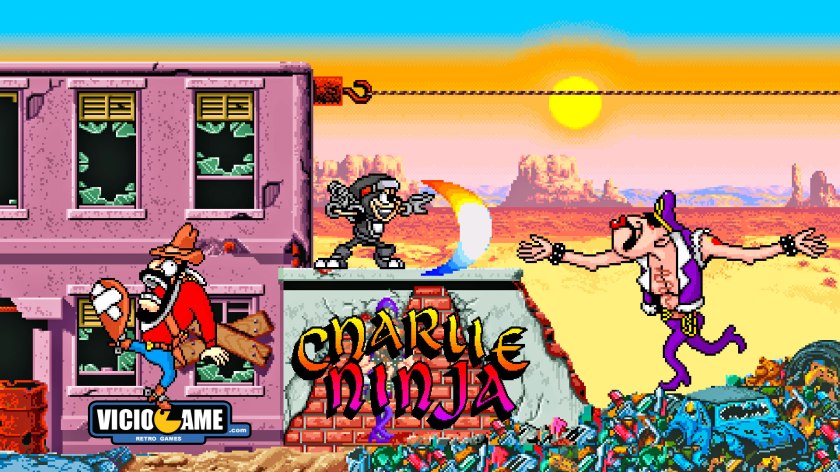
Charlie Ninja is a platform game released for arcades in 1994. Roy and Lon are two bounty-hunter ninjas hired to take down a string of villains. Since it’s a solid title made by former Capcom staff, it wouldn’t be complete without the classic fighting-game moves you’d recognize from Street Fighter.
Developer/Publisher: Mitchell Corporation
Release Date: 1994
Platform: Arcade Data East Simple 156 board
🇺🇸 Charlie Ninja is an arcade game released in October 1994, developed and published by Mitchell Corporation, a Japanese studio based in the Suginami ward of Tokyo. It’s a hybrid title that combines platforming with shoot-‘em-up mechanics, while also borrowing special-move inputs from fighting games. The game features two ninjas working as bounty hunters, hired to take down a string of villains who have nothing to do with one another, each residing in their own themed setting. Despite the title suggesting the existence of a character named Charlie, none of the game’s heroes, villains, or background characters actually bear that name — one of the small mysteries that still surrounds the production to this day.
Mitchell Corporation was originally founded in 1960, and over the following decades brought on board several former Capcom employees, among them Kouichi Yotsui, creator of the Strider franchise and the mind behind another cult title in the company’s catalog, Cannon Dancer, released in the West as Osman. The company also maintained a close relationship with Capcom itself on the Pang series (also known as Buster Bros.) and became known for its puzzle games, such as Puzz Loop. Charlie Ninja emerged from that context as one of the most peculiar entries in Mitchell’s action catalog (made by a production team of 20 people), alongside contemporary titles like Funky Jet and The Karate Tournament. Despite its originality, the game never achieved much commercial success — not even the studio’s own official website ever historically listed Charlie Ninja, even though other titles from the same era were present.
The game uses an eight-way joystick and just a few action buttons, enough to cover attacking, jumping, and the combined inputs that trigger special moves. Up to two players can take part at once in co-op mode. Because it was only ever distributed on a small scale, Charlie Ninja is today one of the rarest boards in Mitchell’s catalog: very few original cabinets are known to exist today, and most of them remain in private collections.
The premise follows the classic mold of 1990s arcade action games: each stage opens with a wanted poster announcing the local villain, and the goal is to push through the level wiping out hordes of enemies until the final showdown against that stage’s boss. The two playable ninjas are named Roy, controlled by player one, and Lon, controlled by player two — the latter recognizable by his red outfit, in contrast to his partner’s. The game adopts an extremely exaggerated cartoonish look, with distorted body proportions and over-the-top facial expressions reminiscent of classic animators like Tex Avery, along with sound effects spelled out directly on screen — a device that, years later, would become popular again in other animated productions. That aesthetic extends to the settings themselves: practically every stage is an exaggerated mashup of scenery and American cultural stereotypes, giving the game an air of good-natured, unpretentious satire.
As for gameplay, the player moves through the stages alternating between jumps, melee attacks with a short sword, and ranged attacks. The default weapon is a shuriken, but progressing through the level lets the player pick up alternate weapons, revealed by smashing or throwing barrels and crates at enemies, or dropped by defeated foes: a sai that automatically homes in on the nearest target, a spiked spherical projectile, kunai thrown at an angle, and a kind of triple bladed boomerang. Hearts scattered across the level restore the health bar, while a double jump — performed by pressing the jump button a second time in midair — lets the player reach elevated platforms and dodge enemy attacks. Beyond the basic moves, each ninja’s moveset includes special attacks triggered by direction-and-button combinations: an aerial spinning kick, a rolling attack, and a slashing lunge performed with an input similar to the classic “Shoryuken” move from the Street Fighter series. Pressing the attack and jump buttons at the same time also triggers a temporary camouflage that makes the character invisible and invulnerable for a few seconds, at the cost of leaving them completely unable to move while the effect lasts.
The first stage drops the player into a typical Old West street, full of miniature saloons and shops, gunslingers hiding inside rolling barrels, and figures inspired by Native American peoples who throw tomahawks. The stage ends with a confrontation against Blues, an outlaw gunslinger who jumps and spins through the air firing both guns at once, in a scene reminiscent of the acrobatic style of protagonists from games like Contra.
The second stage shifts tone dramatically, set in a war-torn military zone full of traps, soldiers armed with M16 rifles, tanks, and an enemy clearly inspired by 1980s war-action movies, evoking the figure of Rambo as a lone warrior with a headband and a bow and arrow. The stage boss, Sanders, is a heavyset soldier wielding a circular-looking weapon, something like a ring launcher, and his name is a tongue-in-cheek nod to the mustachioed colonel mascot of a famous fast-food chain.
In the third stage, the setting shifts to a run-down urban area near a dockyard, populated by thugs who hurl objects at the player. The local villain, Freddie, is a flamboyant biker whose look recalls members of the band Village People and, in particular, the look of singer Freddie Mercury; his attacks include blown kisses thrown from a distance and bursts of toxic gas.
The fourth stage takes place inside a football stadium, where the player faces off against football players and pom-pom-waving cheerleaders who, once defeated, turn out to be men in drag — one of the gags that feels pretty dated by today’s standards. The boss is Bear, a quarterback who attacks by bouncing around the arena trying to crush the hero with his belly, breaking up the fight with the comic pause of messily eating an ice cream cone.
The fifth and final stage changes its aesthetic tone completely, dropping the cultural pastiche of the earlier levels in favor of a run-down lab and factory, populated by robotic ninjas — mechanized versions of the same colored grunts fought throughout the adventure — and by an enemy that evokes the classic look of the Friday the 13th horror films, with Jason and his hockey mask and relentless stamina. The final battle is against Dr. Mac, a mad scientist who, like the other bosses, is introduced with a portrait and an energy bar that slowly fills up before the fight, a device that directly recalls the way Robot Masters are presented in the Mega Man series. Dr. Mac retreats into a multi-stage mechanical exosuit, and part of the fight plays out during an auto-scrolling segment where the player can’t directly attack him, considerably stretching out the length of the final stage; one of his attacks, a horizontal charge, can take out the character instantly regardless of remaining health.
Throughout the adventure, the game reuses a family of colored ninja grunts, each with a fixed attack pattern: the green ones turn into a floating spiked ball that fires projectiles to the sides; the black ones throw shurikens; the blue ones attack in melee with sword strikes; the pink ones perform diving attacks; and the yellow ones throw firebombs. Another recurring detail is a small blue bird wearing aviator goggles that pops up here and there in the levels and on the transition screens between stages — a kind of unofficial Mitchell mascot that had first appeared a year earlier in another of the company’s titles, Double Wings, and never really caught on outside those two games.
At the time of its release, Charlie Ninja went almost completely unnoticed and never received an official home console port, a fate shared by much of Mitchell’s non-puzzle action catalog; some critics have speculated that a Super Nintendo version would have been technically feasible, but that conversion never materialized. The game is often compared to contemporaries like Sunset Riders, for the setting of its first stage, and Metal Slug, for the overall tone of the stages that follow, with Spinmaster on the Neo-Geo frequently cited as the closest title in terms of gameplay style within the same hardware generation. It has vibrant art direction and an upbeat soundtrack, while also showing flaws such as sprites so large and rubbery that they make it hard to read hitboxes accurately during melee attacks, along with screens overloaded with enemies and boss health bars considered disproportionate for such a short game, one that can be cleared in a little over twenty minutes.
More than three decades after its release, Charlie Ninja remains an endearing curiosity in the history of Japanese arcade games: a bold visual experiment, full of mismatched cultural references, lighthearted humor, and a title that, ironically, never quite explains itself. It’s exactly that combination of graphical eccentricity, frantic pacing, and a somewhat messy identity that makes this pair of bounty-hunting ninjas a fun little chapter for anyone interested in the less-explored corners of the arcade golden age, even though the game never achieved the recognition of the genre’s most celebrated classics.
🇧🇷 Charlie Ninja é um jogo de arcade lançado em outubro de 1994, desenvolvido e publicado pela Mitchell Corporation, estúdio japonês sediado no bairro de Suginami, em Tóquio. Trata-se de um título híbrido que combina jogo de plataforma com mecânicas de shoot ‘em up, incorporando ainda comandos de movimentos especiais emprestados dos jogos de luta. A obra apresenta dois ninjas que atuam como caçadores de recompensas, contratados para eliminar uma série de vilões completamente desconectados entre si, cada qual residindo em um cenário temático próprio. Apesar de o título sugerir a existência de um personagem chamado Charlie, nenhum dos heróis, vilões ou figurantes do jogo recebe esse nome — um dos pequenos mistérios que cercam a produção até hoje.
A Mitchell Corporation foi fundada originalmente em 1960 e, ao longo das décadas seguintes, reuniu em seus quadros diversos ex-funcionários da Capcom, entre eles Kouichi Yotsui, criador da franquia Strider e responsável por outro título de culto do catálogo da empresa, Cannon Dancer, lançado no Ocidente sob o nome de Osman. A companhia também manteve relação próxima com a própria Capcom na série Pang (também conhecida como Buster Bros.) e ficou conhecida por seus jogos de quebra-cabeça, como Puzz Loop. Charlie Ninja surgiu nesse contexto como um dos representantes mais peculiares do catálogo de ação da Mitchell (com uma equipe de produção de 20 profissionais), ao lado de títulos contemporâneos como Funky Jet e The Karate Tournament. Apesar de sua originalidade, o jogo jamais alcançou grande destaque comercial — nem mesmo o próprio site oficial do estúdio historicamente nunca chegou a listar Charlie Ninja, ainda que outros títulos da mesma época estivessem presentes.
O jogo utiliza um direcional de oito direções e poucos botões de ação, suficientes para cobrir ataque, salto e os comandos combinados que acionam os movimentos especiais. Até dois jogadores podem participar simultaneamente em modo cooperativo. Por ter circulado em escala reduzida, Charlie Ninja é hoje uma das placas mais raras do catálogo da Mitchell: pouquíssimas máquinas originais são conhecidas atualmente, e a maior parte delas permanece em coleções particulares.
A premissa segue o molde clássico dos jogos de ação de fliperama da década de 1990: cada fase apresenta ao jogador um cartaz de procurado anunciando o vilão local, e o objetivo é avançar pelo cenário eliminando hordas de inimigos até o confronto final contra o respectivo boss. Os dois ninjas jogáveis chamam-se Roy, controlado pelo primeiro jogador, e Lon, controlado pelo segundo — este último reconhecível por sua roupa em tom vermelho, em contraste com o traje do parceiro. O jogo adota uma estética cartunesca extremamente exagerada, com proporções corporais distorcidas e expressões faciais caricatas que remetem ao traço clássico de animadores como Tex Avery, além de efeitos sonoros escritos diretamente na tela — recurso que, anos depois, voltaria a ganhar popularidade em outras produções de animação. Essa estética se estende à própria ambientação: praticamente todas as fases são misturas exageradas de cenários e estereótipos culturais norte-americanos, o que confere ao jogo um tom de sátira despretensiosa.
No quesito jogabilidade, o jogador avança pelas fases alternando entre saltos, ataques corpo a corpo com uma espada curta e disparos à distância. A arma padrão é um shuriken, mas o avanço pelo cenário permite coletar armas alternativas reveladas ao destruir ou arremessar barris e caixotes contra os inimigos, ou obtidas de adversários derrotados: um sai com capacidade de perseguição automática do alvo mais próximo, um projétil esférico recoberto de espinhos, kunais lançados em ângulo e uma espécie de bumerangue triplo com lâminas. Corações espalhados pelo cenário restauram a barra de vida, enquanto um salto duplo — obtido ao pressionar o botão de salto uma segunda vez no ar — permite alcançar plataformas elevadas e escapar de ataques inimigos. Além dos movimentos básicos, o repertório de cada ninja inclui golpes especiais ativados por combinações de direção e botão: um chute giratório aéreo, um ataque de rolamento e uma investida cortante executada com um movimento semelhante ao clássico “Shoryuken” da série Street Fighter. Pressionar simultaneamente os botões de ataque e salto aciona ainda uma camuflagem temporária, que torna o personagem invisível e invulnerável por alguns segundos, ao custo de imobilizá-lo completamente enquanto o efeito dura.
A primeira fase transporta o jogador para uma rua típica do Velho Oeste, repleta de saloons e lojas em miniatura, pistoleiros escondidos dentro de barris rolantes e figuras inspiradas em povos indígenas norte-americanos que arremessam machadinhas. O confronto se encerra contra Blues, um pistoleiro foragido que salta e gira no ar disparando com as duas armas simultaneamente, em uma cena que remete ao estilo acrobático de protagonistas de jogos como Contra.
A segunda fase muda radicalmente de tom, ambientando-se em uma zona de conflito militar repleta de armadilhas, soldados armados com fuzis M16, tanques de guerra e um inimigo claramente inspirado em filmes de ação bélica dos anos 1980, evocando a figura do Rambo, como um guerreiro solitário de testa enfaixada e arco e flecha. O boss da fase, Sanders, é um militar corpulento equipado com uma arma de aparência circular, quase um lança-aros, e seu nome é uma referência irônica ao bigodudo coronel-mascote de uma famosa rede de fast-food.
Na terceira fase, o cenário passa para uma área urbana decadente próxima a um cais portuário, povoada por bandidos que arremessam objetos contra o jogador. O vilão local, Freddie, é um motoqueiro extravagante cuja caracterização remete a integrantes do grupo musical Village People e, em particular, ao visual do cantor Freddie Mercury; seus ataques incluem beijos arremessados a distância e rajadas de gás tóxico.
A quarta fase acontece dentro de um estádio de futebol americano, onde o jogador enfrenta jogadores de futebol e torcedoras com pompons que, ao serem derrotadas, revelam-se homens travestidos — um dos momentos de humor hoje considerados datados. O boss é Bear, um quarterback que ataca quicando pelo cenário na tentativa de esmagar o herói com a barriga, intercalando o combate com a pausa cômica de se lambuzar com um sorvete de casquinha.
A quinta e última fase muda completamente de tom estético, abandonando o pastiche cultural das fases anteriores em favor de um laboratório e fábrica decadentes, povoados por ninjas robóticos — versões mecanizadas dos mesmos capangas coloridos enfrentados ao longo da aventura — e por um inimigo que evoca o visual clássico de filmes de terror Sexta-Feira 13, com Jason e sua máscara de hóquei e fôlego implacável. O confronto final se dá contra Dr. Mac, cientista louco que, como os demais bosses, é apresentado por um retrato e uma barra de energia que se enche lentamente antes da luta, recurso que lembra diretamente a apresentação dos Robot Masters da série Mega Man. Dr. Mac foge para dentro de um exoesqueleto mecânico de múltiplas etapas, e parte do combate se desenrola em um trecho de rolagem automática no qual o jogador não consegue atacá-lo diretamente, alongando consideravelmente a duração da fase final; um de seus golpes, uma carga horizontal, é capaz de eliminar o personagem instantaneamente, independentemente da vida restante.
Ao longo de toda a aventura, o jogo reaproveita uma família de ninjas-capangas coloridos, cada um com um padrão de ataque fixo: os verdes transformam-se em uma bola de espinhos que flutua e dispara projéteis para os lados; os pretos arremessam shurikens; os azuis atacam corpo a corpo com golpes de espada; os rosas executam ataques de mergulho; e os amarelos lançam bombas incendiárias. Outro detalhe recorrente é um pequeno pássaro azul, usando óculos de aviador, que aparece esporadicamente no cenário e nas telas de transição entre fases — uma espécie de mascote não oficial da Mitchell que havia debutado um ano antes em outro título da própria empresa, Double Wings, e que não chegou a se popularizar fora desses dois jogos.
Na época de seu lançamento, Charlie Ninja passou praticamente inadvertido e nunca recebeu uma conversão oficial para consoles domésticos, destino compartilhado por boa parte do catálogo de ação não voltado a quebra-cabeças da Mitchell; alguns críticos chegaram a especular que uma versão para o Super Nintendo teria sido tecnicamente viável, mas essa conversão nunca se concretizou. A obra costuma ser comparada a contemporâneos como Sunset Riders, pela ambientação da primeira fase, e Metal Slug, pelo tom geral das fases seguintes, sendo Spinmaster, do Neo-Geo, frequentemente citado como o título mais próximo em termos de estilo de jogo dentro da mesma geração de hardware. Possui uma direção de arte vibrante e trilha sonora animada, ao mesmo tempo em que demonstra problemas como sprites tão grandes e elásticos que dificultam a leitura precisa das hitboxes durante os ataques corpo a corpo, além de telas excessivamente carregadas de inimigos e bosses com barras de vida consideradas desproporcionais para um título tão curto, que pode ser zerado em pouco mais de vinte minutos.
Mais de três décadas depois de seu lançamento, Charlie Ninja permanece como uma curiosidade simpática dentro da história dos jogos de fliperama japoneses: um experimento visual ousado, repleto de referências culturais desencontradas, humor inconsequente e um título que, ironicamente, nunca chega a explicar a si mesmo. É justamente essa combinação de excentricidade gráfica, ritmo frenético e identidade um tanto bagunçada que faz da dupla de ninjas caçadores de recompensas um pequeno capítulo divertido para quem se interessa pelos cantos menos explorados da era de ouro dos arcades, mesmo sem o jogo jamais ter alcançado o reconhecimento dos clássicos mais célebres do gênero.
🤑💲Earn money without doing anything! Just leave these apps open:
✓ https://r.honeygain.me/CONTA9DB02
✓ https://packetstream.io/?psr=1uPb
🤑💲1-Click button earns Bitcoin every 1 hour: https://freebitco.in/?r=53528449
⬛ 𝗧𝗶𝗸𝗧𝗼𝗸: https://www.tiktok.com/@viciogame
🟧 𝗜𝗻𝘀𝘁𝗮𝗴𝗿𝗮𝗺: http://www.instagram.com/viciogame
🟥 𝗬𝗼𝘂𝘁𝘂𝗯𝗲: http://www.youtube.com/viciogame
🟦 𝗙𝗮𝗰𝗲𝗯𝗼𝗼𝗸: http://www.facebook.com/viciogame
🔳 𝗧𝗵𝗿𝗲𝗮𝗱𝘀: https://www.threads.net/@viciogame
🟪 𝗧𝘄𝗶𝘁𝗰𝗵: https://www.twitch.tv/ViciogameRetroGames
🟨 𝗕𝗹𝗼𝗴: http://www.viciogameblog.com/
🟦𝗧𝘄𝗶𝘁𝘁𝗲𝗿: http://www.twitter.com/viciogame
#Viciogame #Gameplay #LetsPlay #Playthrough #Games #Gaming #Videogames #Review #Game #Detonado #Walkthrough #Ending #Reviews #Facts #Retro #RetroGaming #Roms #Emulator #Longplay #Speedrun #NoCommentary #CharlieNinja #arcade #beatemup #platformer #ninja #Strider #CannonDancer #Osman #Capcom
 VICIOGAME