
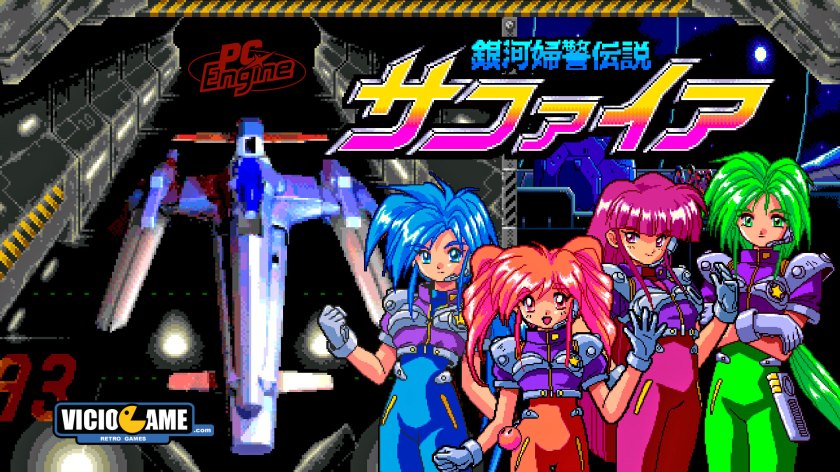
Ginga Fukei Densetsu Sapphire is a vertical-scrolling shoot ‘em up released in 1995 for the PC Engine Arcade CD-ROM². Set in the year 2092, your mission is to travel through time to investigate and eliminate a dangerous terrorist who moves through different historical periods committing crimes.
Developer: CAProduction
Publisher: Hudson Soft
Release Date: 1995
Platform: PC Engine Arcade CD-ROM²
🇺🇸 Released exclusively in Japan on November 24, 1995, Ginga Fukei Densetsu Sapphire (銀河婦警伝説サファイア) occupies a very particular place in the history of the PC Engine: that of a technical farewell piece for a platform which, by that point, was already competing for market space with next-generation consoles. The Japanese title, whose free translation would be something close to “The Legend of the Galactic Policewomen: Sapphire,” identifies a vertically scrolling shoot ‘em up developed by CAProduction and published by Hudson Soft specifically for the Arcade CD-ROM² format, the most advanced and demanding of the optical media tiers the system ever received. Decades after its release, Sapphire is remembered both for the audiovisual spectacle it offers and for the extreme rarity of its original copies — two factors that, combined, have turned the game into one of the most coveted, and most expensive, items among PC Engine and TurboGrafx-16 collectors worldwide.
To understand why such a lavish shoot ‘em up emerged at exactly this moment in the PC Engine‘s life, it’s worth recalling the context of the Japanese video game market in the mid-1990s. The overwhelming success of Street Fighter II had shifted public interest away from spaceship shooters toward fighting games, and NEC, the maker of the PC Engine, responded to that shift by developing the Arcade Card, an expansion card that added roughly 2 MB of RAM to the system along with new ways for the processor to access it. That accessory sat at the top of a compatibility hierarchy that traced back to the original CD-ROM² in 1988, moved through the Super CD-ROM² in 1991, and culminated in the Arcade CD-ROM² format, reserved for just over a dozen titles, most of them conversions of fighting and arcade games such as Fatal Fury, Art of Fighting, and Mad Stalker, designed to compete on equal footing with what the Super Nintendo and Mega Drive had to offer. Despite the shoot ‘em up genre’s already declining popularity in the mainstream market, Hudson Soft decided to commission one last representative of the genre for this format: a project conceived as a genuine technical showcase for what the PC Engine‘s expanded hardware was still capable of delivering. Sapphire would thus become practically the only shoot ‘em up dedicated to the Arcade Card amid that small catalog otherwise dominated by fighting games.
The commission fell to CAProduction, a studio that by this point already enjoyed a solid reputation with Hudson Soft. Its founders came from the team known as Red Raimon (or Red Kaminarimon), a core group within Red Company made up of former Technosoft employees who had left the company in 1991 after working on the Thunder Force series. It was this team that had created Gate of Thunder in 1992 and its unofficial sequel, Lords of Thunder (Winds of Thunder in Japan), in 1993, two of the most celebrated shoot ‘em ups in the entire PC Engine catalog. Formally established as CAProduction in 1993, the team was hard at work on a possible third chapter of the “Thunder” series when Hudson Soft interrupted the project to redirect it toward this new commission. It’s a historical curiosity that this same CAProduction would, decades later, set shoot ‘em ups aside almost entirely to become one of Nintendo’s main partners in developing the Mario Party series.
The other key name behind Sapphire is character designer Mika Akitaka, one of the most respected illustrators and mechanical designers in Japanese animation of the 1980s and 1990s, who worked on Gundam franchise productions such as Zeta Gundam, Gundam ZZ, 0080: War in the Pocket, and 0083: Stardust Memory. It was out of his “MS Girls” illustration series, girls wearing armor styled after Gundam mobile suits, that Akitaka developed, in 1992, the concept that would become Galaxy Fräulein Yuna, the popular adventure and visual novel series also published by Hudson Soft for the PC Engine. As Akitaka himself explained years later, on a panel at Anime Expo 1998, his original pitch for that project had been a shoot ‘em up starring a girl inspired by his mechanical design work for Gundam F91; over the course of development, however, the project evolved into a visual novel instead. The popularity of Galaxy Fräulein Yuna and of the bishōjo genre as a whole caught Hudson Soft’s attention, and the company decided to pair Akitaka with CAProduction right as the studio was looking for a new project, finally allowing the character designer to realize, years later, that original shoot ‘em up concept that had fallen by the wayside. It’s worth noting that, despite the shared name and the same person handling the visuals, Sapphire‘s story has no narrative connection whatsoever to the Galaxy Fräulein Yuna universe: it’s an original, independent plot, even though the similarity in naming caused some confusion among audiences at the time.
Direction of the project fell to Osamu Tsujikawa, while Hudson Soft also brought in animation studio J.C.Staff, the same studio behind the Galaxy Fräulein Yuna OVAs, to collaborate on the game’s animation work. The soundtrack was handled by the collective T’s Music, a group of musicians and sound engineers founded in 1990 that had already been working with Hudson Soft for some years, including on the score for Lords of Thunder; names associated with Sapphire‘s compositions include Toshiharu Yoneyama and Takashi Tateishi. That same collective would go on to score Final Fight CD and the Sentimental Graffiti series.
Sapphire‘s story is set in the year 2092, an era in which time travel has become so commonplace that even flying cars are used as time machines. As one might expect, not everyone who travels across the eras carries good intentions: criminals and terrorists take to hiding weapons and contraband scattered throughout the past, forcing the creation of an all-female police force nicknamed the Burning Rabbits and attached to a division dedicated to investigating time-travel-related crimes. The plot follows this very unit as it pursues BJ, a particularly dangerous, heavily armed terrorist who crosses through different historical periods trying to evade the law.
Players can choose between four policewomen to pilot across the timeline, each with her own ship, color scheme, and playstyle. Sapphire, the title character, has blue hair and is described as someone who pursues lofty ideals without clinging to them too rigidly, always reacting to whatever comes her way with a sense of calm. Charlotte Syphon, with pink hair, tends to come across as younger than she actually is because of her manner of speech, but is considered the best pilot of the four when it comes to handling space-time fighters. Rounding out the group are Helena Evangelin, with green hair, whose ship carries the most powerful arsenal of the cast in exchange for noticeably slower movement speed than her colleagues, and Jasmin Willoung, with purple hair. This kind of speed differentiation between ships is somewhat unusual by PC Engine standards, where shoot ‘em ups typically allowed real-time speed adjustment; here, speed is tied to character selection instead, acting as a counterweight to each pilot’s firepower.
Mechanically, Sapphire follows the classic color-coded weapon formula found in countless other genre entries: red gems grant a wide shot, blue gems a straight laser-style shot, and green gems a weapon that covers the ship’s rear, adding up to twelve distinct weapons across several power-up stages. Holding the fire button without shooting for a few moments charges up a pair of pods that then follow the ship around; once released, they fire at enemies with considerable destructive power, including a degree of automatic homing onto targets, and grant score multipliers proportional to the number of enemies destroyed, on top of being able to absorb a limited amount of enemy fire while hovering beside the ship. Each character also has a limited number of bombs, usually up to two, which grant a brief period of invincibility when used. Difficulty is adjustable, players can grant themselves up to nine credits from the options screen, and both extra lives and additional continues can be earned through a high score; upon clearing the game, players can still tack on final bonuses of 50,000 points for each remaining life and 20,000 points for each unused bomb. A two-player cooperative mode is also available, reinforcing Sapphire‘s identity as a shoot ‘em up geared more toward shared fun than toward extreme challenge.
The campaign spans five stages, each set in a distinct time period and setting, tied together by the throughline of time travel. The first takes players to a futuristic city with an aesthetic reminiscent of films like Blade Runner, complete with fire-spewing pyramids, neon signage everywhere, and digitized holographic faces projected onto the buildings. The second is set in medieval Europe in the year 1194, amid castles, dragons, and enemy ships disguised as gargoyles that transform right before the player’s eyes. The third carries the action to ancient Japan, populated by mythological creatures such as phoenixes and a kirin. The fourth stage has an Egyptian theme, complete with a battle against a sphinx-shaped battleship and an invasion of a pyramid. The fifth and final stage takes place in outer space, with organic-mechanical-looking monsters reminiscent of those found in R-Type. The stages don’t always scroll strictly upward, occasionally featuring terrain obstacles that force players to maneuver around them, an uncommon detail for vertically scrolling shoot ‘em ups. Despite the narrative potential opened up by the time-travel premise, only three of the five stages actually take place in historical periods, which makes the concept feel somewhat underused; add to that the fact that the stages are relatively short compared to the length of the boss fights, and the result is a campaign that many describe as shorter than expected for a game of such visual ambition.
It’s precisely on the visual front that Sapphire builds its most enduring reputation. The game’s great trick is convincing players they’re watching real-time-rendered polygonal graphics: most enemies and bosses display simple, angular models with little to no texturing, animated with a fluidity that’s impressive by PC Engine standards. In practice, though, these are two-dimensional sprites pre-rendered from 3D models, displayed with such a generous number of animation frames, made possible by the Arcade Card‘s extra memory, that the illusion holds up convincingly; the difference from a genuine combination of 2D sprites and real polygons, such as the one seen in Mega Man X2 and Mega Man X3 for the Super Nintendo (which relied on a dedicated math coprocessor chip), is subtle enough to fool most players. Beyond this central effect, the game invests in morphing transformations, like the gargoyle that turns into an enemy ship in the second stage or the holographic faces in the first, along with scaling effects, dramatic lighting, and generous parallax scrolling. The pilots’ portraits and ship designs, both credited to Akitaka, reinforce this anime visual identity, even though the characters themselves appear very little outside the intro, the ending, and brief interludes between stages, in which they exchange short, voiced lines, such as confirming their route or lamenting that the target has slipped away again, a striking contrast with the more narrative-driven nature of the Galaxy Fräulein Yuna series with which Sapphire is associated by creative heritage.
The soundtrack, credited to T’s Music, follows the same standard of excellence associated with PC Engine CD-ROM² CD audio, blending heavy rock with grandiose-sounding synthesizers that recall the same collective’s work on Lords of Thunder directly, more specifically the cleaner-produced version released for Sega CD than the rawer mix originally heard on the PC Engine CD. The heroic tone of the compositions fits the space-cop role played by the protagonists, even if, in hindsight, it also contributes to a certain degree of overstatement in the game’s overall presentation. Despite this soundtrack’s widely recognized quality, no official album was ever released at the time; it would take decades before unofficial compilations, put together by fans and collectors, gathered the tracks extracted directly from the game’s CD.
Sapphire hit Japanese stores on November 24, 1995, a release late enough to coincide with a moment of generational transition in the industry: the Sega Saturn and PlayStation had already been available for over a year, and that same day marked the opening of the 1995 Shoshinkai (Space World) event, at which Nintendo would reveal the Nintendo 64 to the world. Against that backdrop, a PC Engine shoot ‘em up with such lofty technical ambitions sounded almost anachronistic; indeed, the game circulated only in Japan, with no official localization for other markets. To run it, players needed the correct variant of the Arcade Card — the Arcade Card Pro for the original Interface Unit, or the Arcade Card Duo for PC Engine Duo systems and equivalents — which by itself already limited the audience able to experience it even at the time of release.
The immediate critical reception, as measured by Famitsu magazine’s reviewers, was lukewarm: scores averaged out to 4.75 out of ten, reflecting fairly divided opinions. One reviewer likened the game’s flashy aesthetic to older classics such as Truxton and Aleste, while another praised the graphical quality as impressive for an 8-bit machine, a direct reference to the PC Engine‘s architecture, which was technically built around an 8-bit CPU despite its graphical capabilities being advanced for the time. Others found the game too difficult, an opinion that was openly disputed by some, while others complained about a lack of any sense of speed in the action. One reviewer even admitted to being surprised by the game’s genre itself, since the title, in the vein of “Ginga [something] Densetsu,” had led him to expect a character-raising simulation game, in the style of the raising sims popularized by franchises like Galaxy Fräulein Yuna itself, rather than a straightforward shoot ‘em up.
Because it arrived on the market so close to the end of the PC Engine‘s commercial life cycle, Sapphire was produced in a small print run, which quickly turned it into a collector’s item. Used copies were already selling for around $300 in 2008, according to critic E. Kozo, not counting the cost of the period-appropriate Japanese hardware, running into the hundreds of dollars, needed to run it; by 2015, Eurogamer was recording prices near £300 for original copies, and more recent reports, coinciding with the release of the miniature consoles in the early 2020s, were already citing values between $400 and over $900 depending on disc condition and packaging completeness. That price escalation also attracted counterfeiters: around 2005, extremely high-quality bootleg copies began circulating, so well produced that only close examination could tell them apart from the originals, and these bootlegs themselves came to be traded for over £100, further distorting the pricing of genuine copies. In terms of rarity and market value, Sapphire is often mentioned alongside Sylphia, another vertically scrolling PC Engine shoot ‘em up equally coveted by collectors.
Decades on, retrospective criticism has treated Sapphire with far more enthusiasm than Famitsu’s original review panel did. Kurt Kalata of Hardcore Gaming 101 described the game as the ultimate PC Engine shooter, a genuine showcase of what the console was capable of producing, and included it among the “holy grails” of the platform’s game library. E. Kozo, meanwhile, in a review published in the print magazine Hardcore Gamer during the winter of 2008, went so far as to call it one of the best shooters ever made, highlighting the parallax scrolling and lighting effects as standout elements of the production. Italian site IGN, for its part, included Sapphire among the most important shoot ‘em ups in the entire PC Engine catalog, alongside Gate of Thunder, Lords of Thunder, and Rayxanber III. Not every retrospective assessment was pure praise, though: the site HonestGamers, for instance, while celebrating the spotlight effects, the smooth sprite rotation, and the spinning polygons, noted that the game’s arsenal is mastered fairly easily and never demands the technical refinement seen in other shooters of the period, concluding that, for all its visual energy, Sapphire never quite matches the intensity of stages like Gate of Thunder‘s “Dark City” or the mechanical spider showdown in Rayxanber II. The consensus that emerges from these decades of reassessment is fairly consistent: the gameplay itself is competent but not especially innovative, and it’s the audiovisual package that elevates Sapphire to cult-classic status, a reputation so outsized, in fact, that it sometimes overshadows the game’s real quality, still solid if understated, lurking behind the spectacle.
For many years, Sapphire‘s price and rarity kept it essentially out of reach for the vast majority of players. That situation changed somewhat on July 31, 2008, when Hudson Soft released, exclusively in Japan, the Ginga Ojousama Densetsu Collection compilation for PSP, part of the “PC Engine Best Collection” series. The compilation bundles Sapphire together with the first two Galaxy Fräulein Yuna games and adds the ability to adjust the screen aspect ratio between three options — the original ratio, which fills half the screen, a version slightly stretched vertically to cover most of the screen, and a full-screen mode — along with a gallery of concept art by Akitaka. While the conversion is faithful to the original material, it did drop the two-player cooperative mode found in the PC Engine version. In contemporary reviews, Kozo considered the compilation a great deal, since an original copy of Sapphire alone was worth roughly ten times the price of the whole package, though he criticized the implementation of the aspect ratio options — none of the three, in his assessment, was fully satisfactory, and the set was even missing a proper vertical option. Even so, he concluded that the re-release proved Sapphire was an example of a quality game capable of standing the test of time.
More than a decade later, Sapphire got a second life on miniature consoles: the PC Engine mini arrived in Japan on March 19, 2020, followed by the TurboGrafx-16 Mini in North America on May 22, 2020, and in Europe on June 5 of that same year. On both versions, Sapphire stands as the sole representative of the Arcade CD-ROM² format among the shoot ‘em ups on the entire included game list, and it quickly became one of the biggest draws of these re-releases precisely because it represented, for most players, the first realistic chance to experience a game previously restricted to collectors willing to spend hundreds or thousands of dollars. The specialized press repeatedly highlighted this aspect when covering the mini-consoles’ launch, treating Sapphire as a symbol of both the technical peak and the commercial end of the line that the PC Engine experienced in the mid-1990s.
In the end, there’s something poetic about a game named “legend” having, over the course of three decades, become exactly that. Ginga Fukei Densetsu Sapphire condenses, in a single production, the technical ambition CAProduction inherited from its work on Gate of Thunder and Lords of Thunder, the aesthetic sensibility of Mika Akitaka forged between Gundam mobile suits and space girls, and Hudson Soft’s determination to prove, one last time before closing the book on the PC Engine chapter, that there were still fireworks left inside that aging hardware. It’s this combination of factors, more than any specific mechanical innovation, that secures Sapphire a treasured place in the affectionate memory of anyone who closely follows the history of Japanese shoot ‘em ups and of the PC Engine universe as a whole.
🇧🇷 Lançado com exclusividade no Japão em 24 de novembro de 1995, Ginga Fukei Densetsu Sapphire (銀河婦警伝説サファイア) ocupa uma posição muito particular na história do PC Engine: a de peça de despedida técnica de uma plataforma que, àquela altura, já disputava espaço de mercado com consoles de geração seguinte. O título japonês, cuja tradução livre seria algo próximo de “A Lenda das Policiais da Galáxia: Sapphire”, identifica um shoot ‘em up de rolagem vertical desenvolvido pela CAProduction e publicado pela Hudson Soft especificamente para o formato Arcade CD-ROM², a mais avançada e exigente das camadas de mídia óptica que o sistema chegou a receber. Décadas após seu lançamento, Sapphire segue sendo lembrado tanto pelo espetáculo audiovisual que oferece quanto pela raridade extrema de suas cópias originais — dois fatores que, combinados, transformaram o jogo em um dos itens mais cobiçados, e mais caros, entre colecionadores de PC Engine e TurboGrafx-16 em todo o mundo.
Para entender por que um shoot ‘em up tão suntuoso surgiu justamente nesse momento da vida do PC Engine, vale lembrar o contexto do mercado japonês de videogames em meados dos anos 1990. O sucesso arrasador de Street Fighter II havia deslocado o interesse do público dos jogos de nave para os jogos de luta, e a NEC, fabricante do PC Engine, respondeu a essa mudança desenvolvendo o Arcade Card, cartão de expansão que adicionava cerca de 2 MB de memória RAM ao sistema, além de novas formas de acessá-la pelo processador. Esse acessório representava o topo de uma hierarquia de compatibilidade que já vinha do CD-ROM² original, de 1988, passando pelo Super CD-ROM², de 1991, até culminar no formato Arcade CD-ROM², reservado a pouco mais de uma dezena de títulos, a maioria conversões de jogos de luta e de arcade, como Fatal Fury, Art of Fighting e Mad Stalker, concebidas para competir de igual para igual com o que Super Nintendo e Mega Drive ofereciam. Apesar da popularidade já declinante do shoot ‘em up no mercado mainstream, a Hudson Soft decidiu encomendar um último representante do gênero para esse formato: um projeto concebido como verdadeira vitrine técnica daquilo que o hardware expandido do PC Engine ainda era capaz de entregar. Sapphire se tornaria, assim, praticamente o único shoot ‘em up dedicado ao Arcade Card em meio a esse pequeno catálogo dominado por jogos de luta.
A encomenda recaiu sobre a CAProduction, estúdio que a essa altura já gozava de reputação sólida junto à Hudson Soft. Seus fundadores vinham da equipe conhecida como Red Raimon (ou Red Kaminarimon), um núcleo dentro da Red Company formado por ex-funcionários da Technosoft que haviam deixado a empresa em 1991, depois de trabalhar na série Thunder Force. Foi essa equipe que assinou Gate of Thunder, de 1992, e sua continuação não oficial, Lords of Thunder (Winds of Thunder no Japão), de 1993, dois dos shoot ‘em ups mais celebrados de todo o catálogo do PC Engine. Formalizada como CAProduction em 1993, a equipe estava debruçada sobre um possível terceiro capítulo da série “Thunder” quando a Hudson Soft interrompeu o projeto para redirecioná-la a essa nova encomenda. É uma curiosidade histórica que a mesma CAProduction, décadas depois, deixaria de lado os shoot ‘em ups quase por completo para se tornar uma das principais parceiras da Nintendo no desenvolvimento da série Mario Party.
O outro nome fundamental por trás de Sapphire é o character designer Mika Akitaka, um dos ilustradores e mechanical designers mais respeitados da animação japonesa dos anos 1980 e 1990, com passagens por produções da franquia Gundam como Zeta Gundam, Gundam ZZ, 0080: War in the Pocket e 0083: Stardust Memory. Foi a partir de sua série de ilustrações “MS Girls”, garotas vestindo armaduras no estilo dos mobile suits de Gundam, que Akitaka desenvolveu, em 1992, o conceito que se tornaria Galaxy Fräulein Yuna, a popular série de aventura e visual novel também publicada pela Hudson Soft para o PC Engine. Segundo o próprio Akitaka relatou anos depois, em painel na Anime Expo de 1998, sua proposta original para aquele projeto era a de um shoot ‘em up estrelado por uma garota inspirada em seu design mecânico para o Gundam F91; o projeto, no entanto, acabou evoluindo para uma visual novel ao longo do desenvolvimento. A popularidade de Galaxy Fräulein Yuna e do gênero bishōjo como um todo chamou a atenção da Hudson Soft, que decidiu reunir Akitaka à CAProduction bem no momento em que esta buscava um novo projeto, permitindo, enfim, que o character designer concretizasse, anos mais tarde, aquele conceito original de shoot ‘em up que havia ficado pelo caminho. Vale notar que, apesar do título homônimo e do mesmo responsável pelo visual, a história de Sapphire não tem qualquer vínculo narrativo com o universo de Galaxy Fräulein Yuna: trata-se de um enredo original e independente, ainda que essa proximidade de nomenclatura tenha causado certa confusão entre o público da época.
A direção do projeto ficou a cargo de Osamu Tsujikawa, enquanto a Hudson Soft também recorreu ao estúdio de animação J.C.Staff, o mesmo por trás dos OVAs de Galaxy Fräulein Yuna, para colaborar nos trabalhos de animação do jogo. A trilha sonora coube ao coletivo T’s Music, grupo de músicos e engenheiros de som fundado em 1990 que já vinha trabalhando com a Hudson Soft havia alguns anos, incluindo a trilha de Lords of Thunder; entre os nomes associados às composições de Sapphire estão Toshiharu Yoneyama e Takashi Tateishi. O mesmo coletivo assinaria, na sequência, as trilhas de Final Fight CD e da série Sentimental Graffiti.
A história de Sapphire se passa no ano de 2092, época em que a viagem no tempo se tornou algo tão corriqueiro que até carros voadores são utilizados como máquinas do tempo. Como era de se esperar, nem todos que cruzam as eras carregam boas intenções: criminosos e terroristas passam a esconder armamentos e contrabando espalhados pelo passado, forçando a criação de uma força policial formada inteiramente por mulheres, apelidada de Burning Rabbits e vinculada a uma divisão dedicada a investigar crimes relacionados à viagem no tempo. A trama acompanha justamente essa unidade em sua perseguição a BJ, um terrorista especialmente perigoso e bem armado que atravessa diferentes períodos históricos tentando escapar da lei.
O jogador pode escolher entre quatro policiais para pilotar através da linha do tempo, cada uma com nave, esquema de cores e estilo de jogo próprios. Sapphire, a protagonista titular, tem cabelos azuis e é descrita como alguém que persegue ideais elevados sem se apegar rigidamente a eles, sempre reagindo com serenidade diante das situações que surgem pela frente. Charlotte Syphon, de cabelos rosa, costuma ser vista como mais jovem do que realmente é por causa de seu jeito de falar, mas é considerada a melhor piloto entre as quatro no comando de caças espaço-temporais. Completam o grupo Helena Evangelin, de cabelos verdes, cuja nave carrega o arsenal mais poderoso do elenco em troca de uma velocidade de deslocamento sensivelmente mais lenta que a das colegas, e Jasmin Willoung, de cabelos roxos. Essa diferenciação de velocidade entre as naves é um tanto incomum para os padrões do PC Engine, cujos shoot ‘em ups costumavam permitir o ajuste de velocidade em tempo real; aqui, a escolha da velocidade está atrelada à escolha da personagem, funcionando como contrapeso ao poder de fogo de cada uma.
Mecanicamente, Sapphire segue a fórmula clássica de armas coloridas encontrada em inúmeros outros representantes do gênero: gemas vermelhas concedem um tiro largo, gemas azuis um tiro reto no estilo laser, e gemas verdes uma arma que cobre a retaguarda da nave, somando doze armas distintas ao longo de vários estágios de power-up. Ao segurar o botão de tiro sem disparar por alguns instantes, o jogador carrega um par de pods que passam a acompanhar a nave; uma vez liberados, eles disparam contra os inimigos com grande poder de destruição, inclusive com certa capacidade de perseguição automática aos alvos, e concedem multiplicadores de pontuação proporcionais ao número de inimigos abatidos, além de poderem absorver uma quantidade limitada de tiros inimigos enquanto pairam ao lado da nave. Cada personagem também dispõe de um número limitado de bombas, normalmente até duas, que concedem um breve período de invencibilidade ao serem usadas. A dificuldade é ajustável, o jogador pode conceder a si mesmo até nove créditos na tela de opções, e tanto vidas extras quanto continues adicionais podem ser conquistados a partir de uma pontuação elevada; ao zerar o jogo, ainda é possível somar bônus finais de 50.000 pontos para cada vida restante e 20.000 pontos para cada bomba não utilizada. O modo cooperativo para dois jogadores também está disponível, reforçando a vocação de Sapphire como um shoot ‘em up voltado à diversão compartilhada mais do que ao desafio extremo.
A campanha se estende por cinco fases, cada uma ambientada em uma época e um cenário distintos, unidos pelo fio condutor da viagem no tempo. A primeira leva o jogador a uma cidade futurista de estética que remete a filmes como Blade Runner, com pirâmides cuspindo chamas, letreiros de neon por toda parte e rostos holográficos digitalizados projetados sobre os prédios. A segunda se passa na Europa medieval do ano 1194, entre castelos, dragões e naves inimigas disfarçadas de gárgulas que se transformam diante dos olhos do jogador. A terceira transporta a ação ao Japão antigo, povoado por criaturas mitológicas como fênixes e um kirin. A quarta fase tem tema egípcio, com direito a uma batalha contra um encouraçado em forma de esfinge e uma invasão a uma pirâmide. A quinta e última fase se passa no espaço sideral, com monstros de aparência orgânico-mecânica que lembram os encontrados em R-Type. As fases nem sempre rolam estritamente para cima, apresentando ocasionalmente obstáculos de terreno que obrigam o jogador a desviar, um detalhe pouco comum em shoot ‘em ups de visão vertical. Apesar do potencial narrativo aberto pela premissa de viagem no tempo, apenas três das cinco fases de fato se passam em períodos históricos, o que faz esse conceito parecer subaproveitado; some-se a isso o fato de as fases serem relativamente curtas se comparadas à duração das batalhas contra chefes, e o resultado é uma campanha que muitos descrevem como mais breve do que o esperado para um jogo de tamanha ambição visual.
É justamente no terreno visual que Sapphire constrói sua reputação mais duradoura. O grande truque do jogo é convencer o jogador de que está testemunhando gráficos poligonais renderizados em tempo real: boa parte dos inimigos e chefes exibe modelos simples e angulosos, com pouca ou nenhuma textura, animados com uma fluidez impressionante para os padrões do PC Engine. Na prática, porém, trata-se de sprites bidimensionais pré-renderizados a partir de modelos 3D, exibidos com uma quantidade tão generosa de quadros de animação, viabilizada pela memória extra do Arcade Card, que o efeito ilusório se sustenta com convicção; a diferença em relação a um caso de combinação legítima entre sprites 2D e polígonos reais, como o visto em Mega Man X2 e Mega Man X3 para o Super Nintendo (que dependiam de um chip coprocessador matemático dedicado), é sutil o bastante para enganar a maioria dos jogadores. Além desse efeito central, o jogo investe em transformações de morphing, como a gárgula que se converte em nave inimiga na segunda fase ou os rostos holográficos da primeira, além de efeitos de escala, iluminação dramática e parallax scrolling generoso. Os retratos das pilotos e o design das naves, ambos assinados por Akitaka, reforçam essa identidade visual de anime, ainda que as próprias personagens apareçam muito pouco fora da introdução, do final e de breves interlúdios entre fases, nos quais trocam falas curtas e dubladas, como confirmações de rota ou lamentos por o alvo ter escapado outra vez, um contraste chamativo com a natureza mais narrativa da série Galaxy Fräulein Yuna à qual Sapphire está associado por herança criativa.
A trilha sonora assinada pela T’s Music segue o mesmo padrão de excelência associado ao áudio em CD do PC Engine CD-ROM², mesclando rock pesado e sintetizadores de sonoridade grandiosa que remetem diretamente ao trabalho do mesmo coletivo em Lords of Thunder, mais precisamente à versão lançada para Sega CD, de produção mais limpa, do que à mixagem mais crua ouvida originalmente no PC Engine CD. O tom heroico das composições combina com o papel de policial espacial vivido pelas protagonistas, ainda que, em retrospecto, também contribua para uma certa dose de exagero na apresentação geral do jogo. Apesar da qualidade amplamente reconhecida dessa trilha, nenhum álbum oficial chegou a ser lançado à época; apenas décadas depois surgiriam compilações não oficiais organizadas por fãs e colecionadores, reunindo as faixas extraídas diretamente do CD do jogo.
Sapphire chegou às lojas japonesas em 24 de novembro de 1995, um lançamento tardio o suficiente para coincidir com um momento de transição generacional na indústria: Sega Saturn e PlayStation já estavam disponíveis havia mais de um ano, e aquele mesmo dia marcava a abertura do evento Shoshinkai (Space World) de 1995, no qual a Nintendo revelaria ao mundo o Nintendo 64. Nesse cenário, um shoot ‘em up de PC Engine com pretensões técnicas tão elevadas soava quase anacrônico; de fato, o jogo circulou apenas no Japão, sem qualquer localização oficial para outros mercados. Para rodar, era indispensável possuir a variante correta do Arcade Card, Pro para o Interface Unit original ou Duo para os sistemas PC Engine Duo e equivalentes, o que por si só já restringia bastante o público capaz de experimentá-lo mesmo à época do lançamento.
A recepção crítica imediata, medida por avaliadores da revista Famitsu, foi morna: as notas resultaram na média de 4,75 de dez, refletindo opiniões bastante divididas. Um dos avaliadores associou a estética vistosa do jogo a clássicos mais antigos como Truxton e Aleste, enquanto outro elogiou a qualidade gráfica como impressionante para uma máquina de processador de 8 bits, referência direta à arquitetura do PC Engine, tecnicamente construída sobre uma CPU de 8 bits apesar de seus recursos gráficos avançados para a época. Outros consideraram o jogo difícil demais, opinião da qual houve discordância abertamente; enquanto alguns reclamaram da falta de sensação de velocidade na ação. Um dos avaliadores chegou a admitir surpresa com o próprio gênero do jogo, já que o título, na linha de “Ginga [algo] Densetsu”, o havia levado a esperar um jogo de simulação de criação de personagens, no estilo dos raising sims popularizados por franquias como a própria Galaxy Fräulein Yuna, em vez de um shoot ‘em up direto ao ponto.
Por ter chegado ao mercado tão perto do fim do ciclo de vida comercial do PC Engine, Sapphire foi produzido em tiragem baixa, o que rapidamente o transformou em item de colecionador. Cópias usadas já eram vendidas por cerca de 300 dólares em 2008, segundo o crítico E. Kozo, sem contar o custo do hardware japonês de época, na casa das centenas de dólares adicionais, necessário para rodá-lo; em 2015, a Eurogamer registrava preços próximos de £300 por exemplares originais, e relatos mais recentes, coincidindo com o lançamento dos consoles em miniatura no início da década de 2020, já mencionavam valores entre US$ 400 e mais de US$ 900 dependendo da condição do disco e da completude da embalagem. Essa escalada de preços também atraiu falsificadores: por volta de 2005, cópias falsificadas de altíssima qualidade começaram a circular, tão bem produzidas que só um exame minucioso permitia distingui-las dos originais, e que passaram a ser negociadas por si só a preços superiores a £100, distorcendo ainda mais a precificação de exemplares genuínos. Em termos de raridade e valor de mercado, Sapphire costuma ser mencionado ao lado de Sylphia, outro shoot ‘em up de visão vertical do PC Engine igualmente cobiçado por colecionadores.
Passadas as décadas, a crítica retrospectiva tratou Sapphire com bem mais entusiasmo do que o painel original da Famitsu. Kurt Kalata, do site Hardcore Gaming 101, descreveu o jogo como o shooter definitivo do PC Engine, uma verdadeira vitrine daquilo que o console era capaz de produzir, e o incluiu entre os “santos graais” da coleção de jogos da plataforma. Já E. Kozo, em resenha publicada pela revista impressa Hardcore Gamer no inverno de 2008, chegou a chamá-lo de um dos melhores shooters já feitos, destacando o parallax scrolling e os efeitos de iluminação como pontos altos da produção. O site italiano IGN, por sua vez, incluiu Sapphire entre os shoot ‘em ups mais importantes de todo o catálogo do PC Engine, ao lado de Gate of Thunder, Lords of Thunder e Rayxanber III. Nem toda avaliação retrospectiva foi só elogio, porém: o site HonestGamers, por exemplo, embora tenha celebrado os efeitos de holofote, a rotação suave dos sprites e os polígonos giratórios, notou que o arsenal do jogo é dominado com relativa facilidade e nunca exige o refinamento técnico visto em outros shooters do período, concluindo que, apesar de toda a energia visual, Sapphire não chega a igualar a intensidade de fases como a “Dark City” de Gate of Thunder ou o confronto contra a aranha mecânica de Rayxanber II. O consenso que emerge dessas décadas de reavaliação é bastante consistente: a jogabilidade em si é competente, mas pouco inovadora, e é o conjunto audiovisual que eleva Sapphire à condição de clássico cultuado, reputação tão grande, aliás, que por vezes ofusca a qualidade real, ainda sólida, mesmo que discreta, do jogo por trás do espetáculo.
Por muitos anos, o preço e a raridade de Sapphire o mantiveram praticamente inacessível à imensa maioria dos jogadores. Esse cenário mudou parcialmente em 31 de julho de 2008, quando a Hudson Soft lançou, exclusivamente no Japão, a coletânea Ginga Ojousama Densetsu Collection para PSP, parte da série “PC Engine Best Collection”. A coletânea reúne Sapphire aos dois primeiros jogos de Galaxy Fräulein Yuna e adiciona a possibilidade de ajustar a proporção de tela entre três opções, a proporção original, que ocupa metade da tela, uma versão levemente esticada na vertical, cobrindo a maior parte da tela, e um modo de tela cheia, além de uma galeria de artes conceituais assinadas por Akitaka. Se por um lado a conversão é fiel ao material original, por outro abriu mão do modo cooperativo para dois jogadores presente na versão de PC Engine. Na crítica da época, Kozo considerou a coletânea um ótimo negócio, já que uma cópia original de Sapphire valia, sozinha, cerca de dez vezes o preço do pacote completo, embora tenha criticado a implementação das opções de proporção de tela, nenhuma das três, em sua avaliação, era plenamente satisfatória, faltando inclusive uma opção vertical adequada. Ainda assim, concluiu que o relançamento comprovava que Sapphire era um exemplo de jogo de qualidade capaz de resistir ao teste do tempo.
Mais de uma década depois, Sapphire ganhou uma segunda vida em consoles em miniatura: o PC Engine mini chegou ao Japão em 19 de março de 2020, seguido pelo TurboGrafx-16 Mini na América do Norte em 22 de maio de 2020 e na Europa em 5 de junho do mesmo ano. Em ambas as versões, Sapphire figura como o único representante do formato Arcade CD-ROM² entre os shoot ‘em ups de toda a lista de jogos incluídos, e rapidamente se tornou um dos grandes chamarizes dessas reedições justamente por representar, para a maioria dos jogadores, a primeira chance realista de experimentar um jogo antes restrito a colecionadores dispostos a gastar centenas ou milhares de dólares. A imprensa especializada destacou repetidamente esse aspecto ao cobrir o lançamento dos mini-consoles, tratando Sapphire como um símbolo tanto do auge técnico quanto do fim de linha comercial vivido pelo PC Engine em meados dos anos 1990.
No fim das contas, há algo de poético no fato de um jogo batizado de “lenda” ter, ao longo de três décadas, se transformado exatamente nisso. Ginga Fukei Densetsu Sapphire condensa, em uma única produção, a ambição técnica da CAProduction herdada de sua trajetória com Gate of Thunder e Lords of Thunder, a sensibilidade estética de Mika Akitaka forjada entre mobile suits de Gundam e garotas do espaço, e a determinação da Hudson Soft de provar, um último instante antes de encerrar o capítulo do PC Engine, que ainda havia fogo de artifício guardado dentro daquele hardware envelhecido. É esse conjunto de fatores, mais do que qualquer inovação mecânica específica, que garante a Sapphire um lugar cativo na memória afetiva de quem acompanha de perto a história dos shoot ‘em ups japoneses e do universo PC Engine como um todo.
🤑💲Earn money without doing anything! Just leave these apps open:
  ✓ https://r.honeygain.me/CONTA9DB02

   ✓ https://packetstream.io/?psr=1uPb
⬛ 𝗧𝗶𝗸𝗧𝗼𝗸: https://www.tiktok.com/@viciogame
🟧 𝗜𝗻𝘀𝘁𝗮𝗴𝗿𝗮𝗺: http://www.instagram.com/viciogame
🟥 𝗬𝗼𝘂𝘁𝘂𝗯𝗲: http://www.youtube.com/viciogame
🟦 𝗙𝗮𝗰𝗲𝗯𝗼𝗼𝗸: http://www.facebook.com/viciogame
🔳 𝗧𝗵𝗿𝗲𝗮𝗱𝘀: https://www.threads.net/@viciogame
🟪 𝗧𝘄𝗶𝘁𝗰𝗵: https://www.twitch.tv/ViciogameRetroGames
🟨 𝗕𝗹𝗼𝗴: http://www.viciogameblog.com/
🟦𝗧𝘄𝗶𝘁𝘁𝗲𝗿: http://www.twitter.com/viciogame
#Viciogame #Gameplay #LetsPlay #Playthrough #Games #Gaming #Videogames #Review #Game #Detonado #Walkthrough #Ending #Reviews #Facts #Retro #RetroGaming #Roms #Emulator #Longplay #Speedrun #NoCommentary #Sapphire #GingaFukeiDensetsu #PcEngine #Arcade #ShootEmUp #銀河婦警伝説サファイア #gradius #rtype #TurboGrafx16 #ThunderForce #Truxton #Aleste

