
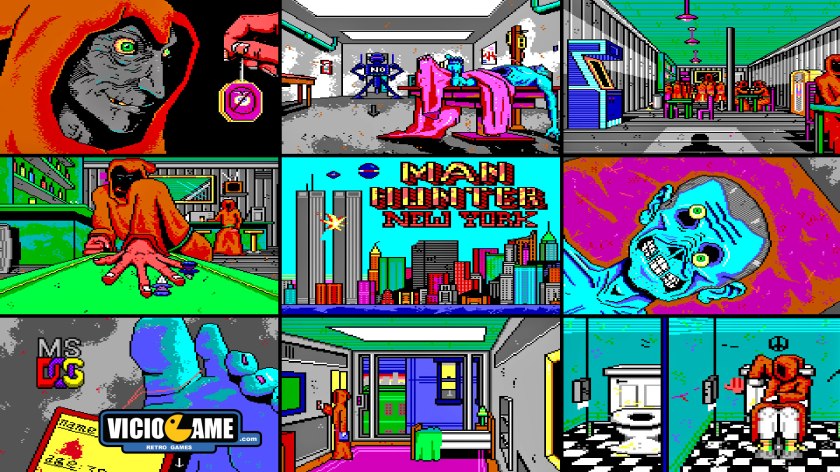
Manhunter: New York is a first-person point-and-click adventure released in 1988 for MS-DOS PC. Aliens have taken over the city and need to recapture rebel humans. Your mission is to carry out this dirty work as a bounty hunter, using the full extent of extraterrestrial technology to your advantage.
Developer: Evryware
Publisher: Sierra On-Line
Release Date: 1988
Platform: PC MS-DOS
🇺🇸 Manhunter: New York is a post-apocalyptic graphic adventure developed by small American studio Evryware and published by Sierra On-Line in September 1988 for MS-DOS. Created by brothers Dave Murry, Barry Murry, and Dee Dee Murry, the game occupies a peculiar place within Sierra’s catalog of the era: while the publisher was building its reputation on family-friendly fantasies like King’s Quest and adult comedies like Leisure Suit Larry, Manhunter: New York proposed something radically different — a dark, violent, and at times deliberately grotesque dystopia set in a New York occupied by alien invaders. Technically, the game also broke with house tradition by completely abandoning the text parser (the engine that interpreted typed text as in-game actions) that had defined Sierra’s adventures up to that point, replacing it with a first-person point-and-click interface built on a modified version of the Adventure Game Interpreter (AGI) engine, the same one used in titles like the early King’s Quest and Space Quest games.
Evryware was born from the Murry brothers’ interest in home computers back in the late 1970s. In 1979, Dave and Barry Murry programmed, as a personal project, an air traffic control radar simulator inspired by Barry’s work as a controller at McChord Air Force Base, an experience that sparked both brothers’ taste for game creation. The following year, Dave Murry teamed up with Joe Gargiulo to officially found Evryware, initially focused on arcade-style games for the CP/M operating system and the Heathkit/Zenith Z-89 computer; shortly afterward, Barry and their sister Dee Dee Murry joined the small studio. The team’s first contract with Sierra On-Line came about almost by accident: Microsoft had considered publishing the duo’s boxing game but backed off, deeming the home market still too small; a Microsoft contact ended up introducing the project to Ken Williams, Sierra’s founder, who took on the publishing. That’s how Sierra Championship Boxing, Evryware’s first work for personal computers, came to be in 1983. In the following years, the Murrys turned to Brøderbund to develop the acclaimed strategy series The Ancient Art of War, with the original 1984 title and its sequel, The Ancient Art of War at Sea, released in 1987. It was around this time that Sierra approached the duo again, inviting them to develop a new project for the publisher — this time, an adventure the Murrys themselves were determined to steer away from the mold the company had already established.
According to Dave and Barry Murry, recalling years later in an interview, the creative process behind Manhunter: New York was a long one, going through several reformulations before arriving at its final concept. The initial idea revolved around a dystopia in the vein of George Orwell’s 1984; next came the decision that the oppressors would be aliens rather than humans, opening the door to the intended mix of horror, humor, and suspense. The brothers also wanted to test the limits of what was expected from an adventure game of that era, surprising the player with unexpected situations and, at a few key moments, deliberately leaning into visual shock and the grotesque. The choice of New York as the setting stemmed from a desire to portray a decayed, gloomy urban landscape, but also from the team’s familiarity with easily recognizable city landmarks like the Statue of Liberty, the Empire State Building, and Central Park; to reinforce the realism, the Murrys themselves traveled to the city to photograph many of the locations that would later be recreated on screen, setting the story sixteen years in the future relative to the game’s release year.
The game’s opening shows the New York skyline in 2002 under attack by a mysterious force: the start of an invasion by an alien race known as the Orbs, creatures resembling enormous floating eyeballs. Two years later, in 2004, the main action of Manhunter: New York begins in a city already fully subjugated by the Orb Alliance. Human survivors are forced to wear identical drab gray togas, are forbidden any form of verbal communication on pain of death, and carry tracking discs surgically implanted in the backs of their necks that tell the Orbs each individual’s location — but not their identity, a technical flaw that forces the invaders to recruit humans for the work of identification and capture. The city’s sky has taken on a reddish tint from the gases released by the Orbs’ atmospheric purification systems, which make the air more breathable for the invaders and, as a side effect, leave the human population more docile and manageable, though this visual detail isn’t always consistent throughout the game, with some areas retaining a conventional blue sky. Important buildings have been seized or sealed off, commerce has all but vanished, vandalism has taken over the streets, and urban upkeep has been abandoned; few areas remain accessible to ordinary humans.
The protagonist of Manhunter: New York has no name, family, friends, or any revealed personal ties — only the role that gives the game its title. A select group of humans, the player among them, has been chosen by the Orbs to serve as a Manhunter, a sort of hybrid between a police officer and a bounty hunter with access to advanced technology; the exact selection criteria are never explained, though the plot itself later suggests that the Orbs favor humans with greater natural resistance to the gases that make others docile — an ironic bind, since that same trait also makes them more likely to turn against the regime. Each morning, the Orb responsible for the protagonist’s sector appears in his apartment to hand out the day’s assignment; from there, it’s up to the player to consult the MAD (Manhunter Assignment Device), a portable terminal that plays back recordings of the suspect’s movements and grants access to a travel map of the city, unlocking only the addresses relevant to the current investigation. At the end of each day, the Orbs interrupt the MAD to demand a report on the tracked suspect’s identity — or a confession that it remains unknown.
On the first day, the protagonist is sent to investigate an explosion at Bellevue Hospital. There, he finds the body of a man identified, by the toe tag and a MAD search, as Reno Davis, a 38-year-old Manhunter supposedly “transferred to Chicago” — the first of several clues suggesting that this phrase is, in fact, a sinister euphemism. Following the trail of his suspect, later identified as Anna Osborne, the player passes through Trinity Church, where a niche by the altar hides something accessible only through a specific sequence of lit candles; the Flatbush Bar in Brooklyn, where he must prove his loyalty in a knife duel against the bartender before gaining access to an arcade game whose map, unbeknownst to him at that point, matches exactly the layout of the sewers beneath Prospect Park; and the sewers themselves, where he collects much of a set of access cards left strategically along the way by the suspect. Emerging from the underground tunnels at Dreier Offerman Park, the player finds a locket she dropped without noticing; the item proves essential shortly after, in Coney Island — recreated in the game not as the modern neighborhood, but as the long-gone Dreamland amusement park, destroyed by a fire in 1911 — where showing it to a street vendor, after knocking down the correct sequence of carnival dolls, earns him a data card reserved for members of the resistance known as the Underground. The card contains coded verses pointing to the group’s plans and carrying the first warning about a man named Phil.
On the second day, the mission is to investigate the theft of a maintenance robot at Grand Central Station, committed by three suspects: the couple Anna and Harvey Osborne, and a third individual not yet identified. When the group splits up, Anna takes refuge in the trendy nightclub Wretched Excess in Greenwich Village; to get in, the player must face down, one by one, four armed thugs in a side alley — two with knives, one with Molotov cocktails, and a last, armed one whose final blow literally sends the protagonist flying through the club’s window. Inside, all it takes to spot Anna is recognizing the one figure wearing the standard drab gray toga among the revelers wrapped in colorful togas; she knocks loose an access card while striking the protagonist with her purse, before he’s thrown out by the bouncer. Harvey, meanwhile, splits off from the third suspect to leave a note on the bulletin board at the Vend-O-Deli — and in doing so, crosses paths with Phil Cook, who talks him into following him to Central Park. The park is littered with land mines planted by the Orbs for the Annual Human Survival Games, forcing the player to retrace, with absolute precision, the exact path the two of them took in order not to be blown to pieces; at the end of it, he finds Harvey’s body, killed by Phil himself with a crowbar, having only managed to write part of the killer’s name in blood before dying — a clue that combines with a pun hidden in the park’s entrance sign to reveal the surname “Cook.” Shortly after, Anna is also murdered by Phil in her own home. Meanwhile, the third suspect takes the stolen robot to the top floor of the American Museum of Natural History but dies trying to extract its contents, falling victim to the tamper-proof explosive mechanism built into the device; the player can only reach the spot — guarded by a creature that calms down at the sight of the locket collected days earlier — after making his way through the museum’s rooms with the help of thirteen access cards gathered over the first two days, always careful to pass through each door before it closes again.
The third day begins with the discovery of a dead Orb atop the grave of a child, Tim Jones, at Greenwood Cemetery — the same cemetery, incidentally, that also appears in Gold Rush!, another classic from Sierra’s catalog. The act is the work of Harry Jones, the boy’s father and a member of the Underground, who avenged his son’s death at the Orbs’ own expense and holds a valuable piece of information: the password to the Orb Alliance’s central computer, hidden in a wall safe concealed in his office at a Times Square theater. Tracked there and then back to Trinity Church, the player finally deciphers the candle sequence mentioned days earlier — revealed by a cryptic tattoo found on the arm of the suspect who died at the museum — and recovers another of the modules that, as is later discovered, are used to arm an Orb ship. Harry, on the run, crosses paths with Phil Cook, mistaking him for an ally, and seeks refuge in Abdul’s pawnshop; to get down into the tunnel hidden beneath the shop, he must prove his loyalty by selecting the correct badges, the same symbols seen at Trinity Church. In the tunnels, however, Phil has already killed Harry and stolen the paper with the safe’s combination; it’s there that the player finally faces the killer head-on, in a direct confrontation that requires dodging knife strikes until landing a punch strong enough to make him flee and drop what he’d stolen. With the combination in hand, the protagonist returns to the theater, opens the safe, and retrieves the document containing the system password; with it, he accesses the Orb Alliance’s central computer at the Empire State Building and uncovers the regime’s true nature: the four main Orb strongholds in New York, identified as Alpha (Bellevue Hospital, where human bodies are processed as food and the species’ young are incubated), Beta (Grand Central Station, home to the entire ship fleet), Gamma (the Statue of Liberty, the center for air purification and anti-aircraft defense), and Delta (the Empire State Building itself, housing the central computer system and the Alliance’s radio transmitter). Faced with irrefutable proof that the Orbs treat humanity as livestock, the protagonist decides to break definitively with his supposed masters and take on, alone, the plan the Underground had been trying to carry out — to that end, still on that third day, he quietly alters the system’s security settings to make the next steps easier.
The fourth and final day holds the most ironic twist in Manhunter: New York: the protagonist himself is assigned to investigate the illegal access he himself carried out on the Alliance’s computer the day before — in other words, he’s tasked with hunting himself. To make matters worse, the Orb supervisor announces that, at the end of the shift, the Manhunter will be “transferred to Chicago,” the same fate assigned to Reno Davis on the first day and now revealed, beyond any doubt, to be a euphemism for execution and consumption by the Orbs themselves. With no time to lose, the player returns to Bellevue Hospital to retrieve the last missing module — the only one the Underground had never managed to obtain — fighting through a room where human bodies are actually processed as food before escaping through a sequence of jumps across cables and platforms in an overloaded power station, dodging fatal electrical discharges. With all four modules finally gathered, the protagonist breaks into the area of Grand Central Station where the Orb Alliance’s fleet is hidden, activates one of the ships, and takes off into the city sky. Phil Cook, frustrated by the protagonist’s success, also takes a ship and gives chase, kicking off an aerial battle the player must win while bombing, one by one, the four strongholds identified on the computer — Bellevue Hospital, Grand Central Station, the Statue of Liberty, and the Empire State Building — considerably expanding on the Underground’s original plan, which had called for only a symbolic strike on the Statue of Liberty. Upon landing, the protagonist is greeted by a grateful crowd of newly freed New Yorkers, a celebration cut short when Phil returns and guns them all down with his ship’s weapons before fleeing once more. The game ends with the protagonist taking off in pursuit, leaving Phil Cook’s fate open for the direct sequel, Manhunter 2: San Francisco.
Although the game itself rarely explains Phil Cook’s motivations directly — the villain’s ambiguity, incidentally, is one of the points most criticized by the press at the time — later interviews given by the Murry brothers shed light on his origin. Contrary to what many players assume, Phil was never a Manhunter: he was, in fact, a serial killer whose lethal efficiency caught the Orb Alliance’s attention, leading them to capture him for study in hopes of replicating his traits and creating the perfect Manhunter. The experiments, however, never fully brought him under the Orbs’ control; Phil escaped with his murderous impulses intact, retaining only an unstable, partial loyalty to his former captors, which explains why he operates with such autonomy throughout the story.
From a technical standpoint, Manhunter: New York represents one of the most unusual uses of Sierra’s Adventure Game Interpreter (AGI) engine. While the engine had typically powered third-person adventures driven by a text parser, the Murry brothers adapted it for a first-person perspective and an icon-based point-and-click interface with no command typing at all. It’s frequently cited as the first Sierra-published game to abandon the parser entirely, anticipating by roughly two years the definitive shift the publisher would make with King’s Quest V — though the point-and-click adventure concept itself had already been introduced a few years earlier by rival LucasArts, through the SCUMM engine, introduced in Maniac Mansion. The lack of mouse support, a feature still uncommon among home computer users at the time and not implemented by AGI, forced the player to move the cursor around the screen using the keyboard or a joystick, making navigation slower than it would become just a few years later.
The ban on verbal communication between humans, established right in the story’s premise, has a direct impact on the game’s construction: there is practically no dialogue in Manhunter: New York. The entire narrative — clues, twists, even the suspects’ identities — has to be deduced from purely visual elements, which makes taking notes on details (names, symbols, routes, codes) all but mandatory for any player hoping to progress without resorting to a guide. The one exception to this rule of silence in the entire game comes when Louis Redman, the bouncer at Wretched Excess, shouts the only spoken word in the whole adventure while barring the protagonist at the front door.
Interspersed with the investigation, a series of action sequences punctuates practically every day of the adventure: the knife duel against the Flatbush Bar’s bartender, the brawl against the four thugs in the alley outside Wretched Excess, the deadly trek through the minefield in Central Park, the underground sewer maze mirrored in the bar’s arcade map, the escape across electrified cables at Bellevue Hospital, and finally the aerial battle against Phil Cook at the climax. Both the press of the era and much of the retrospective analysis agree that this is the game’s most controversial aspect: while the design of the investigative puzzles tends to be praised for its internal logic, the action sequences tend to be seen as repetitive, poorly paced, and only loosely connected to the rest of the narrative, to the point that the protagonist’s premature death in these segments is almost a statistical certainty on any given attempt.
Given how often the protagonist dies — whether run over by a robot, devoured by Orbs, or blown up by a mine — Manhunter: New York does away with the traditional game-over screen: in its place, Dave, Barry, and Dee Dee Murry themselves appear in person, dressed in togas similar to those worn by the humans in the game, to offer a sarcastic or cryptic hint about the mistake just made before handing control back to the player a few instants before the fatal blow. The device, fondly remembered by fans of the series today, softens — without eliminating — the often brutal, trial-and-error difficulty of much of the game’s challenges.
Several other production details reinforce Manhunter: New York‘s reputation as a game full of quirks. The puzzle at the American Museum of Natural History is regarded as one of the most absurd of the year the game came out. Coney Island’s rendition in the game, as already mentioned, doesn’t depict the modern-day neighborhood but rather the long-gone Dreamland amusement park. The original box art featured, on the back cover, a “wanted” poster misspelling the villain’s name as “Phil Cooke,” alongside an ad for another Sierra hit, Thexder; small naming inconsistencies also persist between the game and the real locations that inspired it, such as the spelling “Dryer Offerman Park” used in official materials instead of the correct park name, Dreier Offerman Park, and the popular use of “Grand Central Station” for the terminal whose official name is actually Grand Central Terminal.
Aesthetically, Manhunter: New York still divides opinion today: some critics of the era and later retrospectives considered the graphics crude and low-resolution compared to contemporaries that had already adopted more advanced standards, while other analyses argue the opposite, pointing to background scenery and character portraits that were surprisingly detailed for the aging AGI engine’s limits — one of the last major games to use it, alongside King’s Quest IV and its own sequel, shortly before Sierra migrated to the SCI engine, with support for sound cards and higher resolutions. The game officially supports CGA, Hercules, EGA, VGA/MCGA, and Tandy/PCjr monitors, adapting its color palette to the available hardware; audio, by default, is limited to a single MIDI voice played through the computer’s internal speaker, though users on PCjr and Tandy 1000 systems got an enhanced three-voice simultaneous soundtrack, composed and performed by Barry Murry himself. The explicit scenes — corpses devoured by newborn Orbs, mutilated bodies, and other equally macabre effects — reinforce the heavier tone that set the game apart from the rest of Sierra’s family-friendly catalog. The original packaging, meanwhile, was just as striking as the content: the manual, printed in fluorescent yellow, presented itself within the game’s own fiction as the “Manhunter’s Field Guide,” an official document supposedly issued by the Orbs to every new recruit, accompanied by a field map with additional details about the city.
Manhunter: New York arrived first on MS-DOS in September 1988, closely followed by versions for Apple IIGS, released that November, and Apple II, whose edition — limited by the platform’s available memory, insufficient to save progress midway through the sewer maze — ended up offering the option to skip that section entirely. The Atari ST version came out in January 1989, followed by the Amiga edition in April, and finally the Macintosh version that September, the latter adapted by developer Fairfield Software.
At the time of release, critical reception was favorable, though divided on the action sequences. Computer Gaming World magazine, in December 1988, praised the design’s intelligence despite the arcade segments, advising players to carefully note down everything they observed on screen. British publication Computer and Video Games gave the Atari ST version a score of 88%, with the critic reporting that he’d started out bored and frustrated before ultimately being won over. The Games Machine, another British outlet, was more reserved at 67%, praising the decaying-metropolis atmosphere but criticizing the graphics; Australian publication Commodore and Amiga Review, for its part, highlighted the game’s depth and the quality of Sierra’s typical packaging and documentation, while acknowledging the Amiga version’s visual limitations. Commercially, Manhunter: New York sold more than a hundred thousand copies, a solid enough result to earn an almost immediate green light for a sequel.
Decades later, Manhunter: New York remains a polarizing game among scholars and enthusiasts of classic graphic adventures. Part of the retrospective critique describes it as a true enigma: a work technically rough around certain edges, with a deliberately fragmented plot and shallow characters, yet still fascinating enough to demand being played at least once, largely thanks to its oppressive atmosphere, genuinely unusual for Sierra’s catalog. Other critics are harsher, pointing to puzzles whose logic only makes sense after they’ve been solved — a design style sometimes called “reverse” — as evidence of a project more interested in surprising the player than in being fair to them. Even so, its status as a pioneer is rarely disputed: the combination of a first-person perspective with an exploration structure built on visual puzzles is frequently cited as a forerunner of what Myst would, years later, popularize on a much larger scale, and some fans also speculate, without official confirmation, that the experience served as indirect inspiration for the later adoption of full point-and-click controls in King’s Quest V. Today, the ScummVM engine reimplements support for the MS-DOS, Amiga, Atari ST, and Apple IIGS versions of Manhunter: New York, keeping the curiosity of new generations of players alive for this peculiar chapter in Sierra’s history.
Manhunter: New York‘s commercial and critical success secured the almost immediate production of a direct sequel, Manhunter 2: San Francisco, released in mid-1989 by the same team and on the same modified AGI engine. The story picks up right where the first game left off, with the original protagonist chasing Phil Cook’s ship to a crash landing in San Francisco; there, another Manhunter dies in the crash, and the player takes on his identity to continue the hunt, now amid mutant slaves created by Orb experiments and a new local resistance front. Like the first installment, Manhunter 2: San Francisco also ends on an open note, with Phil Cook once again narrowly escaping. The team’s original idea called for a full trilogy, to be closed out by Manhunter 3: London — the Murrys themselves later mentioned even considering a fourth chapter set on the Orbs’ own home planet — but the third game never advanced past the conceptual stage for lack of a finalized business deal between Evryware and Sierra. In the years that followed, sporadic rumors about a possible revival of the series surfaced on specialized forums, including reports of a new story pitch conceived in the mid-2000s that would have split the narrative between a new protagonist and the original Manhunter resuming the hunt for Phil Cook — but none of these plans ever came to fruition. Evryware itself, for that matter, moved away from regular game production to focus on web design projects and other ventures throughout the 1990s, though it did return sporadically to games with titles like SpaceKids, SpaceDude, and the pioneering online game Pyrosaurus, in addition to reviving The Ancient Art of War franchise decades later with a new sequel in 2014. Today, the rights to the Manhunter franchise belong to Activision, inherited from its 2008 acquisition of Sierra’s catalog, with no announced plans to revive the series.
More than three decades after its release, Manhunter: New York continues to hold a unique place in adventure game history precisely because it refuses to settle into any comfortable mold: it’s simultaneously grim and deliberately comic, brutal toward the player and lavish in atmosphere, capable of turning the protagonist’s own complicity — first in service of the oppressors, then in open rebellion against them — into the emotional core of the entire experience. In a catalog then dominated by fantasy kingdoms and romantic comedies, Sierra let the Murry brothers impose on a Big Apple occupied by giant floating eyeballs a genuinely unsettling vision of science fiction, without losing the biting sense of humor that defined practically the duo’s entire career. It’s that rare balance between the grotesque and the ironic, between relentless challenge and an almost irresistible curiosity to find out what comes next, that makes Manhunter: New York one of the most singular — and still, to this day, most discussed — chapters of the entire classic graphic adventure era.
🇧🇷 Manhunter: New York é uma aventura gráfica pós-apocalíptica desenvolvida pela pequena produtora americana Evryware e publicada pela Sierra On-Line em setembro de 1988 para MS-DOS. Criado pelos irmãos Dave Murry, Barry Murry e Dee Dee Murry, o jogo ocupa um lugar peculiar dentro do catálogo da Sierra da época: enquanto a editora construía sua reputação com fantasias familiares como King’s Quest e comédias adultas como Leisure Suit Larry, Manhunter: New York propôs algo radicalmente diferente — uma distopia sombria, violenta e por vezes intencionalmente grotesca, ambientada numa Nova York ocupada por invasores alienígenas. Tecnicamente, o jogo também rompeu com a tradição da casa ao abandonar por completo o parser de texto (motor que interpretava entradas textuais como ações dentro do jogo) que definia as aventuras da Sierra até então, substituindo-o por uma interface de apontar-e-clicar em primeira pessoa, construída sobre uma versão modificada do mecanismo Adventure Game Interpreter (AGI), o mesmo usado em títulos como as primeiras edições de King’s Quest e Space Quest.
A Evryware nasceu do interesse dos irmãos Murry por computadores domésticos ainda no fim da década de 1970. Em 1979, Dave e Barry Murry programaram, como projeto pessoal, um simulador de radar de controle de tráfego aéreo inspirado no trabalho de Barry como controlador na base aérea de McChord, experiência que despertou nos dois o gosto pela criação de jogos. No ano seguinte, Dave Murry associou-se a Joe Gargiulo para fundar oficialmente a Evryware, voltada de início a jogos no estilo arcade para o sistema operacional CP/M e para o computador Heathkit/Zenith Z-89; pouco depois, Barry e a irmã Dee Dee Murry passaram a integrar o pequeno estúdio. O primeiro contrato da equipe com a Sierra On-Line surgiu quase por acaso: a Microsoft chegou a cogitar publicar o jogo de boxe da dupla, mas recuou por considerar o mercado doméstico ainda pequeno demais; um contato da própria Microsoft acabou apresentando o projeto a Ken Williams, fundador da Sierra, que assumiu a publicação. Nascia assim, em 1983, Sierra Championship Boxing, primeiro trabalho da Evryware para computadores pessoais. Nos anos seguintes, os Murry se voltaram à Brøderbund para desenvolver a aclamada série de estratégia The Ancient Art of War, com o título original de 1984 e a sequência The Ancient Art of War at Sea, lançada em 1987. Foi por volta desse período que a Sierra procurou novamente a dupla, convidando-a a desenvolver um novo projeto para a editora — desta vez, uma aventura que os próprios Murry fariam questão de afastar do molde então já consagrado pela empresa.
Segundo Dave e Barry Murry relembraram anos depois em uma entrevista, o processo de criação de Manhunter: New York foi longo e passou por diversas reformulações até chegar ao conceito final. A ideia inicial girava em torno de uma distopia no clima da obra 1984, do escritor George Orwell; em seguida veio a decisão de que os opressores seriam alienígenas, e não humanos, abrindo espaço para a mistura pretendida de horror, humor e suspense. Os irmãos também queriam testar os limites do que se esperava de um jogo de aventura da época, surpreendendo o jogador com situações inesperadas e recorrendo, em alguns momentos pontuais, ao choque visual e ao grotesco de forma deliberada. A escolha de Nova York como cenário nasceu do desejo de retratar uma paisagem urbana degradada e sombria, mas também da familiaridade da equipe com marcos facilmente reconhecíveis da cidade, como a Estátua da Liberdade, o Empire State Building e o Central Park; para reforçar o realismo, os próprios Murry viajaram até a cidade para fotografar boa parte dos locais que mais tarde seriam recriados nas telas do jogo, situando a trama dezesseis anos no futuro em relação ao ano de lançamento.
A abertura do jogo mostra o horizonte de Nova York em 2002 sendo atacado por uma força misteriosa: o início da invasão de uma raça alienígena conhecida como os Orbs, criaturas que se assemelham a enormes globos oculares flutuantes. Dois anos depois, em 2004, a ação principal de Manhunter: New York começa numa cidade já completamente subjugada pela Orb Alliance. Os sobreviventes humanos são obrigados a vestir togas pardas indistinguíveis entre si, têm proibido qualquer tipo de comunicação verbal sob pena de morte e carregam, implantados cirurgicamente na nuca, discos de rastreamento que informam aos Orbs a localização de cada indivíduo — mas não sua identidade, falha técnica que obriga os invasores a recrutar humanos para o trabalho de identificação e captura. O céu da cidade adquiriu um tom avermelhado por causa dos gases liberados pelos sistemas de purificação atmosférica dos Orbs, que tornam o ar mais respirável para os invasores e, como efeito colateral, deixam a população humana mais dócil e manipulável, embora esse detalhe visual nem sempre seja consistente ao longo do jogo, com algumas áreas mantendo um céu azul convencional. Prédios importantes foram tomados ou lacrados, o comércio praticamente desapareceu, o vandalismo tomou conta das ruas e a manutenção urbana foi abandonada; poucas áreas continuam acessíveis aos humanos comuns.
O protagonista de Manhunter: New York não tem nome, família, amigos ou qualquer vínculo pessoal revelado — apenas a função que dá título ao jogo. Um seleto grupo de humanos, entre os quais o jogador, foi escolhido pelos Orbs para servir como Manhunter, uma espécie de híbrido entre policial e caçador de recompensas com acesso a tecnologia avançada; o critério exato de seleção nunca é explicado, embora o próprio enredo sugira, mais adiante, que os Orbs privilegiam humanos com maior resistência natural aos gases que os tornam dóceis — um dilema irônico, já que esse mesmo traço também os torna mais propensos a se voltar contra o regime. A cada manhã, um Orb responsável pelo setor do protagonista aparece em seu apartamento para atribuir a missão do dia; a partir daí, cabe ao jogador consultar o MAD (Manhunter Assignment Device), um terminal portátil que reproduz gravações dos deslocamentos do suspeito e dá acesso a um mapa de viagem da cidade, liberando apenas os endereços relevantes para a investigação em curso. Ao fim de cada jornada, os Orbs interrompem o MAD para exigir um relatório com a identidade do suspeito rastreado — ou a confissão de que ela permanece desconhecida.
No primeiro dia, o protagonista é enviado a investigar uma explosão no Bellevue Hospital. No local, encontra o cadáver de um homem identificado, pela etiqueta no dedo do pé e pela busca no MAD, como Reno Davis, um Manhunter de 38 anos supostamente “transferido para Chicago” — a primeira de várias pistas que sugerem que essa expressão é, na verdade, um eufemismo sinistro. Seguindo o rastro de sua suspeita, mais tarde identificada como Anna Osborne, o jogador passa pela Trinity Church, onde um nicho junto ao altar esconde algo acessível apenas por meio de uma sequência específica de velas acesas; pelo Flatbush Bar, no Brooklyn, onde precisa provar sua lealdade num duelo de facas contra o barman antes de ganhar acesso a um jogo de arcade cujo mapa, sem que o jogador ainda saiba, corresponde exatamente ao traçado dos esgotos sob o Prospect Park; e pelos próprios esgotos, onde recolhe boa parte de um conjunto de cartões de acesso deixados estrategicamente ao longo do caminho pela suspeita. Ao emergir das galerias subterrâneas no Dreier Offerman Park, o jogador encontra um medalhão que ela deixou cair sem perceber; o item se revela essencial logo em seguida, em Coney Island — reconstituída no jogo não como o bairro moderno, mas como o extinto parque de diversões Dreamland, destruído por um incêndio em 1911 —, onde exibi-lo a um vendedor ambulante, após acertar a sequência correta de bonecas de feira derrubadas, rende ao jogador um cartão de dados reservado aos membros da resistência conhecida como Underground. O cartão contém versos cifrados que apontam para os planos do grupo e trazem o primeiro aviso sobre um homem chamado Phil.
No segundo dia, a missão consiste em investigar o furto de um robô de manutenção na Grand Central Station, cometido por três suspeitos: o casal Anna e Harvey Osborne e um terceiro indivíduo ainda não identificado. Ao se dividirem, Anna refugia-se na badalada boate Wretched Excess, em Greenwich Village; para entrar, o jogador precisa enfrentar, um a um, quatro capangas armados num beco lateral — dois com facas, um com coquetéis molotov e um último, armado, cujo golpe final acaba por arremessar literalmente o protagonista pela janela da boate. Lá dentro, basta reconhecer a única figura vestida com a toga parda padrão em meio aos foliões enrolados em togas coloridas para localizar Anna, que derruba um cartão de acesso ao golpear o protagonista com a bolsa antes de ser expulso pelo segurança. Harvey, por sua vez, separa-se do terceiro suspeito para deixar um bilhete num quadro de avisos do Vend-O-Deli — e, ao fazê-lo, cruza caminho com Phil Cook, que o convence a segui-lo até o Central Park. O parque está lotado de minas terrestres plantadas pelos Orbs para os Annual Human Survival Games, obrigando o jogador a reproduzir com exatidão absoluta o trajeto que os dois seguiram para não ser despedaçado; ao final, encontra o corpo de Harvey, morto pelo próprio Phil com um pé de cabra, tendo conseguido escrever apenas parte do nome do assassino em sangue antes de morrer — pista que se combina com um trocadilho escondido no aviso de entrada do parque para revelar o sobrenome “Cook”. Pouco depois, Anna também é assassinada por Phil em sua própria casa. Enquanto isso, o terceiro suspeito leva o robô roubado até o último andar do American Museum of Natural History, mas morre ao tentar extrair seu conteúdo, vítima do mecanismo explosivo antiadulteração embutido no aparelho; o jogador só consegue alcançar o local — guardado por uma criatura que se acalma diante do medalhão recolhido dias antes — depois de percorrer as salas do museu com o auxílio de treze cartões de acesso reunidos ao longo dos dois primeiros dias, sempre atento para atravessar cada porta antes que ela se feche novamente.
O terceiro dia começa com a descoberta de um Orb morto sobre o túmulo de uma criança, Tim Jones, no Greenwood Cemetery — mesmo cemitério, aliás, que aparece também em Gold Rush!, outro clássico do catálogo da Sierra. O ato é obra de Harry Jones, pai do menino e membro do Underground, que vingou a morte do filho às custas dos próprios Orbs e guarda uma informação preciosa: a senha do computador central da Orb Alliance, escondida num cofre de parede oculto em seu escritório num teatro de Times Square. Rastreado até lá e, em seguida, de volta à Trinity Church, o jogador finalmente decifra a sequência de velas mencionada dias antes — revelada por uma tatuagem enigmática encontrada no braço do suspeito morto no museu — e recupera mais um dos módulos que, como se descobre adiante, servem para armar uma nave dos Orbs. Harry, perseguido, cruza caminho com Phil Cook, que confunde por um aliado, e busca refúgio na loja de penhores de Abdul; para descer ao túnel escondido sob o estabelecimento, o jogador precisa provar sua lealdade selecionando os distintivos corretos, os mesmos símbolos vistos na Trinity Church. Nos túneis, porém, Phil já matou Harry e roubou o papel com a combinação do cofre; é ali que o jogador finalmente enfrenta o assassino cara a cara, num confronto direto que o obriga a esquivar de facadas até acertar um soco capaz de fazê-lo fugir e deixar cair o que havia roubado. De posse da combinação, o protagonista retorna ao teatro, abre o cofre e recupera o documento com a senha do sistema; com ela em mãos, acessa o computador central da Orb Alliance no Empire State Building e descobre a verdadeira natureza do regime: os quatro principais bastiões dos Orbs em Nova York, identificados como Alpha (o Bellevue Hospital, onde corpos humanos são processados como alimento e onde os filhotes da espécie são incubados), Beta (a Grand Central Station, sede de toda a frota de naves), Gamma (a Estátua da Liberdade, centro de purificação do ar e de defesa antiaérea) e Delta (o próprio Empire State Building, com o sistema computacional central e o transmissor de rádio da aliança). Diante da prova irrefutável de que os Orbs tratam a humanidade como gado, o protagonista decide romper definitivamente com seus supostos senhores e assumir, sozinho, o plano que o Underground vinha tentando executar — para isso, ainda naquele terceiro dia, altera discretamente as configurações de segurança do sistema para facilitar os passos seguintes.
O quarto e último dia reserva a reviravolta mais irônica de Manhunter: New York: o próprio protagonista é designado para investigar o acesso ilegal que ele mesmo promoveu ao computador da aliança na véspera — ou seja, é escalado para caçar a si próprio. Para piorar, o Orb supervisor informa que, ao fim do expediente, o Manhunter será “transferido para Chicago”, o mesmo destino atribuído a Reno Davis no primeiro dia e que agora se revela, sem sombra de dúvida, como um termo para execução e consumo pelos próprios Orbs. Sem tempo a perder, o jogador retorna ao Bellevue Hospital para recuperar o último módulo que faltava — o único que o Underground jamais havia conseguido obter —, abrindo caminho por uma sala onde corpos humanos são efetivamente processados como alimento antes de escapar por uma sequência de saltos entre cabos e plataformas de uma central elétrica sobrecarregada, evitando descargas fatais de energia. Com os quatro módulos finalmente reunidos, o protagonista invade a área da Grand Central Station onde a frota da Orb Alliance está escondida, ativa uma das naves e decola rumo ao céu da cidade. Phil Cook, contrariado com o sucesso do protagonista, também assume uma nave e parte em perseguição, dando início a um combate aéreo que o jogador precisa vencer enquanto bombardeia, um a um, os quatro bastiões identificados no computador — Bellevue Hospital, Grand Central Station, a Estátua da Liberdade e o Empire State Building —, ampliando de forma considerável o plano original do Underground, que previa apenas o ataque simbólico à Estátua da Liberdade. Ao pousar, o protagonista é recebido por uma multidão grata de nova-iorquinos recém-libertados, celebração interrompida quando Phil retorna e extermina todos com as armas de sua nave antes de fugir mais uma vez. O jogo termina com o protagonista decolando em perseguição, deixando o destino de Phil Cook em aberto para a continuação direta, Manhunter 2: San Francisco.
Ainda que o próprio jogo raramente explique de forma direta as motivações de Phil Cook — a ambiguidade do vilão, aliás, é um dos pontos mais criticados pela imprensa da época —, entrevistas posteriores concedidas pelos irmãos Murry esclareceram sua origem. Ao contrário do que muitos jogadores supõem, Phil nunca foi um Manhunter: tratava-se, na verdade, de um assassino em série cuja eficiência letal chamou a atenção da Orb Alliance, que o capturou para estudo na esperança de reproduzir suas características e criar o Manhunter perfeito. Os experimentos, porém, nunca chegaram a colocá-lo sob controle total dos Orbs; Phil escapou mantendo intactos seus impulsos assassinos, acompanhado apenas de uma lealdade instável e parcial para com seus antigos captores, o que explica por que ele age com tamanha autonomia ao longo de toda a trama.
Do ponto de vista técnico, Manhunter: New York representa um dos usos mais incomuns do mecanismo Adventure Game Interpreter (AGI) da Sierra. Enquanto a engine costumava sustentar aventuras em terceira pessoa comandadas por um parser de texto, os irmãos Murry a adaptaram para uma perspectiva em primeira pessoa e uma interface point-and-click baseada em ícones de ação, sem qualquer digitação de comandos. É frequentemente apontado como o primeiro jogo publicado pela Sierra a abandonar totalmente o parser, antecipando em cerca de dois anos a mudança definitiva que a editora promoveria com King’s Quest V — embora o conceito de aventura point-and-click em si já tivesse sido introduzido alguns anos antes pela concorrente LucasArts, através do mecanismo SCUMM estreado em Maniac Mansion. A ausência de suporte a mouse, recurso ainda incomum entre usuários de computadores pessoais da época e não implementado pelo AGI, obrigava o jogador a mover o cursor pela tela usando o teclado ou um joystick, tornando a navegação mais lenta do que se tornaria comum poucos anos depois.
A proibição de comunicação verbal entre humanos, estabelecida já na premissa do enredo, tem reflexo direto na construção do jogo: praticamente não há diálogos em Manhunter: New York. Toda a narrativa — pistas, reviravoltas, até mesmo a identidade dos suspeitos — precisa ser deduzida a partir de elementos puramente visuais, o que torna a anotação de detalhes (nomes, símbolos, trajetos, códigos) praticamente obrigatória para qualquer jogador que pretenda avançar sem recorrer a um guia. A única exceção a essa regra de silêncio em todo o jogo ocorre quando Louis Redman, o segurança da boate Wretched Excess, grita a única palavra falada em toda a aventura ao barrar o protagonista na porta da frente.
Intercaladas à investigação, sucessivas sequências de ação pontuam praticamente cada dia da aventura: o duelo de facas contra o barman do Flatbush Bar, a briga contra os quatro capangas no beco da Wretched Excess, o percurso letal entre minas no Central Park, o labirinto subterrâneo dos esgotos espelhado no mapa do fliperama do bar, a fuga por cabos eletrificados no Bellevue Hospital e, por fim, o combate aéreo contra Phil Cook no desfecho. Tanto a crítica da época quanto boa parte das análises retrospectivas concordam que esse é o aspecto mais controverso do jogo: embora o desenho dos quebra-cabeças de investigação costume ser elogiado por sua lógica interna, as sequências de ação tendem a ser vistas como repetitivas, mal ritmadas e apenas frouxamente conectadas ao restante da narrativa, a ponto de a morte prematura do protagonista, nesses trechos, ser quase uma certeza estatística a cada nova tentativa.
Diante da frequência com que o protagonista morre — seja atropelado por um robô, devorado por Orbs ou explodido por uma mina —, Manhunter: New York dispensa a tradicional tela de game over: em seu lugar, os próprios Dave, Barry e Dee Dee Murry aparecem em pessoa, vestidos com togas semelhantes às usadas pelos humanos do jogo, para oferecer uma dica sarcástica ou enigmática sobre o erro cometido antes de devolver o controle ao jogador poucos instantes antes da fatalidade. O recurso, hoje lembrado com carinho por fãs da série, suaviza — sem eliminar — a dificuldade brutal e frequentemente baseada em tentativa e erro de boa parte dos desafios do jogo.
Diversos outros detalhes de produção reforçam a fama de Manhunter: New York como um jogo cheio de peculiaridades. O quebra-cabeça no American Museum of Natural History é reconhecido como um dos enigmas mais absurdos do ano em que o jogo foi lançado. A versão de Coney Island reconstruída no jogo, como já mencionado, não retrata o bairro contemporâneo, mas sim o extinto parque de diversões Dreamland. A caixa original trazia, na contracapa, um cartaz de “procurado” com o nome do vilão grafado incorretamente como “Phil Cooke”, além de uma propaganda para outro sucesso da Sierra, Thexder; pequenas inconsistências de nomenclatura também sobrevivem entre o jogo e os locais reais que o inspiraram, como a grafia “Dryer Offerman Park” usada no material oficial no lugar do nome correto do parque, Dreier Offerman Park, e o uso popular de “Grand Central Station” para a estação cujo nome oficial é, na verdade, Grand Central Terminal.
Esteticamente, Manhunter: New York divide opiniões até hoje: parte da crítica da época e de análises posteriores considerou os gráficos crus e de resolução baixa diante de contemporâneos que já adotavam padrões mais avançados, enquanto outras análises destacam o contrário, apontando cenários de fundo e retratos de personagens surpreendentemente detalhados para os limites do envelhecido mecanismo AGI — um dos últimos jogos de grande porte a utilizá-lo, ao lado de King’s Quest IV e de sua própria continuação, pouco antes de a Sierra migrar para o mecanismo SCI, com suporte a placas de som e resoluções mais altas. O jogo reconhece oficialmente monitores CGA, Hercules, EGA, VGA/MCGA e Tandy/PCjr, adaptando a paleta de cores ao hardware disponível; o som, por padrão, limita-se a uma única voz MIDI reproduzida pelo alto-falante interno do computador, embora usuários de sistemas PCjr e Tandy 1000 contassem com uma trilha sonora aprimorada de três vozes simultâneas, composta e executada pelo próprio Barry Murry. As cenas explícitas — cadáveres devorados por Orbs recém-nascidos, corpos mutilados e outros efeitos igualmente macabros — reforçam o tom mais pesado que separava o jogo do restante do catálogo familiar da Sierra. A embalagem original, por sua vez, era tão marcante quanto o conteúdo: o manual, impresso em tom amarelo fluorescente, apresentava-se dentro da própria ficção como o “Manhunter’s Field Guide”, documento oficial supostamente entregue pelos Orbs a cada novo recruta, acompanhado de um mapa de campo com detalhes adicionais sobre a cidade.
Manhunter: New York chegou primeiro ao MS-DOS, em setembro de 1988, seguido de perto por versões para Apple IIGS, lançada em novembro daquele mesmo ano, e para Apple II, cuja edição — limitada pela memória disponível na plataforma, insuficiente para salvar o progresso no meio do labirinto dos esgotos — passou a oferecer a opção de pular inteiramente aquele trecho. Em janeiro de 1989 saiu a versão para Atari ST, seguida pela edição para Amiga em abril e, por fim, pela versão para Macintosh em setembro daquele ano, esta última adaptada pela produtora Fairfield Software.
Na época do lançamento, a recepção crítica foi favorável, ainda que dividida quanto às sequências de ação. A revista Computer Gaming World, em dezembro de 1988, elogiou a inteligência do design apesar dos trechos de arcade, recomendando que os jogadores anotassem cuidadosamente tudo o que observavam nas telas. A publicação britânica Computer and Video Games concedeu à versão de Atari ST uma nota de 88%, com o crítico relatando ter começado entediado e frustrado antes de se render ao jogo. Já a também britânica The Games Machine foi mais reservada, com 67%, elogiando a atmosfera de metrópole decadente mas criticando os gráficos; a publicação australiana Commodore and Amiga Review, por sua vez, destacou a profundidade do jogo e a qualidade da embalagem e da documentação típicas da Sierra, apesar de reconhecer as limitações visuais da versão para Amiga. Comercialmente, Manhunter: New York vendeu mais de cem mil cópias, resultado sólido o bastante para garantir luz verde quase imediata para uma sequência.
Décadas depois, Manhunter: New York permanece um jogo divisor de opiniões entre estudiosos e entusiastas da aventura gráfica clássica. Parte da crítica retrospectiva o descreve como um verdadeiro enigma: uma obra tecnicamente crua em certos aspectos, de enredo deliberadamente fragmentado e personagens rasos, mas ainda assim fascinante o bastante para exigir ser jogada ao menos uma vez, muito por conta de sua atmosfera opressiva e genuinamente incomum para o catálogo da Sierra. Outra parte da crítica é mais dura, apontando quebra-cabeças cuja lógica só faz sentido depois de resolvidos — um estilo de design às vezes chamado de “reverso” — como prova de um projeto mais interessado em surpreender do que em ser justo com o jogador. Ainda assim, seu pioneirismo raramente é contestado: a combinação de perspectiva em primeira pessoa com uma estrutura de exploração baseada em enigmas visuais é frequentemente citada como precursora do que, anos depois, Myst popularizaria em escala muito maior, e alguns fãs também especulam, sem confirmação oficial, que a experiência serviu de inspiração indireta para a futura adoção do point-and-click completo em King’s Quest V. Hoje, o mecanismo ScummVM reimplementa o suporte às versões de MS-DOS, Amiga, Atari ST e Apple IIGS de Manhunter: New York, mantendo viva a curiosidade de novas gerações de jogadores por esse capítulo peculiar da história da Sierra.
O sucesso comercial e crítico de Manhunter: New York garantiu a produção quase imediata de uma sequência direta, Manhunter 2: San Francisco, lançada em meados de 1989 pela mesma equipe e sobre o mesmo mecanismo AGI modificado. A trama recomeça exatamente onde a primeira parte parou, com o protagonista original perseguindo a nave de Phil Cook até um acidente de pouso em San Francisco; ali, outro Manhunter morre na queda, e o jogador passa a assumir sua identidade para prosseguir a caçada, agora em meio a escravos mutantes criados por experimentos dos Orbs e a uma nova frente de resistência local. Assim como o primeiro capítulo, Manhunter 2: San Francisco também termina em aberto, com Phil Cook novamente escapando por pouco. A ideia original da equipe previa uma trilogia completa, a ser fechada por Manhunter 3: London — os próprios Murry chegaram a mencionar, tempos depois, cogitar até mesmo um quarto capítulo ambientado no próprio planeta natal dos Orbs —, mas o terceiro jogo nunca avançou além do estágio conceitual por falta de um acordo comercial fechado entre a Evryware e a Sierra. Ao longo dos anos seguintes, rumores esporádicos sobre uma eventual retomada da série vieram à tona em fóruns especializados, incluindo relatos de uma nova proposta de roteiro concebida em meados dos anos 2000 que dividiria a narrativa entre um novo protagonista e o Manhunter original retomando a perseguição a Phil Cook — mas nenhum desses planos chegou a se concretizar. A própria Evryware, aliás, deixou a produção regular de jogos para se dedicar a projetos de web design e outras iniciativas ao longo da década de 1990, ainda que tenha voltado esporadicamente ao meio com títulos como SpaceKids, SpaceDude e o pioneiro jogo on-line Pyrosaurus, além de retomar décadas depois a franquia The Ancient Art of War com uma nova sequência em 2014. Atualmente, os direitos sobre a franquia Manhunter pertencem à Activision, herdados da aquisição do catálogo da Sierra em 2008, sem qualquer plano anunciado de retomar a série.
Mais de três décadas depois de seu lançamento, Manhunter: New York continua a ocupar um lugar único na história dos jogos de aventura justamente por recusar qualquer acomodação: é ao mesmo tempo sombrio e propositalmente cômico, brutal com o jogador e generoso em atmosfera, capaz de transformar a própria cumplicidade do protagonista — primeiro a serviço dos opressores, depois em aberta rebelião contra eles — no centro emocional de toda a experiência. Num catálogo então dominado por reinos de fantasia e comédias românticas, a Sierra permitiu que os irmãos Murry impusessem à Big Apple ocupada por olhos gigantes flutuantes uma visão de ficção científica genuinamente perturbadora, sem perder o senso de humor ácido que definiu praticamente toda a carreira da dupla. É esse equilíbrio raro entre o grotesco e o irônico, entre o desafio implacável e a curiosidade quase irresistível de descobrir o que vem a seguir, que faz de Manhunter: New York um dos capítulos mais singulares — e ainda hoje mais discutidos — de toda a era clássica da aventura gráfica.
🤑💲Earn money without doing anything! Just leave these apps open:
  ✓ https://r.honeygain.me/CONTA9DB02

   ✓ https://packetstream.io/?psr=1uPb
⬛ 𝗧𝗶𝗸𝗧𝗼𝗸: https://www.tiktok.com/@viciogame
🟧 𝗜𝗻𝘀𝘁𝗮𝗴𝗿𝗮𝗺: http://www.instagram.com/viciogame
🟥 𝗬𝗼𝘂𝘁𝘂𝗯𝗲: http://www.youtube.com/viciogame
🟦 𝗙𝗮𝗰𝗲𝗯𝗼𝗼𝗸: http://www.facebook.com/viciogame
🔳 𝗧𝗵𝗿𝗲𝗮𝗱𝘀: https://www.threads.net/@viciogame
🟪 𝗧𝘄𝗶𝘁𝗰𝗵: https://www.twitch.tv/ViciogameRetroGames
🟨 𝗕𝗹𝗼𝗴: http://www.viciogameblog.com/
🟦𝗧𝘄𝗶𝘁𝘁𝗲𝗿: http://www.twitter.com/viciogame
#Viciogame #Gameplay #LetsPlay #Playthrough #Games #Gaming #Videogames #Review #Game #Detonado #Walkthrough #Ending #Reviews #Facts #Retro #RetroGaming #Roms #Emulator #Longplay #Speedrun #NoCommentary #Manhunter #NewYork #PC #MsDOS #PcGaming #adventure #pointandclick #sierra #lucasarts #KingsQuest #PoliceQuest #RPG #Myst

