
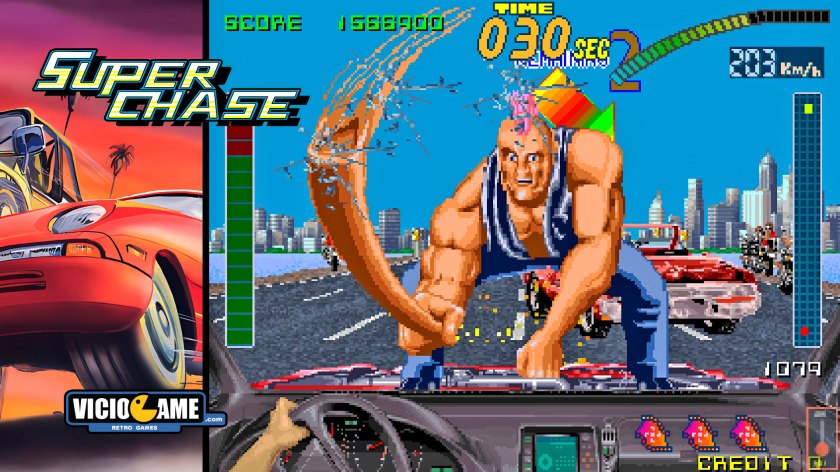
Super Chase: Criminal Termination (also known as Super Chase H.Q.) is an arcade racing game released in 1992. A duo of undercover police officers must capture criminals in high-speed chases across multiple cities.
Developer/Publisher: Taito
Release date: 1993
Platform: Arcade Super Z-System board
🇺🇸 Super Chase – Criminal Termination arrived in Japanese arcades courtesy of Taito in February 1993, even though the hardware’s own credits screen bears a 1992 date — the year in which the game’s development was essentially locked down under the internal codename “Chase 3” — a direct reference to its position as the third arcade chapter in the Chase H.Q. series, following Chase H.Q. (1988) and S.C.I. – Special Criminal Investigation (1989). Its development is credited jointly to a team called Project Power Wheels, and its release was handled regionally, with Taito Corporation covering Japan, Taito America Corporation the United States, and Taito (Europe) Corporation Limited the European market. It’s a first-person racing and police pursuit game running on the Super Z-System hardware (also called the SZ-System, or informally Taito’s “68020” hardware), and it represents the most radical overhaul the franchise had undergone up to that point, both in terms of gameplay and visual presentation.
To understand what changes in Super Chase – Criminal Termination, it’s worth briefly revisiting its two direct predecessors. In Chase H.Q., from 1988, undercover cop Tony Gibson and his partner Raymond Broady chase down criminals aboard a customized black Porsche 928, needing to catch up to them within a time limit before ramming the fleeing car repeatedly until it’s disabled. S.C.I. – Special Criminal Investigation, from 1989, swaps the Porsche for a red Nissan 300ZX T-Top Turbo that was newly released at the time and adds firearms to the formula: Broady takes over driving while Gibson stands up through the car’s sunroof to shoot at enemy vehicles. It’s this same Nissan 300ZX inherited from S.C.I. that Gibson and Broady continue driving in Super Chase – Criminal Termination, even though the firearms have been completely removed: the game returns to the pure pursuit-and-ram mechanic, now under a first-person camera that puts the player literally behind the wheel for the first time in the series.
The technical leap rests on the Super Z-System, a 32-bit evolution of the Taito Z-System used in the two previous games. The main CPU becomes a Motorola 68EC020 running at 16 MHz, assisted by a second 68000 CPU dedicated to sound and other routines, while the custom TC0480SCP chip — responsible for the tilemaps that make up the track — enables the scaling effect that simulates depth and speed without resorting to actual polygons; as with practically every raster racing game of that generation, the “3D” road is, in practice, a sequence of sprites and layers scaled in real time. Sound duties fall to Ensoniq chips (ES5505 and ES5510), and the cabinet was produced in both upright and sit-down versions (also called cockpit, the category under which the game itself appears listed on the era’s earnings charts), equipped with a steering wheel, gas and brake pedals, and a gear shifter housing the Turbo Activator button, the game’s nitro boost.
The most obvious change in Super Chase – Criminal Termination, then, is this shift to first-person: the player now looks out at the world from inside the car, with the hood visible ahead, instead of the elevated, distant camera that followed the vehicle in Chase H.Q. and S.C.I. Broady remains the driver — and the wheel on the dashboard actually turns in sync with the player’s movement on the cabinet’s physical steering wheel — while Gibson, with no weapon to use, is reduced to simply being the other face of the duo in the cutscenes. The pursuit formula stays essentially the same: catch up to the criminals’ car within the time limit — adjustable by the arcade operator through the “TIME SETTING” option, which also controls how much extra time is granted upon spotting the target — and then ram it repeatedly until it’s destroyed. A counter reading “REMAINING: X” appears over the target car as soon as it’s spotted, ticking down by one with each successful collision, each worth 5,000 points; a radar in the corner of the screen shows the distance between the player’s car and the target, a distance that increases again if the player spins out or leaves the track. The Turbo Activator, meanwhile, is now fixed at three uses per stage — in the two previous games, operators could configure up to five uses in regular stages — and each activation abruptly accelerates the vehicle for a few seconds, making it noticeably harder to control, especially in the fourth stage’s truck, which drags a twelve-wheel trailer.
The vehicle isn’t always the same Nissan 300ZX: in the second stage, the duo drives a 4×4 jeep, and in the fourth, an eighteen-wheel articulated truck, returning to the 300ZX in stages one, three, and five. Along the way, obstacles pile up in a way the first two games in the series barely hinted at: bikers shoot at or throw dynamite at the car, vehicles appear head-on in the wrong lane, barricades cut across the track, a helicopter even strafes the player from above during the New Orleans stage, criminals leap onto the hood and even crack the windshield, and other motorcycles ride right over the car. The windshield shatters and the hood visually flies off as damage accumulates, though in practice nothing actually stops the car from moving forward — collisions with tunnel walls, explosions, and gunfire cost at most a few seconds off the clock without halting progress — and the curves are generously forgiving toward the player, to the point that it’s entirely possible to complete the whole game without ever lifting off the gas pedal.
The narrative framework also gets fleshed out. Nancy, the dispatcher who guided the duo in Chase H.Q. and who had been replaced by a colleague named Karen in S.C.I., returns to her post in Super Chase – Criminal Termination, now appearing on a video screen inside the car via the so-called Taito Monitoring System before each stage begins. The structure shifts slightly from the previous games: instead of the mission being presented directly by her, each stage opens with a cutscene showing the crime in progress, and only then does Nancy summarize what just happened and where the target was last seen. The game is also set in the near future relative to its own release: the dates shown on screen place the five cases across a period of about four months, between July and November 1993, months after the game’s actual debut in Japanese arcades — a detail that reinforces the sense of an ongoing police dossier, with each stage functioning almost like a self-contained episode within the same investigation.
These five cases take the duo through some very different cities. The first stage takes place in Beverly Hills, California, where a gang — credited on screen with the unconventional names Ajmagl, M. Lscoa, K. Sktj, and J. Jlrrs — robs a jewelry store and flees in a blue 1986 American convertible. The second stage takes Gibson and Broady to New Orleans, Louisiana, after terrorists who blew up a house and are fleeing to a hideout in the mountains; this is where the duo takes the wheel of the 4×4 jeep, facing a green Jeep Wrangler Sahara and a Sikorsky S-70 helicopter as obstacles.
Next, the action moves to New York, where the so-called Gangrene Gang robs a wealthy man and kidnaps his girlfriend for ransom, fleeing along a highway on the outskirts of the city; back in the Nissan 300ZX, the obstacles now include a Harley-Davidson Fat Boy motorcycle, a red convertible Buick Skylark, and a purple 1970s Pontiac Firebird Trans Am. The fourth stage takes place in Texas, where a multi-vehicle convoy tied to drug trafficking forces its way across the border; the duo takes over the yellow Kenworth truck mentioned above to stop a rival blue Kenworth. The fifth and final stage closes out the game in Chicago, chasing serial killer Arnold, who flees to the city’s suburbs after shooting a politician’s bodyguards; back in the red 300ZX, the target is now a silver version of the same model, driven by Arnold himself.
The English translation carries the awkward charm typical of so many arcade games developed in Japan during that era, with curiously worded phrases popping up both in the dialogue and in the demo text that plays between matches — a trait that only adds to the game’s exaggerated, almost caricature-like personality as a whole. The American version of the cabinet also received the “Winners Don’t Use Drugs” screen, a standard anti-drug notice found in most U.S. arcades of that period. The soundtrack, credited generically to Taito’s in-house sound team, keeps the driving tempo of the pursuit themes that already characterized the series’ previous games.
A prototype version of the game reveals differences from the final version released in arcades: the stage order was different, going from Beverly Hills directly to Texas, then New Orleans, and finally New York, with the game ending right after the fourth stage; the opening lacked the text summarizing the vehicle and the player’s objective, as well as the visual transitions present in the final version; and the main soundtrack reused, without major changes, the pursuit theme from the original Chase H.Q., before receiving its own compositions for the commercial release.
Commercially, Super Chase – Criminal Termination performed respectably without matching the franchise’s biggest numbers. In the April 15, 1993 issue of the Japanese magazine Game Machine, the game placed third among the month’s highest-earning upright and cockpit cabinets; in the United States, the trade magazine Play Meter ranked it eighteenth among the period’s most popular arcade games. The release came at a time when several Japanese manufacturers were experimenting with first-person perspectives within the racing genre, following in the wake of games like Sega’s Rad Mobile, and alongside contemporary offerings like Namco’s Lucky & Wild, which also brought the camera in close to the car’s dashboard.
Also in 1993, Taito adapted the game for the Super Famicom in Japan under the title Super H.Q. Criminal Chaser, released on November 26 of that year; in the west, the same conversion arrived on the Super Nintendo simply as Super Chase H.Q., also in late 1993 in the United States. The console version recreates the first-person perspective using the SNES‘s Mode 7 scaling feature, includes a rearview mirror showing the driver’s face, and adds two features absent from the arcade version: an optional manual transmission mode and damage configuration settings. On the other hand, much of the original game’s visual variety and hazards were left out — the enemies who leap onto the hood or the motorcycles that ride over the car, for instance, don’t appear in the console version — and the track layouts were considerably simplified given the limitations of Nintendo’s hardware. Reception from the press at the time and from later reviews was mixed: Electronic Gaming Monthly‘s four reviewers gave the game a combined score of 30 out of 40, praising the graphics and pace of the action but criticizing the sound and low replay value; years later, retrospectives were split between those who saw the conversion as a shallow step back from the series’ earlier games and those who valued its more cohesive narrative structure, presented as a continuous investigation rather than standalone stages.
A Game Boy port, developed by Japanese studio ITL and published by Taito, followed the same path as the Super Nintendo version: it reached Japan in 1993 as well, the United States in early 1994, and Europe in August of that same year. Despite the obvious limitations of the handheld’s monochrome screen, the game retained the first-person perspective of the 16-bit version and even offered two-player support via link cable.
Within the franchise’s broader timeline, Super Chase – Criminal Termination occupies a particular place: it came after Chase H.Q. and S.C.I. – Special Criminal Investigation, and before Chase H.Q. 2, a numbered sequel not released until 2007, by then rendered in full 3D polygons — a fourteen-year gap that left Super Chase – Criminal Termination as the franchise’s last raster-based arcade chapter. Ray Tracers, released by Taito itself for the PlayStation in 1997, is often described as an unofficial spiritual successor, but specifically to the original Chase H.Q., not to this third game. Unlike its two predecessors, which returned to the public eye in official compilations throughout the 2000s, Super Chase – Criminal Termination has remained a relatively rare piece even among collectors of original cabinets and was left out of those re-releases, which helps explain why genre enthusiasts still ask about its return every time Taito announces a new compilation of in-house classics.
More than three decades after its debut, Super Chase – Criminal Termination remains a curious snapshot of a very specific moment for Taito: a developer willing to take an already well-established formula — chase, ram, capture — and bring it inside the player’s own car, multiplying the obstacles, vehicles, and over-the-top spectacle around it without ever losing sight of what made Chase H.Q. work in the first place. Between jewelry heists in Beverly Hills, a house explosion in New Orleans, and a serial killer loose on the streets of Chicago, the game condenses much of the B-movie action spirit typical of early-1990s arcades, becoming a chapter as bizarre as it is incredible within the police-pursuit legacy that Taito helped popularize.
🇧🇷 Super Chase – Criminal Termination chegou aos arcades japoneses pelas mãos da Taito em fevereiro de 1993, ainda que a tela de créditos do próprio hardware traga a marca de 1992, ano em que o desenvolvimento do jogo foi essencialmente fechado sob o nome interno de “Chase 3” — uma referência direta à sua posição como terceiro capítulo em arcade da série Chase H.Q., vindo depois de Chase H.Q. (1988) e S.C.I. – Special Criminal Investigation (1989). Seu desenvolvimento é creditado em conjunto com uma equipe chamada Project Power Wheels, e sua publicação se deu de forma regionalizada, com a Taito Corporation cuidando do Japão, a Taito America Corporation dos Estados Unidos e a Taito (Europe) Corporation Limited do mercado europeu. Trata-se de um jogo de corrida e perseguição policial em primeira pessoa, rodando sobre o hardware Super Z-System (também chamado de SZ-System, ou informalmente de hardware “68020” da Taito), e representa a reformulação mais radical que a franquia teve até então, tanto na forma de jogar quanto na apresentação visual.
Para entender o que muda em Super Chase Criminal Termination, vale relembrar rapidamente seus dois antecessores diretos. Em Chase H.Q., de 1988, o policial disfarçado Tony Gibson e seu parceiro Raymond Broady perseguem criminosos a bordo de um Porsche 928 preto customizado, precisando alcançá-los dentro de um tempo limite para então bater no carro fugitivo até imobilizá-lo. S.C.I. – Special Criminal Investigation, de 1989, troca o Porsche por um Nissan 300ZX T-Top Turbo vermelho recém-lançado na época e soma armas de fogo à fórmula: Broady assume a direção enquanto Gibson se levanta pelo teto solar do carro para atirar nos veículos inimigos. É justamente esse Nissan 300ZX herdado de S.C.I. que Gibson e Broady continuam pilotando em Super Chase – Criminal Termination, ainda que as armas de fogo tenham sido completamente removidas: o jogo retorna à mecânica pura de perseguir e colidir, agora sob uma câmera em primeira pessoa que coloca o jogador literalmente atrás do volante pela primeira vez na série.
O salto técnico apoia-se no Super Z-System, evolução de 32 bits do Taito Z-System usado nos dois jogos anteriores. A CPU principal passa a ser um Motorola 68EC020 a 16 MHz, coadjuvada por uma segunda CPU 68000 dedicada a som e outras rotinas, enquanto o chip customizado TC0480SCP — responsável pelos tilemaps que compõem a pista — permite o efeito de escalonamento (scaling) que simula profundidade e velocidade sem recorrer a polígonos reais; como em praticamente todo jogo de corrida em raster daquela geração, a estrada “em 3D” é, na prática, uma sequência de sprites e camadas escalonadas em tempo real. O som fica a cargo de chips Ensoniq (ES5505 e ES5510), e o gabinete foi produzido tanto em versão upright quanto em versão sit-down (também chamada de cockpit, categoria na qual o próprio jogo aparece listado nas paradas de sucesso da época), equipado com volante, pedais de acelerador e freio, e uma alavanca de câmbio que embute o botão do Turbo Activator, o acelerador nitro do jogo.
A mudança mais evidente de Super Chase – Criminal Termination, então, é essa virada para a primeira pessoa: o jogador passa a olhar o mundo de dentro do carro, com o capô visível diante de si, em vez da câmera elevada e afastada que acompanhava o veículo em Chase H.Q. e S.C.I. Broady segue como motorista — e o volante do painel gira de fato acompanhando o movimento do jogador no volante físico do gabinete —, enquanto Gibson, sem uma arma para usar, passa a atuar apenas como o outro rosto da dupla nas cutscenes. A fórmula de perseguição permanece a mesma na essência: alcançar o carro dos criminosos dentro do tempo — ajustável pelo operador do arcade através da opção “TIME SETTING”, que também controla quanto tempo extra é concedido ao encontrar o alvo — e, então, bater nele repetidamente até destruí-lo. Um contador com o texto “REMAINING: X” surge sobre o carro-alvo assim que ele é localizado, diminuindo uma unidade a cada colisão bem-sucedida, cada uma valendo 5000 pontos; um radar no canto da tela mostra a distância entre o carro do jogador e o alvo, distância que volta a aumentar caso o jogador rode ou saia da pista. O Turbo Activator, por sua vez, agora está fixo em três usos por fase — nos dois jogos anteriores, operadores podiam configurar até cinco usos nas fases regulares — e cada acionamento acelera bruscamente o veículo por alguns segundos, tornando a direção sensivelmente mais difícil de controlar, sobretudo no caminhão da quarta fase, que arrasta um reboque de doze rodas.
Nem sempre o veículo é o mesmo Nissan 300ZX: na segunda fase, a dupla passa a dirigir um jipe 4×4, e na quarta, um caminhão articulado de dezoito rodas, retornando ao 300ZX nas fases um, três e cinco. Ao longo do caminho, obstáculos se acumulam de um jeito que os dois primeiros jogos da série mal insinuavam: motoqueiros atiram ou arremessam dinamite contra o carro, veículos surgem na contramão, barricadas cortam a pista, um helicóptero chega a metralhar o jogador de cima na fase de New Orleans, criminosos saltam sobre o capô e chegam a rachar o para-brisa, e outras motos passam por cima do carro. O para-brisa se estilhaça e o capô voa fora visualmente conforme o dano se acumula, ainda que, na prática, nada realmente impeça o carro de seguir em frente — colisões contra paredes de túnel, explosões e tiros tiram no máximo alguns segundos do relógio, sem deter o avanço —, e as curvas são generosamente indulgentes com o jogador, a ponto de ser perfeitamente possível completar o jogo inteiro sem nunca tirar o pé do acelerador.
A moldura narrativa também ganha corpo. Nancy, a despachante que orientava a dupla em Chase H.Q. e que havia sido substituída por uma colega chamada Karen em S.C.I., retorna a postos em Super Chase – Criminal Termination, agora aparecendo em uma tela de vídeo dentro do carro através do chamado Taito Monitoring System antes do início de cada fase. A estrutura muda ligeiramente em relação aos jogos anteriores: em vez de a missão ser apresentada diretamente por ela, cada fase abre com uma cutscene mostrando o crime em andamento, e só então Nancy resume o que acabou de acontecer e onde o alvo foi visto pela última vez. O jogo também se passa no futuro próximo em relação ao seu próprio lançamento: as datas exibidas na tela posicionam os cinco casos ao longo de um período de cerca de quatro meses, entre julho e novembro de 1993, meses depois da estreia real do jogo nos arcades japoneses — um detalhe que reforça a sensação de dossiê policial contínuo, com cada fase funcionando quase como um episódio autônomo dentro da mesma investigação.
Esses cinco casos levam a dupla por cidades bem diferentes entre si. A primeira fase se passa em Beverly Hills, na Califórnia, onde uma quadrilha — creditada na tela com os nomes pouco convencionais de Ajmagl, M. Lscoa, K. Sktj e J. Jlrrs — assalta uma joalheria e foge em um conversível americano azul de 1986. A segunda fase leva Gibson e Broady a New Orleans, na Louisiana, atrás de terroristas que explodiram uma casa e fogem para um esconderijo nas montanhas; é aqui que a dupla passa a dirigir o jipe 4×4, enfrentando como obstáculos um Jeep Wrangler Sahara verde e um helicóptero Sikorsky S-70.
Em seguida, a ação se desloca para New York, onde a chamada Gangrene Gang rouba um homem rico e sequestra sua namorada para pedir resgate, fugindo por uma rodovia nos arredores da cidade; de volta ao Nissan 300ZX, os obstáculos agora incluem uma motocicleta Harley-Davidson Fat Boy, um Buick Skylark conversível vermelho e um Pontiac Firebird Trans Am roxo dos anos 1970. A quarta fase acontece no Texas, onde um comboio de vários veículos ligado ao tráfico de drogas atravessa a fronteira à força; a dupla assume o caminhão Kenworth amarelo mencionado acima para deter um Kenworth azul rival. A quinta e última fase fecha o jogo em Chicago, perseguindo o serial killer Arnold, que foge para os subúrbios da cidade depois de atirar nos seguranças de um político; de volta ao 300ZX vermelho, o alvo agora é uma versão prateada do mesmo modelo, pilotada pelo próprio Arnold.
A tradução para o inglês carrega o charme desajeitado típico de tantos jogos de arcade desenvolvidos no Japão naquela época, com frases curiosamente formuladas surgindo tanto nos diálogos quanto no texto de demonstração que roda entre uma partida e outra — um traço que só acrescenta à personalidade exagerada, quase caricatural, do jogo como um todo. A versão americana do gabinete ainda recebeu a tela “Winners Don’t Use Drugs”, aviso antidrogas padrão em boa parte dos arcades dos Estados Unidos naquele período. A trilha sonora, creditada de forma genérica à equipe de som interna da Taito, mantém o tom acelerado dos temas de perseguição que já caracterizavam os jogos anteriores da série.
Uma versão de protótipo do jogo revela diferenças em relação à versão final lançada nos arcades: a ordem das fases era outra, seguindo de Beverly Hills diretamente para o Texas, depois New Orleans e, por fim, New York, com o jogo terminando logo após a quarta fase; a abertura carecia do texto que resume o veículo e o objetivo do jogador, bem como das transições visuais presentes na versão final; e a trilha sonora principal reaproveitava, sem grandes modificações, o tema de perseguição do primeiro Chase H.Q., antes de receber composições próprias para o lançamento comercial.
Comercialmente, Super Chase – Criminal Termination teve um desempenho respeitável sem repetir os grandes números da franquia. Na edição de 15 de abril de 1993 da revista japonesa Game Machine, o jogo apareceu na terceira colocação entre os gabinetes upright e cockpit mais rentáveis do mês; nos Estados Unidos, a revista especializada Play Meter o listou na décima oitava posição entre os arcades mais populares do período. O lançamento aconteceu em um momento em que vários fabricantes japoneses experimentavam com perspectivas em primeira pessoa dentro do gênero de corrida, na esteira de jogos como Rad Mobile, da Sega, e ao lado de propostas contemporâneas como Lucky & Wild, da Namco, que também aproximava a câmera do painel do carro.
Ainda em 1993, a Taito adaptou o jogo para o Super Famicom no Japão, sob o título Super H.Q. Criminal Chaser, lançado em 26 de novembro daquele ano; no ocidente, a mesma conversão chegou ao Super Nintendo simplesmente como Super Chase H.Q., ainda no fim de 1993 nos Estados Unidos. A versão de console recria a perspectiva em primeira pessoa usando o recurso de escalonamento Mode 7 do SNES, inclui um retrovisor mostrando o rosto do motorista e acrescenta duas novidades ausentes do arcade: um modo de câmbio manual opcional e ajustes de configuração de dano. Em contrapartida, boa parte da variedade visual e dos perigos do jogo original ficou de fora — os inimigos que saltam sobre o capô ou as motos que passam por cima do carro, por exemplo, não aparecem na versão para console —, e o traçado das pistas foi consideravelmente simplificado diante das limitações do hardware da Nintendo. A recepção da imprensa da época e de análises posteriores ficou dividida: a revista Electronic Gaming Monthly somou notas de seus quatro avaliadores em 30 de 40, elogiando os gráficos e o ritmo da ação, mas criticando o som e o baixo fator de replay; anos depois, retrospectivas se dividiram entre quem viu a conversão como um retrocesso raso frente aos jogos anteriores da série e quem valorizou sua estrutura narrativa mais coesa, apresentada como uma investigação contínua em vez de fases avulsas.
Um port para Game Boy, desenvolvido pelo estúdio japonês ITL e publicado pela Taito, seguiu o mesmo caminho da versão para Super Nintendo: chegou ao Japão ainda em 1993, aos Estados Unidos no início de 1994 e à Europa em agosto do mesmo ano. Apesar das limitações óbvias da tela monocromática portátil, o jogo manteve a perspectiva em primeira pessoa da versão de 16 bits e ainda ofereceu suporte a dois jogadores via cabo link.
Dentro da cronologia mais ampla da franquia, Super Chase – Criminal Termination ocupa um lugar particular: veio depois de Chase H.Q. e S.C.I. – Special Criminal Investigation, e antes de Chase H.Q. 2, sequência numerada lançada apenas em 2007, já em polígonos tridimensionais completos — um hiato de quatorze anos que deixou Super Chase – Criminal Termination como o último capítulo em raster da franquia nos arcades. Ray Tracers, lançado pela própria Taito para o PlayStation em 1997, costuma ser descrito como um sucessor espiritual não oficial, mas do Chase H.Q. original especificamente, não deste terceiro jogo. Ao contrário de seus dois antecessores, que voltaram a público em coletâneas oficiais ao longo dos anos 2000, Super Chase – Criminal Termination seguiu sendo uma peça relativamente rara mesmo entre colecionadores de gabinetes originais e ficou de fora dessas reedições, o que ajuda a explicar por que entusiastas do gênero ainda perguntam por sua volta sempre que a Taito anuncia uma nova coletânea de clássicos da casa.
Mais de três décadas depois de sua estreia, Super Chase – Criminal Termination permanece como um retrato curioso de um momento muito específico da Taito: uma produtora disposta a levar uma fórmula já consolidada — perseguir, colidir, prender — para dentro do próprio carro do jogador, multiplicando os obstáculos, os veículos e o exagero ao redor dela sem nunca perder de vista o que fazia Chase H.Q. funcionar desde o início. Entre joalherias assaltadas em Beverly Hills, uma casa explodida em New Orleans e um serial killer solto pelas ruas de Chicago, o jogo condensa boa parte do espírito de ação B típico dos arcades do início dos anos 1990, tornando-se um capítulo tão bizarro quanto incrível dentro da trajetória de perseguições policiais que a Taito ajudou a popularizar.
🤑💲Earn money without doing anything! Just leave these apps open:
  ✓ https://r.honeygain.me/CONTA9DB02

   ✓ https://packetstream.io/?psr=1uPb
⬛ 𝗧𝗶𝗸𝗧𝗼𝗸: https://www.tiktok.com/@viciogame
🟧 𝗜𝗻𝘀𝘁𝗮𝗴𝗿𝗮𝗺: http://www.instagram.com/viciogame
🟥 𝗬𝗼𝘂𝘁𝘂𝗯𝗲: http://www.youtube.com/viciogame
🟦 𝗙𝗮𝗰𝗲𝗯𝗼𝗼𝗸: http://www.facebook.com/viciogame
🔳 𝗧𝗵𝗿𝗲𝗮𝗱𝘀: https://www.threads.net/@viciogame
🟪 𝗧𝘄𝗶𝘁𝗰𝗵: https://www.twitch.tv/ViciogameRetroGames
🟨 𝗕𝗹𝗼𝗴: http://www.viciogameblog.com/
🟦𝗧𝘄𝗶𝘁𝘁𝗲𝗿: http://www.twitter.com/viciogame
#Viciogame #Gameplay #LetsPlay #Playthrough #Games #Gaming #Videogames #Review #Game #Detonado #Walkthrough #Ending #Reviews #Facts #Retro #RetroGaming #Roms #Emulator #Longplay #Speedrun #NoCommentary #SuperChase #CriminalTermination #ChaseHQ #Taito #arcade #SCI #SpecialCriminalInvestigation #race #racer #racing #drive #driving #driver #SNES #SuperNintendo #Nintendo #RadMobile

