
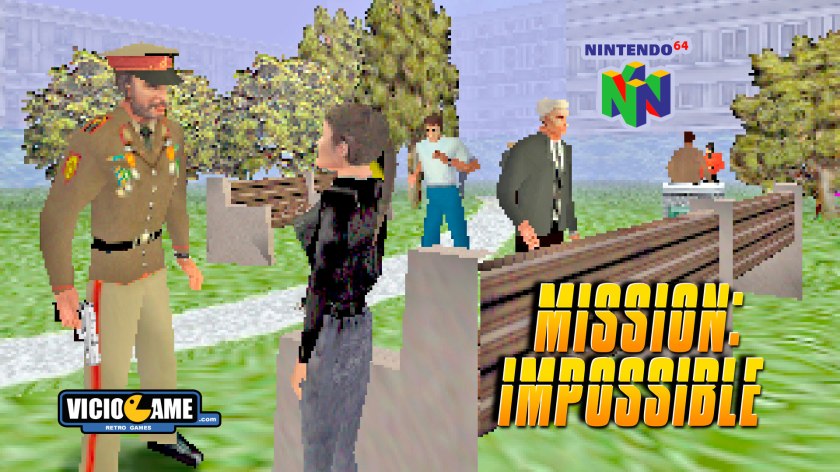
Mission: Impossible is a 3D third-person action game released in 1998 for the Nintendo 64. Loosely based on the film of the same name — released two years earlier and starring Tom Cruise — the game reused the espionage premise and protagonist Ethan Hunt, but built an entirely original plot of its own, with no obligation to recreate the movie’s events scene-for-scene.
Developer: Ocean / Infogrames
Publisher: Infogrames
Release date: 1998
Platform: Nintendo 64
🇺🇸 Ocean Software, the British studio famous for turning film and TV licenses into commercially successful video games, such as its Batman and Jurassic Park adaptations, announced Mission: Impossible in May 1996, half a year before the Nintendo 64 itself even hit store shelves — making it one of the very first projects announced for the console. Since Nintendo’s hardware was still practically an unknown quantity when production began, Ocean’s team, based in San Jose, California, initially conceived the project as an ambitious PC game, an “espionage simulation” worthy of the film. Versions for the 32X, Genesis, Sega Saturn, and SNES were also considered in parallel, with the 16-bit editions planned to follow a two-dimensional approach close to that of Flashback; none of them, however, ever made it off the drawing board.
Internally, development relied on the work of programmer David Dixon, who had already built the engine for the Amiga version of RoboCop and was now building the technology behind Mission: Impossible from scratch. The earliest character models reached as many as 350 polygons each, an ambitious figure for the time, while a new AI system nicknamed SOOL let computer-controlled enemies follow a complex set of priority-ranked instructions. The trouble was that these ambitions ran headlong into the Nintendo 64‘s real-world capabilities: the project was repeatedly delayed throughout 1997, even “disappearing” from that year’s E3 lineup amid rumors of cancellation. Mark Rogers, the American team’s producer at the time, publicly stated that he’d rather rack up delays than ship a product that fell short of expectations, saying the team had decided to push forward and make the game they’d always envisioned, no matter how much extra time it took.
The decisive turning point came at the end of 1997, when Infogrames bought Ocean Software and took over the project, handing off its completion to a new team based in Lyon, France, led by director Benoit Arribart — who came from the Sega Saturn version of Alone in the Dark 2. When Infogrames took charge, the game wasn’t even truly playable yet: it ran at just 4 frames per second. It fell to the French team to redo much of the work inherited from the American team and reduce the models’ polygon counts to bring the frame rate back to something minimally acceptable. The final script was handled by Hubert Chardot and Andy Abrams, with production credited to Arthur Houtman and Erwan Kergall; in the final months, the work schedule reached 16 to 20 hours a day, six days a week, until the game finally went gold with 12 megabytes of data on the cartridge and credits recognizing 88 people involved in the project, between developers and special thanks — closing out a development cycle that added up to roughly three years in total.
The release of Super Mario 64 in 1996, and especially of Rare’s GoldenEye 007 in 1997, directly shaped the direction of Mission: Impossible, which found itself competing with the classic 007 title over very similar thematic territory on the same Nintendo 64. Aware that comparisons were inevitable, the developers tried to set the two productions apart as much as possible: they went as far as planning a wristwatch-based interface, an idea scrapped once they realized GoldenEye 007 already used a similar feature in its menu; they also dropped the possibility of letting Ethan Hunt disguise himself as absolutely any character in the game, since that freedom would have required programming every possible AI reaction scenario; and they set aside planned support for the 64DD peripheral, which would have added extra stages, simply for lack of time to develop it properly. Viacom, which held the film’s rights, also placed limits on the amount of violence and gunplay allowed, while Tom Cruise himself vetoed the use of his facial likeness in the game — decisions that reinforced the more restrained, stealth-oriented tone of the final product. The soundtrack and sound effects were composed in MIDI format by Mike Pummell, supported by a US-based team tasked with making the audio as rich as possible within the cartridge’s limitations.
The finished game organizes its campaign, starring Ethan Hunt under the command of Jim Phelps, leader of the Impossible Missions Force (IMF), into five missions split across a total of 20 stages. In each one, the player has to complete objectives ranging from collecting items and interacting with computers to planting explosives on specific targets and taking out designated enemies, always under one key design principle: caution and restraint matter more than brute force. Shooting the wrong person — a civilian, a hostage, a character who merely looked suspicious at first glance — is the fastest way to fail a stage, and much of the era’s press noted how this quiet emphasis brought Mission: Impossible closer to Metal Gear Solid and stealth gameplay than to a conventional shooter. Many stages can also be completed in non-linear order within their own objectives, and combat, when necessary, plays out in real time: switching to manual aim mode, in an over-the-shoulder view, makes Ethan Hunt himself turn translucent on screen, giving way to a reticle the player can freely aim at targets. From start to finish, this is a strictly single-player experience with no multiplayer mode whatsoever — a notable omission for a direct contemporary of GoldenEye 007, whose split-screen mode would go on to become one of the genre’s greatest legacies on the Nintendo 64.
The first mission, Ice Hit, takes place in an abandoned World War II submarine base located at the 70th parallel north. The second mission, Recover NOC List, shifts the setting to the Russian Embassy in Prague and to KGB headquarters. The third mission, CIA Escape, follows Hunt’s escape from CIA headquarters in Langley. The fourth mission, Mole Hunt, moves the action to London’s Waterloo Station and onto a moving train. Finally, the fifth mission, Ice Storm, returns to the submarine base from the first mission, as the terrorists resurface in the campaign’s finale.
Throughout these stages, the player has access to an arsenal of 22 different devices, including the Facemaker, which disguises Hunt as another character to allow infiltration into restricted areas; night-vision goggles; smoke generators; a fingerprint reader; explosive gum; and a winch controller, a kind of rope used, for instance, to lower Hunt down to a locked safe inside CIA headquarters. An IMF Communicator keeps the player updated on the ongoing mission, while the IMF Field Scanner works like a radar that highlights points of interest, characters, and items around the environment. For actual combat, Hunt has access to a silenced pistol, an Uzi submachine gun, a dart gun, an electric-shock device, and a mini rocket launcher, plus a sniper rifle reserved for specific stages; ammunition tends to be scarce, reinforcing the need to think before shooting.
Three of the 20 stages break from the standard third-person Hunt gameplay: in one, the player guides him as he hangs from a cable, descending and dodging obstacles; in another, the player takes on the role of a teammate tasked with covering Hunt from a distance with a sniper rifle from an elevated position; and in the last, the player mans a cannon to destroy enemy installations while Hunt navigates a warship. The character has a health bar that drops with every hit taken, and emptying it forces the player to restart the stage from scratch, since there’s no mid-stage checkpoint system. The game can be played on two difficulty settings, named “Possible” and “Impossible,” with the latter increasing enemy toughness and Hunt’s vulnerability, raising the number of objectives to complete in certain stages, and even changing how some of them must be completed. Progress can be saved to up to four separate files on the cartridge itself, and the game supports the Nintendo 64‘s Rumble Pak accessory.
The story of Mission: Impossible begins with Jim Phelps receiving word of a terrorist plot at the aforementioned submarine base at the 70th parallel north, a mission that Hunt, Clutter, and Dowey manage to neutralize. Meanwhile, in Prague, Alexander Golystine kidnaps agent Candice Parker and steals half of the NOC (non-official cover) list — a document containing the real and cover names of every IMF agent — using a Russian embassy supercomputer capable, in theory, of decoding the rest of the code. When agent Robert Barnes goes missing after a failed rescue attempt, Phelps sends Hunt to recover the NOC list, save Parker, and find out what happened to Barnes; Hunt finds him dead inside an office at KGB headquarters, but manages to free Parker, and the two escape under cover of a staged fire. Back in the United States, the CIA grows suspicious that someone helped Hunt in Prague and brings him in for interrogation in Langley, accusing him of being a mole working for a mysterious assassin known only as Max. With Parker’s help, Hunt escapes custody, hacks into the IMF’s own system to obtain the other half of the NOC list, and flees by helicopter. He then meets Max at Waterloo Station in London to trade the list for the name of the real traitor, but she steals the document and orders her henchmen to kill him before boarding a train. With backup from Parker and two former CIA agents, Luthur and Kieger, Hunt storms the train, takes down Max, and recovers the list, only to discover, on his way to the cargo car, that the real mole was Jim Phelps all along. After chasing his mentor onto the roof of the train and defeating him — also destroying the helicopter Phelps intended to escape in — Hunt returns to the CIA and is finally cleared of all charges. Promoted to leader of the IMF team, he’s informed that the terrorist group from the opening mission is active again, and sets out with Clutter and Dowey to destroy the enemy base once and for all, closing the campaign with a kiss between Hunt and Parker atop a submarine, just before the final escape.
Among the game’s good-humored hidden details, two unusual moments stand out: in the Lundkwist Base stage of the Ice Hit mission, the player can shoot teammate Andrew Dowey’s boat purely for fun, and rather than simply penalizing the player with a mission failure, he reacts by saluting as the boat sinks. As can be seen in our gameplay footage, it’s also possible, during the party in the Embassy Function stage, to talk to non-playable characters modeled after the development team itself, a kind of inside nod from Infogrames to the professionals behind the project.
In 1999, Mission: Impossible got a PlayStation version, ported by German studio X-Ample Architectures and released in Europe on October 29 and in North America on November 22 of that year, backed by a marketing campaign budgeted at over $2 million. Compared to the original Nintendo 64 game, the PlayStation edition adds full-motion video (FMV) cutscenes, lighting effects, a re-recorded soundtrack and sound effects, and, most notably, full voice acting for every character: the English dialogue was recorded at a British studio, while German had its own separate voice cast, and since the voice data is tied to the language password stored in the save file, it’s possible, even on the American version, to enter a password obtained from a different language release to play with Italian or German dialogue. The big addition praised by critics was the QuickSave feature, which lets players save progress at any moment, effectively solving the most common complaint about the Nintendo 64 version, which forced players to replay entire stages after every failure. Even so, the PlayStation version was criticized for more noticeable frame drops in certain sections, like the train stages, for a more confusing interface menu than the original, and, above all, for weak, poorly written voice acting.
Commercially, Mission: Impossible was treated by Infogrames itself as a success: according to the company’s then-president, Bruno Bonnell, the game had already sold 1.13 million copies worldwide by February 1999, of which 550,000 were in the United States alone by October 1998 — impressive numbers for a production that, just a few months before release, still seemed doomed to never make it out the door.
Critical reception, however, was mixed. On Metacritic, the Nintendo 64 game closed out with an average score of 61 out of 100, reflecting middling scores from outlets like GameSpot and IGN, the latter summing up much of the problem by pointing out that uneven stage design and repetitive mechanics would put off players already used to titles like GoldenEye 007 and the Metal Gear franchise. Comparisons to GoldenEye 007, for that matter, were everywhere in reviews from the time; Next Generation even attributed the less-polished result to the game’s troubled production history. On the positive side, much of the press praised the variety of objectives and the emphasis on gadgets and puzzles: GamePro described it as smarter and more interactive than the typical shooters of the era, singling out the Facemaker as a particularly fun item to use, while Scott McCall of AllGame noted how noticeably enemies reacted whenever the player tried something outside what the design anticipated. The stage where the player covers Hunt with a sniper rifle also drew repeated praise as one of the campaign’s highlights. On the negative side, the consensus centered on trial-and-error progression and poorly balanced stages: Tim Hsu of GameRevolution pointed to the constant difficulty of figuring out what to do in certain situations, while Electronic Gaming Monthly acknowledged some interesting missions and settings but concluded that most of the puzzles were tedious and demanded excessive patience from the player.
The controls also frustrated a considerable portion of the press: Tim Weaver of N64 Magazine described the terrible analog stick calibration, which meant Hunt almost never simply walked, instead jumping straight into an uncontrolled run at the slightest touch of the stick; meanwhile, Cam Shea of the Australian magazine Hyper lamented the absence of moves like crawling, strafing outside of aim mode, hugging walls, or moving stealthily. On the technical side, the low frame rate, heavy distance fog, simple environments, and blurry visual definition drew constant criticism, especially in direct comparison with GoldenEye 007; the audio received similar treatment, with Peer Schneider of IGN describing the sound as unconvincing and muddier than that of the competing game.
A Nintendo 64 sequel was even announced at one point, but it was cancelled before ever taking shape, a casualty of the internal reorganization that followed Infogrames’ acquisition of Ocean Software. The franchise wouldn’t return to video games until years later, in the following console generation, with Mission: Impossible – Operation Surma, released in 2003 for PlayStation 2, Xbox, and GameCube. Decades after its release, Mission: Impossible is remembered above all as a direct counterpoint to GoldenEye 007 within the Nintendo 64‘s espionage catalog — the ambitious game born out of nearly impossible development conditions, marked by repeated delays and a complete last-minute overhaul. Opinion among players and fans about the final result has remained divided for a long time: it’s common to find people who describe it as one of the Nintendo 64‘s most underrated games right alongside those who echo the inconsistency criticisms first raised back in 1998.
At the end of the day, Mission: Impossible sums up the dilemma of so many licensed games from the ’90s rather well: an entire studio trying to build, from the ground up, an espionage simulation worthy of the movie, only to run headlong into both the technical limitations of the era’s hardware and the burden of sharing shelf space and fan memory with one of the greatest classics ever released for the Nintendo 64. Hastily reworked by a team that inherited a project that was practically unfinished and still managed to pull genuinely creative stages out of it — from the quiet tension of Embassy Function to the adrenaline of the final showdown aboard the train — the game carries the ambiguous weight of trying to do too much in too little time. Mission: Impossible may never have reached the must-play status its original conception promised, but it remains a fairly important chapter, proof that even the most debated failures of a generation hide, between one poorly balanced stage and the next, genuine flashes of design brilliance.
🇧🇷 A Ocean Software, estúdio britânico famoso por converter licenças de cinema e televisão em videogames de sucesso comercial, como as adaptações de Batman e Jurassic Park, anunciou Mission: Impossible em maio de 1996, meio ano antes de o próprio Nintendo 64 chegar às lojas — tornando-o um dos primeiríssimos projetos anunciados para o console. Como o hardware da Nintendo ainda era praticamente uma incógnita quando a produção começou, a equipe da Ocean, baseada em San Jose, na Califórnia, chegou a conceber o projeto originalmente como um ambicioso jogo de PC, uma “simulação de espionagem” à altura do filme. Versões para 32X, Mega Drive, Sega Saturn e SNES chegaram a ser cogitadas paralelamente, com as edições de 16 bits planejadas para seguir uma abordagem bidimensional próxima à de Flashback; nenhuma delas, porém, jamais saiu do papel.
Internamente, o desenvolvimento se apoiava no trabalho do programador David Dixon, que já havia assinado o engine da versão para Amiga de RoboCop, e que agora construía do zero a tecnologia por trás de Mission: Impossible. Os primeiros modelos de personagens chegaram a somar 350 polígonos cada, uma cifra ambiciosa para o período, enquanto uma nova inteligência artificial apelidada de SOOL permitia que os inimigos controlados pelo computador seguissem um complexo sistema de instruções hierarquizadas por prioridade. O problema é que essas ambições esbarravam de frente na capacidade real do Nintendo 64: o projeto foi repetidamente adiado ao longo de 1997, chegando a “desaparecer” da programação da E3 daquele ano em meio a rumores de cancelamento. Mark Rogers, produtor da equipe americana à época, chegou a declarar publicamente que preferia acumular atrasos a entregar um produto abaixo do esperado, afirmando que a equipe havia decidido perseverar para fazer o jogo que sempre idealizara, ainda que isso custasse mais tempo.
A virada decisiva veio no fim de 1997, quando a Infogrames comprou a Ocean Software e assumiu o controle do projeto, transferindo sua conclusão para uma nova equipe baseada em Lyon, na França, liderada pelo diretor Benoit Arribart — profissional que vinha da versão para Sega Saturn de Alone in the Dark 2. Quando a Infogrames assumiu, o jogo sequer era jogável de fato: rodava a apenas 4 quadros por segundo. Coube à equipe francesa refazer boa parte do trabalho herdado da equipe americana e reduzir a contagem de polígonos dos modelos para recuperar um frame rate minimamente aceitável. O roteiro final ficou a cargo de Hubert Chardot e Andy Abrams, com produção creditada a Arthur Houtman e Erwan Kergall; nos meses finais, a rotina de trabalho chegou a ser de 16 a 20 horas diárias, seis dias por semana, até que o jogo fosse finalmente fechado com 12 megabytes de dados no cartucho e créditos reconhecendo 88 pessoas envolvidas no projeto, entre desenvolvedores e agradecimentos especiais — encerrando um ciclo de desenvolvimento que somou, ao todo, cerca de três anos.
O lançamento de Super Mario 64, em 1996, e sobretudo de GoldenEye 007, da Rare, em 1997, influenciou diretamente os rumos de Mission: Impossible, que passou a disputar com o clássico 007 um território temático muito parecido dentro do próprio Nintendo 64. Cientes da comparação inevitável, os desenvolvedores tentaram diferenciar ao máximo as duas produções: chegaram a planejar uma interface baseada em relógio de pulso, ideia descartada assim que constataram que GoldenEye 007 já usava recurso semelhante em seu menu; também abandonaram a possibilidade de disfarçar Ethan Hunt como absolutamente qualquer personagem do jogo, já que essa liberdade exigiria programar cada cenário possível de reação da inteligência artificial; e deixaram de lado um suporte planejado ao periférico 64DD, que acrescentaria fases extras, simplesmente por falta de tempo para desenvolvê-lo com cuidado. A Viacom, detentora dos direitos do filme, também impôs limites à quantidade de violência e tiroteios permitidos, enquanto o próprio Tom Cruise vetou o uso de sua imagem facial no game — decisões que reforçaram o tom mais contido e furtivo da produção final. A trilha sonora e os efeitos sonoros foram compostos em formato MIDI pelo compositor Mike Pummell, com apoio de uma equipe nos Estados Unidos incumbida de deixar o áudio o mais rico possível dentro das limitações do cartucho.
O resultado final organiza sua campanha, estrelada por Ethan Hunt sob o comando de Jim Phelps, líder da Impossible Missions Force (IMF), em cinco missões divididas em um total de 20 fases. Em cada uma delas, o jogador precisa cumprir objetivos que vão de coletar itens e interagir com computadores a instalar explosivos em alvos específicos e neutralizar inimigos determinados, sempre sob um princípio-chave do design: cautela e comedimento valem mais do que força bruta. Atirar na pessoa errada — um civil, um refém, um personagem que só parecia suspeito à primeira vista — é o jeito mais rápido de fracassar em uma fase, e boa parte da crítica da época destacou como essa ênfase discreta aproxima Mission: Impossible mais de Metal Gear Solid e da furtividade do que de um atirador convencional. Muitas fases ainda podem ser resolvidas em ordens não lineares dentro de seus próprios objetivos, e o combate, quando necessário, acontece em tempo real: ao acionar o modo de mira manual, em visão sobre o ombro, o próprio Ethan Hunt fica translúcido na tela, dando lugar a uma mira que o jogador posiciona livremente sobre os alvos. Trata-se, em toda a sua extensão, de uma experiência exclusivamente para um jogador, sem qualquer modo multijogador — uma ausência importante para um contemporâneo direto de GoldenEye 007, cujo modo dividido em tela se tornaria um dos maiores legados do gênero no Nintendo 64.
A primeira missão, Ice Hit, transcorre em uma base submarina abandonada da Segunda Guerra Mundial situada no paralelo 70 Norte. A segunda missão, Recover NOC List, muda o cenário para a Embaixada da Rússia em Praga e para o quartel-general da KGB. A terceira missão, CIA Escape, acompanha a fuga de Hunt da sede da CIA, em Langley. A quarta missão, Mole Hunt, leva a ação para a estação londrina de Waterloo e para dentro de um trem em movimento. Por fim, a quinta missão, Ice Storm, retoma o cenário da base submarina da primeira missão, já que os terroristas voltam à ativa no desfecho da campanha.
Ao longo dessas fases, o jogador tem à disposição um arsenal de 22 dispositivos diferentes, entre eles o Facemaker, que disfarça Hunt como outro personagem para permitir a infiltração em áreas restritas; óculos de visão noturna; geradores de fumaça; um leitor de impressões digitais; um chiclete explosivo; e um controlador de guincho, uma espécie de corda usada, por exemplo, para descer até um cofre trancado dentro da CIA. Um Communicator do IMF mantém o jogador informado sobre atualizações da missão em andamento, enquanto o Field Scanner do IMF funciona como um radar que destaca pontos de interesse, personagens e itens pelo cenário. Para o combate propriamente dito, Hunt conta com uma pistola silenciada, uma submetralhadora Uzi, uma arma de dardos, um dispositivo de choque elétrico e um mini-lançador de foguetes, além de um rifle sniper reservado a fases específicas; a munição costuma ser escassa, o que reforça a necessidade de pensar antes de atirar.
Três das 20 fases fugem do padrão jogável pelo próprio Hunt em terceira pessoa: em uma delas, o jogador o guia pendurado em um cabo, descendo e desviando de obstáculos; em outra, assume o papel de um companheiro de equipe encarregado de cobrir Hunt à distância com um rifle sniper a partir de um ponto elevado; e na última, controla um canhão para destruir instalações inimigas enquanto Hunt navega em um barco de guerra. O personagem possui uma barra de vida que diminui a cada ataque sofrido, e zerá-la obriga o jogador a recomeçar a fase do zero, já que não há sistema de checkpoints intermediários. O game pode ser jogado em dois modos de dificuldade, batizados de “Possible” e “Impossible”, sendo que o segundo aumenta a resistência dos inimigos, a vulnerabilidade de Hunt e o número de objetivos a cumprir em certas fases, além de alterar a forma de completar alguns deles. O progresso pode ser salvo em até quatro arquivos distintos no próprio cartucho, e o game oferece suporte ao acessório Rumble Pak do Nintendo 64.
A trama de Mission: Impossible começa com Jim Phelps recebendo um alerta sobre um plano terrorista na já mencionada base submarina do paralelo 70 Norte, missão que Hunt, Clutter e Dowey conseguiam neutralizar. Enquanto isso, em Praga, Alexander Golystine sequestra a agente Candice Parker e rouba metade da lista NOC (non-official cover) — documento que reune nomes reais e falsos de todos os agentes do IMF —, valendo-se de um supercomputador da embaixada russa capaz, em teoria, de decifrar o restante do código. Quando o agente Robert Barnes desaparece após uma tentativa fracassada de resgate, Phelps envia Hunt para recompor a lista NOC, salvar Parker e descobrir o destino de Barnes; ele o encontra morto dentro de um escritório da sede da KGB, mas consegue libertar Parker, e os dois escapam sob a cobertura de um incêndio forjado. De volta aos Estados Unidos, a CIA passa a suspeitar que alguém ajudou Hunt em Praga e o leva para interrogatório em Langley, acusando-o de ser um infiltrado a serviço de uma misteriosa assassina conhecida apenas como Max. Com a ajuda de Parker, Hunt escapa da custódia, invade o sistema do próprio IMF para obter a segunda metade da lista NOC e fuge de helicóptero. Ele então se encontra com Max na estação de Waterloo, em Londres, para negociar a troca da lista pelo nome do verdadeiro traidor, mas ela rouba o documento e ordena que capangas o executem antes de embarcar em um trem. Contando com o apoio de Parker e de dois ex-agentes da CIA, Luthur e Kieger, Hunt invade o trem, neutraliza Max e recupera a lista, só para descobrir, a caminho do vagão de carga, que o verdadeiro infiltrado sempre foi o próprio Jim Phelps. Depois de perseguir o mentor até o teto do trem e derrotá-lo, destruindo também o helicóptero em que tentaria fugir, Hunt retorna à CIA e é finalmente inocentado de todas as acusações. Promovido a líder da equipe do IMF, ele é informado de que o grupo terrorista da missão inicial voltou a agir, e parte com Clutter e Dowey para destruir de vez a base inimiga, encerrando a campanha com um beijo entre Hunt e Parker em cima de um submarino, pouco antes da fuga final.
Entre os detalhes bem-humorados escondidos no jogo, destacam-se duas situações inusitadas: na fase Lundkwist Base, da missão Ice Hit, o jogador pode atirar por pura diversão no barco do companheiro Andrew Dowey, que reage afundando enquanto faz uma continência, em vez de simplesmente penalizar o jogador com uma falha de missão. Como pode ser vito em nossa gameplay, há também a possibilidade de conversar, durante a festa da fase Embassy Function, com personagens não jogáveis modelados como uma homenagem à própria equipe de desenvolvimento, uma espécie de aceno interno da Infogrames aos profissionais responsáveis pelo projeto.
Em 1999, Mission: Impossible ganhou uma versão para PlayStation, portada pelo estúdio alemão X-Ample Architectures e lançada na Europa em 29 de outubro e na América do Norte em 22 de novembro daquele ano, sustentada por uma campanha de marketing orçada em mais de 2 milhões de dólares. Em relação ao jogo original de Nintendo 64, a edição de PlayStation traz cutscenes em vídeo (FMV), efeitos de iluminação, uma trilha sonora e efeitos sonoros regravados e, principalmente, dublagem completa para todos os personagens: a fala em inglês foi gravada em um estúdio britânico, enquanto o alemão contou com elenco de dublagem próprio, e, como os dados de fala ficam atrelados à senha de idioma armazenada no save, é possível, mesmo na versão americana, inserir uma senha obtida em outro idioma para jogar com falas em italiano ou alemão. A grande novidade elogiada pela crítica foi a função QuickSave, que permite salvar o progresso a qualquer momento, resolvendo na prática a reclamação mais comum sobre a versão de Nintendo 64, que obriga o jogador a repetir fases inteiras após cada fracasso. Ainda assim, a versão de PlayStation recebeu críticas por apresentar quedas de quadros mais perceptíveis em certos trechos, como as fases dentro do trem, por um menu de interface mais confuso do que o original, e, sobretudo, por uma dublagem fraca e mal escrita
Comercialmente, Mission: Impossible foi tratado pela própria Infogrames como um sucesso: segundo o então presidente da companhia, Bruno Bonnell, o jogo já somava 1,13 milhão de cópias vendidas em todo o mundo até fevereiro de 1999, das quais 550 mil apenas nos Estados Unidos até outubro de 1998, números expressivos para uma produção que, poucos meses antes de seu lançamento, ainda parecia condenada a nunca sair do papel.
A recepção da crítica especializada, no entanto, foi mista. No Metacritic, o jogo de Nintendo 64 fechou com média de 61 em 100, refletindo notas próximas da média em veículos como GameSpot e IGN, este último resumindo boa parte do problema ao apontar que o desequilíbrio entre fases e a repetição de certas mecânicas afastariam jogadores já acostumados com produções como GoldenEye 007 e a franquia Metal Gear. A comparação com GoldenEye 007, aliás, foi onipresente nas análises da época; a Next Generation chegou a justificar o resultado menos polido pela produção conturbada por trás do jogo. Pelo lado positivo, boa parte da imprensa elogiou a variedade de objetivos e a ênfase em gadgets e quebra-cabeças: a GamePro o descreveu como um jogo mais inteligente e interativo do que os atiradores típicos da época, destacando o Facemaker como um item particularmente divertido de usar, enquanto Scott McCall, da AllGame, notou como os inimigos reagem de forma perceptível sempre que o jogador tentava algo fora do previsto pelo design. A fase em que o jogador cobre Hunt com um rifle sniper também recebeu elogios recorrentes como um dos pontos altos da campanha. Do lado negativo, o consenso girou em torno de uma progressão baseada em tentativa e erro e de fases mal equilibradas: Tim Hsu, da GameRevolution, apontou a dificuldade constante de entender o que fazer em determinadas situações, enquanto a Electronic Gaming Monthly reconheceu missões e cenários interessantes, mas concluiu que a maioria dos quebra-cabeças era cansativa e exigia paciência excessiva do jogador.
Os controles também frustraram parte considerável da crítica: Tim Weaver, da N64 Magazine, descreveu a péssima calibração do analógico, que fazia Hunt quase nunca andar, disparando imediatamente para uma corrida descontrolada ao menor toque no controle; já Cam Shea, da revista australiana Hyper, lamentou a ausência de movimentos como rastejar, deslocar-se lateralmente fora do modo de mira, encostar-se em paredes ou se esgueirar furtivamente. No quesito técnico, o baixo frame rate, o distance fog acentuado, os cenários simples e a definição visual borrada renderam críticas constantes, principalmente em comparação direta com GoldenEye 007; o áudio recebeu recepção parecida, com Peer Schneider, da IGN, descrevendo o som como pouco convincente e mais abafado do que o jogo concorrente.
Uma sequência para Nintendo 64 chegou a ser anunciada, mas foi cancelada antes de sair do papel, vítima da reorganização interna que se seguiu à compra da Ocean Software pela Infogrames. A franquia só voltaria aos videogames anos depois, já na geração seguinte, com Mission: Impossible – Operation Surma, lançado em 2003 para PlayStation 2, Xbox e GameCube. Décadas após seu lançamento, Mission: Impossible segue sendo lembrado, sobretudo, como contraponto direto de GoldenEye 007 dentro do catálogo de espionagem do Nintendo 64, o jogo ambicioso que nasceu sob condições de desenvolvimento quase impossíveis, marcadas por atrasos sucessivos e por uma reformulação completa em cima da hora. A opinião de jogadores e fãs sobre o resultado final permanece dividida por muito tempo: é comum encontrar tanto quem o descreva como um dos jogos mais subestimados do Nintendo 64 quanto quem reforça as críticas de inconsistência levantadas já em 1998.
No fim das contas, Mission: Impossible resume bem o dilema de tantos jogos licenciados dos anos 90: com um estúdio inteiro tentando construir, a partir do zero, uma simulação de espionagem à altura do cinema, mas esbarrou tanto nas limitações técnicas do hardware da época quanto no peso de dividir prateleira e memória afetiva com um dos maiores clássicos já lançados para o Nintendo 64. Reformulado às pressas por uma equipe que herdou um projeto praticamente inacabado e ainda assim conseguiu extrair dali fases genuinamente criativas, da tensão silenciosa da Embassy Function à adrenalina do confronto final a bordo do trem, o jogo carrega o peso ambíguo de quem tentou demais em pouco tempo. Mission: Impossible talvez nunca tenha alcançado o status de obrigatório que sua concepção original prometia, mas permaneceu como um capítulo relativamente importante, provando que até mesmo os fracassos mais discutidos de uma geração guardam, entre uma fase mal balanceada e outra, momentos de verdadeiro brilho de design.
🤑💲Earn money without doing anything! Just leave these apps open:
  ✓ https://r.honeygain.me/CONTA9DB02

   ✓ https://packetstream.io/?psr=1uPb
🤑💲1-Click button earns Bitcoin every 1 hour: https://freebitco.in/?r=53528449
⬛ 𝗧𝗶𝗸𝗧𝗼𝗸: https://www.tiktok.com/@viciogame
🟧 𝗜𝗻𝘀𝘁𝗮𝗴𝗿𝗮𝗺: http://www.instagram.com/viciogame
🟥 𝗬𝗼𝘂𝘁𝘂𝗯𝗲: http://www.youtube.com/viciogame
🟦 𝗙𝗮𝗰𝗲𝗯𝗼𝗼𝗸: http://www.facebook.com/viciogame
🔳 𝗧𝗵𝗿𝗲𝗮𝗱𝘀: https://www.threads.net/@viciogame
🟪 𝗧𝘄𝗶𝘁𝗰𝗵: https://www.twitch.tv/ViciogameRetroGames
🟨 𝗕𝗹𝗼𝗴: http://www.viciogameblog.com/
🟦𝗧𝘄𝗶𝘁𝘁𝗲𝗿: http://www.twitter.com/viciogame
#Viciogame #Gameplay #LetsPlay #Playthrough #Games #Gaming #Videogames #Review #Game #Detonado #Walkthrough #Ending #Reviews #Facts #Retro #RetroGaming #Roms #Emulator #Longplay #Speedrun #NoCommentary #MissionImpossible #Nintendo64 #Nintendo #N64 #GoldenEye #007 #TomCruise #movie #MetalGearSolid #spy #ocean #infogrames #aloneinthedark #playstation #SuperMario64 #64DD #ps2 #xbox #gamecube

