
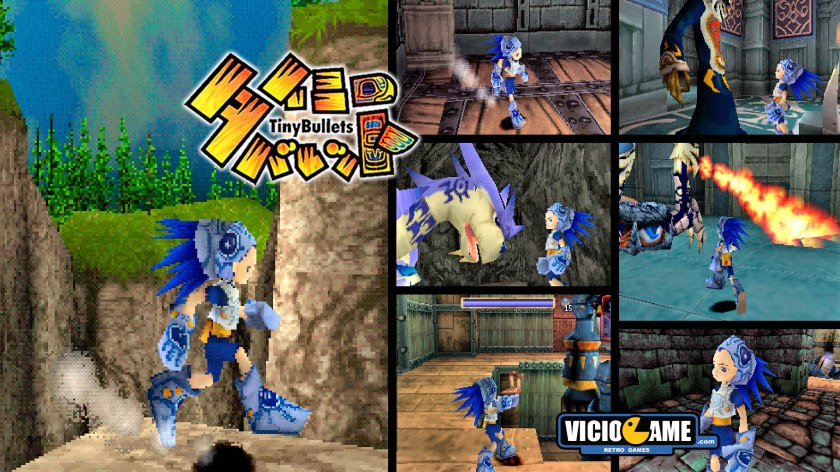
Tiny Bullets is an open-world game inspired by Ocarina of Time and Tomb Raider, released exclusively for PlayStation in 2000. A young adventurer takes the most dangerous path to prove his courage in the city, but ends up heading toward a tower controlled by a demon and becomes entangled in a plot with warriors who were also there fighting evil.
Developer: Contrail Production / Kuusou Kagaku
Publisher: Sony Computer Entertainment
Release date: 2000
Platform: Sony PlayStation
🇺🇸 Tiny Bullets (タイニーバレット) arrived in the final stretch of the PlayStation‘s commercial life, and for decades circulated almost exclusively within the Japanese market. It became known for pairing the aesthetic of The Legend of Zelda: Ocarina of Time with the control scheme of Tomb Raider, an unusual combination for an in-house Sony production of that era, one that helps explain the fascination the game inspires today among enthusiasts of the console’s Japanese catalog.
The development of Tiny Bullets grew out of a meeting between two very different teams. Production duties fell to Contrail, a second-tier internal division created by Sony Computer Entertainment in October 1997 and headed by Takahiro Kaneko, tasked with overseeing, under Sony’s own banner, projects from external partner studios. That same structure also stood behind names now considered cult classics, such as Wild Arms, Alundra, Legend of Legaia, Wild Arms 2, Alundra 2, and Boku no Natsuyasumi, all likewise released for the PlayStation between 1996 and 2000. Tiny Bullets was, in practice, one of the last projects overseen by Contrail before the division was folded back into SCEI’s main structure in August 2000 — just four months after the game’s release, at a moment when the very team responsible for it was ceasing to exist as a separate entity. Technical development, meanwhile, was handled by Kuusou Kagaku (also credited as Kuusoukagaku Corp.), a studio with a far more generalist profile, known for developing the console versions of the RPG-creation tool RPG Tsukuru — the series known in the West as RPG Maker — for utility titles like the simulator Combination Pro Soccer and the licensed strategy game Marmalade Boy, and for porting the shoot ‘em up Strikers 1945 II to the PlayStation and Sega Saturn. Tiny Bullets thus represents one of the rare moments when this duo ventured into an action-adventure project with narrative ambitions well beyond what was typical of their résumés.
The story follows Horin (ホリン) — spelled Hollen in older records tied to the game’s original promotional material, which also place the protagonist in the village of Penofort and associate him with the Gnomur Tribe — a boy who leads a simple life in a small mountain village. One day, his grandmother sends him to buy medicine in a neighboring village, a trip that takes about half a day on foot. The shortest route passes through Mt. Curse, a trail the locals have avoided for generations because of legends of terrible monsters said to live there. Not well respected by the rest of his village, Horin considers risking that route as a way to finally earn some recognition, even as he hesitates in the face of danger.
While he’s still weighing what to do, an earthquake splits open the ground right beneath his feet, destroying the usual route and leaving Mt. Curse as the only way through. With no alternative, Horin ends up forced toward a tower controlled by a powerful demon named Gudia (グディア). There, he witnesses suspicious figures using a machine to calculate the timing of a solar eclipse. He’s nearly caught, but is rescued by two warriors from the Kerufar tribe (ケルファー族): the bearded Quint (クイント) and the giant blue dragon Edol (エドル). They’re on a mission to rescue Carla (カーラ), a 13-year-old girl from the same tribe who wields powerful magical abilities and has been kidnapped by the evil tribe. Carla is essential to demon king Gudia’s plans for world domination. Horin is told to stay put, but an incident leads to Quint’s capture. Feeling responsible, Horin decides to help Edol rescue Quint, save Carla, and put a stop to the villains’ evil ambitions.
In terms of gameplay, Tiny Bullets uses a third-person perspective most of the time, manually switching to first-person during specific moments tied to aiming Horin’s slingshot. The protagonist’s move set is extensive and clearly inspired by Tomb Raider: he jumps, climbs ledges and cliffs — able to hang and shimmy sideways, or climb up and down while gripping an edge — swings on pipes, pushes and pulls heavy blocks, crouches, performs forward and backward rolls, does a quick 180-degree turn, and switches between walking and running. He can also pick up small objects from the environment to throw them and stomp on enemies mid-jump. This full range of actions, spread across the face buttons, triggers, and D-pad of the PlayStation controller, supports the recurring comparison to Core Design’s classic, even though the game’s visual identity stays much closer to the colorful fantasy of Ocarina of Time.
In combat, Horin’s main weapon is a slingshot, used both against the creatures that populate Gudia’s tower and to solve the environmental puzzles scattered along the way. Throughout the adventure, the player collects and stockpiles keys, healing items, antidotes, and bombs. Completing the adventure 100% unlocks New Game+ mode for anyone who wants to replay Horin’s journey with extra advantages, like sturdier armor and the powerful Idol’s Fury weapon, which has infinite ammo and kills enemies in a single hit.
The system for obtaining items and power-ups works in a pretty peculiar way, similar to an open-air shop, where yellow crystals (Item Gems) function as currency. You use them to open magically sealed containers and obtain antidotes, bombs, or slingshot ammo. Once opened, a container stays available for unlimited refills of that resource, although the character’s inventory caps how much of each item you can carry. Containers tend to show up in abundance, and you can choose to open just one and rely on it for the rest of the game. That said, to avoid having to backtrack to some far-off corner of the map, it’s a good idea to open additional containers as you progress.
Antidotes cure poisoning inflicted by certain enemy attacks, which otherwise slowly drain the health bar. Available ammo types are stone (the only one with unlimited quantity), marble, metal, and explosive, and it’s important to use the right type against the right enemy. Some monsters, for instance, are completely immune to stone and resistant to metal, but go down in a single hit from a marble. Knowing each enemy’s weakness makes for better resource management and cuts down the length of every fight.
Blue crystals (Spring Gems) serve one purpose only: unlocking refill points for healing-elixir flasks. Throughout the adventure you’ll find several empty flasks to collect, and once filled, each can be used a handful of times before needing a refill. Finding every item in the game improves your standing on the final ranking, honoring the young adventurer along this scale of completionism: Kid (the worst), Thief, Hunter, Fighter, Master, Knight, Demon Killer, Hero, or King (the best, awarded for reaching the perfect ending).
Green crystals (Idol Gems) strip away the layers of energy protecting the “idols,” collectible items that are purely cosmetic during play but still factor into the final ranking, and whose collection is mandatory to unlock New Game+. There are five idols (green, yellow, blue, red, and purple), each shielded by five layers of energy that dissolve when five green crystals are used. In total, then, you need to find 25 of these crystals to achieve the perfect collection. They’re highly sought-after and become the highlight of exploring the game’s maps. They’re usually scattered across strategic spots in the environment, sometimes hidden behind unconventional passages, and occasionally placed somewhere visible but hard to reach. It’s worth keeping an eye out for cracks in walls and floors, which can be opened using explosives. These bombs can be thrown from a distance, or dropped on the ground to detonate automatically after three seconds.
Occasionally you’ll also come across maps and informational notes. Many of these notes just add flavor for a better understanding of the story, but others hold essential hints for solving complex puzzles — things like color combinations, math equations, encrypted codes, and direct written tips on how to beat bosses or find alternate paths. To access the notes, just press START and go to the Files section.
Tiny Bullets is a vast open-world game, and practically every area remains available to revisit at any time, even once you’re nearing the end of your journey. The path is quite long, but it’s entirely possible to go back and investigate forgotten areas (marked by a darker color on the map, accessible by pressing SELECT) or track down items that previously required additional resources. The only point of no return comes when you choose to take the elevator leading to the final boss, since that moment marks the game’s irreversible ending. Note that in our gameplay we head back right before reaching that elevator, so we can track down the last idol we were missing and genuinely finish the game at 100% completion, earning the best possible ranking.
A particularly curious moment happens near the end of the game, where you need to insert an elevator activation card to reach the tower’s top floor. What many players discover the hard way is that there are actually two cards. The basic card lets you stop on every floor, but it triggers a trap if used to reach the top floor, dropping the elevator’s floor out from under you and causing instant death. The special card, meanwhile, disables the trap and grants safe passage to the top floor. No one notices, but there’s actually a hint of this trap in the text that appears when you pick up the basic card, where the character finds it odd that the cryptic message reads, “May God bless the brave hero!” — a joke from the developers, who clearly already knew players were bound to die at this point.
The final confrontation with the last boss can play out in two different ways, depending on your path through the game. If you’ve collected the Golden Key found in the Demon Temple, you’ll be able to open a secret room in the final corridor, right before the boss elevator. There, the character comes across a box containing a powerful crystal, which vanishes unexpectedly. At first there’s nothing to do but shrug it off, but upon reaching the top of the tower, you’ll find that the box has been teleported to that spot, where it can be used as a weapon, taking down the monster easily with just five throws. If you skipped the Golden Key, defeating him takes much longer, requiring several hits and, in many cases, burning through all your ammo, forcing a risky approach to jump on top of his head.
Taketoyo Ogawa’s art direction is another standout element. Elsewhere in his career, Ogawa is known as the illustrator of the Domitor Leo novel series, published by Kadokawa and licensed in Indonesia by Elex Media Komputindo, as well as for contributing here and there to a few Mario and Sonic productions, and for serving as UI design lead at developer ILCA during the making of One Piece Odyssey for Bandai Namco. That path from a small Japan-only project like Tiny Bullets to far bigger productions decades later is one of the more curious threads to trace in a game so thinly documented.
Despite the robust production reflected in its extensive credits list, the game received practically no meaningful coverage from the Japanese press of the time, and no review of any real weight appears to have survived: Tiny Bullets went unnoticed even in its own country of origin, overshadowed by the bigger releases crowding shelves in the year 2000.
In 2007, Sony gave the game a quiet second life by adding it to the Game Archives digital catalog, making it available for purchase and download on the PlayStation Portable (PSP) and, shortly after, on the PlayStation 3 as well, both in Japan and in other Asian markets. Even so, the re-release didn’t change Tiny Bullets‘s status as a Japan-only game: no Western version was ever publicly considered by Sony, and the title remained known only to a small circle of importers and PlayStation collectors around the world.
The game is truly a hidden gem in the PlayStation catalog, reinforcing the reading that has always accompanied it: that of a small experiment positioned between two celebrated genres of its era. More than twenty-five years after its original release, Tiny Bullets finally deserves the international visibility it was denied back in the 2000s.
In the end, what makes Tiny Bullets such a charming curiosity isn’t the scale of its tower or the variety of mechanics borrowed from other games, but the contrast between the small gesture that sets everything in motion — a boy trying to prove his worth on a simple errand to buy medicine in the next village — and the fantastical scale that journey ends up taking on. It’s this kind of modest story, with no grand commercial ambitions, that makes up a good part of the Japanese PlayStation‘s lesser-known catalog, and Tiny Bullets carries that spirit with a sincerity that has crossed, intact, more than two decades of near-total anonymity.
🇧🇷 Tiny Bullets (タイニーバレット) surgiu na reta final do ciclo comercial do PlayStation, e circulou por décadas de forma quase restrita ao mercado japonês. Ele ficou conhecido por propor um cruzamento entre a estética de The Legend of Zelda: Ocarina of Time e o esquema de controles de Tomb Raider, combinação pouco usual para uma produção interna da Sony daquele período e que ajuda a explicar o fascínio que o jogo desperta hoje entre entusiastas do catálogo japonês do console.
O desenvolvimento de Tiny Bullets nasce do encontro entre duas equipes bem distintas. A produção ficou a cargo da Contrail, braço interno de segundo escalão criado pela Sony Computer Entertainment em outubro de 1997 e comandado por Takahiro Kaneko, com a missão de supervisionar, sob a chancela da própria Sony, projetos de estúdios parceiros externos. Foi essa mesma estrutura que também esteve por trás de nomes hoje cultuados como Wild Arms, Alundra, Legend of Legaia, Wild Arms 2, Alundra 2 e Boku no Natsuyasumi, todos também lançados para o PlayStation entre 1996 e 2000. Tiny Bullets foi, na prática, um dos últimos projetos supervisionados pela Contrail antes de a divisão ser reincorporada à estrutura principal da SCEI em agosto de 2000 — apenas quatro meses após o lançamento do jogo, num momento em que a própria equipe responsável por ele deixava de existir enquanto entidade separada. Já o desenvolvimento técnico ficou com a Kuusou Kagaku (também creditada como Kuusoukagaku Corp.), estúdio de perfil bem mais generalista, conhecido por desenvolver as versões console da ferramenta de criação de RPGs RPG Tsukuru — a série chamada no ocidente de RPG Maker —, por títulos utilitários como o simulador Combination Pro Soccer e o game de estratégia licenciado Marmalade Boy, e por portar o shoot ‘em up Strikers 1945 II para o PlayStation e o Sega Saturn. Tiny Bullets representa, assim, um dos raros momentos em que essa dupla se aventurou por um projeto de ação e aventura com ambições narrativas mais robustas do que o habitual em seus currículos.
A história acompanha Horin (ホリン) — grafado como Hollen em registros mais antigos ligados ao material original de divulgação do jogo, que também situam o protagonista no vilarejo de Penofort e o associam à Gnomur Tribe —, um garoto que leva uma vida simples numa pequena vila de montanha. Um dia, sua avó o envia para comprar remédios numa vila vizinha, viagem que a pé consome cerca de meio dia. O caminho mais curto passa por Mt. Curse, trilha que os moradores locais evitam havia gerações por lendas de monstros terríveis que ali viveriam. Pouco respeitado pelos demais habitantes de sua vila, Horin considera arriscar essa rota como forma de finalmente conquistar algum reconhecimento, mesmo hesitando diante do perigo.
Enquanto ainda pondera o que fazer, um terremoto abre uma fenda no chão bem abaixo de seus pés, destruindo a rota convencional e deixando Mt. Curse como único caminho possível. Sem alternativas, Horin acaba encurralado rumo a uma torre controlada por um poderoso demônio chamado Gudia (グディア). Lá, testemunha figuras suspeitas usando uma máquina para calcular o período de um eclipse solar. Quase é descoberto, mas é resgatado por dois guerreiros da tribo Kerufar (ケルファー族): o homem barbudo Quint (クイント) e o dragão azul gigante Edol (エドル). Eles estão em missão para resgatar Carla (カーラ), uma garota de 13 anos da mesma tribo que possui fortes poderes mágicos e foi sequestrada pela tribo do mal. Carla é essencial para os planos de dominação mundial do rei demônio Gudia. Horin é instruído a ficar quieto, mas um incidente faz com que Quint seja capturado. Sentindo-se responsável, Horin decide ajudar Edol a resgatar Quint, salvar Carla e impedir as ambições maléficas.
Em termos de jogabilidade, Tiny Bullets adota a perspectiva de terceira pessoa na maior parte do tempo, alternando manualmente para a primeira pessoa em momentos pontuais, ligados à mira do estilingue de Horin. O repertório de movimentos do protagonista é amplo e claramente inspirado em Tomb Raider: ele pula, escala saliências e penhascos — podendo se pendurar e se deslocar lateralmente ou subir e descer enquanto agarrado a uma borda —, balança-se em canos, empurra e puxa blocos pesados, agacha, executa rolamentos para frente e para trás, gira 180 graus rapidamente e alterna entre andar e correr. Também é possível pegar pequenos objetos do cenário para arremessá-los e pisotear inimigos durante um salto. Esse conjunto de ações, distribuído entre os botões frontais, os gatilhos e o direcional do controle do PlayStation, sustenta a comparação recorrente com o clássico da Core Design, ainda que a identidade visual do jogo permaneça muito mais próxima da fantasia colorida de Ocarina of Time.
No combate, a arma principal de Horin é um estilingue, usado tanto contra as criaturas que povoam a torre de Gudia quanto na resolução de puzzles ambientais espalhados pelo caminho. Ao longo da aventura, o jogador coleta e armazena chaves, itens de cura, antídotos e bombas. Concluir 100% da aventura libera o modo New Game+ para quem quiser repetir a jornada de Horin com vantagens adicionais, como uma armadura mais resistente e a poderosa arma Idol’s Fury, que além de ter munição infinita, mata inimigos com apenas um tiro.
A dinâmica para obtenção de itens e power-ups funciona de forma bem peculiar, parecida com uma loja a céu aberto, onde cristais amarelos (Item Gems) equivalem a moedas. Você vai usá-los para abrir recipientes selados magicamente e obter antídotos, bombas ou munição para o estilingue. Após aberto, o recipiente estará sempre ali à sua disposição para recarga infinina do recurso necessário, embora o inventário do personagem limite a quantidade máxima de cada item. Os recipientes costumam aparecer de forma abundante, e você pode optar por abrir apenas um e usá-lo para sempre. Porém, para não precisar retornar a uma área muito distante do mapa, é aconselhável abrir outros recipientes conforme avança no jogo.
Os antídotos servem para curar eventuais envenenamentos causados por ataques inimigos que vão drenando lentamente a barra de vida. As munições disponíveis são pedra (a única de quantidade infinita), bolinha de gude, metal e explosivo, sendo ideal utilizar a arma correta de acordo com o tipo de inimigo. Por exemplo, alguns monstros são totalmente imunes à pedra, resistentes ao metal, mas morrem com apenas um tiro de bolinha de gude. Conhecer a fraqueza de cada personagem auxilia num melhor gerenciamento de recursos e reduz o tempo de cada combate.
Os cristais azuis (Spring Gems) servem unicamente para destrancar os pontos de recarga das garrafas com elixir de cura. Durante a aventura você encontrará várias garrafas vazias para coletar, e depois de cheias, podem ser utilizadas algumas vezes até que precise preenchê-las novamente. Encontrar todos os itens do jogo melhora sua posição que aparece no ranking final, condecorando o jovem aventureiro nesta escala de perfeccionismo: Kid (o pior), Thief, Hunter, Fighter, Master, Knight, Demon Killer, Hero, ou King (o melhor, que obteve o final perfeito).
Os cristais verdes (Idol Gems) têm a função de remover as camadas de energia que protegem os “ídolos”, itens colecionáveis com função puramente cosmética durante a partida, mas que também interferem no ranking final, além de ter coleta obrigatória para liberar o modo New Game+. São cinco ídolos (verde, amarelo, azul, vermelho, e roxo), cada um protegido por 5 camadas de energia, que são dissolvidas ao usar cinco cristais verdes. Ou seja, no total você precisa encontrar 25 destes cristais para ser bem sucedido na obtenção da coleção perfeita. Eles são cobiçados e se tornam o ponto alto da exploração dos mapas. Normalmente eles ficam espalhados em locais estratégicos do cenário, por vezes escondidos em passagens pouco convencionais, e em alguns momentos posicionados em locais visíveis, porém, de difícil acesso. É bom ficar de olho em rachaduras nas paredes e no chão, que podem ser abertas usando explosivos. Estas bombas podem ser utilizadas com arremesso de longa distância, ou via detonador automático de 3 segundos se largadas no solo.
Ocasionalmente você também vai encontrar mapas e algumas notas informativas. Boa parte destas notas é apenas incremento para entender melhor a história, mas outras contêm dicas essenciais para solucionar puzzles complexos, como mistura de cores, equações matemáticas, códigos criptografados, e informações textuais diretas de como enfrentar chefões ou encontrar caminhos alternativos. Para acessar as notas, basta pressionar o botão START e ir na seção Files.
Tiny Bullets é um vasto jogo de mundo aberto, e praticamente todas as áreas ficam disponíveis para você revisitar a qualquer momento, mesmo que já esteja perto do fim de sua jornada. O caminho é bastante longo, mas é perfeitamente possível investigar áreas esquecidas (sinalizadas por uma cor mais escura no mapa – acessível ao pressionar o botão SELECT) ou buscar itens que antes requeriam recursos adicionais. O único momento sem volta, é quando você opta por subir o elevador que leva ao chefão final, pois este momento é o desfecho definitivo do jogo. Repare que em nossa gameplay retornamos exatamente antes deste elevador, para podermos buscar o último ídolo que faltava, e realmente completar o jogo com 100% de aproveitamento, obtendo o melhor ranking possível.
Um momento especialmente curioso acontece próximo do final do jogo, onde é necessário inserir um cartão de ativação do elevador para acessar o último andar da torre. O que muitos jogadores descobrem da pior forma, é que existem dois cartões. O cartão básico permite parar em todos os andares, mas com uma armadilha engatilhada se for usado para ir até o último andar, fazendo cair o fundo do elevador, causando morte instantânea. Já o cartão especial, desativa a armadilha e dá permissão para entrada no último andar com segurança. Ninguém percebe, mas há um prenúncio desta armadilha no texto que aparece quando pegamos o cartão básico, onde o personagem estranha a mensagem enigmática que diz “Que Deus abençoe o herói valente!“. Uma piada dos desenvolvedores, já sabendo que os jogadores certamente vão morrer nesta parte.
O confronto final contra o último boss pode ocorrer de duas formas, dependendo de sua trajetória no jogo. Se você coletou a Golden Key que fica em Demon Temple, conseguirá abrir uma sala secreta no corredor final, antes do elevador do chefão. Lá o personagem se depara com uma caixa contendo um poderoso cristal, que some inesperadamente. Num primeiro momento, só resta ignorar o acontecido, no entanto, ao chegar no topo da torre, verá que esta caixa foi teletransportada para o local, podendo ser usada como arma, derrotando o monstro facilmente com apenas cinco arremessos nele. Caso tenha ignorado a Golden Key, você demorará muito mais para derrotá-lo, necessitando vários hits e, em muitos casos, acabando com suas munições, exigindo aproximação arriscada para saltar sobre a cabeça dele.
A direção de arte de Taketoyo Ogawa é outro elemento de destaque. Ogawa é conhecido, em outras frentes de sua carreira, como ilustrador da série de novels Domitor Leo, publicada pela Kadokawa e licenciada na Indonésia pela editora Elex Media Komputindo, além de ter contribuído pontualmente com algumas produções das franquias Mario e Sonic e de ter atuado como líder de design de interface na desenvolvedora ILCA durante o desenvolvimento de One Piece Odyssey, para a Bandai Namco. Esse trânsito entre um pequeno projeto exclusivo do Japão como Tiny Bullets e produções bem maiores, décadas depois, é um dos aspectos mais curiosos de se rastrear num jogo tão pouco documentado.
Apesar da produção robusta refletida na extensa lista de créditos, o jogo praticamente não recebeu cobertura relevante da imprensa japonesa da época, e nenhuma nota de peso parece ter sobrevivido em reviews: Tiny Bullets passou despercebido até mesmo em seu próprio país de origem, ofuscado pelos lançamentos maiores que dividiam as prateleiras no ano 2000.
Em 2007, a Sony deu ao jogo uma sobrevida discreta ao incluí-lo no catálogo do serviço digital Game Archives, disponibilizando-o para compra e download no PlayStation Portable (PSP) e, pouco depois, também no PlayStation 3, tanto no Japão quanto em outros mercados asiáticos. Ainda assim, o relançamento não alterou o status de Tiny Bullets como um jogo exclusivamente japonês: nenhuma versão ocidental chegou a ser cogitada publicamente pela Sony, e o título seguiu conhecido apenas por um círculo pequeno de importadores e colecionadores do PlayStation ao redor do mundo.
O jogo é definitivamente uma pérola escondida do catálogo do PlayStation, reforçando a leitura que o acompanha desde sempre: a de um pequeno experimento situado entre dois gêneros consagrados da época. Passados mais de vinte e cinco anos de seu lançamento original, Tiny Bullets finalmente merece a visibilidade internacional que lhe foi negada nos anos 2000.
No fim das contas, o que torna Tiny Bullets uma curiosidade tão charmosa não é a escala de sua torre nem a variedade de mecânicas emprestadas de outros jogos, mas o contraste entre o gesto pequeno que dá início a tudo — um garoto tentando provar seu valor numa simples ida à vila vizinha para comprar remédio — e a escala fantástica que essa jornada acaba assumindo. É esse tipo de história modesta, sem grandes pretensões de mercado, que compõe boa parte do catálogo menos badalado do PlayStation japonês, e Tiny Bullets carrega esse espírito com uma sinceridade que atravessa, intacta, mais de duas décadas de quase completo anonimato.
🤑💲Earn money without doing anything! Just leave these apps open:
  ✓ https://r.honeygain.me/CONTA9DB02

   ✓ https://packetstream.io/?psr=1uPb
🤑💲1-Click button earns Bitcoin every 1 hour: https://freebitco.in/?r=53528449
⬛ 𝗧𝗶𝗸𝗧𝗼𝗸: https://www.tiktok.com/@viciogame
🟧 𝗜𝗻𝘀𝘁𝗮𝗴𝗿𝗮𝗺: http://www.instagram.com/viciogame
🟥 𝗬𝗼𝘂𝘁𝘂𝗯𝗲: http://www.youtube.com/viciogame
🟦 𝗙𝗮𝗰𝗲𝗯𝗼𝗼𝗸: http://www.facebook.com/viciogame
🔳 𝗧𝗵𝗿𝗲𝗮𝗱𝘀: https://www.threads.net/@viciogame
🟪 𝗧𝘄𝗶𝘁𝗰𝗵: https://www.twitch.tv/ViciogameRetroGames
🟨 𝗕𝗹𝗼𝗴: http://www.viciogameblog.com/
🟦𝗧𝘄𝗶𝘁𝘁𝗲𝗿: http://www.twitter.com/viciogame
#Viciogame #Gameplay #LetsPlay #Playthrough #Games #Gaming #Videogames #Review #Game #Detonado #Walkthrough #Ending #Reviews #Facts #Retro #RetroGaming #Roms #Emulator #Longplay #Speedrun #NoCommentary #TinyBullets #PlayStation #TombRaider #Zelda #PSX #Play1 #PSone #PS #PS1 #PS2 #PS3 #PS4 #PS5 #PS6 #Sony #タイニーバレット #OcarinaOfTime #RPG #プレイステーション #ソニー
 VICIOGAME