
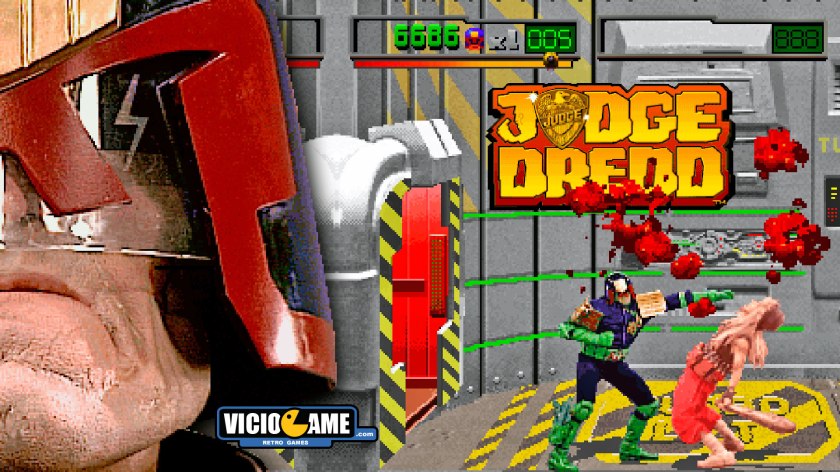
Judge Dredd is a beat-‘em-up arcade game slated for release in 1992, but it was cancelled. Set in a city devastated by nuclear war, the most elite lawman is recruited to serve as judge, jury, and executioner on the crime-ridden streets.
Developer/Publisher: Midway
Release date: 1992
Platform: Arcade Midway T-Unit board
Judge Dredd was born in the pages of the British magazine 2000 AD in 1977, created by writer John Wagner and artist Carlos Ezquerra: a lawman from a dystopian future who combines the roles of investigator, jury, and executioner, enforcing the law on the overcrowded streets of Mega-City One with a brutality that has always worked equally well as straight-up action and as political satire. In the early 1990s, Midway was riding the peak of its most violent and visually distinctive era, an identity cemented by Mortal Kombat and its signature style of digitized graphics captured from real actors. It was in this context that the company acquired the rights to the British character, driven both by the enthusiasm of in-house fans of the comic and by anticipation for the movie adaptation starring Sylvester Stallone, which wouldn’t actually hit theaters until 1995. That’s how, around 1992, an arcade Judge Dredd developed entirely in-house at Midway came to be — a project that came extremely close to release before ultimately being shelved and never making it out of the company’s labs.
The team behind it was small, led by British programmer Jake Simpson, who knew the source material well, alongside fellow programmer Mark Penacho; artist Eric Kinkead joined the project a few months later, with additional contributions from John Vogel and Tim Colman. To inspire the team, Midway even set up a Teenage Mutant Ninja Turtles arcade cabinet from Konami right in the office, and the influence shows: the result was a side-scrolling beat ‘em up in the mold of Final Fight and Double Dragon, with the digitized look Midway was known for, the same technique used in NARC and in Mortal Kombat itself. The man who brought Dredd to life on screen was designer and actor Sal Divita, who years later would lend his face and movements to several fighters in Mortal Kombat 3, including Nightwolf, Cyrax, Sektor, and Smoke. Even the rats that show up as enemies in the sewers came from an oddly literal source: the team rented a rodent from a pet store and filmed it to generate the sprites, and one of the artists ended up adopting the animal after filming wrapped.
Technically, Judge Dredd ran on the Midway T-Unit board, the same hardware behind Mortal Kombat, Mortal Kombat II, NBA Jam, Terminator 2: Judgment Day, Total Carnage, Trog, and Smash TV, among other titles from the company. The cabinet followed Midway’s universal design, reusing the same control panel from NARC, with one unique touch: a red side stripe and a 3D-rendered head of Dredd on the side art, made from an actor in prosthetic makeup rather than a sculpture, as many people assumed. Judge Dredd pioneered this kind of three-dimensional side art at Midway — a technique the company would reuse shortly after on Killer Instinct — and it also helped launch the practice of printing cabinets in multiple colors, since up to that point everything had used a four-color process. Up to three players could compete at once, each on an eight-way joystick with four buttons, controlling a version of Dredd in a different color — not distinct characters, just palette swaps of the same fighter.
Powering on the machine, a digitized intro lays out the premise before the action starts: a Judge appears seated in a rotating 3D chair, quickly flipping through text screens that explain the game’s world. It’s the year 2134, and Mega-City One is home to 400 million people stretched along the entire East Coast of a nuclear-war-ravaged America. Crime is so out of control that the authorities’ solution was to recruit five-year-old children, train them for fifteen years, and turn them into Judges — law officers who also serve as jury and executioner. Dredd is introduced as the best of them all.
The first stage is a straightforward beat ‘em up, with the stated goal of crossing the streets of Mega-City One, descending into the sewers, and reaching a nuclear-hardened shopping mall to stop the Angel Gang. Along the way, Dredd punches and kicks cloned thugs pouring out of storefronts with sarcastic names like “Mr. Clone” and “Music Clown,” a sight gag typical of the consumerism satire that echoes the tone of the original comics — a billboard in the background even name-drops Otto Sump, a recurring character in the magazine, while the city skyline features a Romulan ship design flying overhead, lifted straight from Star Trek: The Next Generation, which was still airing at the time. Unsuspecting civilians wander through the scene and can be rescued from harassment for bonus points, while Dredd can punch and kick in multiple directions, including into and out of the screen, as well as crouch to grab and throw enemies.
Down in the sewers, hordes of rats — the same ones filmed from that pet-store rodent — attack before the stage’s first boss, Fink Angel, a skinny, shirtless guy recognizable by his hat, and a member of the Angel Gang. Later in the same stage, after riding an elevator up, a second confrontation awaits against Mean Machine, another member of the Angel Gang, recognizable by the dial embedded in his forehead that regulates his temper — Dredd has to whittle down his health bar to force him to crank the dial to increasingly “violent” settings, until finally taking him down. Once the stage wraps up, a bonus shooting-gallery stage kicks in, with the camera switching to show Dredd from behind while the player moves a slow-tracking reticle across flickering holographic targets on screen.
The second stage changes the tone completely: Dredd finally draws his Lawgiver sidearm, and the game shifts into a shooting platformer, taking on waves of robots while jumping between walkways and floating elevators. The backdrops and some of the enemies were built from reassembled sci-fi miniatures and toys — at one point, you can spot the base of a Star Wars TIE Fighter model reused as part of a tower’s structure. This marked the first time a Midway game used three-dimensional sprites, roughly two years before Killer Instinct and Donkey Kong Country would popularize the technique, and they were rendered on Amiga computers and ordinary PCs, without the help of Silicon Graphics workstations.
The stage ends with Dredd trading gunfire for hand-to-hand combat against Precious Leglock, a rogue robot faced inside a wrestling ring surrounded by electrified ropes — she threatens to “crush” the hero like a toy and sheds bolts and parts instead of blood when defeated. A motorcycle-chase stage in the style of Spy Hunter, where the player would use Dredd’s Lawmaster to jump over damaged ramps in a race against a fleeing car, was actually prototyped for this point in the game, but was scrapped for being too easy. As in the other stages, a new bonus shooting gallery closes things out.
The third stage drops both the brawling and the first-person shooting to introduce a concept all its own: two rival Mega-City One skyscrapers are preparing to fire cannons at each other, and it’s up to Dredd to hold the line in the street between the two buildings against waves of armed, hostile residents — the so-called block warriors — until police containment foam can arrive, a process that takes just over three minutes. Two steadily depleting meters track the remaining time for each tower; if either one runs out, the cannon fires and the stage restarts from scratch. After winning this war between buildings, the player faces one last bonus shooting gallery, this time with the added challenge of not hitting civilian hostages mixed in among the legitimate targets.
From here on, though, the material is nothing more than a rough sketch: the developers were planning a final showdown against Judge Death, the most iconic of Dredd’s comic-book villains, complete with a conveyor belt of reanimated corpses and a replay against the previous bosses — but all that survives of that idea in the prototype is a single static image of the figure used to represent Judge Death, shown as a preview before the high-score screen, which is the point where production effectively came to a halt.
With development roughly a month from its planned finish, Midway built four prototype cabinets and shipped them out for location testing at arcades in Chicago — standard industry practice at the time for gauging public reaction before greenlighting mass production. The feedback was bad. An internal test report flagged, among other criticisms, how strange it felt for a Judge to rely almost entirely on punches and kicks instead of using his gun more, along with a bug that froze the game during the tower-war stage and seriously hurt the evaluation scores. Market conditions were also working against the project: in 1992 and 1993, three-player cooperative beat ‘em ups — a genre defined by Double Dragon, Final Fight, and Teenage Mutant Ninja Turtles — were rapidly losing ground to one-on-one fighting games like Street Fighter II and Midway’s own Mortal Kombat and NBA Jam, which the company was testing and releasing around the same time with far stronger numbers. Faced with this, the small team lost its motivation, and Midway chose to shelve Judge Dredd entirely rather than rework the project to fix the issues testers had flagged.
In 1994, an internal push tried to reverse the decision, arguing that the roughly eighteen months of work already invested in the project could still be put to use, but the attempt to revive the game never gained traction. After that, an even vaguer proposal circulated internally to repurpose the graphics assets already completed and turn the project into an on-rails shooter in the style of Terminator 2: Judgment Day, another Midway arcade hit — but that idea never got off the ground either. Years later, in interviews about the project, Jake Simpson himself admitted the team’s regret at not pushing just a little harder: according to him, Midway had already paid for the character license, and a relatively small additional effort would likely have been enough to finish the game.
Of the four original cabinets, three are known to have survived and now circulate among collectors in the United States, with at least one restored unit publicly displayed at specialty arcades like Galloping Ghost Arcade in Illinois. Years later, the data from one of the surviving boards was dumped and put into circulation among enthusiasts, which made it possible to run the game both on emulators like MAME and, more recently, on original T-Unit boards adapted from other games that share the same architecture, such as NBA Jam. It’s worth stressing that this in-house Judge Dredd developed by Midway shouldn’t be confused with the Judge Dredd that actually made it to stores: a light-gun shooter released in arcades in 1997 by Acclaim Entertainment and developed by the British studio Gremlin Interactive — a completely separate project with no direct connection to Midway’s prototype, despite sharing a name and a character.
What remains, then, is the record of a project halted right at the finish line, at a moment when Midway itself badly misjudged the distance between a good idea and a product ready for the public. Despite the rough gameplay and lack of variety that counted against it in the Chicago tests, few other Judge Dredd adaptations come as close to visually capturing the grimy, satirical excess of John Wagner and Carlos Ezquerra’s original stories, from the oppressive vertical architecture of Mega-City One to villains pulled almost straight from the pages of 2000 AD. Shelved before it was ever officially born, this behind-the-scenes Judge Dredd from Midway remains a peculiar portrait of a studio at the height of its technical ambition — willing to take risks, and, in the end, all too quick to give up on an idea that maybe deserved just a little more faith.
Judge Dredd nasceu nas páginas da revista britânica 2000 AD em 1977, criado pelo roteirista John Wagner e pelo desenhista Carlos Ezquerra: um policial de um futuro distópico que acumula os papéis de investigador, júri e executor, impondo a lei nas ruas superlotadas de Mega-City One com uma brutalidade que sempre funcionou tanto como ação pura quanto como sátira política. No início dos anos 1990, a Midway vivia o auge de sua fase mais violenta e visualmente marcante, consolidada por Mortal Kombat e por sua assinatura de gráficos digitalizados a partir de atores reais. Foi nesse contexto que a empresa adquiriu os direitos do personagem britânico, motivada tanto pelo entusiasmo de funcionários fãs da HQ quanto pela expectativa em torno da adaptação para o cinema estrelada por Sylvester Stallone, que só chegaria às telonas em 1995. Nascia assim, por volta de 1992, um Judge Dredd de arcade desenvolvido inteiramente pela própria Midway — um projeto que chegou extremamente perto de ser lançado, mas que acabou arquivado antes de deixar os laboratórios da empresa.
A equipe responsável era pequena e liderada pelo programador britânico Jake Simpson, que conhecia bem o material de origem, ao lado do também programador Mark Penacho; o artista Eric Kinkead se juntou ao projeto alguns meses depois, com contribuições adicionais de John Vogel e Tim Colman. Para inspirar o time, a Midway chegou a instalar um gabinete do arcade de Teenage Mutant Ninja Turtles, da Konami, dentro do próprio escritório, e a influência é evidente: o resultado era um beat ‘em up de rolagem lateral no molde de Final Fight e Double Dragon, com o verniz digitalizado característico da Midway, a mesma técnica usada em NARC e no próprio Mortal Kombat. Quem deu corpo a Dredd nas telas foi o designer e ator Sal Divita, que anos depois emprestaria seu rosto e seus movimentos a diversos lutadores de Mortal Kombat 3, entre eles Nightwolf, Cyrax, Sektor e Smoke. Até os ratos que aparecem como inimigos nos esgotos vieram de uma fonte inusitadamente literal: a equipe alugou um roedor de uma pet shop e o filmou para gerar os sprites, e um dos artistas chegou a adotar o animal depois das gravações.
Tecnicamente, Judge Dredd rodava na placa Midway T-Unit, a mesma arquitetura por trás de Mortal Kombat, Mortal Kombat II, NBA Jam, Terminator 2: Judgment Day, Total Carnage, Trog e Smash TV, entre outros títulos da empresa. O gabinete seguia o modelo universal da Midway, com o mesmo painel de controle aproveitado de NARC e um detalhe único: uma faixa vermelha lateral e uma cabeça de Dredd renderizada em 3D na arte lateral, feita a partir de um ator caracterizado com maquiagem protética, e não de uma escultura, como muitos supunham. Judge Dredd foi pioneiro nesse tipo de arte lateral tridimensional dentro da Midway — um recurso que a empresa reaproveitaria pouco depois em Killer Instinct — e também ajudou a inaugurar a impressão de gabinetes em múltiplas cores, já que até então todos usavam processo de quatro cores. Até três jogadores podiam disputar simultaneamente, cada um em um joystick de oito direções com quatro botões, controlando uma versão de Dredd em uma cor diferente — não personagens distintos, apenas variações de paleta do mesmo lutador.
Ao ligar o fliperama, uma introdução digitalizada apresenta a premissa antes de a ação começar: uma Juíza aparece sentada em uma cadeira giratória 3D, folheando rapidamente telas de texto que explicam o mundo do jogo. Estamos no ano de 2134, e Mega-City One abriga 400 milhões de pessoas ao longo de toda a costa leste de uma América devastada pela guerra nuclear. A criminalidade é tão descontrolada que a solução encontrada pelas autoridades foi recrutar crianças de cinco anos, treiná-las por quinze anos e transformá-las em Juízes — policiais que acumulam também os papéis de júri e executor. Dredd é apresentado como o melhor entre eles.
A primeira fase é um beat ‘em up direto, com o objetivo declarado de atravessar as ruas de Mega-City One, descer pelos esgotos e chegar a um shopping blindado contra ataques nucleares para deter a Angel Gang. Pelo caminho, Dredd soca e chuta capangas clonados que saem de fachadas com nomes sarcásticos como “Mr. Clone” e “Music Clown”, em uma piada visual tipicamente satírica sobre consumismo que remete ao tom dos quadrinhos originais — uma placa publicitária no cenário chega a citar Otto Sump, personagem recorrente na revista, enquanto o horizonte da cidade traz, sobrevoando os prédios, o desenho de uma nave romulana emprestado diretamente de Star Trek: The Next Generation, então ainda em exibição. Civis desavisados caminham pela cena e podem ser resgatados de assédios para render pontos bônus, enquanto Dredd consegue socar e chutar em várias direções, inclusive para dentro e para fora da tela, além de agachar para agarrar e arremessar inimigos.
Já nos esgotos, hordas de ratos — os mesmos filmados a partir do roedor de pet shop — atacam antes do primeiro boss da fase, Fink Angel, um sujeito magricela e sem camisa, reconhecível pelo chapéu que usa, integrante da Angel Gang. Ainda na mesma fase, ao subir de elevador, um segundo confronto aguarda contra Mean Machine, outro membro da Angel Gang, reconhecível pelo mostrador cravado na testa que regula seu temperamento — Dredd precisa reduzir sua barra de vida para forçá-lo a girar o disco para ajustes cada vez mais “violentos”, até finalmente derrotá-lo. Encerrada a fase, surge uma fase bônus no estilo galeria de tiro, com a câmera passando a mostrar Dredd de costas enquanto o jogador movimenta uma mira lenta contra alvos holográficos que piscam pela tela.
A segunda fase muda completamente o tom: Dredd finalmente saca o Lawgiver, sua arma de dotação, e o jogo se transforma em uma plataforma com tiro, enfrentando ondas de robôs enquanto salta entre passarelas e elevadores flutuantes. Os cenários e alguns inimigos foram montados a partir de miniaturas e brinquedos de ficção científica remontados — em determinado ponto é possível reconhecer, reaproveitada como parte da estrutura de uma torre, a base de uma nave TIE Fighter de Star Wars. Esta foi a primeira vez que um jogo da Midway utilizou sprites tridimensionais, cerca de dois anos antes de Killer Instinct e Donkey Kong Country popularizarem a técnica, ainda renderizados em computadores Amiga e PCs comuns, sem o auxílio de estações de trabalho Silicon Graphics.
A fase termina com Dredd trocando os tiros pela luta corpo a corpo contra Precious Leglock, uma robô insurgente enfrentada dentro de um ringue de luta livre cercado por cordas eletrificadas — ela ameaça “esmagar” o herói como se fosse um brinquedo e libera parafusos e peças no lugar de sangue ao ser derrotada. Uma fase de perseguição de moto nos moldes de Spy Hunter, na qual o jogador usaria a Lawmaster de Dredd para saltar sobre rampas danificadas em uma corrida contra um carro fugitivo, chegou a ser prototipada para este ponto do jogo, mas foi descartada por ser fácil demais. Como nas demais vezes, uma nova galeria de tiro bônus fecha a fase.
A terceira fase abandona tanto a porrada quanto o tiro em primeira pessoa para apresentar um conceito próprio: dois arranha-céus rivais de Mega-City One se preparam para disparar canhões um contra o outro, e cabe a Dredd conter, na rua entre os dois prédios, ondas de moradores armados e hostis — os chamados block warriors — até que a espuma de contenção da polícia consiga chegar, um processo que leva pouco mais de três minutos. Dois medidores em queda constante marcam o tempo restante de cada torre; se qualquer um deles se esgotar, o canhão dispara e a fase recomeça do zero. Depois de vencer essa guerra entre prédios, resta ao jogador uma última galeria de tiro bônus, desta vez com a exigência extra de não acertar reféns civis misturados aos alvos legítimos.
A partir daqui, porém, o material vira apenas um esboço: os desenvolvedores planejavam um confronto final contra Judge Death, o mais icônico entre os vilões de Dredd nos quadrinhos, incluindo uma esteira rolante de cadáveres reanimados e um replay contra os bosses anteriores — mas tudo o que resta dessa ideia no protótipo é uma única imagem estática do boneco usado para representar Judge Death, exibida como prévia antes da tela de recordes, ponto em que a produção foi efetivamente interrompida.
Com o desenvolvimento a cerca de um mês da conclusão prevista, a Midway produziu quatro gabinetes de protótipo e os enviou para testes em fliperamas de Chicago — prática padrão da indústria da época para medir a reação do público antes de autorizar a produção em massa. O retorno foi ruim. Um relatório de teste interno apontava, entre outras críticas, a estranheza de um Juiz depender quase exclusivamente de socos e chutes em vez de usar mais a arma, além de um bug que travava o jogo durante a fase da guerra entre torres e prejudicou seriamente os números da avaliação. O contexto do mercado também jogava contra o projeto: em 1992 e 1993, os beat ‘em ups cooperativos para até três jogadores — gênero consagrado por Double Dragon, Final Fight e Teenage Mutant Ninja Turtles — perdiam espaço rapidamente para os jogos de luta um contra um, como Street Fighter II e os próprios Mortal Kombat e NBA Jam, que a Midway testava e lançava na mesma época com números muito superiores. Diante disso, a pequena equipe se desmotivou, e a Midway optou por arquivar Judge Dredd por completo, em vez de retrabalhar o projeto para corrigir os problemas apontados pelos testadores.
Em 1994, um movimento interno tentou reverter a decisão, argumentando que os cerca de dezoito meses de trabalho já investidos no projeto ainda podiam ser aproveitados, mas a tentativa de reviver o jogo não avançou. Depois disso, chegou a circular internamente uma proposta ainda mais vaga para reaproveitar os recursos gráficos já prontos e transformar o projeto em um jogo de tiro sobre trilhos, no estilo de Terminator 2: Judgment Day, outro sucesso da própria Midway nos fliperamas — mas essa ideia também não saiu do papel. Anos mais tarde, em entrevistas sobre o projeto, o próprio Jake Simpson reconheceu o arrependimento da equipe por não ter insistido mais um pouco: segundo ele, a Midway já havia pago pela licença do personagem, e um esforço adicional relativamente pequeno provavelmente teria sido suficiente para terminar o jogo.
Dos quatro gabinetes originais, três são conhecidos por terem sobrevivido e hoje circulam entre colecionadores nos Estados Unidos, com pelo menos uma unidade restaurada e exibida publicamente em fliperamas especializados, como o Galloping Ghost Arcade, em Illinois. Anos depois, o conteúdo de uma das placas sobreviventes foi extraído e posto em circulação entre entusiastas, o que tornou possível rodar o jogo tanto em emuladores como o MAME quanto, mais recentemente, em placas T-Unit originais adaptadas a partir de outros jogos que compartilham a mesma arquitetura, como NBA Jam. Vale reforçar que este Judge Dredd desenvolvido internamente pela Midway não deve ser confundido com o Judge Dredd que de fato chegou às lojas: um jogo de tiro com pistola óptica lançado nos arcades em 1997 pela Acclaim Entertainment e desenvolvido pela britânica Gremlin Interactive — um projeto totalmente distinto, sem qualquer ligação direta com o protótipo da Midway, apesar de compartilharem nome e personagem.
Fica, então, o registro de um projeto interrompido bem diante da linha de chegada, num momento em que a própria Midway media mal a distância entre uma boa ideia e um produto pronto para o público. Apesar da jogabilidade rudimentar e da falta de variedade que pesaram contra ele nos testes de Chicago, dificilmente qualquer outra adaptação de Judge Dredd chega tão perto de capturar visualmente o exagero sujo e satírico das histórias originais de John Wagner e Carlos Ezquerra, da arquitetura vertical e opressiva de Mega-City One aos vilões extraídos quase diretamente das páginas da 2000 AD. Encerrado antes de nascer oficialmente, esse Judge Dredd de bastidores da Midway permanece como um retrato peculiar de um estúdio no auge de sua ambição técnica, disposto a arriscar — e, no fim, a desistir rápido demais — de uma ideia que talvez merecesse um pouco mais de fé.
🤑💲Earn money without doing anything! Just leave these apps open:
  ✓ https://r.honeygain.me/CONTA9DB02

   ✓ https://packetstream.io/?psr=1uPb
🤑💲1-Click button earns Bitcoin every 1 hour: https://freebitco.in/?r=53528449
⬛ 𝗧𝗶𝗸𝗧𝗼𝗸: https://www.tiktok.com/@viciogame
🟧 𝗜𝗻𝘀𝘁𝗮𝗴𝗿𝗮𝗺: http://www.instagram.com/viciogame
🟥 𝗬𝗼𝘂𝘁𝘂𝗯𝗲: http://www.youtube.com/viciogame
🟦 𝗙𝗮𝗰𝗲𝗯𝗼𝗼𝗸: http://www.facebook.com/viciogame
🔳 𝗧𝗵𝗿𝗲𝗮𝗱𝘀: https://www.threads.net/@viciogame
🟪 𝗧𝘄𝗶𝘁𝗰𝗵: https://www.twitch.tv/ViciogameRetroGames
🟨 𝗕𝗹𝗼𝗴: http://www.viciogameblog.com/
🟦𝗧𝘄𝗶𝘁𝘁𝗲𝗿: http://www.twitter.com/viciogame
#Viciogame #Gameplay #LetsPlay #Playthrough #Games #Gaming #Videogames #Review #Game #Detonado #Walkthrough #Ending #Reviews #Facts #Retro #RetroGaming #Roms #Emulator #Longplay #Speedrun #NoCommentary #JudgeDredd #arcade #Midway #Acclaim #prototype #proto #MortalKombat #JohnWagner #CarlosEzquerra #Stallone #NBAJam #Terminator #KillerInstinct #SylvesterStallone
 VICIOGAME