
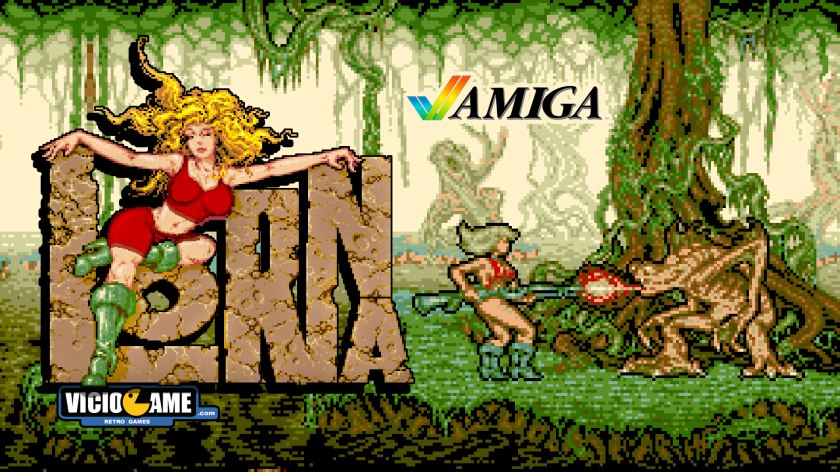
Lorna is an action-platformer released in 1990 for the Commodore Amiga, based on the science fiction comic of the same name. The sexy heroine must infiltrate a temple on an alien planet to rescue and rebuild her robot, a loyal companion in her adventures.
Developer: Topo Soft
Publisher: Erbe Software
Release date: 1990
Platform: Commodore Amiga
🇺🇸 Released in 1990 by Spanish developer Topo Soft and distributed by Erbe Software, Lorna is one of the most peculiar and talked-about titles in all of Spanish software from the turn of the 1990s, blending side-scrolling beat ‘em up action with arcade racing segments and, above all, carrying the direct legacy of one of Europe’s most successful science-fiction comics. Released simultaneously for Amiga, Atari ST, MS-DOS, Amstrad CPC, MSX, and ZX Spectrum, the game adapts the title character created by Madrid-born artist Alfonso Azpiri, bringing to the keyboard (and, in practice, to the joystick as well) the interstellar warrior who was, by that point, already one of the most recognizable figures in Spanish adult comics.
The character was born long before the video game. In 1979, Azpiri teamed up with writer Carlos Sáiz Cidoncha to create Lorna in the pages of the magazine Mastia, blending space opera with a strong erotic charge in short stories that soon began appearing in Cimoc and Humor a Tope as well. International recognition came quickly: the series was featured in major publications like Heavy Metal and Penthouse, and starting in 1981 the publisher Norma released a run of albums collecting the protagonist’s adventures under the title Lorna and Her Robot. The robot in question was an android initially named Matías — a clear homage to C-3PO from Star Wars — later renamed Arnold, whose role in the early stories was essentially to serve as a romantic companion to the lonely scientist on her travels across the galaxy. Despite the near-constant nudity and racy humor of the early adventures, Azpiri always made a point of keeping the series within the realm of the erotic, deliberately steering clear of explicit pornography — an editorial choice that stayed with him for the rest of his career.
Over the years, Dr. Lorna grew from the star of racy, picaresque comic stories into an adventurer who eventually worked for an interstellar Federation on exploration and investigation missions — an evolution that brought her closer to touchstones like Barbarella. Commercial success was substantial: the series was translated into more than ten languages and is still remembered today as one of the great successes of European erotic comics in the 1980s and ’90s. Later albums, such as Mouse Club (1996) and Leviatán (1998, a loose retelling of Moby Dick in which Lorna infiltrates a ship to rescue enslaved robots), as well as the trilogy made up of El Ojo de Dart-An-Gor, Sombras Perdidas, and Las Torres Negras in the 2000s, gradually moved away from the series’ explicitly erotic origins in favor of more classic science-fiction and fantasy plots, eventually working in ecological themes and veiled social commentary.
Azpiri was no stranger to the world of video games long before he saw his creation become the star of one. During the so-called Golden Age of Spanish software, the artist produced roughly two hundred airbrushed covers for companies like Dinamic, Topo Soft, and Opera Soft, establishing an instantly recognizable style built around stylized female figures set against science-fiction and fantasy backdrops. Another of his characters lent its name to Mot, a game released by Opera Soft in 1989 that, unlike Lorna, actually went on to become an animated series produced in France, airing on Canal+ between 1996 and 1997. Azpiri also designed the erotic game La Colmena for Opera Soft in 1992, and in 2012 he received the RetroMadrid Award in recognition of his career as a video game cover artist.
Lorna‘s road to store shelves in 1990, however, was anything but direct. The project had already been announced back in December 1986, in special issue No. 5 of the magazine MicroHobby, as one of Dinamic’s upcoming releases — alongside other titles like Army Moves and Vega Solaris, the latter likewise never released by the company that announced it. Word even circulated at the time of a ZX Spectrum beta version, though no confirmed public record of it has ever surfaced. Dinamic had even used Azpiri’s artwork for Lorna and Vega Solaris in advertising campaigns in the pages of MicroHobby and Micromanía, artwork that was ultimately scrapped. The reason for the change of course was simple: Azpiri was a freelance illustrator with no exclusivity contract, and when Erbe Software — the label that distributed Topo Soft’s games — came calling, the Lorna project naturally moved over there. And so, four years after the original announcement, Topo Soft finally released the game, using it as a kind of bridge into the 16-bit era, since Lorna arrived simultaneously in 8-bit versions and on the newly adopted Amiga, Atari ST, and MS-DOS platforms.
The game’s original concept is credited to Alfonso Azpiri, working with his nephew, Jorge Azpiri, who would go on to handle the graphics for the 16-bit versions — including, therefore, the Amiga version. Jorge had entered the industry at just seventeen, when his uncle told him Dinamic was looking for artists willing to move from traditional drawing to computer work; there, he made a name for himself by almost single-handedly redoing the graphics for Navy Moves, already deep into development at the time, and also handling the visuals for After the War. About a year later, he moved to Topo Soft, where his first 16-bit job was, fittingly, the conversion of Viaje al Centro de la Tierra (Journey to the Center of the Earth) for Amiga, Atari ST, and PC — direct preparation for what he’d do shortly after on Lorna. Programming duties were split between Gabriel Ortas, who handled the 8-bit versions, and Agustín Guillén, who handled both programming and sound for the 16-bit versions; the 8-bit graphics fell to Rafael Ángel García Cabrera, with programming support from Antonio Moya; the soundtrack was composed by T.P.M. (Rubén Rubio Nielpha); and production was handled by Gabriel Nieto. The box art itself was painted by Alfonso Azpiri. One curious detail from the game’s design: Azpiri reportedly asked specifically for Lorna to ride a flying motorcycle at one point, as a direct nod to the speeder bike chase through the forest of Endor in Star Wars: Return of the Jedi — a request the development team actually granted.
On paper, Lorna‘s story is a lean one: the protagonist finds herself stranded on a hostile planet and must fight her way across it, defeating the mutant creatures that inhabit it over the course of five stages, all while collecting pieces of her own robot, scattered across the land, in order to rebuild him. Since most of the narrative is conveyed visually, with very little on-screen text, the language barrier barely affects the experience, even though the game was originally conceived in Spanish. To defend herself, Lorna has melee attacks and an assault rifle with limited ammunition at her disposal, underscoring the strategic role firearms play in the game. Bars and counters at the bottom of the screen track remaining energy, shown as a red bar, along with the number of lives and available ammunition.
The first stage takes place in a region of the planet inhabited by creatures born of a strange mutation between amphibians and primates. Among them are the Jacobeos, who charge at Lorna and strike her with a sword, and gun-wielding patrolmen who guard the entrance to a temple — catching one of their shots means instant death. Flying creatures periodically cross the screen carrying life, energy, or ammo bonuses, and some seemingly harmless scenery elements hide deadly traps. From there, the action shifts inside a cave, where a village must be crossed to reach the exit on the other side of the mountain. It’s home to the Bestiajo, which charges forward, leaps over Lorna’s head, and strikes her relentlessly until defeated, and the Amoroso, a creature hopelessly smitten with the protagonist whose biggest annoyance is clinging to her, briefly preventing any attack until it lets go on its own.
Starting with the third stage, the pace changes entirely: Lorna steals a motorcycle and rides across an entire forest, dodging trees and the patrolmen chasing her, in a section that closely mirrors the speeder bike chase from Star Wars: Return of the Jedi. At the end of the ride, she has to ditch the bike and continue on foot through a cave to cross the mountain ahead. The fourth stage repeats the formula with another forest crossing — another motorcycle is stolen, and the same patrolmen return, now more numerous and aggressive, calling for the same strategy of dodging them and trying to make them slam into tree trunks. The fifth and final stage shifts the tone once again: flying dragons hurl fireballs, as do the Monjes, who can’t be attacked directly — sword-and-shield-wielding skeletons emerge from their fireballs instead, and it’s those skeletons that are the real target, to be taken down before they get close enough to strike.
Visually, Lorna is usually remembered fondly, and rightly so: its art, a direct product of Jorge Azpiri’s work on the 16-bit version, boasts a well-chosen color palette, detailed backgrounds — especially in the underground sections — and character designs worthy of the franchise’s tradition. The Amiga version is often compared to Lionheart for its blend of jungle and sci-fi settings, and to After the War, a Spanish contemporary with an equally post-apocalyptic bent. The game engine doesn’t keep pace with the graphics, though: scrolling in the Amiga version falls short of what the machine was capable of, and the contrast between the fast, flashy motorcycle sections and the slower-paced on-foot segments points to an uneven overall experience. Magazines at the time suggested that, with an engine to match its art, Lorna could have rivaled classics on the level of Ruff’n’Tumble.
The difficulty is extremely high and poorly balanced, making for a short adventure — skilled players can beat the game in about fifteen minutes — but one prone to sudden deaths and frustrating restarts. The original physical edition softened that curve somewhat by including, inside the box itself, a printed comic booklet with Azpiri’s original comic story, combining the two media in a single product in a way that was unusual for its time.
Reviews from the specialized press, curiously, split along almost regional lines. In Spain, Micromanía scored the combined Atari ST, Amiga, and PC version a 9 out of 10, while MicroHobby gave the ZX Spectrum version 85 out of 100 — numbers that reflect the local enthusiasm over one of the most beloved characters of the Golden Age of Spanish comics making the leap to computers. In Germany, on the other hand, the magazine Amiga Joker was far harsher on the Amiga version specifically, awarding it just 31 out of 100. Decades later, retrospective reviews tend to even out that contrast: they acknowledge the game’s technical merits, especially its art and sound, but point to the unbalanced gameplay as its weakest link, generally landing on consensus scores somewhere in the middle of the pack.
It’s worth noting that the various conversions of Lorna aren’t simple copies of one another — enemies and ammo counts vary by platform, making each version a slightly different experience. Among the 8-bit versions, the most common consensus holds up the Amstrad CPC edition as the most polished, followed by ZX Spectrum and then MSX; among the 16-bit versions, Atari ST tends to come out on top, with Amiga in second place and MS-DOS rounding out the list — the latter, incidentally, originally running in either CGA or EGA graphics mode, at the player’s choice. Affection for Lorna in Spain’s collector scene is still alive today: in 2020, the label Topo Siglo XXI, founded by Alfonso Fernández Borro — a former Topo Soft artist himself — released an official physical reissue of the game, with manuals published in Spanish, English, and even Portuguese.
Topo Soft itself, founded in 1987 by producer Paco Pastor and based in Madrid, was one of the major players of the Golden Age of Spanish software, alongside names like Dinamic and Opera Soft, and published dozens of games over the course of its existence. The company, however, didn’t survive the late arrival of 16-bit systems to the Spanish market combined with the era’s rampant piracy, and shut down in 1994; part of its team would later go on to found Pyro Studios, the company behind the Commandos series. Former employees would later acknowledge that the pressure to hit release deadlines sometimes came at the expense of a game’s final polish — a comment that helps explain the balance issues so often pointed out in Lorna.
Alfonso Azpiri kept drawing the adventures of his most famous creation long after the game’s release, alternating between more explicitly erotic phases and forays into more traditional science fiction and epic fantasy, and he also remained active in Spanish cinema, with credits that include production design for El Caballero del Dragón (1985, released in English as Star Knight) and a brief acting role in Rojo Sangre (2004). In 2015, near the end of his career, he made a brief return to the world of video games, painting an alternate cover for Dark Souls II — a late-career reunion, of sorts, with the industry he’d helped illustrate decades before. Azpiri died of cancer on August 18, 2017, at the age of seventy, leaving behind a legacy recognized both as one of the most influential names in Spanish comics and as the country’s foremost video game cover artist.
More than three decades after its release, Lorna still stands as a fairly faithful snapshot of its era: a game born at the crossroads of Spain’s booming software industry and its homegrown tradition of adult science-fiction comics, carrying both the artistic achievements and the production rush that defined that period. It’s also, in a sense, the meeting point of two generations from the same family of artists: the style Alfonso Azpiri built up at newsstands throughout the 1980s found its way, on an Amiga screen, into the hands of his nephew Jorge, closing a creative circle that began in comics and, decades later, carried through into the history of Spanish video games itself.
🇧🇷 Lançado em 1990 pela desenvolvedora espanhola Topo Soft, com distribuição da Erbe Software, Lorna é um dos títulos mais peculiares e comentados de todo o software espanhol da virada para os anos 1990, misturando o beat ‘em up de rolagem lateral com trechos de corrida arcade e, sobretudo, carregando a herança direta de um dos quadrinhos de ficção científica mais bem-sucedidos da Europa. Lançado simultaneamente para Amiga, Atari ST, MS-DOS, Amstrad CPC, MSX e ZX Spectrum, o jogo adapta a personagem-título criada pelo desenhista madrilenho Alfonso Azpiri, transportando para o teclado (e, na prática, também para o joystick) a guerreira interestelar que já era, àquela altura, uma das figuras mais reconhecíveis dos quadrinhos adultos espanhóis.
A personagem nasceu bem antes do videogame. Em 1979, Azpiri uniu forças com o roteirista Carlos Sáiz Cidoncha para criar Lorna nas páginas da revista Mastia, misturando space opera com forte carga erótica em histórias curtas que logo passaram a ser publicadas também em Cimoc e Humor a Tope. A repercussão internacional veio rápido: a série chegou a estampar publicações de peso como a Heavy Metal e a Penthouse, e a editora Norma lançaria, a partir de 1981, uma sequência de álbuns recompilando as aventuras da protagonista sob o título “Lorna e seu Robô”. O robô em questão era um androide batizado inicialmente de Matías — uma clara homenagem ao C-3PO de Star Wars —, mais tarde rebatizado de Arnold, cuja função nas primeiras histórias era, essencialmente, servir de companhia amorosa à cientista solitária em suas viagens pela galáxia. Apesar da nudez praticamente onipresente e do humor picante das primeiras aventuras, Azpiri sempre fez questão de manter a série no terreno do erotismo, evitando deliberadamente resvalar para a pornografia explícita — uma escolha editorial que o acompanharia pelo resto da carreira.
Com o passar dos anos, a doutora Lorna deixou de ser apenas a protagonista de historietas picantes e picarescas para se tornar uma aventureira que, eventualmente, prestava serviços a uma Federação interestelar em missões de exploração e investigação — uma evolução que a aproximou de referências como Barbarella. O sucesso comercial foi expressivo: a série foi traduzida para mais de dez idiomas e é até hoje lembrada como um dos maiores êxitos do quadrinho erótico europeu das décadas de 1980 e 1990. Álbuns posteriores, como Mouse Club (1996) e Leviatán (1998, uma releitura livre de Moby Dick em que Lorna se infiltra em um navio para resgatar robôs escravizados), assim como a trilogia formada por El Ojo de Dart-An-Gor, Sombras Perdidas e Las Torres Negras já nos anos 2000, foram progressivamente abandonando o tom explicitamente erótico das origens em favor de tramas de ficção científica e fantasia mais clássicas, chegando a incorporar temas ecológicos e críticas sociais veladas.
Azpiri não era estranho ao universo dos jogos eletrônicos muito antes de ver sua criação virar protagonista de um. Durante a chamada Idade de Ouro do software espanhol, o desenhista assinou cerca de duzentas capas aerografadas para companhias como Dinamic, Topo Soft e Opera Soft, consolidando um estilo instantaneamente reconhecível de figuras femininas estilizadas em cenários de ficção científica e fantasia. Outro de seus personagens deu nome a Mot, jogo lançado pela Opera Soft em 1989 que, ao contrário do que aconteceria com Lorna, chegou a virar uma série animada de fato produzida na França, exibida pelo Canal+ entre 1996 e 1997. Azpiri também assinou o design do jogo erótico La Colmena, da Opera Soft, em 1992, e em 2012 recebeu o Prêmio RetroMadrid em reconhecimento à sua carreira como ilustrador de capas de videogame.
A trajetória de Lorna até chegar às lojas em 1990, porém, foi tudo menos direta. O projeto já havia sido anunciado ainda em dezembro de 1986, no especial número 5 da revista MicroHobby, como um dos lançamentos futuros da Dinamic — ao lado de outros títulos como Army Moves e Vega Solaris, este último também condenado a nunca sair pela companhia que o anunciou. Chegou a circular menção a uma versão beta para ZX Spectrum ainda naquela fase inicial, da qual, até hoje, nunca surgiu qualquer registro público confirmado. A Dinamic havia inclusive usado ilustrações de Azpiri para Lorna e para Vega Solaris em campanhas publicitárias nas páginas da MicroHobby e da Micromanía, artes que acabariam descartadas. O motivo da mudança de rumo foi simples: Azpiri era um ilustrador freelance sem contrato de exclusividade, e quando a Erbe Software — selo que distribuía os jogos da Topo Soft — o procurou, o projeto de Lorna naturalmente migrou para lá. Foi assim que, quatro anos depois do anúncio original, a Topo Soft finalmente lançou o jogo, usando-o como uma espécie de ponte para sua entrada no mundo dos 16 bits, já que Lorna chegou simultaneamente às versões de 8 bits e às recém-adotadas plataformas de Amiga, Atari ST e MS-DOS.
A ideia original do jogo é creditada a Alfonso Azpiri em parceria com seu sobrinho, Jorge Azpiri, que se tornaria o responsável pelos gráficos das versões de 16 bits — incluindo, portanto, a de Amiga. Jorge havia entrado no ramo ainda aos dezessete anos, quando o tio o avisou que a Dinamic buscava artistas dispostos a migrar do desenho tradicional para o computador; lá, destacou-se refazendo praticamente sozinho a parte gráfica de Navy Moves em estágio avançado de desenvolvimento e assinando também os visuais de After the War. Cerca de um ano depois, mudou-se para a Topo Soft, onde seu primeiro trabalho em 16 bits foi justamente a conversão de Viaje al Centro de la Tierra para Amiga, Atari ST e PC, servindo de preparação direta para o que faria pouco depois em Lorna. A programação ficou dividida entre Gabriel Ortas, nas versões de 8 bits, e Agustín Guillén, responsável tanto pela programação quanto pelo som das versões de 16 bits; os gráficos de 8 bits couberam a Rafael Ángel García Cabrera, com apoio de programação de Antonio Moya; a trilha sonora ficou a cargo de T.P.M. (Rubén Rubio Nielpha); e a produção coube a Gabriel Nieto. A própria arte da capa da caixa foi pintada por Alfonso Azpiri. Uma curiosidade da concepção do projeto: consta que o próprio Azpiri pediu explicitamente que Lorna pilotasse, em determinado trecho, uma moto voadora em referência direta à perseguição de motos-jato na floresta de Endor em Star Wars: O Retorno de Jedi — pedido que a equipe de desenvolvimento efetivamente atendeu.
No papel, o roteiro de Lorna é enxuto: a protagonista se vê presa em um planeta hostil e precisa atravessá-lo derrotando as criaturas mutantes que o habitam ao longo de cinco fases, ao mesmo tempo em que recolhe peças do próprio robô, espalhadas pelo território, para reconstruí-lo. Como boa parte da narrativa é transmitida visualmente, com pouquíssimo texto em tela, a barreira do idioma praticamente não afeta a experiência, mesmo o jogo tendo sido concebido originalmente em espanhol. Para se defender, a jogadora conta com ataques corpo a corpo e com um rifle de assalto de munição escassa, o que reforça o caráter estratégico do uso das armas de fogo. Barras e contadores na parte inferior da tela informam a energia restante, representada por uma barra vermelha, o número de vidas e a munição disponível.
A primeira fase se passa em uma região do planeta habitada por criaturas nascidas de uma estranha mutação entre anfíbios e primatas. Entre elas estão os Jacobeos, que correm em direção a Lorna e a golpeiam com uma espada, e patrulheiros armados com pistolas que vigiam o acesso a um templo — encontrar um de seus tiros significa morte instantânea. Animais voadores cruzam a tela de tempos em tempos carregando bônus de vida, energia ou munição, e alguns elementos aparentemente inofensivos do cenário escondem armadilhas mortais. Na sequência, a ação se transfere para o interior de uma caverna, onde um vilarejo precisa ser atravessado até a saída do outro lado da montanha. Ali moram o Bestiajo, que avança correndo, salta por cima da cabeça de Lorna e a golpeia sem trégua até ser eliminado, e o Amoroso, uma criatura perdidamente apaixonada pela protagonista cujo maior incômodo é grudar-se a ela, impedindo momentaneamente qualquer ataque até se soltar por conta própria.
A partir da terceira fase, o ritmo muda por completo: Lorna rouba uma moto e atravessa uma floresta inteira desviando de árvores e dos patrulheiros que a perseguem, em uma seção que reproduz quase à risca a perseguição de motos-jato de Star Wars: O Retorno de Jedi. Ao final do trajeto, é preciso abandonar o veículo e seguir a pé por uma caverna para transpor a montanha adiante. A quarta fase repete a fórmula em uma nova travessia florestal — outra moto é roubada, e os mesmos patrulheiros retornam agora mais numerosos e agressivos, exigindo a mesma estratégia de desviar deles e tentar fazê-los colidir contra os troncos. A quinta e última fase muda novamente o tom: dragões voadores lançam bolas de fogo, assim como os Monjes, que não podem ser atacados diretamente — de suas bolas de fogo surgem esqueletos armados de espada e escudo, e são eles o verdadeiro alvo a ser eliminado antes que cheguem perto o suficiente para golpear.
Visualmente, Lorna costuma ser lembrado com carinho justamente pela qualidade de sua arte, fruto direto do trabalho de Jorge Azpiri na versão de 16 bits: paleta de cores bem escolhida, cenários detalhados — com destaque para os trechos subterrâneos — e um desenho de personagens à altura da tradição da franquia. É comum ver a versão de Amiga comparada a Lionheart pela ambientação entre selva e ficção científica, e a After the War, contemporâneo espanhol de temática igualmente pós-apocalíptica. O motor do jogo não acompanha o nível dos gráficos: a rolagem de tela na versão de Amiga está aquém do que a máquina permitia, e o contraste entre os trechos velozes e vistosos da moto e o ritmo mais arrastado das seções a pé demonstra um desequilíbrio da experiência. Revistas da época sugeriram que, com um motor à altura da arte, Lorna poderia ter rivalizado com clássicos do calibre de Ruff’n’Tumble.
A dificuldade é extremamente elevada e mal calibrada, resultando em uma aventura curta — jogadores habilidosos podem zerar o jogo em cerca de quinze minutos — mas propensa a mortes súbitas e recomeços frustrantes. A edição física original amenizava um pouco essa curva ao vir acompanhada, dentro da própria caixa, de um gibi impresso com a história em quadrinhos original de Azpiri, unindo as duas mídias em um único produto de forma pouco comum para a época.
A recepção da imprensa especializada, curiosamente, dividiu-se de forma quase regional. Na Espanha, a Micromanía avaliou a versão conjunta de Atari ST, Amiga e PC com nota 9 de 10, enquanto a MicroHobby deu 85 de 100 à versão de ZX Spectrum — números que refletem o entusiasmo local com a chegada de um dos personagens mais queridos da Idade de Ouro do quadrinho espanhol ao computador. Já na Alemanha, a revista Amiga Joker foi bem mais dura com a versão de Amiga especificamente, concedendo apenas 31 de 100. Décadas depois, análises retrospectivas tendem a equilibrar esse contraste: reconhecem os méritos técnicos do jogo, sobretudo na parte artística e sonora, mas apontam a jogabilidade desbalanceada como seu elo mais fraco, resultando em notas de consenso geralmente na faixa intermediária.
Vale notar que as diferentes conversões de Lorna não são simples cópias umas das outras: inimigos e quantidade de munição variam conforme a plataforma, o que torna cada versão uma experiência ligeiramente distinta. Entre as versões de 8 bits, o consenso mais recorrente aponta a de Amstrad CPC como a mais bem-acabada, seguida por ZX Spectrum e depois MSX; entre as de 16 bits, a de Atari ST costuma liderar, com a de Amiga em segundo lugar e a de MS-DOS fechando a lista — esta última, aliás, rodando originalmente em modo gráfico CGA ou EGA, à escolha do jogador. O carinho por Lorna no cenário colecionador espanhol segue vivo até hoje: em 2020, o selo Topo Siglo XXI, criado por Alfonso Fernández Borro — ex-artista da própria Topo Soft —, lançou uma reedição física oficial do jogo, com manuais chegando a ser publicados em espanhol, inglês e até português.
A própria Topo Soft, fundada em 1987 pelo produtor Paco Pastor e sediada em Madri, foi uma das grandes companhias da Idade de Ouro do software espanhol, ao lado de nomes como Dinamic e Opera Soft, chegando a publicar dezenas de jogos ao longo de sua existência. A empresa não resistiu, porém, à chegada tardia dos 16 bits ao mercado espanhol somada à pirataria generalizada da época, encerrando as atividades em 1994; parte de sua equipe seguiria carreira anos depois na fundação da Pyro Studios, responsável pela série Commandos. Ex-funcionários da companhia reconheceriam, tempos depois, que a pressão por cumprir metas de lançamento às vezes comprometia o polimento final dos jogos, um comentário que ajuda a explicar os problemas de balanceamento tantas vezes apontados em Lorna.
Alfonso Azpiri continuou desenhando as aventuras de sua criação mais famosa até bem depois do lançamento do jogo, alternando fases de erotismo mais explícito com incursões na ficção científica e na fantasia épica mais tradicionais, e seguiu ativo também no cinema espanhol, com contribuições que incluem o design de produção de El Caballero del Dragón (1985) e uma aparição breve como ator em Rojo Sangre (2004). Em 2015, já perto do fim da carreira, voltou brevemente ao universo dos videogames ao assinar uma capa alternativa para Dark Souls II, numa espécie de reencontro tardio com a indústria que ajudara a ilustrar décadas antes. Azpiri morreu em 18 de agosto de 2017, aos setenta anos, vítima de câncer, deixando um legado reconhecido tanto como um dos nomes mais influentes do quadrinho espanhol quanto como o mais importante ilustrador de capas de videogame do país.
Mais de três décadas depois de seu lançamento, Lorna permanece como um retrato bastante fiel de seu tempo: um jogo nascido do cruzamento entre a indústria do software espanhol em plena efervescência e a tradição local do quadrinho adulto de ficção científica, carregando tanto os acertos artísticos quanto as pressas de produção que marcaram aquele período. É também, de certa forma, o ponto de encontro entre duas gerações de uma mesma família de artistas: o traço que Alfonso Azpiri consolidou nas bancas de jornal ao longo dos anos 1980 encontrou, na tela do Amiga, as mãos de seu sobrinho Jorge, fechando um ciclo criativo que começou nos quadrinhos e atravessou, décadas depois, a própria história do videogame espanhol.
🤑💲Earn money without doing anything! Just leave these apps open:
  ✓ https://r.honeygain.me/CONTA9DB02

   ✓ https://packetstream.io/?psr=1uPb
🤑💲1-Click button earns Bitcoin every 1 hour: https://freebitco.in/?r=53528449
⬛ 𝗧𝗶𝗸𝗧𝗼𝗸: https://www.tiktok.com/@viciogame
🟧 𝗜𝗻𝘀𝘁𝗮𝗴𝗿𝗮𝗺: http://www.instagram.com/viciogame
🟥 𝗬𝗼𝘂𝘁𝘂𝗯𝗲: http://www.youtube.com/viciogame
🟦 𝗙𝗮𝗰𝗲𝗯𝗼𝗼𝗸: http://www.facebook.com/viciogame
🔳 𝗧𝗵𝗿𝗲𝗮𝗱𝘀: https://www.threads.net/@viciogame
🟪 𝗧𝘄𝗶𝘁𝗰𝗵: https://www.twitch.tv/ViciogameRetroGames
🟨 𝗕𝗹𝗼𝗴: http://www.viciogameblog.com/
🟦𝗧𝘄𝗶𝘁𝘁𝗲𝗿: http://www.twitter.com/viciogame
#Viciogame #Gameplay #LetsPlay #Playthrough #Games #Gaming #Videogames #Review #Game #Detonado #Walkthrough #Ending #Reviews #Facts #Retro #RetroGaming #Roms #Emulator #Longplay #Speedrun #NoCommentary #Lorna #Amiga #Commodore #Comic #AlfonsoAzpiri #StarWars #CommodoreAmiga

