
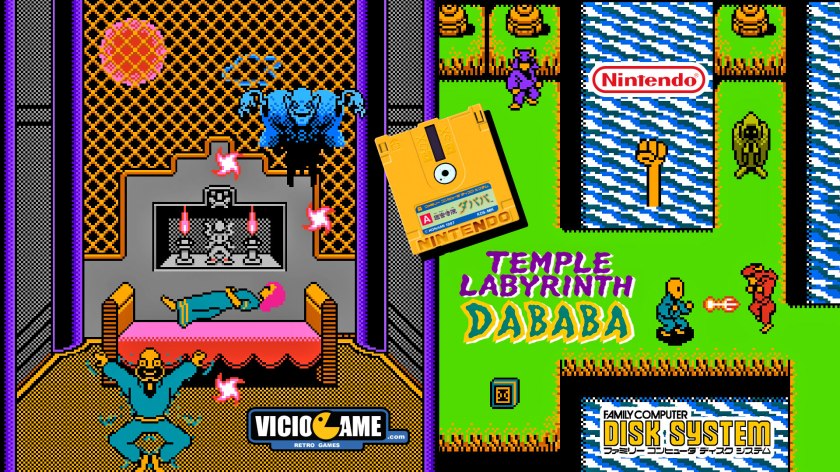
Meikyuu Jiin Dababa (迷宮寺院ダババ), also known as Dababa’s Labyrinth Temple, is an action game released in 1987 for the Famicom Disk System, an add-on that let the Famicom, Nintendo‘s Japanese console, read floppy disks. A young monk must rescue his girlfriend from an evil sorcerer.
Developer/Publisher: Konami
Release date: 1987
Platform: Famicom / Nintendo Famicom Disk System
🇺🇸 Meikyuu Jiin Dababa is an action game released by Konami on May 29, 1987, exclusively for the Famicom Disk System, the magnetic floppy disk peripheral Nintendo used to expand the capabilities of the Japanese Famicom. The title never left Japan, nor was it ever converted to cartridge, remaining a disk-format exclusive from start to finish. The original title, 迷宮寺院ダババ, can be loosely translated as “Dababa’s Labyrinth Temple,” a direct reference to the adventure’s central setting and to the evil god imprisoned in its depths. The game combines direct action with strong puzzle and deduction elements, characteristics that, combined with a setting blending Hindu and Buddhist mythology, would make it, decades later, one of the most peculiar and least remembered chapters in Konami’s entire catalog for the peripheral.
The Famicom Disk System had arrived in the Japanese market on February 21, 1986, sold as an add-on that fit beneath the Famicom and replaced cartridges with low-cost magnetic disks that could be rewritten for just 500 yen at kiosks scattered across toy and game stores — quite a selling point at a time when most cartridge games didn’t even offer a save system. Konami was the first third-party developer to officially support the format and quickly became one of its biggest suppliers of exclusive software. Meikyuu Jiin Dababa emerged from this fertile context just over a month after another Konami release for the Famicom Disk System: Ai Senshi Nicol, from April 24, 1987, also a top-down action game about rescuing a girlfriend kidnapped by a supernatural villain — a thematic coincidence that wouldn’t go unnoticed by critics at the time.
The story takes place in ancient India, in the village of Pataliputra, where a temple once stood dedicated to the heretical cult of the evil god Dababa. A high priest eventually defeats Dababa and frees the villagers from this dark faith; atop the ruins of the old temple, he builds the temple of Surya — the sun god’s name in Hindu mythology — and hides the sutra that keeps Dababa sealed away deep within a vast labyrinth, restoring peace to the region. Generations later, an orphan named Shiva is taken in by the elderly monk Vimala, leader of the temple of Surya, and begins training under his tutelage with dedication and discipline. Training alongside him is Raidon, another of Vimala’s disciples, from a wealthy family and with an attitude far less devoted to his studies.
One day, Raidon skips training to explore the temple alone and ends up finding a tightly sealed sutra — the very one imprisoning Dababa. From that point on, he vanishes without a trace, taking the seal itself with him. Three years pass; the village assumes he simply ran away from his training. During this period, however, young women from the region begin disappearing one by one, victims of what Japanese folklore calls kamikakushi, the sudden and inexplicable vanishing attributed to spirits. The cycle culminates when Vimala’s own daughter, Tanya, is taken right before Shiva’s eyes by Raidon’s henchmen — Raidon now wielding the evil god’s power; Shiva tries to stop the kidnapping but is overpowered before he can save her. Determined to rescue Tanya and confront his old training companion, Shiva sets out alone toward the labyrinth where the seal once rested.
This ancient Indian setting permeates every aspect of the game, which freely blends Hindu and Buddhist iconography — temples, sun deities, sacred birds, hungry ghosts — with an entirely invented mythology built around the cult of Dababa. Both critics at the time and more recent analysts tend to point to this exotic atmosphere as one of the game’s most distinctive traits within Konami’s catalog and the entire Famicom Disk System library, whose titles rarely ventured so far from Japan in search of a setting.
What most sets Meikyuu Jiin Dababa apart from other top-down action games of its era is its movement system, built entirely around a grid of squares. Neither Shiva nor the enemies glide freely across the scenery: they hop from square to square. Pressing a direction for the first time simply makes Shiva turn to face that side, allowing him to attack; pressing the same direction again makes him actually hop one square forward. Holding the A button while moving lets him hop two squares at once, useful both for crossing obstacles like water or lava and for covering ground faster — though it’s rarely possible to hop over an enemy, since both share the same plane of movement. Shiva can also hop in place without moving from his square. The result gives the gameplay a stop-turn-then-act rhythm quite different from the reflexive fluidity of other action games: dodging an enemy projectile, for instance, requires moving a full square, turning, and then moving back, rather than a simple sidestep.
Structurally, the game is divided into four areas, each capped off by a boss fight. With the exception of the last, all of them split into an outdoor stretch followed by a temple interior, adding up to between six and ten rooms per area. Right in the first room of each area, progress hinges on repeatedly shooting statues and trees scattered around the scenery: each one needs to be hit seven times, and some release power-ups, while one specific one actually opens the way forward. Inside the temples, certain floor tiles crack and fully reveal themselves after three hops on top of them, hiding seals, traps, or new power-ups. As soon as all the seals in a room are uncovered, a special item appears that, once collected, clears the screen of enemies for a few moments and unlocks the door to the next room.
Not every door, however, actually leads forward: some are fake doors that send Shiva back to the start of the room or even to a previous one, forcing him to start over, while the real exit is sometimes deliberately hidden, rewarding trial and error more than reflexes. Other rooms do away with the seal hunt entirely: it’s simply a matter of surviving a constant flood of endlessly respawning enemies, or winning a race against time as the floor itself begins to crumble and vanish beneath the player’s feet, forcing them to push forward before the whole room collapses. Given such demands, the disk itself allows progress to be saved at any moment — quite a relief, since without that option, the game would be brutal.
The enemy roster, reused with different sprites in each temple, includes fast, erratic blobs, humanoid monk-like sentries that patrol or chase Shiva, sorcerers who teleport and fire projectiles, and indestructible floating heads that can only be deflected, never destroyed. Shiva’s starting attack is a trident-shaped jet of fire; power-ups along the way can swap it for a lotus flower that fires fireballs, a hail of arrows, a triple shot, or a chain of iron prayer beads visually resembling a rosary, each weapon with its own range and rate of fire. Other items extend the life bar with extra hearts, halve incoming damage for a period, wipe out every enemy on screen at once for a breather, or simply add to the score.
Boss fights swap the top-down view for a side-on perspective, with noticeably floatier controls and jumps capable of carrying Shiva nearly the full height of the screen — necessary given the arenas’ layout, but they coexist with the same quirk of having to hop in a direction just to turn toward it, which more than occasionally costs a hit that a simple pivot would avoid in a conventional action game. This abrupt shift in perspective and the vertical duels it produces become one of the game’s most striking features, seen by some as an odd inconsistency and by others as one of its most unforgettable stretches, depending on who’s evaluating it.
The first area takes place at Lake Takishidara, a cursed body of water, and leads to the Gari temple, guarded by Daiganbutsu — a name that translates literally to something like “great Buddha-face” — a floating, disembodied face that, given the chance, swallows Shiva whole before spitting him back out. The second area occupies the volcanic belt of Marakando, where lava bombs fall relentlessly over the outdoor stretch, leading to the Bimara temple, defended by Maō Kária, whose very name already announces a “demon king”: a fierce dragon waiting for Shiva in the final chamber.
The third area unfolds on the Jandiaru plateau, a sinister grassland overrun with poisonous plants, and empties into the Garuda temple — a name referring to the great divine bird of Hindu and Buddhist mythology — where three Gakidama appear simultaneously, each endlessly spawning hordes of small hungry spirits to attack Shiva. The fourth and final area drops the outdoor stretch and packs in more rooms than any of the previous ones: it’s the Dababa temple itself, the very same labyrinth where the god had been sealed away for generations, and it ends in a double final battle — first against Raidon, transformed into a monster by the evil power Dababa lent him, and immediately after against Dababa himself, now resurrected — after which the game goes straight to the ending.
Visually, the game follows Konami’s typical quality standard for the period: detailed sprites, good animation, and unconventional color choices that reinforce the temples’ atmosphere of mystery, consistently underpinned by the blend of Hindu and Buddhist imagery. The soundtrack is one of the game’s greatest strengths: it makes use of the Famicom Disk System‘s extra sound channel to deliver a handful of genuinely great Indian- and Arabic-inspired melodies — though, spread across so many rooms, the few distinct tracks available end up repeating frequently.
A number of small details reward players who explore the game more deeply: for example, there’s a hidden room holding nothing but the development team’s credits, with no other function — but visible only to players who discover the secret passage leading to the extra stage, and only while wielding the iron prayer bead weapon (as seen in our gameplay video available at the start of this article).
Around the time Meikyuu Jiin Dababa was released, the magazine Famicom Tsūshin — known today as Famitsu — reviewed the game in its traditional Cross Review format, tallying 31 out of 40 possible points and earning the game a spot in what the publication called the silver-tier “hall of honor.” One reviewer summed up the experience as somewhere between the gameplay of King Kong 2: Ikari no Megaton Punch and the cast of characters from Ai Senshi Nicol — a telling comparison, since Nicol had come out of Konami’s own Famicom Disk System lineup just over a month earlier, and King Kong 2 had arrived from the same developer months before that.
Family Computer Magazine, meanwhile, in its reader poll known as the report card, gave the game 15.81 out of 25 points, broken down as 3.25 for characters, 3.25 for music, 2.96 for controls, 3.15 for how well it held the player’s attention, and 3.20 for originality — the value-for-money category went unscored. Later, in 1991, a special catalog from the same magazine dedicated to the entire Famicom Disk System library praised the then-novel one-square-at-a-time hopping movement, Konami’s characteristically solid controls, and the Indian-flavored soundtrack, describing the game as something anyone could pick up and enjoy without difficulty.
Decades later, retrospective reviews proved equally receptive. One outlet called the game “a lost gem from the Famicom Disk System‘s short life,” taking the time to dissect its jump-based puzzles and combat and pointing to it as the biggest outlier within Konami’s own catalog for the format — though the piece stopped short of placing it alongside the developer’s more celebrated works for the same peripheral, such as Almana no Kiseki and the already-mentioned Ai Senshi Nicol.
Yet another, more recent outlet gave the game an 8 out of 10, calling it perhaps the standout among Konami’s Famicom Disk System exclusives and praising how satisfying its blend of action and deduction becomes once its unorthodox rules click — while still noting its short length, under half an hour once the rooms are known, and puzzles that are sometimes too obtuse, demanding trial and error with no on-screen guidance, a gap an instruction manual would normally have filled had the game ever left Japan. Some historians specializing in Konami’s history have stated that Meikyuu Jiin Dababa‘s square-hopping movement system served as the basis for the movement system Nintendo itself would adopt three years later in StarTropics for the NES.
Also in 1987, two strategy guides dedicated to the game hit Japanese stores: Meikyuu Jiin Dababa Kanzen Hisshōbon, roughly “the complete guide to victory,” published by JICC, and an equivalent volume in Kosuka’s line of guides — both aimed at helping players map out the labyrinth’s countless fake doors and hidden seals. The game’s soundtrack resurfaced twice on official compilations: as one of the tracks on the album Famicom 20th Anniversary Original Sound Tracks Vol. 3, released by Scitron Digital Contents on April 21, 2004, and later on the compilation Konami Famicom Chronicle Vol. 1: Disk System Edition.
Meikyuu Jiin Dababa never received an official localization into any other language. Much of its elaborate story is told only through the instruction manual that came with the original disk, since the game itself carries very little Japanese text beyond the title screen — just enough that, among Western fans, only a single amateur translation of that opening screen exists, with no need to touch anything else. The game also never appeared among Konami’s contributions to the official Famicom classics libraries now available on Nintendo Switch, unlike generation mates such as Gradius, TwinBee, Star Soldier, and Yie Ar Kung-Fu. Today, it remains accessible mainly through original disks running on genuine Famicom Disk System hardware, increasingly rare copies that still occasionally circulate through the Japanese secondhand market, usually in the range of a few thousand yen.
What remains, all the same, is the image of a game genuinely out of the ordinary within Konami’s history: an unusual fusion of grid-based puzzle-solving and top-down action, wrapped in a Hindu- and Buddhist-inspired fable about temples, ancient seals, and an old training companion turned monster by a god that should never have awakened. Among the many rescue-and-labyrinth games that populated the Famicom and Famicom Disk System throughout the 1980s, Meikyuu Jiin Dababa continues to be remembered, by those who know it, as a curiosity with no direct parallel — not in the rest of Konami’s own catalog, nor in any other title from the golden age of 8-bit consoles.
🇧🇷 Meikyuu Jiin Dababa é um jogo de ação lançado pela Konami em 29 de maio de 1987, com exclusividade para o Famicom Disk System, o periférico de disquetes magnéticos com que a Nintendo ampliava as capacidades do Famicom japonês. O título nunca deixou o Japão, nem foi convertido para cartuchos, permanecendo, do início ao fim, uma exclusividade do formato em disquete. O título original, 迷宮寺院ダババ, pode ser traduzido livremente como “o templo-labirinto de Dababa”, numa referência direta ao cenário central da aventura e ao deus maligno aprisionado em suas profundezas. O jogo combina ação direta com fortes elementos de puzzle e dedução, características que, somadas a uma ambientação que mistura mitologia hindu e budista, o tornariam, com o passar das décadas, um dos capítulos mais peculiares e menos lembrados de todo o catálogo da Konami para o periférico.
O Famicom Disk System havia chegado ao mercado japonês em 21 de fevereiro de 1986, vendido como um acessório que se encaixava sob o Famicom e substituía os cartuchos por discos magnéticos de baixo custo, regraváveis por apenas 500 ienes em quiosques espalhados por lojas de brinquedo e de games — um diferencial e tanto numa época em que a maioria dos jogos em cartucho não oferecia sequer um sistema de save. A Konami foi a primeira desenvolvedora terceirizada a apoiar oficialmente o formato e rapidamente se tornou uma de suas maiores fornecedoras de software exclusivo. Meikyuu Jiin Dababa surgiu nesse contexto fértil pouco mais de um mês depois de outro lançamento da própria Konami para o Famicom Disk System: Ai Senshi Nicol, de 24 de abril de 1987, também um jogo de ação visto de cima sobre resgatar uma namorada sequestrada por um vilão sobrenatural — uma coincidência temática que não passaria despercebida pela crítica da época.
A história se passa na Índia antiga, na vila de Pataliputra, onde outrora existiu um templo dedicado ao culto herético do deus maligno Dababa. Um alto sacerdote acaba derrotando Dababa e libertando os aldeões dessa fé sombria; sobre as ruínas do antigo templo, ele constrói o templo de Surya — nome do deus-sol na mitologia hindu — e esconde nas profundezas de um vasto labirinto o sutra que mantém Dababa selado, devolvendo a paz à região. Gerações depois, um órfão chamado Shiva é acolhido pelo velho monge Vimala, líder do templo de Surya, e passa a treinar sob sua tutela com afinco e disciplina. Ao seu lado treina também Raidon, outro discípulo de Vimala, de família rica e postura bem menos dedicada aos estudos.
Certo dia, Raidon mata as aulas para explorar sozinho o templo e acaba encontrando um sutra rigorosamente selado — exatamente aquele que aprisiona Dababa. A partir dali, desaparece sem deixar vestígios, levando consigo o próprio selo. Passam-se três anos; a vila supõe que ele simplesmente fugiu dos treinos. Nesse período, porém, começam a desaparecer, uma a uma, jovens moças da região, vítimas do que o folclore japonês chama de kamikakushi, o sumiço súbito e inexplicável atribuído a espíritos. O ciclo culmina quando a própria filha de Vimala, Tanya, é levada diante dos olhos de Shiva pelos capangas de Raidon, que agora empunha o poder do deus maligno; Shiva tenta impedir o sequestro, mas é dominado antes de conseguir salvá-la. Decidido a resgatar Tanya e enfrentar o antigo colega de treino, Shiva parte sozinho rumo ao labirinto onde o selo antes repousava.
Essa ambientação de Índia antiga permeia cada aspecto do jogo, que combina livremente iconografia hindu e budista — templos, divindades solares, aves sagradas, espíritos famintos — a uma mitologia inteiramente inventada em torno do culto a Dababa. Tanto a crítica da época quanto analistas mais recentes costumam apontar essa atmosfera exótica como um dos traços mais distintivos do jogo dentro do catálogo da Konami e de todo o acervo do Famicom Disk System, cujos títulos raramente se aventuravam para tão longe do Japão em busca de cenário.
O que mais diferencia Meikyuu Jiin Dababa de outros jogos de ação vistos de cima da época é seu sistema de movimentação, inteiramente baseado em uma grade de quadrados. Nem Shiva nem os inimigos deslizam livremente pelo cenário: eles saltam de quadrado em quadrado. Pressionar uma direção pela primeira vez apenas faz Shiva se virar para aquele lado, permitindo atacar; pressionar a mesma direção outra vez o faz efetivamente saltar um quadrado adiante. Segurando o botão A ao se mover, é possível saltar dois quadrados de uma vez, o que serve tanto para atravessar obstáculos como água ou lava quanto para ganhar terreno mais rápido — mas raramente é possível saltar por cima de um inimigo, já que ambos compartilham o mesmo plano de movimento. Shiva também pode saltar sem se deslocar, parado no próprio quadrado. O resultado dá à jogabilidade um ritmo de parar, virar e só então agir, bem diferente da fluidez reflexiva de outros jogos de ação: desviar de um projétil inimigo, por exemplo, exige se deslocar um quadrado inteiro, virar-se e depois retornar, em vez de um simples passo lateral.
Estruturalmente, o jogo se divide em quatro áreas, cada uma encerrada por uma luta contra um boss. Com exceção da última, todas se dividem em um trecho ao ar livre seguido pelo interior de um templo, somando entre seis e dez salas por área. Logo na primeira sala de cada área, o progresso depende de atirar repetidamente contra estátuas e árvores espalhadas pelo cenário: cada uma precisa ser atingida sete vezes, e algumas liberam power-ups, enquanto uma única, específica, abre efetivamente o caminho adiante. Já no interior dos templos, certos blocos do piso racham e se revelam por completo depois de três saltos sobre eles, escondendo selos, armadilhas ou novos power-ups. Assim que todos os selos de uma sala são descobertos, surge um item especial que, ao ser coletado, limpa a tela de inimigos por instantes e libera a porta para a sala seguinte.
Nem toda porta, porém, conduz de fato para a frente: algumas são portas falsas, que devolvem Shiva ao início da sala ou até a uma sala anterior, obrigando-o a recomeçar, enquanto a saída verdadeira às vezes fica propositalmente escondida, recompensando mais a tentativa e erro do que os reflexos. Outras salas dispensam totalmente a caça aos selos: basta sobreviver a uma enxurrada constante de inimigos que renascem sem parar, ou vencer uma corrida contra o tempo em que o próprio piso começa a desmoronar e desaparecer sob os pés do jogador, forçando-o a avançar antes que a sala inteira desabe. Diante de tamanha exigência, o próprio disco permite salvar o progresso a qualquer momento — um alívio e tanto, já que, sem essa possibilidade, o jogo seria brutal demais.
O elenco de inimigos, reaproveitado com sprites diferentes em cada templo, inclui manchas rápidas e erráticas, sentinelas humanoides com aparência de monge que patrulham ou perseguem Shiva, feiticeiros que se teleportam e disparam projéteis, e cabeças flutuantes indestrutíveis, que só podem ser desviadas de rota, nunca eliminadas. O ataque inicial de Shiva é um jato de fogo em forma de tridente; power-ups ao longo do caminho podem trocá-lo por uma flor de lótus que dispara bolas de fogo, uma saraivada de flechas, um tiro triplo ou uma corrente de contas de oração em ferro, visualmente parecida com um terço, cada arma com seu próprio alcance e cadência de tiro. Outros itens estendem a barra de vida com corações extras, reduzem à metade o dano recebido por um período, eliminam de uma vez todos os inimigos em tela para dar um respiro, ou simplesmente somam pontos.
As lutas contra os chefões trocam a visão de cima por uma perspectiva lateral, com controles perceptivelmente mais flutuantes e saltos capazes de levar Shiva a quase toda a altura da tela — necessários dado o layout das arenas, mas que convivem com a mesma peculiaridade de precisar saltar em uma direção só para se virar para ela, o que não raro custa um golpe que um simples giro evitaria em um jogo de ação convencional. Essa mudança brusca de perspectiva e os duelos verticais que ela proporciona tornam-se um dos pontos mais marcantes do jogo, ora como uma inconsistência estranha, ora como um de seus trechos mais inesquecíveis, a depender de quem avalia.
A primeira área se passa no lago Takishidara, um corpo d’água amaldiçoado, e conduz ao templo Gari, guardado por Daiganbutsu — nome que significa, ao pé da letra, algo como “grande buda-rosto” —, um rosto flutuante e desencarnado que, se tiver chance, engole Shiva inteiro antes de cuspi-lo de volta. A segunda área ocupa o cinturão vulcânico de Marakando, onde bombas de lava caem sem descanso sobre o trecho ao ar livre, e leva ao templo Bimara, defendido por Maō Kária, cujo próprio nome já anuncia um “rei-demônio”: um dragão feroz que aguarda Shiva no salão final.
A terceira área se desenrola no planalto de Jandiaru, uma campina sinistra tomada por plantas venenosas, e desemboca no templo Garuda — nome que remete à grande ave divina da mitologia hindu e budista —, onde três Gakidama aparecem simultaneamente, cada um gerando sem parar hordas de pequenos espíritos famintos para atacar Shiva. A quarta e última área abre mão do trecho ao ar livre e reúne mais salas do que qualquer uma das anteriores: é o próprio templo Dababa, o mesmíssimo labirinto onde o deus fora selado havia gerações, e termina em uma dupla batalha final — primeiro contra Raidon, transformado em monstro pelo poder maligno que Dababa lhe emprestou, e logo em seguida contra o próprio Dababa, já ressuscitado —, depois da qual o jogo segue direto para o final.
Visualmente, o jogo segue o padrão de qualidade típico da Konami para o período: sprites detalhados, boa animação e escolhas de cor pouco convencionais que reforçam a atmosfera de mistério dos templos, sempre sustentada pela mistura de imaginário hindu e budista. A trilha sonora é um dos maiores méritos do jogo: ela aproveita o canal de som extra do Famicom Disk System para entregar um punhado de melodias de inspiração indiana e árabe genuinamente incríveis — ainda que, distribuídas por tantas salas, as poucas faixas distintas disponíveis acabem se repetindo com frequência.
Uma série de pequenos detalhes recompensa quem explora o jogo mais a fundo: por exemplo, existe uma sala escondida que guarda apenas os créditos da equipe de desenvolvimento, sem qualquer outra função; mas visível apenas para o jogador que descobrir a passagem secreta que leva até a fase extra, e precisa estar empunhando a arma de contas de ferro (como pode ser visto no vídeo de nossa gameplay disponivel no início deste artigo).
Na época do lançamento de Meikyuu Jiin Dababa, a revista Famicom Tsūshin — hoje conhecida como Famitsu — avaliou o jogo em sua tradicional Cross Review: somando 31 dos 40 pontos possíveis e garantindo ao jogo entrada no que a publicação chamava de “salão de honra” na faixa prata. Um dos avaliadores resumiu a experiência como algo entre a jogabilidade de King Kong 2: Ikari no Megaton Punch e o elenco de personagens de Ai Senshi Nicol — uma comparação reveladora, já que Nicol havia saído da própria linha da Konami para o Famicom Disk System pouco mais de um mês antes, e King Kong 2 chegara da mesma desenvolvedora meses antes disso.
Já a Family Computer Magazine, em sua enquete de leitores conhecida como boletim de notas, deu ao jogo 15,81 de 25 pontos, distribuídos em 3,25 para os personagens, 3,25 para a música, 2,96 para o controle, 3,15 para o quanto prendia a atenção do jogador e 3,20 para originalidade — o quesito custo-benefício ficou sem nota. Já em 1991, um catálogo especial da mesma revista dedicado a todo o acervo do Famicom Disk System elogiava a então inédita movimentação em saltos de um quadrado por vez, os controles sólidos característicos da Konami e a trilha de clima indiano, descrevendo o jogo como algo que qualquer um poderia pegar e curtir sem dificuldade.
Décadas depois, análises retrospectivas mostraram-se igualmente receptivas. Uma publicação chamou o jogo de “uma joia perdida da curta vida do Famicom Disk System“, dedicando-se a esmiuçar seus puzzles e combates baseados em saltos e apontando-o como o maior ponto fora da curva dentro do próprio catálogo da Konami para o formato — ainda que o texto evitasse colocá-lo ao lado das obras mais celebradas da desenvolvedora para o mesmo periférico, como Almana no Kiseki e a já mencionada Ai Senshi Nicol.
Já outra publicação ainda mais recente deu ao jogo nota 8 de 10, chamando-o de talvez a maior distinção entre as exclusividades da Konami para o Famicom Disk System e elogiando o quanto sua mistura de ação e dedução se torna satisfatória assim que suas regras pouco ortodoxas fazem sentido — sem deixar de apontar sua curta duração, inferior a meia hora depois que se conhecem as salas, e puzzles às vezes obtusos demais, que exigem tentativa e erro sem qualquer indicação em tela, uma lacuna que um manual de instruções normalmente teria preenchido, caso o jogo alguma vez tivesse deixado o Japão. Alguns historiadores especializados em investigar a Konami, declararam que o sistema de saltos entre quadrados de Meikyuu Jiin Dababa serviram de base para o sistema de movimentação que a própria Nintendo adotaria três anos depois em StarTropics, para o NES.
Ainda em 1987, dois guias de estratégia dedicados ao jogo chegaram às lojas japonesas: o “Meikyuu Jiin Dababa Kanzen Hisshōbon”, algo como “livro completo para a vitória”, publicado pela editora JICC, e um volume equivalente na coleção de guias da editora Kosuka — ambos voltados a ajudar os jogadores a mapear as inúmeras portas falsas e selos escondidos do labirinto. A trilha sonora do jogo ressurgiu por duas vezes em coletâneas oficiais: como uma das faixas do álbum “Famicom 20th Anniversary Original Sound Tracks Vol. 3”, lançado pela Scitron Digital Contents em 21 de abril de 2004, e, mais tarde, na coletânea “Konami Famicom Chronicle Vol. 1: Disk System Edition”.
Meikyuu Jiin Dababa nunca recebeu localização oficial para nenhum outro idioma. Boa parte de sua elaborada história é contada apenas pelo manual de instruções que acompanhava o disco original, já que o próprio jogo carrega muito pouco texto em japonês além da tela de título — o suficiente para que, entre fãs ocidentais, exista apenas uma tradução amadora dessa tela inicial, sem necessidade de mexer em mais nada. O jogo também nunca apareceu entre as contribuições da Konami às bibliotecas oficiais de clássicos do Famicom hoje disponíveis no Nintendo Switch, ao contrário de companheiros de geração como Gradius, TwinBee, Star Soldier e Yie Ar Kung-Fu. Hoje, ele permanece acessível sobretudo por meio de discos originais rodando em hardware genuíno do Famicom Disk System, exemplares cada vez mais raros que ainda circulam ocasionalmente pelo mercado de usados japonês, geralmente na faixa de alguns milhares de ienes.
Fica, ainda assim, a imagem de um jogo genuinamente fora do comum dentro da história da Konami: a fusão pouco usual entre puzzle baseado em grade e ação vista de cima, embrulhada numa fábula de inspiração hindu e budista sobre templos, selos antigos e um antigo colega de treino transformado em monstro por um deus que jamais deveria ter despertado. Entre tantos jogos de resgate e labirintos que povoaram o Famicom e o Famicom Disk System ao longo dos anos 80, Meikyuu Jiin Dababa segue sendo lembrado, por quem o conhece, como uma curiosidade sem paralelo direto — nem no restante do catálogo da própria Konami, nem em qualquer outro título da era de ouro dos consoles de 8 bits.
🤑💲Earn money without doing anything! Just leave these apps open:
  https://r.honeygain.me/CONTA9DB02

   https://packetstream.io/?psr=1uPb
⬛ 𝗧𝗶𝗸𝗧𝗼𝗸: https://www.tiktok.com/@viciogame
🟧 𝗜𝗻𝘀𝘁𝗮𝗴𝗿𝗮𝗺: http://www.instagram.com/viciogame
🟥 𝗬𝗼𝘂𝘁𝘂𝗯𝗲: http://www.youtube.com/viciogame
🟦 𝗙𝗮𝗰𝗲𝗯𝗼𝗼𝗸: http://www.facebook.com/viciogame
🔳 𝗧𝗵𝗿𝗲𝗮𝗱𝘀: https://www.threads.net/@viciogame
🟪 𝗧𝘄𝗶𝘁𝗰𝗵: https://www.twitch.tv/ViciogameRetroGames
🟨 𝗕𝗹𝗼𝗴: http://www.viciogameblog.com/
🟦𝗧𝘄𝗶𝘁𝘁𝗲𝗿: http://www.twitter.com/viciogame
#Viciogame #Gameplay #LetsPlay #Playthrough #Games #Gaming #Videogames #Review #Game #Detonado #Walkthrough #Ending #Reviews #Facts #Retro #RetroGaming #Roms #Emulator #Longplay #Speedrun #NoCommentary #MeikyuuJiinDababa #Nintendo #Famicom #FamicomDiskSystem #DababasLabyrinthTemple #FDS #迷宮寺院ダババ #Konami #NES #ファミリーコンピュータ ディスクシステム #ファミリーコンピュータ #任天堂
 VICIOGAME