
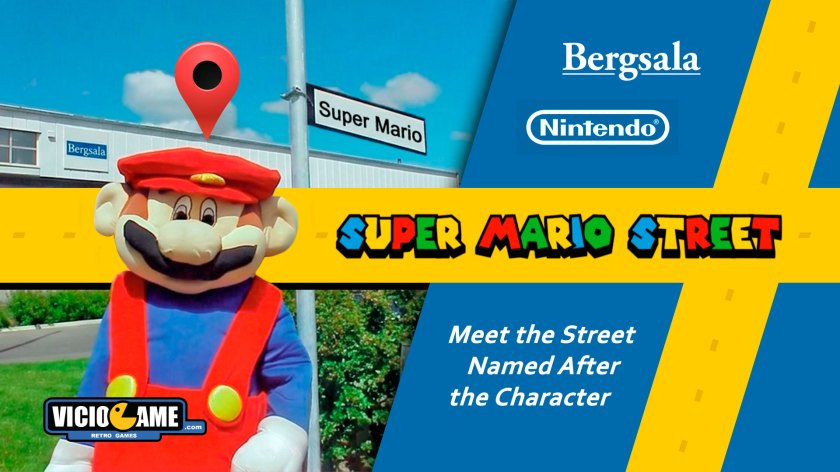
The fascinating story of a Swedish businessman who won the right to officially rename a city street after Super Mario. Through persistence, persuasion, and a love of video games, Owe Bergsten earned his place in history, turning his small company, Bergsala, into one of the world’s biggest Nintendo distributors.
🇺🇸 On a nondescript industrial street on the outskirts of Kungsbacka, a small Swedish city just minutes south of Gothenburg, an official municipal sign announces, with no trace of irony, the name “Marios gata” — “Mario’s Street.” This isn’t a fan joke or an informal nickname: it’s the legal, registered name of a public road, home to the headquarters of Bergsala, the Swedish distributor that introduced Nintendo to the country in 1981 and that remains, to this day, the only official distributor of the Japanese company anywhere in the world that isn’t owned by Nintendo itself. Until the late 1990s, the address was called Energigatan (Energy Street), but on June 19, 1999, the Kungsbacka municipal government formally authorized the name change at the company’s own request — with Bergsala covering all the administrative costs of the switch itself, from replacing the street signs to updating registries, maps, and mail.
The story behind this street begins long before it had anything to do with video games. In April 1976, a young Owe Bergsten — at the time also a student at Chalmers University — teamed up with partners Pierre Sandsten and Lars-Göran Larsson to found a small electronics shop in Kungsbacka called Elbe Hi-Fi, dedicated mainly to importing devices and cassette tapes from Asia; the Maxell brand, for instance, sold well there by the end of that decade. It wasn’t until January 1981, during a business trip to Singapore to buy merchandise for the store, that Bergsten happened upon a Nintendo Game & Watch handheld in a camera shop — the specific model was the one that came with the game “Fire.” He bought it on impulse and spent the entire flight back to Sweden obsessed with it, with no idea that this little toy would change the rest of his life.
Back in Sweden, Bergsten got in touch with Nintendo’s headquarters in Japan through the local chamber of commerce and started sending telex messages — the precursor to the fax machine, billed by the character typed — pretending to represent a distributor far bigger than the small Elbe actually was, in hopes of securing the resale rights to the Game & Watch in Sweden. After months of silence and terse replies from Nintendo’s export department, he landed a first, modest order of a few hundred units — and found out the hard way that the Swedish public wasn’t the least bit interested in video games yet: initial sales were disappointing.
Things changed course when a colleague brought back the new colored Game & Watch models from Japan. Convinced of the product’s potential, Bergsten decided to travel to Nintendo’s headquarters in Kyoto himself, departing on August 25, 1981 — a date he still remembers clearly today. The trip got off to a rough start: the flight was delayed a full day, he missed his scheduled meeting, and he arrived in Japan right in the middle of a national holiday. Following the advice of a friend who had already done business with Japanese companies — find the right person, accept a dinner invitation, never push business matters directly, and finish with an elegant gift — Bergsten managed to get close to Nintendo’s export manager, an executive named Todori. After dinner, in the back seat of the car, he presented him with a crystal ashtray from Orrefors, the traditional Swedish glassmaker, as a gift. Todori asked if it was real crystal, and right there sealed the deal: Bergsala would get the rights to the first ten thousand units of the Game & Watch for one million Swedish kronor (the equivalent of $700,000 today). Orders would grow quickly from there — the first major shipment that actually reached Sweden totaled around 30,000 units.
Sales started slowly, until a watch distributor spotted commercial potential in the little devices and began moving them through its own retail network. The effect was almost immediate: by early 1982, Bergsala was already selling 180,000 units a month, and by January 1983 the cumulative total topped 1.7 million units sold in Sweden alone. In one particular month, the company sold as many units as Germany sold in an entire year — making Scandinavia, second only to Japan itself, the largest market in the world for the Game & Watch in absolute numbers, not per capita. Shortly after, though, the Swedish market for portable electronics became saturated and sales plummeted, a regional echo of the worldwide video game crash of 1983.
It was precisely during this turbulent period that Bergsten became, without realizing it, a small but decisive figure in Nintendo’s history outside Japan. He kept visiting the company regularly, and on one of those trips he brought back units of the newly released Famicom along with NTSC-compatible televisions, convinced the console would repeat the Game & Watch‘s success in Scandinavia. He then began pressing Nintendo to release a European version of the Famicom — the Japanese company, still shaken by the collapse of the American market, was reluctant to bet on another home console. Bergsten pushed so hard that, around 1985, Nintendo even promised to ship about ten thousand units of a Famicom adapted to the PAL video standard specifically for Scandinavia. That deal never came through: Nintendo changed course and redesigned the console entirely, creating what would become the Nintendo Entertainment System, launched first in the United States and, shortly after, in a PAL version for Europe as well. The NES reached Swedish stores on September 1, 1986, and was quickly nicknamed by the local public simply “the 8-bit.”
Not everything went smoothly for Bergsala in the meantime, though. At some point in the first half of the 1980s, Swedish tax rules made it more advantageous for Bergsten to sell the company outright to raise capital, and for a few years Nintendo’s Swedish distributor belonged to the real estate developer Aranäs — right during the darkest years of Nintendo’s recent history in the West, when video games seemed like a spent fad and no new product had emerged. Bergsten, even so, kept working at the company and never gave up betting on a new hit. At a board meeting in the fall of 1985, he presented the owners at the time with news that hadn’t even reached Europe yet: the NES. Tired of years of losses from the games division, Aranäs’s owners agreed to sell Bergsala back to Bergsten for a single Swedish krona (the equivalent of less than $1) — a purely symbolic sum. It was this console, bought back almost by accident, that would go on to become Nintendo’s biggest commercial success in Sweden for many years to come.
The NES launch also brought another, less-remembered Bergsala contribution to Nintendo’s history: the Nintendo Videospelklubb (Nintendo Video Game Club), a fan club launched alongside the console in 1986 that grew to 450,000 members at its peak and served as a direct model for the American Nintendo Fun Club — the forerunner of what would later become the international Club Nintendo. Even after the founding of Nintendo of Europe in 1990, and the arrival of the Japanese company’s own offices in other markets, Bergsala kept exclusive control of distribution in Scandinavia, a position it has held without interruption ever since.
It was also during this period of consolidation that the idea for the statue was born. After moving to the address then called Energigatan, still in the 1980s, right along highway E6 — the main road connecting southern Sweden to Gothenburg — Bergsten came up with the idea of putting up a statue of Mario in front of the office, visible to anyone driving by on the highway. The first version, quite homemade in its construction, was considered a rather unfortunate likeness of the plumber, to the point that Swedish fans and journalists started comparing it, not without some humor, to the Iraqi dictator Saddam Hussein. This version looked so oddly different because it had been based on the miniature piggy banks the company was already selling as souvenirs.
It was in front of this peculiar statue that the Kungsbacka municipal government formalized, in June 1999, the renaming of Energigatan to Marios gata. In Sweden, the naming of streets tends to follow a fairly formal process: municipal naming committees propose names, which then need approval from a council or municipal department, generally following local themes — flowers, historical figures from the region, old rural estates — and the principle that established place names should only be changed for a strong reason. Renaming a public road to honor a video game character belonging to a foreign company was, therefore, a choice well outside the usual pattern — but the economic and symbolic weight that Bergsala already carried for small Kungsbacka was argument enough for the municipality. Bergsten publicly celebrated the decision at the time, describing himself as one of the owners and the group’s managing director:
“We’re celebrating one of the most recognizable characters in the world. Mario and Bergsala have a long shared history, and he had an enormous impact on Nintendo’s success in Sweden. It’s wonderful to be able to show our appreciation by naming our very own street after him.”
The other businesses located on the same street had no reaction to the address change, and there was no dispute or formal resistance to the new name — which, almost three decades later, remains in place unchallenged.
In the years that followed, Bergsala kept diversifying its business without ever cutting ties with Nintendo: in 2004 it founded Rising Star Games, a joint venture with Japan’s Marvelous focused on publishing games in Europe; in 2011 it took a 50 percent stake in the Swedish studio Image & Form — creator of the SteamWorld series — and did the same with studio Zoink in 2014; and between 2012 and 2017 it even held a partnership with the Japanese company Lightweight, which owns the rights to Hello Kitty, called Bergsala-Lightweight, before the two went their separate ways again. In 2016, the same year the company marked both its 40th anniversary and 35 years of partnership with Nintendo, the crude original Mario sculpture was finally replaced with a version far more faithful to the character’s official look, inspired by the design used on amiibo figures, showing the plumber balanced atop the franchise’s iconic green pipe — the warp pipe.
In December 2019, Bergsala stopped operating as an independent company for the first time since the 1985 buyback: together with the other distributors controlled by Bergsala Holding, it merged with the Swedish developer and publisher Thunderful — owner, among others, of the Image & Form and Zoink studios themselves — to form Thunderful Group, a publicly traded company that brought both the distribution of Nintendo products and the development and publishing of its own games under one roof. In September 2022, Bergsala broke ground on a new three-story headquarters spanning 1,200 square meters (roughly 13,000 square feet), right next to the Mario statue; construction was completed and the building opened in 2023, with Bergsten himself in attendance, along with Nintendo of Europe representative Shigeru Ota, an actor dressed as Mario, and local officials. The move even pushed the company’s official street address up a few doors on the same street, from Marios gata 21 — the historic number cited for decades — to Marios gata 23, forcing the statue, which had stood in the same spot since the 1980s, to be relocated a few yards from where it used to be. A longtime exhibit the company kept in its reception area, popular with fans and collectors over the years, was closed during construction and, despite plans to reopen it in a new space inside the building, still has no reopening date.
The time inside Thunderful Group, however, wasn’t smooth sailing. Starting in 2023, and especially throughout 2024, the Swedish company piled up heavy losses and watched its stock plunge on the Nasdaq First North exchange — the result of an acquisition-driven expansion strategy that the market itself came to see as unsustainable. As part of a restructuring effort to cut debt, Thunderful Group announced in May 2024 that it would sell off its entire distribution division — including Bergsala, toy distributor Amo Toys, and other smaller subsidiaries — back to a personal holding company of Owe Bergsten’s own, called Bergsala NDP AB, for the equivalent of 634 million Swedish kronor, around $59 million at the time. The deal closed on June 28, 2024, and Bergsala went back to operating as a private business outside the stock market — though Bergsten remained Thunderful Group’s largest individual shareholder and a board member, with the company moving forward with only its game development and publishing operations.
Today, Bergsala remains Nintendo’s official distributor for the Nordic and Baltic countries, in an unbroken partnership spanning more than four decades and over ten million Nintendo consoles sold since 1981, on top of having more recently taken on distribution of the Amo Toys brand and a joint venture with Audio-Technica for the Nordic market. Little Marios gata, with just over a dozen registered addresses, remains a peripheral street, hemmed in by warehouses and reached mostly by car, in Kungsbacka’s industrial zone — hardly the kind of bustling street you’d picture behind such an unusual honor. But that’s exactly where the charm of the whole story lies: decades before any stadium sponsorship, sports-arena naming rights, or corporate name slapped on a public square, a small Swedish city had already let a mustachioed plumber in overalls onto its own map, officially and for good.
🇧🇷 A Rua do Super Mario: conheça a rua de verdade que leva o nome do personagem. A fascinante história de um empresário da Suécia que conseguiu o direito de renomear oficialmente a rua de uma cidade para o nome do Super Mario. Com insistência, persuasão e amor pelos videogames, Owe Bergsten conquistou seu lugar na históri e tornou sua pequena, a Bergsala, em um dos maiores representantes da Nintendo no mundo.
Numa discreta rua industrial nos arredores de Kungsbacka, pequena cidade sueca a poucos minutos ao sul de Gotemburgo, uma placa oficial do município anuncia, sem qualquer ironia, o nome “Marios gata” — “Rua do Mario”. Não é brincadeira de fã nem apelido informal: é o nome legal e registrado de uma via pública, endereço da sede da empresa Bergsala, distribuidora sueca que introduziu a Nintendo no país em 1981 e que, até hoje, segue sendo a única distribuidora oficial da empresa japonesa no mundo inteiro que não pertence à própria Nintendo. Até o fim dos anos 1990 o endereço se chamava Energigatan, mas em 19 de junho de 1999 a prefeitura de Kungsbacka autorizou formalmente a mudança de nome, a pedido da própria empresa — que arcou sozinha com todos os custos administrativos da alteração, da troca de placas à atualização de registros, mapas e correspondências.
A história por trás dessa rua começa bem antes de qualquer relação com videogames. Em abril de 1976, o jovem Owe Bergsten, então também estudante da Universidade Chalmers, fundou ao lado dos sócios Pierre Sandsten e Lars-Göran Larsson uma pequena loja de eletrônicos em Kungsbacka batizada Elbe Hi-Fi, dedicada sobretudo à importação de aparelhos e fitas cassete vindos da Ásia — a marca Maxell, por exemplo, vendia bem ali no fim daquela década. Foi só em janeiro de 1981, durante uma viagem de negócios a Singapura para comprar mercadoria para a loja, que Bergsten encontrou, por acaso, numa loja de fotografia, um exemplar do portátil Game & Watch, da Nintendo — o modelo específico trazia o jogo “Fire”. Comprou o aparelho por impulso e passou o voo inteiro de volta à Suécia obcecado por ele, sem imaginar que aquele brinquedinho mudaria o resto da sua vida.
De volta à Suécia, Bergsten conseguiu o contato da sede japonesa da Nintendo através da câmara de comércio local e passou a enviar mensagens por telex — o antecessor do fax, cobrado por caractere digitado — fingindo representar uma distribuidora bem maior do que a pequena Elbe realmente era, na tentativa de garantir os direitos de revenda do Game & Watch na Suécia. Depois de meses de silêncio e respostas lacônicas do departamento de exportação japonês, conseguiu um primeiro pedido modesto, de poucas centenas de unidades — e descobriu, da pior forma, que o público sueco ainda não estava nem um pouco interessado em videogames: as vendas iniciais foram decepcionantes.
O rumo das coisas mudou quando um colega trouxe do Japão os novos modelos coloridos do Game & Watch. Convencido do potencial do produto, Bergsten decidiu viajar pessoalmente até a sede da Nintendo, em Kyoto, embarcando em 25 de agosto de 1981 — uma data que ele guarda na memória com clareza até hoje. A viagem começou mal: o voo atrasou um dia inteiro, ele perdeu a reunião marcada e chegou ao Japão bem no meio de um feriado nacional. Seguindo o conselho de um amigo que já havia negociado com empresas japonesas — encontrar a pessoa certa, aceitar um convite para jantar, jamais insistir diretamente sobre negócios e, ao final, presentear com algo elegante —, Bergsten conseguiu se aproximar do gerente de exportação da Nintendo, um executivo de sobrenome Todori. Depois do jantar, já no banco de trás do carro, ofereceu-lhe de presente um cinzeiro de cristal da tradicional vidraria sueca Orrefors. Todori perguntou se era cristal de verdade e, na sequência, fechou o acordo ali mesmo: a Bergsala teria direito às primeiras dez mil unidades do Game & Watch por um milhão de coroas suecas (equivalente a 700 mil dólares hoje em dia). O pedido cresceria rapidamente dali em diante — o primeiro grande carregamento que de fato chegou à Suécia somou cerca de 30 mil aparelhos.
As vendas começaram devagar, até que um distribuidor de relógios enxergou potencial comercial nos aparelhinhos e passou a escoá-los por sua própria rede. O efeito foi quase imediato: no início de 1982 a Bergsala já vendia 180 mil unidades por mês, e em janeiro de 1983 o total acumulado ultrapassava 1,7 milhão de aparelhos vendidos só na Suécia. Em determinado mês, a empresa chegou a vender tantos exemplares quanto se vendia na Alemanha em um ano inteiro — o que fazia da Escandinávia, atrás apenas do próprio Japão, o maior mercado do mundo para o Game & Watch em números absolutos, não per capita. Pouco depois, porém, o mercado sueco de eletrônicos portáteis saturou e as vendas despencaram, reflexo regional do crash mundial dos videogames de 1983.
Foi justamente nesse período turbulento que Bergsten se tornou, sem saber, uma peça pequena mas decisiva na história da Nintendo fora do Japão. Ele seguiu visitando a empresa com regularidade e, numa dessas viagens, trouxe de volta ao país unidades do recém-lançado Famicom e televisores compatíveis com o padrão NTSC, convencido de que o console repetiria na Escandinávia o sucesso do Game & Watch. Passou então a pressionar a Nintendo para lançar uma versão do Famicom na Europa — a empresa japonesa, ainda abalada pelo colapso do mercado americano, hesitava em apostar de novo em qualquer console doméstico. Bergsten insistiu tanto que, por volta de 1985, a Nintendo chegou a prometer o envio de cerca de dez mil unidades de um Famicom adaptado ao padrão de vídeo PAL, especialmente para a Escandinávia. O acordo nunca se concretizou: a Nintendo mudou de planos e redesenhou o console por completo, criando o que se tornaria o Nintendo Entertainment System, lançado primeiro nos Estados Unidos e, pouco depois, também em versão PAL para a Europa. O NES chegou às lojas suecas em 1º de setembro de 1986, logo apelidado pelo público local apenas de “8 bits”.
Nem tudo, porém, foi linear para a Bergsala nesse meio-tempo. Em algum momento da primeira metade dos anos 1980, regras tributárias suecas tornaram mais vantajoso para Bergsten vender a própria empresa para levantar capital, e por alguns anos a distribuidora da Nintendo no país pertenceu à incorporadora imobiliária Aranäs — justamente durante os anos mais sombrios da história recente da Nintendo no Ocidente, quando os videogames pareciam um modismo já esgotado e nenhum produto novo havia surgido. Bergsten, ainda assim, continuou trabalhando na empresa e nunca abandonou a aposta em um novo sucesso. Numa reunião de conselho no outono de 1985, apresentou aos então donos a novidade que ainda nem havia chegado à Europa: o NES. Cansados de anos de prejuízo com a divisão de games, os proprietários da Aranäs concordaram em vender a Bergsala de volta a Bergsten por uma única coroa sueca (equivalente a menos de 1 dólar) — um valor puramente simbólico. Foi esse console, recém-recomprado de forma quase acidental, que se tornaria o maior sucesso comercial da Nintendo na Suécia por muitos anos seguintes.
O lançamento do NES também trouxe outra contribuição pouco lembrada da Bergsala à história da Nintendo: o Nintendo Videospelklubb, clube de fãs lançado junto com o console em 1986 que chegou a somar 450 mil membros no auge e serviu de modelo direto para o Nintendo Fun Club americano — precursor do que mais tarde se tornaria o Club Nintendo internacional. Mesmo depois da fundação da Nintendo of Europe, em 1990, e da chegada de escritórios próprios da empresa japonesa a outros mercados, a Bergsala manteve o controle exclusivo da distribuição na Escandinávia, posição que preserva ininterruptamente até hoje.
Foi também nesse período de consolidação que nasceu a ideia da estátua. Ao se mudar para o endereço então chamado Energigatan, ainda na década de 1980, bem à margem da rodovia E6 — a principal via que liga o sul da Suécia a Gotemburgo —, Bergsten teve a ideia de erguer diante do escritório uma estátua do Mario, visível para quem passasse de carro pela estrada. A primeira versão, de fabricação bastante artesanal, era considerada uma representação bastante infeliz do encanador, a ponto de fãs e jornalistas suecos passarem a compará-la, não sem humor, ao ditador iraquiano Saddam Hussein. Este modelo era estranhamente diferente porque foi baseado nos cofinhos miniatura que a empresa já vendia como souvenir.
Foi diante dessa estátua peculiar que a prefeitura de Kungsbacka formalizou, em junho de 1999, a mudança de nome de Energigatan para Marios gata. Na Suécia, a definição de nomes de ruas costuma seguir um processo relativamente formal: comissões municipais de nomenclatura propõem os nomes, que depois precisam ser aprovados por um conselho ou secretaria municipal, geralmente respeitando temas locais — flores, personalidades históricas da região, antigas propriedades rurais — e o princípio de que topônimos já consolidados só devem ser alterados havendo motivo forte. Trocar o nome de uma via pública para homenagear um personagem de videogame pertencente a uma empresa estrangeira era, portanto, uma escolha fora do padrão habitual — mas o peso econômico e simbólico que a Bergsala já representava para a pequena Kungsbacka foi argumento suficiente para o município. Bergsten comemorou a decisão publicamente à época, definindo-se como um dos proprietários e o diretor-geral do grupo:
“Estamos celebrando um dos personagens mais conhecidos do mundo. Mario e a Bergsala têm uma longa história em comum, e ele teve um impacto enorme no sucesso da Nintendo na Suécia. É maravilhoso podermos demonstrar nosso apreço batizando a nossa própria rua com o nome dele”
Os demais estabelecimentos instalados na mesma via não reagiram à mudança de endereço, e não houve qualquer disputa ou resistência formal ao novo nome — que, quase três décadas depois, segue em vigor sem contestação.
Nos anos seguintes, a Bergsala seguiu diversificando os negócios sem nunca abandonar o vínculo com a Nintendo: fundou, em 2004, a Rising Star Games, joint venture com a japonesa Marvelous voltada à publicação de jogos na Europa; passou a deter metade do estúdio sueco Image & Form — criador da série SteamWorld — em 2011, e do estúdio Zoink em 2014; e chegou a manter, entre 2012 e 2017, uma parceria com a empresa japonesa Lightweight, detentora de direitos sobre a Hello Kitty, batizada Bergsala-Lightweight antes de as duas voltarem a se separar. Em 2016, ano em que a empresa completava ao mesmo tempo 40 anos de fundação e 35 anos de parceria com a Nintendo, a tosca escultura original do Mario foi finalmente substituída por uma versão bem mais fiel ao visual oficial do personagem, inspirada no design usado nas figuras amiibo, mostrando o encanador equilibrado sobre o icônico cano verde — o warp pipe da franquia.
Em dezembro de 2019 a Bergsala deixou de operar como companhia independente pela primeira vez desde a recompra de 1985: junto com as demais distribuidoras controladas pela Bergsala Holding, fundiu-se à desenvolvedora e publicadora sueca Thunderful — dona, entre outros, dos próprios estúdios Image & Form e Zoink — para formar a Thunderful Group, empresa de capital aberto que passou a reunir sob o mesmo teto tanto a distribuição de produtos Nintendo quanto o desenvolvimento e a publicação de jogos próprios. Em setembro de 2022 a Bergsala deu início às obras de uma nova sede de três andares e 1.200 metros quadrados, bem ao lado da estátua do Mario; a construção foi concluída e inaugurada em 2023, com a presença do próprio Bergsten, do representante da Nintendo of Europe Shigeru Ota, de um ator fantasiado de Mario e de autoridades locais. A mudança de prédio levou até a numeração oficial do endereço da empresa a avançar poucas casas na mesma rua, de Marios gata 21 — o número histórico, citado por décadas — para Marios gata 23, obrigando a estátua, no local desde os anos 1980, a ser realocada a poucos metros de onde ficava. Uma antiga exposição que a empresa mantinha em sua recepção, muito procurada por fãs e colecionadores ao longo dos anos, foi fechada durante as obras e, apesar dos planos de reabri-la em um novo espaço dentro do prédio, segue sem previsão de reabertura.
O período dentro da Thunderful Group, porém, não foi tranquilo. A partir de 2023, e principalmente ao longo de 2024, a companhia sueca acumulou prejuízos pesados e viu suas ações despencarem na bolsa Nasdaq First North — resultado de uma estratégia de expansão via aquisições que o próprio mercado passou a considerar insustentável. Como parte de uma reestruturação para reduzir dívidas, a Thunderful Group anunciou em maio de 2024 a venda de toda a sua divisão de distribuição — incluindo a Bergsala, a distribuidora de brinquedos Amo Toys e outras subsidiárias menores — de volta para uma holding pessoal do próprio Owe Bergsten, batizada Bergsala NDP AB, pelo equivalente a 634 milhões de coroas suecas, cerca de 59 milhões de dólares à época. A transação foi concluída em 28 de junho de 2024, e a Bergsala voltou a operar como negócio privado, fora do mercado de ações — ainda que Bergsten tenha permanecido como maior acionista individual e membro do conselho da Thunderful Group, que seguiu adiante apenas com as operações de desenvolvimento e publicação de jogos.
Hoje a Bergsala segue como distribuidora oficial da Nintendo para os países nórdicos e bálticos, numa parceria ininterrupta que já soma mais de quatro décadas e mais de dez milhões de consoles Nintendo vendidos desde 1981, além de ter incorporado mais recentemente a distribuição da marca de brinquedos Amo Toys e uma joint venture com a Audio-Technica para o mercado nórdico. A pequena Marios gata, com pouco mais de uma dezena de endereços cadastrados, permanece uma via periférica, cercada por armazéns e de acesso majoritariamente veicular na zona industrial de Kungsbacka — dificilmente o tipo de rua movimentada que se poderia imaginar por trás de uma homenagem tão inusitada. Mas é justamente aí que mora a graça de toda a história: décadas antes de qualquer patrocínio de estádio, naming rights de arena esportiva ou nome de empresa estampado em praça pública, uma pequena cidade sueca já havia deixado um encanador bigodudo de macacão entrar, oficial e permanentemente, no seu próprio mapa.
🤑💲Earn money without doing anything! Just leave these apps open:
  https://r.honeygain.me/CONTA9DB02

   https://packetstream.io/?psr=1uPb
⬛ 𝗧𝗶𝗸𝗧𝗼𝗸: https://www.tiktok.com/@viciogame
🟧 𝗜𝗻𝘀𝘁𝗮𝗴𝗿𝗮𝗺: http://www.instagram.com/viciogame
🟥 𝗬𝗼𝘂𝘁𝘂𝗯𝗲: http://www.youtube.com/viciogame
🟦 𝗙𝗮𝗰𝗲𝗯𝗼𝗼𝗸: http://www.facebook.com/viciogame
🔳 𝗧𝗵𝗿𝗲𝗮𝗱𝘀: https://www.threads.net/@viciogame
🟪 𝗧𝘄𝗶𝘁𝗰𝗵: https://www.twitch.tv/ViciogameRetroGames
🟨 𝗕𝗹𝗼𝗴: http://www.viciogameblog.com/
🟦𝗧𝘄𝗶𝘁𝘁𝗲𝗿: http://www.twitter.com/viciogame
#Viciogame #Gameplay #LetsPlay #Playthrough #Games #Gaming #Videogames #Review #Game #Detonado #Walkthrough #Ending #Reviews #Facts #Retro #RetroGaming #Roms #Emulator #Longplay #Speedrun #NoCommentary #SuperMarioStreet #Bergsala #ElbeHiFi #Sweden #OweBergsten #Nintendo #SNES #SuperNes #SuperNintendo #SuperFamicom #famicom #NES #Mario #SuperMario #SuperMarioBros #SuperMarioWorld #MariosGata #GameAndWatch
 VICIOGAME