
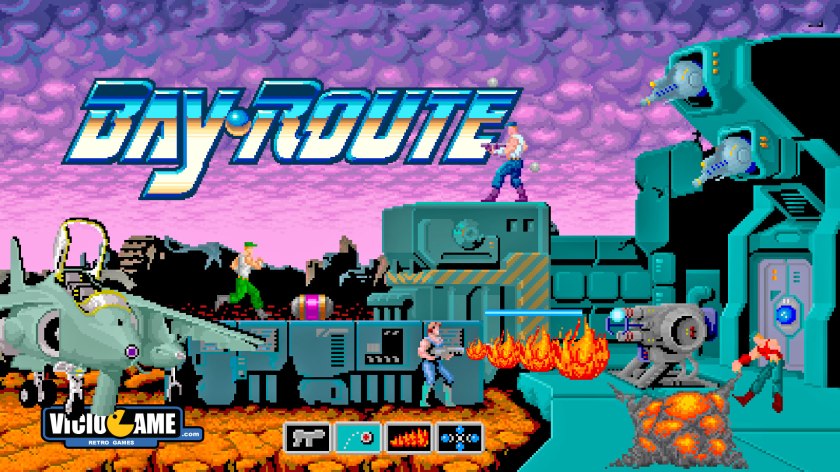
Bay Route is a run-and-gun game similar to Contra, released to arcades in 1989. Your mission is to control a veteran soldier sent in as a last resort to defeat the enemy army and rescue the hostages alive — including your girlfriend — who have been taken captive by a tyrannical terrorist.
Developer: Sunsoft
Publisher: Sega
Release Date: 1989
Platform: Arcade Sega System 16B board
🇺🇸 Bay Route was released by Sunsoft in Japanese arcades in March 1989, published there by Sega and distributed shortly after in North America by Sunsoft’s own American branch. Running on the Sega System 16B board, the same hardware behind classics like Golden Axe and Altered Beast, the game belongs to the wave of run-and-gun titles that flourished in the late 1980s under the shadow of Konami’s Contra, and is treated almost unanimously by retro critics as one of the most transparent clones ever made of that formula.
The project was born within Sunsoft, the trade name under which Sun Electronics — founded in 1971 in the city of Kōnan, in Japan’s Aichi Prefecture, originally as an electronics equipment manufacturer — began operating its games division starting in 1985, after having already debuted in arcades in 1978 with titles like Block Challenger and having made a name for itself over the following decade with technically ambitious releases for the Famicom and NES. The good relationship between Sun Denshi’s leadership and Hayao Nakayama, then president of Sega, opened the doors of the System 16B hardware to Sunsoft’s Japanese team, and it was in this context that two arcade projects were born side by side: Bay Route and Tough Turf, an urban-themed beat ‘em up, both completed and published by Sega that same year, 1989. Credits from the time attribute Bay Route‘s programming to Yoshitaka Kawabe — who would also later be credited with the Mega Drive version of the 1989 Batman film and had ported Route-16 Turbo to the Famicom — the design to Kazuyuki Sugiura, Rieko Sakai, and Masayuki Aikawa, and the sound to Michie Takemori and Shinichi Seya, with an additional credit identified only as “Vial.” Direction is credited to Kiharu Yoshida, who led Sunsoft’s Japanese operations at the time and had, back in 1978, founded Sun Electronics’ own game development division.
Bay Route supports two simultaneous players in cooperative mode, each controlled with an eight-way joystick and three buttons — one to shoot, one to jump, and one to cycle through the available weapons.
The game’s own name is a recurring source of curiosity: it sounds like a pun on “Beirut,” the capital of Lebanon, and that’s how virtually the entire specialized press interprets it, tying the game’s setting to the context of the Lebanese Civil War, still ongoing when the title was released. The setting Bay Route presents is a generic, unspecified wasteland, full of ruined buildings and destroyed vehicles, evoking both Super Contra and aesthetics like Mad Max or Fist of the North Star (北斗の拳), without any visual or cultural marker that actually ties it to the real Beirut or Lebanon.
The plot, summed up in a single opening screen full of the clunky translations typical of Japanese games from the era, introduces the protagonist named Tom — a commando sent behind enemy lines aboard a vertical-takeoff aircraft — whose mission is to infiltrate an airstrip controlled by a terrorist organization and fight his way to an embassy to rescue hostages being held alive, among them Tom’s own girlfriend. The second player takes on the role of an unnamed female soldier. Interestingly, although the story mentions multiple hostages, only one person actually turns up waiting for the hero at the end, with the game making no mention of what happened to the rest — though we can unfortunately imagine…
Bay Route alternates stretches of pure shooting with platforming elements, allowing movement between different height levels within each stage. The resemblance to Konami shows up most strongly right in the first two stages, whose ruined cities under overcast skies echo the opening of the arcade Super Contra almost to the letter — to the point that the game’s first boss, an armored wall bristling with cannon turrets that must be destroyed to open the way forward, is identical to Contra‘s first obstacle.
The weapon system is the game’s most distinctive element, and is widely cited as inspired by — or simply copied from — the weapon-switching scheme seen in Irem’s Ninja Spirit. Unlike most run-and-gun titles of the era, Tom starts the game with all four weapons available at once, able to switch between them freely at any time with the dedicated button: a fast, near-automatic standard shot; a grenade launcher that can only be used while crouching until upgraded; a short-range flamethrower with high firepower, ideal for tricky angles; and a slow-moving spherical projectile that breaks apart into smaller shots on impact.
All of these weapons start out weakened, and it’s up to the player to take down soldiers dressed in red so they drop purple upgrade capsules, which strengthen specifically whichever weapon is selected at the moment of the hit. The standard shot, once upgraded, turns into the classic spread weapon from Contra, the Spread Gun, the only one in the arsenal that accepts two levels of upgrade — going from three to five simultaneous projectiles; the flamethrower gains considerably longer range; the spherical projectile’s fragments spread over a wider radius on explosion; and the grenade launcher becomes able to fire in any direction and also while standing, no longer just while crouching.
The health system follows the double-bar logic common to the genre: Tom can take two hits before losing a life, out of three available per credit, with unlimited continues by inserting more credits. A detail frequently cited as a design flaw is that this health bar doesn’t refill when a life is lost or when continuing the game, making each subsequent life more fragile than the last. Blue capsules add an extra point to the maximum health capacity, while green capsules restore a lost point — bonuses whose practical usefulness is limited precisely by how hard it is to keep the bar full for very long.
One of the most discussed points among those who compare Bay Route directly to Contra is the protagonist’s own movement. While Konami’s soldier tucks up in mid-air during jumps and can aim diagonally downward while airborne — key tools for dodging shots in mid-flight — Tom is a bulkier character who stays upright while jumping and has no way to aim diagonally downward in the air, which turns every jump into a calculated risk rather than a defensive tool. The result is a game that aspires to Contra‘s offensive pace but, in practice, behaves with a mobility stiffness closer to series like Metal Slug, demanding pattern memorization far more than pure reflexes.
Common enemies arrive in constant waves from both sides of the screen, ranging from unarmed thugs who charge in for melee attacks to armed soldiers who open fire in bursts the moment they enter the frame. Some hide behind walls and only attack when the player gets close, while others pop out of doors or slide down poles to reinforce the siege. Stages set in factories and underground facilities add small mechanical drones shaped like a red metallic eye fitted with twin turrets, plus jetpack-equipped enemies who hover in the air firing almost randomly at the player.
Another element that draws frequent complaints is each stage’s timer, quite short by genre standards: if time runs out, a fast pursuit robot that’s practically impossible to avoid shows up and hunts the player down until it kills them, a mechanic that seems to exist mainly to force players to spend more credits.
In all, Bay Route spans seven stages. The first two repeat the formula of long horizontal stretches through a ruined city, deliberately similar to each other and heavily inspired by Super Contra‘s aesthetic. The third changes tone by taking place inside a claustrophobic industrial complex, with narrow corridors that leave very little room to maneuver. The fourth stage breaks from the game’s structure with a one-off sequence on a futuristic hover-bike, an auto-scrolling segment where the player moves up and down the screen while shooting explosive mines; the platforming there is optional, since staying at the bottom of the screen forces the player to jump over gaps, while staying higher up simply lets them fly over the obstacle. The second-to-last stage moves into mechanical corridors and introduces the game’s first robotic enemies, and the last one takes place, almost unexpectedly after so much desert and factory, inside the mansion of the terrorist leader — full of henchmen and even living statues that come to life to attack the player — culminating in a final showdown in the open air.
Each stage ends with its own exclusive boss. After the armored wall of the first stage, the second features a segmented mechanical enemy with an elongated, worm-like body, considered one of the easiest fights in the game; the third holds the boss most hated by anyone who’s played the game, a metal cube that slides around the arena and needs to be hit on all four sides within the stage’s time limit — three of them are simple, but the top side is notoriously hard to hit given the jump’s stiffness and the inability to aim downward, and failing to destroy it in time triggers the unbeatable pursuit robot. The fifth stage eases the tension with a slow, barely threatening mechanical insect, and the final showdown holds a twist: the terrorist leader turns out, at first, to be a short, heavyset man armed only with a small pistol, who spends most of the fight hiding behind a crate while sending in a hefty henchman with a heavy machine gun to do the dirty work; once the bodyguard is taken down, the boss himself takes the controls of a gigantic flying combat robot, with a silhouette reminiscent of killer robots from the movies, for the true final battle.
Visually, Bay Route delivers well-defined sprites and settings that alternate between clear and overcast skies, devastated landscapes, and sterile mechanical interiors, although much of the critical response considers the overall palette gray and unremarkable compared to the vibrant colors Sunsoft was already known for in its Famicom and NES games of the same era. The soundtrack gets a similar description: competent and functional, but hardly memorable, lacking the impact of the compositions that cemented Contra‘s place in the genre’s collective memory. The Sega System 16B hardware also supports voice synthesis, a feature Bay Route makes use of in its mission text and title screen.
The game’s reception, both at the time and in more recent retrospectives, revolves almost entirely around the comparison to Contra. It’s not uncommon to find people summing it up as “the Contra game Konami never made,” and critics place it alongside Tough Turf and another title from the era called Riot City, among what they describe as blatant imitations of other people’s formulas that, even so, work well enough to deserve being played and documented. More recent analyses tend to recognize a solid set of ideas in the game — the complete arsenal from the very start, the aggressive pace, the variety of settings — undermined by specific design decisions, like the punishing timer and the protagonist’s rigid jump, which, by contrast, make it clearer why Contra remains a genre benchmark decades later.
Despite having circulated through arcades in both Japan and North America, Bay Route never received an official port to home consoles or computers, remaining confined to the arcade format throughout its entire existence, which is unusual for most games that ran on the Sega System 16B. The game is quite rare today, with few cataloged units in circulation among enthusiasts — a reflection of its modest commercial performance even at launch.
A relic of a very specific moment in the industry, when Contra‘s overwhelming success in arcades sparked a flood of more or less inspired imitations worldwide, Bay Route also documents Sunsoft’s one-off bet on developing directly for Sega hardware, a partnership that yielded, in the same year and under the same roof, both this run-and-gun title and the beat ‘em up Tough Turf. With no pretense of reinventing anything and no attempt to hide its inspirations, the game remains a competent, if modest, portrait of the fight for attention and quarters that drove arcades in the late ’80s.
🇧🇷 Bay Route foi lançado pela Sunsoft nos fliperamas japoneses em março de 1989, publicado por lá pela Sega e distribuído pouco depois na América do Norte pelo braço americano da própria Sunsoft. Rodando sobre a placa Sega System 16B, o mesmo hardware por trás de clássicos como Golden Axe e Altered Beast, o título se insere na leva de jogos do estilo run and gun que floresceu no fim dos anos 1980 sob a sombra de Contra, da Konami, e é tratado quase unanimemente pela crítica retrô como um dos clones mais transparentes já feitos daquela fórmula.
O projeto nasce dentro da Sunsoft, nome fantasia sob o qual a Sun Electronics — fundada em 1971 na cidade de Kōnan, na província japonesa de Aichi, originalmente como fabricante de equipamentos eletrônicos — passou a operar sua divisão de jogos a partir de 1985, depois de já ter estreado nos fliperamas em 1978 com títulos como Block Challenger e se notabilizado ao longo da década seguinte por seus lançamentos tecnicamente ambiciosos para o Famicom e o NES. A boa relação entre a cúpula da Sun Denshi e Hayao Nakayama, então presidente da Sega, abriu à equipe japonesa da Sunsoft as portas do hardware System 16B, e foi nesse contexto que dois projetos de fliperama nasceram lado a lado: Bay Route e Tough Turf, um beat ‘em up com temática urbana, ambos concluídos e publicados pela Sega ainda em 1989. Os créditos da época atribuem a programação de Bay Route a Yoshitaka Kawabe — que também assinaria mais tarde a versão para Mega Drive do filme Batman de 1989 e havia portado Route-16 Turbo para o Famicom —, o design a Kazuyuki Sugiura, Rieko Sakai e Masayuki Aikawa, e o som a Michie Takemori e Shinichi Seya, com um crédito adicional identificado apenas como “Vial”. A direção é atribuída a Kiharu Yoshida, que comandava as operações japonesas da Sunsoft naquele momento e havia sido, ainda em 1978, o fundador da própria divisão de desenvolvimento de jogos dentro da Sun Electronics.
Bay Route aceita dois jogadores simultâneos em modo cooperativo, com cada um controlado por um joystick de oito direções e três botões — um para atirar, um para pular e um para alternar entre as armas disponíveis.
O próprio nome do jogo é motivo de curiosidade recorrente: soa como um trocadilho com “Beirute”, capital do Líbano, e é assim que praticamente toda a imprensa especializada o interpreta, associando a ambientação do jogo ao contexto da Guerra Civil Libanesa, ainda em curso quando o título foi lançado. O cenário que Bay Route apresenta é uma terra devastada genérica e não explicitamente identificada, cheia de prédios em ruínas e veículos destruídos, que remete tanto a Super Contra quanto a estéticas como Mad Max ou Fist of the North Star (北斗の拳), sem qualquer marca visual ou cultural que o prenda de fato a Beirute ou ao Líbano reais.
A trama, resumida em um único quadro de abertura repleto das traduções capengas típicas de jogos japoneses da época, apresenta o protagonista batizado de Tom — um comando enviado atrás das linhas inimigas, a bordo de uma aeronave de decolagem vertical — cuja missão é infiltrar-se em uma pista de pouso controlada por uma organização terrorista e abrir caminho até uma embaixada para resgatar reféns mantidos vivos, entre eles a namorada do próprio Tom. O segundo jogador assume uma soldado sem nome definido. Curiosamente, apesar de o enredo falar em múltiplos reféns, apenas uma pessoa aparece de fato esperando o herói no desfecho, sem que o jogo faça qualquer menção ao destino dos demais, embora infelizmente possamos imaginar…
Bay Route intercala trechos de puro tiroteio com elementos de plataforma, permitindo deslocamento entre diferentes níveis de altura do cenário. A semelhança com a Konami se manifesta com mais força logo nas duas primeiras fases, cujas cidades arruinadas sob céus encobertos ecoam quase à risca a abertura do Super Contra de fliperama — a ponto de o primeiro chefão do jogo, uma muralha blindada crivada de torres de canhão que precisa ser destruída para liberar a passagem, ser idêntico ao primeiro obstáculo de Contra.
O sistema de armamento é o elemento mais particular do jogo, e é amplamente apontado como inspirado — ou simplesmente copiado — do esquema de troca de armas visto em Ninja Spirit, da Irem. Diferentemente da maioria dos run and gun da época, Tom começa a partida já com as quatro armas disponíveis ao mesmo tempo, podendo alternar entre elas livremente a qualquer momento apertando o botão dedicado: um tiro padrão de disparo rápido, quase automático; um lança-granadas que só pode ser usado agachado até ser aprimorado; um lança-chamas de curto alcance, mas alto poder de fogo, ideal para ângulos difíceis; e um projétil esférico de tiro lento que se fragmenta em disparos menores ao atingir o alvo.
Todas essas armas começam enfraquecidas, e cabe ao jogador eliminar soldados vestidos de vermelho para que deixem cair cápsulas roxas de melhoria, que fortalecem especificamente a arma selecionada no momento do acerto. O tiro padrão, ao ser aprimorado, transforma-se na clássica arma em leque de Contra, a Spread Gun, sendo a única do arsenal que aceita dois níveis de evolução — passando de três para cinco projéteis simultâneos; o lança-chamas ganha alcance consideravelmente maior; os estilhaços do projétil esférico se espalham num raio mais amplo ao explodir; e o lança-granadas passa a poder ser disparado em qualquer direção e também de pé, não mais apenas agachado.
O sistema de vida segue a lógica de barra dupla comum ao gênero: Tom resiste a dois impactos antes de perder uma vida, das três disponíveis por crédito, com continues ilimitados mediante o pagamento de novas fichas. Um detalhe frequentemente citado como falha de design é que essa barra de vida não se restaura ao perder uma vida ou ao continuar a partida, tornando cada vida subsequente mais frágil que a anterior. Cápsulas azuis adicionam um ponto extra à capacidade máxima de vida, enquanto cápsulas verdes recuperam um ponto perdido — bônus cuja utilidade prática é limitada justamente pela dificuldade de manter a barra cheia por muito tempo.
Um dos pontos mais discutidos por quem compara Bay Route diretamente a Contra é a própria movimentação do protagonista. Enquanto o soldado de Konami se encolhe no ar durante os saltos e consegue mirar na diagonal para baixo enquanto está suspenso — recursos centrais para desviar de tiros em pleno voo —, Tom é um personagen maior, permanece ereto ao pular e não tem como apontar para baixo em diagonal no ar, o que torna cada salto um risco calculado em vez de uma ferramenta defensiva. O resultado é um jogo que aspira ao ritmo ofensivo de Contra, mas se comporta, na prática, com a rigidez de mobilidade mais próxima de séries como Metal Slug, exigindo memorização de padrões muito mais do que reflexo puro.
Os inimigos comuns chegam em ondas constantes por ambos os lados da tela, entre capangas desarmados que avançam corpo a corpo e soldados equipados que já abrem fogo com várias rajadas assim que entram em quadro. Alguns se escondem atrás de paredes e só atacam quando o jogador passa por perto, enquanto outros surgem de portas ou descem por postes para reforçar o cerco. Fases ambientadas em fábricas e instalações subterrâneas somam a isso pequenos drones mecânicos, com o formato de um olho metálico vermelho equipado com torres duplas, e inimigos equipados com jetpacks pairam no ar disparando de forma quase aleatória sobre o jogador.
Outro elemento que gera reclamação recorrente é o cronômetro de cada fase, bastante curto para os padrões do gênero: se o tempo se esgota, um robô perseguidor rápido e praticamente impossível de evitar surge em cena e caça o jogador até matá-lo, numa mecânica que parece existir sobretudo para forçar o consumo de fichas.
Ao todo, Bay Route se estende por sete fases. As duas primeiras repetem a fórmula de longos trechos horizontais por uma cidade em ruínas, deliberadamente parecidos entre si e fortemente inspirados na estética de Super Contra. A terceira muda de tom ao se passar dentro de um complexo industrial claustrofóbico, com corredores estreitos que deixam pouquíssimo espaço para desvios. A quarta fase rompe a estrutura do jogo com uma sequência única sobre uma moto flutuante futurista, num trecho de rolagem automática em que o jogador se move para cima e para baixo pela tela enquanto atira em minas explosivas; a plataforma ali é opcional, já que permanecer na parte inferior da tela obriga a pular sobre buracos, enquanto ficar mais alto permite simplesmente sobrevoar o obstáculo. A penúltima fase adentra corredores mecânicos e introduz os primeiros inimigos robóticos do jogo, e a última se passa, de forma quase inesperada depois de tanto deserto e fábrica, dentro da mansão do mandante terrorista — repleta de capangas e até estátuas vivas que ganham movimento para atacar o jogador —, culminando num confronto final ao ar livre.
Cada fase encerra com um chefão exclusivo. Depois da muralha blindada da primeira etapa, a segunda apresenta um inimigo mecânico segmentado, de corpo alongado como uma minhoca, considerado um dos combates mais fáceis do jogo; a terceira reserva o chefão mais odiado por quem já jogou o título, um cubo metálico que desliza pelo cenário e precisa ser atingido nos quatro lados dentro do tempo da fase — três deles são simples, mas o lado superior é notoriamente difícil de acertar dada a rigidez do salto e a impossibilidade de mirar para baixo, e o fracasso em destruí-lo a tempo aciona o robô perseguidor invencível. A quinta fase relaxa a tensão com um inseto mecânico lento e pouco ameaçador, e o confronto final reserva uma reviravolta: o mandante terrorista se revela, a princípio, um homem baixo e corpulento armado apenas com uma pistola pequena, que passa boa parte da luta escondido atrás de uma caixa enquanto envia um capanga corpulento com uma metralhadora pesada para fazer o trabalho sujo; depois de eliminado o guarda-costas, o próprio chefão assume os controles de um robô de combate gigantesco e voador, com silhueta que lembra os robôs assassinos do cinema, para o verdadeiro embate derradeiro.
Visualmente, Bay Route entrega sprites bem definidos e cenários que alternam céus claros e enevoados com paisagens devastadas e interiores mecânicos estéreis, ainda que boa parte da crítica considere a paleta geral acinzentada e pouco marcante se comparada ao colorido pelo qual a própria Sunsoft já era reconhecida em seus jogos de Famicom e NES da mesma época. A trilha sonora é descrita de forma parecida: competente e funcional, mas dificilmente lembrada, sem o impacto das composições que consagraram Contra no imaginário do gênero. O hardware Sega System 16B também suporta síntese de voz, recurso do qual Bay Route lança mão em seus textos de missão e tela de abertura.
A recepção do jogo, tanto em sua época quanto em retrospectivas mais recentes, gira quase inteiramente em torno da comparação com Contra. Não é incomum encontrar quem o resuma como “o jogo de Contra que a Konami nunca fez”, e críticos o colocam ao lado de Tough Turf e de outro título da época chamado Riot City, entre aquilo que descrevem como imitações escancaradas de fórmulas alheias que, ainda assim, funcionam bem o suficiente para merecerem ser jogadas e documentadas. Análises mais recentes tendem a reconhecer no jogo um conjunto de ideias sólidas — o arsenal completo desde o início, o ritmo agressivo, a variedade de cenários — prejudicado por decisões pontuais de design, como o cronômetro punitivo e a rigidez do salto do protagonista, que tornam mais nítido, por contraste, o motivo pelo qual Contra segue sendo referência do gênero décadas depois.
Apesar de ter circulado por fliperamas tanto no Japão quanto na América do Norte, Bay Route nunca recebeu conversão oficial para consoles domésticos ou computadores, permanecendo restrito ao formato arcade ao longo de toda a sua existência, algo incomum para boa parte dos jogos que rodaram sobre o Sega System 16B. O jogo é pouco comum hoje em dia, com poucas unidades catalogadas em circulação entre entusiastas — reflexo de uma performance comercial discreta já em seu lançamento.
Peça de um momento muito específico da indústria, em que o sucesso avassalador de Contra nos fliperamas gerou uma enxurrada de imitações mais ou menos inspiradas mundo afora, Bay Route documenta também a aposta pontual da Sunsoft em desenvolver diretamente para hardware da Sega, numa parceria que rendeu, no mesmo ano e sob o mesmo teto, tanto este run and gun quanto o beat ‘em up Tough Turf. Sem pretensão de reinventar nada e sem esconder de quem se inspirava, o jogo permanece como um retrato competente, ainda que modesto, da disputa por atenção e fichas que movia os fliperamas do fim dos anos 80.
🤑💲Earn money without doing anything! Just leave these apps open:
  https://r.honeygain.me/CONTA9DB02

   https://packetstream.io/?psr=1uPb
⬛ 𝗧𝗶𝗸𝗧𝗼𝗸: https://www.tiktok.com/@viciogame
🟧 𝗜𝗻𝘀𝘁𝗮𝗴𝗿𝗮𝗺: http://www.instagram.com/viciogame
🟥 𝗬𝗼𝘂𝘁𝘂𝗯𝗲: http://www.youtube.com/viciogame
🟦 𝗙𝗮𝗰𝗲𝗯𝗼𝗼𝗸: http://www.facebook.com/viciogame
🔳 𝗧𝗵𝗿𝗲𝗮𝗱𝘀: https://www.threads.net/@viciogame
🟪 𝗧𝘄𝗶𝘁𝗰𝗵: https://www.twitch.tv/ViciogameRetroGames
🟨 𝗕𝗹𝗼𝗴: http://www.viciogameblog.com/
🟦𝗧𝘄𝗶𝘁𝘁𝗲𝗿: http://www.twitter.com/viciogame
#Viciogame #Gameplay #LetsPlay #Playthrough #Games #Gaming #Videogames #Review #Game #Detonado #Walkthrough #Ending #Reviews #Facts #Retro #RetroGaming #Roms #Emulator #Longplay #Speedrun #NoCommentary #BayRoute #Arcade #Sunsoft #Sega #Contra #GoldenAxe #AlteredBeast #Batman #NES #Nintendo #Famicom #SuperContra #MetalSlug #FistOfTheNorthStar #北斗の拳 #MadMax

