
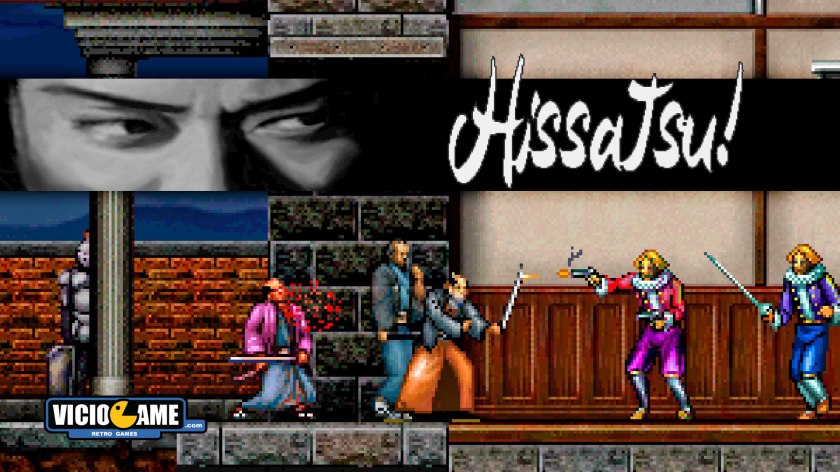
Hissatsu is an action-platformer released in 1996 for the Sega Saturn. Based on a classic Japanese television series, the game features the franchise’s most iconic characters. A clan of hired assassins — who pose as ordinary people by day — must eliminate criminals who have escaped the reach of conventional law.
Developer/Publisher: Emotion Digital Software / Bandai Visual
Release Date: 1996
Platform: Sega Saturn
🇺🇸 Hissatsu! is a side-scrolling action game released exclusively in Japan for the Sega Saturn on June 28, 1996. Developed and published by Emotion Digital Software, a label then linked to Bandai Visual, the title adapts for video games the universe of Hissatsu (必殺), one of the longest-running and most popular period drama franchises on Japanese television, a name that translates to something like “an unerring strike” or “sure death.” Its ambition lies within its own modesty: rather than recreating a specific TV storyline, the game brings together, in a single adventure, four of the assassins most beloved by audiences across decades of episodes, films, and specials.
The Hissatsu franchise debuted on Japanese television in 1972 and, over the years, became a true institution of the jidaigeki genre — period dramas set in feudal Japan. All told, the show and its spin-offs add up to nearly 700 episodes of 45 minutes each, 28 TV movies and specials, 11 theatrical films, and a handful of original videos, plus annual specials produced since a revival in 2007. The premise has remained largely unchanged since the beginning: a group of assassins-for-hire operates in the shadows of the Edo period, eliminating, on commission, unambiguously evil men and women — corrupt officials, tyrants, criminals who slip through the cracks of official justice. Known more delicately as “workers” (shigotonin), these characters lead double lives: by day, they practice humble manual trades; by night, they use the tools of that very trade to kill. It’s this concept — the assassin as a craftsman applying his professional skill to death — that gives the franchise its most recognizable identity, balanced by a tone that blends dry violence with comic relief.
Although the cast changes from series to series, the franchise found its greatest symbol in Nakamura Mondo, a character introduced as comic relief in the second season who, starting with the fifth, would become the protagonist of most subsequent incarnations. Publicly, Mondo is a low-ranking police officer (a doshin), lazy and evasive, a constant source of scolding from his wife and mother-in-law; in secret, he’s one of the deadliest swordsmen in Japan. Actor Makoto Fujita played the role for more than thirty years, until his death in 2010, making Mondo inseparable from his own public image. Despite its overwhelming popularity in Japan, Hissatsu had almost no exposure in the West: the sole exception is a single feature film officially released in North America under the title Sure Death.
It was in 1996 — the very year the TV franchise seemed to have finally come to an end, with a final film (nicknamed in English Mondo Dies) closing out the character’s journey — that Emotion Digital Software released its game as a tribute to the series as a whole. Rather than directly adapting that final film or any specific story arc, the team chose to bring together, in a single playable roster, four of the most popular assassins to emerge over nearly two and a half decades of Hissatsu on TV, creating a kind of “all-star” selection of the franchise’s most beloved incarnations. Hissatsu! was only the second game based on the property, following a Famicom RPG released in 1990 that, like this one, never left the Japanese market — a direct reflection of how little penetration the TV series ever had outside the country.
Visually, Hissatsu! relies on digitized sprites captured from real actors — a simpler take on the same technique popularized by Mortal Kombat, which Sega itself had already used a year earlier in Shinobi Legions (known in Europe as Shinobi X), the only entry in the Shinobi franchise released for the Sega Saturn. The result is admittedly similar: realistic human figures, with the proportions and movements of flesh-and-blood actors, walk across hand-drawn backgrounds and special effects, in a contrast that critics and players alike describe as anything but realistic. Despite running on a 32-bit console, the game’s art direction remains deliberately anchored to the aesthetic of earlier generations, evoking the look of a Mega Drive (Genesis, in the U.S.) title more than the graphical ambition much of the Saturn‘s library was chasing at the time.
Hissatsu!‘s soundtrack reinforces this split personality between feudal Japan and Western references: the franchise is known for compositions with a strong spaghetti western influence, and most of the game’s music consists of variations on a single main theme, built on melancholic trumpets and guitars evoking galloping horses. During regular play, the soundtrack tends to stay understated, almost contemplative, gaining intensity only at key moments, such as boss battles or the appearance of supernatural enemies.
As for gameplay, Hissatsu! plays like a beat ‘em up with a strong dash of hack-and-slash, built around a cast of four playable characters. At the start of each stage, the player picks two of them: one stays under direct control, while the other waits in reserve, able to be called in at any time with the L button. Each character has a regular attack with unlimited use and a more powerful special attack, tied to a gauge that only recharges while that character is off the field — which turns switching between the two into a central strategic decision, especially in later stretches, when the difficulty rises considerably and a well-matched pair, balanced in range and speed, makes all the difference. All four also share the ability to block attacks by holding the A button after a regular strike — a defense strong enough to stop even fire attacks.
Each of the four playable assassins carries a weapon and an identity inherited from decades of Hissatsu lore on TV. Nakamura Mondo, the franchise’s most recognizable face, is the group’s swordsman: his special attack consists of two quick slashes that unleash a cutting wave capable of instantly eliminating regular enemies, and he can also chain together a combo by pressing the attack button repeatedly; with no ranged option, he makes up for it by being the strongest in close combat, even against crouching opponents. Tetsu, a blind monk who fights with his left fist, giving the game an almost hand-to-hand-combat feel, is a nod to Nenbutsu no Tetsu, one of the franchise’s most memorable assassins, also a former monk who dispatched his targets with his bare hands; his special move is a wave of spiritual energy compared to Ken and Ryu’s Hadouken from Street Fighter, capable of piercing through and eliminating every enemy on screen, though at too high a cost to use often.
Hide, the group’s acupuncturist, corresponds to Kazarishokunin no Hide (“Hide the Craftsman”), a classic character from the franchise: his regular attack is the weakest of the four, needing three hits where Mondo and Tetsu need only two, but his poisoned needles kill regular enemies instantly at a very low cost to his special gauge, and he also jumps higher and farther than the others. Yuji, meanwhile, corresponds to Shamisenya no Yuji (“Yuji the Shamisen Player”): he whips enemies with the string of his instrument, coated in candle wax, in a long-range attack that hits multiple enemies and cannot be blocked — but he’s slow, his strike arcs too high for certain situations, and he has the weakest special attack of the group, just a stronger version of his regular strike, which many enemies can simply dodge by crouching.
Structurally, the game is divided into five stages, each corresponding to a distinct “job.” The narrative between them is told through static, hand-drawn illustrations accompanied by Japanese text — short, fully skippable sequences that the original release never made available in any other language. The first two stages are short and direct, almost austere; it’s from the third stage on that the game really opens up, with larger environments, multiple paths, and a structure that requires exploration to track down the mission’s target. In direct reference to the contract-killing premise, early targets tend to hide behind a bodyguard: once the bodyguard is defeated, the player can simply walk up to the now-defenseless target and finish them off with a single blow. Each execution comes with its own brief animation, different depending on which character lands the final blow — Mondo beheads the target with his sword, Hide drives a needle into their neck, Tetsu crushes their bones with a punch, and Yuji strangles them with his shamisen string — and small splashes of blood accompany nearly every clean hit throughout a regular playthrough.
Hissatsu!‘s bestiary includes two main types of ninja: purple ones, who split into three copies and surround the player if they get too close, and green ones, who attack from range, block frequently, and tend to crouch to dodge attacks; both can leave traps on the ground when killed, an easy risk to overlook in the rush of combat. The final stage, meanwhile, set in a large European-style castle, swaps the traditional enemies for Western-style gunmen and swordsmen organized into large groups, safer to fight from a distance than up close. The bosses, generally speaking, follow simple block-and-counter patterns, without major mechanical surprises. There are also platforming sections: the mandatory ones are simple, but some alternate paths — like climbing the towers of the final castle, or the stretch, one of the game’s most memorable, where you climb through the pipes of an organ up to the castle roof — demand more precision. One detail that takes some getting used to is a certain inconsistency in the controls: you can’t attack immediately after landing from a jump, for instance, and the jump sometimes fails to register when pressed right after — or together with — a forward step; nothing that seriously undermines the experience, but it does take patience for players to internalize these quirks.
After Hissatsu!, the franchise never received another action or interactive adventure game. Starting in 2001, already in the Dreamcast era, Hissatsu’s video game adaptations were reduced to pachinko and pachislot simulators, a genre popular in Japan but far removed from the action-oriented approach of the Saturn release. This detail cements Hissatsu! as the franchise’s last attempt to translate itself into a playable video game in the traditional sense, rather than just a licensed gambling simulation.
In the end, Hissatsu! occupies a curious place within the Sega Saturn‘s Japanese catalog: it’s simultaneously a loving tribute to one of Japan’s most traditional period drama franchises and a direct heir to the lineage of two-dimensional action that Sega had already been cultivating since the days of Shinobi on the Mega Drive and in arcades. Its terse, dry strikes, its spaghetti-western-inspired score, and a cast built from four iconic figures out of decades of Japanese television form a combination that could probably only have existed at that specific moment in the industry, when 32-bit consoles were still feeling their way between the ambition of 3D and the comfort of 2D. For fans of old-school samurai- and ninja-inspired action games, or anyone simply curious about these unlikely bridges between Japanese television drama and video games, Hissatsu! remains quite the discovery within the Saturn‘s already vast library.
🇧🇷 Hissatsu! é um jogo de ação em rolagem lateral lançado com exclusividade no Japão para o Sega Saturn em 28 de junho de 1996. Desenvolvido e publicado pela Emotion Digital Software, selo então ligado à Bandai Visual, o título adapta para os videogames o universo de Hissatsu (必殺), uma das franquias de dorama de época mais longevas e populares da televisão japonesa, cujo nome remete a algo como “golpe certeiro” ou “morte certa”. Sua proposta é ambiciosa dentro da própria modéstia: em vez de recriar um enredo específico da TV, o jogo reúne, numa única aventura, quatro dos assassinos mais queridos pelo público ao longo de décadas de episódios, filmes e especiais.
A franquia Hissatsu estreou na televisão japonesa em 1972 e, com o passar dos anos, transformou-se em uma verdadeira instituição do gênero jidaigeki, o dorama de época ambientado no Japão feudal. Ao todo, o programa e seus derivados somam quase 700 episódios de 45 minutos, 28 telefilmes e episódios especiais, 11 longas-metragens para o cinema e alguns vídeos originais, além de especiais anuais produzidos desde uma retomada em 2007. A premissa segue praticamente inalterada desde o início: um grupo de assassinos de aluguel opera nas sombras da era Edo, eliminando por encomenda homens e mulheres inequivocamente maus — corruptos, tiranos, criminosos que escapam da justiça oficial. Em termos mais suaves são chamados de “trabalhadores” (shigotonin), esses personagens levam vidas duplas: de dia, exercem ofícios manuais ou modestos; à noite, usam as ferramentas do próprio ofício para matar. É esse conceito — o assassino como um artesão que aplica seu talento profissional à morte — que dá à franquia sua identidade mais reconhecível, equilibrada por um tom que intercala violência seca com alívio cômico.
Ainda que o elenco mude de série para série, a franquia encontrou seu maior símbolo em Nakamura Mondo, personagem introduzido como alívio cômico na segunda temporada e que, a partir da quinta, se tornaria protagonista da maioria das encarnações seguintes. Publicamente, Mondo é um policial de baixa patente (um doshin), preguiçoso e enrolão, motivo de bronca constante da esposa e da sogra; em segredo, é um dos espadachins mais letais do Japão. O ator Makoto Fujita viveu o papel por mais de trinta anos, até sua morte em 2010, tornando Mondo indissociável de sua própria imagem pública. Apesar de sua popularidade avassaladora no Japão, Hissatsu praticamente não teve exposição no Ocidente: a única exceção é um único longa-metragem lançado oficialmente na América do Norte sob o título Sure Death.
Foi justamente em 1996 — ano em que a franquia televisiva parecia ter finalmente chegado ao fim, com um filme derradeiro (apelidado em inglês de Mondo Dies) encerrando a trajetória do personagem — que a Emotion Digital Software lançou seu jogo em homenagem à série completa. Em vez de adaptar diretamente esse filme final ou qualquer arco específico, a equipe optou por reunir num único elenco jogável quatro dos assassinos mais populares surgidos ao longo de quase duas décadas e meia de Hissatsu na TV, criando assim uma espécie de “seleção” das encarnações mais queridas da franquia. Hissatsu! foi apenas o segundo jogo baseado na propriedade, sucedendo um RPG para Famicom lançado em 1990 que, assim como este, nunca deixou o mercado japonês — reflexo direto da pouca penetração que a série de TV sempre teve fora do país.
Visualmente, Hissatsu! aposta em sprites digitalizados a partir de atores reais — embora de forma mais simplista, é a mesma técnica, popularizada por Mortal Kombat, que a própria Sega já havia utilizado um ano antes em Shinobi Legions (conhecido na Europa como Shinobi X), único capítulo da franquia Shinobi lançado para o Sega Saturn. O resultado é declaradamente semelhante: figuras humanas realistas, com proporções e movimentos de atores de carne e osso, caminham sobre cenários e efeitos especiais desenhados à mão, num contraste que crítica e jogadores descrevem como nada realista. Apesar de rodar num console de 32 bits, a direção de arte do jogo permanece deliberadamente presa à estética de gerações anteriores, lembrando mais o visual de um jogo de Mega Drive do que a ambição gráfica que boa parte do catálogo do Saturn buscava exibir na época.
A trilha sonora de Hissatsu! reforça essa personalidade dividida entre o Japão feudal e referências ocidentais: a franquia é conhecida por composições com forte influência de spaghetti western, e a maior parte da música do jogo consiste em variações de um único tema principal, construído sobre trompetes melancólicos e violões que remetem galopes. No decorrer da partida, a trilha tende a ser discreta, quase contemplativa, ganhando intensidade apenas em momentos-chave, como embates contra chefes ou o aparecimento de inimigos de natureza sobrenatural.
Sobre a jogabilidade, Hissatsu! funciona como um beat ‘em up com forte pitada de hack and slash, estruturado em torno de um elenco de quatro personagens jogáveis. No início de cada fase, o jogador escolhe dois deles: um permanece sob controle direto, enquanto o outro aguarda de reserva, podendo ser chamado a qualquer momento ao apertar o botão L. Cada personagem possui um golpe regular de uso ilimitado e um ataque especial mais poderoso, vinculado a uma barra que só se recarrega quando o personagem está fora de campo — o que transforma a alternância entre os dois numa decisão estratégica central, sobretudo nos trechos mais avançados, quando a dificuldade aumenta consideravelmente e uma boa dupla, bem combinada em termos de alcance e velocidade, faz toda a diferença. Todos os quatro compartilham ainda a capacidade de bloquear ataques ao segurar o botão A após um golpe regular — defesa capaz até de deter ataques de fogo.
Cada um dos quatro assassinos jogáveis carrega uma arma e uma identidade herdadas do imaginário construído ao longo de décadas de Hissatsu na TV. Nakamura Mondo, o rosto mais reconhecível da franquia, é o espadachim do grupo: seu ataque especial consiste em dois cortes rápidos que geram uma onda cortante capaz de eliminar instantaneamente inimigos comuns, e ele ainda pode encadear uma sequência de golpes ao pressionar o botão de ataque repetidamente; sem opção de ataque à distância, compensa isso sendo o mais forte em combate corpo a corpo, inclusive contra adversários agachados. Tetsu, monge cego que luta com o punho esquerdo, emprestando ao jogo uma pegada quase de luta corporal, remete a Nenbutsu no Tetsu, um dos assassinos mais lembrados da franquia, também um ex-monge que eliminava seus alvos com as próprias mãos; seu golpe especial é uma onda de energia espiritual comparada ao Hadouken de Ken e Ryu, de Street Fighter, capaz de atravessar e eliminar todos os inimigos na tela, ainda que a um custo alto demais para ser usado com frequência.
Hide, o acupunturista do grupo, corresponde a Kazarishokunin no Hide (“Hide, o artesão”), clássico personagem da franquia: seu ataque regular é o mais fraco entre os quatro, exigindo três golpes onde Mondo e Tetsu precisam de apenas dois, mas suas agulhas envenenadas matam inimigos comuns instantaneamente a um custo baixíssimo da barra especial, e ele ainda salta mais alto e mais longe que os demais. Já Yuji corresponde a Shamisenya no Yuji (“Yuji, o tocador de shamisen”): ele chicoteia os adversários com a corda do instrumento, embebida em cera de vela, num golpe de longo alcance que atinge múltiplos inimigos e não pode ser bloqueado — mas é lento, tem uma trajetória alta demais para certas situações, e possui o pior ataque especial do grupo, uma versão apenas mais forte do golpe regular, que muitos inimigos conseguem evitar simplesmente agachando.
Estruturalmente, o jogo se divide em cinco fases, cada uma correspondendo a um “trabalho” distinto. A narrativa entre elas é contada por meio de ilustrações estáticas desenhadas à mão, acompanhadas de textos em japonês — sequências curtas, totalmente puláveis, que a versão original nunca disponibilizou em outro idioma. As duas primeiras fases são curtas e diretas, quase austeras; é a partir da terceira que o jogo realmente se abre, com cenários maiores, múltiplos caminhos e uma estrutura que exige exploração para localizar o alvo da missão. Em referência direta à premissa de assassinato por encomenda, os primeiros alvos costumam se esconder atrás de um guarda-costas: derrotado o guarda-costas, o jogador pode simplesmente caminhar até o alvo indefeso e eliminá-lo com um único golpe. Cada execução é acompanhada por uma pequena animação, diferente conforme o personagem responsável pelo golpe final — Mondo decepa o alvo a espada, Hide crava uma agulha em seu pescoço, Tetsu esmaga seus ossos com um soco e Yuji o enforca com a corda do shamisen —, e pequenos esguichos de sangue acompanham praticamente todo golpe certeiro ao longo da partida regular.
O bestiário de Hissatsu! inclui ninjas de dois tipos principais: os roxos, que se dividem em três cópias e cercam o jogador que se aproxima demais, e os verdes, que atacam à distância, bloqueiam com frequência e tendem a se agachar para escapar de golpes; ambos podem deixar armadilhas no chão ao morrer, um risco fácil de ignorar em meio à correria do combate. Já a fase final, ambientada num grande castelo de estilo europeu, troca os inimigos tradicionais por pistoleiros e espadachins ocidentais organizados em grupos numerosos, mais seguros de enfrentar à distância do que corpo a corpo. Os chefes, de modo geral, seguem padrões simples de bloqueio e contra-ataque, sem grandes surpresas mecânicas. Há também trechos de plataforma: os obrigatórios são simples, mas alguns caminhos alternativos — como a escalada das torres do castelo final, ou o trecho, um dos mais lembrados do jogo, em que se sobe pelos tubos de um órgão até o teto do castelo — exigem mais precisão. Um detalhe que pede alguma adaptação é certa inconsistência nos comandos: não é possível atacar imediatamente após aterrissar de um pulo, por exemplo, e o pulo às vezes falha em registrar quando pressionado logo após — ou junto com — um passo à frente; nada que comprometa a experiência de forma grave, mas que exige paciência até que o jogador internalize essas particularidades.
Depois de Hissatsu!, a franquia não recebeu mais nenhum jogo de ação ou aventura interativa. A partir de 2001, já na era Dreamcast, as adaptações de Hissatsu para os videogames passaram a se resumir a simuladores de pachinko e pachislot, gênero popular no Japão mas bem distante da proposta de ação da versão de Saturn. Esse detalhe consolida Hissatsu! como a última tentativa da franquia de se traduzir num jogo eletrônico jogável em sentido tradicional, e não apenas numa simulação de apostas licenciada.
No fim das contas, Hissatsu! ocupa um lugar curioso dentro do catálogo japonês do Sega Saturn: é, ao mesmo tempo, um tributo afetuoso a uma das mais tradicionais franquias de dorama de época do Japão e um herdeiro direto da linhagem de ação bidimensional que a Sega já vinha cultivando desde os tempos de Shinobi no Mega Drive e nos fliperamas. Seus cortes secos, sua trilha inspirada em faroestes e seu elenco montado a partir de quatro figuras icônicas de décadas de televisão japonesa formam uma combinação que talvez só pudesse existir naquele momento específico da indústria, quando consoles de 32 bits ainda tateavam entre a ambição do 3D e o conforto do 2D. Para quem gosta de jogos de ação old-school inspirados em samurais e ninjas, ou simplesmente tem curiosidade por essas pontes improváveis entre a teledramaturgia japonesa e os videogames, Hissatsu! continua sendo uma descoberta e tanto dentro da já vasta biblioteca do Saturn.
🤑💲Earn money without doing anything! Just leave these apps open:
  https://r.honeygain.me/CONTA9DB02

   https://packetstream.io/?psr=1uPb
⬛ 𝗧𝗶𝗸𝗧𝗼𝗸: https://www.tiktok.com/@viciogame
🟧 𝗜𝗻𝘀𝘁𝗮𝗴𝗿𝗮𝗺: http://www.instagram.com/viciogame
🟥 𝗬𝗼𝘂𝘁𝘂𝗯𝗲: http://www.youtube.com/viciogame
🟦 𝗙𝗮𝗰𝗲𝗯𝗼𝗼𝗸: http://www.facebook.com/viciogame
🔳 𝗧𝗵𝗿𝗲𝗮𝗱𝘀: https://www.threads.net/@viciogame
🟪 𝗧𝘄𝗶𝘁𝗰𝗵: https://www.twitch.tv/ViciogameRetroGames
🟨 𝗕𝗹𝗼𝗴: http://www.viciogameblog.com/
🟦𝗧𝘄𝗶𝘁𝘁𝗲𝗿: http://www.twitter.com/viciogame
#Viciogame #Gameplay #LetsPlay #Playthrough #Games #Gaming #Videogames #Review #Game #Detonado #Walkthrough #Ending #Reviews #Facts #Retro #RetroGaming #Roms #Emulator #Longplay #Speedrun #NoCommentary #Hissatsu #SegaSaturn #Sega #Saturn #Ninja #Samurai #必殺 #Shinobi #Genesis #MegaDrive #SegaGenesis #セガサターン #セガ #メガドライブ
 VICIOGAME