
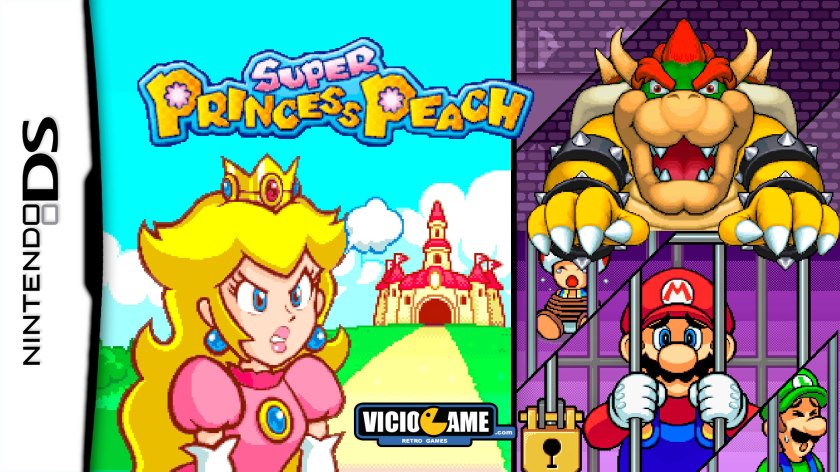
Super Princess Peach is a platformer released in 2005 for the Nintendo DS. The title stands out as an adventure where, after decades, Princess Peach finally becomes the protagonist, turning the franchise’s damsel-in-distress cliché on its head — now she’s the one who has to rescue Mario, Luigi, and countless kidnapped Toads.
Developer: TOSE Software Co.
Publisher: Nintendo
Release Date: 2005
Platform: Nintendo DS
🇺🇸 Super Princess Peach is a two-dimensional platformer developed by the Japanese studio Tose and published by Nintendo as a Nintendo DS exclusive. It marks the first time Princess Peach, one of the most recognizable faces in the Mario universe, headlines a full-fledged adventure of her own on a dedicated console; before it, the character’s only precedent as a playable protagonist had been Princess Toadstool’s Castle Run, a small handheld electronic game released by Nelsonic in 1990. The premise of Super Princess Peach inverts the classic formula established by Super Mario Bros.: rather than Mario racing to rescue the princess from Bowser’s clutches, it’s Peach herself who sets out alone, accompanied only by a magical umbrella named Perry, to free Mario, Luigi, and a large number of kidnapped Toads. Conceived as a spin-off within the Mario franchise, the game is built entirely around a single-player experience, with no multiplayer mode whatsoever, and it retained an all-ages rating in every territory where it launched.
The project was announced by Nintendo in October 2004, without a set release date yet. Direction fell to Akio Imai and Azusa Tajima, a duo who, around the same time, were also directing Densetsu no Starfy 2 and Densetsu no Starfy 3 for the Nintendo DS — a behind-the-scenes connection reflected within the game itself through a minor starfish-shaped enemy that clearly nods to that other series’ mascot. The original concept of turning the princess’s emotions into playable powers is credited to Takayuki Ikeda. In interviews given for the Mario franchise’s twentieth anniversary, Shigeru Miyamoto — creator of both Mario and Peach — remarked that it was essential for the character to stay true to herself in this new adventure, evoking the natural optimism of a princess who never saw herself as someone who needed to be “protected” by Mario, and stressed that the team had always pictured her as a figure of strength, reflecting the fact that many Nintendo developers grew up with an equally strong mother figure at home. Peach’s four controllable emotions, called Vibes within the game, were inspired by the Japanese concept of kidoairaku (喜怒哀楽), a traditional expression that distills the spectrum of human emotion into four core feelings: joy, anger, sorrow, and calm.
Under the Japanese title スーパープリンセスピーチ, Super Princess Peach first launched in Japan and Taiwan on October 20, 2005, followed by South Korea on November 4 of that same year. Reaching the West required a few additional months of localization: North America received the game on February 27, 2006, with Canada close behind on February 28; Australia followed on March 30; Europe on May 26; and finally South Africa on September 26, 2006, closing out the regional rollout almost a full year after the Japanese debut.
The story begins when Bowser learns of the legend of an ancient magical artifact, the Vibe Scepter, long hidden on an island near the Mushroom Kingdom called Vibe Island. Fascinated by the prospect of freely controlling other people’s emotions, the villain has a summer home built for himself right there and sends his right-hand man, Army Hammer Bro., to find the scepter. Once the artifact is found, Army Hammer Bro. entrusts it to a disguised Goomba — chosen precisely because he was once an ordinary citizen of the Mushroom Kingdom, which helps him avoid raising suspicion — who manages to infiltrate Peach’s castle. Under the scepter’s influence, the castle guards lose control of their own emotions, and Army Hammer Bro.’s troops use the chaos to capture Mario, Luigi, and a large number of Toads, scattering them as prisoners across different corners of the island. Back at the newly built village, the Goomba himself ends up overcome by the scepter’s power and starts wielding it uncontrollably, infecting Bowser and his minions with uncontrolled waves of anger, sadness, and euphoria, until the Koopa King finally manages to claim the object for himself.
Meanwhile, Peach is out for a quiet walk with her butler Toadsworth, and upon returning to the castle, finds everything in emotional turmoil, along with a note from Bowser confirming Mario and Luigi’s kidnapping. Furious and more determined than ever, the princess decides to travel to Vibe Island alone to rescue her friends — a decision that leaves Toadsworth reluctant, though he ultimately accepts it, not before presenting her with Perry, a living, talking umbrella who promises to protect her throughout the journey.
Structurally, Super Princess Peach follows the classic logic of side-scrolling two-dimensional platformers: the player guides Peach as she runs, jumps, and explores stages filled with enemies, traps, and collectible items. The adventure is divided into eight worlds, each made up of five regular stages and one boss stage that leads to the next world; defeating a world’s boss unlocks three additional bonus stages within that same setting, for a total of twenty-four extra stages spread across the whole game. Three imprisoned Toads hide in each regular stage, and each of the first six boss fights frees a single Toad trapped inside a bubble; the seventh boss, the adventure’s second-to-last, frees Luigi instead of a Toad. Only after rescuing every single Toad and Luigi does the player unlock the final showdown with Bowser, in his lair, in the game’s eighth and final area. In melee combat, Peach can jump on enemies to stun them — though this rarely defeats them outright — strike them directly with Perry, or have Perry grab and swallow them whole; she also has unlimited lives, so losing all of her health simply means restarting the current stage from scratch.
Super Princess Peach‘s biggest point of difference from any other game in the Mario series is precisely its Vibes system, named after the very Vibe Scepter that sets the whole plot in motion. Unlike the enemies and bosses, who are at the mercy of the emotions forced on them by the scepter and therefore use them automatically and without limit — resulting in faster, more aggressive, or simply altered variations of the series’ classic little monsters, as well as bosses that gain extra rage phases partway through their own fights — Peach learns to voluntarily channel four amplified emotional states, named Joy, Rage, Gloom, and Calm, whenever she wishes, as long as she has enough energy built up in her Vibe Gauge, a meter that occupies the top screen of the Nintendo DS, just below the heart-shaped health meter. Each Vibe is activated on the touch screen, where four colored Heart Panels — orange, red, blue, and green — respond to the stylus; activating a Vibe also changes the background music playing at that moment and alters the expression on the small portrait of Peach shown on the bottom screen. The Vibe Gauge gradually drains while a Vibe is in use and can be refilled by collecting turquoise crystals scattered throughout the stages or by having Perry swallow an already-captured enemy.
Each of the four Vibes carries an elemental association and its own set of effects. Joy, tied to wind, makes Peach spin like a small hurricane and gain altitude with no fixed ceiling — limited only by her available energy — and unleashes a final gust when released, capable of pushing back enemies, dispersing clouds of toxic smoke, and turning mechanisms like windmills. Rage, associated with fire, wraps the princess in flames that set flammable scenery ablaze — torches, wooden bridges, snowmen — melt ice, and instantly take out even certain enemies normally immune to other attacks, while also turning every landing after a jump into a ground slam that can stun anyone nearby; in exchange, under Rage’s effect, Peach jumps lower and runs more slowly. Gloom, watery by nature, increases running speed and jump height and makes Peach cry two continuous streams of tears, which water and grow plants — opening up new paths via vines — douse bonfires, and, in icy regions like Gleam Glacier, freeze on contact with certain surfaces to form ice platforms. Finally, Calm, luminous in nature, is the only purely defensive Vibe: it slowly recovers Peach’s health, and with enough energy stored up, can even restore the health meter completely, working as a safety net during the adventure’s tightest moments.
Perry, the umbrella who accompanies Peach from start to finish, has an expressive design that reinforces his talkative, helpful personality. Besides serving as a weapon for striking, throwing, and capturing enemies, Perry also breaks blocks and, over the course of the adventure, reveals a series of alternate forms that expand Peach’s abilities: as Bowlbrella, he becomes a little boat for crossing stretches of water; as Chargebrella, he builds up a charged strike that can trigger switches from a distance; as Floatbrella, he lets Peach hover in the air for a few seconds like a parachute; as Poundbrella, he works like a hammer that smashes tough blocks and pulls in nearby items; as Slidebrella, he lets Peach slide along hanging ropes; and as Subrella, he turns into a small submarine for underwater passages. A seventh form, Dashbrella, which has Peach twirl Perry like a baton while running, only becomes available after the main adventure has been completed once.
After each of the first seven boss battles, the game cuts to a scene of Peach and Perry camping by a campfire at night; as they sleep, a dream gradually reveals fragments of Perry’s past. It’s revealed that he was once an ordinary boy gifted with magical powers that are never fully explained, whose earliest memory is of finding himself alone on a mountainside; adopted by an old man he comes to call simply “gramps,” Perry lives a quiet life until the day two mysterious strangers — a sinister sorcerer and a hulking henchman — confront him, interested precisely in his powers. The sorcerer then transforms him into a living umbrella, and the pair kidnaps him, separating him forever from his adoptive grandfather; along the way, however, Perry manages to break free and ends up falling by the side of a road, where he spends days trying, in vain, to catch the attention of passersby. A traveling merchant finally notices him glowing on his own, picks him up as just another piece of merchandise, and later sells him to Toadsworth — the link that ultimately leads Perry to become Peach’s companion. It’s worth noting that this narrative thread is never fully resolved: the sorcerer’s identity, the adoptive grandfather’s fate, and Perry’s true human origin all remain, right through the credits, a deliberately open mystery.
The journey across Vibe Island’s eight worlds begins in Ladida Plains, a sunny plain that introduces the basic mechanics and culminates in a confrontation with Petey Piranha, a colossal version of a Piranha Plant who had already appeared as a boss in the GameCube‘s Super Mario Sunshine. Next comes Hoo’s Wood, a dense forest whose boss, Hoo, is a giant owl that attacks by hurling eggs. Shriek Mansion, the third world, turns into a haunted house full of Boos and rooms with trapdoors, guarded by King Boo, the series’ recurring ghost king. In Fury Volcano, the fourth world, Peach makes her way through smoky caverns, pools of lava, and hostile tiki statues before facing Wiggler, the giant caterpillar who, as is customary in the franchise, becomes far more dangerous once provoked.
Next, Wavy Beach recreates a tropical coastline of waves and quicksand hiding secret areas, along with long underwater stretches navigated with the help of Perry’s Subrella form, culminating in a fight against Gooper Blooper, another Super Mario Sunshine veteran, who attacks with tentacles and jets of ink. Gleam Glacier, the sixth world, is made up of slippery snow, ice caves, and dangerous icicles, and is guarded by Blizzaurus, a dragon-like creature that blows blizzards across the arena. Giddy Sky, the second-to-last world, lifts the adventure up into the clouds, through skies that shift between clear blue and evening storms, full of moving platforms, balloons, and even a hot-air balloon shaped like Perry; its boss, the massive Giant Kamek, is the only one in the entire adventure whose defeat frees Luigi instead of a Toad. It all comes to a close at Bowser’s Villa, the eighth and final world, where Peach first faces Army Hammer Bro. — empowered by the Rage Vibe itself on Bowser’s orders — before the final duel against the Koopa King himself.
Defeated in his normal form, Bowser turns to the Vibe Scepter once more to grow to giant proportions, repeating a classic trick from the series’ final boss battles; Peach and Perry finish him off for good by throwing Bob-ombs at him, launching him out of his own villa. With the way clear, Peach finally frees Mario, reunites with Luigi and all the rescued Toads, and the whole group returns together to the Mushroom Kingdom. A closing text even plays with a bit of fourth-wall-breaking humor, suggesting that the abandoned, ownerless Vibe Scepter could very well have ended up right in the player’s own house, secretly influencing the moods of the player’s own family members.
On the technical side, Super Princess Peach makes functional use of the Nintendo DS‘s dual screens: the top screen holds the main action, the heart-shaped health meter, and the Vibe Gauge, while the touch screen on the bottom houses the four Heart Panels and the small portrait of Peach that visually reacts to whichever emotion is currently active. The cartridge also supports the Nintendo DS‘s Rumble Pak accessory, providing haptic vibration feedback whenever Peach activates a Vibe or takes a hit, and it makes use of the console’s built-in microphone for the Toad Jump minigame. Unlike most of the other Mario-character-led games released for the Nintendo DS, Super Princess Peach has never received an official rerelease or a remastered version on any other Nintendo system, remaining, to this day, tied exclusively to its original 2005 and 2006 cartridge.
Coins collected throughout the stages — including through a prize roulette spun at the end of each stretch, in which a turnip is worth 1 coin, a mushroom is worth 10, a flower is worth 30, a star is worth 50, and seven stars in a row yield a special Peach icon worth 777 coins — serve as the currency for a traveling shop run by a Toad. There, players can invest in permanent upgrades to Peach’s health meter, such as the item called Tough Coffee, and to her Vibe Gauge, as well as unlock new moves — like a floating jump or a long-range charged attack — new stages for the three minigames, music tracks for the music room, and puzzle pieces. Beating the game and completing absolutely all of its bonus content finally unlocks an exclusive item called Endless Vibe: a drink that lets Peach use any Vibe without ever draining the Vibe Gauge.
Beyond the Toads hidden in each stage, Super Princess Peach holds a few other kinds of bonus content: eight complete jigsaw puzzles, assembled from pieces found in stages or bought at the shop; a music room that unlocks acquired tracks and a handful of Peach’s voice clips once at least one track has been obtained; a glossary cataloging every enemy and boss faced so far; and the option to rewatch, at any time, whichever flashbacks of Perry’s past have already been unlocked. Three minigames round out this extra package, each with ten stages of increasing difficulty: in Toad Jump, players blow into the Nintendo DS‘s microphone to make a Toad jump over obstacles like Pokeys and Ptooies; in Toad Tote, the stylus is used to drag a Toad, with a steady hand, through a narrow maze surrounded by fire; and in Toad Shot, the stylus is used to hit flying targets within a time limit, with later stages adding trap targets that penalize the player’s score.
After beating Bowser for the first time, the player can restart the whole adventure in a New Game Plus mode, keeping every upgrade already earned and gaining, as a bonus, Perry’s seventh form, the previously mentioned Dashbrella. On this second playthrough, three brand-new, harder stages open up at the end of the first world, and refighting each boss unlocks another set of three equally more challenging stages in the following world; even the final rematch with Bowser changes shape, since his giant form now takes twice as many hits to defeat.
At launch, critical reception to Super Princess Peach was predominantly positive. Aggregator Metacritic settled on an average of 75 out of 100, based on professional reviews, while the now-defunct GameRankings logged 76.60%. Individual outlets handed out scores such as 34 out of 40 from Japanese magazine Famitsu, 8.75 out of 10 from Game Informer, 8.8 out of 10 from GameZone, 7.8 out of 10 from both IGN and Nintendo Life, 8 out of 10 from Nintendo World Report, 7.2 out of 10 from GameSpot, and 6 out of 10 from Eurogamer, along with a B+ from the now-defunct 1Up.com, 72% from the British Official Nintendo Magazine, and scores in the 3.5-to-4-out-of-five range from outlets like GamePro, GameSpy, GamesRadar+, and X-Play. The most praised elements were precisely the Vibes system — described by various outlets as what kept the game from feeling like a generic clone of another Mario title — along with the graphics, the soundtrack, and, above all, the role reversal itself, which was received as a good-humored way of finally putting Peach in charge of her own rescue, after decades as the character being rescued.
On the other hand, the game’s easiness was the most recurring target of criticism: GameSpy noted that the abundance of items in the shop and the Calm Vibe’s healing power made Peach practically impossible to kill; IGN criticized Nintendo for, in its words, over-explaining the information and hints given to the player; and GameSpot found the game too easy even for casual platformer fans, going as far as to flag what it called sexist undertones in the handling of female emotions — a reading echoed, in its own way, by GameSpy, which went so far as to question whether Nintendo was implying that all women were overly emotional. IGN also reported that its review copy arrived in a perfumed box, a reflection of a marketing campaign that leaned heavily on pink packaging aimed at young girls and that even included a special pink Nintendo DS Lite bundle, complete with rhinestone stickers of Peach and Mario. Years later, though, a critical reassessment published by CGMagazine reframed that very aspect as a real strength: for the publication, the fact that Peach feels and expresses her emotions consciously and in a controlled way, rather than being ruled by them, made the game surprisingly ahead of its time in how it handled gender stereotypes.
Commercially, Super Princess Peach had already sold 1.15 million copies worldwide by July 2007, a number that kept climbing to reach roughly 1.7 million units over its lifetime — enough to place it among the fifty best-selling games in the entire Nintendo DS library. The game also earned a measure of formal recognition: it was nominated for the 2006 NAVGTR Award for best original children’s game and for the “Girls’ Choice Award” at that year’s Golden Joystick Awards, and it went on to win, in 2007, an Internet Advertising Competition Award in the category of best integrated advertising campaign for toy and children’s entertainment products.
A number of pieces of content were cut during development. Complete, though never used, sprites and animations exist for the seven Koopalings, arranged in the exact same order in which they originally appeared in Super Mario World, since the initial intent was to turn them into stage bosses before the idea was scrapped — the group wouldn’t take center stage again in a 2D platformer from the series until years later, in New Super Mario Bros. Wii. Unused emotional variations of Goomba designed to reflect specific Vibes also survive, along with several test stages built to try out puzzles based on the Vibes and on Perry’s transformations before they reached their final form.
Peach would have to wait almost two decades to headline another game with her own name in the title: only on March 22, 2024, on the Nintendo Switch, would she return to the spotlight in Princess Peach: Showtime! — a title that, despite sharing two-dimensional platforming elements with Super Princess Peach, isn’t a direct sequel to the Vibe Island adventure. Between February 2006 and early 2007, the Japanese magazine Famitsu DS+GameCube+Advance also published Peach no Daibōken!?, a comic manga by Kazumi Sugiyama based on the game, and Peach herself would go on to use her Vibes alongside Perry in at least one volume of the Super Mario-Kun manga. Perry, for his part, gained a life of his own outside the original game: he appeared as a trophy and as a collectible sticker in Super Smash Bros. Brawl and, years later, as a spirit in Super Smash Bros. Ultimate, where his effect slows any fighter’s fall speed right after a jump. In 2021, the soundtrack composed by Akira Fujiwara even received an independent physical release, simply titled Super Princess Peach – Original Soundtrack. Nearly two decades on, specialized outlets still cite the game on lists of Nintendo DS classics deserving of a remake or a direct sequel, a sign of the lasting affection this solo Peach adventure has earned from the public.
By bringing together, in a single adventure, the classic charm of the Mario universe and a genuinely original mechanical identity, Super Princess Peach holds a special place in Nintendo’s history: it’s the moment when video games’ most-rescued princess stopped waiting and went, herself, to find the people who needed her. Amid hearts, tears, flames, and gusts of wind, Peach’s adventure across Vibe Island remains, above all, an affectionate and good-humored portrait of a character who, for once, got the chance to show all the strength hidden behind her gentle smile.
🇧🇷 Super Princess Peach é um jogo de plataforma bidimensional desenvolvido pelo estúdio japonês Tose e publicado pela Nintendo com exclusividade para o Nintendo DS. Ele representa a primeira vez que a princesa Peach, um dos rostos mais reconhecíveis do universo Mario, protagoniza sozinha uma aventura completa em um console dedicado: antes dele, o único precedente da personagem como protagonista jogável havia sido Princess Toadstool’s Castle Run, um pequeno jogo eletrônico de bolso lançado pela empresa Nelsonic em 1990. A premissa de Super Princess Peach inverte a fórmula clássica consagrada por Super Mario Bros.: em vez de Mario correr para resgatar a princesa das garras de Bowser, é a própria Peach quem parte sozinha, acompanhada apenas de um guarda-chuva mágico chamado Perry, para libertar Mario, Luigi e uma extensa leva de Toads sequestrados. Concebido como um spin-off dentro da franquia Mario, o jogo é voltado inteiramente à experiência individual, sem qualquer modo multijogador, e manteve, em todos os territórios de lançamento, uma classificação indicativa livre para todas as idades.
O projeto foi anunciado pela Nintendo em outubro de 2004, ainda sem data de lançamento definida. A direção coube a Akio Imai e Azusa Tajima, dupla que, na mesma época, também dirigia Densetsu no Starfy 2 e Densetsu no Starfy 3 para o Nintendo DS — uma conexão de bastidores refletida dentro do próprio jogo por meio de um inimigo secundário em forma de estrela-do-mar que faz clara referência ao mascote daquela outra série. O conceito original de transformar as emoções da princesa em poderes jogáveis é creditado a Takayuki Ikeda. Em entrevistas concedidas por ocasião do vigésimo aniversário da franquia Mario, Shigeru Miyamoto — criador tanto de Mario quanto de Peach — comentou que era fundamental que a personagem permanecesse fiel a si mesma nessa nova aventura, evocando o otimismo natural de uma princesa que nunca se enxergou como alguém que precisa ser “protegida” por Mario, e reforçou que a equipe sempre a imaginou como uma figura de força, refletindo o fato de que boa parte dos desenvolvedores da Nintendo cresceu tendo em casa uma figura materna igualmente forte. As quatro emoções controláveis de Peach, batizadas de Vibes dentro do jogo, foram inspiradas no conceito japonês de kidoairaku (喜怒哀楽), expressão tradicional que resume o espectro das emoções humanas em quatro sentimentos centrais: alegria, raiva, tristeza e serenidade.
Sob o título japonês スーパープリンセスピーチ, Super Princess Peach chegou primeiro ao Japão e a Taiwan em 20 de outubro de 2005, seguido pela Coreia do Sul em 4 de novembro daquele mesmo ano. A chegada ao Ocidente exigiu alguns meses adicionais de localização: a América do Norte recebeu o jogo em 27 de fevereiro de 2006, com o Canadá logo atrás, em 28 de fevereiro; a Austrália, em 30 de março; a Europa, em 26 de maio; e, por fim, a África do Sul, já em 26 de setembro de 2006, encerrando o ciclo de lançamentos regionais quase um ano depois da estreia japonesa.
A trama tem início quando Bowser toma conhecimento da lenda de um artefato mágico milenar, o Vibe Scepter, escondido havia muito tempo em uma ilha próxima ao Reino dos Cogumelos batizada de Vibe Island. Fascinado pela perspectiva de controlar as emoções alheias à vontade, o vilão manda erguer ali mesmo uma casa de veraneio só para si e envia seu braço direito, o Army Hammer Bro., em busca do cetro. Uma vez encontrado o artefato, Army Hammer Bro. o confia a um Goomba disfarçado — escolhido justamente por, em outros tempos, ter sido um cidadão comum do Reino dos Cogumelos, o que o ajuda a não despertar suspeitas — que consegue se infiltrar no castelo de Peach. Sob a influência do cetro, os guardas do castelo perdem o controle sobre as próprias emoções, e as tropas de Army Hammer Bro. aproveitam o caos para capturar Mario, Luigi e um grande número de Toads, espalhando-os como prisioneiros pelos diferentes cantos da ilha. De volta à vila recém-erguida, o próprio Goomba acaba dominado pelo poder do cetro e passa a brandi-lo sem controle, contagiando Bowser e seus comandados com ondas descontroladas de raiva, tristeza e euforia, até que o rei Koopa finalmente consegue tomar o objeto só para si.
Enquanto isso, Peach caminha tranquilamente ao lado do mordomo Toadsworth e, ao voltar para o castelo, encontra tudo em polvorosa emocional e um bilhete de Bowser confirmando o sequestro de Mario e Luigi. Furiosa e mais determinada do que nunca, a princesa decide viajar sozinha até Vibe Island para resgatar seus amigos — decisão que deixa Toadsworth relutante, mas que ele acaba aceitando, não sem antes presenteá-la com Perry, um guarda-chuva vivo e falante que promete protegê-la ao longo de toda a jornada.
Estruturalmente, Super Princess Peach segue a lógica clássica dos jogos de plataforma bidimensionais de rolagem lateral: a jogadora guia Peach correndo, pulando e explorando cenários repletos de inimigos, armadilhas e itens colecionáveis. A aventura se divide em oito mundos, cada um composto por cinco fases regulares e uma fase de chefe que conduz ao mundo seguinte; ao derrotar o chefe de um mundo, mais três fases-bônus são liberadas naquele mesmo cenário, totalizando vinte e quatro fases extras espalhadas pelo jogo inteiro. Três Toads aprisionados se escondem em cada fase regular, e os seis primeiros confrontos contra chefes libertam, cada um, um único Toad mantido preso dentro de uma bolha; já o sétimo chefe, penúltimo da aventura, liberta Luigi em vez de um Toad. Somente depois de resgatar absolutamente todos os Toads e Luigi a jogadora destrava o confronto final contra Bowser, em seu covil, na oitava e última área do jogo. No combate corpo a corpo, Peach pode pular sobre os inimigos para atordoá-los — embora isso raramente os derrote de uma só vez —, golpeá-los diretamente com Perry ou fazer com que o próprio Perry os agarre e engula por completo; ela ainda dispõe de vidas ilimitadas, de modo que, ao perder todos os seus pontos de vida, o único custo é recomeçar a fase correspondente do zero.
O grande diferencial de Super Princess Peach frente a qualquer outro jogo da série Mario é justamente o sistema de Vibes, batizado a partir do próprio Vibe Scepter que desencadeia toda a trama. Ao contrário dos inimigos e chefes, que ficam à mercê das emoções impostas à força pelo cetro e por isso as usam de maneira automática e ilimitada — resultando, inclusive, em variações mais rápidas, mais agressivas ou simplesmente diferentes dos monstrinhos clássicos da série, além de chefes que ganham fases extras de fúria ao longo das próprias lutas —, Peach aprende a canalizar voluntariamente quatro estados emocionais amplificados, batizados de Joy, Rage, Gloom e Calm, sempre que desejar, desde que tenha energia suficiente acumulada em sua Vibe Gauge, indicador que ocupa a tela superior do Nintendo DS, logo abaixo do medidor de vida em forma de corações. A ativação de cada Vibe acontece na tela de toque, onde quatro Heart Panels coloridos — laranja, vermelho, azul e verde — respondem ao toque da caneta; ao ser ativada, cada Vibe também altera a trilha sonora tocada naquele instante e muda a expressão do pequeno retrato de Peach exibido na tela inferior. A Vibe Gauge se esvazia gradualmente enquanto uma Vibe está em uso e pode ser reabastecida ao colher cristais turquesa espalhados pelos cenários ou ao fazer Perry engolir um inimigo já capturado.
Cada uma das quatro Vibes carrega uma associação elemental e um conjunto próprio de efeitos. Joy, ligada ao vento, faz Peach girar como um pequeno furacão e ganhar altitude sem limite fixo — restrito apenas pela energia disponível —, gerando, ao ser solta, uma rajada final capaz de afastar inimigos, dissipar nuvens de fumaça tóxica e girar mecanismos como moinhos de vento. Rage, associada ao fogo, envolve a princesa em chamas que incendeiam cenários inflamáveis — tochas, pontes de madeira, bonecos de neve —, derretem gelo e eliminam instantaneamente até certos inimigos normalmente imunes a outros ataques, além de fazer com que cada pouso após um salto vire um tranco no chão capaz de atordoar quem estiver por perto; em compensação, sob o efeito de Rage, Peach pula mais baixo e corre mais devagar. Gloom, de natureza aquática, aumenta a velocidade de corrida e a altura dos saltos e faz Peach chorar dois jatos contínuos de lágrimas, que regam e fazem crescer plantações — abrindo caminhos inéditos por meio de vinhas —, apagam fogueiras e, em regiões geladas como Gleam Glacier, congelam ao entrar em contato com certas superfícies, formando plataformas de gelo. Por fim, Calm, de caráter luminoso, é a única Vibe puramente defensiva: recupera lentamente os pontos de vida de Peach e, com energia suficiente acumulada, chega a restaurar o medidor de vida por completo, funcionando como uma rede de segurança nos momentos mais apertados da aventura.
Perry, o guarda-chuva que acompanha Peach do início ao fim, tem um desenho expressivo que reforça sua personalidade falante e prestativa. Além de servir como arma para golpear, arremessar e capturar adversários, Perry também quebra blocos e, ao longo da aventura, revela sucessivas formas alternativas que ampliam as possibilidades de Peach: como Bowlbrella, vira um barquinho para atravessar trechos de água; como Chargebrella, acumula um golpe carregado capaz de acionar interruptores à distância; como Floatbrella, permite pairar no ar por alguns segundos à maneira de um paraquedas; como Poundbrella, funciona como um martelo que arrebenta blocos resistentes e atrai itens próximos; como Slidebrella, deixa Peach deslizar por cordas penduradas; e como Subrella, transforma-se em um pequeno submarino para as passagens subaquáticas. Uma sétima forma, Dashbrella, que faz Peach girar Perry como um cajado enquanto corre, só fica disponível depois que a aventura principal é concluída pela primeira vez.
Após cada uma das sete primeiras batalhas contra um chefe, o jogo intercala uma cena em que Peach e Perry acampam à beira de uma fogueira durante a noite; enquanto dormem, um sonho revela, aos poucos, fragmentos do passado de Perry. Descobre-se que ele já foi um garoto comum, dotado de poderes mágicos nunca totalmente explicados, cuja lembrança mais antiga é a de ter se encontrado sozinho numa encosta de montanha; adotado por um velho senhor a quem passa a chamar apenas de “vovô”, Perry leva uma vida tranquila até o dia em que dois forasteiros enigmáticos — um mago sinistro e um corpulento capanga — o confrontam, interessados justamente em seus poderes. O mago o transforma então em um guarda-chuva animado, e a dupla o sequestra, separando-o para sempre do avô adotivo; no caminho, porém, Perry consegue se soltar e acaba caindo à beira de uma estrada, onde passa dias tentando, em vão, chamar a atenção de quem passa por ali. Um mercador itinerante finalmente o percebe brilhando sozinho, recolhe-o como mais uma peça de sua mercadoria e, mais tarde, vende-o a Toadsworth — o elo que, por fim, leva Perry a se tornar companheiro de Peach. Vale notar que esse fio narrativo nunca é totalmente resolvido: a identidade do mago, o destino do avô adotivo e a verdadeira origem humana de Perry permanecem, até os créditos finais, um mistério deliberadamente em aberto.
A jornada pelos oito mundos de Vibe Island começa em Ladida Plains, planície ensolarada que introduz as mecânicas básicas e culmina no confronto com Petey Piranha, versão colossal de uma Piranha Plant que já havia aparecido como chefe em Super Mario Sunshine, do GameCube. Segue-se Hoo’s Wood, floresta densa cujo chefe, Hoo, é uma coruja gigantesca que ataca arremessando ovos. Shriek Mansion, terceiro mundo, transforma-se numa mansão mal-assombrada repleta de Boos e de salas com portas-armadilha, sendo defendida por King Boo, o rei fantasma recorrente da série. Já em Fury Volcano, quarto mundo, Peach enfrenta cavernas enfumaçadas, poças de lava e estátuas-tiki hostis antes de encarar Wiggler, a gigantesca lagarta que, como de costume na franquia, fica muito mais perigosa assim que provocada.
Na sequência, Wavy Beach recria um litoral tropical de ondas e areias movediças que escondem áreas secretas, além de longos trechos subaquáticos navegados com a ajuda da forma Subrella de Perry, culminando na luta contra Gooper Blooper, outro veterano de Super Mario Sunshine, que ataca com tentáculos e jatos de tinta. Gleam Glacier, sexto mundo, é feito de neve escorregadia, cavernas de gelo e estalactites perigosas, e tem como guardião Blizzaurus, uma espécie de dragão que sopra nevascas pela arena. Giddy Sky, penúltimo mundo, eleva a aventura às nuvens, em céus que alternam entre um azul claro e tempestades ao entardecer, repletos de plataformas móveis, balões e até um balão de ar quente com o formato de Perry; seu chefe, o gigantesco Giant Kamek, é o único de toda a aventura cuja derrota liberta Luigi em vez de um Toad. Tudo se encerra em Bowser’s Villa, oitavo e último mundo, onde Peach primeiro enfrenta Army Hammer Bro. — potencializado pela própria Vibe Rage a mando de Bowser — antes do duelo final contra o próprio rei Koopa.
Derrotado em sua forma normal, Bowser recorre ao Vibe Scepter mais uma vez para crescer a proporções gigantescas, repetindo um artifício clássico das batalhas finais da série Mario; Peach e Perry o derrubam de vez arremessando Bob-ombs contra ele, lançando-o para fora da própria vila. Com o caminho livre, Peach finalmente liberta Mario, reencontra Luigi e todos os Toads resgatados, e a comitiva inteira retorna junta ao Reino dos Cogumelos. Um texto final ainda brinca em tom de quebra da quarta parede, sugerindo que o Vibe Scepter, abandonado e sem dono por perto, pode muito bem ter parado justamente na casa de quem estiver jogando, influenciando secretamente o humor dos próprios familiares do jogador.
No aspecto técnico, Super Princess Peach aproveita a dupla tela do Nintendo DS de maneira funcional: a tela superior concentra a ação principal, o medidor de vida em corações e a Vibe Gauge, enquanto a tela de toque, na parte inferior, hospeda os quatro Heart Panels e o pequeno retrato de Peach que reage visualmente à emoção ativa no momento. O cartucho também oferece suporte ao acessório Rumble Pak do Nintendo DS, responsável por um retorno tátil de vibração sempre que Peach ativa uma Vibe ou sofre um golpe, e recorre ao microfone embutido do console no minijogo Toad Jump. Diferentemente de boa parte dos demais jogos protagonizados por personagens de Mario lançados para o Nintendo DS, Super Princess Peach nunca recebeu uma reedição oficial ou uma versão remasterizada em nenhum outro sistema da Nintendo, permanecendo, até hoje, associado exclusivamente ao cartucho original de 2005 e 2006.
Moedas coletadas ao longo das fases — inclusive por meio de uma roleta de prêmios sorteada ao final de cada trecho, na qual um nabo vale 1 moeda, um cogumelo vale 10, uma flor vale 30, uma estrela vale 50, e sete estrelas seguidas rendem um ícone especial da própria Peach, avaliado em 777 moedas — funcionam como a moeda corrente de uma loja itinerante administrada por um Toad. Ali, é possível investir em upgrades permanentes para o medidor de vida de Peach, como o item batizado de Tough Coffee, e para sua Vibe Gauge, além de destravar novos golpes — como um pulo flutuante ou um ataque carregado de longo alcance —, novas fases para os três minijogos, partituras musicais para a sala de música e peças de quebra-cabeça. Zerar o jogo e completar absolutamente todo o seu conteúdo bônus libera, por fim, um item exclusivo chamado Endless Vibe: uma bebida que permite usar qualquer Vibe sem jamais consumir a Vibe Gauge.
Além dos Toads escondidos em cada fase, Super Princess Peach reserva outras formas de conteúdo bônus: oito quebra-cabeças completos, montados a partir de peças encontradas nas fases ou compradas na loja; uma sala de música que libera as faixas já adquiridas e alguns efeitos vocais de Peach assim que ao menos uma trilha é obtida; um glossário que cataloga todos os inimigos e chefes já enfrentados; e a possibilidade de reassistir, a qualquer momento, aos flashbacks já desbloqueados do passado de Perry. Três minijogos completam esse pacote extra, cada um com dez fases de dificuldade crescente: em Toad Jump, sopra-se no microfone do Nintendo DS para fazer um Toad saltar sobre obstáculos como Pokeys e Ptooies; em Toad Tote, usa-se a caneta para arrastar um Toad, com pulso firme, por um labirinto estreito cercado de fogo; e em Toad Shot, a caneta serve para acertar alvos voadores dentro de um tempo limite, com fases mais avançadas somando alvos-armadilha que penalizam a pontuação.
Depois de vencer Bowser pela primeira vez, a jogadora pode recomeçar toda a aventura em um modo New Game Plus, mantendo todos os upgrades já conquistados e ganhando, de bônus, a sétima forma de Perry, a já mencionada Dashbrella. Nessa segunda volta, três fases inéditas e mais difíceis se abrem ao final do primeiro mundo, e reenfrentar cada chefe destrava, no mundo seguinte, outro conjunto de três fases igualmente mais desafiadoras; até a revanche final contra Bowser muda de figura, já que sua forma gigante passa a exigir o dobro de golpes para ser derrotada.
Na época do lançamento, a crítica especializada recebeu Super Princess Peach de forma predominantemente positiva. O agregador Metacritic fixou a média em 75 de 100 pontos, com base em avaliações profissionais, enquanto o hoje extinto GameRankings registrou 76,60%. Publicações específicas atribuíram notas como 34 de 40 pela revista japonesa Famitsu, 8,75 de 10 pela Game Informer, 8,8 de 10 pela GameZone, 7,8 de 10 tanto pela IGN quanto pelo Nintendo Life, 8 de 10 pela Nintendo World Report, 7,2 de 10 pela GameSpot e 6 de 10 pela Eurogamer, além de um B+ do extinto site 1Up.com, 72% da Official Nintendo Magazine britânica e notas na faixa de 3,5 a 4 em cinco por veículos como GamePro, GameSpy, GamesRadar+ e X-Play. Os pontos mais elogiados foram justamente o sistema de Vibes — descrito por diferentes veículos como o elemento que impedia o jogo de soar como um clone genérico de outro título Mario — além dos gráficos, da trilha sonora e, sobretudo, da própria inversão de papéis, recebida como uma forma bem-humorada de finalmente deixar Peach no comando do próprio resgate, depois de décadas como a personagem resgatada.
Por outro lado, a facilidade do jogo foi o alvo mais recorrente das ressalvas: a GameSpy notou que a fartura de itens na loja e o poder curativo da Vibe Calm tornavam Peach praticamente impossível de matar; a IGN criticou a Nintendo por, em suas palavras, mastigar demais as informações e dicas oferecidas à jogadora; e a GameSpot considerou o título fácil demais até para o público casual de jogos de plataforma, chegando a apontar o que classificou de sugestões sexistas na abordagem das emoções femininas — leitura ecoada, à sua maneira, pela própria GameSpy, que chegou a questionar se a Nintendo estaria insinuando que todas as mulheres seriam emotivas demais. A IGN relatou ainda que sua cópia de avaliação chegou em uma caixa perfumada, reflexo de uma campanha de marketing que apostou pesado em embalagens cor-de-rosa voltadas ao público infantil feminino e que incluiu até um pacote especial do Nintendo DS Lite na cor rosa, acompanhado de adesivos com pedrarias de Peach e Mario. Anos depois, contudo, uma reavaliação crítica publicada pela CGMagazine reposicionou exatamente esse aspecto como um acerto e tanto: para a publicação, o fato de Peach sentir e expressar suas emoções de forma consciente e controlada, em vez de ser dominada por elas, tornava o jogo surpreendentemente avançado para a época em sua maneira de lidar com estereótipos de gênero.
Comercialmente, Super Princess Peach já somava 1,15 milhão de cópias vendidas em todo o mundo até julho de 2007, número que seguiu crescendo até alcançar, ao longo de sua vida útil, cerca de 1,7 milhão de unidades — o suficiente para posicioná-lo entre os cinquenta jogos mais vendidos de toda a biblioteca do Nintendo DS. O título também rendeu certo reconhecimento formal: foi indicado ao NAVGTR Award de melhor jogo infantil original de 2006 e ao “Girls’ Choice Award” do Golden Joystick Awards do mesmo ano, além de faturar, já em 2007, um Internet Advertising Competition Award na categoria de melhor campanha publicitária integrada para produtos de brinquedo e entretenimento infantil.
Há uma série de conteúdos descartados durante o desenvolvimento. Existem sprites e animações completas, porém nunca utilizadas, para os sete Koopalings, dispostos exatamente na mesma ordem em que apareceram originalmente em Super Mario World, pois a intenção inicial era transformá-los em chefes de fase antes de a ideia ser abandonada — o grupo só voltaria a ocupar papel de destaque em um jogo de plataforma bidimensional da série anos depois, em New Super Mario Bros. Wii. Também sobrevivem, sem uso, variações emocionais de Goomba pensadas para refletir Vibes específicas, além de diversas fases de teste construídas para experimentar quebra-cabeças baseados nas Vibes e nas transformações de Perry antes de sua forma final.
Peach precisaria esperar quase duas décadas para voltar a protagonizar um jogo com seu próprio nome no título: somente em 22 de março de 2024, já no Nintendo Switch, ela retornaria ao centro das atenções em Princess Peach: Showtime! — um título que, apesar de compartilhar elementos de plataforma bidimensional com Super Princess Peach, não configura uma sequência direta da aventura em Vibe Island. Entre fevereiro de 2006 e o início de 2007, a revista japonesa Famitsu DS+GameCube+Advance ainda publicou Peach no Daibōken!?, um mangá cômico de Kazumi Sugiyama baseado no jogo, e a própria Peach voltaria a usar suas Vibes ao lado de Perry em ao menos um volume do mangá Super Mario-Kun. Perry, por sua vez, ganhou vida extra fora do jogo original: apareceu como troféu e como adesivo colecionável em Super Smash Bros. Brawl e, anos depois, como espírito em Super Smash Bros. Ultimate, no qual seu efeito reduz a velocidade de queda de qualquer lutador logo após um pulo. Em 2021, a trilha sonora composta por Akira Fujiwara ainda ganhou uma edição física independente, batizada simplesmente de Super Princess Peach – Original Soundtrack. Passadas quase duas décadas, veículos especializados continuam citando o jogo em listas de clássicos do Nintendo DS que mereceriam um remake ou uma sequência direta, sinal do carinho duradouro que essa aventura solo de Peach conquistou junto ao público.
Ao reunir, numa mesma aventura, o carisma clássico do universo Mario e uma proposta mecânica genuinamente própria, Super Princess Peach ocupa um lugar particular na história da Nintendo: é o momento em que a princesa mais resgatada dos videogames deixou de esperar e foi, ela mesma, buscar quem precisava dela. Entre corações, lágrimas, labaredas e rajadas de vento, a aventura de Peach por Vibe Island permanece, acima de tudo, um retrato afetuoso e cheio de humor de uma personagem que, por uma vez, teve a chance de mostrar toda a força escondida atrás de seu sorriso gentil.
🤑💲Earn money without doing anything! Just leave these apps open:
  https://r.honeygain.me/CONTA9DB02

   https://packetstream.io/?psr=1uPb
⬛ 𝗧𝗶𝗸𝗧𝗼𝗸: https://www.tiktok.com/@viciogame
🟧 𝗜𝗻𝘀𝘁𝗮𝗴𝗿𝗮𝗺: http://www.instagram.com/viciogame
🟥 𝗬𝗼𝘂𝘁𝘂𝗯𝗲: http://www.youtube.com/viciogame
🟦 𝗙𝗮𝗰𝗲𝗯𝗼𝗼𝗸: http://www.facebook.com/viciogame
🔳 𝗧𝗵𝗿𝗲𝗮𝗱𝘀: https://www.threads.net/@viciogame
🟪 𝗧𝘄𝗶𝘁𝗰𝗵: https://www.twitch.tv/ViciogameRetroGames
🟨 𝗕𝗹𝗼𝗴: http://www.viciogameblog.com/
🟦𝗧𝘄𝗶𝘁𝘁𝗲𝗿: http://www.twitter.com/viciogame
#Viciogame #Gameplay #LetsPlay #Playthrough #Games #Gaming #Videogames #Review #Game #Detonado #Walkthrough #Ending #Reviews #Facts #Retro #RetroGaming #Roms #Emulator #Longplay #Speedrun #NoCommentary #SuperPrincessPeach #NintendoDS #Nintendo #DS #NDS #PrincessPeach #Mario #SuperMario #SuperMarioBros #SuperMarioWorld #SNES #SuperNintendo #3DS #スーパープリンセスピーチ #SuperPeach #ニンテンドーDS #ニンテンド
 VICIOGAME