
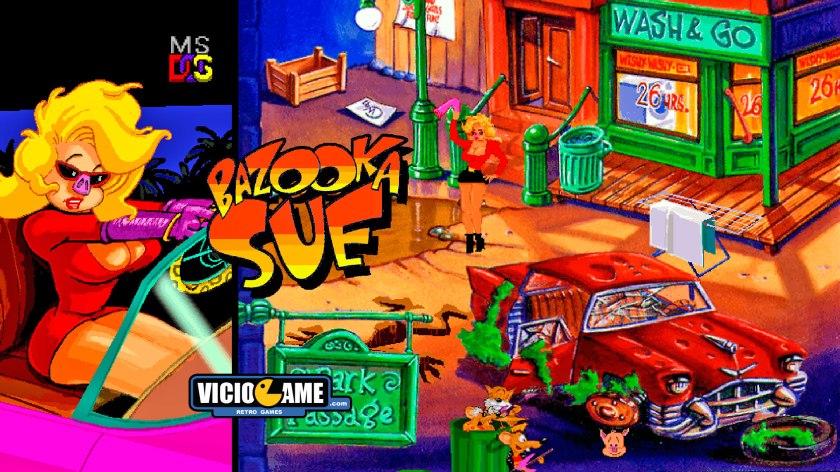
Bazooka Sue is a game in the classic point-and-click genre, the style immortalized by LucasArts titles, released for PC in 1997. While fleeing a police chase, the protagonist, a human-pig hybrid, takes refuge in a small village, where she gets swept up in a plot involving conspiracies, cloning, and even world domination.
Developer/Publisher: Starbyte Software
Release Date: 1997
Platform: PC MS-DOS
🇺🇸 Released in 1997 for the German market exclusively, Bazooka Sue is a point-and-click graphic adventure for MS-DOS that hides, behind a few lines of back-of-box copy, one of the strangest and most remarkable protagonist concepts in 1990s European gaming. Developed and published by Starbyte Software, the game was never localized into any language besides its native German, a fact that, decades later, still keeps much of its history out of reach for non-German speakers. Virtually unknown outside Germany, Bazooka Sue carries a rare curiosity even by the eccentric standards of the genre: its original conception dates back roughly five years before its actual release, a span that outlived the rise and fall of an entire platform before the project finally took its final form on CD.
Everything revolves around Sue, the title character, whom the game’s own official description bluntly calls the only video game protagonist — alongside Miss Piggy of the Muppets — to be simultaneously half woman and half pig. Before the story begins, Sue is said to have been a former adult-content model, now a fugitive from the law, whose hybrid appearance is never treated as a dramatic obstacle to overcome, but rather as the central joke the entire adventure is built around. That cartoonish humor, propped up by a deliberately exaggerated protagonist and a nonsensical premise, is Bazooka Sue‘s main calling card and the element most cited by anyone who, over the years, has stumbled onto the game by chance on some list of MS-DOS curiosities.
The story kicks off with Sue on the run, chased by the local sheriff for speeding. She rolls into Swamp Rock broke, her car’s tank bone dry, with only a few copies of racy magazines left over from her past. She winds up in a fictional village lost in the swamps of Louisiana — the kind of scenery frozen in time, packed with eccentric characters, that makes the perfect backdrop for a comedy of errors. Forced into an indefinite layover, Sue soon finds herself tangled up in the evil schemes of Dr. Bruth, a mad scientist whose true nature the adventure reveals gradually, through dialogue and investigation, at the genre’s characteristic pace. The stated goal is easy to sum up and deliberately over-the-top in its ambition: foil Bruth’s scheme and, while she’s at it, save nothing less than the entire world, turning her — almost against her own will — into the local hero of a town that never expected to host this kind of event. It’s the classic adventure-game structure — an outsider arrives in a small town and uncovers a conspiracy bigger than it first appears — dressed up in the broad, slapstick extravagance the game’s own packaging was already eager to advertise.
In terms of gameplay, Bazooka Sue‘s own promotional material invited the most obvious comparison possible: anyone familiar with LucasArts’ classic adventures, the period description claimed, would already know exactly what to expect. In practice, that means a third-person adventure controlled entirely with the mouse, with no action elements or sudden deaths, in which the player guides Sue through fixed backdrops, collects objects, talks to non-playable characters, and combines inventory items to solve puzzles that unlock the story’s progress — the formula popularized by titles built on SCUMM (Script Creation Utility for Maniac Mansion), the in-house engine LucasArts named after Maniac Mansion itself and reused in practically all of its point-and-click adventures for the following two decades.
The overall tone favors explicit mockery and constant cultural name-dropping, a comedic device used liberally but not always subtly: one recurring joke has someone take credit for creating classic cartoon icons like Bugs Bunny and Daffy Duck, only for the action to stop right there so the game can spell out, in no uncertain terms, exactly where the reference comes from — as if it didn’t trust the joke to land on its own. The same pattern repeats in the visual homages scattered throughout the scenery, which include a sinister house and a rundown motel echoing Psycho, plus a woman sitting on a playground being attacked by birds, a direct nod to Alfred Hitchcock’s The Birds — always followed by some textual clue that makes unmistakably clear where the joke came from. The peak of this self-aware humor arrives when Sue herself, within the fiction, visits Starbyte’s real-life offices, breaking the fourth wall in a moment of self-reference.
Over the years, the game’s critical reception has been modest: the handful of period publications that reviewed it averaged roughly 55%, while players who logged their opinions later tended toward scores around 3 out of 5 — numbers consistent with a release that went relatively unnoticed even within the very market it targeted. Assessments split into two fairly distinct camps. On one side are those who see the game as a comedy that tries too hard and doesn’t trust its own material, piling up arbitrary twists and reference jokes explained in detail exactly where a good cartoon would trust silence; by this reading, the game lacks precisely the consistent internal logic that holds up the comedies it tries to compare itself to, and the result swings between tedious and irritating. On the other side are more forgiving assessments that describe the experience as genuinely fun for fans of the classic point-and-click genre, praise the quality of the puzzles as being right in line with the LucasArts tradition the game itself invokes, and treat the cartoonish excess as part of the production’s campy charm.
Bazooka Sue‘s creation dates back to a period well before its 1997 release: references in the specialized German press already mentioned the project in 1992, when it was conceived as a new SCUMM-style adventure for the Commodore Amiga, with the protagonist described by the press of the time as a cross between actress Kim Basinger and Miss Piggy — a summary that, with almost unintentional irony, captures the character’s visual concept perfectly. One publication of the era even referred to the project by the slightly garbled name “Bazuka Sue.”
The biggest obstacle to getting Bazooka Sue off the ground was technical: without access to the actual SCUMM engine, which was closed LucasArts property, Starbyte had to build its own solution from scratch, which stretched the production schedule out for years on end. At one point, the possibility of a release for the Amiga CD32 — the home console derived from the Amiga that Commodore launched in 1993 — was even floated, and period press outlets went so far as to link British developer Krisalis Software’s name to the project around 1994, a company that partnered commercially with Starbyte on other occasions. Time, however, was unforgiving: by around 1995, the Amiga was already showing clear signs of commercial decline, and Starbyte, like much of the European industry, gradually shifted its production toward MS-DOS. Much of the art originally designed for the Amiga version was recycled for the PC conversion, which explains why the finished 1997 product’s aesthetic still carries a visibly anachronistic quality compared to the graphical standard already available in other CD-ROM titles that same year.
Starbyte Software came to Bazooka Sue as a publisher and developer already well established in the German market for nearly a decade, based in Bochum and known above all for strategy, economic simulation, sports, and adventure games for Amiga, Commodore 64, Atari ST, and MS-DOS, almost always praised for above-average graphical polish. The studio’s catalog included names still revered today by fans of the era, such as the fantasy RPG Rings of Medusa, the historical campaign game Hannibal, the tennis sim Tie Break, and the platformer Rolling Ronny, alongside economic simulations like Black Gold. The scale of the business wasn’t small: in 1993 alone, the company sold roughly 100,000 copies of its games in Germany alone, a figure that doesn’t even count international sales made possible by distribution partnerships with the aforementioned Krisalis Software and the American company Microleague, which were responsible for bringing the studio’s biggest hits to other European countries and the United States as well. It was precisely in this context — that of a company large by German market standards, but already nearing the end of its run as an independent operation — that Bazooka Sue emerged as one of the final chapters in Starbyte’s history, closing a cycle that had begun back in the ferment of the Amiga‘s heyday in the late 1980s.
Bazooka Sue‘s commercial life after its original release was quiet, though not entirely silent: in 1998, the game returned to shelves as part of the Silver Games 1 compilation, a common practice at the time for giving mid-tier titles a second life by bundling them into budget packages. Complete copies of the original big-box edition (with manual, box, and installation CD-ROM) still occasionally turn up among German PC game collectors today, fetching prices that stand in sharp contrast to the lukewarm reception the game got at launch — a gap that says more about the item’s physical rarity than about its historical weight within Starbyte’s own catalog.
In the end, Bazooka Sue will likely be remembered, if it’s remembered at all, less for the specific jokes it tried to land than for the winding road it traveled to reach store shelves: a project conceived as a kind of German answer to the big names of LucasArts point-and-click adventures, one that outlasted an entire generation of home computers and survived the very commercial lifespan of the studio that created it, finally taking shape, on a CD-ROM already quietly out of fashion by 1997, as the improbable image of a former pig-model on the run, determined to save the world from a lost village in the swamps of Louisiana. There’s an almost poetic irony to it: few titles capture the exaggeration, irreverence, and unpredictable production odyssey that marked so much of the 1990s German adventure-game market as well as this improbable heroine — born from the crossing of a magazine pin-up and a farmyard pig — firing off jokes instead of rockets through the muddy streets of a Louisiana that never existed outside a computer screen.
🇧🇷 Lançado em 1997 e destinado unicamente ao mercado alemão, Bazooka Sue é uma aventura gráfica no estilo point-and-click para MS-DOS que carrega, por trás de poucas frases de contracapa, um dos conceitos de protagonista mais estranhos e incríveis entre os jogos europeus dos anos 90. Desenvolvido e publicado pela desenvolvedora Starbyte Software, o título nunca recebeu localização para nenhum idioma além do alemão nativo, fator que, décadas mais tarde, ainda mantém restrita boa parte de sua história. Praticamente desconhecido fora da Alemanha, Bazooka Sue carrega ainda uma curiosidade rara mesmo para os padrões excêntricos do gênero: sua concepção original remonta a cerca de cinco anos antes do lançamento efetivo, intervalo que atravessou a ascensão e a decadência de toda uma plataforma antes de o projeto finalmente ganhar forma definitiva em CD.
Tudo gira em torno de Sue, personagem-título que a própria apresentação oficial do jogo descreve, sem meias palavras, como a única protagonista de um videogame — ao lado da Miss Piggy, dos Muppets — a ser simultaneamente metade mulher e metade porca. Antes dos acontecimentos do enredo, Sue teria sido uma ex-modelo de conteúdo adulto, hoje foragida da lei, cuja aparência híbrida nunca é tratada como um obstáculo dramático a ser superado, mas sim como a piada central sobre a qual toda a aventura se constrói. Esse humor caricatural, apoiado numa protagonista deliberadamente exagerada e numa premissa non-sense, é o principal cartão de visitas de Bazooka Sue e o elemento mais citado por quem, ao longo dos anos, tropeçou no jogo por acaso em alguma lista de curiosidades do MS-DOS.
A história tem início com Sue em fuga: perseguida pelo xerife local por excesso de velocidade. Ela chega a Swamp Rock falida, com o tanque do carro seco e apenas alguns exemplares de revistas picantes remanescentes de seu passado. Acaba em um vilarejo fictício perdido nos pântanos da Louisiana e o tipo de cenário parado no tempo, cheio de personagens excêntricos, que serve de pano de fundo perfeito para uma comédia de mal-entendidos. Obrigada a fazer uma parada por tempo indeterminado, Sue logo se vê enredada nos planos malignos do Dr. Bruth, cientista louco cuja verdadeira natureza a aventura revela aos poucos, por meio de diálogos e investigação, no ritmo característico do gênero. O objetivo declarado é simples de resumir e propositalmente exagerado em sua ambição: frustrar o esquema de Bruth e, de quebra, salvar nada menos que o mundo inteiro, transformando-se, quase contra a própria vontade, na heroína local de uma cidade que jamais esperou abrigar esse tipo de acontecimento. É a estrutura clássica de aventura — forasteira chega a um lugar pequeno e desvenda uma conspiração maior do que aparenta — vestida com a extravagância pastelão que a própria embalagem do jogo já fazia questão de anunciar.
Em termos de jogabilidade, o próprio material promocional de Bazooka Sue convidava à comparação mais óbvia possível: quem conhecesse as aventuras clássicas da LucasArts, dizia a descrição da época, já saberia exatamente o que esperar. Na prática, isso significa uma aventura em terceira pessoa conduzida inteiramente pelo mouse, sem qualquer elemento de ação ou morte súbita, em que o jogador guia Sue por cenários fixos, coleta objetos, conversa com personagens não jogáveis e combina itens de inventário para resolver quebra-cabeças que destravam o avanço da história — a fórmula consagrada por títulos construídos sobre o SCUMM (Script Creation Utility for Maniac Mansion), o engine interno que a LucasArts batizou em homenagem ao próprio Maniac Mansion e reaproveitou em praticamente todas as suas aventuras de apontar-e-clicar pelas duas décadas seguintes.
O tom geral privilegia o deboche explícito e a citação cultural constante, recurso cômico usado com fartura, mas nem sempre com sutileza: uma das piadas recorrentes consiste em atribuir a alguém o mérito de ter criado ícones do desenho animado clássico como Bugs Bunny e Daffy Duck, para em seguida a ação parar e o jogo explicar, com todas as letras, de onde vem a referência, como se não confiasse que a piada falaria sozinha. O mesmo padrão se repete nas homenagens visuais espalhadas pelos cenários, que incluem uma casa sinistra e um motel decadente lembrando Psicose, além de uma mulher sentada num playground sendo atacada por pássaros, numa citação direta a Os Pássaros, de Alfred Hitchcock — sempre seguidas de alguma pista textual que deixa claro, sem margem para dúvida, de onde veio a piada. O ápice desse humor autoconsciente chega quando a própria Sue visita, dentro da ficção, os escritórios reais da Starbyte, quebrando a quarta parede num momento de autorreferência.
Ao longo dos anos, o título teve uma recepção crítica modesta: as poucas publicações da época que avaliaram o título somam uma média de aproximadamente 55%, enquanto jogadores que registraram sua opinião mais tarde tenderam a notas em torno de 3 em 5 — números condizentes com um lançamento que passou relativamente despercebido mesmo dentro do próprio mercado ao qual se destinava. As análises se dividem em dois polos bem distintos. De um lado, há quem enxergue no jogo uma comédia que tenta demais e não confia no próprio material, acumulando reviravoltas arbitrárias e piadas de referência explicadas em detalhe justamente onde um bom desenho animado confiaria no silêncio; para essa leitura, o jogo carece justamente da lógica interna consistente que sustenta as comédias às quais tenta se comparar, e o resultado oscila entre o tedioso e o irritante. De outro lado, há avaliações mais indulgentes, que descrevem a experiência como genuinamente divertida para quem gosta do gênero point-and-click clássico, elogiam a qualidade dos quebra-cabeças na linha direta da tradição LucasArts que o próprio jogo reivindica, e tratam o excesso caricatural como parte do charme “brega” da produção.
A criação de Bazooka Sue remonta a um período bem anterior ao lançamento de 1997: referências na imprensa especializada alemã já mencionavam o projeto em 1992, então concebido como uma nova aventura em estilo SCUMM para o Commodore Amiga, com a protagonista descrita pela imprensa da época como um cruzamento entre a atriz Kim Basinger e a Miss Piggy — síntese que resume, com uma ironia quase involuntária, o próprio conceito visual da personagem. Uma publicação da época chegou a se referir ao projeto pelo nome ligeiramente distorcido de “Bazuka Sue”.
O maior obstáculo para tirar Bazooka Sue do papel era técnico: sem acesso ao engine SCUMM propriamente dito, propriedade fechada da LucasArts, a Starbyte precisou desenvolver sua própria solução do zero, o que esticou o cronograma de produção por anos a fio. Em determinado momento, chegou a circular a possibilidade de um lançamento para o Amiga CD32, console de mesa derivado do Amiga lançado pela Commodore em 1993, e a imprensa da época chegou a associar o nome da desenvolvedora britânica Krisalis Software ao projeto por volta de 1994, parceira comercial da Starbyte em outras ocasiões. O tempo, porém, foi implacável: por volta de 1995, o Amiga já dava sinais claros de declínio comercial, e a Starbyte, como boa parte da indústria europeia, foi migrando sua produção para o MS-DOS. Boa parte da arte originalmente concebida para a versão de Amiga foi reaproveitada na conversão para PC, o que explica por que a estética do produto final de 1997 carrega, ainda hoje, um quê visivelmente anacrônico para o padrão gráfico já disponível em outros títulos em CD-ROM daquele ano.
A Starbyte Software chegava a Bazooka Sue como uma editora e desenvolvedora já consolidada havia quase uma década no mercado alemão, sediada em Bochum e conhecida sobretudo por jogos de estratégia, simulação econômica, esporte e aventura para Amiga, Commodore 64, Atari ST e MS-DOS, quase sempre reconhecidos pelo capricho gráfico acima da média. O catálogo da casa incluía nomes hoje cultuados por entusiastas do período, como o RPG de fantasia Rings of Medusa, a campanha histórica Hannibal, o simulador de tênis Tie Break e o game de plataforma Rolling Ronny, além de simulações econômicas como Black Gold. A escala do negócio não era pequena: somente em 1993, a empresa vendeu cerca de 100 mil cópias de seus jogos apenas na Alemanha, número que não computa as vendas internacionais viabilizadas por parcerias de distribuição como a já mencionada Krisalis Software e a norte-americana Microleague, responsáveis por levar os maiores sucessos da casa também a outros países europeus e aos Estados Unidos. Foi justamente nesse contexto — o de uma empresa grande para os padrões do mercado alemão, mas já às portas do fim de sua atividade independente — que Bazooka Sue surgiu como um dos capítulos finais da história da Starbyte, fechando um ciclo que havia começado ainda na efervescência do Amiga no fim dos anos 80.
A vida comercial de Bazooka Sue após o lançamento original foi discreta, mas não totalmente silenciosa: em 1998, o jogo voltou às lojas como parte da coletânea Silver Games 1, prática comum da época para dar sobrevida a títulos de médio impacto reunindo-os em pacotes de orçamento reduzido. Ainda hoje, cópias completas da edição original em big box (com manual, caixa e o CD-ROM de instalação) circulam ocasionalmente entre colecionadores alemães de jogos de PC, alcançando preços que destoam bastante da recepção morna que o título recebeu no momento do lançamento, contraste que fala mais sobre a raridade física do item do que sobre seu peso histórico dentro do próprio catálogo da Starbyte.
No fim das contas, Bazooka Sue talvez seja lembrado, quando lembrado, menos pelas piadas específicas que tentou contar do que pelo caminho tortuoso que percorreu até chegar às prateleiras: um projeto concebido como uma espécie de resposta alemã aos grandes nomes da aventura point-and-click da LucasArts, que atravessou toda uma geração de computadores domésticos e sobreviveu ao próprio fôlego comercial do estúdio que o criou, para finalmente materializar, num CD-ROM já discretamente fora de moda em 1997, a imagem improvável de uma ex-modelo suína decidida a salvar o mundo a partir de um vilarejo perdido nos pântanos da Louisiana. Há uma ironia quase poética nisso: poucos títulos resumem tão bem o exagero, a irreverência e o imprevisível itinerário de produção que marcaram boa parte do mercado alemão de aventuras dos anos 90 quanto essa heroína improvável, nascida do cruzamento entre uma pin-up de revista e uma leitoa de fazenda, disparando piadas em vez de foguetes pelas ruas enlameadas de uma Louisiana que jamais existiu fora da tela de um computador.
🤑💲Earn money without doing anything! Just leave these apps open:
  https://r.honeygain.me/CONTA9DB02

   https://packetstream.io/?psr=1uPb
⬛ 𝗧𝗶𝗸𝗧𝗼𝗸: https://www.tiktok.com/@viciogame
🟧 𝗜𝗻𝘀𝘁𝗮𝗴𝗿𝗮𝗺: http://www.instagram.com/viciogame
🟥 𝗬𝗼𝘂𝘁𝘂𝗯𝗲: http://www.youtube.com/viciogame
🟦 𝗙𝗮𝗰𝗲𝗯𝗼𝗼𝗸: http://www.facebook.com/viciogame
🔳 𝗧𝗵𝗿𝗲𝗮𝗱𝘀: https://www.threads.net/@viciogame
🟪 𝗧𝘄𝗶𝘁𝗰𝗵: https://www.twitch.tv/ViciogameRetroGames
🟨 𝗕𝗹𝗼𝗴: http://www.viciogameblog.com/
🟦𝗧𝘄𝗶𝘁𝘁𝗲𝗿: http://www.twitter.com/viciogame
#Viciogame #Gameplay #LetsPlay #Playthrough #Games #Gaming #Videogames #Review #Game #Detonado #Walkthrough #Ending #Reviews #Facts #Retro #RetroGaming #Roms #Emulator #Longplay #Speedrun #NoCommentary #BazookaSue #PC #MsDOS #PointAndClick #LucasArts #Adventure #dayofthetentacle #indianajones #maniacmansion #scummvm #dosbox #brokensword #german #Commodore #Amiga #sierra
 VICIOGAME