
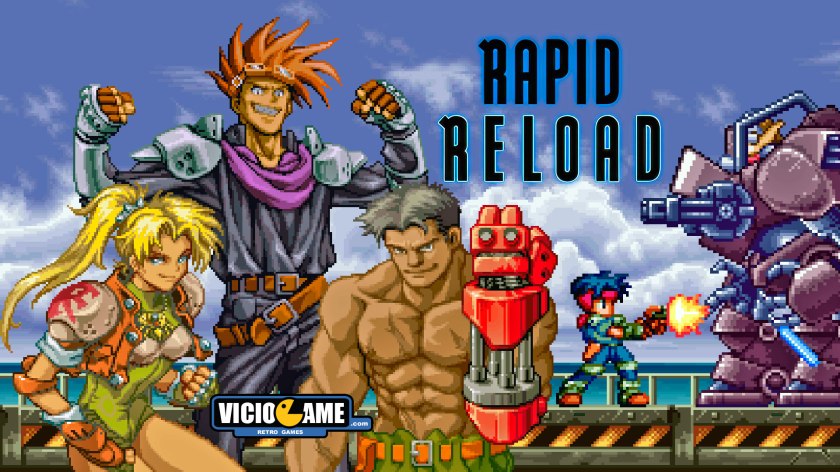
Rapid Reload, known in Japan as Gunner’s Heaven, is a side-scrolling run-and-gun game released in 1995 for the PlayStation. While searching for a powerful, mysterious stone, the duo of adventurers ends up crossing paths with a gang that’s also after the artifact, hoping to use its power to conquer the world.
Developer: Media.Vision Entertainment
Publisher: Sony Computer Entertainment
Release Date: 1995
Platform: Sony PlayStation
🇺🇸 Released during the PlayStation‘s first months on the market, Rapid Reload occupies a curious place in the console’s history: it’s simultaneously one of the platform’s earliest entries in the run-and-gun genre and one of the clearest examples of how Sony treated 2D as an afterthought in the early days of its 32-bit hardware. Known in Japan under the title Gunner’s Heaven (ガンナーズヘヴン), the game pays such blatant homage to Treasure’s Gunstar Heroes that it spawned an urban legend among fans over the years questioning its true authorship. Developed by Media.Vision and published directly by Sony Computer Entertainment, Rapid Reload combines frantic action, a generous arsenal, and two playable characters with distinct identities — traits that, combined, helped turn it, decades after release, into one of the most frequently cited unjustly forgotten classics of the PlayStation‘s early catalog.
The game hit Japanese store shelves on April 28, 1995, and a few months later, on September 29 of that same year, landed in Europe already renamed Rapid Reload — the title under which it would become best known outside Japan. The catalog numbers assigned to the two versions, SCPS-10006 in Japan and SCES-00004 in Europe, show just how early in the console’s life it arrived: the European code, in particular, is among the lowest ever assigned to a PlayStation game in the region, a clear sign that it was one of the platform’s earliest releases on the continent. North America, however, never received an official release of the game, a decision attributed to Sony Computer Entertainment America’s policy at the time, which regarded two-dimensional games with suspicion right at the start of the PlayStation‘s commercial life in the region, preferring to shine the spotlight on titles that showcased polygonal graphics.
Behind the game is Media.Vision, a studio founded in Tokyo on March 1, 1993, by former members of Riot, a Telenet Japan subsidiary responsible for the Tenshi no Uta series on the PC Engine. Still early in its history, Media.Vision received direct support from Japan Studio, Sony’s own internal development arm, and Rapid Reload was only the studio’s second project: a year earlier, in 1994, the company had debuted with Crime Crackers, a hybrid of action RPG and first-person shooter also published by Sony Computer Entertainment. Rapid Reload credited Shigeo Maruyama, Teruhisa Tokunaka, and Takashi Fukushima as producers — the latter also a co-founder of the studio itself — along with Toshiyuki Miyata, Akira Sato, and Yukio Nagasaki as designers, Yukihiko Itō and Keizō Shimizu as the artists behind the visual direction, and Kazuhiko Toyama as the soundtrack composer. It was only a year later, in 1996, that Media.Vision would release Wild Arms, an RPG that would become by far its most recognized work and spawn a franchise with several games over the following two decades — quite a turn for a studio that had begun its journey with a first-person shooter and a 2D run-and-gun.
Rapid Reload‘s story follows Axel Sonics (voiced in the original version by Kazuki Yao) and Ruka Hetfield (voiced by Noriko Hidaka), a pair of treasure hunters who set out in search of the legendary Valkiry stone after hearing rumors of its existence. Along the way, the two discover they aren’t alone in this quest: the terrorist organization Pumpkin Heads is also after the artifact, with the declared goal of using its power to conquer the world. Throughout the adventure, Axel and Ruka face down the organization’s army of soldiers and take out, one by one, the three captains commanding its ranks, among them Ashe, a young blonde woman who attacks the duo from inside a giant robot. The game’s credits also list Vikard, Bellows, and Raquel among the central names in the villain roster, who complete, alongside Ashe, the trio of captains, along with the organization’s own leader, introduced at the story’s climax simply as the Master. She’s the one waiting for the heroes in the group’s final lair, already in possession of the Valkiry, and it’s against her that the decisive confrontation plays out, in which she draws on the stone’s own power to grow stronger before finally being defeated.
The ending changes depending on which character the player chooses. If Axel defeats the Master, he’s quickly caught up to by an ecstatic Ruka, who grabs the Valkiry in the excitement of victory and takes off running, leaving a visibly exhausted Axel struggling, without much success, to keep up with his partner. If Ruka wins the final confrontation instead, the ending takes a more bittersweet turn: she accidentally drops the stone, watching it shatter on the ground, and, overcome with frustration, swears she’ll never hunt treasure again — a promise that, according to a closing caption shown at the end, she ultimately doesn’t keep, staying in the business alongside Axel.
Gameplay-wise, Rapid Reload is a side-scrolling run-and-gun: the goal is to push forward, almost always to the right and occasionally upward, shooting at everything that appears in your path, always solo, since the game, unlike much of its genre’s contemporaries, offers no two-player cooperative mode. Before starting a match, the player chooses between Axel or Ruka, and that choice goes well beyond looks: each character carries their own exclusive set of four weapons, adding up to eight different shot types between the two of them. The basic arsenal includes a standard shot equivalent to an automatic pistol, a homing shot that chases down enemies on screen, a short-range flamethrower, and a multi-shot weapon that scatters projectiles in several directions at once. The player freely switches between these four options at any time during the match, adapting their choice to the type of enemy or situation at hand.
Two additional moves round out the movement repertoire. Holding the L2 button plants the character’s feet firmly on the ground and lets them aim freely in any direction without moving, an essential tool for dealing with threats coming from above, below, or behind. R2, meanwhile, activates the grappling hook, a hook that can latch onto any nearby wall or ceiling, letting the player swing from one point to another; while the hook is in use, the character becomes temporarily invulnerable, though the move is never mandatory for completing the game, functioning more as an optional utility item than a core piece of the design. Players can also grab enemies at close range and hurl them into other targets instead of simply shooting them.
The score earned from destroying enemies feeds into a mechanic that’s fairly unusual for the genre. A counter displayed at the top of the screen works like a constantly ticking countdown clock; killing enemies releases score crystals, and collecting them adds a few seconds to that counter. As long as the meter stays above zero, the player’s shots keep their maximum power; the moment it hits zero, firepower plummets, forcing the player to go back to hunting for items to build strength back up. Every so often, certain enemies drop a special item that temporarily boosts weapon power to absurd levels, but only for an extremely short window. In practice, the system has good intentions (rewarding aggressive, consistent play) but stumbles on an uneven distribution of these items: some stretches are generous, with power-ups every few seconds, while others drop practically nothing, leaving the player weak right when they need strength most. The problem gets worse during boss fights, since dying mid-battle wipes the counter out completely and sends the player back to the point of the last defeated sub-boss, not the start of the stage, but still enough to drag out fights that already tend to run long.
In total, there are six stages, each more challenging than the last. In most of them, the player faces two area sub-bosses, referred to internally as Area Bosses, before taking on the stage’s main boss, called the Guardian; the exceptions are stage 3, which features only one Area Boss before the Guardian, and stage 5, trimmed down to a single direct confrontation with the Guardian. Two stages deliberately break from the more linear run-and-shoot structure: one takes place inside a mining tunnel, covered at high speed on rocket-propelled skates, including an outdoor stretch; another does away with solid ground entirely for an aerial battle, with the protagonist equipped with a jetpack. The second stage, meanwhile, stands out for setting its action in a forest teeming with both enemy robots and hostile wildlife and plant life. One of the most fondly remembered bosses among those still playing Rapid Reload today is a robot with a chassis emblazoned with the Union Jack, the flag of the United Kingdom, wielding a laser flail — one of those tongue-in-cheek details that punctuate the genre’s typical over-the-top cartoonishness. It’s also worth mentioning a balance difference widely discussed among fans: since Ruka’s arsenal is generally considered weaker than Axel’s, finishing the game with her, especially on stages 3 and 4, tends to be noticeably harder, to the point that this imbalance has become one of the most debated aspects of the game’s design.
The most recurring, and frankly almost inevitable, comparison links Rapid Reload to Gunstar Heroes, the classic run-and-gun Treasure had released two years earlier for the Mega Drive. The similarities go well beyond the shared genre: the system of four weapons swappable at any moment, the crouch-and-slide move, the ability to grab enemies at close range and throw them instead of just shooting them, the numeric health gauges shown during boss fights, the combination of small flying robots firing diagonally with hordes of disposable soldiers and a handful of tougher enemies, the way the character hangs from platforms with one hand (able to either shoot or move sideways, but never both at once), and even the single-life structure with one long, per-stage regenerating health bar. Some stages even repeat ideas almost beat for beat, like auto-scrolling sequences inside giant trains or vertical stretches where the player has to climb a series of platforms without falling off screen. It’s this avalanche of coincidences that, over the years, fueled a theory among older fans of the genre — never officially confirmed nor denied — that Rapid Reload was, in practice, an uncredited Treasure production. The game’s credits, however, attribute authorship entirely to Media.Vision, and no official source has ever formally linked Gunstar Heroes‘ Japanese developer to the project; persistent as it is, the rumor remains just that, a rumor, sustained solely by the impression left on anyone who plays the two games side by side.
There are differences between the Japanese and European versions that go beyond just the name on the box. The Japanese edition offers unlimited continues and hides, behind a button combination entered on the title screen, a cheat menu that allows, among other things, free stage selection; it also includes brief voice-acted segments during the moments when the protagonists come face to face with the story’s villains. The European conversion, on the other hand, limits the player to nine continues, removes the stage-select option entirely, and drops the voice acting in favor of English text screens; that version also runs at a different speed than the Japanese one, a result of the European video standard of the time, which drew criticism for the quality of the conversion in publications of the era.
In the specialized press of 1995, scores varied quite a bit, a direct reflection of the split between those who saw the game as a competent tribute and those who viewed it as a shameless copy. British magazine Computer and Video Games gave the most generous score among Western publications, 89 out of 100, praising the scenery, sound design, and overall look, while still acknowledging that the result fell short of Gunstar Heroes. Next Generation, for its part, highlighted the impressive number of simultaneous on-screen sprites with no noticeable flickering or tearing, as proof that the game lived up to the promise suggested by its English-language name. At the other extreme, Maximum handed out just 2 out of 5, openly calling the title an inferior Gunstar Heroes clone and criticizing both the lack of simultaneous co-op and the quality of the European conversion. Japan’s Famitsu scored the game, under the name Gunner’s Heaven, at 26 out of 40, a middling score by the publication’s standards, while Edge settled on 6 out of 10. Other outlets of the era, such as GamesMaster, Hyper, Play, Games World, PlayStation Plus, SonyPro, and Ultimate Future Games, published reviews ranging from lukewarm to quite positive, adding up to an overall reception that today would be described as mixed, but never hostile. Commercially, the game sold 83,942 copies in Japan over its retail life, according to figures published by Famitsu itself, and reached fifth place on Micom BASIC Magazine‘s popularity chart in July 1995 — a respectable showing, if a far cry from the major commercial phenomena of the PlayStation‘s early days.
It was only with the passing years, though, that Rapid Reload cemented its reputation as an unjustly forgotten classic. In a 2007 retrospective on the run-and-gun genre, 1Up.com didn’t hesitate to call it a shameless Gunstar Heroes copy, but acknowledged the title deserved more attention than it got, overshadowed as it was by the era’s obsession with polygonal games. IGN took a similar stance in 2009, including it among the hidden gems of the PlayStation‘s Japanese catalog and describing it as a remarkable piece of work that flew under the radar thanks to the period’s general fascination with polygons. Then in 2016, critic Kurt Kalata of the site Hardcore Gaming 101, which specializes in obscure games, praised the stage design and soundtrack, but pointed to both the modest graphical presentation — going so far as to compare it, at times, to a Super Nintendo title, even though the PlayStation‘s wider color palette gave it a slightly better finish — and the poorly balanced weapon system and lack of a two-player mode as the main factors keeping the game from reaching fully established classic status, something that, in the critic’s own view, would only happen on PlayStation with later titles like Klonoa and Strider 2. British outlet Den of Geek, finally, included Rapid Reload in a 2018 list dedicated to the most underrated games in the entire PlayStation library. Among genre enthusiasts, it’s also commonly acknowledged that Gunner’s Heaven predated Metal Slug by about a year, helping keep the flame of 2D run-and-gun shooters alive right as the industry was beginning to shift heavily toward three-dimensional graphics.
The connection between Rapid Reload and Wild Arms, the RPG Media.Vision would release the very next year and which would become its longest-running franchise, goes beyond simple chronological sequence in the studio’s career. Several weapons and pieces of equipment originally created for Axel and Ruka reappear throughout the Wild Arms series as tools or special items, a kind of running wink to players who catch the reference; one of the most frequently cited examples is the Electel, an item wielded by the character Marivel Armitage in one of the series’ games, a noticeably weaker version of the same weapon Axel Sonics carries in Rapid Reload. The game also came back into official circulation well after its original release: Sony made it available through the PlayStation Network in Japan in 2007 and, a few years later, in 2010, in other Asian markets and in Europe as well, allowing it to be purchased digitally and played on newer Sony consoles like the PlayStation 3, PSP, and PlayStation Vita — North America, once again, was left out of that official release.
In the collector’s market, Rapid Reload now holds a notable place precisely because of this limited release history: having never officially circulated outside Japan and Europe, complete copies (especially the Japanese version) tend to fetch prices well above the average for a typical PlayStation game from the same era; it’s not uncommon to find Japanese copies in good condition listed for close to two hundred dollars on international buy-and-sell platforms, a price that reflects both the title’s relative rarity and the growing interest it draws from collectors and genre enthusiasts.
More than three decades after release, Rapid Reload remains one of those games that seem to exist on the margins of the PlayStation‘s official history, overshadowed at the time by the industry’s widespread obsession with polygons and by marketing that was practically nonexistent outside Japan and Europe. For those discovering it today, whether through a fellow enthusiast’s recommendation or by pure curiosity after stumbling across its name on a list of forgotten classics, the experience tends to surprise: it’s a game with a generous pace, polished visuals by 1995 standards, a varied arsenal, and two genuinely distinct playable personalities, all wrapped in a solid soundtrack and a constant burst of on-screen effects. It doesn’t quite surpass Gunstar Heroes, its most obvious source of inspiration, but it doesn’t need to: Rapid Reload earns its place on its own merits, as a vibrant snapshot of a moment when the PlayStation was still feeling out its own identity and betting, even if a bit hesitantly, on a genre the Mega Drive had already helped establish years before. Above all, it’s a game meant to be felt through the controller — loud, generous with its cartoonish violence, and sincerely fun from the first stage to the last.
🇧🇷 Lançado nos primeiros meses de vida do PlayStation, Rapid Reload ocupa um lugar curioso na história do console: é, ao mesmo tempo, um dos primeiros representantes do gênero run-and-gun na plataforma e um dos exemplos mais evidentes de como a Sony tratou o 2D como um capítulo secundário nos primórdios de seu hardware de 32 bits. Conhecido no Japão sob o título Gunner’s Heaven (ガンナーズヘヴン), o jogo é uma homenagem tão flagrante a Gunstar Heroes, da Treasure, que gerou ao longo dos anos até uma lenda urbana entre fãs sobre sua verdadeira autoria. Desenvolvido pela Media.Vision e publicado diretamente pela Sony Computer Entertainment, Rapid Reload combina ação frenética, um arsenal generoso e dois personagens jogáveis com identidades próprias — características que, somadas, ajudaram a transformá-lo, décadas depois do lançamento, em um dos clássicos injustamente esquecidos mais citados do catálogo inicial do PlayStation.
O jogo chegou às lojas japonesas em 28 de abril de 1995 e, alguns meses depois, em 29 de setembro do mesmo ano, desembarcou na Europa já rebatizado como Rapid Reload — título sob o qual ficaria mais conhecido fora do Japão. Os números de catálogo atribuídos às duas versões, SCPS-10006 no Japão e SCES-00004 na Europa, evidenciam o quão cedo na vida do console ele chegou: o código europeu, em especial, está entre os mais baixos já atribuídos a um jogo de PlayStation na região, sinal claro de que se tratava de um dos primeiros títulos lançados para a plataforma no continente. A América do Norte, porém, nunca recebeu uma edição oficial do jogo, decisão atribuída à política da Sony Computer Entertainment America da época, que via com desconfiança os jogos bidimensionais logo no início da vida comercial do PlayStation na região, preferindo concentrar os holofotes em títulos que explorassem gráficos poligonais.
Por trás do jogo está a Media.Vision, estúdio fundado em Tóquio em 1º de março de 1993 por ex-integrantes da Riot, subsidiária da Telenet Japan responsável pela série Tenshi no Uta no PC Engine. Ainda no início de sua trajetória, a Media.Vision contou com o apoio direto do Japan Studio, braço de desenvolvimento interno da própria Sony, e Rapid Reload foi apenas o segundo projeto da produtora: um ano antes, em 1994, a empresa havia debutado com Crime Crackers, um híbrido de RPG de ação e tiro em primeira pessoa também publicado pela Sony Computer Entertainment. Rapid Reload creditou como produtores Shigeo Maruyama, Teruhisa Tokunaka e Takashi Fukushima — este último, cofundador do próprio estúdio —, além de Toshiyuki Miyata, Akira Sato e Yukio Nagasaki como designers, Yukihiko Itō e Keizō Shimizu como artistas responsáveis pela direção visual, e Kazuhiko Toyama como compositor da trilha sonora. Foi apenas um ano depois, em 1996, que a Media.Vision lançaria Wild Arms, RPG que se tornaria de longe seu trabalho mais reconhecido e daria origem a uma franquia com vários jogos ao longo das duas décadas seguintes — uma guinada e tanto para um estúdio que havia começado sua trajetória com um atirador em primeira pessoa e um run-and-gun bidimensional.
A história de Rapid Reload acompanha Axel Sonics (dublado na versão original por Kazuki Yao) e Ruka Hetfield (dublada por Noriko Hidaka), dupla de caçadores de tesouro que parte em busca da lendária pedra Valkiry após ouvir rumores sobre sua existência. No caminho, os dois descobrem que não estão sozinhos nessa busca: a organização terrorista Pumpkin Heads também persegue o artefato, com o objetivo declarado de dominar o mundo por meio de seu poder. Ao longo da aventura, Axel e Ruka enfrentam o exército de soldados da organização e eliminam, um a um, os três capitães que comandam suas fileiras, entre eles Ashe, uma jovem loira que ataca a dupla por meio de um robô gigante. Os créditos do jogo também apontam Vikard, Bellows e Raquel entre os nomes centrais do elenco de vilões, e que completam, ao lado de Ashe, o trio de capitães e a própria líder da organização, apresentada no clímax da trama simplesmente como a Master. É ela quem aguarda os heróis no covil final do grupo, já de posse da Valkiry, e é contra ela que se trava o confronto decisivo, no qual usa o poder da própria pedra para se fortalecer antes de ser finalmente derrotada.
O desfecho muda conforme o personagem escolhido pelo jogador. Se for Axel quem derrota a Master, ele é logo depois alcançado por uma Ruka eufórica, que agarra a Valkiry na euforia da vitória e sai correndo, deixando um Axel visivelmente exausto tentando, sem muito sucesso, acompanhar o ritmo da parceira. Se for Ruka quem vence o último confronto, o final toma um rumo mais agridoce: ela deixa a pedra cair sem querer, vendo-a se espatifar no chão, e jura, tomada pela frustração, nunca mais voltar a caçar tesouros — promessa que, segundo uma legenda final exibida no encerramento, ela acaba não cumprindo, permanecendo no ramo ao lado de Axel.
Em termos de jogabilidade, Rapid Reload é um run-and-gun de rolagem lateral: o objetivo é avançar, quase sempre para a direita e ocasionalmente para cima, atirando em tudo o que aparece pela frente, sempre sozinho, já que o jogo, ao contrário de boa parte de seus contemporâneos de gênero, não oferece modo cooperativo para dois jogadores. Antes de iniciar a partida, o jogador escolhe entre Axel ou Ruka, e essa escolha vai muito além do aspecto visual: cada personagem carrega seu próprio conjunto exclusivo de quatro armas, somando oito tipos de tiro diferentes entre os dois. O arsenal básico inclui um disparo padrão equivalente a uma pistola automática, um tiro teleguiado que persegue os inimigos na tela, um lança-chamas de curto alcance e uma arma de tiro múltiplo, que espalha projéteis em várias direções simultaneamente. O jogador alterna livremente entre essas quatro opções a qualquer momento durante a partida, adaptando a escolha ao tipo de inimigo ou situação enfrentada.
Dois recursos adicionais completam o repertório de movimentação. Ao segurar o botão L2, o personagem planta os pés no chão e passa a mirar livremente em qualquer direção sem se deslocar, recurso essencial para lidar com ameaças vindas de cima, de baixo ou por trás. Já R2 aciona o grappling hook, um gancho capaz de se prender a qualquer parede ou teto nas proximidades, permitindo balançar de um ponto a outro; enquanto o gancho está em uso, o personagem fica temporariamente invulnerável, embora o recurso nunca seja indispensável para completar o jogo, funcionando mais como um item de utilidade opcional do que como peça central do design. Também é possível agarrar inimigos a curta distância e arremessá-los contra outros alvos, em vez de simplesmente atirar neles.
A pontuação obtida ao destruir inimigos alimenta um mecanismo pouco comum para o gênero. Um contador exibido no alto da tela funciona como uma espécie de cronômetro que corre constantemente contra o tempo; ao eliminar inimigos, cristais de pontuação são liberados, e recolhê-los adiciona alguns segundos a esse contador. Enquanto o marcador permanece acima de zero, os tiros do jogador mantêm potência máxima; assim que chega a zero, o poder de fogo despenca, obrigando o jogador a voltar a caçar itens para recuperar força. De tempos em tempos, certos inimigos derrubam um item especial que eleva temporariamente o poder das armas a níveis absurdos, mas por um período extremamente curto. Na prática, o sistema tem uma boa intenção (recompensar quem joga de forma agressiva e constante), mas peca por uma distribuição irregular desses itens: há trechos generosos, com power-ups a cada poucos segundos, e outros em que praticamente nada cai, deixando o jogador fraco bem no momento em que mais precisaria de força. O problema se agrava nas lutas contra chefes, já que morrer durante o combate zera o contador por completo e faz o jogador recomeçar exatamente no ponto do último subchefe derrotado, não do início da fase, mas ainda assim o suficiente para alongar batalhas que já tendem a ser demoradas.
Ao todo, são seis fases, cada uma mais desafiadora que a anterior. Na maioria delas, o jogador enfrenta dois subchefes de área, chamados internamente de Area Boss, antes de encarar o chefe principal do estágio, batizado de Guardian; as exceções ficam por conta da fase 3, que traz apenas um Area Boss antes do Guardian, e da fase 5, reduzida a um único confronto direto contra o Guardian. Duas fases fogem propositalmente da estrutura mais linear de correr e atirar: uma se passa dentro de um túnel de mineração, percorrido em alta velocidade sobre patins com propulsão a foguete, incluindo um trecho ao ar livre; outra abandona o chão por completo para uma batalha aérea, com o protagonista equipado com um jetpack. Já a segunda fase se destaca por ambientar sua ação em uma floresta repleta tanto de robôs inimigos quanto de fauna e flora hostis. Um dos chefes mais lembrados por quem joga Rapid Reload até hoje é um robô com o chassi estampado com a bandeira do Reino Unido, a Union Jack, armado com um mangual laser, um daqueles detalhes bem-humorados que pontuam o excesso cartunesco típico do gênero. Vale ainda mencionar uma diferença de equilíbrio amplamente discutida entre os fãs: como o arsenal de Ruka é, de forma geral, considerado mais fraco que o de Axel, completar o jogo com a personagem, sobretudo nas fases 3 e 4, costuma ser sensivelmente mais difícil, a ponto de esse desequilíbrio se tornar um dos pontos mais debatidos sobre o design do título.
A comparação mais recorrente, e de fato praticamente inevitável, associa Rapid Reload a Gunstar Heroes, o clássico run-and-gun que a Treasure lançara dois anos antes para o Mega Drive. As semelhanças vão muito além do gênero compartilhado: o sistema de quatro armas comutáveis a qualquer momento, o movimento de agachar e deslizar, a possibilidade de agarrar inimigos a curta distância e arremessá-los em vez de apenas atirar neles, os medidores numéricos de energia exibidos durante as lutas contra chefes, a combinação de pequenos robôs voadores que disparam na diagonal com hordas de soldados descartáveis e alguns inimigos mais resistentes, a forma como o personagem se pendura com uma mão sob plataformas (podendo atirar ou se deslocar lateralmente, mas nunca as duas coisas ao mesmo tempo) e até a estrutura de vida única com uma extensa barra de energia regenerável a cada fase. Alguns estágios chegam a repetir ideias quase estrutura por estrutura, como sequências de rolagem automática dentro de trens gigantescos ou trechos verticais em que o jogador precisa subir uma sucessão de plataformas sem cair para fora da tela. É essa avalanche de coincidências que, ao longo dos anos, alimentou entre fãs mais antigos do gênero a teoria, nunca confirmada nem desmentida oficialmente, de que Rapid Reload seria na prática um trabalho não creditado da própria Treasure. Os créditos do jogo, porém, atribuem a autoria integralmente à Media.Vision, e nenhuma fonte oficial jamais associou formalmente a desenvolvedora japonesa de Gunstar Heroes ao projeto; o boato, por mais persistente que seja, permanece apenas isso, um boato, sustentado unicamente pela impressão de quem joga os dois títulos lado a lado.
Entre a versão japonesa e a europeia existem diferenças que vão além do nome na capa. A edição japonesa oferece continues ilimitados e esconde, atrás de uma combinação de botões pressionada na tela de título, um menu de trapaças que permite, entre outras coisas, pular fases livremente; ela também inclui breves trechos com atuação de voz nos momentos em que os protagonistas encontram frente a frente os vilões da trama. Já a conversão europeia limita o jogador a nove continues, remove por completo a opção de seleção de fases e abre mão da atuação de voz, substituindo-a por telas de texto em inglês; a versão também roda em velocidade diferente da japonesa, resultado do padrão de vídeo europeu da época, o que rendeu críticas à qualidade da conversão em publicações do período.
Na imprensa especializada de 1995, as notas variaram bastante, reflexo direto da divisão entre quem via o jogo como um tributo competente e quem o enxergava como cópia descarada. A revista britânica Computer and Video Games deu a nota mais generosa entre as publicações ocidentais, 89 de 100, elogiando os cenários, a ambientação sonora e o design geral, ainda que reconhecendo que o resultado ficava atrás de Gunstar Heroes. A Next Generation, por sua vez, destacou a quantidade impressionante de sprites simultâneos em tela sem flickering ou tearing perceptíveis, como prova de que o jogo cumpria a promessa sugerida pelo próprio nome em inglês. No outro extremo, a Maximum concedeu apenas 2 de 5, chamando o título abertamente de clone inferior de Gunstar Heroes e criticando tanto a ausência de modo cooperativo simultâneo quanto a qualidade da conversão europeia. A japonesa Famitsu avaliou o jogo, sob o nome Gunner’s Heaven, com 26 de 40 pontos, nota mediana para os padrões da publicação, enquanto a Edge cravou 6 de 10. Outros veículos da época, como GamesMaster, Hyper, Play, Games World, PlayStation Plus, SonyPro e Ultimate Future Games, publicaram avaliações que oscilaram entre o morno e o bastante positivo, consolidando uma recepção geral que hoje seria descrita como mista, mas nunca hostil. Comercialmente, o jogo vendeu 83.942 cópias em solo japonês ao longo de sua vida útil, segundo dados publicados pela própria Famitsu, e chegou à quinta posição na lista de popularidade da revista Micom BASIC Magazine em julho de 1995. Desempenho respeitável, ainda que distante dos grandes fenômenos comerciais do início da vida do PlayStation.
Foi só com o passar dos anos, porém, que Rapid Reload consolidou sua fama de clássico injustamente esquecido. Em uma retrospectiva de 2007 sobre o gênero run-and-gun, o site 1Up.com não hesitou em chamá-lo de cópia descarada de Gunstar Heroes, mas reconheceu que o título mereceria ter recebido mais atenção, ofuscado como foi pela obsessão da época com jogos poligonais. A IGN seguiu linha parecida em 2009, ao incluí-lo entre as joias escondidas do catálogo japonês do PlayStation, descrevendo-o como um trabalho notável que passou despercebido por causa do fascínio geral por polígonos no período. Já em 2016, o crítico Kurt Kalata, do site especializado em jogos obscuros Hardcore Gaming 101, elogiou o nível de design das fases e a trilha sonora, mas apontou tanto a apresentação gráfica modesta, a ponto de compará-la, em certos momentos, a um título de Super Nintendo, apesar da paleta de cores mais ampla do PlayStation garantir um acabamento ligeiramente superior, quanto o sistema de armas mal equacionado e a ausência de modo para dois jogadores como os principais fatores que impediram o jogo de alcançar status de clássico plenamente consagrado, algo que, segundo o próprio crítico, só viria a acontecer no PlayStation com títulos posteriores como Klonoa e Strider 2. A publicação britânica Den of Geek, por fim, incluiu Rapid Reload em uma lista de 2018 dedicada aos jogos mais subestimados de toda a biblioteca do PlayStation. Entre entusiastas do gênero, também é comum o reconhecimento de que Gunner’s Heaven antecedeu Metal Slug em cerca de um ano, ajudando a manter viva a chama dos jogos de tiro e correria bidimensionais justamente no momento em que a indústria começava a migrar em peso para os gráficos tridimensionais.
A ligação entre Rapid Reload e Wild Arms, o RPG que a Media.Vision lançaria já no ano seguinte e que se tornaria sua franquia mais duradoura, vai além da simples sequência cronológica na carreira do estúdio. Diversas armas e equipamentos criados originalmente para Axel e Ruka reaparecem ao longo da série Wild Arms como ferramentas ou itens especiais, numa espécie de piscadela contínua aos jogadores que reconhecem a referência; um dos exemplos mais citados é o Electel, item empunhado pela personagem Marivel Armitage em um dos jogos da série, versão sensivelmente menos poderosa da mesma arma que Axel Sonics carrega consigo em Rapid Reload. O jogo também voltou a circular oficialmente bem depois de seu lançamento original: a Sony o disponibilizou pela PlayStation Network no Japão em 2007 e, alguns anos depois, em 2010, também em outros mercados asiáticos e na Europa, permitindo que fosse adquirido digitalmente e jogado em consoles mais recentes da própria marca, como PlayStation 3, PSP e PlayStation Vita — a América do Norte, mais uma vez, ficou de fora dessa disponibilização oficial.
No mercado de colecionadores, Rapid Reload ocupa hoje um lugar de destaque justamente por causa dessa história de lançamento restrito: por nunca ter circulado oficialmente fora do Japão e da Europa, cópias completas (sobretudo a versão japonesa) costumam alcançar valores bem acima da média de um jogo comum de PlayStation da mesma época; não é incomum encontrar exemplares japoneses em bom estado anunciados por valores próximos de duzentos dólares em plataformas internacionais de compra e venda, preço que reflete tanto a raridade relativa do título quanto o interesse crescente que ele desperta entre colecionadores e apreciadores do gênero.
Mais de três décadas após o lançamento, Rapid Reload segue como um daqueles jogos que parecem existir à margem da história oficial do PlayStation, ofuscado na época pela obsessão generalizada com polígonos e por uma divulgação praticamente inexistente fora do Japão e da Europa. Para quem o descobre hoje, seja por indicação de algum colega entusiasta ou por pura curiosidade ao esbarrar em seu nome numa lista de clássicos esquecidos, a experiência costuma surpreender: é um jogo de ritmo generoso, visual caprichado para os padrões de 1995, com um arsenal variado e duas personalidades jogáveis genuinamente distintas, tudo isso embalado por uma trilha sonora competente e por uma explosão constante de efeitos na tela. Não chega a superar Gunstar Heroes, sua fonte de inspiração mais óbvia, mas tampouco precisa: Rapid Reload conquista seu espaço por méritos próprios, como um retrato vibrante de um momento em que o PlayStation ainda tateava sua própria identidade e apostava, mesmo que de forma hesitante, num gênero que o Mega Drive já havia ajudado a consagrar anos antes. É, acima de tudo, um jogo para ser sentido no controle — barulhento, generoso em sua violência cartunesca e sinceramente divertido do primeiro ao último estágio.
🤑💲Earn money without doing anything! Just leave these apps open:
  https://r.honeygain.me/CONTA9DB02

   https://packetstream.io/?psr=1uPb
⬛ 𝗧𝗶𝗸𝗧𝗼𝗸: https://www.tiktok.com/@viciogame
🟧 𝗜𝗻𝘀𝘁𝗮𝗴𝗿𝗮𝗺: http://www.instagram.com/viciogame
🟥 𝗬𝗼𝘂𝘁𝘂𝗯𝗲: http://www.youtube.com/viciogame
🟦 𝗙𝗮𝗰𝗲𝗯𝗼𝗼𝗸: http://www.facebook.com/viciogame
🔳 𝗧𝗵𝗿𝗲𝗮𝗱𝘀: https://www.threads.net/@viciogame
🟪 𝗧𝘄𝗶𝘁𝗰𝗵: https://www.twitch.tv/ViciogameRetroGames
🟨 𝗕𝗹𝗼𝗴: http://www.viciogameblog.com/
🟦𝗧𝘄𝗶𝘁𝘁𝗲𝗿: http://www.twitter.com/viciogame
#Viciogame #Gameplay #LetsPlay #Playthrough #Games #Gaming #Videogames #Review #Game #Detonado #Walkthrough #Ending #Reviews #Facts #Retro #RetroGaming #Roms #Emulator #Longplay #Speedrun #NoCommentary #RapidReload #GunnersHeaven #PlayStation #GunstarHeroes #ガンナーズヘヴン #プレイステーション #ソニー #WildArms #Sega #Genesis #MegaDrive #SegaGenesis #メガドライブ #セガ #MetalSlug

