
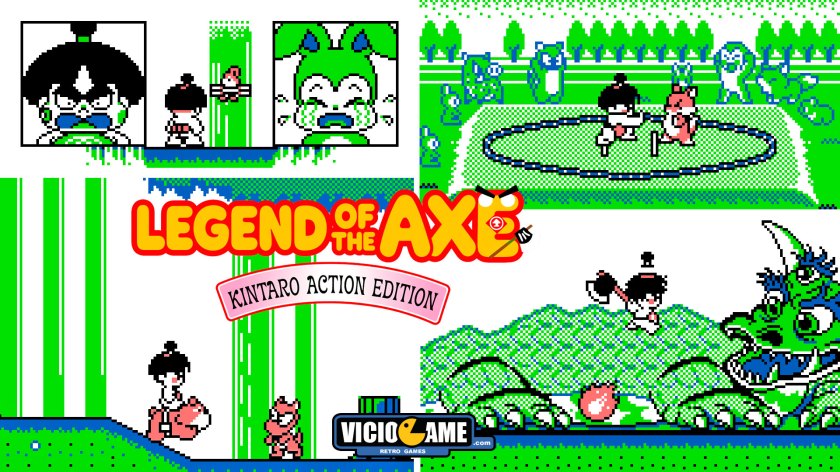
Masakari Densetsu: Kintarou Action-Hen is a platformer released in 1992 exclusively for the Game Boy. A young hero sets out to find his father, accompanied by his loyal bear companion. Beyond defeating enemies and taking part in sumo wrestling matches, the adventure unfolds through ancient Japanese tales and legends.
Developer: TOSE
Publisher: Tonkin House
Release Date: 1992
Platform: Nintendo Game Boy
🇺🇸 Masakari Densetsu: Kintarou Action-Hen (マサカリ伝説 金太郎アクション編) hit Japanese store shelves on August 7, 1992, exclusively for the Game Boy. The title can be loosely translated as something like “Axe Legend: Kintarou’s Action Chapter,” and the game’s protagonist is no original creation: he’s Kintarou, the Japanese folk hero that practically every child in the country instantly recognizes from the silhouette of the red-skinned boy riding a bear and wielding the broad axe that gives the game its name — the masakari. Despite the box carrying the Tonkin House seal, the cartridge was actually programmed by TOSE, a contract studio founded in Kyoto in 1979 that, over more than four decades, worked for practically the entire Japanese industry without ever building a recognizable brand of its own. Its name rarely appeared prominently on packaging, even though its résumé today totals more than 2,350 titles developed across arcade, home consoles, and, more recently, mobile devices. The game never left Japan and never received an official localization, remaining to this day one of the most obscure entries in the catalog of Nintendo’s monochrome handheld. Two years later, the Tonkin House/TOSE duo would return to the property with Masakari Densetsu: Kintarou RPG-Hen, also for Game Boy, closing out what became a small two-chapter franchise.
To understand the game’s choices, it’s worth revisiting who Kintarou is outside the screen. In Japanese oral tradition, he’s a child of superhuman strength raised in the mountains of Ashigara by a yamamba, a mountain witch, and in some versions conceived from the dream of a red dragon. As a young boy, Kintarou already wrestled sumo with bears and other forest animals and beat them with ease, and it’s precisely this image — the boy who subdues a bear through sheer strength and then rides on its back — that became the legend’s most enduring symbol, still reproduced today in commemorative dolls for Tango no Sekku, Boys’ Day, celebrated on May 5th. Growing up, Kintarou is discovered at the Ashigara mountain pass by the warrior Minamoto no Yorimitsu, who recognizes his strength and recruits him as a vassal, granting him the adult name Sakata Kintoki. Under that name, he becomes one of the four Shitennō, Yorimitsu’s legendary guardians, and takes part in the saga’s most famous episode: disguised as yamabushi, ascetic mountain monks, Yorimitsu and his four warriors infiltrate the lair of the oni chief Shuten Douji on Mount Ōe, get him drunk on drugged sake, and behead him in his sleep. It’s this whole arc — the wild childhood, the recruitment, the rise to warrior status, and the final confrontation with the great oni — that Masakari Densetsu: Kintarou Action-Hen freely borrows from and rearranges in its own way.
The game has no relation to Momotarou Densetsu, Hudson Soft’s far more famous RPG franchise. The confusion is understandable, since both titles follow the same naming formula, “[hero] Densetsu: [subtitle]-Hen,” applied to heroes equally central to the Japanese popular imagination. Kintarou’s adventure here begins with a much more specific, video-game-friendly goal than anything found in the original legend: finding his missing father. That’s the hook that pulls him out of the forest and drops him into a ten-stage journey that crosses paths with other figures from Japanese folklore who, strictly speaking, have nothing to do with Kintarou’s story. The moon princess Kaguya-hime, from “The Tale of the Bamboo Cutter,” shows up as a special guest appearance partway through the game, and everything suggests that Momotarou himself turns up later as another guest face — a meeting whose irony fans haven’t failed to notice: if the adventuring duo were Kintarou and his bear instead of Momotarou’s dog, monkey, and pheasant, the original quest would be solved a lot faster. Nor does the game stick to the legend’s chronology: it’s Kintarou himself, even before officially becoming Sakata Kintoki and entering Yorimitsu’s service, who faces and defeats the real Shuten Douji in the final showdown — a knowing, good-humored jump on a fate that, in tradition, wouldn’t have been his to claim for years yet.
This is a fairly straightforward action-platformer, split into ten consecutive stages. The masakari serves as the main short-range weapon, but it isn’t available from the start — it only becomes usable from the second stage on, and even then the script doesn’t pass up a cultural wink: along the way, Kintarou drops the axe in a spring, and a goddess appears to return it to him, a direct nod to Aesop’s fable of the honest woodcutter, which has nothing to do with Japanese folklore. As a secondary weapon, Kintarou can also throw logs of firewood at enemies; the logs pull double duty, since collecting a hundred of them grants an extra life, in the same spirit as the collectible coins found in so many other games of the era. Between the platforming sections, the game intersperses sumo minigames against forest animals. It’s by winning one of these bouts that Kintarou recruits his bear companion, who then accompanies him for the rest of the adventure — a direct and quite faithful translation of the legend’s most famous image into the language of an eight-bit action game. The axe itself also has an extra traversal function, used to hang from specific points in the environment and swing across gaps and drops in sequences that demand precise timing from the player, though an audio cue helps with the call. Onigiri serve as the healing item throughout the stages, especially useful in the underwater section, one of the adventure’s most demanding stretches. There’s no battery in the cartridge to save game progress, which points to a design meant to be beaten in a single sitting, a common practice among Game Boy action games of the early 1990s.
The boss roster is where the game’s personality shows through most, and also where the production’s little inside joke becomes clearest. Practically every boss in the game carries the suffix Douji (“child” or “young one,” a term traditionally associated with children as well as with certain yōkai and young oni, Shuten Douji himself included). The first one, Ookami Douji, a wolf-boy who simply unleashes ordinary wolves on the player, works as a tutorial disguised as a boss; shortly after, Wanioni Douji breaks any expectation of smooth progression by taking up so much space that it doesn’t even fit whole on the Game Boy screen, an impressive visual effect. Taketori Douji, a name that points directly to the tale of Kaguya-hime, is fought “whack-a-mole” style, with the player repeatedly striking an irritating face that pops up through holes in the scenery, in a sequence reminiscent of the fight against Lemmy Koopa in Super Mario World — except here all five heads are real, with none of them fake. Later on, Ningyo Douji, a mermaid boss, combines visual references ranging from the opening of a classic television anime to Botticelli’s “The Birth of Venus.” Near the end, the game reveals that Ooni Douji, one of the bosses already fought, had been posing as the legendary Shuten Douji for much of the adventure, and it’s this very impostor who threatens Rika, the character closest to a heroine in the plot, in a confrontation that precedes the final duel against the true Shuten Douji. Rika’s exact role in the story, however, is never fully clear: she’s a girl as enigmatic as she is under-explained, a reflection of a narrative that, overall, leans more on standalone events between stages than on any tightly stitched arc.
Tonkin House arrived at this project by a less-than-obvious path. The company began as an offshoot of the textbook publisher Tokyo Shoseki, debuting in the games market in 1986 with Keisan Game, a Famicom adaptation of the actual Japanese math textbook “Atarashii Sansuu,” used in Japanese schools. Only from 1989 onward did the Tonkin House name come into use as a brand. From then on, the publisher moved away from pure edutainment and toward commercial games: it commissioned development from Compile, one of the era’s most respected studios, and invested heavily in console conversions of Nihon Falcom’s biggest PC hits, such as Ys III and Ys IV: Mask of the Sun, along with Romancia, which earned it a certain prestige among the hardcore RPG crowd. The house also produced original works like the sci-fi RPG Cyber Knight and its sequel for Super Famicom. Masakari Densetsu: Kintarou Action-Hen occupies a far more modest corner of that catalog, alongside a wave of simple sports games (bowling, softball, boxing, and soccer) released for Game Boy under the same label — material aimed at a young, family audience that echoes, if only distantly, the company’s educational roots. Years later, well into the CD-ROM era of the PlayStation and Saturn, Tonkin House would shift toward a catalog dominated by visual novels, before shutting down its games operations for good in 2006.
Japanese publications tend to describe the game itself as middling and unambitious, though they’re careful to praise the sheer variety of ideas crammed into a single Game Boy cartridge: sumo wrestling, riding the bear, axe-swinging sections, a throwing item that doubles as extra-life currency, and a final sequence that gathers practically every previous boss into a boss rush before the duel with the real Shuten Douji. The title didn’t receive significant coverage in the specialty magazines of the day — nothing comparable, say, to the exposure Famitsu typically gave bigger releases — which fits the game’s profile: a modest bet aimed at a young audience within a much larger catalog.
The sequel arrived in 1994, also for Game Boy, under the name Masakari Densetsu: Kintarou RPG-Hen. There, Kintarou already appears as the adult warrior Kintoki, and the structure shifts from action to a straightforward turn-based RPG, keeping the cast and setting of the first game, including the bear, and once again culminating in a final confrontation with Shuten Douji. Anyone who plays one without knowing the other tends to get lost in references and callbacks that only make sense to those who followed Action-Hen; without that background, what’s left is a competent Japanese RPG, but one deliberately without much ambition to stand out within the genre.
There’s something singular about watching a legend with more than a thousand years on the road — told in woodblock prints, carved into festival dolls, sung in children’s songs — reduced to the very specific mechanical grammar of an early-1990s action game. Masakari Densetsu: Kintarou Action-Hen doesn’t try to revere its source material with solemnity; it would rather scramble it, compress it, and send its hero off to win battles that, in tradition, weren’t even his to win yet. It’s a modest but sincere portrait of how Japanese folklore could become raw material for children’s entertainment without asking anyone’s permission, and of how, between a thrown log and a swing of the axe, a piece of Ashigara’s mythology found its way onto the tiny monochrome screen of a handheld.
🇧🇷 Masakari Densetsu: Kintarou Action-Hen (マサカリ伝説 金太郎アクション編) chegou às lojas japonesas em 7 de agosto de 1992, exclusivamente para o Game Boy. O nome pode ser traduzido livremente como algo como “Lenda do Machado: Capítulo de Ação do Kintarou”, e o protagonista do título não é uma criação original: é Kintarou, o herói folclórico japonês que praticamente qualquer criança do país reconhece de imediato pela silhueta do garoto de pele avermelhada montado sobre um urso, empunhando o machado largo que dá nome ao jogo, o masakari. Apesar de a caixa trazer o selo da Tonkin House, quem efetivamente programou o cartucho foi a TOSE, um estúdio terceirizado fundado em Kyoto em 1979 que, ao longo de mais de quatro décadas, prestou serviço para praticamente toda a indústria japonesa sem nunca construir uma marca reconhecível por conta própria. Seu nome raramente aparecia em destaque nas embalagens, mesmo somando hoje um currículo de mais de 2.350 títulos desenvolvidos entre arcade, consoles domésticos e, mais recentemente, dispositivos móveis. O jogo nunca deixou o Japão e não recebeu localizações oficiais, permanecendo até hoje em um dos cantos mais obscuros do catálogo do portátil monocromático da Nintendo. Dois anos depois, a dupla Tonkin House/TOSE voltaria à propriedade com Masakari Densetsu: Kintarou RPG-Hen, também para Game Boy, fechando o que se tornou uma pequena franquia de dois capítulos.
Para entender as escolhas do jogo, vale relembrar quem é Kintarou fora das telas. Na tradição oral japonesa, ele é a criança de força sobre-humana criada nas montanhas de Ashigara por uma yamamba, uma bruxa das montanhas, sendo em algumas versões, concebido a partir do sonho de um dragão vermelho. Ainda menino, Kintarou já lutava sumô com ursos e outros animais da floresta e os vencia com facilidade, e é exatamente essa imagem, a do garoto que subjuga um urso pela força bruta e passa a andar montado nele, que se tornou o símbolo mais duradouro da lenda, reproduzido até hoje em bonecos comemorativos do Tango no Sekku, o dia do Menino celebrado em 5 de maio. Ao crescer, Kintarou é descoberto no passo de Ashigara pelo guerreiro Minamoto no Yorimitsu, que reconhece sua força e o recruta como vassalo, concedendo-lhe o nome adulto de Sakata Kintoki. Sob esse nome, ele se torna um dos quatro Shitennō, os lendários guardiões de Yorimitsu, e participa do episódio mais célebre de toda a saga: disfarçados de yamabushi, monges ascetas das montanhas, Yorimitsu e seus quatro guerreiros se infiltram no covil do chefe oni Shuten Douji no Monte Ōe, o embebedam com um saquê preparado com drogas e o decapitam enquanto ele dorme. É esse arco completo, passando pela infância selvagem, recrutamento, ascensão a guerreiro, e confronto final com o grande oni, que Masakari Densetsu: Kintarou Action-Hen pega emprestado e reorganiza à sua própria maneira de forma livre.
O jogo não tem qualquer relação com Momotarou Densetsu, a franquia de RPGs muito mais famosa da Hudson Soft. A confusão é compreensível, já que ambos os títulos seguem a mesma fórmula de nomenclatura, “[herói] Densetsu: [subtítulo]-Hen”, aplicada a heróis igualmente centrais no imaginário popular japonês. A aventura de Kintarou aqui começa com um objetivo bem mais pontual e videogamístico do que qualquer coisa presente na lenda original: encontrar o pai que desapareceu. É esse gancho que o tira da floresta e o joga em uma jornada por dez fases que cruza o caminho de outras figuras do folclore japonês que, a rigor, não têm nada a ver com a história de Kintarou. A princesa lunar, Kaguya-hime, de “O Conto do Cortador de Bambu”, aparece como uma participação especial no meio do jogo, e tudo indica que o próprio Momotarou surge mais adiante como outro rosto convidado, um encontro que os fãs não deixam de notar a ironia: se a dupla de aventureiros fosse Kintarou e seu urso em vez do cão, do macaco e do faisão de Momotarou, a missão original seria resolvida muito mais depressa. O jogo tampouco se prende à cronologia da lenda: é o próprio Kintarou, ainda antes de virar oficialmente Sakata Kintoki e de entrar a serviço de Yorimitsu, quem enfrenta e derrota o verdadeiro Shuten Douji no confronto final. Uma antecipação consciente e bem-humorada do destino que, na tradição, só caberia a ele anos mais tarde.
Trata-se de um jogo de plataforma de ação bastante direto, dividido em dez fases sucessivas. O masakari funciona como arma principal de curto alcance, mas não está disponível desde o início: só passa a ser utilizável a partir da segunda fase, e mesmo assim o roteiro não perde a chance de uma piscadela cultural. No caminho, Kintarou deixa cair o machado em uma fonte, e uma deusa surge para devolvê-lo, uma citação direta à fábula do lenhador honesto, de Esopo, que nada tem de folclore japonês. Como arma secundária, Kintarou também pode arremessar toras de lenha contra os inimigos; sendo que ela cumpre dupla função, já que juntar cem unidades concede uma vida extra, no mesmo espírito das moedas colecionáveis de tantos outros jogos de da época. Entre os trechos de plataforma, o jogo intercala minigames de sumô contra animais da floresta. É vencendo um dessas lutas que Kintarou recruta seu companheiro urso, e passa a acompanhá-lo pelo resto da aventura, uma tradução direta e bastante fiel da imagem mais famosa da lenda para a linguagem de um jogo de ação em oito bits. O próprio machado ainda tem uma função extra de deslocamento, usado para se pendurar em pontos específicos do cenário e balançar sobre vãos e precipícios em sequências que exigem timing preciso do jogador, embora um alerta sonoro ajude na decisão. Onigiri fazem o papel de item de cura ao longo das fases, especialmente úteis na seção subaquática, um dos trechos mais exigentes da aventura. Não há bateria no cartucho para salvar o progresso do jogo, o que demonstra um design pensado para ser vencido de uma sentada só, prática comum entre os jogos de ação do Game Boy do início dos anos 90.
A galeria de chefes é onde a personalidade do jogo mais aparece, e também onde fica mais evidente a pequena piada interna da produção. Praticamente todo chefe do jogo carrega o sufixo Douji (“criança” ou “jovem”, termo tradicionalmente associado tanto a crianças quanto a certos yōkai e oni jovens, o próprio Shuten Douji incluído). O primeiro deles, Ookami Douji, um garoto-lobo que apenas solta lobos comuns contra o jogador, funciona como um tutorial disfarçado de chefe; pouco depois, Wanioni Douji rompe qualquer expectativa de progressão suave ao ocupar um espaço tão grande que sequer cabe inteiro na tela do Game Boy, um efeito visual impressionante. Taketori Douji, nome que remete diretamente ao conto de Kaguya-hime, é enfrentado em um estilo “Caça à Toupeira”, com o jogador golpeando repetidamente um rosto irritante que aparece por entre buracos no cenário, em uma sequência que lembra a luta contra Lemmy Koopa em Super Mario World, com a diferença de que aqui todas as cinco cabeças são reais, sem nenhuma falsa. Mais adiante, Ningyo Douji, um chefe-sereia, combina referências visuais que vão da abertura de um anime clássico de televisão a “O Nascimento de Vênus” de Botticelli. Perto do fim, o jogo revela que Ooni Douji, um dos chefes já enfrentados, vinha se passando pelo lendário Shuten Douji durante boa parte da aventura, e é justamente esse impostor quem ameaça Rika, a personagem mais próxima de uma heroína na trama, num confronto que antecede o duelo final contra o Shuten Douji de verdade. O papel exato de Rika na história, porém, nunca fica totalmente claro: é uma garota tão enigmática quanto pouco explicada, reflexo de uma narrativa que, de resto, se apoia mais em eventos soltos entre fases do que em qualquer arco bem costurado.
A Tonkin House chegou a esse projeto por um caminho pouco óbvio. A empresa nasceu como um desdobramento da editora de livros didáticos Tokyo Shoseki, estreando no mercado de games em 1986 com Keisan Game, adaptação para Famicom do próprio livro escolar de matemática “Atarashii Sansuu”, usado nas escolas japonesas. Só a partir de 1989 o nome Tonkin House passou a ser usado como marca. Dali em diante, a editora foi se afastando do edutainment puro e apostando em jogos comerciais: encomendou desenvolvimento à Compile, um dos estúdios mais respeitados da época, e investiu pesado em conversões dos maiores sucessos de PC da Nihon Falcom, como Ys III e Ys IV: Mask of the Sun, além de Romancia, o que lhe rendeu certo prestígio entre o público mais hardcore de RPG. A casa também produziu obras originais como o RPG de ficção científica Cyber Knight e sua sequência para Super Famicom. Masakari Densetsu: Kintarou Action-Hen ocupa um canto bem mais modesto desse catálogo, ao lado de uma leva de jogos esportivos simples (como boliche, softbol, boxe, e futebol) lançados para Game Boy sob o mesmo selo, material voltado a um público infantil e familiar que ecoa, ainda que de longe, as raízes educacionais da empresa. Anos depois, já na era do CD-ROM do PlayStation e do Saturn, a Tonkin House migraria para um catálogo dominado por visual novel, até encerrar de vez as atividades no ramo de games em 2006.
As publicações japonesas costumam descrever o jogo em si como algo mediano e sem grandes ambições, ainda que façam questão de elogiar a variedade de ideias amontoadas num único cartucho de Game Boy: luta de sumô, montaria sobre o urso, trechos de balanço com o machado, um item de arremesso que também funciona como moeda de vida extra e uma sequência final que reúne, em boss rush, praticamente todos os chefes anteriores antes do duelo com o verdadeiro Shuten Douji. O título não recebeu uma cobertura relevante em revistas especializadas da época, nada que se compare, por exemplo, à exposição que a Famitsu costumava dar a lançamentos maiores, o que é coerente com o perfil do jogo: uma aposta modesta e voltada ao público infantil dentro de um catálogo bem mais amplo.
A sequência chegaria em 1994, também para Game Boy, sob o nome Masakari Densetsu: Kintarou RPG-Hen. Ali, Kintarou já aparece como o guerreiro adulto Kintoki, e a estrutura passa de ação para RPG de turno ortodoxo, mantendo o elenco e a ambientação do primeiro jogo, incluindo o urso, e culminando, mais uma vez, em um confronto final contra Shuten Douji. Quem joga um sem conhecer o outro tende a se perder em referências e reencontros que só fazem sentido para quem acompanhou o Action-Hen; sem essa bagagem, resta um RPG japonês competente, mas deliberadamente sem grandes ambições de se diferenciar dentro do gênero.
Há algo particular em ver uma lenda com mais de mil anos de estrada, contada em xilogravuras, esculpida em bonecos de festival, cantada em música infantil, reduzida à gramática mecânica bem específica de um jogo de ação do início dos anos 1990. Masakari Densetsu: Kintarou Action-Hen não tenta reverenciar o material de origem com solenidade; prefere embaralhá-lo, comprimi-lo, colocar o herói para vencer batalhas que, na tradição, ainda nem eram dele para vencer. É um retrato modesto, mas sincero, de como o folclore japonês podia virar matéria-prima de entretenimento infantil sem pedir licença a ninguém, e de como, entre um arremesso de lenha e um golpe de machado, um pedaço da mitologia de Ashigara encontrou seu caminho até a telinha monocromática de um portátil.
🤑💲Earn money without doing anything! Just leave these apps open:
  https://r.honeygain.me/CONTA9DB02

   https://packetstream.io/?psr=1uPb
⬛ 𝗧𝗶𝗸𝗧𝗼𝗸: https://www.tiktok.com/@viciogame
🟧 𝗜𝗻𝘀𝘁𝗮𝗴𝗿𝗮𝗺: http://www.instagram.com/viciogame
🟥 𝗬𝗼𝘂𝘁𝘂𝗯𝗲: http://www.youtube.com/viciogame
🟦 𝗙𝗮𝗰𝗲𝗯𝗼𝗼𝗸: http://www.facebook.com/viciogame
🔳 𝗧𝗵𝗿𝗲𝗮𝗱𝘀: https://www.threads.net/@viciogame
🟪 𝗧𝘄𝗶𝘁𝗰𝗵: https://www.twitch.tv/ViciogameRetroGames
🟨 𝗕𝗹𝗼𝗴: http://www.viciogameblog.com/
🟦𝗧𝘄𝗶𝘁𝘁𝗲𝗿: http://www.twitter.com/viciogame
#Viciogame #Gameplay #LetsPlay #Playthrough #Games #Gaming #Videogames #Review #Game #Detonado #Walkthrough #Ending #Reviews #Facts #Retro #RetroGaming #Roms #Emulator #longplay #Speedrun #NoCommentary #MasakariDensetsu #KintarouActionHen #GameBoy #Nintendo #DragonQuest #金太郎 #キンタロウ #マサカリ #伝説 #アクション編 #RPG #ゲームボーイ #任天堂 #SuperMarioWorld #Ys #Romancia

