
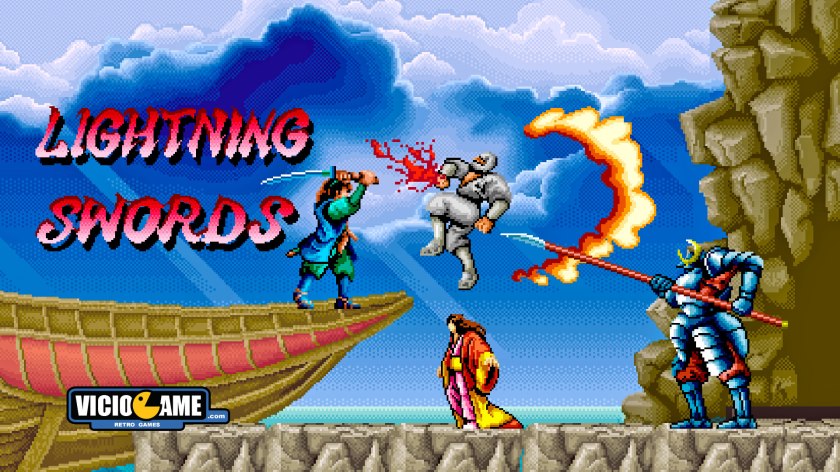
Lightning Swords, known in Japan as Ken-Go, is an action arcade game released in 1991. During a desperate flight through feudal Japan, a young princess is hunted down and brutally slain. The samurai Blue Dragon arrives just in time to witness it, but too late to save her, and sets out on a path of vengeance.
Developer: Nanao
Publisher: Irem
Release Date: 1991
Platform: Arcade Irem M-84 board
🇺🇸 In the arcades of the early ’90s, ninjas and samurai were a dime a dozen, but few games bet on an idea so simple and, at the same time, so contrary to the instincts of anyone standing at a cabinet: instead of mashing the attack button, Lightning Swords tells the player to hold it down and wait. That gesture of patience, with the blade charging up, sparking, and only then unleashed, is what defines the arcade game known in Japan as Ken-Go (剣豪, roughly “master swordsman”), a side-scrolling action game set in feudal Japan, released by Irem in 1991 and produced, in practice, by a team that rarely shows up in the credits. Forgotten for decades, the game now has something rare among the arcade games of its generation: anyone who wants to can still play it, and it remains as strange, dark, and charming as the day it left the factory.
To understand where that strangeness comes from, you have to look behind the scenes. Ken-Go carries the Irem brand, but it didn’t come from the same hands that created R-Type. It all starts in the late 1970s, when Irem, determined to move into game development in earnest, partnered with Nanao Denki, a maker of CRT monitors that supplied the screens for its cabinets. The partnership, both financial and practical, ended with Nanao taking control of the company and pushing out its founder, Kenzo Tsujimoto, who would go on to much greater success with Capcom. From the early ’80s until about a decade later, Nanao (today Eizo) kept three studios under its umbrella: Irem proper, which specialized in arcade games and above all shmups; Tamtex, responsible for most of the NES and Game Boy games; and an in-house software team that made arcade games at a far less frantic pace. Everything shipped under the Irem label, and Nanao’s name only slipped out in rare interviews and in the nicknames the team left in the end credits and high score tables. That was the team that made Kickle Cubicle, R-Type Leo, and this Ken-Go. Hiroya Kita, a.k.a. “Hirogon,” was the main designer behind the team’s best-known titles, and the same man who, years later, would direct R-Type Delta on the PlayStation.
The game’s birth date is a small puzzle. Irem’s records point to February 1991 for the Japanese release, but the soundtrack album was already on sale in Japan on December 15, 1990. The game’s name appears in a list of titles published in Comptiq that December, and Britain’s Your Sinclair covered it in its February 1991 issue. That’s because Ken-Go was already circulating at test locations and industry events before the official date. Outside Japan, the game was called Lightning Swords, and the adaptation was minimal: the text was already in English in the original, so only the title screen had to change. The international version began distribution in the United Kingdom, where at least two brief reviews ran in the press of the day, and there was no North American release.
The plot is one of revenge rather than rescue, and the opening feels like a more violent take on the intro to Double Dragon. A woman on the run collapses in front of a lone, withered tree; men armed with swords and spears catch up to her and cut her down. The hero, Blue Dragon, arrives in time to dodge a few shuriken, but not to save her: he kneels before the victim, Princess Orchid, and sets off after the killers. In co-op mode, the second player joins as Red Dragon, Blue Dragon’s brother. The ending text reveals that the two are avenging the massacre of their families, leaving behind the powerful swords Asura and Siva and vanishing into thin air; it then sets the story in the year 1600, with the evil army crushed, the civil war cooling down, and peace at hand, but warns that the decisive battle has yet to be fought. Anyone familiar with Japanese history will recognize 1600 as the year of Sekigahara, though the text never mentions it. What really intrigues is the final image, which seems to show the woman who died in the opening alive: a memory, a miracle, or just a scripting slip? The game doesn’t say.
The heart of Lightning Swords is a single button. Holding it makes the samurai raise his sword, build up energy, and protect himself at the same time: the charged blade deflects projectiles and blows. The longer the button is held, the farther and harder the attack flies when released, across up to five power levels. The logic of the genre is turned upside down: the quick slash, which any other game of the type would treat as the main attack, becomes a supporting player, useful for clearing out weak enemies or landing a few stray hits, while the real damage comes from a charged strike released at just the right moment. The result is a more defensive, methodical pace than is usual in side-scrolling arcade action, almost a dance of positioning and patience, in which every confrontation comes down to deciding whether you can charge a little longer, whether it’s time to block, or whether it’s smarter to fall back. Not by accident, it recalls the charge shot in R-Type, the house’s calling card.
Since the player spends much of the time with the button held down, jumping moves to the directional pad: just press up, as in a fighting game. It feels odd at first and takes some getting used to, but the game hardly demands platforming in the traditional sense, and the awkwardness fades. The jump serves to dodge, to reach ledges and steps from which you can attack with the advantage (and buy a few seconds to charge a bigger strike), and to fire projectiles into the faces of taller bosses. There’s also a super jump by bouncing off the left side of the screen, which is hard to pull off and rarely necessary, a landing attack by pressing down in midair, which proves useful, and the possibility, pointed out by players, of canceling the jump with the same input. Not everything works perfectly: blocking with the charged sword is unreliable in certain stretches, and later on comes an awkward moment in which the game expects the hero to mount a galloping horse to cross a burning floor.
Survival follows a more generous logic than the standard of the day: the hero can take four regular hits before losing a life, and there are items that raise maximum health, though only until the next death. Mid-bosses usually drop power-ups that strengthen the sword’s attack; other items heal wounds, add points, or extend the stage’s time limit. The timer, by the way, is represented by a row of golden orbs that gradually deteriorate, and the limit isn’t so tight that it forces you to rush, but it’s enough to discourage dawdling. Co-op mode also makes a difference: the second player can jump in at any time and, as with so many two-player arcade games, a reasonably skilled duo can breeze through the game.
There are only five short stages, and the game makes a point of not stretching them out. The setting alternates between sinister landscapes and Japanese castles, with one exception in a stretch where the hero boards a ship before crossing a cave. There are also ruined temples with a giant Buddha statue in the background, a mechanical castle complete with a steampunk tank, and a final stage that starts in a field at night, with lightning flashing in the distance. The enemies are mostly human (ninja, spearmen, kunoichi), but the bosses turn to magic: there’s a kunoichi who teleports, sorcerers who throw boomerangs or make stalactites come crashing down, and brutes who resemble the protagonist of Karnov and spit fire. Defeated bosses come back later as regular enemies, and the mid-bosses (spearmen, hunchbacks, and, according to players, even the twin-bladed swordsman who takes part in the opening massacre) serve as stamina tests between one showdown and the next. The last act swaps the pace for a boss rush and ends with a final boss whose second battle begins when something that looks like scenery reveals itself to be an enemy.
The difficulty is one of the most debated points. Nanao’s design philosophy was far more forgiving than that of Irem proper: no unfair stages, and with a little practice you can reach the end in just a few credits. Even so, at times the difficulty can feel uneven, with strangely empty stretches next to others where ninjas pour in nonstop, along with a slightly unfinished air, such as the fact that touching another sprite only causes knockback when the player is blocking, plus two mid-bosses that are hard to beat without taking cheap damage. Those who reach the end discover that the journey doesn’t stop there: beating the game unlocks a “Special Game,” a second loop with far more enemies, who soak up far more hits, and which holds the true ending, as had already happened in other Irem arcade games.
Visually, the Nanao team shows why its games tend to be more colorful than those of Irem proper. Even in Ken-Go, probably the darkest of them all, the palette of intense reds and blues is light-years away from the grays and rusty browns of R-Type, In the Hunt, or GunForce II. What impresses most are the skies, which layer clouds and rays of sunlight to create distinct moods and use dithering to simulate fog when filtered through the scanlines of a CRT monitor, a detail that feels almost like an inside joke at a company born from making monitors.
The soundtrack is the work of Takushi Hiyamuta (冷牟田卓志, a.k.a. “HIYA!”), who joined Irem in November 1989 and says he found the company without a single dedicated sound professional. He learned the hard way: Air Duel was his baptism by fire, with a deadline of about a month, and Ken-Go landed in his lap toward the end of production on Pound for Pound, with a new one-month deadline that in practice was the date of the location tests. Seeing the game for the first time, he was struck by how fluid the graphics were and decided to take on the challenge; since the production seemed to be built around a story, he composed the music to follow theme and narrative pacing, though he admits his expressiveness at the time wasn’t up to the task. He did everything alone, from music to sound effects to the digitized voice lines, which he recorded with his own voice, and midway through he was even called in to lend some music to Spartan X, the Game Boy version, until a second professional arrived to form a two-person sound team. The sound work was done quickly, and after that there was barely any time left for tweaks, because it was already time to move on to the next project.
The result blends Irem’s trademark funk with the instruments and tonalities of ancient Japan, squeezing everything it can out of the YM2151 chip and the DAC. The stage tracks have English titles (“Master Fencer” for the first, followed by “Crushed Rock,” “Wind Wave,” “Fire Blanket,” and “Lightning Group”), just two boss themes rotate among the five bosses, and the name entry screen gets a farewell theme, “Osaraba.” The Pony Canyon album shared a disc with the Pound for Pound soundtrack, was later reissued in the G.S.M. 1500 series along with a collection of the game’s voice lines, and the music also resurfaces on a compilation of Irem retro music. Critics are divided: Square Enix Music Online gave the album 5 out of 10, finding the Ken-Go score more distinctive and more extensive than the boxing game’s, but lacking the melodic hooks that would put it among the best samurai soundtracks of the era. The composer, for his part, would go on to work on Super R-Type, Undercover Cops, Gallop, and Metal Slug, according to the list of highlights he publishes himself.
The reception at the time was lukewarm. Your Sinclair, in its arcade column, compared the game to Strider, said it added nothing to the genre, and griped about bosses that take too many hits to go down. According to HG101, the author of the British reviews seems not to have even realized that you had to charge your attacks, and so dismissed the game as boring. In Japan, Game Machine included Ken-Go in its Best Hit Games list, with a score of 5.53 out of 10. It also didn’t help that the game arrived just as Street Fighter II was beginning to redraw the arcade world.
Over time, the game’s reputation split into very distinct camps. Retro Gamer included Ken-Go in its “The Unconverted” section and called it a mediocre run-and-gun that starts well but soon settles into recycled enemies, frustrating bosses, and tiresome level design. HG101, in 2019, prefers to sum it up as a fun, short, no-frills game that wants an identity of its own and gets one. Sega-16 admitted that it lacks the fluidity and polish of The Revenge of Shinobi, but reasoned that, with colorful graphics, a varied soundtrack, and interesting bosses, it wasn’t a bad way to spend a handful of quarters, and lamented that the game never made it to the Genesis, where it would have fit right in. MobyGames goes further and declares that the game simply has no flaws. Not even the genre is a matter of consensus: between hack and slash, beat ‘em up, run-and-gun, and action platformer, each write-up files Lightning Swords in a different box, and when it reported on the game, Co-Optimus even brought up The Ninja Warriors.
Once the arcade era passed, Lightning Swords went without a home for a long time. Like most of Irem’s arcade games in the ’90s, it never got a console or computer conversion, and it was left off the Irem Arcade Hits compilation, released for PC and Mac between 2010 and 2011. The side exception is the Super Retro-Cade, Retro-Bit’s plug-and-play console announced in December 2017 with more than 90 games from Capcom, Data East, Technos, and Irem, whose list includes Ken-Go alongside Ninja Spirit, Kickle Cubicle, and Mr. Heli, though Seafoam Gaming describes that version as a victim of poor emulation. The big moment came in 2022, when Blaze Entertainment announced, on May 31, the Irem Arcade 1 cartridge for the Evercade, with six games: R-Type, Moon Patrol, Mr. Heli (also called Battle Chopper), In the Hunt, 10-Yard Fight, and Lightning Swords, the latter billed as its first official home release. The cartridge arrived at the end of that year and came as a bonus in the standard Evercade EXP bundle. Time Extension praised the collection, highlighting R-Type and In the Hunt as the main attractions and the official home debut of Lightning Swords as a bonus that sweetens the package even more. Seafoam Gaming, which gave the set an 8 out of 10, goes further: it calls Lightning Swords one of the best hidden gems of Irem’s arcade catalog, says it’s probably the game that most justifies buying the cartridge, praises the faithful emulation, music included, and only laments the lack of cabinet customization options. The cartridge runs on the entire Evercade family, and it’s through this official route that the game remains accessible to anyone who wants to wield the swords of Blue Dragon and Red Dragon today.
The cycle of the team that made Ken-Go closed quickly. In 1994, the original Irem left the video game business; with Superior Soldiers marking the company’s turning point, it scaled back its arcade output and saw several employees leave to found Nazca Corporation, the house behind Metal Slug. Around 1997, a new company, Irem Software Engineering, brought together former members of the old Irem and Nanao. It’s a quiet ending for a team that left behind a small collection of colorful, peculiar arcade games.
At the end of the day, Lightning Swords is a game about waiting for the right moment, and maybe that’s why it feels so curious in an era when every arcade game demanded reflexes and speed: it asked for calm, timing, and a certain cool head, and it still does. It doesn’t have the prestige of R-Type, or the polish of the great sword-fighting classics, and it stumbles here and there in its own design, but there’s personality in every blood-red sky, in every track of funk-samurai flavor, in every charge held to the limit before the blade lets loose its lightning. It’s one of those games you come to understand gradually: first you find it strange, then you hesitate, then you hold the button a little longer, and when you let go, you realize you waited exactly as long as you needed to. For anyone who wants to get to know a lesser-talked-about side of Irem’s catalog, it’s worth a credit.
🇧🇷 Nos salões de fliperama do começo dos anos 90, ninjas e samurais eram figurinha fácil, mas poucos jogos apostaram numa ideia tão simples e, ao mesmo tempo, tão contrária ao instinto de quem senta diante de um gabinete: em vez de martelar o botão de ataque, Lightning Swords manda o jogador segurá-lo e esperar. É esse gesto de paciência, com a lâmina que se carrega, faísca e só então é liberada, que define o arcade conhecido no Japão como Ken-Go (剣豪, algo como “mestre espadachim”), um jogo de ação com rolagem lateral ambientado no Japão feudal, lançado pela Irem em 1991 e produzido, na prática, por uma equipe que raramente aparece nos créditos. Esquecido por décadas, o jogo tem hoje algo raro entre os fliperamas da sua geração: ainda pode ser jogado por quem quiser, e continua tão estranho, sombrio e charmoso quanto era ao sair de fábrica.
Para entender de onde vem essa esquisitice, é preciso olhar os bastidores. Ken-Go leva a marca da Irem, mas não saiu das mesmas mãos que criaram R-Type. Tudo começa no fim de 1970, quando a Irem, decidida a entrar de vez no desenvolvimento de jogos, se associou à Nanao Denki, fabricante de monitores CRT que fornecia as telas dos gabinetes. A parceria, financeira e prática, terminou com a Nanao assumindo o controle da empresa e afastando seu fundador, Kenzo Tsujimoto, que anos depois teria muito mais sucesso com a Capcom. Do início dos anos 80 até cerca de uma década mais tarde, a Nanao (hoje Eizo) manteve sob seu guarda-chuva três estúdios: a Irem propriamente dita, especializada em arcades e principalmente em shmups; a Tamtex, responsável pela maior parte dos jogos de NES e Game Boy; e uma equipe interna de software que fazia arcades em ritmo bem menos frenético. Tudo saía com o selo da Irem, e o nome da Nanao só escapava em raras entrevistas e nos apelidos que a equipe deixava nos créditos finais e nas tabelas de high score. Foi esse time que fez Kickle Cubicle, R-Type Leo e este Ken-Go. Hiroya Kita, o “Hirogon”, foi o principal designer por trás dos títulos conhecidos da equipe, o mesmo que, anos depois, dirigiria R-Type Delta no PlayStation.
A data de nascimento do jogo é um pequeno quebra-cabeça. Registros da Irem apontam fevereiro de 1991 para o lançamento japonês, mas o álbum com a trilha sonora já estava à venda no Japão em 15 de dezembro de 1990. O nome do jogo aparece numa lista de títulos publicada pela revista Comptiq em dezembro daquele ano e a britânica Your Sinclair o comentava na edição de fevereiro de 1991. Isso porque Ken-Go já circulava em locais de testes e em eventos do setor, antes mesmo da data oficial. Fora do Japão, o jogo ganhou o nome Lightning Swords, e a adaptação foi mínima: os textos já estavam em inglês no original, de modo que só a tela de título precisou mudar. A versão internacional começou a distribuição pelo Reino Unido, onde saíram pelo menos duas resenhas rápidas na imprensa da época, e não houve lançamento na América do Norte.
A trama é de vingança, e não de resgate, e a abertura lembra uma versão mais violenta da introdução de Double Dragon. Uma mulher em fuga desaba diante de uma árvore seca e solitária; homens armados com espadas e lanças a alcançam e a abatem. O herói, Blue Dragon, chega a tempo de desviar algumas shuriken, mas não de salvá-la: ajoelha-se diante da vítima, a Princess Orchid, e parte atrás dos assassinos. No modo cooperativo, o segundo jogador entra como Red Dragon, irmão de Blue Dragon. O texto do final revela que os dois vingam o massacre de suas famílias, deixam para trás as poderosas espadas Asura e Siva e somem no ar; em seguida, situa a história no ano de 1600, com o exército maligno esmagado, a guerra civil esfriando e a paz por perto, mas avisa que a batalha decisiva ainda não foi travada. Quem conhece a história japonesa lembra que 1600 é o ano de Sekigahara, embora o texto não a mencione. O que realmente intriga é a última imagem, que parece mostrar viva a mulher morta na abertura: uma lembrança, um milagre ou apenas um descuido de roteiro? O jogo não responde.
O coração de Lightning Swords é um único botão. Segurá-lo faz o samurai erguer a espada, acumular energia e, ao mesmo tempo, se proteger: a lâmina em estado de carga desvia projéteis e golpes. Quanto mais tempo o botão fica pressionado, mais longe e mais forte sai o ataque quando ele é solto, em até cinco níveis de potência. A lógica do gênero se inverte: o talho rápido, que qualquer outro jogo do estilo trataria como ataque principal, vira coadjuvante, útil para limpar inimigos fracos ou encaixar alguns golpes soltos, enquanto o dano de verdade vem da carga liberada no instante certo. O resultado é um ritmo mais defensivo e metódico do que o normal nos arcades de ação lateral, quase uma dança de posicionamento e paciência, em que cada confronto se resume a decidir se dá para carregar mais um pouco, se é hora de bloquear ou se convém recuar. Não por acaso, lembra o charge shot de R-Type, o grande cartão de visitas da casa.
Como o jogador passa boa parte do tempo com o botão pressionado, o pulo migra para o direcional: basta apertar para cima, como num jogo de luta. É estranho no começo, e requer um período de adaptação, mas o jogo quase não exige plataforma no sentido tradicional, e o incômodo diminui. O salto serve para esquivar, para alcançar bordas e degraus de onde se ataca com vantagem (e se ganha alguns segundos para carregar um golpe maior) e para lançar projéteis no rosto de chefes mais altos. Há ainda um super salto ao quicar na lateral esquerda da tela, difícil de executar e raramente necessário, um golpe de aterrissagem ao apertar para baixo no ar, que se mostra útil, e a possibilidade, apontada por jogadores, de cancelar o pulo com o mesmo comando. Nem tudo funciona com perfeição: pois o bloqueio com a espada carregada é pouco confiável em certos trechos, e mais adiante surge um momento desajeitado, em que o jogo espera que o herói monte num cavalo em disparada para atravessar um chão em chamas.
A sobrevivência segue uma lógica mais generosa do que o padrão da época: o herói aguenta quatro golpes comuns antes de perder uma vida, e há itens que aumentam a vitalidade máxima, embora só até a próxima morte. Os mid-bosses costumam largar power-ups que reforçam o ataque da espada; outros itens curam ferimentos, somam pontos ou acrescentam tempo ao limite da fase. O cronômetro, aliás, é representado por uma fileira de esferas douradas que vão se deteriorando, e o limite não é tão apertado a ponto de forçar a corrida, mas basta para desencorajar a enrolação. O modo cooperativo também faz diferença: o segundo jogador pode entrar a qualquer momento e, como acontece em tantos arcades para dois, uma dupla razoavelmente habilidosa consegue dominar o jogo com folga.
São só cinco fases curtas, e o jogo faz questão de não esticá-las. A ambientação se divide entre paisagens sinistras e castelos japoneses, com uma exceção de um trecho em que o herói embarca num navio antes de atravessar uma caverna. Há ainda templos em ruínas com uma estátua gigante de Buda ao fundo, de um castelo mecânico com direito a tanque steampunk e de uma fase final que começa num campo à noite, com relâmpagos ao longe. Os inimigos são majoritariamente humanos (ninjas, lanceiros, kunoichi), mas os chefes recorrem à magia: há uma kunoichi que se teletransporta, feiticeiros que atiram bumerangues ou fazem estalactites despencarem e brutamontes que lembram o protagonista de Karnov e cospem fogo. Chefes derrotados voltam depois como inimigos comuns, e os mid-bosses (lanceiros, corcundas e, segundo jogadores, até o espadachim de duas lâminas que participa do massacre da abertura) funcionam como testes de fôlego entre um confronto e outro. O último ato troca o ritmo por um boss rush e termina em um chefão final cuja segunda batalha começa quando algo que parece cenário se revela um inimigo.
A dificuldade é um dos pontos mais debatidos. A filosofia de design da Nanao era bem mais indulgente do que a da Irem propriamente dita: nada de fases injustas, e com alguma prática dá para chegar ao fim em poucos créditos. No entanto, em alguns momento a dificuldade pode parecer desigual, com trechos estranhamente vazios ao lado de outros em que os ninjas surgem sem parar, incluindo um ar levemente inacabado, como o fato de encostar em outro sprite só produzir knockback quando o jogador está bloqueando, além de dois mid-bosses difíceis de vencer sem tomar dano injusto. Quem chega ao fim descobre que a jornada não termina ali: completar o jogo libera um “Special Game”, um segundo loop com bem mais inimigos, que aguentam bem mais golpes, e que guarda o final verdadeiro, como já acontecia em outros arcades da Irem.
Visualmente, a equipe da Nanao mostra por que seus jogos costumam ser mais coloridos do que os da Irem propriamente dita. Mesmo em Ken-Go, provavelmente o mais sombrio de todos, a paleta de vermelhos e azuis intensos está a anos-luz dos cinzas e marrons enferrujados de R-Type, In the Hunt ou GunForce II. O que mais impressiona são os céus, que sobrepõem camadas de nuvens e raios de sol para criar climas distintos e recorrem a dithering para simular neblina quando filtrados pelas scanlines de um monitor CRT, um detalhe que soa quase como piada interna numa empresa nascida da fabricação de monitores.
A trilha é obra de Takushi Hiyamuta (冷牟田卓志, o “HIYA!”), que entrou na Irem em novembro de 1989, e conta que encontrou a empresa sem nenhum profissional de som dedicado. Aprendeu na marra: Air Duel foi seu batismo, com cerca de um mês de prazo, e Ken-Go chegou às suas mãos no fim da produção de Pound for Pound, com um novo prazo de um mês, que na prática era a data dos testes localizados. Ao ver o jogo pela primeira vez, ficou impressionado com a fluidez dos gráficos e decidiu encarar o desafio; como a produção parecia pensada em torno de uma história, montou as músicas acompanhando tema e andamento narrativo, embora reconheça que sua expressividade da época não deu conta do recado. Fez tudo sozinho, entre músicas, efeitos e até as falas digitalizadas, que gravou com a própria voz, e no meio do processo ainda foi convocado para emprestar músicas a Spartan X, versão de Game Boy, até que um segundo profissional chegou para formar uma equipe de som de dois integrantes. O som era feiro rapidamente, e depois disso quase não sobrava tempo para ajustes, porque já era hora de partir para o próximo projeto.
O resultado funde o funk característico da Irem com instrumentos e tonalidades do Japão antigo, extraindo o que dá do chip YM2151 e do DAC. As faixas das fases têm títulos em inglês (“Master Fencer” na primeira, seguida de “Crushed Rock”, “Wind Wave”, “Fire Blanket” e “Lightning Group”), apenas duas músicas de chefe se revezam entre os cinco chefões e a tela de entrada de nome ganha um tema de despedida, “Osaraba”. O álbum da Pony Canyon dividia o disco com a trilha de Pound for Pound, foi reeditado mais tarde na série G.S.M. 1500, com uma coleção das falas do jogo, e a música também reaparece numa coletânea de música retrô da Irem. A crítica se divide: o Square Enix Music Online deu 5 em 10 ao álbum, achando a trilha de Ken-Go mais singular e extensa do que a do jogo de boxe, mas sem os ganchos melódicos que a colocariam entre as melhores trilhas samurais da época. O compositor, por sua vez, seguiria para Super R-Type, Undercover Cops, Gallop e Metal Slug, segundo a lista de trabalhos de destaque que ele mesmo publica.
A recepção da época foi morna. A Your Sinclair, na coluna de fliperamas, comparou o jogo a Strider, disse que ele não acrescentava nada ao gênero e reclamou de chefes que exigem golpes demais para cair. Segundo o HG101, o autor das resenhas britânicas parece nem ter percebido que era preciso carregar os ataques, e por isso descartou o jogo como tedioso. No Japão, a Game Machine incluiu Ken-Go em sua lista Best Hit Games, com nota 5,53 numa escala de 10. Não ajudava, também, o fato de o jogo chegar num momento em que Street Fighter II começava a redesenhar o mundo dos fliperamas.
Com o tempo, a reputação se dividiu em campos bem distintos. A Retro Gamer incluiu Ken-Go em sua seção The Unconverted e o definiu como um run-and-gun mediano, que começa bem mas logo se acomoda em inimigos reciclados, chefes frustrantes e um level design cansativo. O HG101, em 2019, prefere resumi-lo como um jogo divertido, curto e sem firulas, que quer ter identidade própria e consegue. A Sega-16 admitiu que ele não tem a fluidez nem o polimento de The Revenge of Shinobi, mas ponderou que, com gráficos coloridos, trilha variada e chefes interessantes, não era um mau jeito de gastar um punhado de fichas, e lamentou que o jogo nunca tenha ido para o Mega Drive, onde teria caído bem. A MobyGames vai mais longe e declara que o jogo simplesmente não tem defeitos. Nem o gênero é consenso: entre hack and slash, beat ‘em up, run-and-gun e action platformer, cada texto encaixa Lightning Swords numa caixinha diferente, e ao noticiar o jogo o Co-Optimus chegou a lembrar The Ninja Warriors.
Passada a era dos fliperamas, Lightning Swords ficou sem casa por muito tempo. Como a maioria dos arcades da Irem nos anos 90, nunca ganhou conversão para console ou computador, e ficou de fora da coletânea Irem Arcade Hits, lançada para PC e Mac entre 2010 e 2011. A exceção lateral é o Super Retro-Cade, console plug and play da Retro-Bit anunciado em dezembro de 2017 com mais de 90 jogos de Capcom, Data East, Technos e Irem, cuja lista inclui Ken-Go ao lado de Ninja Spirit, Kickle Cubicle e Mr. Heli, embora a Seafoam Gaming descreva essa versão como vítima de emulação ruim. O grande momento veio em 2022, quando a Blaze Entertainment anunciou, em 31 de maio, o cartucho Irem Arcade 1 para o Evercade, com seis jogos: R-Type, Moon Patrol, Mr. Heli (também chamado de Battle Chopper), In the Hunt, 10-Yard Fight e Lightning Swords, este apresentado como o primeiro lançamento doméstico oficial. O cartucho chegou no fim daquele ano e vinha de brinde no pacote padrão do Evercade EXP. O Time Extension elogiou a coletânea, destacando R-Type e In the Hunt como as grandes atrações e a estreia doméstica oficial de Lightning Swords como um bônus que adoça ainda mais o pacote. A Seafoam Gaming, que deu 8 em 10 ao conjunto, vai além: chama Lightning Swords de uma das melhores joias escondidas da Irem nos arcades, diz que ele provavelmente é o jogo que mais justifica a compra do cartucho, elogia a emulação fiel, inclusive da música, e só lamenta a ausência de opções de personalização da máquina. O cartucho roda em toda a família Evercade, e é por essa via oficial que o jogo continua acessível a quem quiser empunhar as espadas de Blue Dragon e Red Dragon hoje.
O ciclo da equipe que fez Ken-Go se fechou depressa. Em 1994, a Irem original deixou o negócio de videogames; tendo Superior Soldiers como a virada da empresa, que reduziu sua produção de arcades e viu vários funcionários saírem para fundar a Nazca Corporation, a casa por trás de Metal Slug. Por volta de 1997, uma nova companhia, a Irem Software Engineering, reuniu ex-integrantes da antiga Irem e da Nanao. É um desfecho discreto para um time que deixou um pequeno conjunto de arcades coloridos e peculiares.
No fim das contas, Lightning Swords é um jogo sobre esperar o momento certo, e talvez por isso soe tão curioso numa era em que todo fliperama pedia reflexo e pressa: ele pedia calma, timing e um certo sangue-frio, e ainda pede. Não tem o prestígio de R-Type, nem o polimento dos grandes clássicos de espada, e tropeça aqui e ali no próprio desenho, mas há personalidade em cada céu tingido de vermelho, em cada faixa de sotaque funk-samurai, em cada carga levada até o limite antes de a lâmina soltar seu raio. É um daqueles jogos que a gente entende aos poucos: primeiro estranha, depois hesita, depois segura o botão um pouquinho mais e, quando solta, percebe que esperou exatamente o tempo necessário. Para quem quer conhecer um lado menos falado do catálogo da Irem, vale o crédito.
🤑💲Earn money without doing anything! Just leave these apps open:
  https://r.honeygain.me/CONTA9DB02

   https://packetstream.io/?psr=1uPb
⬛ 𝗧𝗶𝗸𝗧𝗼𝗸: https://www.tiktok.com/@viciogame
🟧 𝗜𝗻𝘀𝘁𝗮𝗴𝗿𝗮𝗺: http://www.instagram.com/viciogame
🟥 𝗬𝗼𝘂𝘁𝘂𝗯𝗲: http://www.youtube.com/viciogame
🟦 𝗙𝗮𝗰𝗲𝗯𝗼𝗼𝗸: http://www.facebook.com/viciogame
🔳 𝗧𝗵𝗿𝗲𝗮𝗱𝘀: https://www.threads.net/@viciogame
🟪 𝗧𝘄𝗶𝘁𝗰𝗵: https://www.twitch.tv/ViciogameRetroGames
🟨 𝗕𝗹𝗼𝗴: http://www.viciogameblog.com/
🟦𝗧𝘄𝗶𝘁𝘁𝗲𝗿: http://www.twitter.com/viciogame
#Viciogame #Gameplay #LetsPlay #Playthrough #Games #Gaming #Videogames #Review #Game #Detonado #Walkthrough #Ending #Reviews #Facts #Retro #RetroGaming #Roms #Emulator #Longplay #Speedrun #NoCommentary #LightningSwords #KenGo #Arcade #剣豪 #Ninja #Samurai #Shinobi #Irem #Rtype #忍者 #にんじゃ #さむらい #しのび

