
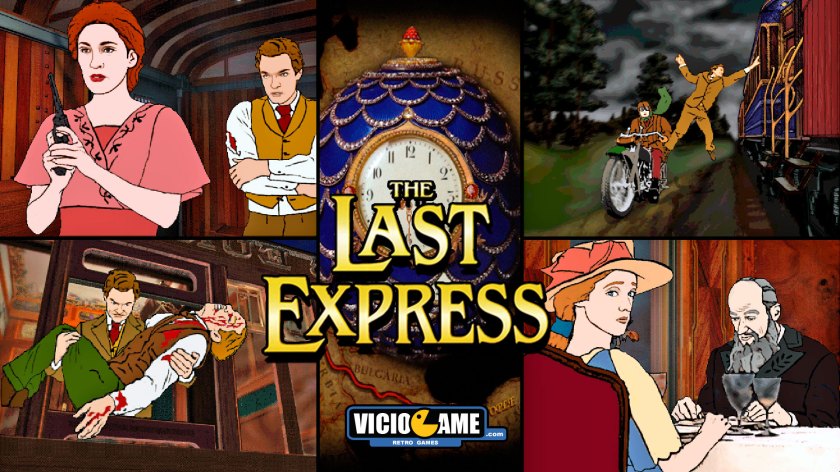
The Last Express is a point-and-click adventure game released for PC in 1997. Robert Cath boards the legendary Orient Express only to find his friend already dead. To avoid becoming a suspect, he assumes his friend’s identity, which pulls him into a complex plot of murder, political intrigue, and conspiracy on the eve of World War I.
Developer: Smoking Car Productions
Publisher: Phoenix Licensing
Release date: 1997
Platform: PC MS-DOS
🇺🇸 It is 7:12 p.m. on Friday, July 24, 1914, and the Orient Express is getting ready to leave the Gare de l’Est in Paris, bound for Constantinople. It is the most luxurious train in Europe: cars of teak and mahogany, sleeper sofas upholstered in gold-tooled leather, frosted glass and brass fittings at the height of Art Nouveau. Outside, the continent is living its last days of peace. The day before, the Austro-Hungarian Empire delivered an ultimatum to Serbia that was written to be rejected, and the chancelleries of London, Berlin, St. Petersburg and Paris are trading telegrams about alliances that no one knows how to defuse anymore. It is aboard this train, which carries aristocrats, industrialists, spies, artists and revolutionaries, that a young American doctor boards in a most unorthodox way: leaping from a motorcycle onto the rear platform of a sleeping car, with the train already in motion. His name is Robert Cath, and that is how The Last Express begins, the point-and-click adventure created by Jordan Mechner, the father of Prince of Persia, and released in 1997 by Brøderbund.
Almost three decades later, The Last Express remains one of those rare critical darlings that the public ignored. Praised by the press when it came out, awarded for its story and remembered with devotion by those who played it, it sold very little, vanished from stores within months and took the studio that made it down with it. Even so, it never died: it is still on sale in digital stores for computers and phones, and anyone who boards today will find that its most remarkable tricks still have no direct equivalent: time that keeps running on its own, characters who live their own lives, conversations in languages the player may not understand, and a clock capable of turning back time. Here we will look at how this train was built, what makes it so singular and why it has never stopped being remembered, even after its commercial failure.
To understand how a project of this size came about, we have to go back to the story of Jordan Mechner. Born in New York in 1964, he had his first professional contact with the industry in 1982, when he sent Brøderbund a copy of Deathbounce, an Asteroids imitation that Doug Carlston, the company’s co-founder, found dated, and which earned him, in return, a borrowed joystick and a copy of Choplifter, the first game Mechner had seen that was not an arcade copy. Inspired by the example, he dropped the project and wrote Karateka, which Brøderbund published in 1984, while he was still studying at Yale. Obsessed with making characters move like real people, he filmed his father and his mother’s karate teacher with a Super 8 camera to animate the fighter in Karateka; for Prince of Persia (1989), he recorded his brother David, then 15, running and jumping in a school parking lot and transferred the footage, frame by frame, to the Apple II. This method, rotoscoping, gave the prince a fluidity that almost no game of the era had, helped the title pass two million copies and led to a sequel, Prince of Persia 2: The Shadow and the Flame (1993), which Mechner followed from a distance: in 1992, at 28, with fame and plenty of money, he had moved to Paris looking for time away from games.
The break did not last long. In the summer of 1992, Mechner shot the 16 mm short film Waiting for Dark in Cuba, which won awards at festivals, and began flirting with cinema. The person who pulled him back was Tomi Pierce, an old friend from the days of Brøderbund’s “authors’ loft,” the windowless space the company reserved for outside developers, where she ran a small educational software firm. Over the phone and without mincing words, she told him his life was a pretentious and pathetic mess and gave him, as a gift, the first line of a story: a wartime spy taking the night train to Berlin. Mechner accepted the train and rejected World War II, territory that was too well trodden. The summer of 1914, when the dominoes fell one by one before a society that did not realize what was coming, seemed infinitely more interesting. Curiously, the future author of one of the most celebrated adventures of the 1990s even confessed at the time that he did not like adventure games: he found the existing ones stuck with fixed plots and arbitrary puzzles, and was convinced he could do better.
The choice of the train made historical sense. In 1914, the Orient Express, the first luxury train to link Paris to Constantinople, passing through Strasbourg, Munich, Vienna, Budapest and Belgrade, was the symbol of integration and financial interdependence among the European nations, something like the European Economic Community of its day, and it ran straight through the countries that were about to go to war. In its cars, diplomats, artists, potentates from the East and industrialists mingled in the smoking lounge, making it a cross-section of the continent’s society: nationalities, classes and political factions that would soon find themselves on opposite sides, confined in a closed, moving space, with a finite cast and a clock ticking against everyone, the classic recipe for a mystery. For a story about the end of a world, it was the ideal setting.
In December 1992, on a visit to Brøderbund’s headquarters, Mechner pitched “the train game” to Doug Carlston. Excited, he talked about a work of art, the first adventure whose story and visuals could stand on their own merits, and he already imagined an entire line of games with the same interface. Carlston was cordial but cautious: Brøderbund would publish the result, but it would not produce it or bear the entire cost. Mechner would have to fend for himself as an independent developer, under a standard outsourcing contract, and he financed part of the venture with his Prince of Persia royalties. On January 7, 1993, he moved into an apartment in San Francisco and, five days later, opened the bank account of Smoking Car Productions, a name that alludes to the train’s smoking lounge, the social epicenter of prewar Europe, where intellectuals, aristocrats and anarchists drank and smoked side by side. The studio occupied two floors above an antiques shop in Jackson Square, one of the oldest areas of the city, a setting that producer Mark Netter saw as tailor-made for an Art Nouveau game set in 1914.
In terms of design, two references weighed heavily. The first was Myst: Mechner, who was watching the arrival of the Miller brothers’ game from inside Brøderbund, was fascinated by the immersion of its first-person, pre-rendered 3D environments, and in August 1993 he flew to Spokane to spend a few days with the Cyan team and learn how it was done; the manual’s credits thank Rand and Robyn Miller. The second was Deadline, the Infocom classic mystery in which the residents of a mansion move and act on their own, without waiting for the detective. Mechner wanted to combine the two: a rich, navigable 3D world like Myst‘s, populated by people with their own agendas as in Deadline, and with the depth of characters and plot that cinema allowed and that the games he had made for the Apple II, because of hardware limitations, could never have supported.
If the project had a watchword, it was authenticity, and it came at a high price. After an initial writing phase that stretched until March 1993, the team spent a month in France trying to find out everything about the 1914 train. The archives of the Compagnie Internationale des Wagons-Lits from that period, they were told, had been destroyed. A classified ad in a French railway magazine changed the course of the story: the response came from a club of retired railwaymen who kept precisely what the company had thrown away. In a dimly lit office beneath the Gare de l’Est, two very elderly gentlemen opened piles of boxes for the Americans, full of floor plans, July 1914 menus, passenger lists and even the conductors’ rulebook; in the station’s basement, they also showed them a giant model railway, kept under continuous construction for decades purely for pleasure. Mechner realized then that he was dealing with information on the verge of disappearing and, when the programmers suggested simplifying the corridors, which in the original plans curve at the ends, he refused. That stubbornness, in his own words, added two years to the project.
The hunt for the cars was the second part of the obsession. Of the 1914 fleet, researchers managed to locate only two examples: a dining car turned into an attraction in Budapest and, thanks to a postcard from a stranger, the Italian enthusiast Alessandro Bellenda, a sleeping car abandoned in a railyard in Athens, in terrible condition, which Mechner and 3D art director Patrick Ladislav combed through over two days of stifling heat. They documented everything (the painted ceiling, the bunk mechanism, the embossed leather on the walls, the carpet pattern and so on), and lead 3D artist Donald Grahame took hundreds of measurements so that the interior could be rebuilt on the computer with blueprint-level precision. According to the producers, there was even a chance of buying the Athens car, but the freight to the United States killed the idea. The result is so meticulous that the manual thanks museums and railway associations in France, Hungary and Greece, among them the Musée Français du Chemin de Fer in Mulhouse, the Közlekedési Múzeum in Budapest and the Hellenic Railways Organization in Athens, and states that the railway company’s name and monogram appear with the permission of Wagons-Lits itself.
The script was born under the same discipline. Mechner and Pierce started from a linear 119-page screenplay, which served as the bible in the first months, until they arrived at a complete script of more than 800 pages, needed to handle about thirty characters, each with a personal biography, secrets and an agenda to carry out during the journey. All of them are aboard for a reason, represent something of the change of era and, in their own minds, are the heroes of their own stories. That is why there is no classic villain, only clashing interests in the cauldron of a train. Mechner explains that the First World War resists the hero-versus-villain scheme: the more he read about it, the more he realized the conflict had been a mistake for everyone. When it came to references, the duo admits to having stolen from everything: the films “Casablanca,” “The Maltese Falcon,” “The Third Man” and “The Lady Vanishes”; the European comics of Hugo Pratt, François Schuiten and Enki Bilal; Russian fairy tales; the novel “The Birds Fall Down” by Rebecca West, in which an anarchist tries to kill an old Russian count, something the relationship between Alexei and Count Vassili seems to echo; and W. B. Yeats’s poem “The Second Coming,” with its falcon turning in ever-widening circles, which gave Pierce the idea of the Firebird, an object also inspired by the automatons and Fabergé eggs that fascinated the 19th century.
The technical heart of the game is the decision that time waits for no one. The clock runs in real time, accelerated by a factor of six, and each character has their own script, written in a language the team created just for this purpose: August Schmidt, for example, goes to dinner at a certain time, smokes in the lounge at another and, if he does not cross paths with the player, ends up knocking on the player’s door. Everything happens with or without Cath around. According to programmer Mark Moran, just up to the arrival in Vienna there are seven distinct paths, three of which let you move forward and four of which end with the protagonist off the train, dead or even “victorious” ahead of time, because the characters decide based on what Cath has done, where he is and what he is doing at that moment. Netter sums up the system as a very complex series of artificial intelligence. The practical effect is that listening to a conversation in the dining car means missing another in the lounge, and that a second playthrough can reveal entire dialogues that the first never showed.
A game like this needed an escape valve, and it takes the form of a jewel: the Egg, a Fabergé-style clock-egg that serves as menu, pause and time machine. There is no save command: progress is recorded automatically and, at any moment, the player can go back to the egg to rewind the clock, with a click on the red jewel on the left, or fast-forward again, on the one on the right, up to the point where they left off, never beyond it. The game marks return points every five to fifteen minutes and at key moments of the plot, and the city buttons on the route map allow long jumps: clicking Paris sends everything back to the beginning. On entering a rewound game, the player gets a grace period of 15 to 30 seconds, signaled by a blinking egg in the corner of the screen, to decide whether they really want to change the past; when the time runs out with a hiss of steam, the change becomes permanent, unless the player extends it, indefinitely, with the right mouse button. Up to six games coexist at the same time, each identified by an egg of a different color: blue, red, green, purple, teal and gold.
When Cath dies, is arrested or is thrown off the train, the entire screen fades to white, sometimes followed by a brief narration, and the game rewinds on its own to the last point at which it was still possible to change the outcome. The logic, as explained by its creators, is to eliminate the silent dead end, the famous “walking dead” of adventure games, in which the player wanders through a game that can no longer be won without realizing it: since the train never stops moving and the plot advances without waiting, an apparently hopeless situation does not last long. Those who prefer can rewind on their own to another moment, or fast-forward to the instant the game ended to see the ending again. Events rarely repeat in the same way, and when the player feels stuck, the best thing to do is go back and redo part of the journey: a clue or a missed opportunity may show up the second time.
Visually, The Last Express is unmistakable. At a time when adventure games were stacking digitized actors over 3D backdrops, so-called full motion video (FMV), the team chose to film real people and turn the footage into drawings: ink lines and flat colors that recall Toulouse-Lautrec and the Art Nouveau of period posters, the same style that decorated the train itself. In practice, scenes were shot on 16 mm film against a blue screen, transferred to video, stripped of color, run through a program that generated black-and-white drawings and then painted by hand, frame by frame, by artists trained for the job, with custom-made tools. The initial idea was to automate the painting, but the computer could not handle it. The process, led by art director Nicole Tostevin, was patented, and the result adds up to 40,000 frames of animation. The obsession with detail goes so far that the handwriting on the documents had a chief calligrapher, Dan Kern, and the sketchbook of conductor Coudert, full of portraits of the passengers, had an artist all to itself, James Courtney.
Filming took place in San Francisco. There was a one-day test in October 1993 and, in September 1994, the main shoot, with 18 days on set and one more day to photograph train models; Mechner directed, Mark Netter produced and Andrew B. Andersen handled the cinematography. There was no set, only a blue wall and the actors’ imagination, dressed on purpose in flamboyant costumes, such as coats half purple and half orange, wigs that highlighted the curls and so on, so that the computer could distinguish the edges of fabrics and strands of hair. As Mechner recalls, it is not easy to convince yourself that you are an elegant lady on a luxury train in 1914 while wearing what looks like a clown suit. The method was, in his words, the opposite of dubbing: the voices were recorded first, pencil storyboards were edited over the audio, the filming was done without sound, the assembly was cut on an Avid and only then were the key frames chosen and animated to match the lines. Because of the demand for authentic accents, most roles had two performers, one in front of the camera and one at the microphone; only four of the main characters, Kronos, August Schmidt, Abbot and Alexei, did both. Anna Wolff, for example, has the body of actress Dunja Djordjevic and the voice of Ingeborg Weinmann; Robert Cath has the body of David Svensson and the voice of C.W. Morgan. Max the husky was played by a dog named Kodiak, and Mechner himself and Robert Cook, the technical director, appear as the porters Porter Eins and Porter Zwei. Part of the dialogue was only written after the footage had been seen, and the scene in which Schmidt tells Abbot how his father had a modest business grew out of the actors’ improvisation on set.
The voice sessions took place at American Zoetrope, Francis Ford Coppola’s studio, a block from the team’s office, which gave rise to the anecdote that Coppola himself once called and was mistakenly answered by the producer, and to the technicians at the studio insisting on offering helicopter sounds. The score is by Elia Cmiral, a composer born in what was then Czechoslovakia who, shortly afterward, would write the music for the films “Ronin” and “Stigmata.” Synthesizers predominate, with occasional violin solos, and the score was recorded at Forte Muzika Studios in Los Angeles; the exception is César Franck’s Sonata for Violin and Piano, which accompanies the concert scene and whose recording the manual credits to Josef Suk. The 39-minute album was released by Intrada Records in 2000 and is now out of print, but since 2011 it has come as a free download with the digital versions sold by DotEmu and GOG. Critics at the time highlighted both the music and the fidelity of the sounds of the most famous train in the world.
Behind the screen, production became a marathon. In October 1994, the team had 15 people; in December, 28; in July 1995, about 50, spread across four offices and working 70 hours a week. At its peak, the studio reached 60 full-time employees. In 1996, the operation ran 24 hours a day, with people sharing computers in shifts. The 3D department created thousands of train interiors, the programmers built the animation tools, the sound system and the game’s structure, and the artists processed the endless frames. The team missed the first three delivery deadlines; since cash advances depended on those milestones, salaries were cut in half and tension rose. Scheduled to last two years and cost US$1 million, the project took four years and cost a little over US$5 million. The beta version, finally playable from start to finish, only reached Brøderbund a year late and after the 1996 Christmas season had been lost; over three months, testers logged more than five thousand bugs, all of them fixed. In February 1997, the game was ready. The heavy routine had its reliefs: marshmallow wars at four in the morning on a Sunday night and a group of programmers who juggled (one of them kept six balls in the air) to the point that Netter learned the craft in order to be able to talk to them. There is even an Easter egg in which the conductor takes off his own head and juggles it.
The interface dispenses with the keyboard: everything is done with the mouse and with cursors that change shape to indicate what is possible: arrows to move forward, back, turn or do an about-face; a hand to pick up an object or open a door; a magnifying glass to look closely; and a speech bubble to start a conversation. In the corridor, a double click automatically takes you to the next car, and the right button skips animations you have already seen. The inventory opens by clicking and holding Cath’s portrait in the upper left corner and dragging to the desired item; some objects, like the Firebird, are too big for him and have to be set down somewhere on the train before the protagonist’s hands are free again. When an item can be offered to someone, the cursor itself turns into the object’s icon. Cath starts with only two objects, a telegram from Tyler and a newspaper clipping, and one of the most valuable tools is with the conductor Mertens: the passenger list, which matches names to compartments and, with each click on a name, plays a short excerpt of the protagonist’s conversations with that person, a discreet clue for anyone who feels lost. The general advice is to pick up everything that can be picked up, take advantage of the fact that the conductor cannot watch the player all the time, visit different parts of the train at different times and, when everyone falls asleep in the small hours, do the same: sleeping also moves the clock forward.
Listening is as important as acting. Besides native English, Robert Cath understands French, Russian and German, and whenever the player gets close enough to a conversation in one of those languages, English subtitles appear; Arabic, Turkish and Serbo-Croatian, which Cath does not understand, are left without subtitles, and those who speak those languages realize that these dialogues make perfect sense as well. There are seven languages in all, something extremely rare in a game of that era, and if a conversation is too quiet, you have to move closer. The philosophy behind this is as follows: this is not the kind of game in which a scrap of paper or a phrase overheard by chance holds a password you will need two hours later; much of what is read and heard exists to deepen characters and story. Mechner sums up the idea with a classic rule of dramaturgy, according to which the gun hanging on the wall in the first act must go off in the last: in an ordinary adventure game, if you hear someone mention a birth date you should write it down, because it might be a safe combination, and The Last Express breaks that rule on purpose. In the creators’ intent, a player who gets distracted by a conversation or the newspaper and misses other events is not punished for it: they simply live a different journey.
The game also has its moments of brawling, half a dozen fights in which Cath has to dodge punches by clicking on the lower half of the screen and strike back by clicking on the opponent, and that is where its weakest point lies: the controls are clumsy and the response is slow. The team itself left an out for those who hate them: aborting the fight five times in a row, with the right button, makes Cath carry on as if he had won. The closest the adventure comes to a traditional puzzle is the opening of the Firebird, a mechanical egg in the shape of a globe whose five-jewel sequence depends on deciphering a poem, translated by Tatiana, that refers to the Russian tale of Prince Ivan, the Firebird and the Gray Wolf. Everything else consists of situational challenges, inseparable from the story: hiding Tyler’s body, escaping from the police, finding out why a famous Austrian violinist seems to want to kill him.
Robert Cath is a 29-year-old American doctor, sidelined from practice in the United States for his unorthodox methods and his interest in ancient and esoteric forms of medicine, who lives discreetly in Paris and who, on top of that, is wanted by the police over a murder in Belfast. His old college friend Tyler Whitney, a wealthy idealist and the son of Southern landowners, who traded his inheritance for the Wobblies labor movement, the Zapatista revolt in Mexico and, finally, the Serbian cause in the Balkan Wars, summons him by telegram to board the Orient Express. Cath arrives in a hurry and finds Tyler dead in the compartment. Unable to attract the attention of the authorities, he disposes of the body, swaps coats with his friend and begins passing himself off as him. The question the game poses, then, is not only who killed Tyler, but what Tyler was plotting: he was brokering the sale of weapons from the German industrialist August Schmidt to the Black Hand, the Serbian organization, and would pay the bill with the gold of the mysterious Kronos, to whom he intended to sell the Firebird, a Serbian national treasure, a mechanical egg that opens into a metal bird and sings when activated by a scarab-shaped whistle. Only the Firebird has vanished from the dead man’s luggage.
Those who cross Cath’s path form a human portrait of the Europe of 1914. August Schmidt, a German industrialist of humble origins who built an empire in metallurgy and armaments, follows politics closely and expects prosperous times; he enjoys fine food and is sensitive to beauty in all its forms. Anna Wolff, a concert violinist and daughter of an Austro-Hungarian military commander, uses her fame as a passport to the continent’s most influential circles and never travels without Max, her Siberian husky. Count Vassili Obolensky, a former advisor to two tsars, a fervent monarchist, a despotic aristocrat in fragile health, has affection only for his granddaughter, Tatiana Obolenskaya, 16, an excellent chess player, who is returning from a boarding school in Paris to a probable arranged marriage and still harbors a childhood love for Alexei Dolnikov, the son of a neighboring aristocratic family who became an anarchist in London and renounced his own inheritance. Milos Jovanovic, a young Serbian commander, charismatic and self-taught, a veteran of the Balkan Wars and a friend of Tyler, travels with Vesna Savin, Ivo Biskupovic and Salko Popivoda, irregular soldiers loyal to him who would rather be in the hills than on a luxury train.
In the rest of the train, Kronos, an art collector of obscure North African origin, owner of a colossal fortune, a private army and a fortress in the Pyrenees, travels in his luxurious private car, the Saturn, accompanied by Kahina, his secretary and bodyguard, the last of an ancient tribe of Matabele warriors, defeated and driven out of southern Africa, who owes her life to him and speaks English, French and Ndebele. George Abbot, a British commercial agent, boards in Munich without appearing on the passenger list; behind the chatty, overly curious manner there is a sharp mind and a strange familiarity with other people’s lives. The Boutarel family, the engineer and geologist Claude, who works for the Anglo-Persian Oil Company at the first refinery in Abadan, the practical Madame Boutarel and the precocious seven-year-old François, a fanatic for insects and experiments, share the train with the friends Sophie de Bretheuil, bohemian and spoiled, and Rebecca Norton, an Englishwoman on her first adventure abroad, who keeps a diary and will one day be a famous journalist. There are also Mahmud, the Persian eunuch in charge of escorting a harem of four women (Fatima, Yasmin, Hadidja and Alouan) to Cairo, the conductors Coudert, born in Algeria and a few months from retirement, and Mertens, who owes his post to his uncle, Trainmaster Verges, plus a staff of waiters, cooks and porters.
The plot fans out, at a pace of suspense, tension and constant mystery. Cath realizes that Anna knows he is not Tyler and suspects she knows the secret of his friend’s death; he is interrupted by the nervous collapse of old Count Vassili, which forces him to act as a doctor; he sees George Abbot board in Munich; he discovers that the Firebird’s whistle is in the hands of little François; and he is probed by Kronos, who soon notices the identity swap and grows suspicious of Tyler’s supposed friend, while Kahina sniffs through the cars. This is only the introductory act, and from there on the story unfolds in an incredible way, with shocking and unexpected plots, extremely well planned by the production.
The game closes with a map of Europe showing, in time-lapse, the borders changing between 1914 and 1994. There are about thirty losing endings, four outcomes in which Cath survives and only one considered the true ending, the one the player reaches only by putting the right pieces together over the entire journey. Some are deliciously ironic: in one, Anna stops the train in time and Cath ends up decorated as a hero; in another, Kronos leaves with the Firebird and Cath keeps the gold. The creators themselves speak of an ending capable of breaking your heart a little. That does not make the game a maze of choices: for Mechner, what is essential is the illusion of consequence, not visible branching. The player must feel they are truly on a train, able to open any door and follow whoever passes, and yet always be in the same story, so that, on reaching the end, they feel that this was how it was meant to end.
Real history is not decorative background but the game’s yardstick. The unfolding of the crisis arrives through the newspapers in the dining car lounge, which carry different news each day, and through the passengers’ conversations, such as the argument between the conductors Coudert, a convinced socialist, and Mertens, who leans toward nationalism. The passenger list holds names that real history removed from the journey: the French pacifist leader Jean Jaurès, who canceled his trip to Vienna to call a rally against the war and would be assassinated in Paris a week later, and the Serbian field marshal Putnik, who took an earlier train and was arrested and released in Budapest. Even the weather obeys: on the second day of the game, Saturday, July 25, it rains, because it really did rain over much of Europe, a decision that, the developers admit, was a pain to program. For Mechner, the Great War is, in the image of historian Barbara Tuchman, a strip of scorched earth between that world and ours, and the game treats this border with humility: no one there can stop it.
The release, in April 1997, was the opposite of what the team had hoped for. The three CDs, one for each day of the journey, with a behind-the-scenes video as a bonus, reached stores at a terrible moment: Brøderbund’s entire marketing team had resigned shortly before, and the company, busy with restructurings and with Riven, the Myst sequel that would fill the year-end calendar, barely ran a campaign. Smoking Car fended for itself: Tomi Pierce landed a four-page feature in Newsweek, and the game got space in outlets like USA Today and MSNBC, rare attention for a game at the time. It was not enough. Worldwide distribution had been split between Brøderbund and GameBank, the games arm of SoftBank, which soon left the business, shut down the subsidiary and canceled dozens of projects, among them an almost finished PlayStation version of The Last Express; in 1998, Brøderbund itself was absorbed by The Learning Company, which concentrated the catalog on educational software. Within weeks, the game disappeared from shelves: according to Netter, by the summer of 1997 it could no longer be bought. It reached about 100,000 copies sold by 2000, something like a million units short of the break-even point by Moran’s estimate, and Smoking Car Productions quietly closed its doors.
Critics, however, were warm. Computer Gaming World gave it 4.5 out of 5 and ranked it, in its year-end retrospective, as the best mystery of 1997; the American PC Gamer awarded it 90%; Next Generation, 4 out of 5; GameSpot, which only reviewed it in 2000 and gave it 7.9 out of 10, had named it best story and runner-up for best ending in 1997, behind Fallout. In the best-adventure-of-the-year lists, it was runner-up at Computer Gaming World, CNET Gamecenter and GameSpot, which gave the crown to The Curse of Monkey Island and Dark Earth; the creators, for their part, say the game was voted adventure of the year by major newspapers and magazines such as PC Gamer. The British edition of PC Gamer was much colder, at 58%, and the reservations recur in the reviews: the real time that at times forces you to rewatch scenes and at others to wait; the first-person navigation, which some compare to a slideshow; the interface and puzzles, too conventional for some critics; and, above all, the fights. But the praise dominated: the period setting, the complex and unpredictable plot, the unique look, the music, the performances and the authentic accents; many critics admitted to getting glued to other people’s conversations just to follow the subplots, with the impression of truly being on board.
Over time, its reputation only grew. In 2000, Computer Games Strategy Plus included it among the ten essential graphic adventures and lamented that a game that should have pointed to a new future for interactive fiction had sold so little that it practically bankrupted the company and sent the industry the message that the public did not want this; the same year, Bruce Geryk of GameSpot suggested that its failure could be seen, in a sense, as the beginning of the end of the genre. The 2010 book “1001 Video Games You Must Play Before You Die” includes it, and in 2011 the site Adventure Gamers ranked it seventh among the best adventure games of all time.
After the failure, Mechner returned to the series that had made his name in Prince of Persia: The Sands of Time (2003), a huge worldwide success whose central mechanic (rewinding time) has the Egg as a recognized ancestor: Netter himself points to the clock-egg as the inspiration for that idea. In film, Mechner began writing screenplays; between 2010 and 2011, he developed with Dutch director Paul Verhoeven an adaptation of The Last Express, something between the Hitchcockian suspense of “The Lady Vanishes” and Indiana Jones-style adventure, in Verhoeven’s description, which never got off the page; the screenplay is published on the author’s website, with a warning that many characters and subplots from the game were left out. Tomi Pierce, who gave the project as much as the name on the box, died in 2010, and Mechner paid tribute to her. The behind-the-scenes story continues to be told by the author himself: every Wednesday he posts his journals from the period on his website, exactly thirty years late, and episodes from the creation of Karateka, Prince of Persia and The Last Express are in the autobiographical graphic novel “Replay: Memoir of an Uprooted Family,” released in France in 2023 and later in English.
The game’s commercial ups and downs after the fiasco would make for another article. In 2000, Interplay re-released it at a reduced price. The crisis that soon hit Interplay took the title out of the catalog again, and in 2006 the GameTap service began offering it. In January 2011, DotEmu released a Collector’s Edition, with soundtrack, making-of and walkthrough, and GOG began selling the original version again, in English only. Mechner managed to regain the rights and, with DotEmu, prepared the ports for iOS, in September 2012, and Android, in August 2013; in November 2013, The Last Express Gold Edition arrived on Steam, with an improved interface and inventory, a hint system, achievements and cloud saves, followed in March 2015 by the macOS version. The game also had localized editions in French, German, Spanish, Italian and Japanese, and an unofficial Russian translation circulated as well.
Today, The Last Express is on sale on Steam; on GOG, which since February 2026 has also offered the Gold edition alongside the original version; and in the Apple and Google app stores, with the iOS version’s description citing more than 20 hours of gameplay. Current editions include English, French, German, Italian and Spanish. The train’s vitality also shows outside the stores: in February 2026, Chicago Gamespace included the game in a public session of the exhibition “The Plot Thickens: Storytelling in Gaming,” and Mechner himself says his favorite way to play it today is with headphones on a plane or, better yet, on a train.
In the end, what The Last Express offers is a rare sensation in video games: that of being just another passenger. No one there is waiting for the hero. The train moves, people talk, argue, sleep, confess, lie, and the story (grand, indifferent, inevitable) arrives in Constantinople with or without the player. Perhaps that is why the game remains so alive in the memory of those who played it: it does not promise to save the world, it only lets you hear, for a few hours, the noise of an entire era on its way to the abyss. In 1997, the market did not know what to do with that. Today, it is hard not to recognize that boarding this train remains one of the most singular journeys a game has ever offered.
🇧🇷 São 19h12 de sexta-feira, 24 de julho de 1914, e o Orient Express se prepara para deixar a Gare de l’Est, em Paris, rumo a Constantinopla. É a composição mais luxuosa da Europa: vagões de teca e mogno, sofás-cama forrados de couro lavrado a ouro, vidros foscos e detalhes de latão no auge do Art Nouveau. Lá fora, o continente vive seus últimos dias de paz. No dia anterior, o Império Austro-Húngaro entregou à Sérvia um ultimato redigido para ser recusado, e as chancelarias de Londres, Berlim, São Petersburgo e Paris trocam telegramas sobre alianças que ninguém mais sabe como desarmar. É nesse trem, onde circulam aristocratas, industriais, espiões, artistas e revolucionários, que um jovem médico americano embarca de maneira nada ortodoxa: saltando de uma motocicleta para a plataforma traseira de um vagão-leito, com a composição já em movimento. Seu nome é Robert Cath, e assim começa The Last Express, o adventure point and cilck criado por Jordan Mechner, o pai de Prince of Persia, e lançado em 1997 pela Broderbund.
Quase três décadas depois, The Last Express segue como uma daquelas raras unanimidades da crítica que o público ignorou. Elogiado pela imprensa na época do lançamento, premiado por sua história e lembrado com devoção por quem o jogou, vendeu muito pouco, sumiu das lojas em questão de meses e levou consigo o estúdio que o criou. Mesmo assim, não morreu: continua à venda em lojas digitais para computadores e celulares, e quem embarca hoje descobre que seus truques mais incríveis ainda não encontraram equivalente direto: um tempo que corre sozinho, personagens que vivem a própria vida, diálogos em línguas que o jogador talvez não entenda, e um relógio capaz de voltar no tempo. Aqui veremos como esse trem foi construído, o que o torna tão singular e por que ele nunca deixou de ser lembrado, mesmo depois do fracasso comercial.
Para entender como um projeto desse tamanho nasceu, é preciso voltar à história de Jordan Mechner. Nascido em Nova York em 1964, ele teve seu primeiro contato profissional com a indústria em 1982, quando mandou à Brøderbund uma cópia de Deathbounce, imitação de Asteroids que Doug Carlston, cofundador da empresa, achou antiquada, e que lhe rendeu, de volta, um joystick emprestado e um exemplar de Choplifter, o primeiro jogo que Mechner via sem ser cópia de fliperama. Despertado pelo exemplo, largou o projeto e escreveu Karateka, que a Brøderbund publicou em 1984, quando ele ainda estudava em Yale. Obcecado em fazer personagens se moverem como gente de verdade, filmou o pai e o professor de caratê da mãe com uma câmera Super 8 para animar o lutador de Karateka; para Prince of Persia (1989), gravou o irmão David, então com 15 anos, correndo e saltando no estacionamento da escola e passou as imagens, quadro a quadro, para o Apple II. Esse método, a rotoscopia, deu ao príncipe uma fluidez que quase nenhum jogo da época tinha, ajudou o título a passar dos dois milhões de cópias e rendeu uma sequência, Prince of Persia 2: The Shadow and the Flame (1993), que Mechner acompanhou à distância: em 1992, aos 28 anos, com fama e dinheiro de sobra, ele havia se mudado para Paris em busca de um tempo longe dos jogos.
A pausa durou pouco. No verão de 1992, Mechner rodou em Cuba o curta em 16 mm Waiting for Dark, premiado em festivais, e passou a flertar com o cinema. Quem o puxou de volta foi Tomi Pierce, velha amiga dos tempos do “sótão dos autores” da Brøderbund, o espaço sem janelas que a empresa reservava aos desenvolvedores externos e onde ela mantinha uma pequena firma de software educativo. Por telefone e sem rodeios, ela lhe disse que sua vida era um desastre pretensioso e patético e lhe deu de presente a primeira frase de uma história: um espião de guerra tomando o trem noturno para Berlim. Mechner aceitou o trem e recusou a Segunda Guerra, território batido demais. O verão de 1914, quando as peças do dominó caíam uma a uma diante de uma sociedade que não percebia o que vinha pela frente, parecia infinitamente mais interessante. Curiosamente, o futuro autor de uma das aventuras mais celebradas dos anos 1990 chegou a confessar, na época, que nem gostava de jogos do estilo adventure: achava os que existiam presos a enredos fixos e puzzles arbitrários, e estava convencido de que podia fazer melhor.
A escolha do trem tinha lógica histórica. Em 1914, o Orient Express, o primeiro trem de luxo a ligar Paris a Constantinopla, passando por Estrasburgo, Munique, Viena, Budapeste e Belgrado, era o símbolo da integração e da interdependência financeira entre as nações europeias, algo como a Comunidade Econômica Europeia da época, e cortava justamente os países que estavam prestes a entrar em guerra. Em seus carros, diplomatas, artistas, potentados do Oriente e industriais se misturavam no salão de fumantes, o que fazia dele uma seção transversal da sociedade do continente: nacionalidades, classes e facções políticas que logo se veriam em campos opostos, confinadas num espaço fechado e em movimento, com elenco finito e um relógio correndo contra todos, a receita clássica de um mistério. Para uma história sobre o fim de um mundo, era o cenário ideal.
Em dezembro de 1992, numa visita à sede da Brøderbund, Mechner apresentou “o jogo do trem” a Doug Carlston. Empolgado, falava em uma obra de arte, na primeira aventura cuja história e cujo visual se sustentassem por mérito próprio, e já imaginava uma linha inteira de jogos com a mesma interface. Carlston foi cordial, mas cauteloso: a Brøderbund publicaria o resultado, mas não o produziria nem arcaria com todo o custo. Mechner teria de se virar como desenvolvedor independente, sob um contrato de terceirização comum, e financiou parte da empreitada com os royalties de Prince of Persia. Em 7 de janeiro de 1993, mudou-se para um apartamento em San Francisco e, cinco dias depois, abriu a conta bancária da Smoking Car Productions, nome que alude ao salão de fumantes do trem, o epicentro social da Europa pré-guerra, onde intelectuais, aristocratas e anarquistas bebiam e fumavam lado a lado. O estúdio ocupava dois andares acima de uma loja de antiguidades, no Jackson Square, uma das áreas mais antigas da cidade, cenário que o produtor Mark Netter via como talhado para fazer um jogo Art Nouveau passado em 1914.
Em termos de design, duas referências pesaram. A primeira foi Myst: Mechner, que acompanhava de dentro da Brøderbund a chegada do jogo dos irmãos Miller, ficou fascinado com a imersão de seus ambientes em primeira pessoa, pré-renderizados em 3D, e voou em agosto de 1993 até Spokane para passar alguns dias com a equipe da Cyan e aprender como aquilo se fazia, os créditos do manual agradecem a Rand e Robyn Miller. A segunda foi Deadline, o clássico mistério da Infocom em que os moradores de uma mansão se movem e agem por conta própria, sem esperar pelo detetive. Mechner queria juntar as duas coisas: um mundo 3D rico e navegável como o de Myst, povoado por gente com agenda própria como a de Deadline, e com a profundidade de personagens e de enredo que o cinema permitia e que os jogos que ele fizera para o Apple II, por limitação de hardware, jamais comportariam.
Se o projeto teve uma palavra de ordem, foi autenticidade, e ela custou caro. Depois de uma fase inicial de escrita que se estendeu até março de 1993, a equipe passou um mês na França tentando descobrir tudo sobre o trem de 1914. Os arquivos da Compagnie Internationale des Wagons-Lits daquele período, disseram-lhes, tinham sido destruídos. Um anúncio classificado numa revista ferroviária francesa mudou o rumo da história: quem ligou foi um clube de ferroviários aposentados que guardava justamente o que a empresa jogara fora. Num escritório mal iluminado sob a Gare de l’Est, dois senhores muito idosos abriram para os americanos pilhas de caixas com plantas baixas, cardápios de julho de 1914, listas de passageiros e até o regulamento dos condutores; no subsolo da estação, ainda mostraram uma maquete ferroviária gigantesca, mantida em construção contínua havia décadas só por prazer. Mechner percebeu ali que lidava com informações prestes a desaparecer e, quando os programadores sugeriram simplificar os corredores, que nas plantas originais fazem uma curva nas pontas, ele recusou. A teimosia, nas palavras dele, acrescentou dois anos ao projeto.
A caça aos vagões foi a segunda parte da obsessão. Da frota de 1914, os pesquisadores só conseguiram localizar dois exemplares: um vagão-restaurante transformado em atração em Budapeste e, graças ao cartão-postal de um desconhecido italiano, o entusiasta Alessandro Bellenda, um vagão-leito abandonado num pátio ferroviário de Atenas, em péssimo estado, que Mechner e o diretor de arte 3D, Patrick Ladislav, vasculharam durante dois dias de calor sufocante. Documentaram tudo (o teto pintado, o mecanismo dos beliches, o couro estampado das paredes, o desenho do carpete etc) e o artista 3D principal, Donald Grahame, tirou centenas de medidas para que o interior fosse reconstruído no computador com precisão de planta. Segundo os produtores, havia até a possibilidade de comprar o carro de Atenas, mas o frete até os Estados Unidos enterrava a ideia. O resultado é tão minucioso que o manual agradece a museus e associações ferroviárias da França, da Hungria e da Grécia, entre eles o Musée Français du Chemin de Fer, de Mulhouse, o Közlekedési Múzeum, de Budapeste, e a Hellenic Railways Organization, de Atenas, e informa que o nome e o monograma da empresa ferroviária aparecem com autorização da própria Wagons-Lits.
O roteiro nasceu sob a mesma disciplina. Mechner e Pierce partiram de um roteiro linear de 119 páginas, que serviu de bíblia nos primeiros meses, até chegarem a um script completo com mais de 800 páginas, necessárias para dar conta de cerca de trinta personagens, cada um com biografia própria, segredos e uma agenda a cumprir durante a viagem. Todos estão a bordo por um motivo, representam algo da mudança de época e, na cabeça de cada um, são os heróis da própria história. Por isso não há vilão clássico, apenas interesses em choque no caldeirão de um trem. Mechner explica que a Primeira Guerra resiste ao esquema do herói contra o vilão: quanto mais lia sobre ela, mais percebia que o conflito fora um erro para todos. Na hora de buscar referências, a dupla admite ter surrupiado de tudo: os filmes “Casablanca”, “O Falcão Maltês”, “O Terceiro Homem” e “A Dama Oculta”; os quadrinhos europeus de Hugo Pratt, François Schuiten e Enki Bilal; os contos de fadas russos; o romance “Os Pássaros Caem”, de Rebecca West, em que um anarquista tenta matar um velho conde russo, algo que a relação entre Alexei e o conde Vassili parece ecoar; e o poema “A Segunda Vinda”, de W. B. Yeats, com seu falcão que gira em círculos cada vez mais largos, que deu a Pierce a ideia do Firebird, objeto inspirado também nos autômatos e nos ovos de Fabergé que fascinaram o século XIX.
O coração técnico do jogo é a decisão de que o tempo não espera ninguém. O relógio corre em tempo real, acelerado por um fator de seis, e cada personagem tem um script próprio, escrito numa linguagem criada pela equipe só para isso: August Schmidt, por exemplo, vai jantar em certo horário, fuma no salão em outro e, se não cruzar com o jogador, acaba batendo à porta dele. Tudo acontece com ou sem Cath por perto. Segundo o programador Mark Moran, só até a chegada a Viena existem sete caminhos distintos, dos quais três permitem seguir em frente e quatro terminam com o protagonista fora do trem, morto ou até “vencedor” antes da hora, porque os personagens decidem com base no que Cath fez, em onde ele está e no que faz naquele instante. Netter resume o sistema como uma série muito complexa de inteligência artificial. O efeito prático é que ouvir uma conversa no vagão-restaurante significa perder outra no salão, e que uma segunda partida pode revelar diálogos inteiros que a primeira jamais mostrou.
Um jogo assim precisava de uma válvula de escape, e ela tem a forma de uma joia: o Egg, ovo-relógio de estilo Fabergé que serve de menu, de pausa e de máquina do tempo. Não existe comando de save: o progresso é gravado automaticamente e, a qualquer momento, o jogador pode voltar ao ovo para rebobinar o relógio, com um clique na joia vermelha da esquerda, ou avançar de novo, na da direita, até o ponto em que parou, nunca além dele. O jogo marca pontos de retorno a cada cinco a quinze minutos e em momentos-chave da trama, e os botões das cidades no mapa da rota permitem saltos longos: clicar em Paris devolve tudo ao começo. Ao entrar numa partida rebobinada, o jogador ganha uma carência de 15 a 30 segundos, sinalizada por um ovo piscante no canto da tela, para decidir se realmente quer mudar o passado; quando o prazo termina com um silvo de vapor, a mudança é definitiva, a menos que ele a prolongue, indefinidamente, com o botão direito do mouse. Até seis partidas convivem ao mesmo tempo, cada uma identificada por um ovo de cor diferente: azul, vermelho, verde, roxo, verde-azulado e dourado.
Quando Cath morre, é preso ou expulso do trem, a tela inteira esmaece para o branco, às vezes seguida de uma breve narração, e o jogo se encarrega de rebobinar sozinho até o último ponto em que ainda era possível mudar o desfecho. A lógica, explicada pelos criadores, é eliminar o beco sem saída silencioso, o famoso walking dead dos adventures, em que o jogador vaga por uma partida que já não tem como ganhar sem saber disso: como o trem não para de andar e o roteiro avança sem esperar, a situação aparentemente sem saída não dura muito. Quem preferir pode rebobinar por conta própria para outro momento, ou avançar até o instante em que a partida terminou para rever o final. Os eventos raramente se repetem do mesmo jeito e quando o jogador se sente travado, o melhor é voltar e refazer parte da viagem: uma pista ou uma oportunidade perdida talvez apareça na segunda vez.
Visualmente, The Last Express é inconfundível. Num momento em que os adventures empilhavam atores digitalizados sobre cenários 3D, o chamado full motion video (FMV), a equipe preferiu filmar gente de verdade e transformar as imagens em desenho: linhas de nanquim e cores chapadas que remetem a Toulouse-Lautrec e ao Art Nouveau dos cartazes da época, o mesmo estilo que decorava o próprio trem. Na prática, as cenas eram filmadas em 16 mm contra um blue screen, transferidas para vídeo, tinham as cores removidas, passavam por um programa que gerava desenhos em preto e branco e eram então pintadas à mão, frame a frame, por artistas treinados para isso, com ferramentas feitas sob medida. A ideia inicial era automatizar a pintura, mas o computador não deu conta. O processo, que a diretora de arte Nicole Tostevin chefiou, foi patenteado, e o resultado soma 40 mil frames de animação. A obsessão com o detalhe chega ao ponto de a caligrafia dos documentos ter um calígrafo-chefe, Dan Kern, e de o caderno de esboços do condutor Coudert, cheio de retratos dos passageiros, ter um artista só para ele, James Courtney.
As filmagens aconteceram em San Francisco. Houve um teste de um dia, em outubro de 1993, e, em setembro de 1994, as filmagens principais, com 18 dias de set e mais um dia para fotografar maquetes de trem; Mechner dirigiu, Mark Netter produziu e Andrew B. Andersen cuidou da fotografia. Não havia cenário, só um paredão azul e a imaginação dos atores, vestidos de propósito com figurinos espalhafatosos, como casacos metade roxos, metade laranja, perucas que realçam os cachos e assim por diante, para que o computador distinguisse as bordas dos tecidos e das mechas. Como lembra Mechner, não é fácil convencer-se de que se é uma dama elegante num trem luxuoso de 1914 vestindo o que parece um terno de palhaço. O método foi, nas palavras dele, o oposto da dublagem: as vozes foram gravadas primeiro, storyboards a lápis foram editados em cima do áudio, a filmagem foi feita sem som, a montagem rodou numa Avid e só então os quadros-chave foram escolhidos e animados para acompanhar as falas. Por causa da exigência de sotaques autênticos, a maioria dos papéis teve dois intérpretes, um diante da câmera e outro no microfone; só quatro dos principais, Kronos, August Schmidt, Abbot e Alexei, fizeram as duas coisas. Anna Wolff, por exemplo, tem o corpo da atriz Dunja Djordjevic e a voz de Ingeborg Weinmann; Robert Cath, o de David Svensson e a voz de C.W. Morgan. O husky Max foi vivido por um cão chamado Kodiak, e o próprio Mechner e Robert Cook, o diretor técnico, aparecem como os carregadores Porter Eins e Porter Zwei. Parte dos diálogos só foi escrita depois de vistas as filmagens, e a cena em que Schmidt conta a Abbot como o pai dele tinha um negócio modesto nasceu da improvisação dos atores no set.
As sessões de voz aconteceram no American Zoetrope, estúdio de Francis Ford Coppola, a um quarteirão do escritório da equipe, o que rendeu a anedota de ter sido o próprio Coppola, certa vez, a telefonar e ser atendido por engano pela produtora, e a de os técnicos do estúdio insistirem em oferecer sons de helicóptero. A trilha é de Elia Cmiral, compositor nascido na então Tchecoslováquia que, pouco depois, assinaria as músicas dos filmes “Ronin” e “Stigmata”. Predominam sintetizadores, com solos de violino ocasionais, e a partitura foi gravada no Forte Muzika Studios, em Los Angeles; a exceção é a Sonata para Violino e Piano de César Franck, que acompanha a cena do concerto e cuja gravação o manual credita a Josef Suk. O disco, de 39 minutos, saiu pela Intrada Records em 2000 e já está fora de catálogo, mas desde 2011 acompanha, em download gratuito, as versões digitais vendidas pela DotEmu e pela GOG. Os críticos da época destacaram tanto a música quanto a fidelidade dos sons do trem mais famoso do mundo.
Por trás da tela, a produção virou uma maratona. Em outubro de 1994, a equipe tinha 15 pessoas; em dezembro, 28; em julho de 1995, cerca de 50, espalhadas por quatro escritórios e trabalhando 70 horas por semana. No auge, o estúdio chegou a 60 funcionários em tempo integral. Em 1996, a operação funcionava 24 horas por dia, com gente dividindo computador em turnos. O departamento de 3D criou milhares de interiores do trem, os programadores construíram as ferramentas de animação, o sistema de som e a estrutura do jogo, e os artistas processaram a infinidade de frames. A equipe perdeu os três primeiros prazos de entrega; como os adiantamentos de caixa dependiam desses marcos, os salários caíram pela metade e a tensão aumentou. Previsto para durar dois anos e custar US$ 1 milhão, o projeto levou quatro anos e custou um pouco mais de US$ 5 milhões. A versão beta, enfim jogável de ponta a ponta, só chegou à Brøderbund com um ano de atraso e depois de perdida a temporada de Natal de 1996; ao longo de três meses, os testadores registraram mais de cinco mil bugs, todos corrigidos. Em fevereiro de 1997, o jogo estava pronto. A rotina pesada tinha seus alívios: guerras de marshmallow às quatro da manhã de uma noite de domingo e uma turma de programadores que fazia malabarismo (um deles mantinha seis bolas no ar) a ponto de Netter aprender o ofício para conseguir conversar com eles. Há até um Easter egg em que o condutor tira a própria cabeça e faz malabarismo com ela.
A interface dispensa o teclado: tudo se resolve com o mouse e com cursores que mudam de forma para indicar o que é possível: setas para avançar, recuar, virar ou dar meia-volta; mão para pegar um objeto ou abrir uma porta; lupa para olhar de perto; e balão de fala para puxar conversa. No corredor, um duplo clique leva automaticamente ao vagão seguinte, e o botão direito pula as animações já vistas. O inventário se abre ao clicar e segurar o retrato de Cath, no canto superior esquerdo, e arrastar até o item desejado; alguns objetos, como o Firebird, são grandes demais para ele e precisam ser largados em algum lugar do trem antes que as mãos do protagonista voltem a ficar livres. Quando um item pode ser oferecido a alguém, o próprio cursor vira o ícone do objeto. Cath começa com apenas dois objetos, um telegrama de Tyler e um recorte de jornal, e uma das ferramentas mais valiosas está com o condutor Mertens: a lista de passageiros, que relaciona nomes e compartimentos e, a cada clique num nome, toca um trecho curto das conversas do protagonista com aquela pessoa, uma pista discreta para quem se sente perdido. A orientação geral é pegar tudo o que puder ser pego, aproveitar que o condutor não consegue vigiar o jogador o tempo todo, visitar partes diferentes do trem em horários diferentes e, quando todos adormecem, de madrugada, fazer o mesmo: dormir também faz o relógio avançar.
Escutar é tão importante quanto agir. Além do inglês nativo, Robert Cath entende francês, russo e alemão, e sempre que o jogador chega perto o bastante de uma conversa em um desses idiomas surgem legendas em inglês; já o árabe, o turco e o servo-croata, que Cath não compreende, ficam sem legenda, e quem fala essas línguas percebe que também esses diálogos fazem pleno sentido. São sete idiomas ao todo, algo raríssimo num jogo da época, e se uma conversa estiver baixa demais, é preciso se aproximar. A filosofia por trás disso é a seguinte: este não é o tipo de jogo em que um pedaço de papel ou uma frase ouvida por acaso guarda uma senha de que o jogador precisará duas horas depois; boa parte do que se lê e se ouve existe para aprofundar personagens e história. Mechner resume a ideia com uma regra clássica da dramaturgia, segundo a qual o revólver pendurado na parede no primeiro ato precisa disparar no último: num adventure comum, quem ouve alguém citar a data de nascimento deve anotá-la, porque pode ser a combinação de um cofre, e The Last Express quebra essa regra de propósito. Na intenção dos criadores, quem se distrai com uma conversa ou com o jornal e perde outros acontecimentos não é punido por isso: apenas vive uma viagem diferente.
O jogo também tem seus momentos de pancadaria, meia dúzia de combates em que Cath precisa se esquivar de socos, clicando na metade inferior da tela, e revidar clicando no oponente, e é aí que mora seu ponto mais fraco: os controles são desajeitados e a resposta é lenta. A própria equipe deixou uma saída para quem os detesta: abortar a luta cinco vezes seguidas, com o botão direito, faz Cath prosseguir como se tivesse vencido. O mais próximo que a aventura tem de um puzzle tradicional é a abertura do Firebird, um ovo mecânico em forma de globo cuja sequência de cinco joias depende de decifrar um poema, traduzido por Tatiana, que remete ao conto russo do príncipe Ivan, do Pássaro de Fogo e do Lobo Cinzento. Todo o resto são desafios situacionais, inseparáveis da história: esconder o corpo de Tyler, escapar da polícia, descobrir por que uma violinista austríaca famosa parece querer matá-lo.
Robert Cath é um médico americano de 29 anos, afastado da prática nos Estados Unidos por seus métodos pouco ortodoxos e pelo interesse em formas antigas e esotéricas de medicina, que vive discretamente em Paris, e que, além disso, é procurado pela polícia por causa de um assassinato ocorrido em Belfast. Seu velho amigo de faculdade Tyler Whitney, idealista rico, filho de latifundiários sulistas, que trocou a herança pelo movimento operário dos Wobblies, pela revolta zapatista no México e, por fim, pela causa sérvia nas Guerras Balcânicas, convoca-o por telegrama a embarcar no Expresso do Oriente. Cath chega às pressas e encontra Tyler morto no compartimento. Sem poder chamar a atenção das autoridades, livra-se do corpo, troca de casaco com o amigo e passa a se fazer passar por ele. A pergunta que o jogo faz, então, não é apenas quem matou Tyler, mas o que Tyler estava tramando: ele intermediava a venda de armas do industrial alemão August Schmidt à Black Hand, a organização sérvia, e pagaria a conta com o ouro do misterioso Kronos, a quem pretendia vender o Firebird, um tesouro nacional sérvio, um ovo mecânico que se abre num pássaro de metal e canta quando acionado por um apito em forma de escaravelho. Só que o Firebird sumiu da bagagem do morto.
Quem cruza com Cath no caminho forma um retrato humano da Europa de 1914. August Schmidt, industrial alemão de origem humilde que ergueu um império em metalurgia e armamentos, acompanha de perto a política e espera tempos prósperos; gosta de comer bem, é sensível à beleza em todas as suas formas. Anna Wolff, violinista de concerto e filha de um comandante militar austro-húngaro, usa a fama como passaporte para os círculos mais influentes do continente e nunca viaja sem Max, seu husky siberiano. O conde Vassili Obolensky, antigo conselheiro de dois tsares, monarquista fervoroso, aristocrata despótico e de saúde frágil, só tem afeto pela neta, Tatiana Obolenskaya, de 16 anos, excelente enxadrista, que volta de um colégio em Paris para um provável casamento arranjado e ainda guarda um amor de infância por Alexei Dolnikov, filho de uma família aristocrática vizinha que, em Londres, virou anarquista e renegou a própria herança. Já Milos Jovanovic, jovem comandante sérvio, carismático e autodidata, veterano das Guerras Balcânicas e amigo de Tyler, viaja com Vesna Savin, Ivo Biskupovic e Salko Popivoda, soldados irregulares fiéis a ele que prefeririam estar nas colinas a estar num trem de luxo.
No resto da composição, Kronos, colecionador de arte de origem obscura norte-africana, dono de fortuna colossal, de um exército particular e de uma fortaleza nos Pireneus, viaja em seu luxuoso vagão particular, o Saturn, ao lado de Kahina, secretária e guarda-costas, última de uma antiga tribo de guerreiras matabele, derrotada e expulsa do sul da África, que deve a vida a ele e domina inglês, francês e ndebele. George Abbot, agente comercial britânico, embarca em Munique sem constar da lista de passageiros; por trás do jeito tagarela e curioso demais, há uma mente afiada e uma estranha familiaridade com a vida alheia. A família Boutarel, o engenheiro e geólogo Claude, que trabalha para a Anglo-Persian Oil Company na primeira refinaria de Abadan, a prática Madame Boutarel e o precoce François, de sete anos, fanático por insetos e experimentos, divide o trem com as amigas Sophie de Bretheuil, boêmia e mimada, e Rebecca Norton, inglesa em sua primeira aventura no exterior, que mantém um diário e um dia será uma jornalista famosa. Há ainda Mahmud, o eunuco persa encarregado de escoltar até o Cairo um harém de quatro mulheres (Fatima, Yasmin, Hadidja e Alouan), os condutores Coudert, nascido na Argélia e a poucos meses da aposentadoria, e Mertens, que deve o cargo ao tio, o Trainmaster Verges, além de uma equipe de garçons, cozinheiros e carregadores.
A trama se abre em leque, em ritmo de suspense, tensão e mistério constante. Cath percebe que Anna sabe que ele não é Tyler e desconfia que ela conhece o segredo da morte do amigo; é interrompido pelo colapso nervoso do velho conde Vassili, que o obriga a agir como médico; vê George Abbot embarcar em Munique; descobre que o apito do Firebird está com o pequeno François; e é sondado por Kronos, que logo percebe a troca de identidade e passa a desconfiar do suposto amigo de Tyler, enquanto Kahina fareja os vagões. Isto é apenas o ato introdutório, e daí por diante a história se desenrola de maneira incrível, com plots chocantes e inesperados super bem planejados pela produção.
O jogo se encerra com um mapa da Europa que mostra, em time-lapse, as fronteiras mudando entre 1914 e 1994. Há cerca de trinta finais de derrota, quatro desfechos em que Cath sobrevive e apenas um considerado o verdadeiro, aquele que o jogador só alcança juntando as peças certas ao longo da viagem inteira. Alguns são deliciosamente irônicos: num deles, Anna interrompe o trem a tempo e Cath acaba condecorado como herói; noutro, Kronos parte com o Firebird e Cath fica com o ouro. Os próprios criadores falam de um final capaz de partir um pouco o coração. Isso não faz do jogo um labirinto de escolhas: para Mechner, o essencial é a ilusão de consequência, e não a ramificação visível. O jogador precisa sentir que está de fato num trem, podendo abrir qualquer porta e seguir quem passa, e ainda assim estar sempre na mesma história, de modo que, ao chegar ao fim, sinta que era assim que ela devia terminar.
A história real não é pano de fundo decorativo, e sim a régua do jogo. O desenrolar da crise chega pelos jornais do salão do vagão-restaurante, que trazem notícias diferentes a cada dia, e pelas conversas dos passageiros, como a discussão entre os condutores Coudert, socialista convicto, e Mertens, mais inclinado ao nacionalismo. A lista de passageiros reserva nomes que a história real tirou da viagem: o líder pacifista francês Jean Jaurès, que cancelou a ida a Viena para convocar um comício contra a guerra e seria assassinado em Paris uma semana depois, e o marechal sérvio Putnik, que tomou um trem anterior e foi preso e solto em Budapeste. Até o clima obedece: no segundo dia do jogo, sábado, 25 de julho, chove, porque choveu de verdade em boa parte da Europa, decisão que, admitem os desenvolvedores, deu trabalho para programar. Para Mechner, a Grande Guerra é, na imagem da historiadora Barbara Tuchman, uma faixa de terra arrasada entre aquele mundo e o nosso, e o jogo trata essa fronteira com humildade: ninguém ali consegue impedi-la.
O lançamento, em abril de 1997, foi o oposto do que a equipe esperava. Os três CDs, um para cada dia da viagem, com um vídeo de bastidores como brinde, chegaram às lojas num momento péssimo: toda a equipe de marketing da Brøderbund havia pedido demissão pouco antes, e a empresa, às voltas com reestruturações e com Riven, a sequência de Myst que ocuparia o calendário de fim de ano, quase não fez campanha. A Smoking Car se virou sozinha: Tomi Pierce emplacou uma reportagem de quatro páginas na Newsweek, e o jogo ganhou espaço em veículos como o USA Today e a MSNBC, atenção rara para um game na época. Não bastou. A distribuição mundial havia sido dividida entre a Brøderbund e a GameBank, braço de games da SoftBank, que logo deixou o negócio, fechou a subsidiária e cancelou dezenas de projetos, entre eles uma versão quase pronta de The Last Express para PlayStation; em 1998, a própria Brøderbund foi absorvida pela The Learning Company, que concentrou o catálogo em software educativo. Em questão de semanas, o jogo desapareceu das prateleiras: segundo Netter, já no verão de 1997 não era mais possível comprá-lo. Chegou a cerca de 100 mil cópias vendidas até 2000, algo como um milhão de unidades aquém do ponto de equilíbrio, nas contas de Moran, e a Smoking Car Productions fechou as portas em silêncio.
A crítica, no entanto, foi calorosa. A Computer Gaming World deu 4,5 de 5 e o classificou, na retrospectiva do ano, como o melhor mistério de 1997; a PC Gamer americana concedeu 90%; a Next Generation, 4 de 5; a GameSpot, que só o analisou em 2000 e lhe deu 7,9 de 10, o havia premiado em 1997 como melhor história e como vice no quesito melhor final, atrás de Fallout. Nas listas de melhor adventure do ano, foi vice na Computer Gaming World, na CNET Gamecenter e na GameSpot, que deram a coroa a The Curse of Monkey Island e a Dark Earth; os criadores, por sua vez, dizem que o jogo foi eleito aventura do ano por jornais de grande circulação e por revistas como a PC Gamer. A edição britânica da PC Gamer foi bem mais fria, com 58%, e as reservas se repetem nas análises: o tempo real que ora obriga a rever cenas, ora a esperar; a navegação em primeira pessoa, que alguns comparam a um slideshow; a interface e os puzzles convencionais demais para certos críticos; e, sobretudo, as lutas. Mas os elogios dominaram: a ambientação de época, o enredo complexo e imprevisível, o visual único, a música, as atuações e os sotaques autênticos, muitos críticos admitiam ter ficado grudados em conversas alheias só para acompanhar as subtramas, com a impressão de estar realmente a bordo.
Com o tempo, a reputação só cresceu. Em 2000, a Computer Games Strategy Plus o incluiu entre as dez aventuras gráficas essenciais e lamentou que um jogo que deveria ter apontado um futuro novo para a ficção interativa tivesse vendido tão pouco a ponto de praticamente quebrar a empresa e mandar à indústria o recado de que o público não queria aquilo; no mesmo ano, Bruce Geryk, da GameSpot, sugeriu que o fracasso poderia ser visto, em certo sentido, como o começo do fim do gênero. O livro “1001 Videogames Para Jogar Antes de Morrer”, de 2010, o inclui, e em 2011 o site Adventure Gamers o colocou em sétimo lugar entre os melhores jogos de aventura de todos os tempos.
Depois do fracasso, Mechner voltou à série que o consagrara em Prince of Persia: The Sands of Time (2003), grande sucesso mundial cuja mecânica central (voltar no tempo) tem no Egg um ancestral reconhecido: o próprio Netter aponta o relógio-ovo como a inspiração dessa ideia. No cinema, Mechner passou a escrever roteiros; entre 2010 e 2011, desenvolveu com o diretor holandês Paul Verhoeven uma adaptação de The Last Express, algo entre o suspense hitchcockiano de “A Dama Oculta” e a aventura de Indiana Jones, na descrição de Verhoeven, que não saiu do papel; o roteiro está publicado no site do autor, com o aviso de que muitos personagens e subtramas do jogo ficaram de fora. Tomi Pierce, que deu ao projeto tanto quanto o nome na caixa, morreu em 2010, e Mechner lhe prestou homenagem. Os bastidores seguem sendo contados pelo próprio autor: toda quarta-feira ele publica em seu site os diários da época, com exatos trinta anos de atraso, e episódios da criação de Karateka, Prince of Persia e The Last Express estão na graphic novel autobiográfica “Replay: Memoir of an Uprooted Family”, lançada na França em 2023 e depois em inglês.
As idas e vindas comerciais do jogo depois do fiasco dariam outra matéria. Em 2000, a Interplay o relançou a preço reduzido. A crise que logo se abateu sobre a Interplay fez o título sair outra vez de catálogo, e em 2006 o serviço GameTap passou a oferecê-lo. Em janeiro de 2011, a DotEmu lançou uma Collector’s Edition, com trilha, making of e walkthrough, e a GOG voltou a vender a versão original, só em inglês. Mechner conseguiu reaver os direitos e, com a DotEmu, preparou os portes para iOS, em setembro de 2012, e Android, em agosto de 2013; em novembro de 2013 chegou à Steam a The Last Express Gold Edition, com interface e inventário aprimorados, sistema de dicas, conquistas e saves na nuvem, seguida, em março de 2015, pela versão para macOS. O jogo também teve edições localizadas em francês, alemão, espanhol, italiano e japonês, e circulou ainda uma tradução russa não oficial.
Hoje, The Last Express está à venda na Steam; na GOG, que desde fevereiro de 2026 oferece também a edição Gold, ao lado da versão original; e nas lojas de aplicativos da Apple e do Google, com a descrição da versão para iOS falando em mais de 20 horas de jogo. As edições atuais trazem inglês, francês, alemão, italiano e espanhol. A vitalidade do trem aparece também fora das lojas: em fevereiro de 2026, o Chicago Gamespace incluiu o jogo numa sessão pública da mostra “The Plot Thickens: Storytelling in Gaming”, e o próprio Mechner diz que sua forma favorita de jogá-lo hoje é de fones de ouvido, num avião, ou, melhor ainda, num trem.
No fim das contas, o que The Last Express oferece é uma sensação rara nos videogames: a de ser apenas mais um passageiro. Ninguém ali espera pelo herói. O trem anda, as pessoas conversam, discutem, dormem, confessam, mentem, e a história (grande, indiferente, inevitável) chega a Constantinopla com ou sem o jogador. Talvez seja essa a razão pela qual o jogo continua tão vivo na lembrança de quem o jogou: ele não promete salvar o mundo, apenas deixa que se escute, durante algumas horas, o ruído de uma época inteira a caminho do abismo. Em 1997, o mercado não soube o que fazer com isso. Hoje, é difícil não reconhecer que embarcar nesse trem continua sendo uma das viagens mais singulares que um jogo já ofereceu.
🤑💲Earn money without doing anything! Just leave these apps open:
https://r.honeygain.me/CONTA9DB02
https://packetstream.io/?psr=1uPb
⬛ 𝗧𝗶𝗸𝗧𝗼𝗸: https://www.tiktok.com/@viciogame
🟧 𝗜𝗻𝘀𝘁𝗮𝗴𝗿𝗮𝗺: http://www.instagram.com/viciogame
🟥 𝗬𝗼𝘂𝘁𝘂𝗯𝗲: http://www.youtube.com/viciogame
🟦 𝗙𝗮𝗰𝗲𝗯𝗼𝗼𝗸: http://www.facebook.com/viciogame
🔳 𝗧𝗵𝗿𝗲𝗮𝗱𝘀: https://www.threads.net/@viciogame
🟪 𝗧𝘄𝗶𝘁𝗰𝗵: https://www.twitch.tv/ViciogameRetroGames
🟨 𝗕𝗹𝗼𝗴: http://www.viciogameblog.com/
🟦𝗧𝘄𝗶𝘁𝘁𝗲𝗿: http://www.twitter.com/viciogame
#Viciogame #Gameplay #LetsPlay #Playthrough #Games #Gaming #Videogames #Review #Game #Detonado #Walkthrough #Ending #Reviews #Facts #Retro #RetroGaming #Roms #Emulator #Longplay #Speedrun #NoCommentary #TheLastExpress #PcGaming #PC #MsDOS #PointAndClick #Adventure #Sierra #LucasArts #train #JordanMechner #PrinceOfPersia #Myst #MonkeyIsland #OrientExpress

