
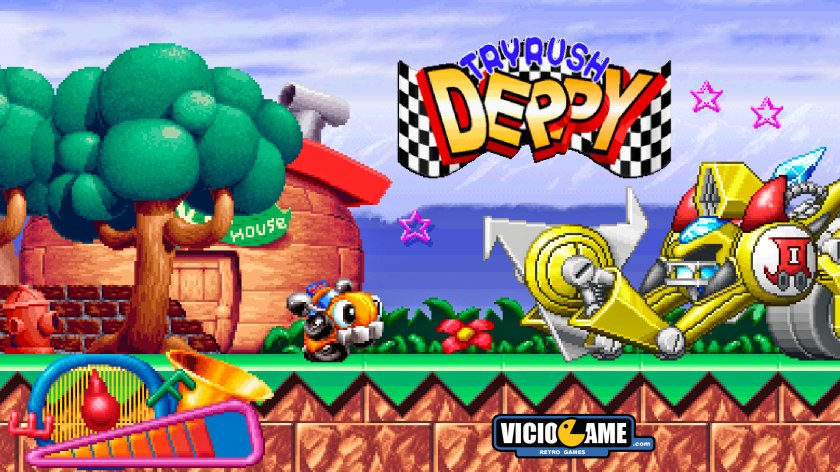
Tryrush Deppy is a 2D platformer released in 1996 for the Sega Saturn. Deppy is a friendly anthropomorphic taxicab competing in a race across the United States. Along the way, Deppy has to refill the gas tank to stay in the running, find collectibles, help out several friends, and take on dangerous villains.
Developer: N-Tech / Tetra
Publisher: Nihon Create
Release Date: 1996
Platform: Sega Saturn
🇺🇸 On November 22, 1996, the Sega Saturn turned exactly two years old in Japan (the console had debuted there on the same date in 1994), and on that very day Virtua Cop 2 arrived in stores, another heavyweight addition from Sega itself. It was a moment of transition: just a few months earlier, Super Mario 64 had shown the world what a 3D platformer would look like, and much of the industry was chasing that new horizon. It was in this climate that a title heading in the opposite direction landed with very little fanfare: Tryrush Deppy (トライラッシュ デッピー), a 2D platformer starring a taxi that walks on its rear wheels. The Saturn was always an especially capable machine in two dimensions, thanks to the combination of its two video processors, and that is exactly where the game places its bet. Three decades later, the disc that almost nobody fought over on store shelves ranks among the rarest, priciest, and most talked-about titles in the console’s library, and it deserves the attention it never got at the time.
The original concept and the publishing are credited to Nihon Create; programming went to System Supply N-Tech, credited as the game’s developer; and the graphics were handed off to Graphic Factory Tetra. The team even included a designer hired exclusively for what they called the “Dramasystem,” a position created specifically to build the short visual-novel-style episodes that tell the stories linking Deppy to his rivals.
For Nihon Create, the project was an unexpected turn. The company was coming off a run of video game adaptations of Yuzo Takada’s manga, such as 3×3 Eyes: Kyūsei Kōshu, an adventure released in 1995 for the PlayStation, and 3×3 Eyes: Kyūsei Kōshu S, which arrived on the Sega Saturn in April 1996. Trading a well-known license for an original, lighthearted story was an unusual gamble, and Tryrush Deppy appears to have remained a one-off: in 1998, the company returned to the world of manga with 3×3 Eyes: Tenrinō Genmu, once again on the PlayStation, and the taxi never got a sequel.
The premise is pure cartoon. In a world where adults and children have all turned into cars, ten vehicles set off in the Tryrush Rally, a coast-to-coast race across the United States. Deppy, the protagonist, is a yellow taxi that recalls the classic New York cab, with headlights for eyes and the expressiveness of a cartoon character, and the game’s anime-inspired look anticipates the world of Pixar’s Cars by a decade. Despite the title, the plot, and the competitive atmosphere, though, Tryrush Deppy is not a racing game: there is no passing and there are no race positions, and the competition serves only as a through-line that justifies the journey. What you actually play is a side-scrolling platformer, in which the trip across the country becomes a succession of stages to clear, enemies to stomp, and bosses to take down.
When a new game begins, the player chooses one of three save slots, enters a name of up to five letters and a four-digit number, watches a short opening animation, and arrives at a map showing where the rally awaits. The route is divided into five legs (New York City to Buffalo, Buffalo to Chicago, Chicago to Denver, Denver to the Grand Canyon, and the Grand Canyon to Los Angeles), and each one consists of two side-scrolling acts followed by a boss fight. Levels are labeled with number pairs, such as 1-1 and 1-2, and a Final Stage caps off the trip. The stages are of medium length and offer two or three routes to the goal: anyone who knows the way can clear one of them in a minute or two, but the level design nudges the player toward exploring. The settings are predominantly urban, although the geography is only a pretext, and they include water sections, dark mines, a train, and even a whimsical mushroom forest on the road between Chicago and Denver. At the end of each stage, a stats screen tallies what the player found, and the game offers to save the player’s progress or, with auto-save turned on, saves on its own. There are checkpoints along the way, but the player can’t backtrack over ground already covered, so missing a hidden detour can mean replaying the entire stage.
The heart of the gameplay is the gas gauge, which doubles as health bar and timer. Deppy begins each stage with the tank half full, and fuel drains away nonstop, as in Gauntlet, at a rate that speeds up with every dash, every hit taken, and every stun; the emptier the tank, the slower the taxi moves, and when the last drop is gone, a life is lost. To refuel, the player has to collect the gas cans scattered around the stage, and red enemies drop fuel when defeated. The rare mini-taxis grant extra lives, and the car battery provides invincibility and zero fuel consumption for a while, even displaying a counter of the enemies defeated while its effect lasts. The hazards have rules of their own: catching fire burns gas until the player puts out the flames by mashing the buttons; in stages with water, tapping the jump button is all it takes to swim, but sinking too deep is fatal; getting run over calls for a sequence of button taps before the taxi can pull itself together; and Officer Harris can pull Deppy over for a traffic stop, draining fuel until the player breaks free.
The controls are streamlined: jump is mapped to three buttons on the Saturn controller and dash to five, so almost any configuration works, and pressing down on the D-pad makes the taxi crouch and, if held, look downward. Jumping on enemies is enough to destroy them, but those with spikes on top or flames across their bodies fall only to the Super Dash, a burst of speed that can be charged up (the longer the button is held, the greater the power and the greater the fuel cost) and fired off even in midair. The dash also smashes through suspicious walls, which hide items and passages, and it is the foundation of the boss duels. The price is risk: slamming into a wall leaves Deppy stunned, and recovering takes frantic button mashing. The burst recalls the spin dash popularized by Sonic the Hedgehog 2, with the difference that here every boost is paid for in gasoline. Rounding out the repertoire are magnets, which attract steel blocks; springs, which launch Deppy or any blocks that fall onto them; and the goal, which must be crossed to end each stage.
Deppy’s rivals aren’t limited to the story’s framing device: they turn up throughout the stages, often in the role of opponents, and almost always offer a chance to lend a hand. The player can free Amigo, Dukankaberg, Dobersky, and Cute Hip from their cages, return Mr. Silkhat’s hat, pull Officer Harris out of the water, get Pamcom down from a tree, or find Star Child in the dark of the mines. Each one has a look of its own: Amigo is a Mexican car in a sombrero; Mr. Silkhat, a classic model with a top hat and cane; Dukankaberg, a green military truck with a German-sounding name; Dobersky, a red vehicle shaped like a locomotive, with a Russian-sounding name; Star Child, a small rocket with a radar dish on its back; Cute Hip, a red car with feminine features; and Officer Harris, a sheriff-style patrol car that both pulls Deppy over and needs rescuing himself. The cast also includes figures like a swordsman car and a ninja car armed with a sickle. Helping is optional, but it earns Drama icons, which appear on the stats screen at the end of the level, and a rescued rival may, in certain cases, return the favor later on.
The combination of icons (especially Hat, Star, and Heart) determines which ending the player will see: the Hat and Heart pairing always takes precedence over the others, and the game holds up to nine different endings, including those reserved for players who collect every Bonus Star and every Drama icon and for those who complete all the extra stages. The nine ending cutscenes aren’t simple videos but a dynamic slideshow, scripted to display images and animations according to what the player did over the course of the game.
Players who stray from the main route will find plenty to do. Each stage has a giant golden star that serves as a portal to a Star Room, a bonus mini-stage whose goal is to collect every neon star scattered across platforms and breakable walls, as its slogan puts it: “Let’s get all Neon-Stars!” The first of these, hidden near the goal of stage 1-1, contains twenty stars, and pausing the game inside a Star Room lets the player rotate the view with the D-pad to study the layout; completing the room earns Bonus Stars and an icon on the stats screen. Even harder is finding the five extra stages (Extra Courses), whose entrances are very well hidden and which each have their own boss, plus a hidden enemy that must be defeated to register the icon. Beating the game after completing all five extra stages unlocks Time Attack, in which the challenge is to beat the target times for each Extra Course. Other bonuses on the disc include a little slot machine game and an Extra mode, unlocked by a secret command on the options screen after the ending: just place the cursor over Exit and press down.
The bosses follow a recognizable formula but vary quite a bit in looks and attacks. Before each duel, the game reveals the opponent’s weak point, and landing about eight hits on it, preferably with the charged dash, which does more damage, is the path to victory; striking any other part merely stuns Deppy and drains the tank, and the arenas provide enough fuel for the fight. The first is Hi-Jacker, a crane that attacks with a wrecking ball and hurls enemies that knock out sections of the floor. Mangler, the second, is a cross between a steamroller and a street sweeper, fires missiles, spins a spiked cylinder, and summons henchmen. W-Bull resembles a fire truck with two hoses, one that spits fire and one that shoots ice, has helpers of its own, and adds the risk of a fall into the water. Dead Drank, a motorcycle whose front wheel is a blade, takes on Deppy atop a train, first trying to run him over and then, in its second form, firing lasers. G.O. closes out the final leg toward Los Angeles, and at the end of the Final Stage, Bad-Head wraps up the rally in a seven-round duel: the first six begin with a laser to dodge before two charges at the boss, in a true boss rush that tests patience more than skill.
It is in its audiovisual polish that Tryrush Deppy stands out most. The sprites are big, colorful, and animated with real cartoon-style care: the dash, the stomp, and the characters’ reactions all got careful treatment, and the art direction recalls the energy of Mega Man mixed with the dazzle of Treasure’s games. The scenery, from big-city streets to mines and forests, is rich in detail, and the soundtrack, sunny and upbeat, takes on tenser tones during the boss fights. Nearly all of the game’s text is in English (names, messages, and the Star Room slogan), so the language barrier is practically nonexistent for anyone importing it.
As for difficulty, the game is tamer than the gas gauge would lead you to expect. The main campaign can be finished in just a few hours, fuel rarely becomes a concern until the final stages, extra lives are hardly missed, and only the Final Stage brings a jump in difficulty. The weak points are well documented: Deppy is slow to build momentum, which hurts in the tighter platforming sections; the controls have an annoying stiffness; the stuns from heavy hits, which force the player to mash buttons, turn into a nuisance late in the campaign; and the level design, competent as it is, rarely reaches the creativity of the great platformers of the 16-bit era. Among the international press that discovered the game years later, the most common verdict is that of a charming, above-average game full of personality, though one with no place in the genre’s pantheon, and some defend it as a forgotten gem of the Saturn. In Japan, the final reader ranking of Sega Saturn Magazine, closed in 2000, gave it an average score of 5.83 and 803rd place out of 945 titles, a fitting snapshot of the game’s anonymity in its own country.
Today, the disc’s rarity is better known than the game itself. Published by a small company and distributed in a limited run, Tryrush Deppy became one of the most coveted titles on the Sega Saturn: in Japan, used copies typically go for tens of thousands of yen, and in the Western market they easily reach hundreds of dollars, with sealed copies worth considerably more.
In the end, Tryrush Deppy has a dual nature: it is a true child of a generation in love with mascots and, at the same time, a misfit in its own time. It lacks the sheer speed and technical daring of the genre’s big names, but it holds something that no price chart or magazine score can measure: the charisma of a taxi that crosses the United States and, along the way, finds a little time to help those in need. There is, on this road, a kindness uncommon among platformers of its era: the idea that arriving first matters less than leaving no one behind. It is this generosity, more than the sky-high price of the physical disc, that explains why those who know the game tend to speak of it with an affection out of proportion to its fame.
🇧🇷 Em 22 de novembro de 1996, o Sega Saturn completava exatos dois anos de vida no Japão (o console havia estreado no país na mesma data de 1994) e, naquele mesmo dia, chegava às lojas Virtua Cop 2, mais um reforço de peso vindo da própria Sega. O momento era de transição: poucos meses antes, Super Mario 64 havia mostrado ao mundo como seria o jogo de plataforma tridimensional, e boa parte da indústria corria atrás desse horizonte. Foi nesse clima que desembarcou, com pouquíssimo alarde, um título que seguia o caminho oposto: Tryrush Deppy (トライラッシュ デッピー), um jogo de plataforma 2D protagonizado por um táxi que caminha sobre as rodas traseiras. O Saturn sempre foi uma máquina especialmente competente em duas dimensões, graças à combinação de seus dois processadores de vídeo, e é justamente aí que o jogo faz a sua aposta. Três décadas depois, o disco que quase ninguém disputou nas prateleiras figura entre os títulos mais raros, caros e comentados da biblioteca do console, e merece ser olhado com a atenção que lhe faltou na época.
A concepção original e a publicação são assinadas pela Nihon Create; a programação ficou com a System Supply N-Tech, apontada como desenvolvedora do jogo; e a parte gráfica foi entregue à Graphic Factory Tetra. No time de profissionais havia inclusive um designer contratado exclusivamente para o que chamaram de “Dramasystem”, um cargo destinado especificamente para criar os pequenos episódios em estilo visual novel para contar as histórias que ligam Deppy aos seus rivais.
Para a Nihon Create, o projeto representou uma curva inesperada. A empresa vinha de adaptações do mangá de Yuzo Takada para o videogame, como 3×3 Eyes: Kyūsei Kōshu, aventura lançada em 1995 para o PlayStation, e 3×3 Eyes: Kyūsei Kōshu S, que chegou ao Sega Saturn em abril de 1996. Trocar uma licença conhecida por uma história original e leve foi uma aposta incomum, e Tryrush Deppy parece ter ficado como caso isolado: em 1998, a companhia voltou ao mundo do mangá com 3×3 Eyes: Tenrinō Genmu, de novo no PlayStation, e não se houve continuação para o táxi.
A premissa é puro cartoon. Num mundo em que adultos e crianças se transformaram em automóveis, dez veículos largam no Tryrush Rally, uma corrida de costa a costa pelos Estados Unidos. Deppy, o protagonista, é um táxi amarelo que lembra o clássico modelo nova-iorquino, com faróis no lugar dos olhos e a expressividade de um personagem de desenho animado, e o visual de inspiração animê antecipa em uma década o universo de Carros, da Pixar. Apesar do título, da trama e do clima de competição, porém, Tryrush Deppy não é um jogo de corrida: não há ultrapassagens nem colocações, e a disputa funciona apenas como fio condutor que justifica a viagem. O que se joga, de fato, é um jogo de plataforma de rolagem lateral, em que a viagem pelo país vira uma sucessão de fases a vencer, inimigos a pisotear e bosses a derrubar.
Ao iniciar uma nova partida, o jogador escolhe um entre três espaços de gravação, digita um nome de até cinco letras e um número de quatro dígitos, assiste a uma curta animação de abertura e chega a um mapa que indica onde o rali o espera. A rota se divide em cinco etapas (de New York City a Buffalo, de Buffalo a Chicago, de Chicago a Denver, de Denver ao Grand Canyon e do Grand Canyon a Los Angeles), e cada uma é formada por dois atos de rolagem lateral seguidos de um confronto com um boss. Os níveis são identificados por pares de números, como 1-1 e 1-2, e uma Final Stage coroa a viagem. As fases têm extensão média e oferecem duas ou três rotas até a meta: quem conhece o caminho cruza uma delas em um ou dois minutos, mas o desenho dos cenários empurra o jogador a explorar. Os ambientes são predominantemente urbanos, embora a geografia seja só um pretexto, incluindo trechos aquáticos, minas escuras, um trem e até uma fantasiosa floresta de cogumelos no percurso entre Chicago e Denver. Ao fim de cada fase, uma tela de estatísticas contabiliza o que foi encontrado, e o jogo oferece gravar o progresso ou, com o auto-save ligado, grava sozinho. Há checkpoints ao longo do trajeto, mas não é possível recuar sobre o que já foi percorrido, de modo que deixar passar um desvio escondido pode significar repetir a fase inteira.
O coração da jogabilidade é o medidor de gasolina, que faz as vezes de barra de energia e de cronômetro. Deppy começa cada fase com o tanque pela metade, e o combustível escoa sem parar, como em Gauntlet, num ritmo que se acelera a cada dash, a cada pancada recebida e a cada atordoamento; quanto mais vazio o tanque, mais lento o táxi se move, e, quando a última gota se vai, uma vida é perdida. Para reabastecer, é preciso recolher os galões espalhados pelo cenário, e os inimigos de cor vermelha deixam combustível ao serem derrotados. Os raros miniatáxis concedem vidas extras, e a bateria de carro garante invencibilidade e consumo zero por algum tempo, exibindo ainda um contador dos inimigos eliminados sob o efeito dela. Os perigos têm regras próprias: entrar em chamas queima gasolina até que o jogador apague o fogo martelando os botões; nas fases com água, basta tocar no botão de salto para nadar, mas afundar demais é fatal; ser atropelado exige uma sequência de toques para o táxi se recompor; e Officer Harris pode abordar Deppy numa parada de trânsito, drenando combustível até que o jogador se desvencilhe.
Os comandos são enxutos: o salto responde a três botões do controle do Saturn e o dash a cinco, de modo que quase qualquer configuração serve, e o direcional para baixo faz o táxi se agachar e, se mantido pressionado, olhar para baixo. Pular sobre os inimigos basta para destruí-los, mas os que exibem espinhos no topo ou chamas pelo corpo só caem diante do Super Dash, uma arrancada que pode ser carregada (quanto mais tempo o botão fica pressionado, maior a potência e maior o gasto de combustível) e disparada até no ar. O dash também derruba as paredes suspeitas, que escondem itens e passagens, e é a base dos duelos contra os bosses. O preço é o risco: trombar contra um muro deixa Deppy atordoado, e a recuperação exige apertar os botões freneticamente. A arrancada lembra o spin dash popularizado por Sonic the Hedgehog 2, com a diferença de que aqui cada impulso é pago em gasolina. Completam o repertório os ímãs, que atraem blocos de aço, as molas, que lançam Deppy ou os blocos que caem sobre elas, e a meta, que precisa ser cruzada para encerrar cada fase.
Os concorrentes de Deppy não ficam apenas na moldura da história: aparecem pelas fases, muitas vezes na pele de adversários, e quase sempre oferecem uma chance de ajuda. É possível libertar Amigo, Dukankaberg, Dobersky e Cute Hip de suas jaulas, devolver o chapéu de Mr. Silkhat, tirar Officer Harris da água, soltar Pamcom de uma árvore ou encontrar Star Child no escuro das minas. Cada um tem visual próprio: Amigo é um carro mexicano de sombrero; Mr. Silkhat, um modelo clássico de cartola e bengala; Dukankaberg, um caminhão militar verde de nome germânico; Dobersky, um veículo vermelho com formas de locomotiva e nome de sabor russo; Star Child, um pequeno foguete com radar nas costas; Cute Hip, um carro vermelho de traços femininos; e Officer Harris, uma viatura de ares de xerife que tanto aborda Deppy quanto precisa de socorro. Completam o elenco figuras como um carro espadachim e um carro ninja armado com foice. Ajudar é opcional, mas rende os ícones de Drama, que aparecem na tela de estatísticas ao fim do nível, e o rival socorrido pode, em certos casos, retribuir o favor mais adiante.
A combinação dos ícones (em especial Hat, Star e Heart) decide qual desfecho o jogador verá: a dupla Hat e Heart sempre prevalece sobre as demais, e o jogo guarda até nove finais diferentes, entre eles os reservados a quem reúne todas as Bonus Stars e todos os ícones de Drama e a quem completa todas as fases extras. As nove cutscenes do final do jogo não são simples vídeos, mas um slideshow dinâmico programado com scripts para exibir as imagens e animações conforme as atividades realizadas durante o jogo.
Quem foge da rota principal encontra bastante o que fazer. Em cada fase há uma estrela dourada gigante que serve de portal para uma Star Room, minifase de bônus em que o objetivo, resumido no lema “Let’s get all Neon-Stars!”, é recolher todas as estrelas de neon espalhadas por plataformas e paredes quebráveis. A primeira delas, escondida perto da meta da fase 1-1, reúne vinte estrelas, e pausar o jogo dentro de uma Star Room permite girar a visão com o direcional para estudar o percurso; concluir a sala rende Bonus Stars e um ícone na tela de estatísticas. Mais difícil ainda é achar as cinco fases extras (Extra Course), cujas entradas são muito bem escondidas e que têm, cada uma, o seu próprio boss, além de um inimigo oculto que precisa ser abatido para registrar o ícone. Zerar o jogo depois de completar as cinco fases extras libera o Time Attack, em que o desafio é bater os tempos-padrão de cada Extra Course. Entre os bônus do disco estão ainda um joguinho de caça-níqueis e um modo Extra, aberto por um comando secreto na tela de opções depois do final: basta posicionar o cursor sobre Exit e apertar para baixo.
Os bosses seguem uma fórmula reconhecível, mas variam bastante em aparência e ataques. Antes de cada duelo, o jogo revela o ponto fraco do adversário, e acertá-lo cerca de oito vezes, de preferência com o dash carregado, que causa mais dano, é o caminho da vitória; golpear qualquer outra parte apenas atordoa Deppy e esvazia o tanque, e as arenas oferecem combustível suficiente para o confronto. O primeiro é Hi-Jacker, um guindaste que ataca com uma bola de demolição e lança inimigos que derrubam partes do piso. Mangler, o segundo, mistura rolo compressor e varredeira de rua, dispara mísseis, gira um cilindro de espinhos e convoca capangas. W-Bull lembra um caminhão de bombeiros com duas mangueiras, uma que cospe fogo e outra que lança gelo, conta com ajudantes e ainda impõe o risco de uma queda na água. Dead Drank, uma moto cuja roda dianteira é uma lâmina, enfrenta Deppy sobre um trem, primeiro tentando atropelá-lo e depois, em sua segunda forma, atirando lasers. G.O. fecha o trecho final rumo a Los Angeles e, ao término da Final Stage, Bad-Head encerra o rali num duelo de sete rounds: os seis primeiros começam com um laser a ser desviado antes de duas investidas contra o boss, num verdadeiro boss rush que testa mais a paciência do que a habilidade.
É no acabamento audiovisual que Tryrush Deppy mais se destaca. Os sprites são grandes, coloridos e animados com um capricho de desenho animado: a arrancada, o pisão e a reação dos personagens receberam tratamento cuidadoso, e a direção de arte lembra a energia de Mega Man misturada ao brilho dos jogos da Treasure. Os cenários, de ruas de metrópole a minas e florestas, são ricos em detalhe, e a trilha, de clima solar e animado, ganha tons mais tensos nos duelos com os bosses. Quase todo o texto do jogo está em inglês (nomes, avisos, e o lema das Star Rooms), de modo que a barreira do idioma é praticamente inexistente para quem o importa.
Como desafio, o jogo é mais manso do que o medidor de gasolina faz supor. A campanha principal se resolve em poucas horas, o combustível raramente preocupa até as últimas fases, as vidas extras fazem pouca falta e só a Final Stage dá um salto de dificuldade. Os pontos fracos são conhecidos: Deppy demora a ganhar embalo, o que pesa nos trechos de plataforma mais apertados; os controles têm uma rigidez incômoda; os atordoamentos por golpes pesados, que obrigam a apertar os botões, viram aborrecimento no fim da campanha; e o desenho das fases, correto, raramente alcança a criatividade dos grandes jogos de plataforma da era dos 16 bits. Na imprensa estrangeira que descobriu o jogo anos depois, o veredito mais comum é o de um jogo simpático, acima da média e cheio de personalidade, ainda que sem lugar no panteão do gênero, e há quem o defenda como uma joia esquecida do Saturn. No Japão, a classificação final dos leitores da revista Sega Saturn Magazine, fechada em 2000, lhe deu média de 5,83 e o 803º lugar entre 945 títulos, um retrato fiel do anonimato do título em seu próprio país.
A raridade do disco é, hoje, mais famosa do que o próprio jogo. Publicado por uma empresa de pequeno porte e distribuído em tiragem modesta, Tryrush Deppy virou um dos títulos mais cobiçados do Sega Saturn: no Japão, exemplares usados costumam custar dezenas de milhares de ienes, e no mercado ocidental chegam facilmente a centenas de dólares, com cópias lacradas valendo bem mais.
No fim das contas, Tryrush Deppy tem dupla natureza: é filho legítimo de uma geração apaixonada por mascotes e, ao mesmo tempo, um corpo estranho dentro do próprio tempo. Não tem a velocidade absoluta nem a ousadia técnica dos grandes nomes do gênero, mas guarda algo que nenhuma tabela de preços ou nota de revista mede: o carisma de um táxi que cruza os Estados Unidos e, pelo caminho, dispensa um tempinho para ajudar quem precisa. Há, nessa estrada uma gentileza incomum entre os jogos de plataforma de sua época: a ideia de que chegar primeiro importa menos do que não deixar ninguém para trás. É essa generosidade, mais do que o preço de ouro da mídia física, que explica por que quem o conhece costuma falar dele com um carinho desproporcional ao tamanho de sua fama.
🤑💲Earn money without doing anything! Just leave these apps open:
https://r.honeygain.me/CONTA9DB02
https://packetstream.io/?psr=1uPb
⬛ 𝗧𝗶𝗸𝗧𝗼𝗸: https://www.tiktok.com/@viciogame
🟧 𝗜𝗻𝘀𝘁𝗮𝗴𝗿𝗮𝗺: http://www.instagram.com/viciogame
🟥 𝗬𝗼𝘂𝘁𝘂𝗯𝗲: http://www.youtube.com/viciogame
🟦 𝗙𝗮𝗰𝗲𝗯𝗼𝗼𝗸: http://www.facebook.com/viciogame
🔳 𝗧𝗵𝗿𝗲𝗮𝗱𝘀: https://www.threads.net/@viciogame
🟪 𝗧𝘄𝗶𝘁𝗰𝗵: https://www.twitch.tv/ViciogameRetroGames
🟨 𝗕𝗹𝗼𝗴: http://www.viciogameblog.com/
🟦𝗧𝘄𝗶𝘁𝘁𝗲𝗿: http://www.twitter.com/viciogame
#Viciogame #Gameplay #LetsPlay #Playthrough #Games #Gaming #Videogames #Review #Game #Detonado #Walkthrough #Ending #Reviews #Facts #Retro #RetroGaming #Roms #Emulator #Longplay #Speedrun #NoCommentary #TryrushDeppy #Saturn #Sega #SegaSaturn #Taxi #トライラッシュデッピー #セガサターン #セガ

