
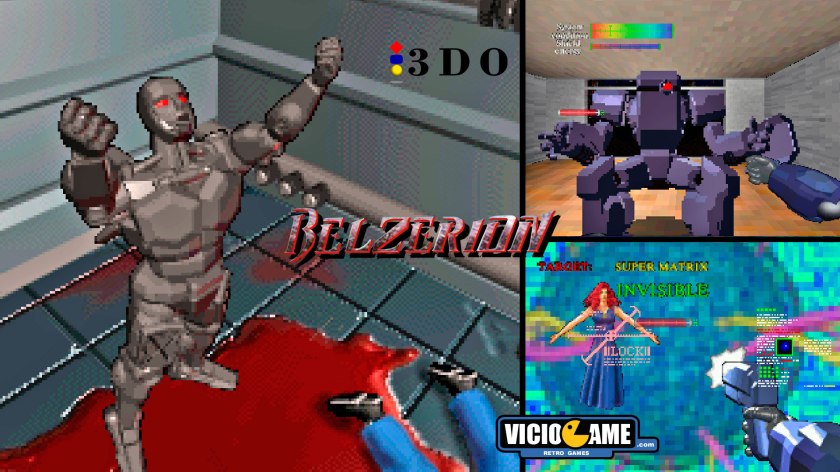
Belzerion is a cyberpunk-themed action-adventure game with investigative elements, released in 1994 for the 3DO. In the last city left standing after a nuclear war, Leon is spared a sentence in exchange for serving as an investigator at the behest of the superintelligent AI that subjugates humanity.
Developer/Publisher: Human Entertainment
Release Date: 1994
Platform: 3DO
🇺🇸 By 1994, the race for Japan’s next console generation had already begun, and it was in this crowded field that Human put a CD in stores with an improbable promise: an investigator in metal armor who solves crimes in an underground future and, when talking gets him nowhere, throws punches at robots. Today, Belzerion (ベルゼリオン) is the territory of 3DO collectors, but few games from that holiday season carried so many ideas trying to fit on the same disc: a first-person adventure, real-time 3D exploration, fistfights and shootouts, and a script organized like an anime miniseries. To understand how a company known for pro wrestling and soccer ended up here, and why the result still sparks curiosity more than three decades later, it makes sense to start with the hardware that housed it.
The 3DO arrived in Japan on March 20, 1994, by way of Matsushita, with the 3DO REAL. Sanyo entered the competition with the 3DO TRY on October 1, and on November 11 came the 3DO REAL II, at the same price the Sega Saturn would carry eleven days later. The PlayStation debuted on December 3, and NEC’s PC-FX would arrive on December 23, a week after Belzerion. In the middle of this siege, the 3DO library lived on titles imported from the West and a few local hits, among them Super Street Fighter II X and D no Shokutaku, the latter not until April 1995. Estimates put sales at around 350,000 units in Japan through March 1995, counting both Matsushita models, which gives a measure of the potential audience. A game that cost nearly a fifth of the price of Matsushita’s cheapest console spoke to a small, specialized audience willing to pay a premium for experiments, and that helps explain why a project like this had the feel of a gamble. The window, in fact, was short: software sales for the system in Japan would end in 1996.
Human, which traces its roots to 1983, was one of the most restless studios in Japan. It made its name with Fire Pro Wrestling and Formation Soccer, but what set it apart from its competitors was the school it ran in Kichijoji, Tokyo: the Human Creative School, opened in 1990 and considered the first in the world dedicated to training game creators. Student projects came out of there that the company actually released, such as S.O.S. (Septentrion in Japan, 1993), in which the player tries to rescue as many passengers as possible from a luxury liner capsized by a wave, and The Firemen, from 1994. The company called the ambition behind these titles Cinematic Live: giving a game the power of a film and the presence of a live performance. In January 1994, it even opened a subsidiary in San Francisco, a sign that it was looking toward the West, and yet Belzerion, which shares the company’s cinematic appetite, stayed confined to Japan and is Human’s only title for the 3DO.
Before reaching the console, Belzerion was a CD-ROM for Macintosh, released in 1993. The packaging recommended a Macintosh from the II family or the LC line, or a Color Classic, with 3 MB of memory and a 12- or 13-inch color monitor displaying 256 colors, which reveals a game designed for entry-level models with color displays, at the height of the CD-ROM craze. The original is a first-person point-and-click adventure, with the concept credited to Yuichi Kobayashi, a name that reappears among the ten members of the Sapporo Visual Center, the visual arts group Human opened in Sapporo in March 1994 and that is listed as a collaborator on the 3DO version. In the move to the console, the task was to trade clicking for action: exploration came to happen in real-time 3D, and combat gained the locked perspective that defines it. The result is a reinterpretation of the same ideas, to the point that the two versions are quite different experiences, one more tied to the mouse, the other closer to an action game.
At the helm of the console version is Keita Kimura, responsible for the planning, production, direction, and rewrite of the original script. Kimura, then in his twenties, had debuted as a game designer on S.O.S. while still a student at Human’s own school, which helps explain the project’s experimental appetite. Lead programming is credited to Tetsutaro Hoshino and Yuji Kuriyama, and the 3D to Kenichi Matsuda. Main graphics fall to Kazuyuki Ogawa and Toshitsugu Tsunoda, and Ogawa, who also worked on the original Macintosh version alongside Takeshi Kadoma, visual advisor on S.O.S., serves as the bridge between the two versions. The sound team brings together four names, among them Koji Niikura, who would soon write the soundtrack for Clock Tower. In all, there are 27 names in the production credits and five in the special thanks, the size of a niche project in which a few people juggle many roles.
The story takes place in 2047 and is set in Shangri-La, a domed shelter where ten million people live under a regime of machines created to preserve the species, which in practice turns it into an underground prison with the name of a paradise. The game’s promotional text sells the idea as an extremely heavy sci-fi adventure in which steel clashes with steel, and opens its account with a man descending over a metropolis of skyscrapers that looks as if Pandora’s box had been opened. Command belongs to Vishnu, an omnipresent artificial intelligence whose name, that of the god who preserves the universe in the Hindu tradition, fits the mission it assigns itself. The player takes the role of Leon, a young man with no memory who was about to be tried as a war criminal and escapes that fate because his former commander, Ken Bernard, persuades Vishnu to give him a second chance inside a Protect Suit, a form of parole in the shape of armor, run by an AI called Flare-207. From there, Leon investigates strange crimes as a member of the special unit that gives the game its name, with the journalist Saeko as a human counterpoint outside the uniform.
The structure recalls an OVA series: there are eight episodes, each with its own arc, that seem standalone until, after the sixth, the threads cross to reveal Leon’s past and the secret of the dome. Much of the plot arrives through short FMV cutscenes, and the opening, with its heavy soundtrack, sets the dark mood from the very start. The visuals gather the symbols of period cyberpunk, such as flying cars, servant androids who address humans as “master,” robotic security guards, and a cyberspace where psychedelic computer graphics meet classical architecture, while the suit design swings between the Knight Sabers of Bubblegum Crisis and tokusatsu heroes, and a Japanese publication of the time even summed up the whole package as a hero for adults. Originality is not the point: what carries weight is the conviction with which the game commits to its mood and the careful execution of familiar tropes.
The game alternates among three modes throughout the campaign, and the first is the adventure proper. The settings are pre-rendered images that the player crosses by jumping from one screen to the next, in the manner of Myst, with the difference that here the game makes a point of not leaving anyone lost: an indicator in the upper right corner shows where it is possible to walk and whether anything interactive is in sight, and the cursor snaps on its own to the objects that matter. The A button triggers the search command, abbreviated SCH on the interface, and the D-pad moves the cursor over whatever you want to examine. Despite the rigidity, there is room left for curiosity: in Leon’s apartment, even a pack of cigarettes can be inspected, and in an art gallery, every painting allows a closer look. What changes relative to the genre is the contract with the player. The narrative is linear, and whatever dialogue options come up, they lead in practice to the same place, and nothing that goes unnoticed comes back later to demand payment, which sustains the miniseries pace and frees the player from the doubt that torments more open-ended adventures: what did I miss?
In the second mode, the player enters buildings and facilities rendered in real-time 3D. Movement works in board-game steps, one square at a time, as in a dungeon crawler, but the corridor design keeps anyone from getting lost: each area comes with a minimap with red markers pointing to the objective, and none is complex enough to deserve the name “maze.” The ambition lies elsewhere, in making those corridors feel inhabited. Animated characters step aside instead of vanishing from the map, vases decorate well-lit lobbies, explosions go off in the distance, and metal shutters come down to the sound of alarms across a path that had looked clear. Enemy encounters are not random: they happen at fixed points, and the transition into combat is disguised by a loading screen in the shape of a radar.
Combat is where Belzerion shows what it’s made of. During fights, the view is locked facing forward, in the manner of The Super Spy, a 1990 SNK game for the Neo Geo, but Leon moves freely from side to side. With the enemy at a distance, he switches to his gun on his own: all it takes is moving the cursor over the target, which is marked in red, and holding the A button to lock on and keep firing without standing still in the line of fire. If the opponent closes in, the metal fists come into play, with straight punches and hooks combined through the D-pad and the single attack button. The L and R buttons make Leon perform a sideways dodge flip, with the whole screen spinning along with him, which gives the move a cinematic weight, and the B button raises an energy shield of limited use, which later on starts firing energy balls. The system’s most refined detail lies right there: Leon’s attacks can start before the shield has finished disappearing, so good reaction timing lets you push through an enemy’s devastating combo and cut its sequence in half. Strategy comes down to managing the shield, which burns through energy quickly, and deciding between going in with a combo or backing off and waiting to use the gun. What looks simple gains depth thanks to the cast: swarms of small machines call for prioritizing targets, ceiling turrets are only vulnerable when turned to one side, and larger humanoids have multiple attacks, idle animations, and even taunts. Every enemy has a name, which makes the bosses blend in with the other opponents instead of standing out as exceptions.
Outside of combat, the game’s design thrives on eliminating friction. There is no menu or inventory: the only feedback on Leon’s condition comes from the gauges for armor integrity and shield energy in the corner of the screen. Dying carries no real penalty, because the Continue option returns the player to the start of the fight with both gauges full, as many times as necessary, and progress is saved automatically at the end of each episode, never in the middle, which turns each episode into a self-contained session. Repairs between fights are rare and limited to terminals in the final episodes. This generosity hides a cruel catch, however. Anyone who goes past about five continues finds out only after the final boss that the game reserves a static screen with the word “INCOMPLEATED,” misspelled in English, in place of the real ending, with no warning from the manual and no indication from the game of how many times the player has fallen. It is a curious contradiction: for hours it holds the player’s hand and, at the last minute, hands over the bill. Reaching the true ending, in return, earns codes to enter on the title screen that unlock Omnibus Mode (for choosing any episode), Sound Test Mode, and Battle Mode (a sequence of boss fights).
Its reception has always been that of a niche game. The Japanese owners who have weighed in over the years repeat a pattern: they praise the dark, adult world, the suit design, and the excitement of the 3D fights, and complain about the loading times, which break the pace even in mundane actions like leaving a room, the dark screens that strain the eyes, and the one-way-street linearity of the adventure portion. A Japanese overview of the 3DO library was drier, describing the game as a 3D sci-fi shooter with a script too light to justify the adventure label. Both readings have a point, and the game lives in that tension: the fantasy of being an armored hero is served with care, while the plot wrapped around it is content to be efficient.
Rediscovery came late, and from the Western side. The game is entirely in Japanese, and that barrier helps explain why interest stayed limited for so long. Among 3DO enthusiasts, comparisons come up with Snatcher and Policenauts, because of the mix of investigation and first-person shooting, and some even rank it among the best on the system, while conceding that many people don’t recommend it. In terms of direct influence, the outcome is modest: Belzerion founded no school and left no heirs in sight. What it leaves behind is proof that easing friction and being occasionally cruel can go hand in hand, that a locked perspective allows fights that feel like a fighting game inside an adventure, and a picture of how a Japanese studio, caught between the CD-ROM craze on computers and the race of the new consoles, tried to merge cinema, adventure, and action with the tools it had.
Among 3DO titles, Belzerion remains a faithful portrait of what Human was capable of when it decided to step off the beaten path. The company no longer exists: it sought a settlement with its creditors in November 1999 and went bankrupt in January 2000, and part of its staff scattered to studios such as Goichi Suda’s Grasshopper Manufacture and Sandlot. The game has a boldness that today’s market rarely tolerates: a young team betting that cinema, adventure, and fighting could fit on the same CD, getting some things wrong and others right, but never asking permission to try. Anyone who dares to play it will find not a perfect game but a period document full of life, one that still sparks debate today.
🇧🇷 Em 1994 a corrida pela nova geração japonesa já tinha iniciado, e foi nesse cenário apertado que a Human colocou nas lojas um CD com uma promessa improvável: um investigador de armadura metálica que resolve crimes em um futuro subterrâneo e, quando a conversa não rende, distribui socos em robôs. Belzerion (ベルゼリオン) é hoje território de colecionadores de 3DO, mas poucos jogos daquele fim de ano carregavam tantas ideias tentando caber no mesmo disco: aventura em primeira pessoa, exploração em 3D em tempo real, lutas de socos e tiros e um roteiro organizado como minissérie de anime. Para entender como uma empresa conhecida por luta livre e futebol chegou a isso, e por que o resultado ainda desperta curiosidade mais de três décadas depois, convém começar pelo aparelho que o hospedava.
O 3DO chegou ao Japão em 20 de março de 1994, pelas mãos da Matsushita, com o 3DO REAL. A Sanyo entrou na disputa com o 3DO TRY em 1º de outubro, e em 11 de novembro veio o 3DO REAL II com o mesmo preço que o Sega Saturn cobraria onze dias depois. O PlayStation estreou em 3 de dezembro, e o PC-FX, da NEC, apareceria em 23 de dezembro, uma semana após Belzerion. No meio desse cerco, o catálogo do 3DO vivia de títulos importados do Ocidente e de poucos sucessos locais, entre eles Super Street Fighter II X e D no Shokutaku, este só em abril de 1995. Estimativas apontam cerca de 350 mil aparelhos vendidos no país até março de 1995, contando as duas versões da Matsushita, o que dá a medida do público possível. Um jogo que custava quase um quinto do preço do aparelho mais barato da empresa falava com uma plateia pequena, especializada e disposta a pagar caro por experimentos, e isso ajuda a entender o tom de aposta de um projeto como esse. A janela, aliás, era curta: as vendas de software para o aparelho no Japão se encerrariam em 1996.
A Human, com raízes em 1983, era uma das casas mais inquietas do país. Ela se firmou com Fire Pro Wrestling e Formation Soccer, mas o que a distinguia dos concorrentes era a escola que mantinha em Kichijoji, em Tóquio: a Human Creative School, aberta em 1990 e considerada a primeira do mundo dedicada a formar criadores de jogos. Dali saíam projetos de alunos que a empresa lançava de verdade, como S.O.S. (Septentrion, no Japão, de 1993), em que o jogador tenta resgatar o maior número possível de passageiros de um navio de luxo virado por uma onda, e The Firemen, de 1994. A casa batizava a ambição por trás desses títulos de Cinematic Live: dar ao jogo a força de um filme e a presença de uma apresentação ao vivo. Em janeiro de 1994, ela ainda abriu uma subsidiária em San Francisco, sinal de que olhava para o Ocidente, e mesmo assim Belzerion, que compartilha o apetite cinematográfico da empresa, ficou restrito ao Japão e é o único título da Human para o 3DO.
Antes de chegar ao console, Belzerion foi um CD-ROM para Macintosh, lançado em 1993. A embalagem recomendava um Macintosh da família II, da linha LC ou um Color Classic, com 3 MB de memória e monitor colorido de 12 ou 13 polegadas em 256 cores, o que revela um jogo pensado para os modelos de entrada com tela colorida, em plena febre do CD-ROM. O original é uma aventura de apontar e clicar em primeira pessoa, com a ideia creditada a Yuichi Kobayashi, nome que reaparece entre os dez integrantes do Sapporo Visual Center, núcleo visual que a Human inaugurou em Sapporo em março de 1994 e que consta como cooperador da versão para 3DO. Na passagem para o console, o trabalho foi trocar o clique pela ação: a exploração passou a acontecer em 3D em tempo real e o combate ganhou a perspectiva travada que o caracteriza. O resultado é uma reinterpretação das mesmas ideias, a ponto de as duas versões serem experiências bem diferentes, uma mais presa ao mouse, outra mais próxima do jogo de ação.
Quem assume o comando da versão para console é Keita Kimura, responsável pelo planejamento, produção, direção e reescrita do roteiro original. Kimura, então na casa dos vinte anos, estreara como game designer em S.O.S., ainda aluno da escola da própria Human, o que ajuda a entender o apetite experimental do projeto. A programação principal é assinada por Tetsutaro Hoshino e Yuji Kuriyama, e o 3D, por Kenichi Matsuda. Os gráficos principais ficam com Kazuyuki Ogawa e Toshitsugu Tsunoda, e Ogawa, que também integrou a equipe do original em Macintosh ao lado de Takeshi Kadoma, assessor visual de S.O.S., faz a ponte entre as duas versões. O som reúne quatro nomes, entre eles Koji Niikura, que logo depois assinaria a trilha de Clock Tower. Ao todo são 27 nomes na produção e cinco em agradecimentos, o tamanho de um projeto de nicho em que poucas pessoas acumulam muitas funções.
A história se passa em 2047 e tem como palco Shangri-La, um domo-abrigo onde dez milhões de pessoas vivem sob um regime de máquinas criado para preservar a espécie, o que na prática o transforma em uma prisão subterrânea com nome de paraíso. O texto de apresentação do jogo vende a ideia como uma aventura de ficção científica pesadíssima, em que aço bate em aço, e abre o relato com um homem descendo sobre uma metrópole de arranha-céus que parece ter tido a caixa de Pandora aberta. O comando é de Vishnu, uma inteligência artificial onipresente cujo nome, o do deus que preserva o universo na tradição hindu, combina com a missão que ela atribui a si mesma. O jogador assume Leon, um jovem sem memória que estava prestes a ser julgado como criminoso de guerra e escapa porque seu antigo comandante, Ken Bernard, convence Vishnu a lhe dar uma segunda chance dentro de uma Protect Suit, uma liberdade condicional em forma de armadura, gerida por uma IA chamada Flare-207. Dali em diante, Leon investiga crimes estranhos como integrante da unidade especial que dá nome ao jogo, tendo a jornalista Saeko como contraponto humano fora do uniforme.
A estrutura lembra uma série em OVA: são oito episódios, cada um com o próprio arco, que parecem avulsos até que, depois do sexto, as linhas se cruzam para revelar o passado de Leon e o segredo do domo. Boa parte da trama chega por cutscenes curtas em FMV, e a abertura, com uma trilha pesada, instala o clima sombrio logo de saída. O visual reúne os símbolos do cyberpunk de época, como carros voadores, androides servos que tratam os humanos por mestre, seguranças robóticos e um ciberespaço em que a computação gráfica psicodélica encontra arquitetura clássica, enquanto o traje oscila entre as Knight Sabers de Bubblegum Crisis e os heróis de tokusatsu, e uma publicação japonesa da época chegou a resumir o conjunto como um herói para adultos. A originalidade não é o ponto: o que pesa é a convicção com que o jogo se entrega ao clima e a execução cuidadosa de tropos já conhecidos.
O jogo alterna três modos ao longo da campanha, e o primeiro é a aventura propriamente dita. Os cenários são imagens pré-renderizadas que o jogador atravessa saltando de uma tela para a seguinte, à moda de Myst, com a diferença de que aqui o jogo faz questão de não deixar ninguém perdido: um indicador no canto superior direito mostra para onde é possível andar e se há algo interativo à vista, e o cursor gruda sozinho nos objetos que importam. O botão A aciona o comando de busca, abreviado SCH na interface, e o direcional move o cursor sobre o que se quer examinar. Apesar da rigidez, sobra espaço para a curiosidade: no apartamento de Leon até um maço de cigarros pode ser inspecionado, e numa galeria de arte cada quadro admite uma olhada de perto. O que muda em relação ao gênero é o contrato com o jogador. A narrativa é linear, e independentemente dos diálogos que apareçam, levam na prática ao mesmo ponto, e nada que passe despercebido volta para cobrar a conta depois, o que sustenta o ritmo de minissérie e livra o jogador da dúvida que atormenta as aventuras mais livres: o que será que deixei passar?
No segundo modo, o jogador entra em prédios e instalações renderizados em 3D em tempo real. O deslocamento acontece como em passos de uma casa de tabuleiro, como em um dungeon crawler, mas o design dos corredores evita que alguém se perca: cada área traz um minimapa com marcadores vermelhos apontando o objetivo, e nenhuma é complexa o bastante para merecer o nome de labirinto. A ambição está em outro ponto, em fazer esses corredores parecerem habitados. Personagens animados dão passagem em vez de sumir do mapa, vasos enfeitam saguões bem iluminados, explosões estouram ao longe e persianas metálicas descem ao som de alarmes sobre um caminho que parecia livre. Os encontros com inimigos não são aleatórios: ocorrem em pontos fixos, e a transição para o combate é disfarçada por uma tela de carregamento em forma de radar.
É no combate que Belzerion mostra a que veio. Durante as lutas, a visão fica travada para a frente, à maneira de The Super Spy, jogo de 1990 da SNK para Neo Geo, mas Leon se move livremente para os lados. Com o inimigo à distância, ele troca sozinho para a arma: basta passar o cursor sobre o alvo, que fica marcado em vermelho, e segurar o botão A para travar a mira e seguir atirando sem ficar parado na linha de fogo. Se o oponente se aproxima, entram em cena os punhos metálicos, com diretos e ganchos combinados pelo direcional e pelo único botão de ataque. Os botões L e R fazem Leon executar uma cambalhota lateral de esquiva, com a tela inteira girando junto, o que dá ao gesto um peso de cinema, e o botão B levanta um escudo de energia de uso limitado, que mais adiante passa a disparar bolas de energia. O detalhe mais refinado do sistema está aí: os golpes de Leon podem começar antes de o escudo terminar de desaparecer, de modo que um bom tempo de reação permite atravessar o combo devastador de um inimigo e cortar a sequência dele pela metade. A estratégia passa por administrar o escudo, que gasta energia rápido, e decidir entre entrar com um combo ou recuar e esperar para usar a arma. O que era simples, ganha profundidade graças ao elenco: enxames de máquinas pequenas pedem priorização, torres de teto só ficam vulneráveis quando viradas para um lado, e humanoides maiores têm vários golpes, animações de espera e até provocações. Todos os inimigos têm nome, o que faz os chefes se misturarem aos demais adversários em vez de surgirem como exceções.
Fora do combate, o design do jogo vive de eliminar atritos. Não há menu nem inventário: o único retorno sobre o estado de Leon vem dos medidores de integridade da armadura e de energia do escudo, no canto da tela. Morrer não pesa, porque a opção Continue devolve o jogador ao começo da luta com os dois medidores cheios, quantas vezes forem necessárias, e o progresso é salvo automaticamente ao fim de cada episódio, nunca no meio, o que faz de cada episódio uma sessão fechada. Reparos entre as lutas são raros e ficam restritos a terminais nos episódios finais. Essa generosidade esconde, porém, uma pegadinha cruel. Quem passa de uns cinco continues descobre só depois do último chefe que o jogo reserva uma tela estática com a palavra “INCOMPLEATED”, grafada errado em inglês, no lugar do final de verdade, sem que o manual avise e sem que o jogo informe quantas vezes o jogador já caiu. É uma contradição curiosa: durante horas ele pega o jogador pela mão e, no último minuto, cobra a conta. Alcançar o final verdadeiro, em compensação, rende códigos para digitar na tela de título que liberam o Omnibus Mode, para escolher qualquer episódio, o Sound Test Mode e o Battle Mode, uma sequência de lutas contra os chefes.
A recepção sempre foi a de um jogo de nicho. Os donos japoneses que se manifestaram ao longo dos anos repetem um padrão: elogiam o mundo sombrio e adulto, o design do traje e a empolgação das lutas em 3D, e reclamam do tempo de carregamento, que quebra o ritmo até em gestos banais como sair de um cômodo, das telas escuras que cansam a vista e da mão única da parte de aventura. Um balanço japonês do catálogo do 3DO foi mais seco: o descreveu como um shooter 3D de ficção científica, com roteiro leve demais para sustentar o rótulo de aventura. As duas leituras têm razão, e é nessa tensão que o jogo vive: a fantasia de ser um herói de armadura é servida com esmero, enquanto a trama que a envolve se contenta em ser eficiente.
A redescoberta veio tarde e pelo lado ocidental. O jogo é inteiramente em japonês, e essa barreira ajuda a explicar por que o interesse ficou restrito por tanto tempo. Entre os entusiastas do 3DO surgem comparações com Snatcher e Policenauts, pela mistura de investigação e tiro em primeira pessoa, e há quem o ponha entre os melhores do aparelho, ainda que reconheça que muita gente não o recomenda. Em termos de influência direta, o saldo é modesto: Belzerion não fundou escola nem deixou herdeiros à vista. O que ele deixa é a demonstração de que aliviar atritos e ser ocasionalmente cruel podem andar juntos, de que a perspectiva travada permite lutas com cara de jogo de luta dentro de uma aventura e de como um estúdio japonês, entre a febre do CD-ROM nos computadores e a corrida dos novos consoles, tentou fundir cinema, aventura e ação com as ferramentas que tinha.
Entre os títulos do 3DO, Belzerion segue como retrato fiel do que a Human era capaz quando decidia sair do trilho. A empresa não existe mais: pediu acordo aos credores em novembro de 1999 e foi à falência em janeiro de 2000, e parte de sua equipe se espalhou por estúdios como a Grasshopper Manufacture, de Goichi Suda, e a Sandlot. Há no jogo uma ousadia que o mercado de hoje raramente tolera: um grupo jovem apostando que cinema, aventura e luta cabiam no mesmo CD, errando em alguns pontos e acertando em outros, mas sem pedir licença para tentar. Quem ousa jogá-lo, não encontra um jogo perfeito, mas um documento de época cheio de vida, que ainda rende discussões até hoje.
🤑💲Earn money without doing anything! Just leave these apps open:
https://r.honeygain.me/CONTA9DB02
https://packetstream.io/?psr=1uPb
⬛ 𝗧𝗶𝗸𝗧𝗼𝗸: https://www.tiktok.com/@viciogame
🟧 𝗜𝗻𝘀𝘁𝗮𝗴𝗿𝗮𝗺: http://www.instagram.com/viciogame
🟥 𝗬𝗼𝘂𝘁𝘂𝗯𝗲: http://www.youtube.com/viciogame
🟦 𝗙𝗮𝗰𝗲𝗯𝗼𝗼𝗸: http://www.facebook.com/viciogame
🔳 𝗧𝗵𝗿𝗲𝗮𝗱𝘀: https://www.threads.net/@viciogame
🟪 𝗧𝘄𝗶𝘁𝗰𝗵: https://www.twitch.tv/ViciogameRetroGames
🟨 𝗕𝗹𝗼𝗴: http://www.viciogameblog.com/
🟦𝗧𝘄𝗶𝘁𝘁𝗲𝗿: http://www.twitter.com/viciogame
#Viciogame #Gameplay #LetsPlay #Playthrough #Games #Gaming #Videogames #Review #Game #Detonado #Walkthrough #Ending #Reviews #Facts #Retro #RetroGaming #Roms #Emulator #Longplay #Speedrun #NoCommentary #Belzerion #3DO #Panasonic #ベルゼリオン #RPG #Adventure #FPS #firstpersonshooter #Human #anime #Manga #ova #pointandclick #sierra #lucasarts #myst #robot

