
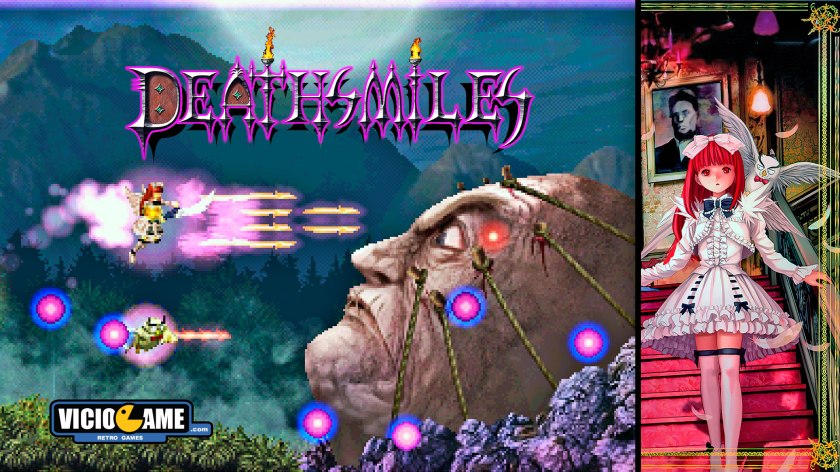
Deathsmiles is a bullet hell shoot ‘em up released for arcades in 2007. Young girls on the brink of death are mysteriously transported to a fantasy world, where they are saved, become angels, and must battle evil. Once the mission is complete, they have to decide whether to stay in the fantasy world or return to the real world.
Developer: Cave
Publisher: Amusement Marketing International
Release date: 2007
Platform: Arcade Cave CV1000-B board
🇺🇸 Just days before Halloween 2007, Japanese arcades received a shoot ’em up that promised no spaceships and no helicopters. A girl in a gothic dress, a white owl flying beside her, and a port town decked out in pumpkins. Deathsmiles was Cave’s biggest bet on answering a question the company had been putting off for years: how to invite into the genre the people who have always seen bullet hell as a wall, without driving away the veterans who sustain it? The answer was not to simplify the game. The developer gave players the chance to choose how much suffering they want in each stage, dressed everything up in lighthearted gothic horror, and turned the screen on its side. It launched in arcades, but it lives on across PC, Nintendo Switch, PlayStation 4, and Xbox One, and it is still one of the best examples of accessible design the genre has ever produced.
To gauge how daring this was, it helps to remember where Cave came from. Founded in 1994 by Toaplan veterans, the company entered the early 2000s running out of steam: after Progear (2001), its first shoot ’em up experiment, made in partnership with Capcom, leadership considered abandoning arcades for good. What brought it back was a push from outside. DoDonPachi II, made by the Taiwanese company IGS (of which AMI is a part) under a license for the series, sold well enough to convince Cave that a market still existed. The partnership with AMI also produced a request that would change the company’s identity: more human characters. Espgaluda proved the idea right, Mushihimesama (2004) debuted Cave’s own board, which finally allowed transparency effects, and the heroines opened the way for merchandise and for the Cave Matsuri festivals. By 2007, the company already knew how to sell a character, but it still had to sell the genre.
The decision to turn the screen sideways grew out of a nearly contradictory line of thinking. After Progear, Tsuneki Ikeda, Cave’s cofounder and the man behind DoDonPachi, the game that cemented bullet hell, concluded that the horizontal format did not suit bullet dodging, and the company went back to vertical. Years later, the goal was different: to attract casual players, with plans for a console port from day one. For that, the wide screen was the logical choice, easier to read, better looking, and better at suggesting depth, something enemies lined up vertically rarely manage. Ikeda knew, however, that the horizontal format needs a second draw beyond pure dodging, and the solution was to make the environment itself part of the equation. The order to break away from the “Cave way” fell to programmer Takashi Ichimura, a veteran of Dangun Feveron and Ketsui, and it landed in sympathetic hands: Ichimura admits he was never good at dodging bullet hell patterns and prefers games built on rhythm and flow. Composer Manabu Namiki recalls that Junya Inoue kept repeating, throughout development, his wish to make something outside the company’s style, and the list of departures is long: choosing stages and difficulty, scrolling sideways, and not dying on contact with enemies. The team itself wavered between swearing the game wasn’t bullet hell (while conceding it might be, a little) and inviting players to enjoy the storm of bullets.
Junya Inoue is the one who gives the game its face. A former Cave employee and now the author of manga such as BTOOOM!, he joined the company midway through the development of the first DoDonPachi and is credited here as “graphic president,” a title that covers art direction, characters, and environments. In planning sessions with Ikeda, the visual concept was settled as gothic horror with a light touch. Inoue signed on because he felt the genre was so well-worn that it was starting to feel fresh again, and he paired classic Western horror (graveyards, castles under the moon, swamps) with Japan’s taste at the time for gothic lolita, a fashion that also made it easy to come up with pretty characters. The project’s name, by the way, went through some twists: in Inoue’s documents it was called Essential Smiles, until Ikeda and leadership turned up their noses at a name that sounded like a shampoo and renamed it on their own, much to Inoue’s fury. Another working title, Death Lolita, also circulated during development and surfaced informally in July 2007, before the official unveiling at the Amusement Machine Show in September, when two models dressed as Windia and Casper livened up the booth.
The story, told through short dialogues and individual endings, fits in a few lines and shows more care than the genre usually demands. In Gilverado, a kingdom of magic and monsters, children who vanish from the real world are taken in by the old Count Dior and trained to defend the place: they are the “angels” of the title. Windia, the newcomer from London, flies with the owl Hoo; Casper, the youngest, a Berliner who has repressed the memory of how she ended up there, has a bat-faced familiar named Kiki; Follett, from Paris, awakened her fire after being swept away by an icy river, and has the little dragon Bobo at her side; Rosa, the oldest and the group’s informal leader, shares the screen with the fairy Tee-Tee. Inoue named the girls by direct association (Windia from wind, Casper from ghost, Follett from fire) and the familiars after the sounds they make, hence Hoo, Kiki, and Bobo. In the original arcade version, only Windia and Casper are available at the start: Follett, Rosa, and the optional Gorge stage only appear through command sequences that Cave revealed little by little between November and December 2007, which kept the game delivering surprises after launch. Sakura, the swamp witch and Windia’s friend in the real world, is a boss who becomes a playable character in the 2008 revision; Jitterbug, the castle boss, is her father and the one responsible for summoning the monsters, voiced by Inoue himself.
Players control the character with an eight-way stick and three buttons: shoot left, shoot right, and the bomb, which here is a summoning spell. Firing in two directions is a rarity the genre had barely seen since Side Arms (1986), and it solves the biggest problem of the horizontal format, since enemies enter from either side and a warning at the screen’s edge shows where the next one is coming from. Tapping a button fires the regular shot; holding it swaps the shot for a stronger beam and slows the character down; pressing both at the same time triggers the lock shot, which attacks on its own, hitting enemies inside a targeting area. Each girl’s pet acts as an invulnerable orb, sometimes circling its owner, sometimes locked in place while firing (the rule changes from character to character), and it also absorbs the yellow retaliation bullets. Each plays in her own way: Windia is the easiest to use and the least powerful, Casper demands proximity in exchange for more damage, Follett makes up for the short reach of her flames with brute force, and Rosa, with her piercing shots, is the strongest choice for anyone who just wants to reach the ending. The hitbox is a little glowing heart at the center of the body, which means the rest of the character passes through bullets with no consequence, and touching neutral obstacles doesn’t hurt either. Health comes in bars: a bullet takes a whole one, contact with an enemy takes half, and recovery arrives in the form of desserts (pudding, strawberry parfait, frosted cake), a touch that says a lot about the spirit of the project.
The big trick in Deathsmiles is the map. The first six stages are organized into three chapters of two acts each: in every chapter, one location is chosen from among Port Town, Forest of the Lost, and Lake Shore, and then another from among Graveyard, Swamp Wastes, and Volcano, without repeating any. After that come the optional Gorge and, as the final stage, Hades Castle. In each stage, the player also chooses the difficulty, from 1 to 3: level 1 brings milder patterns, level 3 is the most aggressive, and the harder paths hide rewards, such as bombs and life items, which turns courage into an investment. The game limits how many times the easy levels can be chosen, forcing players to take on at least two stages at level 3, and anyone who strings together five or more stages at that level enters Death Mode, an extra layer of difficulty with its own rank, in which enemies start returning bullets when they die. The mechanic is simple and effective: difficulty stops being a barrier to entry and becomes a route, and two players of different skill levels can share the same game without one spoiling the other’s fun. A behind-the-scenes detail helps explain the sense of balance: the idea of letting players cancel Death Mode’s retaliation bullets only came up two days before the final deadline, when the team was still looking for a way to make the visuals flashier without raising the difficulty.
Defeated enemies drop skulls and crowns that fill a counter in the lower corner of the screen, and each type of enemy responds best to a particular attack: some pay out more crowns when they die to the regular shot, others to the beam, and others to the lock shot, which drains the counter while it is active. When the counter reaches 1,000, pressing both shot buttons triggers the power-up: the bullets on screen disappear, damage goes up, the character passes through enemies (except bosses) unharmed, and each item collected earns increasing bonuses, reaching 10,000 points apiece. The decisive detail is on the ground. Items fall and, when they hit the floor or the terrain, break into smaller versions; outside the power-up that is a loss, so it pays to catch them in midair, but during the power-up quantity is what counts, and letting everything fall and scatter pays off. Here lies the second draw Ikeda was looking for: the environment stops being a backdrop and becomes a scoring variable. Veterans take the idea further with “recharging,” a technique of emptying the counter exactly where there are enough enemies to fill it again and enter the power-up once more without a break. Each character has a high-score table of her own, and none of these techniques is mandatory: the game’s two extra lives come naturally to anyone who plays well, even without mastering recharging.
Running on the CV1000-B, a variant of Cave’s in-house board, the game balances the macabre and the endearing with good taste. The stages, mapped out by Hiroyuki Tanaka, who has handled the company’s backgrounds since DoDonPachi DaiOuJou, feature graveyards, castles under the moon, a festive port town, and a volcano where the screen starts scrolling downward, the only vertical stretch among the first six stages. Tanaka keeps the colors of bullets and explosions out of the backgrounds, and the result is an ornate setting, full of destructible pieces, where the player can still see what matters. The bestiary brims with personality: floating eyeballs, pig-faced cooks wielding cleavers, hellhounds, and cyclopes that shake the ground. The bosses are even more elaborate. Jordan, the half-buried giant, hurls rocks and then detaches his own face to bite; Mary is a colossal cow’s head surrounded by floating cubes; Bavaria, the volcano’s dragon, grows a second head on the higher difficulties; in the Gorge, twin dragons attack from both sides at once; and Tyrannosatan, the demonic emperor of Hades Castle, closes out the parade with a presence worthy of his name.
The soundtrack by Manabu Namiki, of Basiscape, deserves a paragraph of its own. A veteran of DoDonPachi DaiOuJou, Ketsui, and Mushihimesama, he composed everything alone, with electric guitar, church organ, choirs, and arrangements of classical music, and he says the first meetings, with Inoue’s sketches on the table, made the direction clear right away. Even so, the gothic was not comfortable territory. Namiki was wary of the habit of reaching for Bach and organs whenever the goal is to evoke old Europe, but he concluded that, for a horror game, it was the right path, as long as he gave the material a touch of his own. The first theme, “Burning Halloween Town,” came easily, and after it the music for the other stages arrived one after another, like a scroll unrolling. Beneath the melody, that track carries uncredited samples from a 1966 film, Mondo Keyhole, the same ones that appear in a track from Command & Conquer: Red Alert 2, and the final boss gets no original composition: Tyrannosatan’s theme is Bach’s Toccata and Fugue in D minor. The soundtrack received its own release, with 23 tracks and a CD of desktop accessories, and it spawned arrangement albums.
A year later, in October 2008, Cave put out a revision in a tiny print run, estimated at around 200 boards: Deathsmiles Mega Black Label. Part of its base came from a non-commercial board, Deathsmiles DIE, shown at company events, and the name is a behind-the-scenes joke: Ikeda says that, while talking with Inoue, the ideas kept growing so much that all that was left was to call the thing “Mega.” The list of additions is generous. Sakura becomes playable, Ice Palace comes in as the second optional stage, the power-up can be triggered with just 500 items, the counter is easier to read and no longer resets when the power-up ends, and a level 999 appears, with denser, faster patterns and retaliation bullets that are fewer in number but much faster. Anyone who clears all six stages on 999, goes through both optional stages, and reaches the end without a continue faces a true last boss, Bloody Jitterbug, whose equivalent achievement on the Xbox 360 is notorious for being nearly impossible. This is also where the score attack community finds a proving ground worthy of it: arcade records top 15 billion points, while the original game hovers around 700 million, and the console variants reach into the hundreds of billions. Not everything is masochism: Namiki proudly says that his son, then in third grade, beat Mega Black Label at an arcade on a single credit.
On April 23, 2009, the game debuted on the Xbox 360 as Cave’s first title on the platform, produced by Makoto Asada. The port brings together four components. Arcade mode preserves the original experience, with its difficulty limits; Xbox 360 mode redraws all the graphics except the backgrounds, removes some of the slowdown, and lifts the restrictions on choosing levels 1 and 2; Ver 1.1 hands the pet over to the right analog stick, makes every enemy return bullets, turns absorbed bullets into items, and allows the power-up with only 100 items and a multiplier ten times higher; and Mega Black Label arrives as downloadable content, later built into the disc of the April 2010 Platinum edition. Everything the arcade version kept hidden is unlocked from the start. The base game includes a training mode, online co-op, leaderboards, and replays, and anyone who bought it at launch received a code for fully voiced dialogue. Japanese retail also got a limited edition with Namiki’s arrangement CD and a Hori arcade stick sold exclusively through Amazon Japan. The market responded better than expected: 19,635 copies in the first week and about 30,000 in a few months, three times what Cave itself had predicted, numbers that wouldn’t turn heads on a console but that, combined with the arcade take, justified the investment.
To the surprise of many, Deathsmiles was also the first Cave game localized for release outside Japan. The choice, as Asada explained it, was strategic: the girls’ gothic anime style and the horizontal screen had a better chance of appealing in the West than a vertical spaceship shooter. Aksys released the game in the United States in June 2010, with Mega Black Label already on the disc (six versions in all) and a limited first print run that included a faceplate for the Xbox 360 and an arrangement CD. Some of the press criticized the tone of the marketing, which deliberately leaned into the most controversial side of the visuals, where the protagonists are children and teenagers. The game itself received less successful tweaks: the text gave the girls heavy accents, and the slowdown was cut back so far that several sections became faster and harder than in Japan, making it impossible to compare scores. Aksys attributed the change to Cave, which claimed to be seeking the ideal version, and players pointed out that slowdown also works as a survival tool. A later patch restored most of the original slowdown. Combining sales in Japan and the United States, the game came close to 100,000 units by early 2011. In Europe, in February of that year, Rising Star Games published Deathsmiles: Deluxe Edition, with the original soundtrack CD and another disc of desktop accessories, without the accents and without the reduced slowdown.
Today the game is available almost everywhere. The iOS version arrived in July 2011, with an exclusive mode starring Tiara, the princess of Gilverado who until then had existed only in the Drama CDs, and Android received the game in 2013. In March 2016, Degica brought Deathsmiles to Steam in a port that is, in practice, the European Xbox 360 edition adapted for Windows, without online play and with the slowdown fixed by a patch after launch. The most complete collection arrived in December 2021, when City Connection published Deathsmiles I・II for PlayStation 4, Xbox One, and Nintendo Switch, featuring Deathsmiles, Mega Black Label, and Deathsmiles IIX: Makai no Merry Christmas, each with its own arcade and console modes, English text, a full training mode, and online leaderboards separated by version. As add-on content, the package sells five characters from Gothic wa Mahou Otome, the Cave mobile game set in the same universe, playable only in Normal and Ver 1.1 modes. The collection reached PC in June 2022 and holds a score of 75 on OpenCritic.
The effect inside Cave was immediate. Ikeda acknowledges that the console version won over a new class of players, and the projects that followed show it: Deathsmiles II, in arcades in May 2009, the company’s first game built with polygons instead of sprites, a job Ikeda remembers as the most grueling of his career, both because of the lack of 3D experience and because arcade owners reserved their high-resolution screens for other genres; and Akai Katana, the company’s third horizontal shooter, with a system that also doesn’t rely on dodging alone. Inoue, who twice promised it would be his last project with Cave and later admitted to being a liar, is credited with the visual concept of the sequel. Around the game grew the merchandise machine that Cave had learned to run: three Drama CDs, an official guide with comics by Inoue himself, and two superplay DVDs. Inoue proudly says that a fan told him he met his girlfriend because of Deathsmiles, at a Cave Matsuri. For someone who describes the game as an attempt to please others rather than to express himself, that is the kind of result he said he was chasing: a game pretty enough for a girl to look at without finding it strange, and accessible enough for someone who has never touched a shooter.
Nearly two decades after that Halloween, what Deathsmiles offers remains rare: a shoot ’em up in which the first win is possible and the hundredth still holds discoveries. Those who come for the aesthetics find a system of choices that respects everyone’s pace; those who come for the records find variants that punish overconfidence. Between the two, what remains is the pleasure of shooting in both directions, of watching the environment and the items work together, and of hearing organ and electric guitar drive the action. Cave tried to make a game that didn’t look like Cave and ended up delivering one of the finest portraits of what the company knows how to do. The rest is deciding, stage by stage, how much risk fits in the night.
🇧🇷 A poucos dias do Halloween de 2007, os fliperamas japoneses receberam um shoot ‘em up que não prometia naves nem helicópteros. Uma menina de vestido gótico, uma coruja branca voando ao lado dela e uma cidade portuária enfeitada de abóboras. Deathsmiles era a maior aposta da Cave para responder a uma pergunta que a empresa vinha adiando havia anos: como convidar para o gênero quem sempre enxergou o bullet hell como uma muralha, sem expulsar os veteranos que o sustentam? A resposta não foi simplificar o jogo. A desenvolvedora deu ao jogador a chance de escolher quanto sofrimento ele quer a cada fase, vestiu tudo de horror gótico em tom leve e deitou a tela na horizontal. Foi lançado nos arcades, mas segue vivo no PC, no Nintendo Switch, no PlayStation 4 e no Xbox One, e continua sendo um dos melhores exemplos de design acessível que o gênero já produziu.
Para medir a ousadia, vale lembrar de onde a Cave surgiu. Fundada em 1994 por veteranos da Toaplan, a empresa chegou ao começo dos anos 2000 com o fôlego curto: depois de Progear (2001), seu primeiro experimento shoot em up, feito em parceria com a Capcom, a direção cogitou abandonar os fliperamas de vez. O que a trouxe de volta foi um empurrão externo. DoDonPachi II, feito pela taiwanesa IGS (da qual a AMI faz parte) a partir da licença da série, vendeu o bastante para convencer a Cave de que ainda havia mercado. Da parceria com a AMI saiu também um pedido que mudaria a identidade da casa: mais personagens humanas. Espgaluda deu razão à ideia, Mushihimesama (2004) estreou a placa própria que finalmente permitia efeitos de transparência, e as heroínas abriram caminho para mercadorias e para os festivais Cave Matsuri. Em 2007, a empresa já sabia vender personagem, mas faltava vender o gênero.
A decisão de girar a tela nasceu de um raciocínio quase contraditório. Depois de Progear, Tsuneki Ikeda, cofundador da Cave e responsável por DoDonPachi, o jogo que consolidou o bullet hell, concluiu que o formato horizontal não combinava com desviar de balas, e a empresa voltou à vertical. Anos depois, o objetivo era outro: atrair os jogadores casuais, com planos de conversão para console desde o primeiro dia. Para isso, a tela larga era a escolha lógica, mais fácil de ler, mais bonita e melhor para sugerir profundidade, algo que inimigos em fila vertical raramente conseguem. Ikeda sabia, porém, que o formato horizontal pede um segundo atrativo além do desvio puro, e a solução foi fazer o próprio cenário entrar na conta. Ao programador Takashi Ichimura, veterano de Dangun Feveron e Ketsui, coube a ordem de fugir do “jeito Cave”, e a ordem caiu em mãos simpáticas: Ichimura confessa nunca ter sido bom em desviar de padrões de bullet hell e prefere jogos de ritmo e fluxo. O compositor Manabu Namiki lembra que Junya Inoue repetia, durante o desenvolvimento, o desejo de fazer algo fora do estilo da empresa, e a lista de rupturas é longa: escolher as fases e a dificuldade, rolar para os lados, e não morrer ao encostar em inimigos. A própria equipe oscilava entre jurar que o jogo não era bullet hell, ressalvando que talvez fosse um pouco, e convidar o público a aproveitar o caos de balas.
Quem dá rosto ao jogo é Junya Inoue, ex-funcionário da Cave e hoje autor de mangás como BTOOOM!, que entrou na empresa no meio do desenvolvimento do primeiro DoDonPachi e aqui assina como “graphic president”, cargo que acumula direção de arte, personagens e cenário. Nas sessões de planejamento com Ikeda, o conceito visual ficou definido como terror gótico de pegada leve. Inoue topou porque achou que o gênero, de tão batido, voltava a soar fresco, e casou o terror ocidental clássico (cemitérios, castelos sob a lua, pântanos) com o gosto japonês da época pelo gothic lolita, moda que também rendia personagens bonitas com facilidade. O nome do projeto, aliás, passou por reviravoltas: nos documentos de Inoue, ele se chamava Essential Smiles, até Ikeda e a direção torcerem o nariz para a sonoridade de xampu e o rebatizarem por conta própria, para fúria do autor. Durante o desenvolvimento circulou ainda o provisório Death Lolita, que veio a público de modo informal em julho de 2007, antes da apresentação oficial na Amusement Machine Show, em setembro, quando duas modelos fantasiadas de Windia e Casper animaram o estande.
A história, contada em diálogos curtos e finais individuais, cabe em poucas linhas e tem mais cuidado do que o gênero costuma exigir. Em Gilverado, reino de magia e monstros, crianças que somem do mundo real são acolhidas pelo velho Count Dior e treinadas para defender o lugar: são os “anjos” do título. Windia, a recém-chegada de Londres, voa com a coruja Hoo; Casper, a caçula berlinense que reprimiu a lembrança de como foi parar ali, tem o familiar Kiki, de feições de morcego; Follett, de Paris, despertou o fogo ao ser arrastada por um rio gelado e conta com o dragãozinho Bobo; Rosa, a mais velha e líder informal do grupo, divide a tela com a fada Tee-Tee. Inoue batizou as meninas por associação direta (Windia vem de vento, Casper de fantasma, Follett de fogo) e os familiares pelo som que fazem, daí Hoo, Kiki e Bobo. No arcade original, só Windia e Casper estão disponíveis de início: Follett, Rosa e o cenário opcional Gorge só aparecem com sequências de comandos que a Cave foi revelando aos poucos, entre novembro e dezembro de 2007, o que mantinha o jogo rendendo novidades depois do lançamento. Sakura, a bruxa do pântano e amiga de Windia no mundo real, é chefe e vira personagem jogável na revisão de 2008; Jitterbug, o chefe do castelo, é o pai dela e o responsável por invocar os monstros, com a voz do próprio Inoue.
É possível controlar a personagem com um direcional de oito direções e três botões: tiro para a esquerda, tiro para a direita e a bomba, que aqui é uma magia de invocação. O disparo em duas direções é raridade que o gênero quase não via desde Side Arms (1986) e resolve o maior problema do formato horizontal, já que os inimigos entram por qualquer lado e um aviso na borda da tela indica por onde vem o próximo. Tocar um botão dá o tiro comum; segurá-lo troca o disparo por um feixe mais forte e desacelera a personagem; apertar os dois ao mesmo tempo aciona o lock shot, que ataca sozinho os inimigos dentro de uma área de mira. O animal de estimação de cada garota funciona como orb invulnerável, ora orbitando a dona, ora travado no lugar durante o tiro (a regra muda de personagem para personagem), e ainda absorve as balas amarelas de retaliação. Cada uma joga de um jeito: Windia é a mais fácil de usar e a menos potente, Casper cobra proximidade em troca de mais dano, Follett compensa o alcance curto das chamas com força bruta e Rosa, de tiros perfurantes, é a mais forte para quem só quer chegar ao fim. A hitbox é um coraçãozinho brilhante no centro do corpo, o que significa que o resto da personagem atravessa balas sem consequência, e encostar em obstáculos neutros também não machuca. A energia vem em barras: bala tira uma inteira, contato com inimigo tira meia, e a recuperação chega na forma de sobremesas (pudim, parfait de morango, bolo confeitado), um toque que diz muito sobre o espírito do projeto.
O grande truque de Deathsmiles está no mapa. Os seis primeiros cenários se organizam em três capítulos de dois atos: a cada capítulo, escolhe-se um lugar entre Port Town, Forest of the Lost e Lake Shore e, em seguida, outro entre Graveyard, Swamp Wastes e Volcano, sem repetir nenhum. Depois vêm o Gorge, opcional, e o Hades Castle, fase final. Em cada cenário, o jogador também escolhe a dificuldade, de 1 a 3: o nível 1 traz padrões mais brandos, o 3 é o mais agressivo, e os caminhos difíceis escondem recompensas, como bombas e itens de vida, o que transforma a coragem em investimento. O jogo limita quantas vezes os níveis fáceis podem ser escolhidos, obrigando a encarar pelo menos duas fases no nível 3, e quem encadeia cinco ou mais fases nele entra no Death Mode, uma camada extra de dificuldade, com rank próprio, em que os inimigos passam a devolver balas ao morrer. A mecânica é simples e eficaz: a dificuldade deixa de ser barreira de entrada e vira rota, e dois jogadores de níveis diferentes conseguem dividir a mesma partida sem que um sabote a diversão do outro. Um detalhe de bastidor ajuda a entender a sensação de equilíbrio: a ideia de permitir que o jogador cancele as balas de retaliação do Death Mode só surgiu dois dias antes do prazo final, quando a equipe ainda buscava um jeito de deixar o visual mais vistoso sem aumentar a dificuldade.
Inimigos abatidos soltam caveiras e coroas que enchem um contador no canto inferior da tela, e cada tipo de adversário responde melhor a um ataque: alguns pagam mais coroas quando morrem pelo tiro comum, outros pelo feixe, outros pelo lock shot, que drena o contador enquanto está ativo. Ao chegar a mil, apertar os dois botões de tiro liga o power-up: as balas na tela se desfazem, o dano sobe, o corpo atravessa inimigos (exceto chefes) sem prejuízo e cada item coletado rende bônus crescentes, que chegam a 10 mil pontos por unidade. O detalhe decisivo está no chão. Os itens caem e, ao tocar o piso ou o terreno, se partem em versões menores; fora do power-up isso é prejuízo, então convém pegá-los no ar, mas durante o power-up o que vale é a quantidade, e deixar tudo cair e se espalhar compensa. Aí está o segundo atrativo que Ikeda procurava: o cenário deixa de ser pano de fundo e vira variável de pontuação. Os veteranos levam a ideia adiante com o “recarregamento”, técnica de esvaziar o contador exatamente onde há inimigos suficientes para enchê-lo de novo e entrar em power-up outra vez sem pausa. Cada personagem tem a própria tabela de recordes, e nenhuma dessas técnicas é obrigatória: as duas vidas extras do jogo chegam naturalmente a quem joga bem, mesmo sem dominar o recarregamento.
Rodando na CV1000-B, variante da placa própria da Cave, o jogo equilibra o macabro e o simpático com bom gosto. Os cenários, mapeados por Hiroyuki Tanaka, que cuida dos fundos da casa desde DoDonPachi DaiOuJou, trazem cemitérios, castelos sob a lua, uma cidade portuária em clima de festa e um vulcão onde a tela passa a rolar para baixo, o único trecho vertical dos seis primeiros cenários. Tanaka evita nos fundos as cores das balas e das explosões, e o resultado é um palco ornamentado, cheio de peças destrutíveis, em que o jogador ainda enxerga o que importa. O bestiário esbanja personalidade: olhos flutuantes, cozinheiros de cutelo com cara de porco, cães infernais, e ciclopes que sacodem o chão. Os chefes capricham ainda mais. Jordan, o gigante meio enterrado, atira pedras e depois solta o próprio rosto para morder; Mary é uma cabeça de vaca colossal cercada por cubos flutuantes; Bavaria, o dragão do vulcão, ganha uma segunda cabeça nas dificuldades mais altas; no Gorge, dois dragões gêmeos atacam pelos dois lados ao mesmo tempo; e Tyrannosatan, imperador demoníaco do Hades Castle, fecha o desfile com uma presença à altura do nome.
A trilha de Manabu Namiki, da Basiscape, merece parágrafo próprio. Veterano de DoDonPachi DaiOuJou, Ketsui e Mushihimesama, ele compôs tudo sozinho, com guitarra elétrica, órgão de igreja, coros e arranjos de música clássica, e conta que as primeiras reuniões, com os esboços de Inoue na mesa, deixaram a direção clara de imediato. Mesmo assim, o gótico não era território confortável. Namiki desconfiava do hábito de recorrer a Bach e a órgãos sempre que se quer evocar a Europa antiga, mas concluiu que, para um jogo de terror, era o caminho, desde que desse ao material um toque próprio. O primeiro tema, Burning Halloween Town, saiu fácil e, depois dele, as músicas dos outros cenários vieram em fila, como um rolo de pergaminho se desenrolando. Por baixo da melodia, a faixa guarda trechos não creditados de um filme de 1966, Mondo Keyhole, os mesmos que aparecem em uma música de Command & Conquer: Red Alert 2, e o chefe final dispensa composição original: o tema de Tyrannosatan é a Tocata e Fuga em ré menor, de Bach. A trilha ganhou edição própria, com 23 faixas e um CD de acessórios para o desktop, e rendeu álbuns de arranjos.
Um ano depois, em outubro de 2008, a Cave soltou uma revisão em tiragem mínima, estimada em cerca de duzentas placas: Deathsmiles Mega Black Label. Parte da base veio de uma placa não comercial, Deathsmiles DIE, exibida em eventos da empresa, e o nome é piada de bastidor: Ikeda conta que, conversando com Inoue, as ideias foram crescendo tanto que só restou chamar a coisa de “Mega”. A lista de adições é generosa. Sakura se torna jogável, o Ice Palace entra como segundo cenário opcional, o power-up pode ser ativado com apenas 500 itens, o contador fica mais claro e deixa de zerar ao fim do power-up, e surge um nível 999, de padrões mais densos e velozes e com balas de retaliação menos numerosas, porém muito mais rápidas. Quem completa os seis cenários no 999, atravessa os dois cenários opcionais e chega ao fim sem continue enfrenta um verdadeiro último chefe, Bloody Jitterbug, cuja conquista equivalente no Xbox 360 tem fama de quase impossível. É também aqui que a comunidade de score attack ganha um terreno à altura: os recordes do arcade passam de 15 bilhões de pontos, enquanto o jogo original gira em torno de 700 milhões, e as variações de console chegam à casa das centenas de bilhões. Nem tudo é masoquismo: Namiki conta, orgulhoso, que o filho, então no terceiro ano do ensino fundamental, zerou Mega Black Label num fliperama com um único crédito.
Em 23 de abril de 2009, o jogo estreou no Xbox 360 como o primeiro título da Cave na plataforma, produzido por Makoto Asada. A conversão reúne quatro frentes. O modo Arcade preserva a experiência original, com seus limites de dificuldade; o modo Xbox 360 redesenha todos os gráficos, menos os fundos, tira parte do slowdown e libera a escolha dos níveis 1 e 2 sem restrição; o Ver 1.1 entrega o animal de estimação ao analógico direito, faz todos os inimigos devolverem balas, converte as balas absorvidas em itens e permite o power-up com apenas 100 itens e um multiplicador dez vezes mais alto; e Mega Black Label chega como conteúdo para baixar, depois embutido no disco da edição Platinum, de abril de 2010. Tudo o que o arcade escondia já nasce liberado. A base inclui modo de treino, cooperativo on-line, rankings e replays, e quem comprou na estreia recebeu um código para dublagem completa nos diálogos. O varejo japonês ainda ganhou uma edição limitada com o CD de arranjos de Namiki e um controle de arcade da Hori, vendido com exclusividade pela Amazon japonesa. O mercado respondeu acima do esperado: 19.635 cópias na primeira semana e cerca de 30 mil em poucos meses, três vezes o que a própria Cave previa, números que não assustam num console, mas que, somados ao arcade, justificaram o investimento.
Para surpresa de muita gente, Deathsmiles foi também o primeiro jogo da Cave localizado para o exterior. A escolha, explicada por Asada, foi estratégica: o estilo anime gótico das garotas e a tela horizontal tinham mais chance de agradar no Ocidente do que uma nave vertical. A Aksys lançou o jogo nos Estados Unidos em junho de 2010, com Mega Black Label já no disco (seis versões ao todo) e uma primeira tiragem limitada com faceplate para o Xbox 360 e CD de arranjos. Parte da imprensa criticou o tom da divulgação, que apostava de forma deliberada no lado mais polêmico do visual, em que as protagonistas são crianças e adolescentes. O jogo em si recebeu ajustes menos felizes: os textos ganharam sotaques carregados para as meninas, e o slowdown foi reduzido a ponto de várias seções ficarem mais rápidas e difíceis do que no Japão, o que inviabilizava comparar pontuações. A Aksys atribuiu a mudança à Cave, que alegava buscar a versão ideal, e os jogadores lembraram que o slowdown também funciona como ferramenta de sobrevivência. Um patch posterior devolveu a maior parte da lentidão original. Somadas as vendas do Japão e dos Estados Unidos, o jogo chegou perto de 100 mil unidades no início de 2011. Na Europa, em fevereiro daquele ano, a Rising Star Games publicou a Deathsmiles: Deluxe Edition, com o CD da trilha original e outro disco de acessórios para desktop, sem os sotaques e sem o slowdown reduzido.
Hoje o jogo está espalhado por quase toda parte. A versão para iOS veio em julho de 2011, com um modo exclusivo estrelado por Tiara, a princesa de Gilverado que até então só existia nos Drama CDs, e o Android recebeu o título em 2013. Em março de 2016, a Degica levou Deathsmiles ao Steam, numa conversão que é, na prática, a edição europeia do Xbox 360 adaptada para Windows, sem o on-line e com o slowdown corrigido por patch depois do lançamento. A reunião mais completa chegou em dezembro de 2021, quando a City Connection publicou Deathsmiles I・II para PlayStation 4, Xbox One e Nintendo Switch, com Deathsmiles, Mega Black Label e Deathsmiles IIX: Makai no Merry Christmas, cada um com seus modos de arcade e de console, textos em inglês, modo de treino completo e rankings on-line separados por versão. O pacote vende, como conteúdo adicional, cinco personagens de Gothic wa Mahou Otome, o jogo para celulares da Cave que compartilha o mesmo universo, jogáveis apenas nos modos Normal e Ver 1.1. A coletânea chegou ao PC em junho de 2022 e soma 75 pontos no OpenCritic.
O efeito dentro da Cave foi imediato. Ikeda reconhece que a versão de console conquistou uma nova classe de jogadores, e os projetos seguintes mostram isso: Deathsmiles II, nos arcades em maio de 2009, o primeiro jogo da empresa em polígonos em vez de sprites, trabalho que Ikeda lembra como o mais penoso de sua carreira, tanto pela falta de experiência em 3D quanto porque os donos de fliperama reservavam suas telas de alta resolução para outros gêneros; e Akai Katana, o terceiro horizontal da empresa, com um sistema que também não depende só de desvio. Inoue, que prometeu duas vezes que seria seu último trabalho com a Cave e admitiu depois ser um mentiroso, assina o conceito visual da sequência. Em torno do jogo cresceu a máquina de mercadoria que a Cave aprendeu a operar: três Drama CDs, um guia oficial com quadrinhos do próprio Inoue e dois DVDs de superplay. Inoue conta, com orgulho, que um fã lhe disse ter conhecido a namorada por causa de Deathsmiles, num Cave Matsuri. Para quem descreve o jogo como uma tentativa de agradar os outros, e não de se expressar, é o tipo de resultado que ele dizia perseguir: um jogo bonito o bastante para uma garota olhar sem estranhar e acessível o bastante para quem nunca encostou num shooter.
Quase duas décadas depois daquele Halloween, o que Deathsmiles oferece continua raro: um shoot ‘em up em que a primeira vitória é possível e a centésima ainda reserva descobertas. Quem chega pela estética encontra um sistema de escolhas que respeita o ritmo de cada um; quem chega pelos recordes encontra variantes que punem o excesso de confiança. Entre uma coisa e outra, resta o gosto de atirar para os dois lados, de ver cenário e itens trabalhando juntos e de ouvir órgão e guitarra elétrica empurrando a ação. A Cave tentou fazer um jogo que não parecesse com a Cave e acabou entregando um dos melhores retratos do que a empresa sabe fazer. O resto é decidir, fase a fase, quanto risco cabe na noite.
🤑💲Earn money without doing anything! Just leave these apps open:
https://r.honeygain.me/CONTA9DB02
https://packetstream.io/?psr=1uPb
⬛ 𝗧𝗶𝗸𝗧𝗼𝗸: https://www.tiktok.com/@viciogame
🟧 𝗜𝗻𝘀𝘁𝗮𝗴𝗿𝗮𝗺: http://www.instagram.com/viciogame
🟥 𝗬𝗼𝘂𝘁𝘂𝗯𝗲: http://www.youtube.com/viciogame
🟦 𝗙𝗮𝗰𝗲𝗯𝗼𝗼𝗸: http://www.facebook.com/viciogame
🔳 𝗧𝗵𝗿𝗲𝗮𝗱𝘀: https://www.threads.net/@viciogame
🟪 𝗧𝘄𝗶𝘁𝗰𝗵: https://www.twitch.tv/ViciogameRetroGames
🟨 𝗕𝗹𝗼𝗴: http://www.viciogameblog.com/
🟦𝗧𝘄𝗶𝘁𝘁𝗲𝗿: http://www.twitter.com/viciogame
#Viciogame #Gameplay #LetsPlay #Playthrough #Games #Gaming #Videogames #Review #Game #Detonado #Walkthrough #Ending #Reviews #Facts #Retro #RetroGaming #Roms #Emulator #Longplay #Speedrun #NoCommentary #Deathsmiles #arcade #ShootEmUp #Shmup #Shooter #BulletHell #デススマイルズ #gothic #lolita #Progear

