
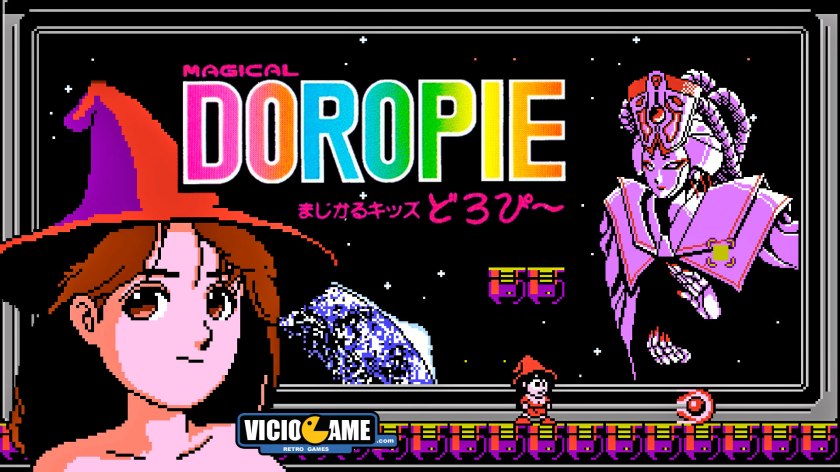
The Krion Conquest (known as Magical Kids Doropie in Japan) is an adventure game released in 1990 for the NES. An enemy empire invades Earth with an army of robots immune to conventional weapons. Humanity’s last hope is to recruit a brave young witch with magical powers to defeat evil.
Developer/Publisher: Vic Tokai
Release date: 1990
Platform: Nintendo / Famicom
🇺🇸 The American box for The Krion Conquest promises a fairy tale: a benevolent-looking sorceress on the cover, a helpless people on the back, and a plea for the heroine to return. Anyone who inserts the cartridge into the NES, however, finds something else entirely: an action game whose look, pacing, and weapon menu immediately call Mega Man to mind, a protagonist who changes color with each spell chosen, and a difficulty level that makes no concessions. Between the promise on the packaging and what happens on screen lies a disconnect, and a good part of this cartridge’s story lives right there.
The game was born in Japan, where it arrived on the Famicom on December 14, 1990, under the title Magical Kids Doropie (まじかるキッズどろぴー) in its promotional materials and Magical Doropie (まじかるどろぴー) on the title screen. The American edition, renamed The Krion Conquest, came out in January 1991 through Vic Tokai Inc., the arm based in Torrance, California, that handled the localization and distribution of the company’s titles in the West. The parent company, Vic Tokai of Shizuoka, belonged to the Tokai natural gas group (the “Vic” in the name stands for Valuable Information & Communication) and ran a games division from 1984 to 1997, with an eclectic catalog that ranged from the irreverent Clash at Demonhead to the mature Golgo 13: Top Secret Episode. Europe never officially received the game.
The project, which took about ten months of work, began as something else. In a later account, the designer says the original idea was a licensed game based on the 1986 anime Ozu no Mahōtsukai (オズの魔法使い), an adaptation of The Wizard of Oz that aired in Japan on TV Tokyo, the network that held the rights in the country, which ruled out using the property. Without a license, the team went with a protagonist of its own, and all that remained of the initial inspiration was the name: Doropie is a transliteration of Dorothy, and nothing else in the character’s design references Oz.
The choice of a girl as the heroine, in turn, caused friction inside the studio. Part of the team pushed back: some kept repeating that the Famicom was for boys, and others reminded everyone that nearly every game of the era starred men because audiences wouldn’t identify with female characters. The designer defended the idea with an argument from tradition: the witch with the hat and broom was, in his words, one of the oldest heroine looks in arcade and console games. The design also carried an unusual trait: the absence of eyelashes. In anime-style female characters, eyelashes usually work as an instant code for femininity, and the person in charge of the design chose to go for cuteness without that symbol. One detail sums up the tone: when she crouches, Doropie covers her face with the brim of her hat.
The kinship with Mega Man is obvious, and the menu confirms it: the selection screen switches the active spell, and the protagonist’s outfit changes color along with it, from the red of the normal shot to the blue of ice and the green of the bouncing orbs. But the imitation goes no deeper than the surface. Doropie starts out with her full arsenal, with no weapons to win from bosses and no strict energy meter to manage, and there is no stage select: there are four rounds, each with three areas and a boss fight, followed by a short fifth round containing the final sequence. There are also freedoms that the first three Mega Man games didn’t offer, such as shooting upward while standing still, ducking under projectiles, and charging the basic shot by holding down the button, something the Mega Buster wouldn’t learn until Mega Man 4, released in Japan in December 1991.
There are six spells, all unlocked from the start: the normal shot; Fire, which summons a phoenix that can wipe out every enemy on screen at the cost of a third of the life bar; Freeze, which freezes enemies and some obstacles when charged; Ball, orbs that ricochet off walls and hit enemies at awkward angles; Shield, a temporary barrier that absorbs shots; and Broom, the broomstick. In practice, Ball and Broom see most of the use, while Freeze and Shield are relegated to specific situations, partly because the original ambition was pruned by the hardware. According to the designer, the idea was for Freeze to turn enemies into platforms and for Shield to serve as a support for going down, but the cartridge’s limited memory and technical problems blocked those plans.
The broom is the game’s most distinctive idea and also its most controversial. It appears with the shoot button, follows the direction in which Doropie fires (left, right, or up, never down), and disappears if the witch jumps or if the broom touches a wall. Because the stage design assumes the player always has it at hand, it stops being an option and becomes a requirement: it carries Doropie across spike pits and up tall walls, and in Round 4 the first area is practically a vertical climb made astride it. The problem is that the broom is wide, the control is imprecise, and the heavy gravity of the heroine’s jumps complicates dismounting, so a feature conceived as free mobility ends up producing more deaths than enchantment. It’s a good idea for a witch game; the execution, not so much.
The difficulty comes from less obvious places than simple brawling. Doropie suffers no knockback when hit and gets a generous window of invincibility after each hit, which softens spikes and ambushes, but the life bar is short, the pumpkins that restore health rarely appear, and health is only refilled between rounds. Each area works as a checkpoint, and the flying enemies, with unfriendly hitboxes, come in at angles that are hard to predict even for players carrying the full arsenal. The stage design tries to mix things up with slippery ice in Round 2 and an air meter in the flooded tunnels of Round 3, but the areas look more alike than they should, and the enemy robots feel like pale imitations of Dr. Wily’s henchmen. Most of the bosses follow the recipe of waiting for an opening, dodging, and repeating, with the exception of Yukimaru, the robotic snowman of Round 2, whose snowballs demand sharper timing. The high point comes at the end: the final sequence, which starts with Astro Guard, passes through a clone of the heroine herself, and ends with the enormous Gokuraku Kishintei, demands more reflexes and aim than the earlier fights.
Where the game departs from Capcom’s playbook is in its presentation. The cutscenes in the Japanese version follow the formula of those in Tecmo’s Ninja Gaiden, with large, expressive portraits, a Doropie with a surprisingly broad emotional range for the NES, and anime-style intermission screens between rounds that give the whole package the air of a forgotten magical-girl series. The stage visuals are another story: they sit in the range of Mega Man and Mega Man 2, a step behind what Capcom itself was already showing in Mega Man 3, and some critics see in this a game slightly behind the times for late 1990. There is a plausible explanation for the lag: the math on the ten months of production suggests that work began before the third installment reached Japanese stores in September 1990. The soundtrack was outsourced to Aicom and credited to Kiyoshi Yokoyama and Masaki Kase, and it delivers stage themes with catchy melodies. The Japanese title screen music, incidentally, is much cuter than the American one, and the difference says a lot about the mood each edition wanted to sell.
The Japanese story is more elaborate than the Western edition lets on. In 1999, the Akudama Empire (Akudama roughly means “the villains”) attacks Earth with an army of robots that are immune to conventional weapons and vulnerable only to magic. The mercenary Kagemaru turns to the only witch who escaped imprisonment, Doropie, who is kept inside a magic wand. The leader of the invaders, Gokuraku Kishintei, is an old adversary of the heroine, sealed away by her in the past; by kidnapping Kagemaru, she forces Doropie to break that seal, and the final confrontation takes place at the empire’s space base. That is where the most curious revelation comes: on the verge of death, the villain confesses that she started the invasion in response to humanity’s destruction of nature. Kagemaru, presumed dead, turns up alive in the ending, and Doropie returns to Earth. The ending carries an unexpectedly environmentalist streak for a 1990 action game.
The Western version cut this narrative and replaced it with a fairy tale. The back of the box says that, in ancient times, giant animals ravaged the world and the people sought help from the Old Witches’ World, and from there came Francesca, a sorceress of great power who restored peace; now it is the Krions who occupy the planet, and the text ends with a plea for her to return. Doropie became Francesca, the empire came to be called the Krion Empire, and both the mercenary and the villain were left without official names. At an earlier stage, the game was going to be released in the United States as Francesca’s Wand. Only two images from that phase are known, and they show a title screen with that name and a concrete difference in the first area: where the final version places an enemy, the earlier one offered an extra life, and the floor to the right had not yet been raised. A realistic portrait of the heroine, with blinking eyes, survives to this day buried in the cartridge’s graphics data, in both the American and Japanese versions, as a fossil of that abandoned title screen.
The covers tell parallel stories. The American one, painted by illustrator Lawrence “Lars” Fletcher, who was responsible for the art on nearly the entire Vic Tokai line between 1989 and 1991, reinforces the fairy tale, and the sorceress ironically recalls the Good Witch of the North from Oz, the very universe the project had lost at the outset. The Japanese one shows Kagemaru armed, a detail the game barely bears out: he only wields a weapon when he becomes a playable character through a code. Swapping Francesca’s Wand for The Krion Conquest also shifts the focus from the witch to the war, and the result is a Western package that says very little about what the cartridge holds.
The most visible cut is inside the cartridge. The American edition drops all of the cutscenes except for a slightly retouched version of the introduction, in which Francesca is given more childlike features, while the Japanese Doropie keeps the same look in every scene. Also gone are the screens that introduce each round, the continues, and the direct return to the boss room: whoever dies in a fight goes back to the start of the third area instead of restarting in front of the opponent, and whoever loses all their lives starts the game over from scratch. The circled hexagram that closes out each stage in the Japanese version also disappears, owing to Nintendo of America’s policy against religious symbols, since the figure resembles the Star of David. In place of the Japanese ending with its environmental message, the American player gets only a “congratulations” and the credits, and there are also small layout differences in Round 4 and one fight in Round 5, the Astro Guard fight, in which the fireballs can be avoided by ducking in the American version but not in the Japanese one. The common explanation for the missing continues is that Vic Tokai wanted to cater to the American taste for hard games, but the traces left in the code suggest a different reading.
There are signs that the American edition derives from a build that predates the Japanese one, rather than from a version deliberately simplified. The invincibility routine is still in the cartridge, just without the code that activates it; the character-swap routine is gone; and a glitch lets players skip the boss fights of Rounds 2 and 3, which reinforces the impression of a less polished product. In the Japanese version, the button sequences exist and deliver what the American one hides: a variation of the Konami code, entered on the second controller and confirmed on the first, unlocks Kagemaru as a playable character and an alternate Doropie in a beret and jacket; another code leads to a stage select; a third grants invincibility. Technically, the character codes merely write a value to memory that determines which graphics banks the MMC3 chip loads, and the swap is limited to sprites, with no new dialogue or abilities. Whichever edition came first, anyone playing the Japanese one gets more game in their hands, and that is the most common opinion among those who have played through both.
What the team couldn’t include weighs as much as what the American edition removed. The fifth round was cut short for lack of space on the cartridge: it has a single area, and the graphic of the number 5, intended for the stage-clear screen, never appears, because the credits roll right after the final fights. Graphics that were never put to use, such as a portrait of Doropie that seems to have been meant to move in sync with the dialogue in the Round 1 cutscenes, show that the ambition was greater than the memory budget allowed. A sequel was even planned, but the Super Famicom had debuted in Japan on November 21, 1990, less than a month before Magical Doropie came out, and the development kit for the new machine cost more than the team could afford for a second game.
Reception at the time was lukewarm. Famitsu gave it 23 out of 40, a middling result on the magazine’s scale, and Hippon Super! gave it 5 out of 10 in January 1991. In the United States, with modest promotion and the shadow of Mega Man cast over it, the game went almost unnoticed. Later retrospectives split into two camps. For some, it is merely a copy lacking the tightness of the original. For others, it goes beyond it, thanks to a charismatic heroine, control ideas that Capcom’s series would only adopt later, and spells that give the player more than one way to solve each room. The average of the few verdicts collected on aggregator sites hovers around 56%, a portrait of a game that divides more than it excites.
The game had an unexpected epilogue. On January 14, 2004, Genki Mobile released a mobile phone version in Japan, distributed through Vodafone’s service, with scaled-down graphics to fit the small screens of the era, an Easy mode for those who found the original too tough, and a non-functional option called Upload. Aside from that, there have been no official re-releases. The collector market, however, has been more generous to the cartridge than critics ever were: in 2026, a loose American copy goes for around $100, a complete-in-box copy tops $200, and sealed units exceed $800.
What keeps The Krion Conquest in circulation is not the precision of its design but the sum of accidents running through it: a license that slipped away, memory space that ran short, a Western edition that showed less than the original. Today, every cartridge that goes into the NES delivers an imperfect game full of personality, the kind people criticize with relish and restart to try one more round. Between the shadow of Mega Man and the choices of a team that bet on a witch when part of the studio preferred a male hero, Doropie, or Francesca to those who met her under the American name, keeps riding her broomstick, a little off-kilter. She crosses the screen with a stubbornness that explains why the game is still being discussed more than three decades later.
🇧🇷 A caixa americana de The Krion Conquest promete uma fábula: uma feiticeira de ar benevolente na capa, um povo desamparado no verso e um apelo para que a heroína reapareça. Quem insere o cartucho no NES, porém, encontra outra coisa: um jogo de ação com visual, ritmo e menu de armas que remetem de imediato a Mega Man, uma protagonista que troca de cor a cada magia escolhida e uma dificuldade que não faz concessões. Entre a promessa da embalagem e o que acontece na tela existe um desencontro, e boa parte da história desse cartucho mora justamente nele.
O jogo nasceu no Japão, onde chegou ao Famicom em 14 de dezembro de 1990 com o título Magical Kids Doropie (まじかるキッズどろぴー) nas divulgações e Magical Doropie (まじかるどろぴー) na tela de abertura. A edição americana, rebatizada The Krion Conquest, saiu em janeiro de 1991 pela Vic Tokai Inc., o braço sediado em Torrance, na Califórnia, que cuidava da localização e da distribuição dos títulos da empresa no Ocidente. A matriz, a Vic Tokai de Shizuoka, pertencia ao grupo de gás natural Tokai (o “Vic” do nome vem de Valuable Information & Communication) e manteve uma divisão de games de 1984 a 1997, com um catálogo eclético que vai do irreverente Clash at Demonhead ao adulto Golgo 13: Top Secret Episode. A Europa nunca recebeu o jogo oficialmente.
O projeto, que tomou cerca de dez meses de trabalho, começou como outra coisa. Em depoimento posterior, o designer conta que a ideia original era um jogo licenciado a partir do anime de 1986 Ozu no Mahōtsukai (オズの魔法使い), adaptação de O Mágico de Oz exibida no Japão pela TV Tokyo, emissora que detinha os direitos no país, o que inviabilizou o uso da obra. Sem licença, a equipe partiu para uma protagonista própria, e da inspiração inicial restou apenas o nome: Doropie é uma transliteração de Dorothy, e nada mais no desenho da personagem faz referência a Oz.
A escolha de uma garota como heroína, por sua vez, gerou atrito dentro do estúdio. Parte da equipe resistiu: havia quem repetisse que o Famicom era coisa de menino e quem lembrasse que quase todos os jogos da época tinham homens no comando porque o público não se identificaria com personagens femininas. O designer defendeu a ideia com um argumento de tradição: a bruxa de chapéu e vassoura era, nas palavras dele, um dos visuais de heroína mais antigos dos fliperamas e dos consoles. O desenho ganhou ainda uma marca incomum, a ausência de cílios. Em personagens femininas de estilo anime, os cílios costumam funcionar como código imediato de feminilidade, e o responsável pelo design preferiu buscar a fofura sem esse símbolo. Um detalhe resume o tom: ao se abaixar, Doropie cobre o rosto com a aba do chapéu.
O parentesco com Mega Man é evidente e o menu o confirma: a tela de seleção troca a magia ativa e o figurino da protagonista muda de cor junto, do vermelho do tiro normal ao azul do gelo e ao verde das esferas que quicam. Mas a imitação não vai além da superfície. Doropie já nasce com o arsenal completo, sem armas a conquistar dos chefes e sem barra de energia rigorosa para administrar, e não existe seleção de fases: são quatro rounds, cada um com três áreas e uma luta de chefe, seguidos de um quinto round curto com a sequência final. Também há liberdades que os três primeiros Mega Man não davam, como atirar para cima com a heroína parada, agachar para passar sob projéteis e carregar o tiro básico segurando o botão, algo que o Mega Buster só aprenderia em Mega Man 4, lançado no Japão em dezembro de 1991.
São seis magias, todas liberadas desde o começo: o tiro normal; Fire, que invoca uma fênix capaz de varrer todos os inimigos da tela ao custo de um terço da barra de vida; Freeze, que congela adversários e alguns obstáculos quando carregado; Ball, esferas que ricocheteiam nas paredes e atingem inimigos em ângulos incômodos; Shield, uma barreira temporária que absorve tiros; e Broom, a vassoura. Na prática, Ball e Broom concentram a maior parte do uso, enquanto Freeze e Shield ficam relegados a situações específicas, em parte porque a ambição inicial foi podada pelo hardware. Segundo o designer, a ideia era que Freeze transformasse inimigos em plataformas e que Shield servisse de apoio para descer, mas a memória limitada do cartucho e problemas técnicos barraram esses planos.
A vassoura é a ideia mais característica do jogo e também a mais controversa. Ela surge com o botão de tiro, obedece à direção em que Doropie atira (esquerda, direita ou para cima, nunca para baixo) e desaparece se a bruxa pula ou se a vassoura encostar numa parede. Como o design das fases pressupõe que o jogador sempre a tenha à mão, ela deixa de ser opção e vira obrigação: cruza poços de espinhos, escala paredes altas e, no Round 4, a primeira área é praticamente uma subida vertical montada nela. O problema é que a vassoura é larga, o controle é impreciso e a gravidade pesada dos saltos da heroína complica o desembarque, de modo que um recurso pensado como mobilidade livre acaba rendendo mais mortes do que encantamento. A ideia é boa para um jogo de bruxa; a execução, nem tanto.
A dificuldade vem de lugares menos óbvios do que a simples pancadaria. Doropie não sofre knockback ao ser atingida e tem uma janela generosa de invencibilidade depois de cada dano, o que suaviza espinhos e emboscadas, mas a barra de vida é curta, as abóboras que recuperam energia raramente aparecem e a saúde só é reposta entre um round e outro. Cada área funciona como checkpoint, e os inimigos voadores, com hitboxes pouco amigáveis, chegam em ângulos difíceis de prever mesmo para quem carrega o arsenal completo. O design de fases tenta variar o cardápio com gelo escorregadio no Round 2 e um medidor de ar nos túneis alagados do Round 3, mas as áreas se parecem mais do que deveriam e os robôs inimigos soam como versões apagadas dos capangas do Dr. Wily. Os chefes seguem, em sua maioria, a receita de esperar a brecha, desviar e repetir, com a exceção de Yukimaru, o boneco de neve robótico do Round 2, cujas bolas de neve pedem uma sincronia mais apurada. O ponto alto fica para o fim: a sequência final, que começa com o Astro Guard, passa por um clone da própria heroína e termina na enorme Gokuraku Kishintei, pede mais reflexo e mira do que as lutas anteriores.
Onde o jogo se afasta do manual da Capcom é na apresentação. As cutscenes da versão japonesa seguem a cartilha das de Ninja Gaiden, da Tecmo, com retratos grandes e expressivos, uma Doropie de repertório emocional surpreendente para o NES e telas de intervalo no estilo anime entre os rounds, que dão ao conjunto o ar de uma série de garota mágica esquecida. O visual das fases é outra história: fica na faixa de Mega Man e Mega Man 2, um passo atrás do que a própria Capcom já mostrava em Mega Man 3, e parte da crítica enxerga aí um jogo um pouco defasado para o fim de 1990. A defasagem tem explicação plausível: a conta dos dez meses de produção indica que o trabalho começou antes de o terceiro capítulo chegar às lojas japonesas, em setembro de 1990. A trilha foi terceirizada à Aicom e assinada por Kiyoshi Yokoyama e Masaki Kase, e rende temas de fase de melodias grudentas. A música da tela de título japonesa, aliás, é bem mais fofa do que a americana, e a diferença diz muito sobre o clima que cada edição quis vender.
O enredo japonês é mais elaborado do que a edição ocidental deixa supor. Em 1999, o Akudama Empire (Akudama é algo como “os vilões”) ataca a Terra com um exército de robôs imunes a armas convencionais e vulneráveis apenas à magia. O mercenário Kagemaru recorre à única bruxa que escapou de um aprisionamento, Doropie, guardada numa varinha mágica. A líder dos invasores, Gokuraku Kishintei, é uma antiga adversária da heroína, selada por ela no passado; ao sequestrar Kagemaru, força Doropie a romper essa prisão, e o confronto final acontece na base espacial do império. Ali surge a revelação mais curiosa: moribunda, a vilã confessa que iniciou a invasão em resposta à destruição da natureza pela humanidade. Kagemaru, dado como morto, aparece vivo no desfecho e Doropie volta à Terra. O fecho tem um viés ecológico inesperado para um jogo de ação de 1990.
A versão ocidental cortou essa narrativa e a trocou por uma fábula. O verso da caixa conta que, em tempos remotos, animais gigantescos devastaram o mundo e o povo pediu ajuda ao Old Witches’ World, de onde veio Francesca, uma feiticeira de grandes poderes que restaurou a paz; agora são os Krions que ocupam o planeta, e o texto termina com um apelo para que ela volte. Doropie virou Francesca, o império passou a se chamar Krion Empire e tanto o mercenário quanto a vilã ficaram sem nome oficial. Numa fase anterior, o jogo seria lançado nos Estados Unidos como Francesca’s Wand. Só duas imagens dessa etapa são conhecidas, e mostram uma tela de título com esse nome e uma diferença concreta na primeira área: onde a versão final posiciona um inimigo, a anterior oferecia uma vida extra, e o piso à direita ainda não tinha sido elevado. Um retrato realista da heroína, de olhos que piscam, sobrevive até hoje enterrado nos dados gráficos do cartucho, tanto no americano quanto no japonês, como fóssil dessa tela de título abandonada.
As capas contam histórias paralelas. A americana, pintada pelo ilustrador Lawrence “Lars” Fletcher, responsável pela arte de quase toda a linha da Vic Tokai entre 1989 e 1991, reforça a fábula, e a feiticeira lembra, por ironia, a Bruxa Boa do Norte de Oz, justamente o universo que o projeto perdera no começo. A japonesa mostra Kagemaru armado, detalhe que o jogo praticamente não confirma: ele só empunha a arma quando vira personagem jogável por código. A troca de Francesca’s Wand por The Krion Conquest ainda desloca o foco da bruxa para a guerra, e o resultado é uma embalagem ocidental que diz muito pouco sobre o que o cartucho guarda.
O corte mais visível está dentro do cartucho. A edição americana abre mão de todas as cutscenes, exceto uma versão levemente retocada da introdução, na qual Francesca ganha traços mais infantis, enquanto a Doropie japonesa mantém o mesmo aspecto em todas as cenas. Também somem as telas que apresentam cada round, os continues e o retorno direto à sala do chefe: quem morre numa luta volta ao início da terceira área, em vez de recomeçar diante do adversário, e quem perde todas as vidas recomeça o jogo do zero. Desaparece ainda o hexagrama circulado que fecha cada fase na versão japonesa, por causa da política da Nintendo of America contra símbolos religiosos, já que a figura lembra a estrela de Davi. No lugar do desfecho ecológico japonês, o jogador americano recebe apenas um parabéns e os créditos, e há ainda pequenas diferenças de layout no Round 4 e uma luta do Round 5, a do Astro Guard, em que as bolas de fogo podem ser evitadas agachando na versão americana, mas não na japonesa. A explicação corrente para a ausência de continues é que a Vic Tokai quis agradar o gosto americano por jogos difíceis, mas os vestígios no código sugerem outra leitura.
Há sinais de que a edição americana derive de uma compilação anterior à japonesa, e não de uma versão simplificada de propósito. A rotina de invencibilidade continua no cartucho, só que sem o código que a ativa; a rotina de troca de personagem desapareceu; e um defeito permite pular as lutas contra os chefes dos Rounds 2 e 3, o que reforça a impressão de um produto menos lapidado. Na japonesa, as sequências existem e entregam o que a americana esconde: uma variação do código da Konami, digitada no segundo controle e confirmada no primeiro, libera Kagemaru como personagem jogável e uma Doropie alternativa de boina e jaqueta; outro código leva à seleção de fases; um terceiro garante invencibilidade. Tecnicamente, os códigos de personagem só gravam um valor em memória que escolhe quais bancos gráficos o chip MMC3 carrega, e a troca se limita a sprites, sem diálogos ou habilidades novas. Seja qual for a edição que veio primeiro, quem joga a japonesa tem mais jogo nas mãos, e essa é a opinião mais comum entre quem já passou pelas duas.
O que a equipe não pôde incluir pesa tanto quanto o que a edição americana tirou. O quinto round foi encurtado por falta de espaço no cartucho: tem uma única área, e o gráfico do número 5, previsto para a tela de fase concluída, nunca aparece, porque os créditos rolam logo depois das lutas finais. Gráficos que nunca entraram em uso, como um retrato de Doropie que parecia previsto para se mexer em sincronia com os diálogos das cutscenes do Round 1, mostram que a ambição era maior do que o orçamento de memória permitia. Uma continuação chegou a ser planejada, mas o Super Famicom estreara no Japão em 21 de novembro de 1990, menos de um mês antes de Doropie, e o kit de desenvolvimento da nova máquina custava mais do que a equipe podia pagar para um segundo jogo.
A recepção na época foi morna. A Famitsu concedeu 23 pontos em 40, resultado mediano na escala da revista, e a Hippon Super! deu 5 em 10, em janeiro de 1991. Nos Estados Unidos, com promoção modesta e a sombra de Mega Man projetada sobre ele, o jogo passou quase despercebido. As retrospectivas posteriores se dividem em dois campos. Para uns, é apenas uma cópia sem a firmeza do original. Para outros, vai além dela, graças a uma heroína carismática, a ideias de controle que a série da Capcom só adotaria depois e a magias que dão ao jogador mais de uma forma de resolver cada sala. A média dos poucos veredictos reunidos em agregadores ronda os 56%, retrato de um jogo que divide mais do que entusiasma.
O jogo teve um epílogo inesperado. Em 14 de janeiro de 2004, a Genki Mobile lançou no Japão uma versão para celulares, distribuída pelo serviço da Vodafone, com gráficos reduzidos para caber nas telas pequenas da época, um modo Easy para quem achava o original duro demais e uma opção não funcional chamada Upload. Fora isso, não houve relançamentos oficiais. O mercado de colecionadores, porém, é mais generoso com o cartucho do que a crítica jamais foi: em 2026, um exemplar americano avulso gira em torno de 100 dólares, a versão completa passa dos 200 e unidades lacradas ultrapassam os 800.
O que mantém The Krion Conquest em circulação não é a precisão do projeto, e sim a soma de acasos que o atravessam: uma licença que escapou, um espaço de memória que faltou, uma edição ocidental que mostrou menos do que o original. Hoje, cada cartucho que entra no NES devolve um jogo imperfeito e cheio de personalidade, desses que se criticam com gosto e se reiniciam para tentar mais um round. Entre as sombras de Mega Man e as escolhas de uma equipe que apostou numa bruxa quando parte do estúdio preferia um herói, Doropie, ou Francesca para quem a conheceu pelo nome americano, segue montada na vassoura, um pouco fora de prumo. Atravessa a tela com uma teimosia que explica por que o jogo continua sendo discutido mais de três décadas depois.
🤑💲Earn money without doing anything! Just leave these apps open:
https://r.honeygain.me/CONTA9DB02
https://packetstream.io/?psr=1uPb
⬛ 𝗧𝗶𝗸𝗧𝗼𝗸: https://www.tiktok.com/@viciogame
🟧 𝗜𝗻𝘀𝘁𝗮𝗴𝗿𝗮𝗺: http://www.instagram.com/viciogame
🟥 𝗬𝗼𝘂𝘁𝘂𝗯𝗲: http://www.youtube.com/viciogame
🟦 𝗙𝗮𝗰𝗲𝗯𝗼𝗼𝗸: http://www.facebook.com/viciogame
🔳 𝗧𝗵𝗿𝗲𝗮𝗱𝘀: https://www.threads.net/@viciogame
🟪 𝗧𝘄𝗶𝘁𝗰𝗵: https://www.twitch.tv/ViciogameRetroGames
🟨 𝗕𝗹𝗼𝗴: http://www.viciogameblog.com/
🟦𝗧𝘄𝗶𝘁𝘁𝗲𝗿: http://www.twitter.com/viciogame
#Viciogame #Gameplay #LetsPlay #Playthrough #Games #Gaming #Videogames #Review #Game #Detonado #Walkthrough #Ending #Reviews #Facts #Retro #RetroGaming #Roms #Emulator #Longplay #Speedrun #NoCommentary #TheKrionConquest #MagicalKidsDoropie #MagicalDoropie #Nintendo #Famicom #まじかるキッズどろぴー #まじかるどろぴー #NES #ファミリーコンピュータ #任天堂 #オズの魔法使い #TheWizardofOz #halloween #witch #Doropie #MegaMan #Rockman #NinjaGaiden #Francesca

