
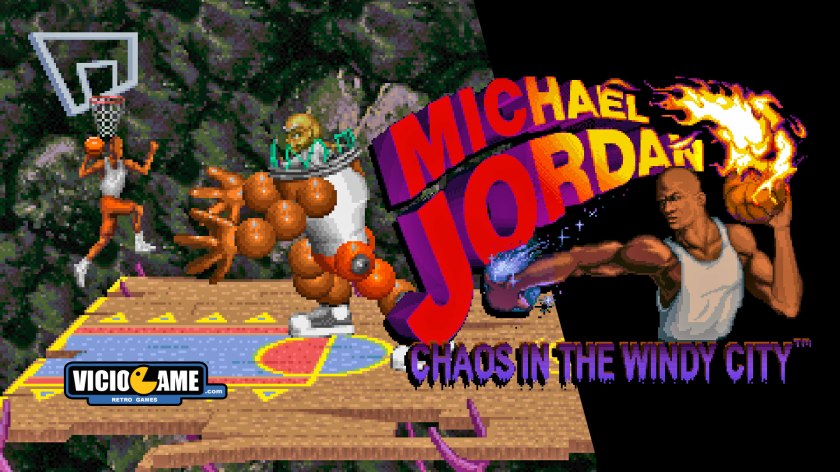
Michael Jordan: Chaos in the Windy City is a platformer released in 1994 for the Super Nintendo. A mad scientist has kidnapped every member of a basketball team that was set to take part in a charity event. Jordan is the only one skilled enough to take on the enemies and rescue the team.
Developer/Publisher: Electronic Arts
Release date: 1994
Platform: Super Nintendo / Super Famicom
🇺🇸 In 1994, the most famous athlete on the planet wasn’t playing basketball. Michael Jordan had traded the court for minor-league baseball diamonds, and the industry that lived off his image was facing an awkward question: what do you do with a name that big when its owner steps away from the sport? Electronic Arts answered in its own way, releasing a Super Nintendo cartridge with Jordan’s face on the cover and, inside, not a single basketball game. Michael Jordan: Chaos in the Windy City pits the man in the No. 23 jersey against a mad scientist, lab mutants, and factory traps in a platforming and exploration game that reached American stores on November 21. It’s the kind of product only the licensing logic of the 1990s can explain, and that is exactly why it makes for a far more interesting conversation than many perfectly decent, forgotten sports games from the same year.
The context helps explain the nature of the bet. Jordan announced his retirement in 1993, signed with the White Sox baseball organization, and spent 1994 with the Birmingham Barons. The Bulls carried on without him, and the country was still coming to terms with his absence when, on September 9, Jordan returned to the court for a charity game organized by Scottie Pippen at Chicago Stadium, starring in what is considered the last basketball game played in that arena. On November 1, the United Center retired his No. 23 jersey and unveiled his statue. Three weeks later, EA’s cartridge hit the shelves, and in 1995, less than four months after that, a statement announced Jordan’s return to the NBA. Chaos in the Windy City was therefore born in the gap between the farewell and the comeback, and its plot, built around a charity game of stars, found a curious echo in real life just weeks before launch.
EA and Jordan knew each other well. Ever since Jordan vs. Bird: One on One in 1988, the company had used his face as the calling card of its basketball games, and in 1993 it had released Michael Jordan in Flight, a basketball simulation with a 3D engine. The partnership came at a price: Jordan negotiated the use of his image on his own, outside the collective agreement that covered the rest of the league’s players, and the contract with EA kept him out of other publishers’ smash hits, such as NBA Jam. With the star off the court, simulating basketball in his name felt forced, so the solution was to switch genres. The company made a similar bet on Shaquille O’Neal, whose Shaq Fu, a fighting game, reached stores in October 1994: two basketball stars headlining action games instead of basketball games, just weeks apart.
Having Jordan’s name and little else also shaped the game. Anyone hoping to run into Scottie Pippen or other familiar names from the league will find athletes without identifiable faces or last names, and the final boss, a giant robotic version of the star himself, shows up in a generic white tank top and orange shorts instead of a Bulls uniform. All signs point to the contract covering Jordan’s likeness and almost nothing around him, and EA got around the limitation with anonymous extras and plenty of science fiction.
The job of turning that premise into a game fell to Amy Hennig. Coming from the art and animation side at EA, she took over as lead designer when the concept was already locked in, and she describes the situation as a crazy idea that had to be given shape: putting Michael Jordan in a platformer. It was her debut as lead designer, years before she put her signature on the Legacy of Kain series at Crystal Dynamics and fifteen years before she led the team on Uncharted 2: Among Thieves at Naughty Dog. Production went to Jim Rushing, a regular on the company’s Jordan games, who had already produced Michael Jordan in Flight, and the programming team was made up of David O’Connor, Chuck Sommerville, Simon Freeman, and Lisa Ching. The soundtrack was split among four composers, including David Whittaker, a Brit and veteran of the Commodore 64 and Amiga who composed the music for Shadow of the Beast. During development, the project circulated under the working title Michael Jordan: The Mad Professor Showdown, a name that already put the villain front and center on the poster.
Hardware limits shaped many of the team’s choices. Cartridges of the era offered very little memory, and Hennig recalls that the game carries only a handful of recorded voice lines, with the rest of the dialogue delivered in text boxes, which explains why the rescued athletes communicate in writing.
The story is simple and completely unhinged. Dr. Max Cranium kidnaps the stars invited to the charity game, and it’s up to Jordan to make his way through four areas (Holding Cells, Laboratory, Factory, and Riverview, an amusement park whose name recalls Chicago’s old Riverview Park, which closed in 1967) to free them. The game opens with a comic-book sequence and, between areas, treats itself to transition levels aboard the L, the city’s elevated train, in which Jordan has to fend off pushy photographers, a joke about being hounded by the press, a subject the star knew well. In all, there are more than twenty levels, linked by map screens that show Chicago landmarks.
In practice, Chaos in the Windy City works as a side-scrolling exploration adventure in which the ball is just one of the tools. The levels are mazes with locked doors, and the player collects keys in different colors, decides which one to carry when it’s time to open each door, and has to remember what each one opens, with no map to help. Along the way, captured athletes are freed and repay the favor with text hints; portals lead to timed bonus rooms, where the goal is to sink baskets or defeat enemies; and the hoops scattered around the scenery double as checkpoints and as triggers for assorted effects.
The main weapon is the ball itself. Jordan throws it at enemies and, with the special jump, performs a dunk that doubles as a downward strike, hitting anything beneath his feet. Special balls join the inventory over the course of the campaign: an ice ball, a flaming one that deals double damage, an iron one as heavy as a bowling ball, a golden homing ball, one that ricochets, a seismic one, and a baseball that passes through walls and enemies and returns like a boomerang, an inevitable wink at the star’s side career. Health is measured in orbs, and two of Jordan’s real-life sponsors turn into healing items: Gatorade restores half an orb, and Wheaties restores a full one. Rookie, Pro, and All-Star, the three difficulty settings, come from NBA vocabulary and make up one of the few points where the game remembers its subject is basketball. An alphanumeric password lets players pick the campaign back up, a common solution on cartridges of the era.
The controls are where the game divides opinion. Jordan runs with a dedicated shoulder button, rides elevators, slides along pulleys, and jumps with a weight and inertia that some call loose and others call rigid, to the point of drawing comparisons to the stiff cadence of Super Castlevania IV. Some read this as a flaw, while others see an attempt to give physical presence to an athlete famous for his hang time. The scrolling also has a slight back-and-forth wobble when the character stops, a detail that irritates anyone who has to line up precision jumps.
Visually, the game does better with animation than with variety. Jordan has a generous repertoire of dunks and, after defeating a boss, repeats the fist-pump celebration from the game-winning shot against Cleveland in the 1989 playoffs, a direct nod to anyone who followed his career. The bestiary includes swooping bats, giant spiders, floating robotic eyes, mechanical monkeys, mutants, and zombies with basketballs for heads, with no concern whatsoever for coherence. The sound alternates between the dark tension of the labs and nearly playful passages, in a soundtrack that does its job without sticking in your head.
The level design is where the game’s ambition and its stumbles come together. Keys and checkpoints don’t mix well: activating a hoop too early and dying soon afterward can send the player back to a safe point without the key they need, and on the Pro setting, a slip like that is costly. Enemy AI is basic, and much of the challenge comes from where the enemies are placed and from the geometry of the mazes, not from behaviors that require reading and reacting. The result swings between the satisfaction of carving a path through a setting full of doors and the weariness of retracing the same routes.
It isn’t all flaws, though, and perhaps that is where the project’s greatest merit lies: the game treats Jordan as an action character, not as a logo. The dunk becomes an attack, the special balls change how each room is approached, and the key system forces the player to read the environment closely, which gives the whole package a personality that many licensed games of the era never even tried to have. There is also an unusual boldness in the tone, placing the squeaky-clean image of an advertising pitchman in the middle of a parade of monsters and sinister laboratories.
The initial reception was more generous than the game’s later reputation suggests. GamePro was the most enthusiastic, although it complained about the blatant advertising and the tricky controls. Nintendo Power praised Jordan’s moves, the password system, and the graphics, with reservations about the controls and the generic enemies. In Europe, Super Play gave it 83% and Total! gave it 82%; in the United States, Game Players came in at 72%, and the three reviewers at GameFan ranged between 74% and 82%. The harshest verdict came from Next Generation, which gave it two stars out of five, praising the concept but finding the result repetitive. Taken together, the scores sketch a game good enough to do its job, but without the muscle to compete for attention with the big Super Nintendo releases of that holiday season.
Its reputation as a flop came later. In 1997, Nintendo Power listed the ten worst games of all time, and Chaos in the Windy City came in at number seven, with Shaq Fu at number three. The write-up admitted that the cartridge wasn’t really that bad, but condemned it for wasting the best license in the world, a verdict that says more about expectations than about the game. Nearly three years earlier, the magazine itself had treated the title kindly. What changed was the context: 3D had become the market’s yardstick, Jordan was back on the court, and a side-scrolling maze platformer seemed like too little for anyone with the star at their disposal.
The Super Nintendo was the only platform to get the game. Versions for the Genesis (known as the Mega Drive outside the United States) and the Game Gear were announced, and Sega’s official magazine in the United States even published a preview of the version for the 16-bit console back in 1994, with the conversion handled by the studio Foley Hi-Tech. Neither version reached stores, the reasons were never made clear, and images survive of a box and a cartridge for the Genesis port, a sign that the work progressed further than the silence that followed suggests. In Europe, the SNES cartridge came out in 1995, published by Ocean.
In Brazil, the game arrived through Playtronic, Nintendo’s distributor in the country, in a box with Portuguese text. At a time when the red Bulls jersey turned up even among people who had never watched a full NBA game, the cover with Jordan holding a flaming basketball promised basketball, and the cartridge delivered something else, a surprise that Brazilian retrospectives still bring up when they put it next to Shaq Fu on lists of games starring sports idols.
Looking back, the game is a snapshot of an era when an athlete’s name was enough to justify any genre. Putting a star into over-the-top action already had precedents, such as Michael Jackson’s Moonwalker in 1990, and the idea would get its most popular incarnation in 1996, on the big screen, with the movie Space Jam, which puts that same Jordan up against threats every bit as absurd as Dr. Max Cranium. In 1994, though, the competition was playing in a different league: the same week Chaos in the Windy City arrived on store shelves, Nintendo released Donkey Kong Country, with pre-rendered graphics and a $16 million marketing campaign in the United States alone, and Super Metroid, months earlier, had raised the bar for side-scrolling exploration on the same console. A platformer with conventional graphics, mazes built around keys, and a star away from the court had little to say next to those neighbors, and that helps explain why the cartridge ended up overshadowed.
The game has never received an official re-release, and anyone who pops it into a console today finds an uneven game, with rough edges in the level design and controls, but one driven by a rare boldness: denying the court to the most marketable name in sports and sending him on a trek through a comic-book nightmare in the streets of Chicago. It isn’t the game the cover promises, and maybe that is exactly why it still gives people something to talk about.
🇧🇷 Em 1994 o atleta mais famoso do planeta não estava jogando basquete. Michael Jordan tinha trocado a quadra pelos campos de beisebol da liga menor, e a indústria que vivia da imagem dele enfrentava uma dúvida incômoda: o que fazer com um nome desse tamanho quando o dono se afasta do esporte? A Electronic Arts respondeu à sua maneira e lançou para o Super Nintendo um cartucho com o rosto de Jordan na capa e, por dentro, nenhuma partida de basquete. Michael Jordan: Chaos in the Windy City coloca o camisa 23 contra um cientista maluco, mutantes de laboratório e armadilhas de fábrica, num jogo de plataforma e exploração que chegou às lojas americanas em 21 de novembro. É o tipo de produto que só a lógica de licenciamento dos anos 90 explica, e por isso mesmo rende uma conversa bem mais interessante do que a de muitos jogos esportivos corretos e esquecidos da mesma safra.
O contexto ajuda a entender a natureza da aposta. Jordan anunciou a aposentadoria em 1993, assinou com o time de beisebol White Sox e passou 1994 na equipe Birmingham Barons. Os Bulls seguiram sem ele, e o país ainda digeria a ausência quando, em 9 de setembro, Jordan voltou à quadra num jogo beneficente organizado por Scottie Pippen no Chicago Stadium, protagonizando o que é considerado a última partida de basquete disputada naquele ginásio. Em 1º de novembro, o United Center aposentou a camisa 23 e inaugurou a estátua do jogador. Três semanas depois, o cartucho da EA chegava às prateleiras, e em 1995, menos de quatro meses mais tarde, um comunicado anunciava a volta de Jordan à NBA. Chaos in the Windy City nasce, portanto, no intervalo entre a despedida e o retorno, e seu enredo, centrado num jogo beneficente de astros, ganhou um eco curioso na vida real semanas antes do lançamento.
A EA e Jordan se conheciam bem. Desde Jordan vs. Bird: One on One, de 1988, a empresa usava o rosto dele como cartão de visitas dos seus jogos de basquete, e em 1993 tinha lançado Michael Jordan in Flight, simulador com engine tridimensional. O vínculo tinha um preço: Jordan negociava a própria imagem por conta, fora do acordo coletivo que reunia os demais jogadores da liga, e o contrato com a EA o manteve de fora de fenômenos de outras publicadoras, como NBA Jam. Com o astro afastado das quadras, simular basquete em nome dele soava forçado, e a saída foi trocar de gênero. A empresa fez uma aposta parecida com Shaquille O’Neal, cujo Shaq Fu, um jogo de luta, chegou às lojas em outubro de 1994: dois astros do basquete protagonizando jogos de ação em vez de jogos de basquete, com poucas semanas de diferença.
Ter o nome de Jordan e pouco além disso também moldou o jogo. Quem espera cruzar com Scottie Pippen ou com outros nomes conhecidos da liga encontra atletas sem rosto nem sobrenome identificáveis, e o chefe final, uma versão robótica gigante do próprio astro, aparece de regata branca e short laranja genéricos, em vez do uniforme dos Bulls. Tudo indica que o contrato cobria a imagem de Jordan e quase nada ao redor dele, e a EA contornou a limitação com figurantes anônimos e muita ficção científica.
Quem herdou a tarefa de transformar essa premissa em jogo foi Amy Hennig. Vinda da arte e da animação na EA, ela assumiu o design principal quando o conceito já estava fechado e descreve a situação como uma ideia maluca à qual restava dar forma: pôr Michael Jordan num jogo de plataforma. Foi a estreia dela como designer principal, anos antes de assinar a série Legacy of Kain na Crystal Dynamics e quinze anos antes de liderar a equipe de Uncharted 2: Among Thieves na Naughty Dog. A produção ficou com Jim Rushing, nome habitual dos jogos de Jordan na casa, que já tinha produzido Michael Jordan in Flight, e a programação reuniu David O’Connor, Chuck Sommerville, Simon Freeman e Lisa Ching. A trilha foi repartida entre quatro compositores, entre eles o britânico David Whittaker, veterano de Commodore 64 e Amiga que assinou a música de Shadow of the Beast. Durante o desenvolvimento, o projeto circulou com o título provisório de Michael Jordan: The Mad Professor Showdown, um nome que já punha o vilão no centro do cartaz.
Os limites do hardware pesaram nas escolhas. Os cartuchos da época ofereciam pouca memória, e Hennig lembra que o jogo carrega apenas algumas falas gravadas, com o restante dos diálogos entregue em caixas de texto, o que explica por que os atletas resgatados falam por escrito.
A história é simples e delirante. O Dr. Max Cranium sequestra os astros convocados para o jogo beneficente, e cabe a Jordan atravessar quatro territórios (Holding Cells, Laboratory, Factory e Riverview, um parque de diversões cujo nome remete ao antigo Riverview Park de Chicago, fechado em 1967) para libertá-los. O jogo abre com uma sequência em quadrinhos e, entre um território e outro, se permite fases de transição a bordo do L, o trem elevado da cidade, nas quais Jordan precisa se livrar de fotógrafos insistentes, uma piada sobre o assédio da imprensa, assunto que o astro conhecia bem. Ao todo são mais de vinte fases, ligadas por telas de mapa que exibem marcos de Chicago.
Na prática, Chaos in the Windy City funciona como uma aventura lateral de exploração em que a bola é apenas uma das ferramentas. As fases são labirintos com portas trancadas, e o jogador coleciona chaves de cores diferentes, escolhe qual carregar na hora de abrir cada porta e precisa lembrar o que cada uma abre, sem mapa para ajudar. Pelo caminho, atletas capturados são libertados e retribuem com dicas em texto; portais levam a salas de bônus cronometradas, nas quais é preciso acertar cestas ou derrotar inimigos; e os aros espalhados pelo cenário fazem às vezes de checkpoint e de gatilho para efeitos diversos.
A arma principal é a própria bola. Jordan a arremessa contra os inimigos e, com o salto especial, executa a enterrada que funciona como golpe em queda e atinge quem está sob seus pés. Bolas especiais entram no inventário ao longo da campanha: uma de gelo, uma flamejante que causa dano dobrado, uma de ferro pesada como bola de boliche, uma dourada teleguiada, uma que ricocheteia, uma sísmica e uma de beisebol que atravessa paredes e inimigos e volta como bumerangue, piscadela inevitável à carreira paralela do astro. A energia é medida em esferas, e dois patrocinadores reais de Jordan viram itens de cura: o Gatorade devolve meia esfera, e o Wheaties, uma inteira. Rookie, Pro e All-Star, os três níveis de dificuldade, vêm do vocabulário da NBA e formam um dos poucos pontos em que o jogo lembra que o assunto é basquete. Um password alfanumérico permite retomar a campanha, solução comum nos cartuchos da época.
É no controle que o jogo divide opiniões. Jordan corre com um botão de ombro dedicado, sobe em elevadores, desliza em roldanas e salta com um peso e uma inércia que alguns chamam de frouxidão e outros de rigidez, a ponto de aparecerem comparações com a cadência dura de Super Castlevania IV. Há quem leia isso como defeito e quem enxergue ali uma tentativa de dar corpo a um atleta célebre pelo tempo de suspensão no ar. A rolagem também tem um leve vai e vem quando o personagem para, detalhe que irrita quem precisa calcular saltos de precisão.
Visualmente, o jogo acerta mais na animação do que na variedade. Jordan tem um repertório generoso de enterradas e, ao derrotar um chefe, repete a comemoração de punho cerrado do arremesso decisivo contra o Cleveland nos playoffs de 1989, um aceno direto a quem acompanhava a carreira dele. O bestiário reúne morcegos que mergulham, aranhas gigantes, olhos robóticos flutuantes, macacos mecânicos, mutantes e zumbis com bolas de basquete no lugar da cabeça, sem a menor cerimônia com a coerência. O som alterna a tensão sombria dos laboratórios com passagens quase brincalhonas, numa trilha que cumpre o papel sem grudar na memória.
O design de fases concentra a ambição e os tropeços. Chaves e checkpoints convivem mal: ativar um aro cedo demais e morrer em seguida pode devolver o jogador a um ponto seguro sem a chave de que precisa, e na dificuldade Pro um deslize assim sai caro. A inteligência dos inimigos é básica, e boa parte do desafio vem do posicionamento deles e da geometria dos labirintos, não de comportamentos que exijam leitura. O resultado oscila entre a satisfação de abrir caminho num cenário cheio de portas e o cansaço de repetir percursos.
Nem tudo é defeito, e talvez esteja aí o maior mérito do projeto: o jogo trata Jordan como personagem de ação, não como logotipo. A enterrada vira golpe, as bolas especiais mudam a maneira de abordar cada sala e o sistema de chaves obriga a ler o cenário com atenção, o que dá ao conjunto uma personalidade que muitos jogos licenciados da época nunca tentaram ter. Há ainda uma ousadia de tom pouco comum, ao pôr a imagem impecável de um garoto-propaganda no meio de um desfile de monstros e laboratórios sinistros.
A recepção inicial foi mais generosa do que a reputação posterior sugere. A GamePro foi a mais entusiasmada, embora reclamasse da publicidade escancarada e da dificuldade do controle. A Nintendo Power elogiou os movimentos de Jordan, o sistema de passwords e os gráficos, com ressalvas ao controle e aos inimigos genéricos. Na Europa, a Super Play deu 83% e a Total!, 82%; nos Estados Unidos, a Game Players ficou em 72%, e os três avaliadores da GameFan oscilaram entre 74% e 82%. A voz mais dura foi a da Next Generation, que deu duas estrelas de cinco, elogiando o conceito e achando o resultado repetitivo. Somadas, as notas desenham um jogo bom o bastante para cumprir o papel, sem fôlego para disputar atenção com os grandes lançamentos do Super Nintendo naquele fim de ano.
A fama de fracasso veio depois. Em 1997 a Nintendo Power elencou os dez piores jogos de todos os tempos, e Chaos in the Windy City ficou em sétimo, com Shaq Fu no terceiro posto. O texto admitia que o cartucho nem era tão ruim assim, mas o condenava por ter desperdiçado a melhor licença do universo, um veredito que fala mais de expectativas do que do jogo. Quase três anos antes, a própria revista tinha tratado o título com simpatia. O que mudou foi o contexto: o 3D virara régua do mercado, Jordan estava de volta às quadras e um jogo de plataforma lateral de labirintos parecia pouco para quem tinha o astro nas mãos.
O Super Nintendo foi a única plataforma a receber o jogo. Versões para Mega Drive (Genesis, nos Estados Unidos) e Game Gear foram anunciadas, e a revista oficial da Sega nos Estados Unidos chegou a publicar, ainda em 1994, uma prévia da versão para o console de 16 bits, com a conversão a cargo do estúdio Foley Hi-Tech. Nenhuma das duas chegou às lojas, os motivos nunca ficaram claros, e restam imagens de uma caixa e de um cartucho do port para Mega Drive, indício de que o trabalho avançou mais do que o silêncio posterior sugere. Na Europa, o cartucho de SNES saiu em 1995, pela Ocean.
No Brasil, o jogo chegou pela Playtronic, que distribuía a Nintendo no país, em caixa com textos em português. Numa época em que a camisa vermelha dos Bulls aparecia até entre quem nunca tinha visto uma partida inteira da NBA, a capa com Jordan segurando uma bola de basquete em chamas prometia basquete, e o cartucho entregava outra coisa, surpresa que retrospectivas brasileiras ainda lembram ao colocá-lo ao lado de Shaq Fu nas listas de jogos estrelados por ídolos do esporte.
Visto em perspectiva, o jogo é um retrato de uma época em que o nome de um atleta bastava para justificar qualquer gênero. Levar um astro para a ação delirante já tinha precedentes, como Michael Jackson’s Moonwalker, de 1990, e a ideia teria sua encarnação mais popular em 1996, no cinema, com o filme Space Jam, que põe o mesmo Jordan diante de ameaças tão absurdas quanto o Dr. Max Cranium. Em 1994, porém, a concorrência jogava em outra divisão: na mesma semana em que Chaos in the Windy City chegava às prateleiras, a Nintendo lançava Donkey Kong Country, com gráficos pré-renderizados e uma campanha de marketing de 16 milhões de dólares só nos Estados Unidos, e Super Metroid, meses antes, tinha elevado o padrão da exploração lateral no mesmo console. Um jogo de plataforma de gráficos convencionais, labirintos de chaves e um astro afastado das quadras tinha pouco a dizer ao lado desses vizinhos, e isso ajuda a entender por que o cartucho ficou à sombra.
O jogo nunca ganhou relançamento oficial, e quem o coloca no console encontra um jogo desigual, com arestas no design de fases e no controle, mas movido por uma ousadia rara: recusar a quadra ao nome mais vendável do esporte e mandá-lo atravessar um pesadelo de quadrinhos pelas ruas de Chicago. Não é o cartucho que a capa promete, e talvez seja justamente por isso que ele ainda rende assunto.
🤑💲Earn money without doing anything! Just leave these apps open:
https://r.honeygain.me/CONTA9DB02
https://packetstream.io/?psr=1uPb
⬛ 𝗧𝗶𝗸𝗧𝗼𝗸: https://www.tiktok.com/@viciogame
🟧 𝗜𝗻𝘀𝘁𝗮𝗴𝗿𝗮𝗺: http://www.instagram.com/viciogame
🟥 𝗬𝗼𝘂𝘁𝘂𝗯𝗲: http://www.youtube.com/viciogame
🟦 𝗙𝗮𝗰𝗲𝗯𝗼𝗼𝗸: http://www.facebook.com/viciogame
🔳 𝗧𝗵𝗿𝗲𝗮𝗱𝘀: https://www.threads.net/@viciogame
🟪 𝗧𝘄𝗶𝘁𝗰𝗵: https://www.twitch.tv/ViciogameRetroGames
🟨 𝗕𝗹𝗼𝗴: http://www.viciogameblog.com/
🟦𝗧𝘄𝗶𝘁𝘁𝗲𝗿: http://www.twitter.com/viciogame
#Viciogame #Gameplay #LetsPlay #Playthrough #Games #Gaming #Videogames #Review #Game #Detonado #Walkthrough #Ending #Reviews #Facts #Retro #RetroGaming #Roms #Emulator #Longplay #Speedrun #NoCommentary #MichaelJordan #ChaosInTheWindyCity #SNES #Jordan #SuperNes #SuperNintendo #SuperFamicom #Nintendo #Chicago #basketball #NBA #basquete #EA #ElectronicArts #ScottiePippen #lebronjames #shaq #NBAJam #スーパーファミコン #任天堂

