
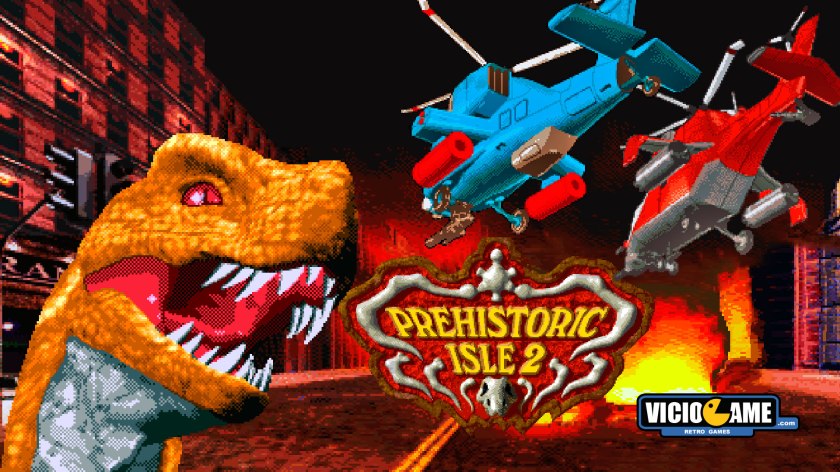
Prehistoric Isle 2 is a shoot ‘em up game released in arcades in 1999. Dinosaurs have invaded several parts of the world, leaving a trail of destruction and chaos in their wake. The two best pilots on the planet, flying helicopters equipped with state-of-the-art weaponry, are chosen to wipe out the prehistoric threat.
Developer: SNK
Publisher: Yumekobo
Release date: 1999
Platform: Arcade Neo Geo MVS
🇺🇸 A big-city street wrecked by a T. rex, two pterodactyls tearing apart an entire building and, in the midst of the chaos, an attack helicopter banking toward the back of the screen to join the fight. That is how Prehistoric Isle 2 kicks things off, and the first impression makes it clear that the game wants to be seen before it is understood. It debuted in arcades on September 27, 1999, running on the Neo Geo MVS, a system launched in 1990 whose marquee attractions revolved around fighting games and Metal Slug. A horizontal shoot ’em up featuring dinosaurs, coming from a company that still trusted mid-’90s computer graphics, looked like a badly timed bet, and that mismatch has followed the game to this day.
The family name goes back a long way. Prehistoric Isle in 1930 (in Japan, Genshi-Tō) hit arcades in 1989, before the Neo Geo even existed, and put U.S. Marine pilots in biplanes over Greenhell Isle, a fictional island where dinosaurs and other creatures that should have been extinct were still alive and well. The route took players through forests patrolled by cavemen, skies infested with pterodactyls, treacherous caves, shark-filled seas and the island’s volcanic core, and the formula took R-Type as its model, with a satellite pod whose position changed the type of attack. The British press of the day gave it a warm welcome (Sinclair User awarded it a perfect score, and Computer & Video Games gave it 81%), and the game’s fame rested on ferocious difficulty and a bitter ending. The credits already hinted at a sequel, which took ten years to arrive. By and large, SNK left most of its pre-Neo Geo franchises reduced to cameo appearances, as happened with Psycho Soldier and Ikari Warriors, so seeing one of them return as a full game was already an exception.
The backdrop against which the sequel arrives explains much of what it is. On July 1, 1999, Capcom released Dino Crisis in Japan, bringing giant reptiles to PlayStation survival horror, and the Dreamcast was already selling the promise of real-time polygons. Within the shoot ’em up genre itself, the trend was toward the excess of projectiles in bullet hell and toward 3D, and sprites, generally speaking, were starting to look like something from another decade. SNK, for its part, was living through its last months of independence: Aruze, a maker of pachinko machines, bought the company in January 2000, ordered its North American and European operations shut down in June of the same year, and the company went bankrupt in October 2001. It was in this climate of aging hardware and tight finances that Prehistoric Isle 2 was born.
Behind the project is an unusual partnership. Yumekobo was the heir to Aicom, a company founded in 1988 that passed into Sammy’s hands in 1992 and broke away from it in 1996, with SNK’s money, to work almost exclusively on platforms in the Neo Geo ecosystem; its track record included Pulstar (1995) and Blazing Star (1998), two shoot ’em ups that put the studio on the map for the platform. Saurus, the studio behind the run-and-gun games Shock Troopers and Shock Troopers: 2nd Squad, comes in as a development partner, and the end credits thank the staff of all three companies: Yumekobo, Saurus and SNK.
Back in the early 1990s, Masanori Kuwasashi (who would later direct The King of Fighters ’94 and ’95) brought SNK’s management a sequel proposal drawn up together with Yasushi Adachi, a Samurai Shodown designer, and the idea was initially turned down. The sequel would only arrive almost a decade later, at the hands of other teams.
The premise changes in scale. Instead of an expedition lost on an island, the game shows dinosaurs that have spilled out of isolation and into the cities, and it puts two machines inspired by real military aviation into play: an Apache, more agile and with a concentrated shot, and a Hind, slower and with a wide, fan-shaped spread, one American and one Soviet, classic Cold War rivals brought together here against the reptiles. The pilots are never given names: Player 1 commands men, Player 2 women, and both can pick the same aircraft at the same time. Unlike in Blazing Star, the portraits drop the anime style in favor of more realistic faces. An opening cutscene shows the creatures invading the city and the armed forces fighting back, and the promise is that of a monster disaster movie. What it delivers is less grandiose than the opening suggests: only some of the six stages actually explore urban destruction, and the rest follows a fairly conventional linear structure.
What stands out most about the game is its look. Enemies and vehicles start out as computer-rendered 3D models and are then converted into sprites, the same recipe that made Donkey Kong Country famous on the Super NES and that, on modern screens, leaves its rough edges showing. Here the technique gets a staging all its own: rainbow-hued reptiles spit fire, lightning bolts, bubbles and rings of energy, flying dinosaurs carry power-up crates dangling from their beaks, and the animations have so many frames that the whole thing looks like a parade of plastic toys in motion. The backgrounds are simpler than the monsters’ animation, with subtle parallax, but the transitions make up for it: the helicopter chases creatures into collapsing buildings and shifts depth on the screen, creating a pseudo-3D effect that gives the disaster its scale.
The sound matches the tone. The soundtrack is bombastic and slightly over the top, with the feel of an old-school sci-fi TV series, and it contrasts with the cartoonish mood of the whole package. Civilians communicate through goofy noises and show speech bubbles with a “HELP” in huge, colorful letters (swapped for “OH NO!” when the helicopter carrying them is shot down), while the monsters roar with every explosion. The music divides opinion: for some it is the high point, for others it is repetitive and forgettable. The series, by the way, has a tradition when it comes to music: the original even got a soundtrack album in Japan.
The controls are straightforward: eight directions, one fire button and one bomb button. The main shot alternates between two items that keep changing color: the blue C is a cannon whose shots pierce through enemies; the red G is a machine gun that spreads out like a curtain. Picking up the same icon repeatedly raises the power up to level four, picking up the other one swaps weapons, and on top of that come the missiles, in four types (straight, homing, napalm and a super missile), plus instant-detonation smart bombs and extra bombs, with a separate bomb animation for each helicopter. Holding the fire button releases a slower, aimable barrage; tapping it tightens the pattern, which is why a lot of players turn on autofire. Anyone familiar with Raiden will recognize this icon scheme from a mile away, and the comparison is telling: the first game’s satellite pod was retired in favor of a more conventional logic, which makes the action easier to read and the game more accessible.
The scoring is where the game shows its cleverest side. With the weapon at maximum level, picking up one more icon of the same color triggers Bonus Time, a timer represented by hearts below the score counter: while it lasts, every enemy defeated is worth double, and the multiplier climbs up to sixteen times. The stars dropped by swarms and big creatures are added up at the end of each stage, where finishing without dying earns a hefty bonus and getting through without taking any damage at all also earns a challenge badge. Everything is worth a lot of points, which gives the game the air of a number-inflating machine, and the system pushes players toward taking risks: some hold on to a smart bomb until the screen fills up, precisely so that every enemy turns into an item and the multiplier doesn’t run out.
The second layer of personality comes from the rescue mechanic. Civilians scattered across the stages cry out for help and, when the helicopter flies over them, they grab a rope and hang on; if the aircraft drops down to the ground, they keep walking behind it without letting go of the rope, in a slapstick scene that, luckily, doesn’t enlarge the hitbox. In four of the six stages it is possible to rescue five people, twenty in all, and handing them over to the rescue helicopter that shows up before the boss, marked by a speech bubble reading “TOUCH ME,” trades points for items: players chasing the biggest end-of-stage bonus have to decide whether to give up the boost. At specific moments the scrolling stops, the screen flashes “DEFEND PEOPLE,” and the player becomes an escort for groups of civilians boarding a helicopter while the creatures try to stop them. The idea of an aerial rescue has roots in Choplifter, but here it serves a different purpose: to break up the rhythm of the action and feed the score, without turning the game into a logistics exercise.
All of this comes packaged with a difficulty that runs counter to the series’ track record. The sequel eliminates rank (the automatic adjustment that toughens the challenge based on player performance), does away with randomness, adopts predictable patterns and hands out recovery items generously. The arcade board offers seven difficulty levels and, depending on the version and settings, works with traditional lives or an energy bar, and some criticize the abundance of healing items in the second setup. The most visible weak point is slowdown: when the screen fills with monsters and bullets, the speed drops, and the dips grow more frequent in the final stretch. The bosses make up for it, ranging from a giant insect whose abdomen swells in a frightening way, in stage four, to the final creature, which the player has to circle around while dodging an enormous laser.
Its commercial life was short and quiet. For a long time the game existed only on MVS: it never got an official home version for the Neo Geo AES or the Neo Geo CD, remaining restricted to arcades and to the operators who bought cartridges, in Japanese and English editions. The Japanese press dedicated to the system gave the release some coverage, and the American magazine GameFan reviewed the arcade version in January 2000 with a mixed verdict. The result was a smaller success than its predecessor, and the West had little time to discover it.
Its reputation has improved over time, but it remains divided. Among shoot ’em up specialists, the comparison with what Yumekobo had been doing carries weight: some feel the developer scaled back its ambition compared to Blazing Star; others find the result decent but odd and repetitive, and below what the company’s name promised. Anyone expecting the punishment dished out by the first game had reason to be disappointed, and much of the recent praise falls precisely on what is new in the sequel: the unmistakable look, the civilian rescue as a seasoning, and the score multiplier. Nintendo Life gave the Nintendo Switch version a 6 out of 10; Video Chums gave it 4 out of 5 and placed it among the genre’s best; TouchArcade landed on 3.5 out of 5, noting echoes of Cave’s shooters in the power-ups; and a critic who played the original cartridge in 2011 gave it an A and flagged it as a likely favorite among Neo Geo shooters. Among regular players the reception is warmer, with an average of around 4.6 out of 5 on the PlayStation 4 store, and some recommend the title to two audiences that rarely converge on a single cartridge: dinosaur fans and old-school shoot ’em up fans. What unites such distant opinions is the recognition that no other game on the system looks like this.
The game holds a unique place on the system, as one of the last shoot ’em ups officially released for the Neo Geo. In the lineage of helicopter shooters, which goes back to Tiger-Heli and Twin Cobra, it stands out for swapping military seriousness for matinee-style humor, in a theme that is still rare in the genre. From a design standpoint, the charm lies in the inversion: where the original demanded memorization and suffering, the sequel bets on comfort, spectacle and a layer of scoring that only reveals itself to those who go looking for it. That design, which welcomes newcomers and saves its depth for veterans, explains why the game keeps generating content.
Today the game remains available through official channels. Hamster released ACA NEOGEO Prehistoric Isle 2 in 2018 for Nintendo Switch, Xbox One and PlayStation 4 (on the latter, the Western release did not arrive until 2019), then for Windows 10 in May 2019, and for iOS and Android in January 2023. The editions are based on the MVS version and let players adjust the difficulty, mimic the look of the era’s arcade monitors, play in two-player mode and compete on online leaderboards. Those who prefer the original physical object can find MVS cartridges in collector shops and auctions, usually in the hundreds of dollars, which helps explain the aura of rarity. And there is a new chapter: in 2026, the first Prehistoric Isle, already included in the SNK 40th Anniversary Collection, got its own edition in the Arcade Archives line, bringing the two ends of the series back together in the modern catalog.
Prehistoric Isle 2 is best understood through its contrasts rather than its strengths: a toy-box aesthetic set against an urban disaster, the harshness of the original swapped for a Saturday-matinee mood, a conventional structure hiding a clever scoring system. The credits thank everyone who played and say goodbye with a “see you in the next game,” a promise Yumekobo never made good on in the genre, since this was its last shoot ’em up and the company’s later releases were handheld titles for the Neo Geo Pocket Color. Anyone taking on the adventure today will find a flashy, generous campaign, with more depth than its reputation suggests. And what remains, after the last rope comes loose and the last civilian climbs down safely, is the image from the beginning: a helicopter banking toward the back of the screen as a city collapses behind it.
🇧🇷 Uma rua de metrópole devastada por um tiranossauro, dois pterodáctilos desmontando um prédio inteiro e, no meio da confusão, um helicóptero de combate que faz a curva em direção ao fundo da tela para entrar em ação. É assim que Prehistoric Isle 2 abre os trabalhos, e a primeira impressão já avisa que o jogo quer ser visto antes de ser compreendido. Ele estreou nos fliperamas em 27 de setembro de 1999, rodando no Neo Geo MVS, um sistema lançado em 1990 cuja vitrine girava em torno de jogos de luta e de Metal Slug. Um shoot ’em up horizontal com dinossauros, saído de uma empresa que ainda confiava na computação gráfica de meados da década, parecia uma aposta fora de hora, e esse descompasso acompanha o jogo até hoje.
O sobrenome vem de longe. Prehistoric Isle in 1930 (no Japão, Genshi-Tō) surgiu nos fliperamas em 1989, antes mesmo de o Neo Geo existir, e punha pilotos dos fuzileiros navais americanos em biplanos sobre Greenhell Isle, uma ilha fictícia onde dinossauros e outras criaturas que deveriam estar extintas seguiam firmes e fortes. O percurso passava por florestas patrulhadas por homens das cavernas, céus infestados de pterodáctilos, grutas traiçoeiras, mares com tubarões e o miolo vulcânico da ilha, e a receita tomava R-Type como modelo, com um módulo satélite cuja posição mudava o tipo de ataque. A imprensa britânica da época o recebeu muito bem (a Sinclair User deu nota máxima, e a Computer & Video Games, 81%), e a fama do jogo se apoiava numa dificuldade feroz e num final amargo. Os créditos já insinuavam uma continuação, que levou dez anos para aparecer. A SNK, de resto, deixou a maioria de suas marcas anteriores ao Neo Geo reduzidas a participações especiais, como aconteceu com Psycho Soldier e Ikari Warriors, de modo que ver uma delas voltar como jogo completo já era uma exceção.
O cenário em que a sequência desembarca explica boa parte do que ela é. Em 1º de julho de 1999, a Capcom lançou Dino Crisis no Japão, levando répteis gigantes ao terror de sobrevivência do PlayStation, e o Dreamcast já vendia a promessa de polígonos em tempo real. No próprio gênero dos tiros, a moda apontava para o excesso de projéteis do bullet hell e para o 3D, e os sprites, de modo geral, começavam a parecer coisa de outra década. A SNK, por sua vez, vivia seus últimos meses de independência: a Aruze, fabricante de máquinas de pachinko, comprou a empresa em janeiro de 2000, mandou fechar as operações na América do Norte e na Europa em junho do mesmo ano, e a companhia foi à falência em outubro de 2001. Era nesse ambiente de hardware envelhecido e caixa apertado que Prehistoric Isle 2 nasceu.
Quem assina o projeto é uma parceria incomum. A Yumekobo era a herdeira da Aicom, fundada em 1988 que passou às mãos da Sammy em 1992 e se desligou dela em 1996, com dinheiro da SNK, para trabalhar quase só em plataformas do ecossistema Neo Geo; no currículo, tinha Pulstar (1995) e Blazing Star (1998), dois shoot ’em ups que a colocaram no mapa do sistema. A Saurus, dos run-and-guns Shock Troopers e Shock Troopers: 2nd Squad, entra como parceira de desenvolvimento, e os créditos finais agradecem aos funcionários das três marcas: Yumekobo, Saurus e SNK.
Ainda no começo dos anos 1990, Masanori Kuwasashi (que depois dirigiria The King of Fighters ’94 e ’95) levou à diretoria da SNK uma proposta de continuação elaborada junto com Yasushi Adachi, designer de Samurai Shodown, e a ideia foi recusada de início. A sequência só viria quase uma década depois, pelas mãos de outras equipes.
A premissa muda de escala. Em vez de uma expedição perdida numa ilha, o jogo mostra dinossauros que transbordaram do isolamento para as cidades, e coloca em campo duas máquinas inspiradas na aviação militar real: um Apache, mais ágil e de tiro concentrado, e um Hind, mais lento e de tiro aberto em leque, um americano e outro soviético, rivais clássicos da Guerra Fria aqui reunidos contra os répteis. Os pilotos nunca ganham nome: o primeiro jogador comanda homens, o segundo, mulheres, e os dois podem escolher a mesma aeronave ao mesmo tempo. Diferentemente do que se via em Blazing Star, os retratos abandonam o traço de anime e apostam em rostos mais realistas. Uma cutscene de abertura mostra os bichos invadindo a cidade e as forças armadas reagindo, e a promessa é a de um filme-catástrofe de monstros. A entrega é menos grandiosa do que a abertura sugere: só uma parte das seis fases explora de fato a destruição urbana, e o resto segue uma estrutura linear bem convencional.
O que o jogo tem de mais evidente é o visual. Inimigos e veículos nascem como modelos tridimensionais renderizados em computador e depois convertidos em sprites, a mesma receita que consagrou Donkey Kong Country no Super Nintendo e que, em telas modernas, deixa as arestas à mostra. Aqui a técnica ganha encenação própria: répteis em tons de arco-íris cospem fogo, raios, bolhas e anéis de energia, dinossauros voadores trazem caixotes de power-ups pendurados no bico, e as animações têm tantos quadros que o conjunto parece um desfile de bonecos de plástico em movimento. Os cenários são mais simples que a animação dos monstros, com parallax discreto, mas as transições compensam: o helicóptero persegue criaturas para dentro de prédios que desabam e muda de profundidade na tela, criando um pseudo-3D que dá escala ao desastre.
O som acompanha o tom. A trilha é pomposa e levemente exagerada, com jeito de seriado de ficção científica de antigamente, e contrasta com o clima de desenho animado do conjunto. Os civis falam por ruídos engraçados e exibem balões com um “HELP” em letras enormes e coloridas (trocado por “OH NO!” quando o helicóptero que os carrega é derrubado), enquanto os monstros rugem a cada explosão. A música divide opiniões, e para uns é o ponto alto, para outros, repetitiva e discreta. A série, aliás, tem tradição nisso: o original chegou a ganhar um disco de trilha sonora no Japão.
No controle, tudo é direto: oito direções, um botão de tiro e outro de bomba. O tiro principal alterna entre dois itens que trocam de cor sem parar: o C, azul, é um canhão cujos projéteis atravessam os inimigos; o G, vermelho, é uma metralhadora que abre em cortina. Pegar o mesmo ícone sucessivas vezes eleva o poder até o quarto nível, pegar o outro troca de arma, e por cima disso vêm os mísseis, em quatro tipos (reto, teleguiado, napalm e um super míssil), além de smart bombs de detonação imediata e bombas extras, com uma animação de bomba própria para cada helicóptero. Segurar o botão de tiro libera uma saraivada mais lenta e direcionável; tocar nele compacta o padrão, e por isso muita gente liga o autofire. Quem conhece Raiden reconhece de longe esse esquema de ícones, e a comparação é reveladora: o módulo satélite do primeiro jogo foi aposentado em favor de uma lógica mais convencional, que deixa a ação mais legível e o jogo mais acessível.
É no placar que o jogo mostra o que tem de mais astuto. Com a arma no nível máximo, pegar mais um ícone da mesma cor ativa o Bonus Time, um cronômetro representado por corações sob o contador de pontos: enquanto ele dura, cada inimigo derrotado vale o dobro, e o multiplicador sobe até dezesseis vezes. As estrelas soltas por enxames e por bichos grandes são somadas ao fim de cada fase, onde terminar sem morrer rende um bônus pesado e passar sem tomar dano algum garante ainda um emblema de desafio. Tudo vale muitos pontos, o que dá ao jogo um ar de máquina de inflar números, e o sistema empurra quem joga para o risco: há quem guarde uma smart bomb até a tela encher justamente para que cada inimigo se converta em item e o multiplicador não se apague.
A segunda camada de personalidade vem do resgate. Civis espalhados pelas fases pedem socorro e, quando o helicóptero passa por cima, agarram-se a uma corda e seguem pendurados; se a aeronave baixa até o chão, eles continuam andando atrás dela sem largar a corda, numa cena de pastelão que, por sorte, não aumenta o hitbox. Em quatro das seis fases é possível salvar cinco pessoas, vinte ao todo, e a entrega delas ao helicóptero de resgate que surge antes do chefe, identificado por um balão com “TOUCH ME”, troca pontos por itens: quem busca o maior bônus de fim de fase precisa decidir se abre mão do reforço. Em momentos específicos o scroll para, a tela manda “DEFEND PEOPLE” e o jogador vira escolta de grupos de civis que embarcam num helicóptero enquanto os bichos tentam impedir. A ideia do resgate aéreo tem raízes em Choplifter, mas aqui ela serve a outro propósito: quebrar o ritmo da ação e alimentar o placar, sem transformar o jogo num exercício de logística.
Tudo isso vem numa dificuldade que contraria o histórico da série. A continuação elimina o rank (o ajuste automático que endurece o desafio conforme o desempenho), dispensa o acaso, adota padrões previsíveis e distribui itens de recuperação com generosidade. A placa oferece sete níveis de dificuldade e, dependendo da versão e da regulagem, trabalha com vidas tradicionais ou com uma barra de energia, e há quem critique a fartura de itens de cura na segunda configuração. O ponto fraco aparente é o slowdown: quando a tela se enche de monstros e de balas, a velocidade cai, e a queda fica mais frequente na reta final. Compensam os chefes, que vão de um inseto gigante cujo abdômen incha de forma assustadora, na quarta fase, até a criatura final, que o jogador precisa contornar enquanto desvia de um laser enorme.
A vida comercial foi curta e discreta. O jogo existiu por muito tempo apenas em MVS: não ganhou versão doméstica oficial para o Neo Geo AES nem para o Neo Geo CD, ficando restrito aos fliperamas e aos operadores que compravam cartuchos, em edições japonesa e inglesa. A imprensa japonesa dedicada ao sistema deu espaço ao lançamento, e a revista americana GameFan avaliou a versão de arcade em janeiro de 2000 com um parecer dividido. O resultado foi um sucesso menor que o do antecessor, e o Ocidente teve pouco tempo para descobri-lo.
A reputação melhorou com o tempo, mas continua dividida. Entre os especialistas em shoot ’em ups, a comparação com o que a Yumekobo vinha fazendo pesa: para alguns, a desenvolvedora recuou em ambição em relação a Blazing Star; para outros, o resultado é decente, porém esquisito e repetitivo, e abaixo do que o nome da empresa prometia. Quem esperava o castigo do primeiro jogo tinha motivo para se decepcionar, e boa parte dos elogios recentes recai justamente sobre o que a continuação tem de novo: o visual inconfundível, o resgate de civis como tempero e o multiplicador de pontos. O Nintendo Life atribuiu 6 de 10 à versão do Nintendo Switch; o Video Chums chegou a 4 de 5 e o colocou entre os melhores do gênero; o TouchArcade ficou em 3,5 de 5, notando ecos dos shooters da Cave nos power-ups; e um crítico que testou o cartucho original em 2011 deu nota A e o apontou como provável favorito entre os shooters do Neo Geo. Entre os jogadores comuns a recepção é mais calorosa, com média em torno de 4,6 de 5 na loja do PlayStation 4, e há quem recomende o título a dois públicos que raramente se encontram num mesmo cartucho: os fãs de dinossauros e os de shoot ’em ups da velha guarda. O que une opiniões tão distantes é a constatação de que nenhum outro jogo do sistema tem esta aparência.
O jogo ocupa um lugar singular no sistema, como um dos últimos shoot ’em ups lançados oficialmente para o Neo Geo. Na linhagem dos tiros com helicóptero, que vem de Tiger-Heli e Twin Cobra, ele se destaca por trocar a seriedade militar por humor de matinê, num tema que segue raro no gênero. Do ponto de vista do design, a graça está na inversão: onde o original cobrava memorização e sofrimento, a continuação aposta em conforto, espetáculo e uma camada de pontuação que só se revela a quem procura. Esse design, que acolhe o novato e reserva profundidade ao veterano, explica por que o jogo continua rendendo conteúdo.
Hoje o jogo segue acessível por vias oficiais. A Hamster lançou ACA NEOGEO Prehistoric Isle 2 em 2018 para Nintendo Switch, Xbox One e PlayStation 4 (neste último, a chegada ao Ocidente ficou para 2019), depois para Windows 10, em maio de 2019, e para iOS e Android, em janeiro de 2023. As edições partem da versão MVS, permitem ajustar a dificuldade, imitar a atmosfera dos monitores de arcade da época, jogar em dupla e disputar placares online. Quem prefere o objeto original encontra cartuchos MVS em lojas e leilões de colecionismo, geralmente na casa das centenas de dólares, o que ajuda a explicar a aura de raridade. E há um capítulo novo: em 2026, o primeiro Prehistoric Isle, já presente na SNK 40th Anniversary Collection, ganhou a própria edição na linha Arcade Archives, reaproximando as duas pontas da série no catálogo moderno.
Prehistoric Isle 2 se entende melhor pelos contrastes do que pelos acertos: uma estética de brinquedo diante de um desastre urbano, a aspereza do original trocada por um clima de Sessão da Tarde, uma estrutura convencional escondendo um sistema de pontos astuto. Os créditos agradecem a quem jogou e se despedem com um até o próximo jogo, promessa que a Yumekobo não voltou a cumprir no gênero, já que este foi seu último shoot ’em up e os lançamentos seguintes da empresa foram portáteis para o Neo Geo Pocket Color. Quem encara a aventura hoje encontra uma campanha espalhafatosa e generosa, com mais profundidade do que a fama sugere. E o que fica, depois que a última corda se solta e o último civil desce em segurança, é a imagem do começo: um helicóptero fazendo a curva rumo ao fundo da tela, enquanto uma cidade de desaba às suas costas.
🤑💲Earn money without doing anything! Just leave these apps open:
https://r.honeygain.me/CONTA9DB02
https://packetstream.io/?psr=1uPb
⬛ 𝗧𝗶𝗸𝗧𝗼𝗸: https://www.tiktok.com/@viciogame
🟧 𝗜𝗻𝘀𝘁𝗮𝗴𝗿𝗮𝗺: http://www.instagram.com/viciogame
🟥 𝗬𝗼𝘂𝘁𝘂𝗯𝗲: http://www.youtube.com/viciogame
🟦 𝗙𝗮𝗰𝗲𝗯𝗼𝗼𝗸: http://www.facebook.com/viciogame
🔳 𝗧𝗵𝗿𝗲𝗮𝗱𝘀: https://www.threads.net/@viciogame
🟪 𝗧𝘄𝗶𝘁𝗰𝗵: https://www.twitch.tv/ViciogameRetroGames
🟨 𝗕𝗹𝗼𝗴: http://www.viciogameblog.com/
🟦𝗧𝘄𝗶𝘁𝘁𝗲𝗿: http://www.twitter.com/viciogame
#Viciogame #Gameplay #LetsPlay #Playthrough #Games #Gaming #Videogames #Review #Game #Detonado #Walkthrough #Ending #Reviews #Facts #Retro #RetroGaming #Roms #Emulator #Longplay #Speedrun #NoCommentary #PrehistoricIsle2 #Arcade #NeoGeo #AES #MVS #SNK #ShootEmUp #Shooter #Shmup #dinosaur #helicopter #MetalSlug #RType #Gradius #BlazingStar #Pulstar #TheKingOfFighters #KoF #Choplifter

