
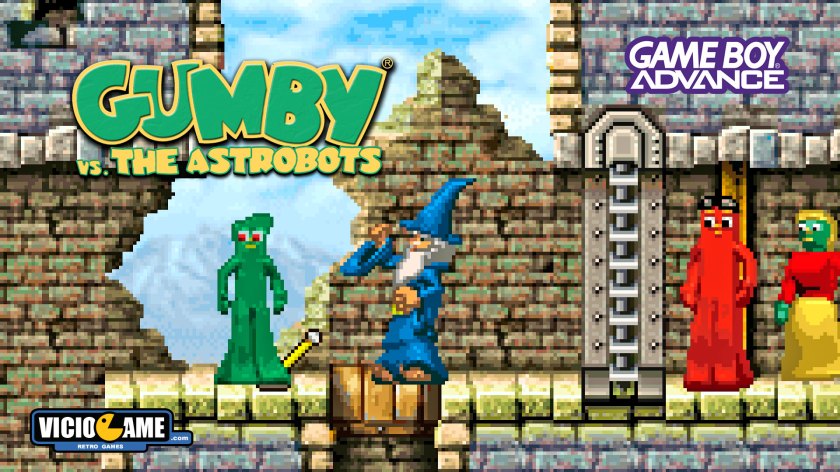
Gumby Vs. The Astrobots is a platformer released in 2005 for the Game Boy Advance. It is based on the classic animated TV series made with clay animation. Out-of-control robots attack Gumby’s friends and family. Out of fear, each of them hides inside a different themed book, and they must be rescued.
Developer: Torus Games
Publisher: Namco Hometek Inc.
Release date: 2005
Platform: Nintendo Game Boy Advance
🇺🇸 At fifty years old, the stretchiest clay figure on American television got the first video game of his career on August 9, 2005. Gumby Vs. The Astrobots reached North American stores on a Game Boy Advance cartridge, a handheld that was already sharing shelf space with the Nintendo DS, released nine months earlier, and that, counting all its revisions, would go on to sell 81.5 million units. The GBA catalog was full of platformers based on cartoons and movies, many of them made to order on short deadlines, and this one has a better-than-average story behind it, involving an exclusive contract, a family-run studio in Melbourne, a birthday celebrated ahead of schedule, and a tight production calendar.
To understand how odd this release was, you have to know what Gumby was in 2005. Art Clokey created the character out of the experimental short Gumbasia, from 1953, made while he was still a film student at the University of Southern California. The green figure with the slanted head arrived on NBC in the mid-1950s, made an appearance on Howdy Doody, and got his own series, The Gumby Show, which ran until 1969 with a cast that included Pokey, the orange pony, and the Blockheads, to which Goo and Prickle were added in the 1960s. After a long hiatus, Eddie Murphy’s parody on Saturday Night Live, beginning in 1982, rekindled interest and led to a new series in 1988, with 99 short episodes, and an independent feature film in 1995, Gumby: The Movie.
Between one wave of popularity and the next, what kept the brand alive were the bendable figures on toy store shelves. By 2005, it had been nearly twenty years since American television had seen any new episodes, and the Clokey family, which runs Premavision and Prema Toy, was using the fiftieth anniversary to try to get the character back on the air. The date was debatable (his TV debut came in 1956), but the celebrations kicked off early, with exhibitions in New York and California and a party in San Francisco. Joe Clokey, Art’s son and the one in charge of the business, described the character’s appeal as the surreal trips through Toyland, in and out of books, into the future and the past, and that book-shaped door is the backbone of the game.
The road to the Game Boy Advance began on January 27, 2005. That day, Namco Hometek, the North American arm of the Japanese company, headquartered in Santa Clara, California, announced that Prema Toy Co. had granted it exclusive rights to publish Gumby games, valid for any platform and for the entire cast, from Pokey, Prickle, and Goo to the Blockheads. The contract also provided for appearances by the character in other Namco releases. In the press release, Art Clokey cited Pac-Man as proof that the company knew what it was doing in the medium, and business director Jeff Lujan called the deal the moment for Gumby to make his debut in interactive entertainment. At Namco’s booth at E3 in May 2005, the company was betting on kids’ licenses: Atomic Betty, Hello Kitty Roller Rescue, and The Berenstain Bears and the Spooky Old Tree shared the space with the green figure. Among Nintendo fans, the project was met with irony from the start: some thought Gumby would make more sense in some run-of-the-mill platformer from the Super Nintendo era and, later on, others seized on the title’s resemblance to the Autobots for the inevitable joke.
The job went to Torus Games, of Bayswater, in the Melbourne area, founded in 1994 by Bill McIntosh, who came from Beam Software and Melbourne House. Torus’s debut was an adaptation of Stargate for Game Boy and Game Gear, and from then on the company established itself as a supplier of action and adventure games based on well-known licenses, backed by a proprietary engine that carried the same code over to different platforms. On the GBA, its résumé includes games like Doom II and Duke Nukem Advance, for Activision, in 2002, and, with Namco itself, the top-down shooter Dead to Rights, inspired by a violent console action game and released in late 2004. In less than a year, the studio went from an urban shooter to a clay figure, which shows the kind of commissions it accepted. The credits list about sixty names and make the family-business nature of the studio plain to see: the McIntosh surname appears in studio leadership (Bill), production and design (Kevin), art (Andrew), and quality assurance (David L.). Richard Au leads programming, Paul Clarke and Ivan Kenny-Sumiga head up the art, and Edward Colman is credited with the music and sound effects.
The calendar shows how tight things were: a little over six months passed between signing the license and the game arriving in stores, and the game, announced on April 4, went gold on July 28, twelve days before it hit shelves. The version shown at E3 in May was a skeleton: stomping on Astrobots and two transformations were already working, but only the weakest types of robot were in, and the promise was for more abilities and more enemies by launch. The team also reported that the sprites were all hand-drawn. The final cartridge keeps traces of that process: the code includes a debug menu with a build date of June 22, 2005, five weeks before the final submission, along with a list of objects that hints at the engine’s architecture: trampolines, collapsing rails, icicles, snowballs, and piranhas. Among the characters, there is a class for Minga, Gumby’s sister, who is not among those rescued in the story.
The plot is a neatly constructed pretext. Professor Kapp has just built a remote control capable of commanding the Astrobots, and the Blockheads, a silent duo of red figures with cube-shaped heads, lock the inventor in a metal cabinet and run off with the device. At Gumby’s picnic, where Prickle uses his fiery breath to toast bread, the robots, already under the villains’ command, crash the party and send Pokey, Prickle, Goo, Gumbo, and Gumba off into the books scattered around Toyland. The dialogue plays out in speech bubbles between levels, and that is where the script shows its taste for the absurd: the wizard who imprisons Gumby’s parents seems thrilled at the prospect of painful experiments, and Goo, held hostage by Count Dracula, only wants the vampire to stop singing, because the serenade hurts her ears.
The controls are streamlined: the D-pad moves Gumby, the A button jumps, and B toggles ball form, and combat inherits its rule from Super Mario Bros.: stomp on heads. The first jump stuns the Astrobot, the second deactivates it, and since the robots get back up when left alone and keep appearing in a seemingly endless supply, the player learns to choose which ones are worth taking down. What changes the pace is the clay. Green lollipops scattered through the books grant new powers: Gumby turns into a ball to roll through low corridors and launch off curved ramps, sticks to walls to hop up narrow shafts, and gets propeller feet to control his fall for a few moments. The level design follows that grammar: once the sticking technique has been learned, the walls start to have spikes, and with the propellers, pits stop being instant punishment. The stumbles come down to precision. A publication from the time complained about jumps that end with Gumby hitting the enemy from the side instead of landing on top, and later reviews cite the rolling that doesn’t always respond on ramps and the difficulty of telling which walls Gumby will stick to. The sprites are large for the 240-by-160-pixel screen of the Game Boy Advance, which gives each robot weight on screen.
The structure is hub-based: Toyland works as the lobby, and each book is a doorway to a world with a few levels in sequence. There are six, among them The Wild West, African Safari, and The Magic Castle, plus an ice book at the North Pole, another set in Transylvania, and Planet Astrobot, the robots’ territory, which closes out the adventure. Ice cream cones scattered through the levels earn extra lives when enough of them are collected and serve as a guide in the more maze-like settings; pie slices restore health, measured on a plate that can take four hits; and green flags mark the checkpoints. There are three difficulty settings, and the whole game can be beaten in about two hours.
What keeps the repetition from turning into boredom are the moments that break the rules. In the Transylvania book, the chase after Count Dracula turns Gumby into a flying platform with a propeller, on which Goo throws clay bombs at the vampire: it is the only flying section in the game. In The Wild West, a mine cart race against the cowboy Ricochet Pete, full of pits and robot heads to jump over, has earned a reputation as the hardest part of the adventure. The bosses have peculiar ideas, some work as platforming puzzles, and nearly all of them take very little damage to beat. The final showdown is the biggest letdown, because it relies on attacks that are hard to avoid instead of testing the skills accumulated along the way.
Visually, the game delivers on the promise of its packaging: characters and settings look like they are made of clay, and Gumby’s transformations, with his body stretching, flattening, and curling up, are the best-animated part. The palette is saturated, and the variety of settings (ice, desert, castle, savanna) sustains the cartoon feel, although the level design repeats structures more than it should. The audio divides opinion: GameVortex praises the vibrant tones inherited from the series, as Namco promised from the announcement onward, while GameZone points to a repetitive soundtrack and sound effects that come across as thin. The Clokey family also left its mark on the marketing: the game’s trailer was animated at the family’s own studio, with music by Tim Wiedenkeller.
The target is young children, and the game makes no attempt to hide it. The ESRB gave it an E rating, with cartoon violence that boils down to robots exploding and vanishing when stomped on, and the difficulty is low, so veterans finish the adventure without breaking a sweat. At the time, parents were glad to have found something to play with their kids and highlighted the absence of explicit violence. The problem is everyone else: the adult who grew up with the cartoon or the experienced GBA player finds a game that is over before it really gets going, and that mismatch is where the middling scores come from.
The 2005 scores reflect that mismatch. Nintendo Power gave it 50 out of 100 and found the game short, easy, and lacking in enemy variety, far from ranking among the system’s great platformers. GameZone settled on 7.4, said the genre suits the character well, and cautioned that the simplicity pushes older players away. GameVortex came in at 72% with reservations about the jumping, and BonusStage also gave it a 72, liking the faithful visuals and the fun, but judging the game too easy and too short to be worth buying. Metacritic calculates a weighted average of 63. Recent retrospectives describe the game as a competent curiosity, one that entertains anyone who stumbles across it and isn’t worth hunting down.
For some recent reviews, the biggest frustration is not the jumping but a wasted idea. Worlds that live inside books would let players roam an entire library, full of recognizable stories, and the game prefers broad, generic themes: a Western, a safari, a castle. The Blockheads, whom Art Clokey saw, according to his son, as the embodiment of his mischievous side, appear less than their billing promises and function as remote-control thieves, while the Astrobots fill the role of a faceless army. There are more interesting echoes underneath: the disaster springs from a communication problem, since Professor Kapp can’t reach an understanding with the villains, and the inability to communicate as a source of confusion is a theme often associated with Clokey’s work. The humor, somewhere between innocent and macabre, works for kids and gives adults a reason to keep reading the speech bubbles.
Robots, incidentally, are nothing new in Gumby’s universe: the episode Robot Rumpus features household robots running amok, and the 1995 feature has the Blockheads swapping Gumby’s band for robots, so the Astrobots fit into an iconography the character already knew. The core mechanic is also true to the cartoon: in classic episodes, Gumby molds himself into a race car to win a race sabotaged by the Blockheads and multiplies into a platoon to scare off pursuers. The game works best when the transformations change the problem, as in the flying section, and pays off less when they merely open up passages.
Weeks after the release, on September 29, 2005, Namco Bandai Holdings came into being, and the Namco Hometek that published the game ceased to exist as a brand in January 2006, when it merged with Bandai Games to form Namco Bandai Games America. The exclusive license for all platforms and the possibility of cameos in other company titles did not produce a second game, and the cartridge remains the character’s only game. The rights have changed hands since then: in February 2022, Fox Entertainment acquired the intellectual property from the estate of Joe Clokey, and in June 2024 two new series were announced, a 2D children’s show and another for adults, both handled by Bento Box Entertainment. Torus, for its part, brought its own cycle to a close: in March 2024, it was reported to be all but shut down, with McIntosh himself describing the studio as being in hibernation, after more than 140 games across dozens of platforms.
Today, the game remains available only on cartridge, and only in the North American version. Since the Game Boy Advance has no region lock, the cartridge runs on any system in the family, from the original model to the Game Boy Advance SP and the Game Boy Micro, and also on the Nintendo DS and DS Lite, which have a slot for GBA cartridges (the Nintendo DSi and later models do not). The price is low: in sales over the past few years, a loose cartridge typically goes for somewhere between $11 and $17, and a complete copy, with box and manual, between $28 and $35.
In the end, Gumby Vs. The Astrobots is a hurried but sincere translation of a simple idea: a hero who changes shape to solve problems. Between the ambition of an exclusive license and a short deadline, what was left was a lean platformer, clear in its rules and strange in its details, that gets the clay skin right and the library wrong. In a catalog of more than a thousand games like the GBA’s, where cartoon adaptations fill entire shelves, the cartridge stands out less for its quality than for its personality: the hours of play are few, but a good share of them carry the off-kilter humor and the freedom of form that have always distinguished the character. Whatever the fate of Gumby’s new projects, this remains the only time he has jumped, rolled, and stretched at the player’s command.
🇧🇷 Aos cinquenta anos de idade, o boneco de massinha mais elástico da televisão americana ganhou, em 9 de agosto de 2005, o primeiro jogo de sua carreira. Gumby Vs. The Astrobots chegou às lojas da América do Norte em cartucho de Game Boy Advance, um portátil que já dividia a vitrine com o Nintendo DS, lançado nove meses antes, e que, somadas as revisões, venderia 81,5 milhões de unidades. O catálogo do GBA estava cheio de jogos de plataforma baseados em desenhos e filmes, muitos feitos sob encomenda e com prazo curto, e este exemplar tem uma história acima da média: envolve um contrato exclusivo, um estúdio familiar de Melbourne, um aniversário comemorado antes da hora e um calendário de produção apertado.
Para entender a estranheza do lançamento, é preciso saber o que Gumby era em 2005. Art Clokey criou o personagem a partir do curta experimental Gumbasia, de 1953, feito quando ainda estudava cinema na University of Southern California. O boneco verde de cabeça inclinada chegou à NBC em meados dos anos 1950, passou pelo programa Howdy Doody e ganhou a série The Gumby Show, que rodou até 1969 com um elenco formado por Pokey, o pônei laranja, e pelos Blockheads, ao qual se somaram Goo e Prickle nos anos 1960. Depois de um longo intervalo, a paródia de Eddie Murphy no Saturday Night Live, a partir de 1982, reacendeu o interesse e rendeu uma série nova em 1988, com 99 episódios curtos, e um longa independente em 1995, Gumby: The Movie.
Entre uma onda e outra, o que mantinha a marca viva eram os bonecos flexíveis das prateleiras de brinquedo. Em 2005, fazia quase vinte anos que a televisão americana não via episódios inéditos, e a família Clokey, que comanda a Premavision e a Prema Toy, usava o cinquentenário para tentar recolocar o personagem no ar. A data era discutível (a estreia na TV aconteceu em 1956), mas as comemorações começaram antes da hora, com exposições em Nova York e na Califórnia e uma festa em San Francisco. Joe Clokey, filho de Art e responsável pelos negócios, definia o fascínio do personagem nas viagens surreais por Toyland, entrando e saindo de livros, rumo ao futuro e ao passado, e essa porta em forma de livro é o esqueleto do jogo.
O caminho até o Game Boy Advance começou em 27 de janeiro de 2005. Nesse dia, a Namco Hometek, braço norte-americano da empresa japonesa, com sede em Santa Clara, Califórnia, anunciou que a Prema Toy Co. lhe concedera os direitos exclusivos de publicação de jogos de Gumby, válidos para qualquer plataforma e para todo o elenco, de Pokey, Prickle e Goo aos Blockheads. O contrato previa ainda participações do personagem em outros lançamentos da Namco. Art Clokey citou Pac-Man no comunicado como prova de que a empresa sabia o que fazia nesse meio, e o diretor de negócios Jeff Lujan tratou o acordo como a hora de Gumby estrear no entretenimento interativo. No estande da E3 de maio de 2005, a Namco apostava em licenças infantis: Atomic Betty, Hello Kitty Roller Rescue e The Berenstain Bears and the Spooky Old Tree dividiam o espaço com o boneco verde. Entre os entusiastas de Nintendo, o projeto foi recebido com ironia desde o início: houve quem achasse que Gumby faria mais sentido num plataforma qualquer da era do Super Nintendo e, mais tarde, quem aproveitasse a semelhança do título com os Autobots para a piada inevitável.
O trabalho coube à Torus Games, de Bayswater, na região de Melbourne, fundada em 1994 por Bill McIntosh, que vinha da Beam Software e da Melbourne House. A estreia da Torus foi uma adaptação de Stargate para Game Boy e Game Gear, e dali em diante a empresa se firmou como fornecedora de jogos de ação e aventura baseados em licenças conhecidas, apoiada num motor próprio que levava o mesmo código a plataformas diferentes. No GBA, o currículo inclui jogos como Doom II e Duke Nukem Advance, para a Activision, em 2002, e, com a própria Namco, o shooter de visão superior Dead to Rights, inspirado num jogo de ação violenta para consoles e lançado no fim de 2004. Em menos de um ano, o estúdio passou de um shooter urbano a um boneco de massinha, o que mostra o tipo de encomenda que aceitava. Os créditos reúnem cerca de sessenta nomes e deixam à vista o caráter de negócio de família: o sobrenome McIntosh aparece na direção do estúdio (Bill), na produção e no design (Kevin), na arte (Andrew) e no controle de qualidade (David L.). Richard Au lidera a programação, Paul Clarke e Ivan Kenny-Sumiga conduzem a arte e Edward Colman assina música e efeitos sonoros.
O calendário mostra o aperto: da assinatura da licença à chegada às lojas passaram-se pouco mais de seis meses, e o jogo anunciado em 4 de abril atingiu o status gold em 28 de julho, doze dias antes de chegar às prateleiras. A versão mostrada na E3 de maio era um esqueleto: a pisada nos Astrobots e duas transformações já funcionavam, mas só havia os tipos mais fracos de robô, e a promessa era de mais habilidades e mais inimigos até o lançamento. A equipe informou ainda que os sprites eram todos feitos à mão. O cartucho final guarda marcas desse processo: o código traz um menu de depuração com a data de compilação de 22 de junho de 2005, cinco semanas antes da apresentação, com uma lista de objetos que lembra a arquitetura da engine, com trampolins, trilhos que desabam, pingentes de gelo, bolas de neve e piranhas. Entre os personagens, há uma classe para Minga, a irmã de Gumby, que não aparece entre os resgatados da trama.
A trama é um pretexto bem armado. O Professor Kapp acaba de construir um controle remoto capaz de comandar os Astrobots, e os Blockheads, dupla muda de figuras vermelhas com cabeça de cubo, trancam o inventor num armário metálico e fogem com o aparelho. No piquenique de Gumby, onde Prickle usa o sopro de fogo para tostar pão, os robôs, já sob comando dos vilões, caem sobre a festa e despacham Pokey, Prickle, Goo, Gumbo e Gumba para dentro dos livros espalhados por Toyland. O diálogo corre em balões de texto entre as fases, e é nele que o roteiro mostra o gosto pelo absurdo: o feiticeiro que prende os pais de Gumby parece animado com a perspectiva de experiências dolorosas, e Goo, refém de Conde Drácula, só quer que o vampiro pare de cantar, porque a serenata machuca seus ouvidos.
A interface é enxuta: o direcional move Gumby, o botão A pula e B alterna a forma de bola, e a regra do combate herda de Super Mario Bros.: pisar na cabeça. O primeiro pulo atordoa o Astrobot, o segundo o desativa, e como os robôs se levantam quando abandonados e surgem em suprimento aparentemente infinito, o jogador aprende a escolher quais vale a pena derrubar. O que muda o ritmo é a massinha. Pirulitos verdes espalhados pelos livros concedem novos poderes: Gumby vira bola para atravessar corredores baixos e se lançar de rampas curvas, gruda nas paredes para subir poços estreitos aos saltos e ganha pés de hélice para controlar a queda por alguns instantes. O design de fases acompanha essa gramática: aprendida a técnica de grudar, as paredes passam a ter espinhos, e com as hélices os abismos deixam de ser punição imediata. Os tropeços ficam por conta da precisão. Uma publicação da época reclamou de pulos que terminam de lado no inimigo em vez de em cima, e análises posteriores citam a rolagem que nem sempre responde nas rampas e a dificuldade de saber em quais paredes Gumby gruda. Os sprites são grandes para a tela de 240 por 160 pixels do Game Boy Advance, o que dá peso a cada robô no quadro.
A estrutura é em hub: Toyland funciona como saguão, e cada livro é uma porta para um mundo com algumas fases em sequência. São seis, entre eles The Wild West, African Safari e The Magic Castle, além de um livro de gelo no Polo Norte, outro ambientado na Transilvânia e a Planet Astrobot, território dos robôs, que fecha a aventura. As casquinhas de sorvete espalhadas pelas fases rendem vidas extras quando coletadas em número suficiente e servem de guia nos cenários mais labirínticos, as fatias de torta restauram a energia, medida num prato que aguenta quatro golpes, e bandeiras verdes marcam os checkpoints. Há três níveis de dificuldade, e o jogo inteiro se resolve em algo próximo de duas horas.
O que impede a repetição de virar tédio são as quebras de regra. No livro da Transilvânia, a perseguição a Conde Drácula transforma Gumby numa plataforma voadora com hélice, na qual Goo atira bombas de massinha no vampiro: é o único trecho de voo do jogo. Em The Wild West, uma corrida de carrinho de mina contra o cowboy Ricochet Pete, cheia de abismos e cabeças de robô para saltar, ganha a fama de trecho mais difícil da aventura. Os chefes têm ideias peculiares, alguns funcionam como quebra-cabeças de plataforma e quase todos pedem pouco dano. O confronto final é o que mais decepciona, porque aposta em ataques difíceis de evitar em vez de cobrar as habilidades acumuladas ao longo do caminho.
Visualmente, o jogo cumpre a promessa da embalagem: personagens e cenários parecem feitos de massinha, e as transformações de Gumby, com o corpo se esticando, achatando e enrolando, são a parte mais bem animada. A paleta é saturada e a variedade de cenários (gelo, deserto, castelo, savana) sustenta o clima de desenho, embora o design de fases repita estruturas mais do que o ideal. O áudio divide as opiniões: a GameVortex elogia os timbres vibrantes herdados da série, como a Namco prometeu desde o anúncio, enquanto a GameZone aponta trilha repetitiva e efeitos que soam finos. A família Clokey também deixou a marca na divulgação: o trailer do jogo foi animado no estúdio da própria família, com música de Tim Wiedenkeller.
O alvo é a criança pequena, e o jogo não disfarça. A ESRB deu classificação E, com violência de desenho animado que se resume a robôs explodindo e sumindo quando pisoteados, e a dificuldade é baixa, de modo que veteranos terminam a aventura sem suar. Na época, pais celebravam ter encontrado algo para jogar com seus filhos e destacavam a ausência de violência explícita. O problema está no público que sobra: o adulto que cresceu com o desenho ou o jogador experiente de GBA encontra um jogo que acaba antes de a engrenagem esquentar, e é desse desencontro que vêm as notas medianas.
As notas de 2005 refletem esse desencontro. A Nintendo Power deu 50 em 100 e achou o jogo curto, fácil e pobre em variedade de inimigos, longe de figurar entre os grandes títulos de plataforma do console. A GameZone fechou em 7,4, disse que o gênero cai bem ao personagem e ressalvou que a simplicidade afasta os jogadores mais velhos. A GameVortex chegou a 72% com ressalvas aos pulos, e o BonusStage também deu 72, gostando do visual fiel e da diversão, mas julgando o jogo fácil e curto demais para valer a compra. O Metacritic calcula uma média ponderada de 63. Retrospectivas recentes descrevem o jogo como uma curiosidade competente, que entretém quem o encontra por acaso e não justifica uma caçada.
Para parte das análises recentes, a maior frustração não está nos pulos, e sim numa ideia desperdiçada. Mundos que moram dentro de livros permitiriam percorrer uma biblioteca inteira, com contos reconhecíveis, e o jogo prefere temas amplos e genéricos: um faroeste, um safári, um castelo. Os Blockheads, que Art Clokey enxergava, segundo o filho, como a encarnação do seu lado travesso, aparecem menos do que o cartaz promete e funcionam como ladrões de controle remoto, enquanto os Astrobots cumprem o papel de exército sem rosto. Há ecos mais interessantes por baixo: o desastre nasce de um problema de comunicação, já que o Professor Kapp não consegue se entender com os vilões, e a incomunicabilidade como origem de confusão é um tema frequentemente associado à obra de Clokey. O humor, entre o inocente e o macabro, funciona para as crianças e dá ao adulto um motivo para continuar lendo os balões de texto.
Robôs, aliás, não são novidade no universo de Gumby: o episódio Robot Rumpus mostra robôs domésticos fora de controle, e o longa de 1995 tem os Blockheads trocando a banda de Gumby por robôs, de modo que os Astrobots se encaixam numa iconografia que o personagem já conhecia. A mecânica central também é fiel ao desenho: em episódios clássicos, Gumby se molda num carro de corrida para vencer uma prova sabotada pelos Blockheads e se multiplica num pelotão para espantar perseguidores. O jogo funciona melhor quando as transformações mudam o problema, como no trecho de voo, e rende menos quando elas se limitam a abrir passagens.
Semanas depois do lançamento, em 29 de setembro de 2005, nascia a Namco Bandai Holdings, e a Namco Hometek que publicou o jogo deixou de existir como marca em janeiro de 2006, quando se uniu à Bandai Games para formar a Namco Bandai Games America. A licença exclusiva para todas as plataformas e a possibilidade de aparições em outros títulos da empresa não renderam um segundo jogo, e o cartucho segue como o único jogo do personagem. Os direitos mudaram de mãos desde então: em fevereiro de 2022, a Fox Entertainment adquiriu a propriedade intelectual do espólio de Joe Clokey, e em junho de 2024 foram anunciadas duas novas séries, uma infantil em 2D e outra para adultos, a cargo da Bento Box Entertainment. A Torus, por sua vez, encerrou o ciclo: em março de 2024 foi dada como praticamente fechada, com o próprio McIntosh descrevendo o estúdio em hibernação, depois de mais de 140 jogos em dezenas de plataformas.
Hoje, o jogo continua disponível apenas em cartucho, e apenas na versão norte-americana. Como o Game Boy Advance não tem trava regional, o exemplar importado roda em qualquer aparelho da família, do modelo original ao Game Boy Advance SP e ao Game Boy Micro, e também no Nintendo DS e no DS Lite, que trazem entrada para cartuchos de GBA (o Nintendo DSi e os modelos seguintes não trazem). O preço é baixo: nas vendas dos últimos anos, o cartucho solto costuma sair por algo entre US$ 11 e US$ 17, e o exemplar completo, com caixa e manual, entre US$ 28 e US$ 35.
No fim, Gumby Vs. The Astrobots é a tradução apressada, mas sincera, de uma ideia simples: um herói que muda de forma para resolver problemas. Entre a ambição de uma licença exclusiva e um prazo curto, sobrou um jogo de plataforma enxuto, claro nas regras e estranho nos detalhes, que acerta na pele de massinha e erra na biblioteca. Num catálogo de mais de mil jogos como o do GBA, onde as adaptações de desenhos ocupam prateleiras inteiras, o cartucho se destaca menos pela qualidade do que pela personalidade: as horas de jogo são poucas, mas boa parte delas carrega o humor torto e a liberdade de forma que sempre distinguiram o personagem. Seja qual for o destino dos projetos novos de Gumby, essa continua sendo a única vez em que ele pulou, rolou e se esticou sob o comando do jogador.
🤑💲Earn money without doing anything! Just leave these apps open:
https://r.honeygain.me/CONTA9DB02
https://packetstream.io/?psr=1uPb
⬛ 𝗧𝗶𝗸𝗧𝗼𝗸: https://www.tiktok.com/@viciogame
🟧 𝗜𝗻𝘀𝘁𝗮𝗴𝗿𝗮𝗺: http://www.instagram.com/viciogame
🟥 𝗬𝗼𝘂𝘁𝘂𝗯𝗲: http://www.youtube.com/viciogame
🟦 𝗙𝗮𝗰𝗲𝗯𝗼𝗼𝗸: http://www.facebook.com/viciogame
🔳 𝗧𝗵𝗿𝗲𝗮𝗱𝘀: https://www.threads.net/@viciogame
🟪 𝗧𝘄𝗶𝘁𝗰𝗵: https://www.twitch.tv/ViciogameRetroGames
🟨 𝗕𝗹𝗼𝗴: http://www.viciogameblog.com/
🟦𝗧𝘄𝗶𝘁𝘁𝗲𝗿: http://www.twitter.com/viciogame
#Viciogame #Gameplay #LetsPlay #Playthrough #Games #Gaming #Videogames #Review #Game #Detonado #Walkthrough #Ending #Reviews #Facts #Retro #RetroGaming #Roms #Emulator #Longplay #Speedrun #NoCommentary #Gumby #GBA #Astrobots #GameBoyAdvance #Nintendo #GameBoy #Color #NDS #NintendoSwitch #ArtClokey #EddieMurphy #SaturdayNightLive #SNES #SuperNintendo

