
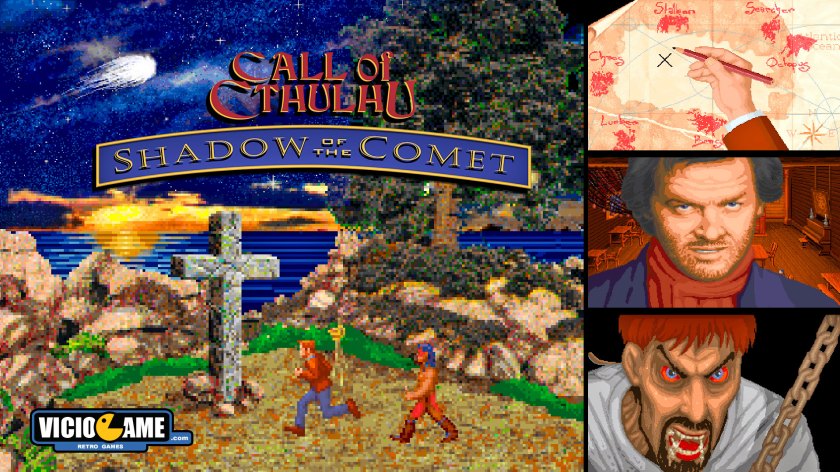
Call of Cthulhu: Shadow of the Comet is an adventure game released in 1993 for PC (MS-DOS). In 1910, photographer John Parker travels to the isolated village of Illsmouth to photograph the passage of Halley’s Comet. Upon arrival, he gets drawn into a conspiracy involving a local cult tied to cosmic entities and must investigate.
Developer: Infogrames
Publisher: I•Motion
Release date: 1993
Platform: PC MS-DOS
🇺🇸 In May 1910, street vendors were cashing in on “anti-comet pills,” and residents of many cities sealed their doors and windows with cloth to keep out a poison no one ever saw arrive. The reason was Halley’s Comet: spectroscopy had detected cyanogen in its tail, French astronomer Camille Flammarion had speculated that the gas could permeate the atmosphere, and Earth was set to pass through that trail between the 18th and 19th. Nothing happened. But a panic sold in newspaper headlines is the ideal backdrop for Shadow of the Comet, an adventure game from Infogrames released in March 1993 for PC, which converts the cosmic fear of that spring into cosmic horror, under an official Chaosium license for the tabletop RPG Call of Cthulhu.
You play as John T. Parker, a young British photographer and reporter convinced that the best spot on the planet to capture the comet’s return is Illsmouth, a quiet fishing village in New England. That conviction comes from the diary of Lord Boleskine, a respected English scientist who traveled there in 1834 (the date in the game’s chronology, although the comet did not actually reappear until 1835) to observe the comet’s previous passage and came back deeply disturbed, ending his days in an asylum. Seventy-six years later, Parker persuades W.B. Griffith, editor of the magazine British Scientific News, to bankroll the expedition, books a room at Dr. Cobble’s house, and arrives with three days off. It takes only the first few conversations, with Dr. Cobble himself and with Mayor Arlington, to make you suspect that Illsmouth’s hospitality has an expiration date.
The project’s origins involve another hit from the Villeurbanne studio, on the outskirts of Lyon, France. After roughly two years of talks, Infogrames closed a deal with Chaosium around the end of 1990 for the rights to Call of Cthulhu, in negotiations that involved its president, Bruno Bonnell, and Chaosium’s founder, Greg Stafford, and even announced a series of five games in five years. The first of them was meant to be what would become Alone in the Dark, but Chaosium found the result too simple and too far removed from the RPG to let it carry the official seal, and the 1992 box came out without it. The Mythos was already there, though, in the monsters and in books scattered around the mansion, and one of those books contained excerpts from Lord Boleskine’s diary, published by a fictional Aleister Publications (the surname and the publisher both seem to wink at the occultist Aleister Crowley, who once owned Boleskine House, a Scottish manor). The license ended up landing on the next project, which was precisely the story of that diary.
Command falls to a lean team that finished the game in under two years. Norbert Cellier, an engineer trained in Lyon who joined the studio as an intern in 1989 and moved through programming and design before taking on management roles, directs the project. Patrick Charpenet produces and is credited with the design, Laurent Salmeron is responsible for the technical side, and Yaël Barroz, an artist who came over from Alone in the Dark, is credited with the art alongside Christophe Anton, Pascal Astie, and other colleagues. The soundtrack goes to Philippe Vachey, a self-taught freelancer who had composed the music for the previous game.
The story comes from the mind of Hubert Chardot, a former journalist and former 20th Century Fox employee who came to the studio through a friend who knew Bruno Bonnell. A voracious Lovecraft reader since his teens, Chardot once went so far as to trade paperbacks for photocopies of the author’s own letters and postcards on his first trip to the United States. It was the synopsis of Shadow of the Comet that made him give up his Panasonic typewriter and switch to a computer, and Didier Briel and Beate Vigliano-Reiter round out the writing team.
Technically, the game inherits the engine from Eternam, a 1992 adventure also designed by Chardot, minus the 3D sequences, and that kinship explains a lot: 256-color graphics, small characters walking across painted backdrops, and huge portraits of whoever is speaking during dialogue. As for Lovecraft, the team cited two stories as sources, “The Dunwich Horror” and “The Shadow over Innsmouth,” but almost nothing from the original plots shows up on screen. What survives is the atmosphere: a coastal village where everyone seems to know something, a cult hidden beneath the routines of long-established families, the sense that science is a lantern far too weak for whatever lurks out there. Illsmouth echoes Innsmouth, the decaying town in Massachusetts, but without the ruin in plain sight: on the outside, it is clean, civilized, and almost friendly.
The development process left some curious traces. In the early drafts, the hero was named John T. Carter (a name that echoes Randolph Carter, Lovecraft’s recurring protagonist) and was an astronomer; the archivist Tobias Jugg went by Rugs; and the village was called Isthmuth, a tongue twister. The name change left a proofreading slip behind: the back-cover copy reached store shelves still talking about Carter, and the descriptions on today’s digital storefronts keep repeating the mistake. A demo distributed before launch, whose animated scenes barely made it into the final game, points to another omission: all signs suggest that Lovecraft himself was going to appear behind a curtained door in Jugg’s house, introducing himself to the player as Howard Phillips. The idea was cut, but the writer’s face survived in the cast, apparently lent to Underhouse, the broken-legged resident who speaks only in riddles. And inside the floppy disk box was a copy-protection check typical of the era: an invitation card to the “Arkham Planetarium,” which folded into a little box with a magnifying lens at one end and a miniature star chart at the other, used to verify constellations displayed on the screen.
Visually, the game bets on a gloomy naturalism. The backdrops, painted in 256-color VGA, have a finish that in certain scenes looks almost photographic, and the palette concentrates on the grays and browns of a damp coastline, with dark wooden houses, fog-covered cliffs, and empty streets. The characters on screen are small and somewhat stiff, but when someone speaks, the screen gives way to a large-scale portrait, and plenty of those faces are borrowed: Dr. Cobble has the features of Vincent Price, Jack Nicholson turns up, shamelessly, in another resident, and the gallery recalls a double feature of horror and period cinema. Some actions, such as picking up an object or unlocking a door, get a rotoscoped close-up, in the style of what Another World and Flashback did in their cutscenes, and the opening presents the comet tearing across the night, a lighthouse, an owl, and a Native American figure with flaming hands before taking the player to editor Griffith’s office.
Philippe Vachey’s score carries the mood on its shoulders. On Alone in the Dark, he had faced the problem of translating compositions made on a sampler into the FM editor for AdLib sound cards, with limited polyphony and a reduced palette of timbres; on Shadow of the Comet, he repeated the method and had fewer headaches, because the technical problems had already been solved. The result is restrained themes of dissonant strings and creeping textures that, even in FM synthesis, sound hostile. The 1994 CD-ROM version, retitled Call of Cthulhu: Shadow of the Comet, refines the audio and adds full English voice acting, a new opening that shows Boleskine’s madness, more animation frames for the characters, and a tour of a small museum dedicated to Lovecraft, played with the same control system. The cover art changes too: the floppy disk cover gathers figures around a bonfire whose flames form eyes in the sky, while the CD-ROM cover shows a monstrous face in the heavens and a terrified man in the foreground. Infogrames promised new characters, puzzles, and locations; what you actually get is two extras, a woman and a child, who vanish after the second day. The voices divide opinion: part of the cast speaks in a nearly monotone delivery that, in practice, suits the village’s paranoia, while other moments slip into the theatrical, especially in the invocations in a made-up language.
The area where the game departs most from what its competitors were doing is the controls. Sierra and LucasArts were coming off King’s Quest VI and Indiana Jones and the Fate of Atlantis, and the year would still bring Day of the Tentacle, Myst, and Gabriel Knight: Sins of the Fathers, all built around the mouse. Shadow of the Comet, by contrast, asks you to guide Parker with the keyboard arrow keys, with no diagonal movement, and to trigger actions through shortcuts (L to look, G to grab, T to talk, U to use) or through the menu opened with the TAB key. To use an object, you first have to select it in the inventory and make it the active item; to talk, you have to stop right next to the other person; and to cross the village there is a fast-travel map with only a few marked destinations. Parker walks slowly, and the settings menu lets you speed up his pace. A dotted line running from the hero’s eye to objects he can interact with works as a discreet hint system and spares you much of the pixel hunting, although not everything worth your attention gets that signal. Mouse support only arrived in the CD-ROM version, and clumsily: the cursor merely indicates the direction Parker walks, and plenty of players go back to the keyboard.
If the interface gets in the way, the structure of the script makes up for much of the damage. The story is organized into three days and three nights, and each day opens up new areas, characters, and complications, on a course that begins with scouting out the village and ends with the sky on fire. There is no clock ticking against the player, which gives the pacing an unusual serenity for the genre (timed sequences exist, but they are exceptions), and the logbook automatically records every relevant clue, a feature that was still uncommon in adventure games at the time. You take as long as you like to read, talk, and take notes, and the game collects its toll elsewhere: an object ignored early on can block everything further along, and the ten save slots show no mercy to anyone who trusts their own memory too much.
Around forty residents are waiting to talk, in multiple-choice dialogues where the risk is real: saying too much, or talking to the wrong person, can cost the protagonist his life. The cast you meet in the first hour already sets the tone: Dr. Cobble, host and physician; Mayor Arlington; the archivist Tobias Jugg, who loves to chat and becomes Parker’s first ally; the prudish Miss Picott; Sergeant Baggs, whose fists move faster than his wits; and the Hambletons, a family of fishermen who settle disagreements with punches. The harbor, warehouse, tavern, pharmacy, town hall, cemetery, lighthouse, and forest open up in stages, and islands on the horizon promise worse destinations. The village is a character in its own right, and the merit of Chardot’s script lies in piling up suspicion in small doses, making every kindness feel like a favor with interest attached.
Photography is what most sets the game apart from other investigative adventures. In 1910, the photographic plate was one of astronomy’s newest tools, and it is what Parker bets on: he has to buy the materials, set up the equipment in the darkness of the forest, and then develop the images in a laboratory, with real reagents. It is the most talked-about puzzle in the game, and not for its merits: in the English version, two of the reagents appear with swapped labels, which makes the solution impossible to deduce without knowing about the error. When the images finally appear, though, the camera performs the most Lovecraftian function possible, capturing what the human eye cannot bear: on one of the plates, a pair of eyes stares back at Parker. The puzzles also take advantage of the astronomy theme, with drawings of constellations and star charts that help locate points on a map of the forest. And then there is the protagonist’s fragility, a distant relative of the RPG’s sanity loss: after the scare on the first night, Parker’s heart cannot handle careless walks, and wandering the village without the medicine prescribed by Dr. Cobble ends in sudden death.
The horror in Shadow of the Comet builds through accumulation. Almost everything boils down to talking, observing, and piecing together clues, and the Mythos (a term coined by August Derleth, not by Lovecraft himself) appears in layers: the Miskatonic University diploma on the wall, the Necronomicon kept in a secret library, invocations of Yog-Sothoth and Dagon, a lighthouse at Pickman’s Promontory (a wink at “Pickman’s Model”), and Narackamous, the main antagonist. Few graphic adventures gather so many references, and the game uses them sparingly, saving the actual creatures for the final act. The residents’ prejudice against Romani people and Native Americans reinforces the sense of a closed community, and the script rewards those who stand with the persecuted. None of this erases the stumbles. The crypt beneath the cemetery, a maze of bats, spiders, spikes, and trapdoors conquered through trial and error, is a test of endurance worse than any monster, and the sudden deaths demand that you save the game as often as someone who distrusts their own fate.
The European press received the game with enthusiasm in 1993, though not unanimously: Génération 4 gave it 90%, as did PC Master, Micromanía went as high as 92%, Joystick and PC Zone landed at 87%, while a cooler Tilt stopped at 14 out of 20, and some German publications, such as PC Games (62%) and PC Player (66%), were less generous. In the United States, where it was released by I-Motion, Computer Gaming World treated the adventure as the latest French export, at a time when Delphine, Coktel Vision, and Cryo were building their reputations on games with a signature style of their own, and praised the script, the puzzles, the writing, and a dark, slightly mischievous, very French sense of humor, but found it painful to manipulate objects and solve puzzles without a mouse. When the CD-ROM arrived in 1994, Génération 4 repeated its 90%, Joystick scored 84%, and White Wolf gave it top marks, five out of five, for tension built without resorting to gore or cheap scares. Pyramid, a magazine focused on tabletop RPGs, named it a standout in 1995, and the official Prima Publishing guide from 1994 included the short story “The Call of Cthulhu” alongside the solutions. In 2011, Adventure Gamers ranked the game 74th on its list of the 100 best adventure games of all time.
Its strong performance paved the way for a spiritual successor: Prisoner of Ice, from 1995, also under the Chaosium license, swaps New England for Antarctica and the eve of World War II, with an American intelligence officer, Lieutenant Ryan, aboard a British submarine. It is not a direct sequel, but it makes a point of reconnecting the threads: Parker reappears near the end, in Argentina, and Narackamous returns as the antagonist. The game received versions for Sega Saturn and PlayStation in Japan in 1997, and Shadow of the Comet reached the PC-98 in 1995. The RPG brand, for its part, would take a long time to return in force: Call of Cthulhu: Dark Corners of the Earth came out in 2005, and a new Call of Cthulhu in 2018.
Meanwhile, the team scattered. Vachey went on to Little Big Adventure, Charpenet founded the studio Arkham Graphics in California in 1997, Cellier worked on Heart of Darkness as a producer, and Chardot wrote The Devil Inside, for Cryo, and From Dusk Till Dawn, the latter an unapologetic shooter.
Today, the game is still available. Since 2015, GOG has sold Shadow of the Comet alongside Prisoner of Ice, with both the floppy disk and CD-ROM versions, and Steam offers it as well. The campaign runs around six and a half hours (seven and a half with the extras), with text in English, German, Spanish, French, and Italian. Reception among today’s players is divided: the average rating on GOG sits near 3.7 out of 5, with praise for the atmosphere and the writing and complaints about the interface, the deaths without warning, and the dead ends. The split makes sense: it is, at once, one of the most faithful adaptations of Lovecraft’s mood and one of the most demanding adventures to control. In 2016, some scenes recreated in 3D circulated online, for a possible remake with modern controls, an idea that, as far as anyone can tell, never went beyond a prototype.
To gauge the game’s significance, it helps to compare what it chose to do. Infocom’s The Lurking Horror had flirted with Lovecraft in 1987, only in text, and Alone in the Dark, driven by Frédérick Raynal’s technology, had turned the mood into action with polygons; Shadow of the Comet sets out to bring the pacing of a Call of Cthulhu session to the graphic adventure, in which ordinary people uncover truths they would rather not know. Parker doesn’t fight: he observes, takes notes, asks questions, hides, runs, and every wrong decision exacts a permanent price. The stiffness of the controls, which is so irritating, is also part of that design, because a hero who drags himself across the scenery convinces you that he is at a disadvantage, up to the point where the discomfort stops being fear and becomes plain frustration. It is on that border, clumsily drawn in some stretches and dead-on in others, that the game continues to spark debate more than three decades later.
Anyone who lands in Illsmouth today finds a village that makes no effort to please: it demands patience with the keyboard arrows, forgives little, and charges dearly for any ill-timed curiosity. In return, it delivers an investigation in which the fear comes from the residents’ good manners, from smiles that last a second longer than they should, and from a sky that seems a little closer each night. The comet passes in three days, and the feeling of having stepped where you shouldn’t have lasts much longer.
🇧🇷 Em maio de 1910, vendedores ambulantes lucravam com “pílulas anticometa” e moradores de várias cidades vedavam portas e janelas com panos para barrar um veneno que ninguém viu chegar. O motivo era o cometa Halley: a espectroscopia tinha acusado cianogênio em sua cauda, o astrônomo francês Camille Flammarion especulou que o gás poderia impregnar a atmosfera, e a Terra atravessaria aquele rastro entre os dias 18 e 19. Nada aconteceu. Mas um pânico vendido em manchete de jornal é o pano de fundo ideal para Shadow of the Comet, aventura da Infogrames lançada em março de 1993 para PC, que converte o medo cósmico daquela primavera em terror cósmico, com licença oficial da Chaosium para o RPG de mesa Call of Cthulhu.
O jogador assume John T. Parker, jovem fotógrafo e repórter britânico convencido de que o melhor ponto do planeta para registrar a volta do cometa fica em Illsmouth, pacata vila pesqueira da Nova Inglaterra. A convicção nasce do diário de Lord Boleskine, respeitado cientista inglês que viajou até lá em 1834 (data da cronologia do jogo, embora o astro só tenha reaparecido em 1835) para observar a passagem anterior e voltou transtornado, terminando os dias em um asilo. Setenta e seis anos depois, Parker convence W.B. Griffith, editor da revista British Scientific News, a bancar a empreitada, reserva um quarto na casa do Dr. Cobble e desembarca com três dias de folga. Bastam as primeiras conversas, com o próprio Dr. Cobble e com o prefeito Arlington, para você desconfiar de que a hospitalidade de Illsmouth tem prazo de validade.
A origem do projeto passa por outro sucesso do estúdio de Villeurbanne, nos arredores de Lyon. Depois de cerca de dois anos de conversas, a Infogrames fechou com a Chaosium, por volta do fim de 1990, os direitos de Call of Cthulhu, em negociação que envolveu o presidente Bruno Bonnell e o criador da editora, Greg Stafford, e a empresa chegou a anunciar uma série de cinco jogos em cinco anos. O primeiro deles seria o futuro Alone in the Dark, mas a Chaosium achou o resultado simples e distante demais do RPG para autorizar o selo, e a caixa de 1992 saiu sem ele. O Mythos, porém, já estava lá, em monstros e em livros espalhados pela mansão, e um desses livros trazia trechos do diário de Lord Boleskine, publicado por uma fictícia Aleister Publications (o sobrenome e a editora parecem piscar para o ocultista Aleister Crowley, que foi dono do casarão escocês de Boleskine). A licença acabou aterrissando no projeto seguinte, que era justamente a história daquele diário.
O comando fica com uma equipe enxuta, que fechou o jogo em menos de dois anos. Norbert Cellier, engenheiro formado em Lyon que entrou no estúdio como estagiário em 1989 e passou pela programação e pelo design antes de assumir funções de gestão, dirige o projeto. Patrick Charpenet produz e assina o design, Laurent Salmeron responde pela parte técnica, e Yaël Barroz, artista que já vinha de Alone in the Dark, assina a arte ao lado de Christophe Anton, Pascal Astie e outros colegas. A trilha fica com Philippe Vachey, freelancer autodidata que havia composto a música do jogo anterior.
A história sai da cabeça de Hubert Chardot, ex-jornalista e ex-funcionário da 20th Century Fox que chegou ao estúdio por intermédio de um amigo que conhecia Bruno Bonnell. Leitor voraz de Lovecraft desde a adolescência, Chardot chegou a trocar livros de bolso por fotocópias de cartas e cartões-postais do próprio autor, em sua primeira viagem aos Estados Unidos. Foi a sinopse de Shadow of the Comet que o fez largar a máquina de escrever Panasonic e migrar para o computador, e Didier Briel e Beate Vigliano-Reiter completam o time de texto.
Tecnicamente, o jogo herda o motor de Eternam, aventura de 1992 também desenhada por Chardot, sem os trechos em 3D, e esse parentesco explica muita coisa: gráficos de 256 cores, personagens pequenos andando sobre cenários pintados e retratos enormes de quem fala durante os diálogos. Quanto a Lovecraft, a equipe citou duas histórias como fontes, “O Horror de Dunwich” e “A Sombra sobre Innsmouth”, mas quase nada dos enredos originais aparece na tela. O que sobrevive é o clima: uma vila costeira onde todo mundo parece saber de algo, um culto escondido sob a rotina de famílias tradicionais, a sensação de que a ciência é uma lanterna fraca demais para o que espreita lá fora. Illsmouth ecoa Innsmouth, a cidade decadente de Massachusetts, mas sem a ruína à vista: por fora é limpa, civilizada e quase simpática.
O processo deixou rastros curiosos. Nos rascunhos, o herói se chamava John T. Carter (nome que ecoa Randolph Carter, o protagonista recorrente de Lovecraft) e era astrônomo; o arquivista Tobias Jugg atendia por Rugs; e a vila se chamava Isthmuth, um trava-língua. A troca deixou uma falha de revisão: o texto da contracapa chegou ao varejo ainda falando em Carter, e a descrição das lojas digitais de hoje continua repetindo o deslize. Uma demo distribuída antes do lançamento, cujas cenas animadas quase não aparecem no jogo final, guarda outra ausência: tudo indica que o próprio Lovecraft entraria em cena atrás de uma porta com cortina, na casa de Jugg, apresentando-se ao jogador como Howard Phillips. A ideia foi cortada, mas o rosto do escritor sobreviveu no elenco, emprestado, ao que parece, a Underhouse, o morador de pernas quebradas que só se expressa por enigmas. E na caixa do disquete havia um sistema de verificação típico da época: um cartão-convite para o “Arkham Planetarium”, que se dobrava numa caixinha com lupa numa ponta e carta celeste em miniatura na outra, usada para conferir constelações exibidas na tela.
Visualmente, o jogo aposta num naturalismo sombrio. Os cenários, pintados em VGA de 256 cores, têm acabamento que em certos quadros lembra fotografia, e a paleta se concentra nos cinzas e marrons de uma costa úmida, com casas de madeira escura, penhascos cobertos de neblina e ruas vazias. Os personagens em cena são pequenos e um tanto duros, mas, quando alguém fala, a tela dá lugar a um retrato em grande escala, e muitos desses rostos têm dono: o Dr. Cobble tem as feições de Vincent Price, Jack Nicholson aparece em outro morador sem a menor cerimônia, e a galeria lembra uma sessão dupla de cinema de terror e de época. Algumas ações, como pegar um objeto ou destrancar uma porta, ganham um close-up em rotoscopia, no estilo do que Another World e Flashback faziam em suas cutscenes, e a abertura apresenta o cometa rasgando a noite, um farol, uma coruja e uma figura indígena com as mãos em chamas antes de levar o jogador ao escritório do editor Griffith.
A trilha de Philippe Vachey carrega o clima nas costas. Em Alone in the Dark, ele havia enfrentado o problema de transpor composições feitas em sampler para o editor FM das placas AdLib, com polifonia curta e paleta de timbres reduzida; em Shadow of the Comet, repetiu o método e teve menos dor de cabeça, porque os problemas técnicos já tinham sido resolvidos. O resultado são temas contidos, de cordas dissonantes e texturas rastejantes que, mesmo na síntese FM, soam hostis. A versão em CD-ROM de 1994, rebatizada Call of Cthulhu: Shadow of the Comet, refina o áudio, adiciona atuação de voz completa em inglês, uma nova abertura que mostra a loucura de Boleskine, mais quadros de animação nos personagens e um passeio por um pequeno museu dedicado a Lovecraft, jogado com o mesmo sistema de controle. A capa também muda: a do disquete reúne figuras em volta de uma fogueira cujas chamas formam olhos no céu, enquanto a do CD-ROM traz um rosto monstruoso no firmamento e um homem aterrorizado em primeiro plano. A Infogrames prometeu personagens, enigmas e locais inéditos; o que há de fato são dois figurantes, uma mulher e uma criança, que somem depois do segundo dia. As vozes dividem opiniões: parte do elenco fala num tom quase monocórdico que, na prática, combina com a paranoia da vila, enquanto outros momentos escorregam para o teatral, sobretudo nas invocações em língua inventada.
O ponto em que o jogo mais destoa do que a concorrência fazia é o controle. Sierra e LucasArts vinham de King’s Quest VI e Indiana Jones and the Fate of Atlantis, e o ano ainda traria Day of the Tentacle, Myst e Gabriel Knight: Sins of the Fathers, todos apoiados no mouse. Shadow of the Comet, em contraste, pede que você guie Parker pelas setas do teclado, sem diagonais, e acione ações por atalhos (L para olhar, G para pegar, T para falar, U para usar) ou pelo menu aberto com a tecla TAB. Para usar um objeto, é preciso selecioná-lo antes no inventário e torná-lo o item ativo; para conversar, é preciso parar bem ao lado do interlocutor; e para atravessar a vila existe um mapa de viagem rápida com poucos destinos marcados. Parker anda devagar, e o menu de configuração permite acelerar o passo. Uma linha pontilhada que sai do olho do herói até objetos com os quais é possível interagir funciona como discreto sistema de dicas e dispensa boa parte da caça ao pixel, embora nem tudo que merece atenção ganhe esse aviso. O suporte ao mouse só veio na versão em CD-ROM, e de forma desajeitada: o cursor serve apenas para indicar a direção em que Parker anda, e muita gente volta ao teclado.
Se a interface atrapalha, a estrutura do roteiro compensa muito do estrago. A história se organiza em três dias e três noites, e cada dia abre áreas, personagens e complicações novas, num rumo que parte do reconhecimento da vila e termina com o céu em chamas. Não há relógio correndo contra o jogador, o que dá ao ritmo uma serenidade incomum para o gênero (as sequências cronometradas existem, mas são exceções), e o diário de bordo registra automaticamente cada pista relevante, recurso que na época ainda era pouco frequente em aventuras. Você leva o tempo que quiser para ler, conversar e anotar, e o jogo cobra a conta em outro lugar: um objeto ignorado no começo pode travar tudo mais adiante, e os dez slots de save não perdoam quem confia demais na própria memória.
Cerca de quarenta moradores esperam por conversa, em diálogos de múltipla escolha cujo risco é real: falar demais, ou falar com a pessoa errada, pode custar a vida do protagonista. O elenco da primeira hora já dá o tom: o Dr. Cobble, anfitrião e médico, o prefeito Arlington, o arquivista Tobias Jugg, que adora conversar e vira o primeiro aliado de Parker, a pudica Miss Picott, o sargento Baggs, de punhos mais rápidos que o raciocínio, e os Hambleton, família de pescadores que resolve desentendimentos na base do soco. Porto, armazém, taverna, farmácia, prefeitura, cemitério, farol e floresta se abrem em etapas, e ilhas no horizonte prometem destinos piores. A vila é uma personagem à parte, e o mérito do roteiro de Chardot está em acumular desconfiança em doses pequenas, fazendo cada gentileza parecer um favor com juros.
A fotografia é o que mais diferencia o jogo de outras aventuras de investigação. Em 1910, a chapa fotográfica era uma das ferramentas mais novas da astronomia, e é nela que Parker aposta: precisa comprar o material, montar o equipamento na escuridão da floresta e depois revelar as imagens num laboratório, com reagentes de verdade. É o enigma mais comentado da aventura, e não por virtude: na versão em inglês, dois dos reagentes aparecem com rótulos trocados, o que torna a solução impossível de deduzir sem conhecer o erro. Quando as imagens finalmente aparecem, porém, a câmera cumpre a função mais lovecraftiana possível, registrando o que a vista humana não tolera: numa das chapas, um par de olhos encara Parker de volta. Os enigmas aproveitam ainda o tema astronômico, com desenhos de constelações e cartas celestes que servem para localizar pontos num mapa da floresta. E há a fragilidade do protagonista, parente distante da perda de sanidade do RPG: depois do susto da primeira noite, o coração de Parker não suporta caminhadas descuidadas, e andar pela vila sem o remédio receitado pelo Dr. Cobble termina em morte súbita.
O terror de Shadow of the Comet avança por acúmulo. Quase tudo se resume a conversar, observar e juntar pistas, e o Mythos (expressão cunhada por August Derleth, não pelo próprio Lovecraft) aparece por camadas: o diploma da Miskatonic University na parede, o Necronomicon guardado numa biblioteca secreta, invocações a Yog-Sothoth e Dagon, um farol em Pickman’s Promontory (piscadela a “O Modelo de Pickman”) e Narackamous, o antagonista principal. Poucas aventuras gráficas reúnem tantas referências, e o jogo as usa com economia, deixando as criaturas de verdade para o último ato. O preconceito dos moradores contra ciganos e indígenas reforça a sensação de comunidade fechada, e o roteiro recompensa quem se solidariza com os perseguidos. Nada disso apaga os tropeços. A cripta sob o cemitério, labirinto de morcegos, aranhas, espetos e alçapões vencido na base da tentativa e erro, é uma prova de resistência pior que qualquer monstro, e as mortes súbitas pedem que você salve o jogo com a frequência de quem desconfia do próprio destino.
A imprensa europeia recebeu o jogo com entusiasmo em 1993, ainda que sem unanimidade: a Génération 4 deu 90%, a PC Master também, a Micromanía chegou a 92%, a Joystick e a PC Zone ficaram em 87%, enquanto a Tilt, mais fria, parou em 14 de 20, e algumas publicações alemãs, como PC Games (62%) e PC Player (66%), foram menos generosas. Nos Estados Unidos, onde saiu pela I-Motion, a Computer Gaming World tratou a aventura como a mais recente exportação francesa, numa época em que Delphine, Coktel Vision e Cryo faziam fama com jogos de assinatura própria, e elogiou o roteiro, os enigmas, a escrita e um humor sombrio e meio maroto, bem francês, mas achou doloroso manipular objetos e resolver enigmas sem mouse. Quando o CD-ROM chegou, em 1994, a Génération 4 repetiu os 90%, a Joystick marcou 84% e a White Wolf concedeu nota máxima, cinco de cinco, pela tensão construída sem recorrer a gore nem a sustos baratos. A revista Pyramid, voltada ao RPG de mesa, o elegeu destaque em 1995, e o guia oficial da Prima Publishing, de 1994, incluía o conto “O Chamado de Cthulhu” ao lado das soluções. Em 2011, o Adventure Gamers colocou o jogo na 74ª posição de sua lista dos cem melhores jogos de aventura de todos os tempos.
O bom desempenho abriu caminho para uma continuação espiritual: Prisoner of Ice, de 1995, também sob a licença da Chaosium, troca a Nova Inglaterra pela Antártida e pela véspera da Segunda Guerra Mundial, com um oficial de inteligência americano, o tenente Ryan, a bordo de um submarino britânico. Não é uma sequência direta, mas faz questão de reconectar as pontas: Parker reaparece perto do fim, na Argentina, e Narackamous volta como antagonista. O jogo ganhou versões para Sega Saturn e PlayStation no Japão, em 1997, e Shadow of the Comet chegou ao PC-98 em 1995. O selo do RPG, por sua vez, demoraria a voltar com peso: Call of Cthulhu: Dark Corners of the Earth sai em 2005, e um novo Call of Cthulhu, em 2018.
A equipe, enquanto isso, se espalhou. Vachey seguiu para Little Big Adventure, Charpenet fundou em 1997 o estúdio Arkham Graphics, na Califórnia, Cellier acompanhou Heart of Darkness como produtor e Chardot escreveu The Devil Inside, para a Cryo, e From Dusk Till Dawn, este último um jogo de tiro assumido.
Hoje, o jogo continua acessível. Desde 2015, a GOG vende Shadow of the Comet ao lado de Prisoner of Ice, com as versões em disquete e em CD-ROM, e a Steam também o oferece. A campanha dura algo em torno de seis horas e meia (sete e meia com os extras), com texto em inglês, alemão, espanhol, francês e italiano. A recepção dos jogadores de hoje é dividida: a nota média na GOG fica perto de 3,7 em 5, com elogios à atmosfera e à escrita e queixas sobre a interface, as mortes sem aviso e os becos sem saída. A divisão faz sentido: é, ao mesmo tempo, uma das adaptações mais fiéis do clima de Lovecraft e uma das aventuras mais exigentes de se manipular. Em 2016, circularam na internet alguns cenários recriados em 3D, para um possível remake com controle moderno, ideia que, pelo que se vê, não passou de protótipo.
Para medir o peso do jogo, vale comparar o que ele escolheu fazer. The Lurking Horror, da Infocom, flertara com Lovecraft em 1987, só que em texto, e Alone in the Dark, empurrado pela tecnologia de Frédérick Raynal, transformara o clima em ação com polígonos; Shadow of the Comet se propõe a transpor para a aventura gráfica o ritmo de uma sessão de Call of Cthulhu, em que pessoas comuns descobrem verdades que prefeririam ignorar. Parker não luta: observa, anota, pergunta, esconde-se, foge, e cada decisão errada cobra um preço permanente. A rigidez dos controles, que tanto irrita, também faz parte desse design, porque um herói que se arrasta pelo cenário convence de que está em desvantagem, até o ponto em que o incômodo deixa de ser medo e vira simples frustração. É nessa fronteira, mal traçada em alguns trechos e certeira em outros, que o jogo continua rendendo discussão mais de três décadas depois.
Quem desembarca hoje em Illsmouth encontra uma vila que não faz questão de agradar: pede paciência com as setas do teclado, perdoa pouco e cobra caro por qualquer curiosidade fora de hora. Em troca, entrega uma investigação em que o medo vem da boa educação dos moradores, dos sorrisos que duram um segundo a mais do que deveriam e de um céu que, a cada noite, parece mais próximo. O cometa passa em três dias, e a sensação de ter pisado onde não devia dura muito mais.
🤑💲Earn money without doing anything! Just leave these apps open:
https://r.honeygain.me/CONTA9DB02
https://packetstream.io/?psr=1uPb
⬛ 𝗧𝗶𝗸𝗧𝗼𝗸: https://www.tiktok.com/@viciogame
🟧 𝗜𝗻𝘀𝘁𝗮𝗴𝗿𝗮𝗺: http://www.instagram.com/viciogame
🟥 𝗬𝗼𝘂𝘁𝘂𝗯𝗲: http://www.youtube.com/viciogame
🟦 𝗙𝗮𝗰𝗲𝗯𝗼𝗼𝗸: http://www.facebook.com/viciogame
🔳 𝗧𝗵𝗿𝗲𝗮𝗱𝘀: https://www.threads.net/@viciogame
🟪 𝗧𝘄𝗶𝘁𝗰𝗵: https://www.twitch.tv/ViciogameRetroGames
🟨 𝗕𝗹𝗼𝗴: http://www.viciogameblog.com/
🟦𝗧𝘄𝗶𝘁𝘁𝗲𝗿: http://www.twitter.com/viciogame
#Viciogame #Gameplay #LetsPlay #Playthrough #Games #Gaming #Videogames #Review #Game #Detonado #Walkthrough #Ending #Reviews #Facts #Retro #RetroGaming #Roms #Emulator #Longplay #Speedrun #NoCommentary #ShadowOfTheComet #CallOfCthulhu #PC #MsDOS #PcGaming #PointAndClick #Adventure #RPG #Sierra #LucasArts #AloneInTheDark #MonkeyIsland #IndianaJones #PoliceQuest #DayOfTheTentacle #Infogrames #JackNicholson

