
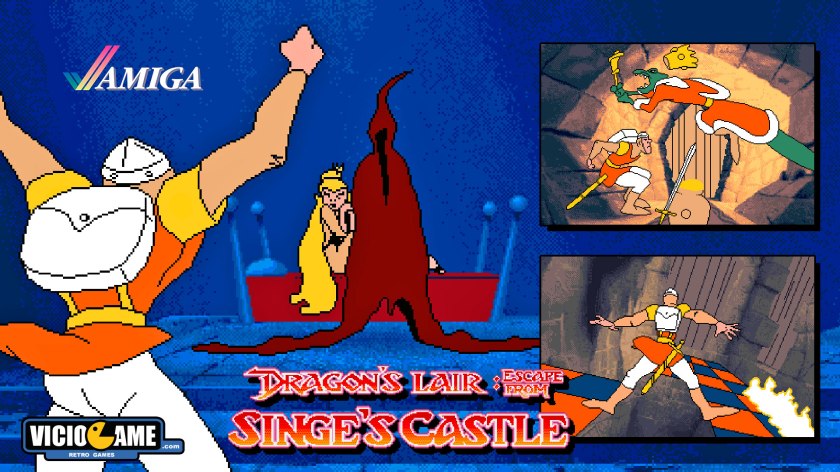
Dragon’s Lair: Escape from Singe’s Castle is an interactive movie game released in 1990 for the Amiga computer. The story picks up exactly where the previous game left off. After being defeated, the dragon casts one last spell that causes the princess to be kidnapped once again, forcing the hero to return to the castle.
Developer: Visionary Design Technologies
Publisher: ReadySoft Incorporated
Release Date: 1990
Platform: Commodore Amiga
🇺🇸 In June 1983, lines started forming at American arcades for a new machine that charged 50 cents a play, double the going rate. The reason was on the screen: Dragon’s Lair didn’t display sprites; it displayed an animated cartoon with a cinematic finish, played back from a laserdisc hidden inside the cabinet, while the player’s job was limited to telling the knight Dirk the Daring to dodge, climb, or draw his sword at exactly the right instant. The animation, credited to Don Bluth, a former Disney animator, ran about twenty minutes and cost more than a million dollars, which made the rest of the arcade look like it belonged to another decade. Seven years later, a Canadian programmer in his twenties delivered the follow-up to that feat to the Amiga: Dragon’s Lair: Escape from Singe’s Castle, a sequel on five floppy disks that fixes nearly everything the previous port got wrong and yet still leaves standing the question that has followed the series since 1983: how much game fits inside an interactive movie?
The mechanics behind the spectacle fit in a single sentence: in each scene, the game demands one or two correctly timed moves, and any mistake triggers a death animation. What we now call a quick time event has one of its ancestors in this game, with the twist that every failure is also an attraction, because Dirk’s deaths get the same meticulous care as the rest of the cartoon. The arcade game branches into something close to 800 decision points, but each point allows only one correct response, so mastering it means memorizing a map rather than improvising within it. That design has divided opinion since day one: for some, a movie worth the price of a token and conquered through sheer stubbornness; for others, a game that barely qualifies as a game. The cabinets were expensive and the laserdisc units broke down often, which shelved several projects in the genre and pushed Bluth’s studio toward home computers. At home, what existed until then were makeshift hacks, like the one Microdeal went so far as to sell for hooking a laserdisc player up to the Atari ST, with the movie playing on a TV and the computer interrupting the action to ask for commands.
The task of making the movie fit on a floppy disk fell to two Canadians. David Foster founded ReadySoft in 1987, and Randy Linden, not yet twenty, ran Visionary Design Technologies out of his mother’s basement, a company that also published the shoot ‘em up Datastorm, written by Danish programmer Søren Grønbech (who also wrote Sword of Sodan), with a loading and compression system by Linden. He tracked down the laserdisc the way a collector hunts a rare piece: he asked around at arcades, bought the discs from an operator, rented a player and, following the chain of manufacturers from company to company, ended up at Sullivan Bluth Interactive Media, which agreed to license the port. Electronic Arts, approached beforehand, didn’t believe it could be done and turned the project down. Bluth’s studio kept its distance: Linden never spoke with Don Bluth, and oversight stayed in the background, which left the team free to decide how to turn a movie into data.
The credits of the first game list four programmers and about ten artists, and it was their work that defined the method, a handcrafted assembly line. The frames came off the laserdisc through a digitizer from Sunrize Industries, the company of Anthony Wood, who would go on to found Roku years later: the first model required three passes with color filters for each image, until a prototype of the next generation made the process nearly painless. Then came the work nobody sees. Each artist received a tape with a recording of the game (Victor Sue’s was on Betamax) and floppy disks with the captured frames, and retouched or redrew everything by hand in Deluxe Paint, with the palette cut down to something like 16 colors. Sue recalls that the pay came to about one Canadian dollar per frame. The reason for all that hand work was compression: areas that should have been flat color came out dirty from the digitizing, and every bit of noise cost bytes. Background and foreground were kept separate, so that only what moved took up real space, and the appetite for processing power was enormous: Foster would later recount that on Dragon’s Lair II: Time Warp, compressing a single frame could take as long as two hours on a 68030 processor. Sue also remembers that the animated sparkles in the final kiss between Dirk and Princess Daphne, painstakingly drawn, were cut so the game would fit on the floppy disks.
The first game’s engine takes up less than 8 KB. Instead of relying on the Amiga‘s operating system, the program takes control of the drive, uses its own disk format that fits more data per track, and loads the next chunk while the animation is still running, a form of streaming that, according to Linden, no home game had tried at full screen, in color, and with stereo sound. On the Amiga 1000, it even reuses the memory where the system would normally be loaded. The first Dragon’s Lair debuted at the World of Commodore show in Toronto in December 1988, and production couldn’t keep up with demand. It takes up six floppy disks, which at the time cost something like $1.25 each, and the marketing touted 130 MB of animation compressed into that space. It requires 1 MB of memory, which on the Amiga 500 means buying the expansion, and it cost £45 in the United Kingdom. Foster estimates that the version contained something like 15% of the arcade game, and the press was as divided as it ever gets: 92% in Amiga Format, which recommended it to anyone still hesitating to expand their machine’s memory, and 32% in CU Amiga, which dismissed it as irritating window dressing.
The flaws of that first game are practical ones, and ReadySoft knew it. After about fifteen seconds of action come twenty seconds of disk access, and anyone who runs out of all three lives has to start over from disk 1. The game includes only a dozen scenes, leaves out sequences that arcade fans were looking for, and only works with hard drives from a single manufacturer that nobody sold in the United Kingdom. Amiga Computing treated it as a demonstration of what the machine could do, not as a game to play for hours, and that is the bill Escape from Singe’s Castle tries to settle.
It was predictable that what was left over from the arcade game would call for a second set of floppy disks, and Escape from Singe’s Castle was created to hold it. Zzap! 64 treated the release as the second half of the arcade game, and the game reached stores in early 1990, after Space Ace had given the Amiga a port criticized for lacking gameplay. ReadySoft would repeat the same approach with Space Ace II: Borf’s Revenge. The title, incidentally, wasn’t new: in 1987, the British company Software Projects had released Dragon’s Lair Part II: Escape from Singe’s Castle for 8-bit home computers such as the Commodore 64, the ZX Spectrum, and the Amstrad CPC, with scenes adapted from the arcade game, and ReadySoft inherited the name. Beyond that, the two games have little in common, starting with the groundwork: the 1990 release is, once again, an animated cartoon rebuilt frame by frame, and the credits give Linden the programming, rotoscoping, digitizing, and audio synchronization, with Fulvio Ciano sharing the graphics pasting and Digital Dream Productions credited with the computer graphics.
The plot serves as a pretext and picks up, without ceremony, the story of the arcade version. Dirk the Daring has just defeated Singe and freed Princess Daphne when the dragon, before dying, casts a curse on her. Dirk awakens her with a kiss and watches her vanish before his eyes. Amid smoke and thunder, the Shapeshifter appears, the hooded specter who in the arcade game watched over the bridge of the spinning rods, and warns that Singe was only guarding a wizard’s gold and that Daphne belongs to that wizard. The knight must go back down through the castle. The first editions come with an illustrated map of the kingdom, a curious freebie, since all of the action takes place inside Singe’s walls.
The game has a little over ten scenes, and most of them unfold across two or more screens. Some come straight from the arcade game, and scenes such as Metallic Flying Horse, The Smithy, The Lizard King, and Lava Field of the Mudmen are among those the first game had left out. Others were created for this edition and deliver its most distinctive moments: Knocker, in which Dirk hums carelessly in front of a door and the door knocker turns into a monster (Amiga Computing considered the scene one of the funniest it had ever seen on a computer), the Labyrinth that comes right before the final showdown, and the fight against the Shapeshifter in The Shapeshifter’s Den. Some point out that the finish on the new scenes is a notch below Bluth’s own material, and the ending is where the gap is most glaring.
The Labyrinth deserves a closer look, because it is the only stretch where the game truly puts the player in the driver’s seat. Lost in a maze, Dirk follows whichever path the player picks, the sequence can last almost indefinitely, and a mistake only happens when the character hits a wall. It’s not much, but it’s enough to show what the technology already allowed in 1990 and what the format preferred not to attempt, and the press noticed: if the rest of the game offered the same freedom, it would be a different game. The contrast with Cinemaware is instructive. While Cinemaware was selling the idea of the interactive movie on the Amiga with purpose-built games, such as Defender of the Crown, ReadySoft delivered the opposite: a finished movie with a minimal game laid on top. On a press visit to Bluth’s studio in Dublin in 1990, Sullivan Bluth Interactive Media producer Rick Van Ysseldyk admitted that the linearity (one correct move leads forward, anything else triggers a death) stemmed from the fact that everything there was an arcade port, and that projects born for computers, such as the announced title The Sea Beast and Barnacle Bill, would be written around each machine’s capabilities. The studio was also eyeing CD-ROM and CD-i as the future of the business, and that is where the series ended up migrating.
The real advance in Escape from Singe’s Castle lies in what surrounds the scenes. The player chooses among three difficulty levels, which in practice measure the amount of content: on the easiest, there are eight stages, about half an hour of play, and no ending; on the intermediate, fifteen; on the hardest, twenty, and only that one leads to the Shapeshifter and the closing cutscene. You can start with three, four, or five lives, keep up to five save slots, and activate the Helper, a brown box at the bottom of the screen that flashes the correct joystick direction a second before it’s needed and disappears near the end. One option shuffles the order of the scenes and mirrors several of them, forcing you to play most of them twice, and anyone who has memorized the routine has to relearn it with their reflexes. What was trial and error in the first game becomes a matter of timing.
Under the hood, the program was rewritten to coexist with the machine instead of dominating it. It runs in full on an Amiga with 1 MB of memory and, with 512 KB, gives up the sound and the death sequences; turning off the sound in the main menu makes the animation smoother; the loader is about ten times faster than the first game’s; the system’s multitasking keeps working when there is memory to spare; and the installer accepts hard drives from any manufacturer, unlike its predecessor. It’s a game that gets better the more machine you give it, and there is also an option to link the two disk sets into a single adventure, with the Helper working in the first game’s scenes as well, which turns two boxes into one continuous playthrough on a scale rare for 1990.
On screen, it’s a different story, and the critics’ scores show it: 92% for graphics in Zzap! 64, 94% in CU Amiga, 97 points in ZERO, and 98% in Amiga Joker, which called the pairing of Linden and the Amiga unbeatable when it came to visuals. Dirk takes up a large part of the screen in wide, colorful, fast animations, and the pared-down palette gives it a flat, clean look, closer to a cartoon than to a digitized photograph. The sound mixes samples taken from the arcade game with occasional humorous effects, and the death sequences are still treated as visual jokes, an inseparable part of the spectacle. Amiga Joker complained that the audio barely differs from the first game, and it is in the new effects, with their looser humor, that the game stands out.
The price of that ambition shows up as friction. Disk swapping is constant, and a death of Dirk’s usually calls for another disk access, sometimes in the middle of an animation. The password system requires the player to recognize coats of arms printed on a black-and-red sheet, and Amiga Joker didn’t hide its annoyance. ZERO did the math the store didn’t: with £45 asked for the set, each disk came out to £9. The same magazine observed that some players finish the game quickly while others never get past the first screen, which guarantees love-it-or-hate-it reactions with no middle ground, and even suggested that the best way to enjoy the game is to watch a friend play, because the attention the timing demands robs you of the very animation you came to see. With the save feature, Amiga Joker estimated that you can beat it in about an hour, and the extra challenge of playing with three lives, no direction arrows, and no saves appeals only to the truly devoted.
Averaged out, the scores from that time land near 66%, and the extremes are far apart. Amiga Computing gave it 85% and an excellence award; The Games Machine, 80%; CU Amiga, 73%; Zzap! 64, 71%; and ZERO, 68%. At the bottom of the table were The One with 58%, France’s Génération 4 with 46%, and Germany’s Power Play with just 25%. The pattern repeats across the reviews: top marks, or close to it, for visuals and sound, and much lower marks for gameplay, longevity, and price. Amiga Computing saw in the game the computer being used the way it was designed to be used, to astonish, but complained about the cost; Zzap! 64 called it a leap over the frustrating Space Ace and an essential purchase for anyone who already owned the first game, though it found the price excessive. The praise converges on what changed around the scenes: the Helper, the adjustable difficulty, the saves, and the fast loader fixed part of what had soured the reception of the previous game. The core, however, is the same, and that is what drags the scores down. Players today reach a similar verdict, with an average of 3.3 out of 5 and the recurring observation that the game is an excellent port of a debatable game.
In 1991, the sequel also arrived on PC, Atari ST, and Macintosh, and the PC edition includes new scenes, such as Mirror in Castle Corridor and Skeleton Grounds, which the Amiga never received. ReadySoft even completed a version for the Apple IIGS, but it never came out; in 2022, Brutal Deluxe released a new port, based on the PC one. The series, for its part, kept going: Dragon’s Lair II: Time Warp came out in November 1990 for Amiga, Atari ST, and PC, the NES got a Dragon’s Lair reimagined as a platformer, and the floppy disk era ended in 1992 with Dragon’s Lair III: The Curse of Mordread, which the press received coolly. With the arrival of the CD, ReadySoft remade the series for 3DO, CD-i, Sega CD, and Jaguar CD and produced the interactive movie Brain Dead 13, until Foster, after selling the company and founding Digital Leisure in 1997, rewrote the code to reproduce the arcade game faithfully, including the scenes that were missing from the computer ports. Digital Leisure continues to re-release the series on current platforms and even made, in 2012, a version for the Xbox 360 with Kinect, in which the player jumped and gestured to move Dirk.
Among those who looked at that spectacle with technical envy was the Frenchman Éric Chahi, who pointed to Linden’s work as one of the inspirations for the graphical solutions in Another World, released in 1991 with polygons in place of compressed bitmaps. The kinship is conceptual: in both cases, the storage constraint forces you to rethink how to tell a story in motion. Linden went on collecting technical impossibilities, and the 1995 Super Nintendo version of Doom was born of the same willingness to push a machine beyond what it promised.
More than three decades later, Escape from Singe’s Castle remains what it always was: an engineering demonstration that uses a cartoon as a pretext and the joystick as an advance button. Anyone who puts the first floppy disk into an Amiga with 1 MB of memory sees proof that a Don Bluth movie could fit inside a home computer, and also understands why the format only found its place once technology caught up with ambition, with the CD and then the DVD. The 1990 release sits at the exact point of that transition, when assistance for the player tries to lend the interactive movie something resembling a real game. It doesn’t get there, and the Labyrinth, with its timid freedom, points to what was missing. Even so, the package has the merit of candor: it doesn’t pretend to be more than it is and delivers to the eyes the showiest thing the Amiga had to offer.
🇧🇷 Em junho de 1983, uma máquina nova começou a formar fila nos fliperamas americanos cobrando 50 centavos de dólar por partida, o dobro do preço corrente. O motivo estava na tela: Dragon’s Lair não exibia sprites, exibia um desenho animado com acabamento de cinema, tocado por um laserdisc escondido no gabinete, e o jogador se limitava a mandar o cavaleiro Dirk the Daring desviar, subir ou sacar a espada no instante exato. A animação, assinada por Don Bluth, ex-animador da Disney, somava cerca de vinte minutos e custou mais de um milhão de dólares, o que fazia o resto do salão parecer de outra década. Sete anos depois, um programador canadense na casa dos vinte anos entregava ao Amiga a continuação dessa proeza: Dragon’s Lair: Escape from Singe’s Castle, uma sequência em cinco disquetes que conserta quase tudo o que a conversão anterior fazia de errado e, mesmo assim, deixa de pé a pergunta que acompanha a série desde 1983, a de quanto jogo cabe dentro de um filme interativo.
A mecânica por trás do espetáculo cabe numa frase: a cada cena, o jogo cobra um ou dois movimentos no tempo certo, e qualquer erro dispara uma animação de morte. O que hoje se chama quick time event tem ali um de seus ancestrais, com a particularidade de que cada falha também é atração, porque as mortes de Dirk recebem o mesmo capricho do resto do desenho. O arcade se ramifica em algo próximo de 800 pontos de decisão, mas cada ponto admite uma única resposta correta, de modo que dominá-lo é decorar um mapa, e não improvisar dentro dele. Esse design dividiu opiniões desde o primeiro dia: para uns, um filme que vale o preço da ficha e se vence por teimosia; para outros, um jogo que mal chega a ser jogo. Os gabinetes eram caros e as unidades de laserdisc davam defeito com frequência, o que engavetou vários projetos do gênero e empurrou o estúdio de Bluth para os computadores domésticos. Em casa, o que existia até então eram gambiarras, como a que a Microdeal chegou a vender para ligar um aparelho de laserdisc ao Atari ST, com o filme rodando numa TV e o computador interrompendo a ação para pedir comandos.
A tarefa de fazer o filme caber num disquete caiu nas mãos de dois canadenses. David Foster fundou a ReadySoft em 1987, e Randy Linden, com menos de vinte anos, tocava a Visionary Design Technologies a partir do porão da casa da mãe, empresa que publicou ainda o shoot ‘em up Datastorm, escrito pelo dinamarquês Søren Grønbech (autor também de Sword of Sodan), com sistema de carregamento e compressão assinado por Linden. Foi atrás do laserdisc como quem rastreia uma peça rara: perguntou em fliperamas, comprou os discos de um operador, alugou um aparelho e, seguindo a cadeia de fabricantes de empresa em empresa, chegou à Sullivan Bluth Interactive Media, que topou licenciar a conversão. A Electronic Arts, procurada antes, não acreditou que aquilo fosse possível e recusou o projeto. O estúdio de Bluth manteve distância: Linden jamais falou com Don Bluth, e a supervisão ficou em segundo plano, o que deixou a equipe livre para decidir como transformar um filme em dados.
O primeiro disco traz nos créditos quatro programadores e uma dezena de artistas, e foi o trabalho deles que definiu o método, uma linha de montagem artesanal. Os frames saíam do laserdisc por um digitalizador da Sunrize Industries, empresa de Anthony Wood, o mesmo que anos depois fundaria a Roku: o primeiro modelo exigia três passagens com filtros coloridos para cada imagem, até que um protótipo da geração seguinte tornou o processo quase indolor. Vinha então o trabalho que ninguém vê. Cada artista recebia uma fita com a gravação do jogo (a de Victor Sue era em Betamax) e disquetes com os quadros capturados, e retocava ou redesenhava tudo à mão no Deluxe Paint, com a paleta reduzida a algo como 16 cores. Sue recorda que o pagamento ficava perto de um dólar canadense por frame. A razão era a compressão: áreas que deveriam ser chapadas saíam sujas da digitalização, e cada ruído custava bytes. Cenário e primeiro plano eram separados, de modo que só o que se mexia ocupava espaço de verdade, e o apetite por processamento era enorme: em Dragon’s Lair II: Time Warp, Foster contaria que comprimir um único frame chegava a tomar duas horas de um processador 68030. Sue lembra ainda que as faíscas animadas do beijo final entre Dirk e a Princess Daphne, desenhadas com paciência, foram cortadas para o jogo caber nos disquetes.
O motor do primeiro jogo ocupa menos de 8 KB. Em vez de recorrer ao sistema operacional do Amiga, o programa assume o controle do drive, usa um formato de disco próprio que acomoda mais dados por trilha e carrega o trecho seguinte enquanto a animação ainda roda, uma forma de streaming que, segundo Linden, nenhum jogo doméstico havia tentado com tela cheia, cores e som estéreo. No Amiga 1000, chega a reaproveitar a memória em que o sistema normalmente seria carregado. O primeiro Dragon’s Lair estreou no World of Commodore de Toronto, em dezembro de 1988, e a produção não dava conta da procura. Ocupa seis disquetes, que na época custavam algo como 1,25 dólar cada, e a divulgação falava em 130 MB de animação comprimidos nesse espaço. Exige 1 MB de memória, o que no Amiga 500 significa comprar a expansão, e custava 45 libras no Reino Unido. Foster calcula que a versão reunia algo como 15% do arcade, e a imprensa se dividiu como poucas vezes: 92% na Amiga Format, que o recomendou a quem ainda hesitava em ampliar a memória da máquina, e 32% na CU Amiga, que reduziu o disco a um enfeite irritante.
Os defeitos desse primeiro disco são práticos, e a ReadySoft sabia disso. Depois de uns quinze segundos de ação vêm vinte de acesso ao drive, e quem esgota as três vidas recomeça pelo disquete 1. O jogo reúne só uma dúzia de cenas, deixa de fora sequências que os fãs do arcade procuravam e só aceita discos rígidos de um fabricante que ninguém vendia no Reino Unido. A Amiga Computing o tratou como uma demonstração do que a máquina podia fazer, não como um jogo para horas, e é essa a conta que Escape from Singe’s Castle tenta acertar.
Era previsível que a sobra do arcade pedisse um segundo conjunto de disquetes, e Escape from Singe’s Castle nasce para abrigá-la. A Zzap! 64 tratou o lançamento como a segunda metade do fliperama, e o disco chegou às lojas no início de 1990, depois de Space Ace ter dado ao Amiga uma conversão criticada pela falta de jogabilidade. A ReadySoft repetiria o expediente com Space Ace II: Borf’s Revenge. O título, aliás, não era inédito: em 1987, a britânica Software Projects lançara Dragon’s Lair Part II: Escape from Singe’s Castle para micros de 8 bits como o Commodore 64, o ZX Spectrum e o Amstrad CPC, com cenas aproveitadas do arcade, e a ReadySoft herdou o nome. Fora isso, os dois jogos têm pouco em comum, a começar pelo trabalho de base: o disco de 1990 é, de novo, um desenho animado reconstruído quadro a quadro, e os créditos concentram em Linden a programação, a rotoscopia, a digitalização e a sincronização de áudio, com Fulvio Ciano dividindo a colagem dos gráficos e a Digital Dream Productions assinando a computação gráfica.
A trama serve de pretexto e continua, sem cerimônia, a história da versão arcade. Dirk the Daring acaba de derrotar Singe e libertar a Princess Daphne quando o dragão, antes de morrer, lança uma maldição sobre ela. Dirk a desperta com um beijo e a vê desaparecer diante dos olhos. Em meio a fumaça e trovões surge o Shapeshifter, o espectro encapuzado que no arcade vigiava a ponte dos bastões giratórios, e avisa que Singe apenas guardava o ouro de um mago e que Daphne pertence a esse mago. O cavaleiro precisa descer outra vez pelo castelo. As primeiras edições acompanham um mapa ilustrado do reino, um brinde curioso, já que toda a ação transcorre dentro das muralhas de Singe.
O jogo reúne pouco mais de uma dezena de cenas, e a maioria se desdobra em duas ou mais telas. Parte vem direto do arcade, e cenas como Metallic Flying Horse, The Smithy, The Lizard King e Lava Field of the Mudmen estão entre as que o primeiro disco havia deixado de fora. Outras foram criadas para esta edição e rendem os momentos mais particulares: Knocker, em que Dirk cantarola despreocupado diante de uma porta e a aldrava se transforma num monstro (a Amiga Computing considerou a cena uma das mais engraçadas que já vira num computador), o Labyrinth que antecede o confronto final e a luta contra o Shapeshifter em The Shapeshifter’s Den. Há quem note que o acabamento das cenas novas fica um degrau abaixo do material de Bluth, e o desfecho é o ponto em que a diferença mais salta aos olhos.
O Labyrinth merece atenção à parte, porque é o único trecho em que o jogo entrega de fato a direção ao jogador. Perdido num labirinto, Dirk segue o caminho escolhido, a sequência pode durar quase indefinidamente e o erro só acontece quando o personagem bate numa parede. É pouco, mas suficiente para mostrar o que a tecnologia já permitia em 1990 e o que o formato preferia não tentar, e a imprensa percebeu: se o resto do disco concedesse a mesma liberdade, o jogo seria outro. O contraste com a Cinemaware é instrutivo. Enquanto ela vendia no Amiga a ideia de filme interativo com jogos feitos sob medida, como Defender of the Crown, a ReadySoft entregava o inverso, um filme pronto com um jogo mínimo por cima. Numa visita de imprensa ao estúdio de Bluth em Dublin, em 1990, o produtor da Sullivan Bluth Interactive Media, Rick Van Ysseldyk, admitiu que a linearidade (um acerto leva adiante, qualquer outra coisa dispara uma morte) vinha de tudo ali ser conversão de arcade, e que projetos nascidos para computadores, como o anunciado The Sea Beast and Barnacle Bill, seriam escritos para as capacidades de cada máquina. O estúdio olhava ainda para o CD-ROM e o CD-i como futuro do negócio, e foi para lá que a série acabou migrando.
O avanço de Escape from Singe’s Castle está no que cerca as cenas. O jogador escolhe entre três níveis de dificuldade, que na prática medem a quantidade de conteúdo: no mais fácil são oito fases, cerca de meia hora de partida e nenhum final; no intermediário, quinze; no difícil, vinte, e só ele leva ao Shapeshifter e à cutscene de encerramento. Dá para começar com três, quatro ou cinco vidas, guardar até cinco posições de save e acionar o Helper, uma caixa marrom no rodapé da tela que pisca a direção correta do joystick um segundo antes do necessário e some perto do final. Uma opção sorteia a ordem das cenas e espelha várias delas, obrigando a jogar a maioria duas vezes, e quem decorou a rotina precisa reaprendê-la com os reflexos. O que no primeiro disco era tentativa e erro vira questão de timing.
Por baixo, o programa foi reescrito para conviver com a máquina em vez de dominá-la. Roda inteiro num Amiga com 1 MB de memória e, com 512 KB, abre mão do som e das sequências de morte; desligar o som no menu principal deixa a animação mais fluida; o carregador é cerca de dez vezes mais veloz que o do primeiro jogo; a multitarefa do sistema funciona quando sobra memória; e o instalador aceita discos rígidos de qualquer fabricante, ao contrário do antecessor. É um jogo que melhora conforme a máquina cresce, e há ainda a opção de ligar os dois discos numa só aventura, com o Helper valendo também nas cenas do primeiro, o que transforma duas caixas numa partida contínua de proporções raras para 1990.
Na tela, a conversa é outra, e as notas dos críticos mostram isso: 92% em gráficos na Zzap! 64, 94% na CU Amiga, 97 pontos na ZERO e 98% na Amiga Joker, que chamou a dupla formada por Linden e pelo Amiga de imbatível em imagem. Dirk ocupa grande parte da tela em animações largas, coloridas e rápidas, e a paleta enxuta dá um aspecto chapado e limpo, mais próximo de um desenho que de uma fotografia digitalizada. O som mistura samples tirados do arcade com efeitos pontuais de humor, e as sequências de morte seguem tratadas como piada visual, parte indissociável do espetáculo. A Amiga Joker reclamou que o áudio mal difere do primeiro jogo, e é nos efeitos novos, de humor mais solto, que o disco se destaca.
O preço dessa ambição aparece na fricção. A troca de disquetes é constante, e a morte de Dirk costuma pedir novo acesso ao drive, às vezes no meio de uma animação. O sistema de password exige que o jogador reconheça brasões impressos numa folha em preto e vermelho, e a Amiga Joker não escondeu o incômodo. A ZERO fez a conta que a loja não fazia: com 45 libras pedidas pelo conjunto, cada disquete saía por nove. A mesma revista observou que há quem termine a partida rapidamente e quem não passe da primeira tela, o que garante amores e ódios sem meio-termo, e chegou a sugerir que o melhor jeito de aproveitar o jogo é assistir a um amigo jogando, porque a atenção que o timing exige rouba justamente a animação que se veio ver. Com o save, a Amiga Joker estimou que dá para zerar em cerca de uma hora, e o desafio extra de jogar com três vidas, sem setas e sem save atrai só quem gosta muito.
Somadas, as notas da época ficam perto de 66%, e os extremos estão longe um do outro. A Amiga Computing deu 85% e um prêmio de excelência, a The Games Machine 80%, a CU Amiga 73%, a Zzap! 64 71% e a ZERO 68%; no fim da tabela ficaram a The One com 58%, a francesa Génération 4 com 46% e a alemã Power Play com apenas 25%. O padrão se repete nas análises: nota máxima, ou perto dela, para imagem e som, e valores bem mais baixos para jogabilidade, durabilidade e preço. A Amiga Computing viu no disco um uso do computador como ele foi concebido, para espantar, mas reclamou do custo; a Zzap! 64 o chamou de salto sobre o frustrante Space Ace e de item essencial para quem já tinha o primeiro disco, embora achasse o preço exagerado. Os elogios convergem para o que mudou ao redor das cenas: o Helper, a dificuldade ajustável, o save e o carregador rápido resolveram parte do que havia azedado a recepção do jogo anterior. O núcleo, porém, é o mesmo, e é ele que puxa as notas para baixo. Quem joga hoje chega a um veredito parecido, com média de 3,3 em 5 e a observação recorrente de que o disco é uma conversão excelente de um jogo discutível.
Em 1991, a sequência chegou também ao PC, ao Atari ST e ao Macintosh, e a edição para PC inclui cenas inéditas, como Mirror in Castle Corridor e Skeleton Grounds, que o Amiga nunca recebeu. Uma versão para o Apple IIGS chegou a ser concluída pela ReadySoft e jamais saiu; em 2022, a Brutal Deluxe lançou uma conversão nova, baseada na de PC. A série, por sua vez, seguiu adiante: Dragon’s Lair II: Time Warp veio em novembro de 1990 para Amiga, Atari ST e PC, o NES ganhou um Dragon’s Lair reinventado como jogo de plataforma, e o ciclo dos disquetes se encerrou em 1992 com Dragon’s Lair III: The Curse of Mordread, recebido com frieza pela imprensa. Com a chegada do CD, a ReadySoft refez a série para 3DO, CD-i, Sega CD e Jaguar CD e produziu o filme interativo Brain Dead 13, até que Foster, depois de vender a empresa e fundar a Digital Leisure em 1997, reescreveu o código para reproduzir o arcade com fidelidade, incluindo as cenas que faltavam nas conversões para computadores. A Digital Leisure continua relançando a série em plataformas atuais e chegou a fazer, em 2012, uma versão para o Xbox 360 com Kinect, em que o jogador pulava e gesticulava para mover Dirk.
Entre os que olharam para aquele espetáculo com inveja técnica estava o francês Éric Chahi, que apontou o trabalho de Linden como uma das inspirações para as soluções gráficas de Another World, lançado em 1991 com polígonos no lugar de bitmaps comprimidos. O parentesco é conceitual: nos dois casos, a restrição de armazenamento obriga a repensar como se conta uma história em movimento. Linden seguiu colecionando impossibilidades técnicas, e a versão de Doom para o Super Nintendo, de 1995, nasceu da mesma disposição de empurrar uma máquina além do que ela prometia.
Mais de três décadas depois, Escape from Singe’s Castle continua sendo o que sempre foi: uma demonstração de engenharia que usa um desenho animado como pretexto e o joystick como botão de avançar. Quem põe o primeiro disquete num Amiga com 1 MB de memória vê a prova de que um filme de Don Bluth podia caber num computador doméstico, e percebe também por que o formato só encontrou seu lugar quando a tecnologia alcançou a ambição, com o CD e depois o DVD. O disco de 1990 está no ponto exato dessa transição, quando a ajuda ao jogador tenta dar ao filme interativo algo parecido com uma partida de verdade. Não chega lá, e o Labyrinth, com sua liberdade tímida, aponta o que faltou. Ainda assim, o conjunto tem o mérito da franqueza: não finge ser mais do que é e entrega aos olhos o que o Amiga tinha de mais vistoso para mostrar.
🤑💲Earn money without doing anything! Just leave these apps open:
https://r.honeygain.me/CONTA9DB02
https://packetstream.io/?psr=1uPb
⬛ 𝗧𝗶𝗸𝗧𝗼𝗸: https://www.tiktok.com/@viciogame
🟧 𝗜𝗻𝘀𝘁𝗮𝗴𝗿𝗮𝗺: http://www.instagram.com/viciogame
🟥 𝗬𝗼𝘂𝘁𝘂𝗯𝗲: http://www.youtube.com/viciogame
🟦 𝗙𝗮𝗰𝗲𝗯𝗼𝗼𝗸: http://www.facebook.com/viciogame
🔳 𝗧𝗵𝗿𝗲𝗮𝗱𝘀: https://www.threads.net/@viciogame
🟪 𝗧𝘄𝗶𝘁𝗰𝗵: https://www.twitch.tv/ViciogameRetroGames
🟨 𝗕𝗹𝗼𝗴: http://www.viciogameblog.com/
🟦𝗧𝘄𝗶𝘁𝘁𝗲𝗿: http://www.twitter.com/viciogame
#Viciogame #Gameplay #LetsPlay #Playthrough #Games #Gaming #Videogames #Review #Game #Detonado #Walkthrough #Ending #Reviews #Facts #Retro #RetroGaming #Roms #Emulator #Longplay #Speedrun #NoCommentary #DragonsLair #EscapeFromSingesCastle #Amiga #Commodore #PcGaming #PC #retrocomputing #PcGamer #SullivanBluth #DonBluth #SpaceAce

