
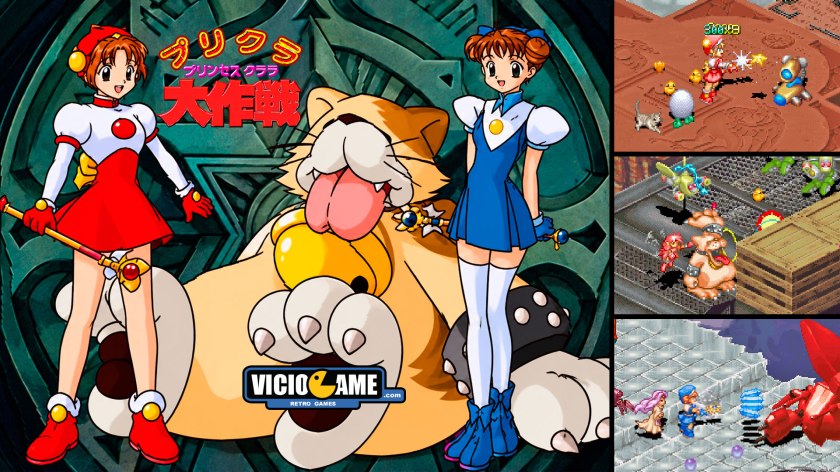
Purikura Daisakusen (プリクラ大作戦 / PriCla Daisakusen) is an isometric action shooter released in 1996 for the Sega Saturn. A spin-off of Power Instinct, the game begins when an evil empire invades the kingdom, kidnaps the queen, and turns the inhabitants into cute animals.
Developer: Atlus Osaka Development Office
Publisher: Atlus
Release date: 1996
Platform: Sega Saturn
🇺🇸 In November 1996, the Sega Saturn’s lineup of new releases in Japan mixed arcade ports, dating sims, and niche RPGs, and few covers stood out as much as the one on Purikura Daisakusen: girls in white and pink outfits, drawn in delicate linework and bearing Atlus’s signature. Behind that fairy-tale packaging lies an action game with gunfire, hammer swings, and a chain-reaction mechanic with few parallels in the console’s library. It is a port of an arcade game that had debuted shortly before on Sega’s ST-V board, and its history runs through passing fads, marketing puns, and a character transplanted from a fighting game.
The title only makes sense in the context of Japanese arcades in the mid-1990s. In February 1995, Atlus and Sega launched Print Club, the booth that photographs groups of friends and prints the portraits as stickers. The idea came from an Atlus employee, Sasaki Miho, who had been championing it since 1994 to skeptical bosses. The effect was explosive: in 1996, the machine became the highest-grossing arcade machine in the country, and by 1997 it had already sold around 45,000 units. More than money, Print Club brought arcades an audience of schoolkids that fighting and shooting games rarely attracted, and “purikura,” the popular short form of the name, became synonymous with an entire teenage pastime. Atlus, a co-creator of the phenomenon, then found a coincidence that seemed made to order. The heroine of its new game is Princess Kurara (Princess Clara in the Western versions of the game in which she debuted), and combining the first syllables of “purinsesu” and “kurara” gives you exactly Purikura. The working title was Kira Kira Kurakura Daisakusen, and the switch to the final name drew immediate attention. To this day, the spelling varies across catalogs between Purikura Daisakusen, Prikura Daisakusen, PriCla Daisakusen, and Princess Clara Daisakusen.
Kurara wasn’t born in an action game. She debuted in Power Instinct 2 (Gouketsuji Ichizoku 2, 1994), the sequel in the fighting series Atlus created in 1993, which became known for its zany humor, with explosive grandmas serving as final bosses. The magical girl was such a hit with audiences that she got a spin-off, and Atlus transplanted her into a genre far removed from where she began. The team comes from the same unit behind the fighting series, the company’s Kansai branch in Osaka, which had only just opened when the first Power Instinct was made. Leading the project as director is Keiko Ijuu, who is credited as Chuuko in Atlus games. A veteran of SNK, where she started in the mid-1980s and designed the protagonists Ralf and Clark of Ikari Warriors, she would leave Atlus in 1997 to found Noise Factory in January 1998, a studio that would later produce Power Instinct Matrimelee, a game in which the heroine reappears under the name Clara. The visuals change hands too: the fighting series is associated with the art of Range Murata, while here the character design and illustrations are by You Shiina.
The story is a fairy tale with nuts and bolts. The kingdom of Miracle World lives in peace until the Scrap Empire invades, an empire of machines hunting for the magic stone the royal family guards. Princess Urara, Kurara’s older sister, tries to defend the treasure and is captured, while the inhabitants are turned into small animals and locked inside the war machines. Kurara, who was away training, returns to the kingdom and teams up with her twin sister Kirara and with Grey, Urara’s boyfriend, whom the curse left in the form of a plump, cat-like creature. The storytelling is economical, with only a few scenes in Japanese, but it gives the action a clean through-line that fits the game’s system: defeating enemies can free trapped critters. The voice cast includes Masayo Kurata as Kurara, Tomoe Hanba as Kirara, Makiko Ohmoto as Grey, and Jun Mizusawa as Urara.
The ST-V, a low-cost Sega board built on the architecture of the Saturn itself, explains why the port is nearly identical to the original: the arcade game is distributed by Sega and developed by Atlus, and it shares the same technical core with the console. The same path was also taken by Puyo Puyo Sun and Radiant Silvergun, and Atlus itself would repeat it the following year with Groove on Fight, the third game in the fighting series. At that point, the company was a constant presence on the console: it had published ports of DonPachi and Strikers 1945, released the RPG Shin Megami Tensei: Devil Summoner, and was preparing Princess Crown, which would arrive at the end of 1997. The Sega Saturn version adds a brand-new animated opening (the arcade one is still there, now as video), a character showcase mode in which each character tells their own story in spoken narration, endings with voice acting, a sound test with the soundtrack in new arrangements, and button configuration. The price of the move to CD shows in the noticeable load times and the modest quality of the videos. The first batches come with a 1997 calendar, with a cover page and twelve months.
The soundtrack, credited to Atlus’s sound team with Kikuko Hataya at the helm, got a CD release on November 21, 1996, through Pony Canyon and Scitron, compiling the arcade music along with a collection of voices and sound effects. The disc does not include what is new on the Saturn, such as the all-new main theme “Yuuki Shinjite” and the songs for each character in the showcase mode. The credits also list composer Toshikazu Tanaka as a contributor, a partner of the director since their SNK days.
Played from an isometric perspective, the game evokes the lineage of Commando and Mercs, but swaps the rifles for a magic wand and adds a hammer. The controls boil down to three buttons: the long-range shot, the hammer strike, and the bomb, which in practice is the attack of the Pure Egg, a living egg that follows the heroine like an orb and fires on her behalf. Double-tapping the D-pad makes the character roll out of danger, a dash that, on the Saturn, can also be mapped to an extra button on the six-button controller. The fun lies in a choice that seems simple but isn’t. The shot is weak, but every enemy taken down with it frees one of the captive animals, and rescuing critters fills the Pure Egg’s gauge. The hammer demands proximity and leaves the heroine exposed, but it makes the target explode and hit the enemies around it, and every enemy knocked out by the chain reaction yields bigger, more valuable gems; picking up gems of the same color in a row multiplies the score. Since the screens fill up with groups of enemies, the chain reaction becomes a crowd-control tool and a scoring engine at once. The result is a shooter that rewards those who take risks up close, the opposite of what the genre usually preaches.
The Pure Egg is the heart of the system and the reason to come back to the game. At the end of each stage, the score screen tallies gems, animals, and time, and the egg evolves according to the ratio of rescued critters to collected gems, for a total of ten forms that change the effect of the bomb. Among the creatures are Jack Frost, the snowman who became the mascot of the Megami Tensei franchise, Valkyrie, and Lich, recurring presences in Atlus’s RPG series. The inside joke is subtle but has consequences: the final forms change the story’s outcome, and chasing one of them forces you to play a specific way, with more shooting and rescuing for one path, more hammer work and chain reactions for another. In a short campaign, this layer is what justifies going back to the game.
The three playable characters have distinct temperaments. Kurara has the best shot and the weakest hammer strike. Kirara, the twin, flips the equation: she hits harder and shoots with less power, over a wider area. Grey is the hardest to master: he hits hard on both fronts, but he moves slowly, has a large hitbox, and is left vulnerable after every attack. A specific item transforms each of them into an adult, invulnerable version of themselves for a few seconds, a direct carryover from the transformations in the fighting series (Super Kurara, Super Kirara, and, in Grey’s case, a return to his human form, a good-looking young man, as opposed to the cat), with the added bonus of destroying enemies on contact. The remaining items stick to the sweet tone: slices of cake restore health, and a Kurara doll is worth an extra life. The simultaneous two-player mode is where the game picks up steam, because two hammer strikes add up, groups of enemies fall together, and the screen turns into a party of gems and little critters.
The chosen camera angle takes its toll. In isometric perspective, judging the distance between the heroine and incoming projectiles is tricky, and dodging shots takes more reading than reflexes. The pace is calmer than that of a typical arcade shooter, and the main shot, even when upgraded, has little impact, which pushes the player back toward the hammer. A per-stage timer, which costs a life when it reaches zero, is one of the few sources of pressure. The campaign is short, made up of a handful of quick stages, although the bosses take a while to go down and the last one even has a second form. The Saturn version limits continues, unlike the arcade game, but makes up for it with a difficulty select, and with the level adjusted, any player can reach the ending without much suffering. What it lacks is content: there is only the arcade mode, and the character showcase mode does more to show off the voices and illustrations than to extend the disc’s lifespan.
Reception in Japan was divided. Famitsu reviewed the game in its November 22, 1996 Cross Review, with scores of 6, 4, 5, and 6, a total of 21 out of 40, a low result by the magazine’s scale. The publications dedicated to the console were less harsh: Sega Saturn Magazine and Saturn Fan landed at around 7 out of 10, and Germany’s MAN!AC gave it 66%. In the final reader rankings of Sega Saturn Magazine, which closed in 2000, the game sits at position 508 out of 945, with a score near 7.5, a middle ground that fits a game that pleases with its visuals and ideas but wears thin because of its slowness and short scope.
Over time, its reputation improved. Retrospective pieces tend to highlight the quality of the sprites and animation, the flow of switching between shooting and hammering to build up resources, and the pleasure of watching entire groups of enemies fall like dominoes, and Spain’s Hobby Consolas, in a 2021 retrospective, even included it among the best titles in the Saturn library. In 2017, when mini consoles were dominating the conversation, a columnist for the Japanese site Nlab put the game on a list of ten titles he would like to see on a hypothetical Saturn Mini, praising the fun of the two-player mode and the charm of the characters. Among shooter fans, how to classify the game is a matter of debate: with no auto-scrolling, free movement, and an emphasis on close-quarters combat, it sits on the border between shooter and action game, which doesn’t stop it from showing up on recommendation lists for the console. The language barrier is low: menus and voices are in Japanese and the plot barely comes up, but the action explains itself, which makes it accessible to anyone importing the game without reading Japanese.
The arcade version saw little circulation: in Akihabara, some people only remember seeing it at Tri Tower, a spot known for getting niche titles. For Atlus, though, the Print Club craze kept paying off, and in October 1997 the company brought the trend to the Game Boy with the Purikura Pocket series, which would get a sequel just the following month.
Today, the Saturn port is a collector’s item. The game never left Japan, so it never made it to store shelves in other countries, and complete copies, with the box, manual, obi, and the calendar from the first batches, go for roughly $60 to $125 at Japanese auctions, while in Europe listings run past $165.
Purikura Daisakusen is a small-scale game, with its ambition focused on a single idea: making the hammer, not the shot, the engine of the score. It doesn’t fix the slow pace or the treacherous camera angle, and the campaign ends before the Pure Egg system shows everything it could. But what it offers still works: carefully crafted sprites, charming characters, chain reactions that reward courage, and the willingness to experiment that defined Atlus in 1996. With two players, and with the difficulty well adjusted, it still delivers an afternoon of good humor and colorful explosions, which is plenty for a title born from a pun and a fad.
🇧🇷 Em novembro de 1996, a vitrine de lançamentos do Sega Saturn no Japão misturava conversões de fliperama, simuladores de romance e RPGs de nicho, e poucas capas se destacavam tanto quanto a de Purikura Daisakusen: garotas de roupas brancas e rosadas, desenhadas em traço delicado, com a assinatura da Atlus. Por trás dessa embalagem de conto de fadas há um jogo de ação com tiros, marteladas e uma mecânica de reações em cadeia que dificilmente tem paralelo no catálogo do console. Esta é a conversão de um jogo de fliperama que havia estreado pouco antes na placa ST-V da Sega, e sua história passa por modas passageiras, trocadilhos de marketing e uma personagem transplantada de um jogo de luta.
O título só faz sentido no contexto dos fliperamas japoneses de meados da década. Em fevereiro de 1995, Atlus e Sega lançaram o Print Club, a cabine que fotografa grupos de amigos e imprime os retratos em adesivos, ideia de uma funcionária da Atlus, Sasaki Miho, que a defendia desde 1994 diante de chefes céticos. O efeito foi explosivo: em 1996, a máquina se tornou o fliperama de maior faturamento do país, e em 1997 já somava cerca de 45 mil unidades vendidas. Mais do que dinheiro, o Print Club trouxe aos fliperamas um público de colegiais que as máquinas de luta e de tiro raramente atraíam, e “purikura”, a abreviação popular do nome, virou sinônimo de um hábito inteiro entre adolescentes. A Atlus, coautora do fenômeno, encontrou então uma coincidência que parecia encomendada. A heroína de seu novo jogo é a Princess Kurara (Princess Clara nas versões ocidentais do jogo em que estreou), e juntar as primeiras sílabas de “purinsesu” e “kurara” resulta exatamente em Purikura. O título provisório era Kira Kira Kurakura Daisakusen, e a troca pelo nome definitivo rendeu atenção imediata. Até hoje a grafia varia nos catálogos entre Purikura Daisakusen, Prikura Daisakusen, PriCla Daisakusen e Princess Clara Daisakusen.
Kurara não nasceu em um jogo de ação. Estreou em Power Instinct 2 (Gouketsuji Ichizoku 2, 1994), sequência da série de luta que a Atlus criou em 1993 e que ficou conhecida pelo humor desvairado, com avós explosivas no posto de chefes finais. A garota mágica caiu tanto no gosto do público que ganhou um spin-off, e a Atlus a transplantou para um gênero bem distante do original. A equipe vem da mesma estrutura da série de luta, a filial de Kansai da empresa, em Osaka, recém-aberta quando o primeiro Power Instinct foi feito. À frente do projeto, como diretora, está Keiko Ijuu, creditada como Chuuko nos jogos da Atlus. Veterana da SNK, onde começou em meados dos anos 1980 e desenhou os protagonistas Ralf e Clark de Ikari Warriors, ela deixaria a Atlus em 1997 para fundar a Noise Factory, em janeiro de 1998, estúdio que mais tarde produziria Power Instinct Matrimelee, jogo em que a heroína reaparece sob o nome de Clara. O visual também muda de mãos: a série de luta é associada ao traço de Range Murata, enquanto aqui o design de personagens e as ilustrações são de You Shiina.
A história é um conto de fadas com ferragem. O reino de Miracle World vive em paz até ser invadido pelo Scrap Empire, um império de máquinas atrás da pedra mágica que a família real guarda. A princesa Urara, irmã mais velha de Kurara, tenta defender o tesouro e é capturada, enquanto os habitantes são transformados em animais pequenos e trancados dentro das máquinas de guerra. Kurara, que estava longe em treinamento, volta ao reino e se une à irmã gêmea Kirara e a Grey, namorado de Urara, que a maldição deixou com a forma de uma criatura felina e rechonchuda. A narrativa é econômica, com poucas cenas em japonês, mas dá à ação um fio condutor limpo e coerente com o sistema: derrotar inimigos pode libertar bichos presos. No elenco de vozes estão Masayo Kurata como Kurara, Tomoe Hanba como Kirara, Makiko Ohmoto como Grey e Jun Mizusawa como Urara.
A ST-V, placa econômica da Sega construída sobre a arquitetura do próprio Saturn, explica por que a conversão é quase idêntica ao original: o fliperama tem distribuição da Sega e desenvolvimento da Atlus, e partilha com o console o mesmo núcleo técnico. O caminho foi trilhado também por Puyo Puyo Sun e Radiant Silvergun, e a própria Atlus o repetiria no ano seguinte com Groove on Fight, terceiro jogo da série de luta. Naquele momento a empresa era uma presença constante no console: havia publicado conversões de DonPachi e Strikers 1945, lançado o RPG Shin Megami Tensei: Devil Summoner e preparava Princess Crown, que chegaria no fim de 1997. A versão para Sega Saturn acrescenta uma abertura animada inédita (a do fliperama permanece, agora em vídeo), um modo de apresentação dos personagens em que cada um conta a própria história com narração falada, finais com vozes, teste de som com a trilha em arranjos novos e configuração de botões. O preço da migração para o CD aparece nas leituras perceptíveis e na qualidade modesta dos vídeos. Os primeiros lotes acompanham um calendário de 1997, com capa e doze meses.
A trilha, creditada à equipe de som da Atlus com Kikuko Hataya à frente, ganhou CD em 21 de novembro de 1996, pela Pony Canyon e pela Scitron, reunindo a música do fliperama e uma coletânea de vozes e efeitos. O disco não traz o que há de novo no Saturn, como o tema principal inédito Yuuki Shinjite e as músicas de cada personagem no modo de apresentação. Nos créditos consta ainda, como colaborador, o compositor Toshikazu Tanaka, parceiro da diretora desde os tempos de SNK.
Em perspectiva isométrica, o jogo evoca a linhagem de Commando e Mercs, mas troca os fuzis por uma varinha mágica e acrescenta um martelo. Os controles se resumem a três botões: o tiro de longa distância, a martelada e a bomba, que na prática é o ataque do Pure Egg, um ovo vivo que segue a heroína como um orb e dispara por ela. Um toque duplo no direcional faz a personagem rolar para fora de perigo, o dash que, no Saturn, também pode ser mapeado em um botão extra do controle de seis botões. A graça está numa escolha que parece simples e não é. O tiro é fraco, mas cada inimigo abatido com ele solta um dos animais prisioneiros, e salvar bichos enche a barra do Pure Egg. O martelo exige proximidade e deixa a heroína exposta, mas faz o alvo explodir e atingir os vizinhos, e cada inimigo derrubado por contágio gera gemas maiores e mais valiosas; recolher gemas da mesma cor em sequência multiplica a pontuação. Como as telas se enchem de adversários em grupo, a reação em cadeia vira ao mesmo tempo ferramenta de controle de multidão e motor do placar. O resultado é um shooter que premia quem se arrisca de perto, o contrário do que o gênero costuma pregar.
O Pure Egg é o coração do sistema e a razão de voltar ao jogo. No fim de cada fase, o placar contabiliza gemas, animais e tempo, e o ovo evolui conforme a proporção entre bichos resgatados e gemas coletadas, num total de dez formas que alteram o efeito da bomba. Entre as criaturas estão Jack Frost, o boneco de neve que virou mascote da franquia Megami Tensei, Valkyrie e Lich, presenças recorrentes na série de RPGs da Atlus. A piada interna é discreta, mas tem consequência: as formas finais alteram o desfecho da história, e perseguir uma delas obriga a jogar de um jeito específico, com mais tiro e salvamentos para um caminho, mais martelo e reações em cadeia para outro. Numa campanha curta, essa camada é o que justifica voltar ao jogo.
Os três personagens jogáveis têm temperamentos distintos. Kurara tem o melhor tiro e a martelada mais fraca. Kirara, a gêmea, inverte a equação: bate mais forte e atira com menos potência, em área maior. Grey é o mais difícil de dominar: ataca forte nas duas frentes, mas anda devagar, tem hitbox generosa e fica vulnerável depois de cada golpe. Um item específico transforma cada um em sua versão adulta e invulnerável por alguns segundos, herança direta das transformações da série de luta (Super Kurara, Super Kirara e, no caso de Grey, a volta à forma humana, um rapaz bem apessoado, ao contrário do gato), com o bônus de destruir inimigos ao simples toque. Os demais itens seguem o tom doce: fatias de bolo recuperam energia e uma boneca de Kurara vale uma vida extra. O modo para dois jogadores simultâneos é onde o jogo ganha embalo, porque duas marteladas se somam, os grupos de inimigos caem juntos e a tela vira uma festa de gemas e bichinhos.
O ângulo escolhido cobra seu preço. Na perspectiva isométrica, calcular a distância entre a heroína e os projéteis é traiçoeiro, e esquivar de tiros exige mais leitura do que reflexo. O ritmo é mais calmo que o de um shooter de fliperama típico, e o tiro principal, mesmo evoluído, tem pouco impacto, o que empurra o jogador de volta ao martelo. Um cronômetro por fase, que tira uma vida quando chega a zero, é uma das poucas fontes de pressão. A campanha é curta, feita de poucas fases rápidas, embora os chefes demorem a cair e o último ainda tenha uma segunda forma. A versão de Saturn limita os continues, ao contrário do fliperama, mas compensa com seleção de dificuldade, e com o nível ajustado qualquer jogador chega ao final sem grande sofrimento. O que falta é conteúdo: só existe o modo arcade, e o modo de apresentação dos personagens serve mais para exibir as vozes e as ilustrações do que para estender a vida útil do disco.
A recepção no Japão foi dividida. A Famitsu avaliou o jogo em seu Cross Review de 22 de novembro de 1996, com notas 6, 4, 5 e 6, soma de 21 em 40, resultado baixo para a escala da revista. As publicações dedicadas ao console foram menos duras: Sega Saturn Magazine e Saturn Fan ficaram em torno de 7 em dez, e a alemã MAN!AC deu 66%. No ranking final de leitores da Sega Saturn Magazine, encerrado em 2000, o título aparece na posição 508 entre 945, com nota próxima de 7,5, um meio-termo coerente com um jogo que agrada pelo visual e pelas ideias, mas cansa pela lentidão e pelo escopo curto.
Com o tempo, a reputação melhorou. Os textos retrospectivos costumam destacar a qualidade dos sprites e das animações, o fluxo de alternar entre tiro e martelo para construir recursos e o prazer de ver grupos inteiros de inimigos caírem como dominós, e a espanhola Hobby Consolas, em uma retrospectiva de 2021, chegou a incluí-lo entre os melhores títulos do catálogo do Saturn. Em 2017, quando os mini consoles dominavam a conversa, um colunista do portal japonês Nlab pôs o jogo numa lista de dez títulos que gostaria de ver em um hipotético mini Saturn, elogiando a graça do modo a dois e o carisma das personagens. Entre os fãs de shooters, a classificação do jogo rende debate: sem rolagem automática, com movimentação livre e ênfase no corpo a corpo, ele fica na fronteira entre o shooter e o jogo de ação, o que não impede que apareça em listas de recomendação do console. A barreira do idioma é baixa: menus e vozes estão em japonês e a trama pouco aparece, mas a ação se explica sozinha, o que o torna acessível a quem importa o jogo sem ler japonês.
O fliperama circulou pouco: em Akihabara, há quem só se lembre de tê-lo visto no Tri Tower, endereço conhecido por receber títulos de nicho. Para a Atlus, porém, a febre do Print Club continuava rendendo, e em outubro de 1997 a empresa levou a moda ao Game Boy com a série Purikura Pocket, que teria uma continuação já no mês seguinte.
Hoje, a conversão de Saturn é item de colecionador. O jogo nunca saiu do Japão, e por isso jamais passou pelas prateleiras de vários países, e as cópias completas, com caixa, manual, obi e o calendário dos primeiros lotes, giram entre cerca de 60 e 125 dólares em leilões japoneses, enquanto na Europa os anúncios passam dos 165 dólares.
Purikura Daisakusen é um jogo de escala pequena, com ambição concentrada em uma ideia só: fazer do martelo, e não do tiro, o motor do placar. Não resolve a lentidão nem o ângulo traiçoeiro, e a campanha termina antes de o sistema do Pure Egg mostrar tudo o que poderia. Mas o que oferece continua funcionando: sprites caprichados, personagens carismáticos, reações em cadeia que recompensam a coragem e a disposição de experimentar que marcava a Atlus de 1996. Em dupla, e com a dificuldade bem ajustada, ainda entrega uma tarde de bom humor e explosões coloridas, o que já é bastante para um título que nasceu de um trocadilho e de uma moda.
🤑💲Earn money without doing anything! Just leave these apps open:
https://r.honeygain.me/CONTA9DB02
https://packetstream.io/?psr=1uPb
⬛ 𝗧𝗶𝗸𝗧𝗼𝗸: https://www.tiktok.com/@viciogame
🟧 𝗜𝗻𝘀𝘁𝗮𝗴𝗿𝗮𝗺: http://www.instagram.com/viciogame
🟥 𝗬𝗼𝘂𝘁𝘂𝗯𝗲: http://www.youtube.com/viciogame
🟦 𝗙𝗮𝗰𝗲𝗯𝗼𝗼𝗸: http://www.facebook.com/viciogame
🔳 𝗧𝗵𝗿𝗲𝗮𝗱𝘀: https://www.threads.net/@viciogame
🟪 𝗧𝘄𝗶𝘁𝗰𝗵: https://www.twitch.tv/ViciogameRetroGames
🟨 𝗕𝗹𝗼𝗴: http://www.viciogameblog.com/
🟦𝗧𝘄𝗶𝘁𝘁𝗲𝗿: http://www.twitter.com/viciogame
#Viciogame #Gameplay #LetsPlay #Playthrough #Games #Gaming #Videogames #Review #Game #Detonado #Walkthrough #Ending #Reviews #Facts #Retro #RetroGaming #Roms #Emulator #Longplay #Speedrun #NoCommentary #Purikura #SegaSaturn #PurikuraDaisakusen #Sega #Saturn #プリクラ大作戦 #PriClaDaisakusen #PowerInstinct #Prikura #PrikuraDaisakusen #Atlus

