
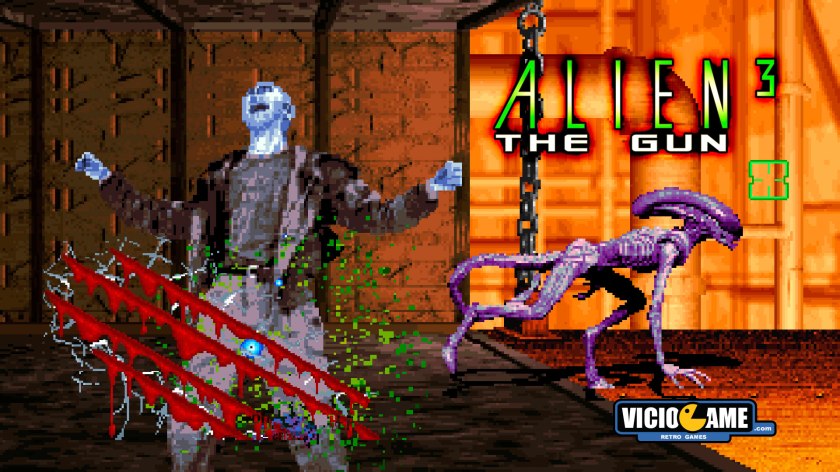
Alien 3: The Gun is a rail shooter released for arcades in 1993. Two soldiers escape from an infested spaceship and, during the getaway, end up on a ravaged and dangerous planet overrun with thousands of aliens from several generations, along with a horde of powerful robots.
Developer: Sega AM1
Publisher: Sega Enterprises
Release date: 1993
Platform: Arcade Sega System 32 board
🇺🇸 Turning Alien 3 into a shooter meant working around a detail the film itself made famous: on the planet Fiorina Fury 161, nobody has a gun. Sega resolved the impasse without ceremony. Instead of respecting the premise of unarmed inmates, it put two rifles in the hands of whoever is standing at the cabinet and filled the screen with creatures to justify them. The result, Alien 3: The Gun, is a rail shooter for up to two players, released in 1993 on the System 32 board, and the subtitle works less as a name than as a sales pitch: what matters here is the gun in your hands.
David Fincher’s film, his feature-film debut, reached theaters in May 1992 after a troubled production, divided audiences, and grossed about $159.8 million. In the story, Ripley crash-lands on a penal colony populated by shaven-headed inmates with an apocalyptic faith, who face a single creature with no weapons at their disposal. On consoles, the Twentieth Century Fox license became an action platformer in versions by Probe for the Genesis, the Master System, and other platforms, and Konami had already brought the franchise to arcades with Aliens (1990), a side-scrolling run-and-gun. Sega chose a different path: drop Ripley, keep the setting and the mood, and rewrite the plot so the conflict could be settled with gunfire.
Behind the project is Sega’s AM1 division, the same one responsible for Golden Axe: The Revenge of Death Adder and OutRunners (which runs on the same family of boards). Leading it was Rikiya Nakagawa, who had programmed Alien Syndrome years earlier. The names credited on the game include programmer Koji Tanuma, artists Keiichi Baba (with the company since 1991 and also involved in OutRunners) and Tsuyoshi Akai, and composer Kentaro Koyama, in one of his first scores for Sega. The team delivered a game that sustains the mood of the film even under constant gunfire, and much of that comes from the attention paid to the atmosphere of Fiorina.
On the real cabinet, which weighs 474 lb (215 kg), everything revolves around the two rifles attached to the front panel. Modeled after the M41A pulse rifle from Aliens, they are big and heavy, and they don’t read light from the screen like a conventional light gun: they work as sophisticated joysticks, and the physical movement of the barrel controls the crosshair on the screen. Each shot triggers a recoil motor that shakes the player’s arms, and a red button on the barrel launches a limited-use bomb. The gun setup would go on to enjoy a long life: the same chassis and the same motor reappear in Gunblade NY and L.A. Machineguns, and some maintenance technicians have turned to parts from those machines to revive the guns of Alien 3: The Gun.
As in every rail shooter, the camera drives the route and leaves the player with nothing but the aim, but the gameplay adds a rule that makes you ration your fire. Holding the trigger produces continuous bursts, but it drains the POWER bar at the bottom of the screen, and the longer you keep it held, the slower the rate of fire gets, like a weapon that’s overheating; releasing the trigger refills the bar. The trigger stops being a button for dumping ammo and becomes a resource to manage, which imposes a rhythm of short bursts and calculated pauses. Health isn’t measured in lives: a LIFE bar drops with every attack you take, and items hidden in crates and scenery restore energy, add more bombs, or unlock a flamethrower with a short burn time. The prisoners who survive the waves inside the colony also restore health, and from a certain point on the game offers alternate routes, each with its own cast of enemies.
There are six stages in total, with the second split into two acts, and each section ends in a boss fight. What sets the game apart is the time it spends on the surface of Fiorina Fury 161, something unusual in a genre where the setting is usually a corridor. Rain and wind leave the landscape washed out, and the path includes a minefield, a graveyard of androids where some of them wake up, a giant tank called Iron Tortoise, and a retreat in the face of creature stampedes at sunset, with the image switching to infrared vision as darkness falls. The route winds instead of running in a straight line, and that gives the colony an existence that goes beyond the target of the moment.
Inside the facilities, the game trades the landscape for scenes from the film and turns them into shooting galleries. There’s the slaughterhouse area, with hanging carcasses that chestbursters leap out of; the Mess Hall, where creatures drop from the ceiling and grab prisoners by the head; a chase through tunnels that recalls the inmates’ run to lure the monster into the trap; and, in the Lead Works, the execution of the Dragon with molten lead and water, the same death the film has in store for the creature. Players recognize the place before they understand what they’re about to face there, and that recognition is part of the pleasure.
The game’s own plot follows two nameless Colonial Marines who board the Sulaco, fight a Super Face Hugger, flee in an escape pod, and crash down on Fiorina Fury 161, where Weyland-Yutani has left automated defenses and keeps troops hunting for specimens. This parallel storyline hides a surprise for film buffs: the game shows imagery that the theatrical cut left out. The Super Face Hugger was cut from the 1992 release and only returned in the Assembly Cut of 2003, and the creature’s births appear both in oxen, among the carcasses in the slaughterhouse, and in dogs, the two variants the film shows depending on the cut. The general public wouldn’t see this material until ten years after the arcade release, and how it reached the Japanese team remains a mystery.
The final villain reinforces the game’s fidelity to the spirit of the film and disappoints anyone expecting a showdown with the Queen. After defeating the Dragon, the Marines face a man in a long coat, identified on the data screen as “An Unidentified Man,” who calls to mind the executive from the film who claims to be the creator of the android Bishop. Upon learning that the aliens are dead, he loses control and attacks with a flamethrower, only to fall like any other human, and a squad of commandos storms the room, opening fire on the pair. The game ends with a message that leaves the soldiers’ fate open, and the real enemy, as throughout the franchise, turns out to be corporate greed. The film’s religious mysticism is left out, but the sense of helplessness remains.
The bestiary runs through the monster’s entire life cycle: Face Hugger, Chestburster, Runner, the adult, and even the baby queen that bursts out of Ripley’s chest at the end of the film, and adult versions return as bosses more than once. The response to damage is visual and raw: the aliens lose limbs as they take hits, and you can keep shooting the bodies as they writhe on the floor. Before each boss, a data sheet describes the creature in the tone of a report, including whether it was born from a human or from a dog, and the enemies advance as sprites scaled by the System 32, which lend weight to the horde’s arrival. It’s a far more careful treatment of the monsters than the earlier home adaptations gave them.
The sound reinforces the choice of discomfort. Koyama delivers a score that, aside from the energetic boss themes, moves at a slow tempo, with timbres that recall a march toward the end, which fits the universal value of Alien 3 even amid the shootout. The sonic palette comes from an FM chip from the Genesis family (the YM3438) combined with a Ricoh PCM chip, responsible for the digitized voices: the Marines let loose two recorded swear words, one when the plan to lure the monster into the trap starts to go wrong and another when it reappears for one last attack, a rare bit of daring in arcade games of the early 1990s. The work steered Koyama toward a string of shooters, beginning with the soundtrack for Virtua Cop, and years later he would become better known for the music of Cyber Troopers Virtual-On.
The arcade machine debuted in Japan in September 1993 and reached the United States in November, with anti-drug and recycling message screens added to the American version. Its commercial performance kept pace: Game Machine magazine put the game at the top of its list of the month’s most successful cabinets in Japan, a sign that the combination of a movie license and giant guns worked in Japanese arcades.
Critical reception was favorable. All Game Guide gave it four stars out of five, describing it as a thrilling shooter, faithful to the spirit of the film and able to please both die-hard fans and casual players. Retro Gamer placed the game well ahead of competitors such as Lethal Enforcers and, more recently, devoted an extensive guide to it. In 2014, GamesBeat included it among the Alien games worth playing, preferred it to Aliens: Extermination, and highlighted both its faster pace and its underground chase.
The caveats exist and are well known: the item selection is slim, the visual variety is uneven from stage to stage, and the structure follows the genre’s well-established playbook. What sets the game apart from its competitors is not the invention of new rules but its physical and visual execution. Among players, its reputation is that of a tough challenge.
In the landscape of the genre, Alien 3: The Gun occupies a transitional spot. In 1993, Sega’s attention in arcades was on the polygons of Virtua Racing and Virtua Fighter, and this 2D shooter is the other side of the portfolio: the formula of turning action blockbusters into rail shooters, already tested by titles like Terminator 2: Judgment Day (1991), taken into far darker territory. The following year, AM2 would bring polygons to the genre with Virtua Cop, and the most direct legacy of Alien 3: The Gun comes from somewhere else: from AM1 itself, which would release The House of the Dead in 1996, with the same taste for horror, for data sheets that introduce the bosses, and for creatures that fall apart under gunfire.
Outside of Sega, the tradition of giant guns was picked back up by Aliens: Extermination (2006) and Aliens: Armageddon (2014), and two decades after the arcade release, Sega itself would return to the franchise as publisher of Aliens: Colonial Marines (2013) and Alien: Isolation (2014).
The machine never received a home conversion, which kept its status as an arcade-only experience intact. Around fifteen original cabinets are still officially accounted for among organized collectors, and Sega Logistics Service, the unit responsible for maintaining the company’s machines in Japan, announced the end of support for them as of March 31, 2017. Even so, the game remains in operation in arcades and bars dedicated to retro gaming, especially in the United States and Europe, where pairs of players still share the two rifles.
In the end, the paradox of the title resolves in a way the film itself would never admit: the chapter of the franchise in which almost nobody fires a shot became an arcade game where you shoot nonstop, and the hopelessness that makes Alien 3 recognizable remains intact beneath the ammunition. That is what sustains interest in Alien 3: The Gun more than three decades later: proof that a licensed game can have a personality of its own.
🇧🇷 Transformar Alien 3 em jogo de tiro exigia contornar um detalhe que o próprio filme tornou famoso: no planeta Fiorina Fury 161 ninguém tem arma. A Sega resolveu o impasse sem cerimônia. Em vez de respeitar a premissa de presidiários desarmados, colocou dois fuzis nas mãos de quem está diante do gabinete e encheu a tela de criaturas para justificá-los. O resultado, Alien 3: The Gun, é um rail shooter para até dois jogadores, lançado em 1993 sobre a placa System 32, e o subtítulo funciona menos como nome do que como promessa de venda: o que importa ali é a arma que você segura.
O filme de David Fincher, sua estreia em longas-metragens, chegou aos cinemas em maio de 1992 depois de uma produção conturbada, dividiu o público e arrecadou cerca de 159,8 milhões de dólares. Na história, Ripley cai numa colônia penal habitada por detentos de cabeça raspada e fé apocalíptica, que enfrentam uma única criatura sem nenhum armamento à disposição. Nos consoles, a licença da Twentieth Century Fox virou plataforma de ação em versões da Probe para o Mega Drive, para o Master System e para outras plataformas, e a Konami já havia levado a franquia aos fliperamas com Aliens (1990), um run and gun de rolagem lateral. A Sega escolheu outro caminho: dispensar Ripley, manter o cenário e o clima, e reescrever a trama para que o conflito acontecesse a tiros.
Por trás do projeto está a divisão AM1 da Sega, a mesma de Golden Axe: The Revenge of Death Adder e de OutRunners (que roda na mesma família de placas). À frente dela estava Rikiya Nakagawa, que anos antes programara Alien Syndrome. Entre os nomes creditados no jogo aparecem o programador Koji Tanuma, os artistas Keiichi Baba (na empresa desde 1991, também envolvido em OutRunners) e Tsuyoshi Akai, e o compositor Kentaro Koyama, em uma de suas primeiras trilhas na Sega. O grupo entregou um jogo que sustenta o clima do filme mesmo sob tiroteio constante, e boa parte disso vem da atenção dada à ambientação de Fiorina.
No gabinete real de 215 kg, o centro de tudo são os dois fuzis presos ao painel frontal. Modelados a partir do rifle de pulso M41A de Aliens, grandes e pesados, eles não leem a luz da tela como num light gun convencional: funcionam como joysticks sofisticados, e o movimento físico do cano comanda a mira na imagem. Cada disparo aciona um motor de recuo que sacode os braços de quem joga, e um botão vermelho no cano lança uma bomba de uso limitado. O conjunto de armas ainda teria vida longa: o mesmo chassi e o mesmo motor reaparecem em Gunblade NY e L.A. Machineguns, e há técnicos de manutenção que já recorreram a peças dessas máquinas para reviver as armas de Alien 3: The Gun.
Como em todo rail shooter, a câmera conduz o percurso e deixa ao jogador apenas a mira, mas a jogabilidade acrescenta uma regra de economia de fogo. Segurar o gatilho produz rajadas contínuas, só que drena a barra POWER no rodapé da tela, e quanto mais se insiste, mais lenta fica a cadência, como numa arma que superaquece; soltar o gatilho recarrega a barra. O gatilho deixa de ser um botão de despejo e vira um recurso a administrar, o que impõe um ritmo de rajadas curtas e pausas calculadas. A vida não vem em vidas: uma barra LIFE desce a cada ataque recebido, e itens escondidos em caixas e cenários devolvem energia, trazem mais bombas ou liberam um lança-chamas de fôlego curto. Os prisioneiros que sobrevivem às ondas dentro da colônia também restauram saúde, e a partir de certo ponto o jogo oferece rotas alternativas, cada uma com seu elenco de inimigos.
São seis fases no total, com a segunda dividida em dois atos, e cada trecho termina em um chefe. O que distingue o conjunto é o tempo que o jogo passa na superfície de Fiorina Fury 161, algo incomum num gênero em que o cenário costuma ser um corredor. Chuva e vento deixam a paisagem desbotada, e o caminho inclui um campo minado, um cemitério de androides em que alguns despertam, um tanque gigante chamado Iron Tortoise e uma retirada diante de debandadas de criaturas ao pôr do sol, com a imagem trocando para visão infravermelha conforme a escuridão avança. A progressão serpenteia em vez de seguir em linha reta, e isso dá à colônia uma existência que vai além do alvo da vez.
Dentro das instalações, o jogo troca a paisagem por cenas do filme e as converte em galerias de tiro. Há a área do matadouro, de carcaças penduradas de onde saltam chestbursters, o Mess Hall em que criaturas descem do teto e agarram prisioneiros pela cabeça, uma perseguição por túneis que lembra a corrida dos detentos para atrair o monstro até a armadilha e, na Lead Works, a execução do Dragon com chumbo derretido e água, a mesma morte que o filme reserva à criatura. O jogador reconhece o lugar antes de entender o que vai enfrentar nele, e esse reconhecimento faz parte do prazer.
A trama própria acompanha dois Colonial Marines sem nome que embarcam na Sulaco, enfrentam um Super Face Hugger, escapam numa cápsula de fuga e desabam em Fiorina Fury 161, onde a Weyland-Yutani deixou defesas automatizadas e mantém tropas à caça de espécimes. Esse enredo paralelo esconde uma pegadinha para cinéfilos: o jogo exibe imagens que o corte dos cinemas deixou de fora. O Super Face Hugger foi suprimido da versão de 1992 e só voltou na Assembly Cut, de 2003, e os nascimentos da criatura aparecem tanto em bois, nas carcaças do matadouro, quanto em cães, as duas variantes que o filme mostra conforme a montagem. O grande público só veria esse material dez anos depois do fliperama, e como ele chegou ao time japonês continua uma incógnita.
O vilão final reforça a fidelidade de espírito e frustra quem esperava um duelo com a Queen. Depois de derrotar o Dragon, os Marines encaram um homem de casaco comprido, descrito na tela de dados como An Unidentified Man, que remete ao executivo do filme que se diz criador do androide Bishop. Ao saber que os alienígenas morreram, ele perde o controle e ataca com um lança-chamas, cai como qualquer humano, e uma tropa de comandos invade a sala abrindo fogo contra a dupla. O jogo termina com uma mensagem que deixa o destino dos soldados em aberto, e o inimigo real, como em toda a franquia, acaba sendo a ganância corporativa. O misticismo religioso do filme fica de fora, mas o desamparo permanece.
O bestiário percorre todo o ciclo de vida do monstro: Face Hugger, Chestburster, Runner, o adulto e até o filhote de rainha que rompe o peito de Ripley no final do filme, e versões adultas reaparecem como chefes em mais de um momento. A resposta ao dano é visual e crua: os alienígenas perdem membros conforme levam tiros, e dá para continuar atirando nos corpos que se contorcem no chão. Antes de cada chefe, uma ficha descreve a criatura em tom de relatório, incluindo se ela nasceu de um humano ou de um cão, e os inimigos avançam em sprites escalonados pela System 32, que dão peso à chegada da horda. É um tratamento dos monstros bem mais cuidadoso do que o das adaptações domésticas anteriores.
O som reforça a opção pelo desconforto. Koyama assina uma trilha que, fora os temas enérgicos dos chefes, avança em andamento lento, com timbres que lembram uma marcha em direção ao fim, o que combina com o valor universal de Alien 3 mesmo em meio ao tiroteio. A paleta vem de um chip FM da família do Mega Drive (o YM3438) somado a um chip de PCM da Ricoh, responsável pelas vozes digitalizadas: os Marines soltam dois palavrões gravados, um quando o plano de atrair o monstro para a armadilha começa mal e outro quando ele reaparece para um último ataque, uma ousadia rara em fliperamas do início dos anos 1990. O trabalho encaminhou Koyama para uma sequência de shooters, a começar pela trilha de Virtua Cop, e anos depois ele se tornaria mais conhecido pelas músicas de Cyber Troopers Virtual-On.
O fliperama estreou no Japão em setembro de 1993 e chegou aos Estados Unidos em novembro, com telas de mensagem antidrogas e de reciclagem acrescentadas à versão americana. O desempenho comercial acompanhou: a revista Game Machine colocou o jogo no topo entre os gabinetes de maior sucesso do mês no Japão, sinal de que a combinação de licença cinematográfica e armas gigantes funcionou nos salões japoneses.
A crítica foi favorável. A All Game Guide concedeu quatro estrelas de cinco, o descrevendo como um shooter empolgante, fiel ao espírito do filme e capaz de agradar tanto a fãs ardorosos quanto a jogadores casuais. A Retro Gamer colocou o jogo bem à frente de concorrentes como Lethal Enforcers e, mais recentemente, lhe dedicou um guia extenso. Em 2014, o GamesBeat o incluiu entre os jogos de Alien que merecem ser jogados, preferiu-o a Aliens: Extermination e destacou tanto o ritmo mais veloz quanto a perseguição subterrânea.
As ressalvas existem e são conhecidas: o repertório de itens é enxuto, a variedade visual oscila entre as fases e a estrutura segue a cartilha já consolidada do gênero. O que separa o jogo dos concorrentes não é a invenção de regras, e sim a execução física e visual. Entre os jogadores, a fama é de desafio alto.
No panorama do gênero, Alien 3: The Gun ocupa um ponto de transição. Em 1993, as atenções da Sega nos fliperamas estavam nos polígonos de Virtua Racing e Virtua Fighter, e este shooter em 2D é o outro lado do portfólio: a fórmula de transformar blockbusters de ação em rail shooters, já testada por títulos como Terminator 2: Judgment Day (1991), levada para um território bem mais sombrio. No ano seguinte, a AM2 levaria os polígonos ao gênero com Virtua Cop, e o legado mais direto de Alien 3: The Gun vem de outro lugar: da própria AM1, que lançaria em 1996 The House of the Dead, com o mesmo gosto por terror, por fichas que apresentam os chefes e por criaturas que se desfazem sob os tiros.
Fora da Sega, a tradição das armas enormes foi retomada por Aliens: Extermination (2006) e Aliens: Armageddon (2014), e duas décadas depois do fliperama a empresa voltaria à franquia como publicadora de Aliens: Colonial Marines (2013) e Alien: Isolation (2014).
A máquina nunca ganhou conversão doméstica, o que manteve intacta sua condição de experiência de fliperama. Cerca de quinze gabinetes originais ainda constam oficialmente entre colecionadores organizados, e a Sega Logistics Service, responsável pela manutenção das máquinas da empresa no Japão, anunciou o fim do suporte a elas para 31 de março de 2017. Ainda assim, o jogo segue em operação em salões e bares dedicados ao retro arcade, sobretudo nos Estados Unidos e na Europa, onde duplas continuam dividindo os dois fuzis.
No fim, o paradoxo do título se resolve de um jeito que o próprio filme jamais admitiria: o capítulo da franquia em que quase ninguém atira virou um fliperama em que se atira sem parar, e a desesperança que torna Alien 3 reconhecível continua intacta debaixo da munição. É isso que sustenta o interesse por Alien 3: The Gun mais de três décadas depois: a prova de que um jogo de licença pode ter personalidade própria.
🤑💲Earn money without doing anything! Just leave these apps open:
https://r.honeygain.me/CONTA9DB02
https://packetstream.io/?psr=1uPb
⬛ 𝗧𝗶𝗸𝗧𝗼𝗸: https://www.tiktok.com/@viciogame
🟧 𝗜𝗻𝘀𝘁𝗮𝗴𝗿𝗮𝗺: http://www.instagram.com/viciogame
🟥 𝗬𝗼𝘂𝘁𝘂𝗯𝗲: http://www.youtube.com/viciogame
🟦 𝗙𝗮𝗰𝗲𝗯𝗼𝗼𝗸: http://www.facebook.com/viciogame
🔳 𝗧𝗵𝗿𝗲𝗮𝗱𝘀: https://www.threads.net/@viciogame
🟪 𝗧𝘄𝗶𝘁𝗰𝗵: https://www.twitch.tv/ViciogameRetroGames
🟨 𝗕𝗹𝗼𝗴: http://www.viciogameblog.com/
🟦𝗧𝘄𝗶𝘁𝘁𝗲𝗿: http://www.twitter.com/viciogame
#Viciogame #Gameplay #LetsPlay #Playthrough #Games #Gaming #Videogames #Review #Game #Detonado #Walkthrough #Ending #Reviews #Facts #Retro #RetroGaming #Roms #Emulator #Longplay #Speedrun #NoCommentary #Alien3TheGun #Arcade #Alien #TheGun #Aliens #Alien3 #Gun #Shooter #lightgun #zombie #Zombies #Ripley #SigourneyWeaver #Fliperama #Extermination #Terminator #VirtuaCop #TheHouseOfTheDead #Armageddon

